A23
Experimental examinations of the soil-water characteristics of a loess soil, China
○Yao JIANG, Wenwu CHEN, Guanping SUN, Gonghui WANG, Toshitaka KAMAI
1 Introduction
In Northwest of China, most slopes have loess that is desiccated from the ground surface to a consid-erable depth, and pore-water pressure at shallow depths in these slopes is generally negative with re-spect to atmospheric pressure. The presence and mag-nitude of matric suction have been found to be crucial to the stability of this kind of slopes. To understand and analyze the soil-water characteristics of these slopes and then provide evidence for their stability analysis, the soil-water characteristic curve (SWCC), with regard to the relationship between volumetric water content and matric suction, has been used. In this study, the influences of several factors, including initial dry density, moulding water content and particle size fraction, upon the soil-water characteristics of loess soil in Northwestern China were examined in the laboratory.
2 Soil and Testing Program
The loess obtained from Jiuzhoutai landslide, Lanzhou, China, was used in this study. This loess is classified as a CL, and the particle ranged from fine sand to silt with the specific gravity of about 2.71. A specimen 61.8 mm in diameter and 20.0 mm in height was statically compacted to the desired density and water content in a cutting ring. And then the speci-mens were submerged in de-aired water inside a des-iccator subjected to a small vacuum for about 12 hours to ensure full saturation. These saturated specimens were then used to obtain data for soil-water
character-istic from a 15 bar pressure plate apparatus. 3 Results
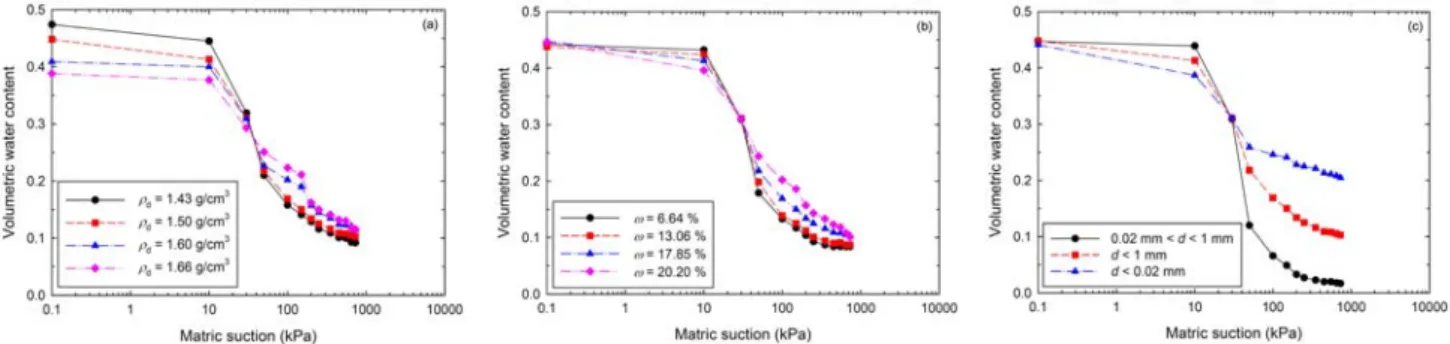
Figure 1 shows the obtained SWCCs for different tests and all results plot in a semi-log coordinate. The results indicate that there is a monotone-decreasing nonlinear relationship between volumetric water con-tent and matric suction for all loess specimens. The dry density has considerable influence on soil-water characteristics. With increasing the dry density, the air-entry value increase and rate of desorption de-crease. The initial moulding water content affects soil structure (aggregation), which can be investigated by comparing the soil-water characteristics of the speci-mens that have the same dry density but were com-pacted at different initial water contents. The high ini-tial water content specimens have higher air-entry value and lower rate of desorption. The specimens that have different particle size fractions appear to be dis-tinct soil-water characteristics. A coarse-grained specimen has a lower air-entry value and higher rate of desorption than a fine-grained specimen.
4 Summary
An experimental program was carried out to gain a fundamental understanding of the soil-water charac-teristics of a loess soil in China. Various factors influ-encing the soil-water characteristics were considered in the experimental program, including initial dry density, moulding water content and particle size frac-tion. These factors have apparent influences on the soil-water characteristics of loess.