Southeast Asian Studies, Vol. 29, No.1, June 1991
Salinization in the Holocene Fan-delta
of Maekhlong River, Thailand
Somboon
JARUPONGSAKUL, *Tomoo
HATTORI* *and Pichai
WICHAIDIT* * *Abstract
The salts in the groundwater of the Maekhlong fan-delta are of marine origin. Intensive human activities have triggered an impact on the long-run effects of salinization. The construction of a serial dam in the river systems, over-irrigation, and the development of sand-quarries in the areas of a highly saline aquifer have not only increased the rate of salinization, but also decreased the rate of desalinization of the salinity profile. Both for flood management and to increase the rate of desalinization, open drains should be constructed within the rice irrigation systems to allow flushing of salt to occur.
Introduction
Fan deltas have been defined as alluvial fans that prograde into a standing body of water from an adjacent highland [Holmes
1965;McGowen 1970; Rust 1979;Wescott and
Ethridge 1980; Ricci Lucchi et al. 1981]. Most modern fan-deltas are located along tectonically active coastlines which are usu-ally wave dominated and receive between 100
and300em annual precipitation [Wescott and Ethridge 1980]. These workers cite numerous examples of modern fan-deltas. The essential elements for the development of fan-deltas are high relief adjacent to the coastal zone and steep gradient, bed-load streams that are braided to the coast, resulting in fan-shaped
*Department of Geology, Chulalongkorn Univ., Bangkok 10330, Thailand
**~I*$ ~1:., Laboratory of Soil Science, Kyoto Prefectural Univ., I Nakaragi-cho, Shimogamo, Sakyo-ku, Kyoto 606, Japan ***Soil Survey Section, Department of Land
Development, Bangkok, Thailand
sedimentary deposits. These conditions and the resulting sedimentary deposits are com-mon along some Holocene coastlines and throughout a large segment of geologic history.
At the height of Holocene transgression period, the sea covered most of the lower central plain of Thailand. Small fan-deltas have developed at the mouths of old river channels and along the adjacent coastline during this period when the temperatures and rainfall were higher than today. In the lower sea-level period, the old river had both steep and flat parts of its course in the marginal area. The alluvial fan could prograde rela-tively unhindered to the flat plain. The Holocene sea-level rise brought the coastal environment closer to the steeper slopes. This would have squeezed the zone intermediate between the coastal and the fluviatile plains and has apparently caused the alluvial fan to dump its sediments directly into the sea, result-ing in the formation of Maekhlong fan-delta.
Sediment flows from the fan met inert sea-water, which acted as an efficient brake on their forward movement. The fan would be limited in its areal expansion but have built up vertically and steepened its slope, causing increased mass movements and eventual shift-ing of lobes, as the progradation of the fan became blocked by its own deposits. These mass movement processes and the braided stream action would have caused the coastal plain to be covered with alluvial fan sedi-ments [Somboon 1990J.
A problem which recently has come to loom large in relation to some agricultural land of the Maekhlong fan-delta is that of soil salinization. Soil salinization in the fan delta came to be recognized when a water reservoir was dug in 1985 at the khamphaeng Saen campus of Kasetsart University. Some of the salt-affected spots are going to be devastated as a habitat for salt tolerant spiny shrubs like
Maytenus marcanii(NaamDaeng) and Azima
sarmentosa(Naam Phungdo). Several
hun-dreds of hectares of rice fields in the saucer-shaped lowland of Amphoe Song Phinong are now covered by salts crusts on the ground surface in the dry season. Salinization in this area began to become extensive about six years ago when irrigation projects were com-pleted. The saucer-shaped lowlands are now completely surrounded by irrigation dykes and ditches. Salts have been added to soils through the intensification of human activities in this area of highly saline groundwater. These activities include more intensive irriga-tion, dam construcirriga-tion, and sand-quarrying.
Landform and Sedimentary Facies of the Fan-delta
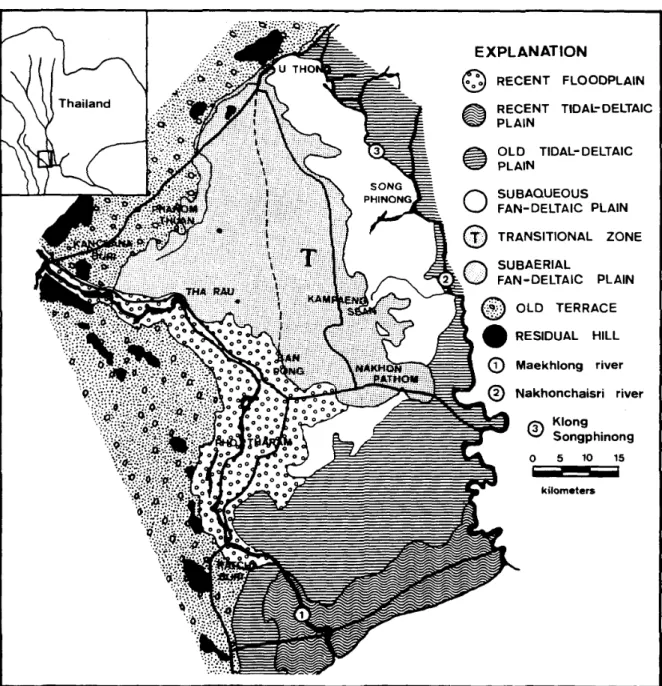
The Maekhlong fan-delta is located on the western fringe of the lower central plain with an area of approximately 700,000 ha adjoining the old terrace to the west and northwest, surrounded by the Nakhon Chaisri river and Khlong Song Phinong in the east and north-east and by the Gulf of Thailand in the south. Environments that constitute the Maekhlong fan-delta system can be grouped according to their general geomorphic setting under the following three broad categories:
1. subaerial fan-delta plain; 2. transitional zone; and 3. subaqueous fan-delta plain.
The area shown in Fig. 1 can be classified into the following eight types of landform based on its topographical and geomorphic features and sedimentary facies. Fig. 2 illus-trates the typical conceptual geomorphic and stratigraphic pattern in the Maekhlong fan-delta.
Residual Hill
Small residual hills are dotted within the alluvial fan deposits, besides rising as rare isolated mountain blocks or peaks on the Old Terrace in the western part. Most of the hills are composed of limestone, metasediments of the Palaeozoic era, and the granitic pegmatite with quartz dykes considered to be intrusions of Mesozoic age.
Old Terrace
The flat land of Middle and High Terrace is
10-60m above sea level and forms the western fringe of the fan. The preservation condition
I
j
I.J.R.P. Somboon, T. HATTORI and P. WICHAIDIT: Salinization in the Holocene Fan-delta
EXPLANATION
@
RECENT FLOODPLAIN~ RECENT TIDAL-DELTAIC
~ PLAIN
~ OLD TIDAL- DELTAIC
"€if} PLAIN
O
SUBAQUEOUS FAN-DELTAIC PLAIN@
TRANSITIONAL ZONEo
~~~~~:~~;IC
PLAIN®
OLD TERRACEe
RESIDUAL HILL<D
Maekhlong river®
Nakhonchaisri river t:>\ Klongo
Songphinong o 5 10 15 ! kilometersFig. 1 Geomorphology of the Maekhlong Fan-delta, Thailand of the terrace surface is relatively good in the
north but the southern fringe area has lost its original surface due to erosion by surface runoff. Terrace deposits mainly comprise well consolidated gravel, sand, silt, and sandy clay layers which are commonly capped by a later-itic layer. The laterlater-itic layer consists of laterite with gravel and pisolitic concretion of
Fe-oxide or honey-comb structured laterite with quartz and gravel grains, 10 cm to 2 m thick-ness. The pisolitic masses give the laterite a pellet-like structure.
Subaerial Fan-delta Plain
A fan-shaped delta plain deposit spreads eastward from Kanchanaburi which is on the
FAN·DELTA PLAIN
RESIDUAL Hill.
OLD TERRACE SUBAERIAL
FAN·DELTA PLAIN TRANSITIONAL ZONE SUBAQUEOUS , OLD
I
TIDAL-DELTAICi
PLAINI
iI
NAKHOH CHAlSRt T0MGj57T:m~;""'---~ RlV£RFig. 2 Conceptual Geomorphic and Stratigraphic Pattern in the Maekhlong Fan-delta, Thailand apex of the alluvial fan. The trend of the
median line of the fan is approximatelyN800E
with an elevation of about 15-30 m above mean sea-level. This is an area with gentle slopes consisting of river deposits formed as part of an extensive alluvial fan by innumer-able repetitive changes in the old river course and overflow flooding from the river and fmm the western hill land. The deposits are pre-dominantly gravel beds alternating with sand, silt, and clayey layers and clay-rich loam with some pisolites of Fe-oxide. The topography has become highly undulating locally due to the previously mentioned residual hills which occur within this zone.
Transitional Zone
The transitional zone has a most significant feature for recognition of fan-delta deposits. With the high sea-level during the Holocene, the coastal plain was inundated; the sea stood at or close to the foot of the fan. Sediment flows coming from the fan then met inert sea water which acted as a very efficient break on their forward movement. The fan was limited in its areal expansion but built up vertically
and steepened its slope, causing increased mass movements and eventual shifting of the river course, as progradation of the fan was blocked by its own deposits. These mass movement processes and the development of braided stream belts would have caused the coastal plain to become covered with allu-vial fan sediments [Somboon 1990J. The transitional-zone deposit is mainly composed of alluvial deposits by the Maekhlong river in the I-3m uppermost part and marine splay deposits the location of which is controlled by shifts in the old river patterns. The topmost alluvial deposits are very loose and silt and clay strata alternate with the riverine deposits consisting of sand to silty sand. The marine deposits have limited distribution and are mainly composed of sand, gravel clay, and sandy clay.
Subaqueous Fan-delta Plain
Slumping and resulting dumping of sedi-ments into the Holocene sea occurred fre-quently in the old coastline of the fan-delta [Somboon 1990]. It is probably the principal process initiating the movement of sediments
J.R.P. Somboon, T. HATTORI and P. WICHAIDIT: Salinization in the Holocene Fan-delta from the subaerial fan to the marine
environ-ments of subaqueous fan-delta. The large amount of sediments dumped into the sea would have been reworked significantly by marine processes resulting in the formation of many sand bar, sand lenses, and beds of sandy clay interfingering with marine clay (Fig.·2).
The deposits are mainly composed of brackish and marine sediments of black to yellowish gray clay interbedded or interfingering with sand and sandy clay containing jarosite and gypsum crystals.
Old Tidal-deltaic Plain
A flat and low-lying plain is referred to as the old tidal-deltaic plain and comprises brackish and marine deposits of the Holocene transgression [Somboon 1988J. The elevation of this plain ranges from 5 m to about less than 2 m with average elevation of 2 m above
mean sea level. The brackish deposits consist mainly of medium black clay interbedded with a thin layer of sandy clay containing abundant wood fragments, jarosite, and gyp-sum crystals. The marine deposits are char-acterized by light yellowish gray clay inter-bedded with thin layers of fine sand, contain-ing shell fragments.
Recent Tidal-deltaic Plain
The recent tidal-deltaic plain is an extensive low-lying area situated about 1 m to 1.5 m above mean sea-level which is affected by the present tidal influence of sea-water. It is mainly occupied by mangrove, Nipa swamp and tidal-flats area. The deposits consist mainly of dark black to olive gray soft clay interbedded with thin layers of sand to sandy clay with mottles of iron oxide and soft con-centrations of manganese oxide.
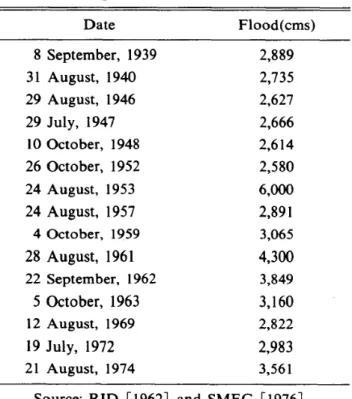
Table 1 Extreme High Flood Exceeding 2,500 ems
during the Period 1939-75 Date 8 September, 1939 31 August, 1940 29 August, 1946 29 July, 1947 10October, 1948 26 October, 1952 24 August, 1953 24 August, 1957 4 October, 1959 28 August, 1961 22 September, 1962 5October, 1963 12 August, 1969 19July, 1972 21 August, 1974 Flood(cms) 2,889 2,735 2,627 2,666 2,614 2,580 6,000 2,891 3,065 4,300 3,849 3,160 2,822 2,983 3,561 Source: RID [1962J and SMEC [1976].
Table 2· Probable Peak Flood of Maekhlong River at the Vajiralongkorn Dam
Return Period (Years)
After Completion of Srinagarind Dam and Khao Laem Daml)
(ems) After Completion of Srinagarind Dam2 ) (ems) Without Flood Control (RID; 1939-61)3> (ems) 3,350 4,050 2 5 10 20 25 50 100 2,500 2,580 3,250 4,050 4,850 5,100 5,000 5,900 5,700 6,000
Note) Source of data: 1) SMEC [1976J, 2) ILACO [1974J and 3) RID[1962J.
Recent Floodplain
The recent floodplain of the Maekhlong river is formed as a narrowed set of natural levees along the recent river, the riverbed, and recent overbank alluvial deposits. The grotmd surface consists of sandy to loamy soils.
Overflow Flooding and Groundwater Conditions
The fan-delta area consists of, for the greater part, an alluvial fan formed by the Maekhlong river. The eastern edge is formed by the Nakhon Chaisri river. Thus, from a topographical and hydrological as well as geological point of view, the area has a very large potential yield of surface and ground-water.
Overflow Flooding
The topmost alluvial deposition of the fan-delta seems to be still active due to the very high silt load presently carried by the
Mae-khlong river. Because of this nature as an active fan, the topmost fan sediment with many mica flakes overlies the acid sulfate-rich soil derived from brackish sediments in the subaqueous fan-delta plain. Flooding by the Maekhlong river occurs in the latter half of July into October when the discharge exceeds 2,500 m3/s; overflow normally occurs on the
left bank downstream from the Vajiralong-korn Dam to the fan area. As the Table 1 shows, floods due to the discharge exceeding
2,500m3/s were recorded 15 times during the
period from 1939 to 1975 [RID 1962; SMEC 1976]. Flood probability without flood con-trol and with concon-trol after the completion of the Srinagarind and Khao Laem dams may be obtained as the Table 2. According to the table, flooding of the Maekhlong river will be reduced greatly by the completion of the Khao Laem dam; the probability of flooding of the magnitude of 2,500 m3
/s falls from 1/2 year to
1/20 year frequency [ILACO 1974; SMEC 1976J. In the lowland area, the subaqueous fan-delta which is subjected to the influence of
l.R.P. Somboon, T. HATTORI and P. WICHAIDIT: Salinization in the Holocene Fan-delta BAN PHO ~THONG V LAEN 52012 SAMUT SAKHQN o Representation station Flood from western hill and khlong Songphinong
Flood from Nakhon Chaisri river
Flood from
Maekhlong river
o
I
10 20 kilometers
bad I
Fig. 3 Overflow-Flood Way and Affected Area in the Maekhlong Fan-delta, Thailand (after JleA
[1980J)
flooding, runs south in a belt as shown in Fig. 3. These areas are subjected to the influ-ence of flooding from the Maekhlong river and the N akhon Chaisri river and also of local flooding from the western hills in some
parts.
Groundwater Condition
A groudwater survey in the fan-delta area was carried out from 1978 to 1979 by the study
Fig. 4 Isobath Map of Wet Season Groundwater Table in the Maekhlong Fan-delta Area (modified after JICA [1980J)
team of Japan International Cooperation Agency (JICA) with cooperation of Royal Irrigation Department (RID) using existing wells and the available data concerning the wells and groundwater. A diagram of isobath lines of groundwater over the whole area is
shown in Fig. 4. As seen from the diagram, the depth of the groundwater surface generally corresponds well with the topography. In the flat-land at the southern part of the area or the plain along the Nakhon Chaisri river, the water table is less than 1 m from the ground
J.R.P. Somboon, T. HATTORI and P. WICHAIDIT: Salinization in the Holocene Fan-delta Ell PLANATION
lflTuA~
0" : :.. ,EC,~ 0, . i t. , ~...,. ot....t••t ... .PH I I • I " 0 J44. I,
•
•
:.
.
,
•
.
~·I:·
o.
•
J103.
I . . I I I , I , J411..rn·· ;·
..
i,
10.11,0·J38
0ru'·
..
o ;. 0 :..
: " All. ;, I I • • 0, J&7J30
4-1 • .1 0' :.
0 ·11 J33•
A71 0..
• IS • o ••
:.
.,
.
M2•
I · ·
•
:~:
'.
•.
0 • o..
J46..
•
( i,
·Mj:
I .31•
, 0 JIIII~
I~lIII. ~,:,~
.1 . 6I I 6-* • * :4~38•
J42·0 • I..
,...
A41I
•
~
• :l :.
;.
•
Jll • o I•
.. 113•
·
..
114•
I I o 110•
o o•
.
:' :.
:
.
,.
•
:' ~.J12 nil•
1 o o..
A18 &411'1·
, ,.
, , , '.
,.
ITTISlIt EIiIlISIt, cloo.IiIlI
SIt .... 10_ ElDc,,", -<' 1017 •I"
1 • Al0 : ' '. an 1013•
..
•
•
,
I.
I.
I' .12 J7 , , I I•
I I·
.
,~j
••
· , ,•
..
:.
,..
I·
.
, • o•..
!Illc... [nJS-' SALINE SOILS SOOll* ADSORPTION RATIO LEGEND A.~4 ~.
.
'.1';·
...
: :.
,'
:. i:
..
A. • SlIGHtlV SAL" SOIlS [Jl)!III...-c"vrID
LoM'[Ill
,-::.:te
y [IDS8NIv to.... ( D l _ . - D -Ec CI.AS&lFICATION OF SALT·AfFECTED 501.5 _ SAUlt SOLS 0 •o.m
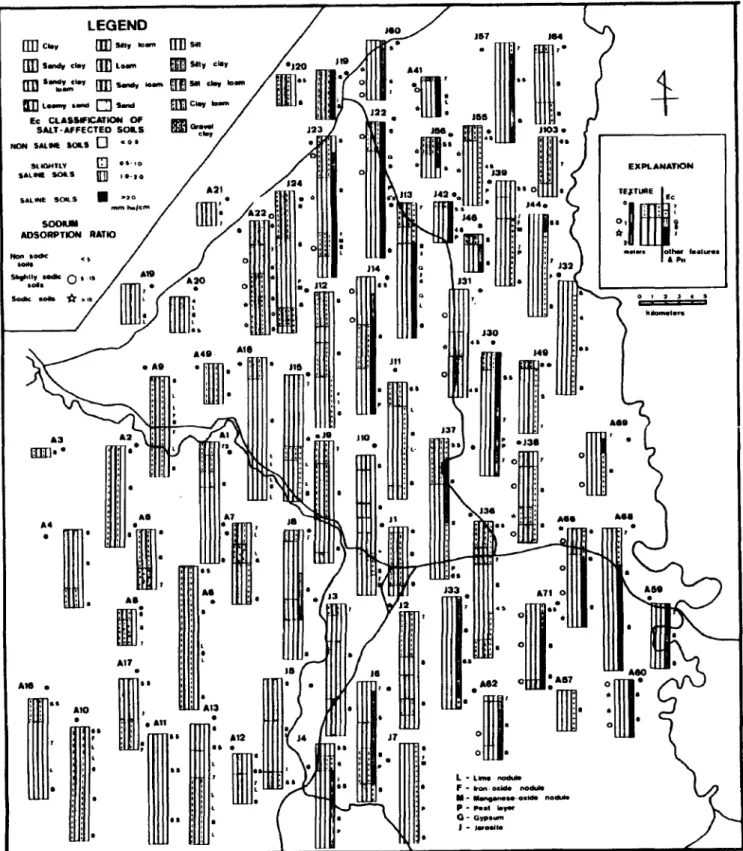
.1-10 [l) '0-'0 • :-:10 A3 mJ' • Non.ock -Sll,hlly ,lDdc .010Fig. 5 The 68 Columnar Section in the Maekhlong Fan-delta Area, together with pH, Ec, SAR, and
surface, and the isobath line of the depth of 1 m agrees relatively well with this topographical classification. On the other hand, in the central to the western part of the area, the isobath line of the groundwater table becomes complex and shows remarkable local changes along the Maekhlong river. This is related to the degree of connectivity of the shallow aquifer with the existin~riverbed. In the absence of a systematic survey of the groundwater yield potential of the fan-delta area (although for some areas, survey reports of Department of Mineral Resource (DMR) and RID are available), an approximate annual yield of groundwater will be estimated upon the record of successive observations of the water table. The annual mean fluctuation of the water table in the area is about2meters. This fluctuation of 2 m corresponds to the annual yield potential of shallow ground-water.
Salinization in the Fan-delta Area
Saline soils along the present sea coast of the central plain, Thailand have long been familiar to Thai scholars, but the saline soils in the inland part of the ancient shoreline have not been well recognized and have never been studied. The following is the result of a pre-liminary study on the inland salinity of the Maekhlong fan-delta in relation to the ancient shoreline of Holocene sea.
Salt-Affected Soils and Potential Influence of Salt
Precipitation of salt on a ground surface of the fan-delta, especially in the subaqueous fan-delta plain and transitional zone (Fig. 1)
during the dry season has become known recently after the greater Maekhlong river irrigation project was completed. In the fol-lowing paragraphs, we present some results of the salinity study in this area. Data for discuss-ing the salinity were mainly obtained from the
68 auger-drilled boreholes (Fig. 5). These auger-holes penetrate to depths of up to 6-7 m in order and provide a check on the strati-graphic sequence as well as providing a measure of the salinity of shallow ground-water.
Electric conductivity (EC) values of groundwater were measured at20°C. The tra-ditional classification of salt-affected soils has been based on the soluble salt concentration (EC) and on the sodium adsorption ratio (SAR) of the associated soil which are esti-mated in the saturation soil extract. The Terminology Committee of the Soil Science Society of American has recently lowered the
Ee
boundary between saline and nonsaline soils to 2 mmho/ cm and the SAR boundary between sodic and nonsodic soils to 15%[Bohn et al. 1979].
Sixty eight columnar sections in the fan-delta area, together with pH, other features, and the degree of salinity and sodicity of sediments are shown in Fig. 5. The saline aquifer is high in the section in the sub-aqueous plain and the transitional zone of fan-delta area (Fig. 6). As noted above, the salts are of marine origin; they diffuse from saline groundwater of the underlying marine sediments upwards into the topsoil. The source of the high concentrations of dissolved salt in groundwater (Table 3) of the sub-aqueous plain and transitional zone is connate sea-water which was entrapped at the time of
l.R.P. Somboon, T. HATTORI and P. WICHAIDIT: Salinization in the Holocene Fan-delta kilometers
•
EXPLANATION PHAMA•
•
•
•
•
•
•
•
Shallow wells and • auger·drilled boreholes
used to compile the salinity contour /f!!!!JSalinity of groundwater
\if}more than 10 mm.ho.,cm.
o 2 4 6 8
/ Salinity contour of
...-'l- shallow groundwater
Fig. 6 The Contour of Saline Aquifer in the Maekhlong Fan-delta Area, Thailand
Table 3 Water Quality of the High Saline Aquifers in the Maekhlong Fan-delta
(ppm)
Sample No. pH Ec(mmho/cm)
Na K Ca Mg CI S04 1 7.8 14.0 2,205 17.1 537.22 606.3 1,605.7 8,181 2 8.0 4.2 610 36 112.2 41.79 866.7 1,III 3 8.0 6.4 525 3.7 387.6 521.1 337.7 7,070 4 3.7 3.4 295 5.3 350.3 77.55 413.3 2,323 5 7.1 7.4 777 1.1 650.9 220.57 1,405.2 2,020
fan-delta formation at the height of Holocene sea-level period, especially within marine sand deposits during shifts in the old river course and movements of the transitional zone into marine sand bar, sand lenses, and interfinger-ing sands of the subaqueous fan-delta. Hence, the groundwater in the subaqueous plain and transitional zone has become extremely saline, and this probably constitutes the immediate source of the salinity. This explanation was well supported by the water quality of high saline aquifers in Table 3.
Possible Mechanism of Salinization
It seems likely that the various human activities in this area have already started to have an impact on the saline problem. A corresponding increase in salinity undoubt-edly occurred due to seepage associated with over-irrigation. This created all the conditions for a decisive rise in groundwater level. Sev-eral parallel lines of evidence allow a number of factors in the salinization process to be identified. The high salt concentration results from saline groundwater of Holocene age. The salinity of irrigation water is very ·low in EC value and does not exceed 0.4 mmho/cm. The groundwater which flows down the fan, tends to flow out along a zone of springs along the edge of the subaqueous fan-delta, particularly around Amphoe Song Phinong. A flow of saline groundwater developed by interaction of meteoric water with marine connate water from within the fan has emerged at edge of the fan since the fan was deposited. If the land near the springs is flooded, the salts diffuse into the surface water which is drained by surface runoff. As long as the areas are sub-merged regularly by the influence of overflow
flooding from the Maekhlong river, Nakhon Chaisri river and local flooding from the western hill (Fig. 3), there is no danger of salinization. However, flood control and intensive water use following the completion of a diversion dam and construction of big dams in the drainage basin caused a decrease in both the volume and frequency of flood discharge in this area. As a result, flushing is much less effective resulting in gradually intensifying salinity problems.
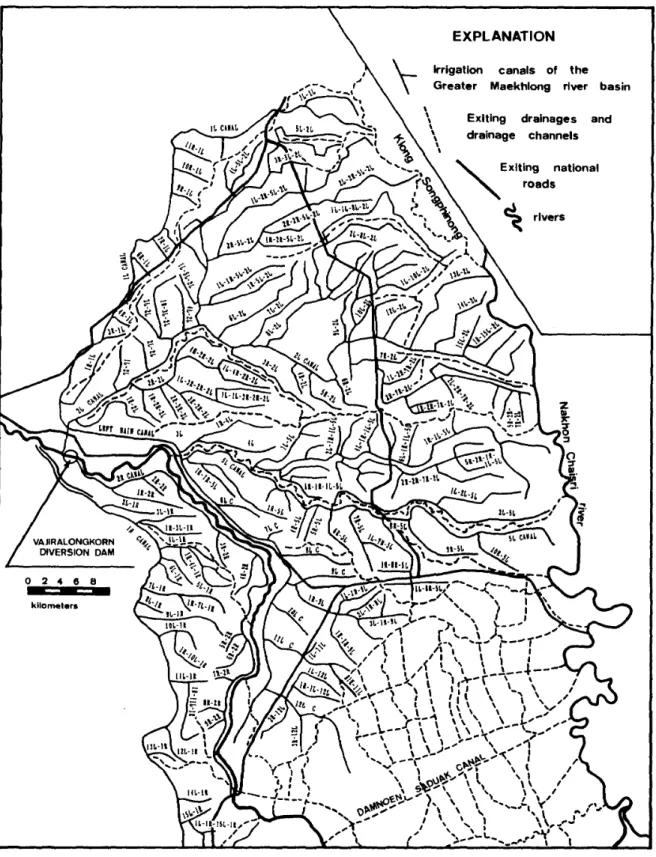
Attaching great importance to agriculture from economic and social points of view, the Thai Government has given a high priority to agricultural development, and constructed reservoirs and a major irrigation project in the Maekhlong river basin (Fig. 7). Conversely, we are confronted with an imbalance in the control of the irrigation level. This has deci-sively increased the groundwater level causing the emission of more saline water from springs. At the same time the mechanism for the dispersion of the salt emitted by the springs (seasonal floods) has been largely removed. Thus, a combination of overirriga-tion, poor drainage and flood mitigation/ prevention in this area will cause even more serious salinization problems in the medium to longer term.
In the transitional zone of the fan-delta area, highly saline groundwater is exposed and drains into the surface water system dur-ing sand quarrydur-ing operations. In particular, sand quarries opened in the old river course and connected with the recent drainage system are suspected to cause zones of severe saliniza-tion at the fringe of the fan-delta.
The process of salinization is broadly seen as follows. Connate water associated with a
l.R.P. Somboon, T. HATTORI and P. WICHAIDIT: Salinization in the Holocene Fan-delta EXPLANATION
~
rivers Exiting drainage basin and the rivet' drainages channels canals of Maekhlong Irrigation Greater kilometersmarIne transgression has become stored within the groundwater system. In places smaller and larger natural salt-pans formed within the intertidal zone and perhaps within back barrier systems as saline groundwater became redistributed. When the marine ment was covered by thin layers of river sedi-ment, salt moved up in these fresh layers under the influence of capillary action and diffusion. This movement, however, takes place in the top 2 or 3 meters only and does not signifi-cantly contribute to desalinization. In the case of Maekhlong fan-delta, intensive human activities have not only increased the rate of salinization, but also decreased the rate of desalinization of the saline parts of the system.
Conclusions
The study of salinization, (that is, the pres-ence and origin of the salts, the actual processes of salinization, the rate of saliniza-tion and desalinizasaliniza-tion, and the salinity haz-ards under various conditions) pose more questions than can be answered from the data available for this study. Nevertheless, on the basis of the field observations and theoretical considerations, some tentative conclusions have been reached.
~ The salts in the groundwater are of marine origin. The salts move upward by capillary action and diffusion under the influ-ence of a concentration gradient.
- Ifthe land is flooded, salts diffuse from the soil into the surface water, which may be drained by surface runoff. The soil salinity and the concentration gradient are dependent on the period of desalinization. Therefore, where levees systems have risen over flood
levels for a long time a more saline profile with a larger concentration gradient occurs than in depressions which are subject to fre-quent flooding, and attendant dilution and subsequent drainage.
- In this region, salinization is a continous process; the flood management or drainage systems are needed together with internal drainage to wash out the salts.
- Intensive human activities in this region have already started to have an impact on the long-run effects of salinization.
- It is proposed that open drains should be constructed in the rice fields of this region as soon as salinity becomes apparent to restore the process of flushing which has been inter-rupted by the construction of dams.
- More careful management of the amount of water used during irrigation is likely to be necessary both to limit salt emission at the surface and to ensure sufficient water is avail-able to provide dilution and subsequent drainage.
Acknowledgments
We thank Prof. Y. Takaya who provided inval-uable discussion and important ideas during the field survey; Prof. H. Furukawa who provided information on his unpublished data and helpful comments on the manuscript; Prof. Dr. Alan C.
Cook who provided critical comments and discus-sion during the preparation of early drafts. Prof. Y. Kaida who provided helpful comments on the hydrology of the Fan; and Dr. Somsri, Dr. Paiboon, Mr. Kriangsak and the stafT of Saline Soil Section, Department of Land Development showed us kindness and assistance during the field.
J.R.P. Somboon, T. HATTORI and P. WICHAIDIT: Salinization in the Holocene Fan-delta
References
Bohn, H. L.; Mcneal, B.L.; and0' Connor, G. A., eds. 1979. Salt-affected Soils. In Soil
Chemis-try, pp. 217-246. John Wily & Sons.
Furukawa, H.; and Wichaidit, P. 1989. Salt and Sinkhole: Corrosion as a Principal Factor Governing Topography and Mass Movement
in Northeast Thailand. Tonan Ajia Kenkyu
[Southeast Asian Studies] 27 (1): 3-34. Hattori, T.; and Takaya, Y. 1989. Salinity in
Thailand. In Report of ADRC Short Term
Expert 22, pp. 1-61. Department of Land
Development, Thailand.
Holmes, A. 1965. Principles of Physical Geology.
New York: Ronald Press Co.
ILACO. 1974. Greater Maekhlong Irrigation
Project. Arnhem, the Netherland:
Interna-tional Land Development Consultants. JICA. 1980. Master Plan Study for the Greater
Maekhlong River Basin Development
Proj-ect. Japan International Cooperation
Agency.
McGowen, J.H. 1970. Gum Hollow Fan Delta, Nueces Bay, Texas. Bur. Econ. Geology Rept.
Inv. 69: 1-91. Texas University.
Ricci Lucchi, F.; Colella, A.; Ori, G.G.; Ogliani,
M. L. ; and Colalongo, M. L. 1981. Pliocene Fan Deltas of the Intra-Apenninic Basin,
Bologna. lAS 2nd European Meeting,
Excursion Guidebook, Excursion4: 78-162.
RID. 1962. Hydrology of the Maekhlong River
Basin and Water Studies of the Maekhlong Irrigation Project. (Hydrology No. 127.) Royal Irrigation Department; Ministry of National Development, Bangkok, Thailand. Rust, B. R. 1979. Coarse Alluvial Deposits. In
Facies Models (Geoscience Canada Reprint
Series 1), edited by R. G. Walker, pp.9-21. Somboon, J.R.P. 1988. Paleontological Study of
the Recent Marine Sediments in the Central
Plain, Thailand. Jour. SE. Asian Earth
Science 2(3/4): 201-210.
. 1990. Geomorphology of the Chao
-Phraya Delta, Thailand. Ph. D. dissertation, Kyoto University.
SMEC. 1976. Khao Laem Project Feasibility
Report.
Wescott, W. A.; and Ethridge, F. G. 1980. Fan Delta Sedimentology and Tectonic Setting,
Yallahs Fan Delta, Southeast Jamaica.
American Association of Petroleum Geolo-gists Bulletin 64(3): 374-399.