Architectural Institute of Japan
ArchitecturalInstitute of Japan
S'-t'S:.,,N,2,,,.,,,,,.,,
leT",T.'.Zi,:,`i,S.igU.Cft"A'?}f",d.F,o,",?tr,"c.//g:R,:Fir,e,e,riEg
spt,?,mif#mfix,de,szff:st"-=,f
STOCHASTIC
RESPONSE
ANALYSIS
OF
LINEAR
SYSTEM
'
SUBJECTED
TO
NON--GAUSSIAN
NON-WHITE
NOISES
by
MASANORI
IZUMI*,
LI
ZAIMING**,
HIROSHI
KATUKURA***,
MASAHIKO
KIMURA*'"'
and
KOHE
KISHIMOTO'"g
Members
of
A.
I.
J.
1.
Introduction
The
stochasticresponse
analysis
of structural modelshas
been
widelystudied
and
has
attracted more and moreconcerns
among researchersand
engineers,
It
canbe
statedthat
most ofthe
imposed
excitation
noisesfor
the
analysishave,
up
till
now,been
assumedto
be
Gaussian
whiteCGW
for
short)
processes
orfiltered
GW
ones which,in
fact,
are essentiallyprocesses
dealing
withGW
excitation.To
the
subjectof
dynamic
systems underGW
orfiitered
GW
noise
excitation,there
is
alarge
body
of analyticalapproaches
availabie.Fer
ageneral
review,
refer
to
Reference
1.
In
particular,
the
approachZ)3)based
onthe
Ito's
equationappears
to
be
effective
tQ
evaluatethe
higher
(than
second) moment responses of a nonlinear system underGW
orfiltered
GW
noises.One
reason
for
the
Gaussian
assumptionis
the
fact
that
a
Gaussian
randomprocess
canbe
completelydefined
by
its
rneari value and variance,However,
in
manytypes
ofpractical
situations,there
exist
non-Gaussian(NG>
excitationnoises
and
the
effect ofthe
non-normality cannot
be
considered
to
be
negligible.As
amatter offact,
recent studies offirst
passage
probabilities4}
and offatigue
damage
ac¢umulation5}have
shownthat
these
quantities
canbe
significantly
affectedby
the
non-normalityof
the
randomprocess
being
studied.Such
non-normalityis,
particularly,
likely
to
occurin
adynamic
systemhaving
large
nen-linearity6i.
More
recently,Lutes,
L.D,
et al.')have
investigated
the
non-normality ofthe
response of alinear
system
subjected
to
NG
white excitation noisesthrough
directly
extendingthe
conventionalanalysis
ofthe
2nd
moment responseto
the
calculationof
the
4th
moment response.On
the
otherhand,
the
white assumptionis
mainlydile
to
the
fact
that
the
response of alinear
system subjectedto
white noises orfiltered
white noises canbe
considered as a multi-dimensionalMarkov
process.
This
facilitates
the
responseanalysis
of
the
systemgreatly.
However,
the
whiteprocesses
are notphysically
encountered
in
any engineeringpractice.
Indeed,
many
actual excitation noises canbe
modelledneither
as
the
whiteprecesses
nor asthe
filtered
whiteprocesses.
FoT
the
above reasons,the
authorshave
recently studiedthe
stochastic response of alinear
single-degree-of-freedom
(SDOF)
system subjectedto
non-Gaussian non-white{NGNW)
noisesin
ReferencesS)9).
This
papeT
is
・t
specifically
intended
to
pTesent
and completethe
previous
workS)9} onthis
subject.We
wMdevelop
adistinguishing
approachto
the
analysis
by
introducing
the
multi-dimensionalstochastic
equation
andby
characterizingthe
$tochastic responsein
terms
of cumulant(corretation)
functions
instead
ofthe
conventionalmoment
funetions,
This
enablesus
conveniently
to
construct
the
differential
equationsfor
the
cumutant
responses andtherefore
to
studythe
effect ofboth
the
non-normality andthe
non-whitenessof
the
excitationupon
the
stochastic response.'
2.
Excitation
Process
2.1
Normality
and
Whiteness
A
randomprocess
g<
t)
can
be
completelydescribed
by
its
cumulantfunctions
k.(
t,,
-・・・・・,
t.)e.
In
terms
ofle.<
ti,
・・-・・・,
t.),,
the
normality and whitenessof
theprocess
g(
t)
canbe
defined
as
follows.
By
.normality
we meanthat
the
*
Professor
ofArchitecture
Dep.,
Engin.
Factilty,
Tohoku
Univ.,
Sendai,
Japan,
Dr.
#Graduate
Student
ofATchitectuTe
Dep.,
Engin.
Faculty,
Tohoku
Uniy.,
Sendai
#*Ohsaki
Research
Institute,
Shimizu
Constfuction
Co.
Ltd,
Dr.
ofEngin.
#i'
Associate
Researcher
ofArchiteeture
Dep.,
Engin,
Faculty,
Tehoku
Univ.,
Sendat,
{Manuseript
receiyedAp[il
10,
1988)
of
Engin.
Japan,
Dr,
ofEngin.
--NII-Electronic Library Service
process
e(t)
satisfieshs(th""",
ts)e=O
S=3,
4,'"
-H'"HH'-HH"""(l
>
Inversely
the
non-normalitydescribes
that
e(t)
has
cumulantfunctions
whichdo
notsatisfy
the
above
condi-tion,
l.e,
.
ks(t""-'.
ts)e40
s=3,
4"''
'''''''H'''"'-''''''(2)
On
the
otherhand,
by
whiteRess we meanthat
g(t)
is
delta・
correlated,
i,e.
ks(ti,--・・,
t.)t=K.(tt)ea(ti-tt)D(t:-t3)・-cr(ti-t.)
s==2,3,・・-
・・・・--・・・・・・・・・・・・・・・・(3)
Otherwise
if
ks<ti"-''',ts)eiKs(ti)ea(ti-te)O(t]-t3)'''a(tt-ts)
then
e(t)
is
said
to
be
NW,
in
other
words,
to
have
IR
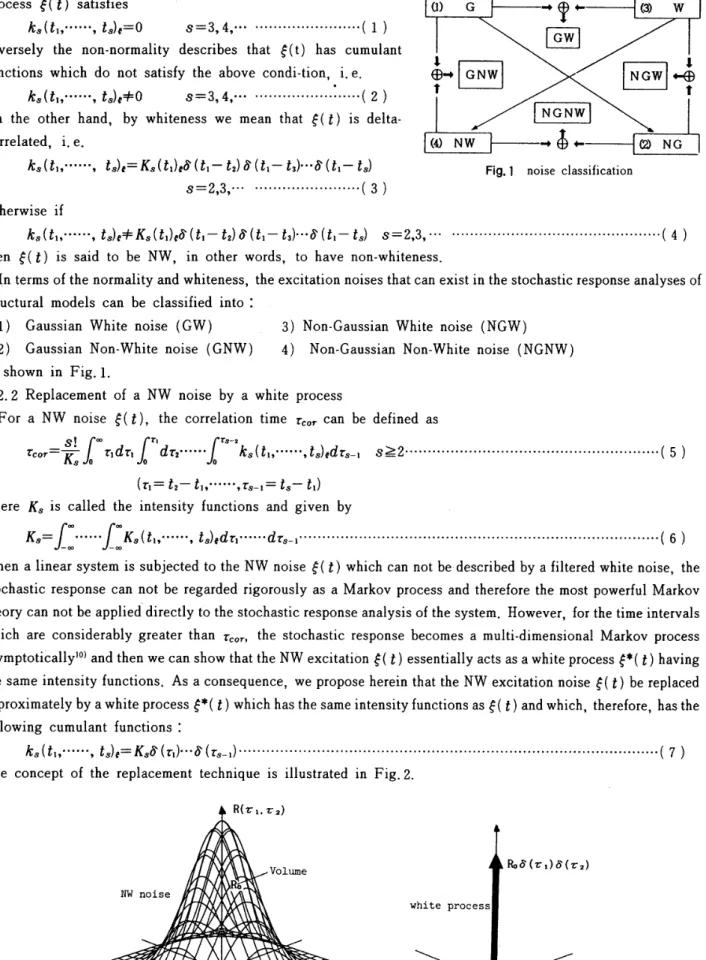
terms
ofthe
normality and whiteness, structural models canbe
classifiedinto
:
1)
Gaussian
White
noise(GW)
3)
Non・Gaussian
2)
Gaussian
Non-White
noise(GNW)
4)
NonGaussian
asshown
in
Fig,1,
2.2
Replacement
of aNW
noiseby
a whiteprocess
For
a
NW
noise
e(t),
the
correlation
time
T,..
canbe
defined
Tber=21JCcoTid".L'T'dh'""'Xts-'hs(t,"""',ts)edts.i
(q
==t2L
tl,''-''',
Tls.}==ts-
tl>
where
K.
is
calledthe
intensity
functions
andgiven
by
Ks"f:'""'f:Ks(t,,"'"',ts)edTi--""'dTle-i'''''''"''""''''''
When
alinear
systemis
subjectedto
the
NW
noise
e(
t)
which canstochastic response
can
notbe
regardedrigorously
astheory
canwhich are considerably
greater
than
k..
the
stochastic responsethe
sameintensity
functions.
As
aconsequence, approximatelyby
awhiteprocess
e*
following
cumulantfunctions
:
h.(ti,・・・・・・,t.)e=Ksa(ti)
The
conceptof
the
replacementtechnique
is
illustrated
in
Fig.2.
a)G
e-[iEi]
to
NW
9-[l!!g]
[i[iN!l]
di
-raW
twe
Fig.
1
noise classifications=2.3,・-
-・---・・---・----・(4)
non-whiteness.
the
excitation noisesthat
can existin
the
stochastic response analyses ofWhite
noiseNon-White(NGW)
noise(NGNW)
as
sl2・・・・・・-・・・-・・・・・・--・・・・-・・・-・・-・・・--・・・・・・・・--{5)
・----・---・・---・---・・-・----・-(6)
not
be・described
by
afiltered
white noise,the
a
Markov
process
andtherefore
the
mestpowerful
Markov
not
be
applied
directly
to
the
stochastic
response analysis ofthe
system.HQwever,
for
the
time
intervals
becomes
a
multi-dimensionalMarkov
process
asymptoticallyiO)and
then
wecan
show
that
the
NW
excitation
e(
t)
essentially acts as a whiteprocess
e'(
t)
having
we
propose
herein
that
the
NW
excitation
neise
e(t>
be
replaced(
t)
whichhas
the
same
intensity
functions
ase{
t)
and which,therefore,
has
the
・-S(Tb.i)・----・----ny---・・---・・---・--(7)
(a)
Fig.2
cencept of replacement of a TNW
(b}
noise
by
a whiteprocess
:/
'
-82-Architectural Institute of Japan
ArchitecturalInstitute ofJapan
As
willbe
shownin
section4,
the
replacementtechnique
produces
a very satisfactoryapproximation
to
the
response
when
the
correlation
time
lt,.
ofthe
excitation noiseis
small(much
smallerthan
1).
Fdr
apractical
noise whose correlationtime
Tz..is
large
(larger
than
1),
it
is
necessaryto
adopt aproper
linear
fitter
to
$imulateit
Although
the
excitation noisefof
the
chosenfilter
is,
by
andlarge,
non-white, we understandfrom
the
knowledge
behind
the
replacementtechnique
that
it
canbe
expressedproperly
by
a white noise.Above
all,the
concept ofthe
replacementtechnique
is
ofgreat
interest
in
the
sensethat
it
makes
the
application
of
the
Markov
theory
pQssible,
3.
Stochastic
Response
In
this
paper,
the
stochastic iesponseis
characterized
by
the
cumulant
functiQns.
For
simplicity,our
main attentionis
paid
to
the
2nd
and4th
cumulantfunctiens.
One
should noticethat
all
the
odd-order
cumulant
functions
are equalto
O
sincethe
symmetry
of
the
excitation
is
taken
into
accountherein.
3.1
deTivation
ofthe
differential
equationsfor
cumulant
response
Without
loss
ofgenerality,
consideT alinear
SDOF
systemhaving
dirnensionless
equation of motionx+2hth+x=e(t)・-・----"---・---・・・--・--・---・-・-・---<s)
where
the
overdot meansthe
differentiation
with respectto
time,
h
is
the
damping
ratio
;
and
e(
t)
is
a stationaryNGNW
process
withhi
(ti)e=
le3(th
ts,
t3)e=O
""'""'h'"""H''-"''"M'H"'""""''-'H'HH'H'HH---・-・-・・---・-(9a)
ib!(ti,t2)t=R(t]-t2}=R(Ti)--H''-'""'"''""'"'H'''-'v'"''"'"'-・---・-・-・--・--・・---(9b)
k,(tb
t!,
t3,
tOt=
Q(rh
Thft)''・・・・''''''''・・・・-・・・・・・・・-・・・・・・-・・-・・-・・・・・-・-・・・・・・・・・・・-・・・・・・・・・・・t・・・・・・・・・・・・・・・-・-・・(gc)
(Tl
=tl-
t2,
lt
:=:tl-
t:,
n=
tl-
ta)
Applying
the
replacementtechnique
described
in
section
2.2,
we can obtain a corresponding white noisee*{t)
having
R<ri)==Refi(TO'""'"'-""'-'"'--H'"'"-""""--"""-""-""-HHH'H'H'H''H'HH'HH'H'"'""HH'H(10a)
Q(rh
T2,lt)=
Qocr<Ti)D(lt)O(k)'''''''''''・・・・--・--・--・-・・-・・・・・-・・-・・・・・・・・・・・-・・-・・-・・-・・・・・-・・・・・・・--・-・・--・--・--・-・・-
(lo
b)
whereRa'=JC:R(TOd:t''''''''-"H'''''--'--''''''''''・・・・-・・・・・・・・・・・・・・・・・・・・・・t・・t・・・・・・・・-・・・・・-・・・・・・・・・・・-・・・・・・・・・・・・・・・・・・・-(loc)
'
Qo=.L:f:.L:Q(q,h,k)dTidT2dts''''''''''''''''''-''-''-'''''''''-'''''''''''"''・・・-・+・--・・----・・-・-・・・・・・・・・・-・(lod)
By
introducing
the
state variable vectorY
withy,=x
andy,=th,
(
8
>
canbe
rewritteninto
:
dyt
=y,-・--・--・-・-・・t--・----・-・---・-・-・-・---・-・---・-・・--・-・-・-・(11a)
dt
dyt
umdmt
=g'(t)ne2hyt-yi・----・-・・----・-・---・-・---・・--・-・-・・-・-・-・---・<n
b)
As
aresult,
since
g'(
t)
is
a white excitationthe
vectorY
becomes
atwo-dimensional
Markov
process,
Here
weintroduce
the
two-dimensional
stochastic
(kinetic>
equation
for
Y,
whichdescribes
ddt
a)(y,,
yn== -t9.,
aay,
[Kt
{y;,
y:)
a,(yi,
y2)]
+'ia,;,
oy?Sy,
[Kw
(yi,
ya)
w(y,,y,)]
-g,,tl..
oy,aay3,ey.
[Kwit(yh
yz)
a,(yh
y,)]
・・・・----・・・--・--・-・・-・・・・・・・・・・・・・-・・・・・・・・・-・・・-・・・・・・・s・・・・・-・・{i2)
+ilttsjS.i!i
'ay,oy95y,ay,
[Ktm
(yi,
yD
tu(yi,
y2)]
i-
・・・
whereK.(y)..iim<(Yt-YIS->--・・-・・・-・・・-・・・-・-・・・---・・-・・--・--・----・-・・-・・-・・・-・・-・---・-・・・・・・・・・・・-・・-・・・・・・・・・・・・・・・-・・-・a3)
r-o T
In
the
above
expression,
to(y,,y,)is
the
joint-probability
density
function
ofy,
andy,
and<
>
denotes
expectation.The
stochastic
equation
{12)
can
be
deduced
similarly asin
one-dimensional stochastic equation whichhas
been
described
in
ReferenceiO).
After
substituting(11)
into
{12),
it
canbe
shownthat
-83-NII-Electronic Library Service
itt
Q,
Oe'ytu;
-fliR,lae:yco;
+
aay,
l(2hy,+y,)
di-
aay,
{y,w)=
aaWt
-・・・-・・・・・・・・・・・-・・・・・・・・・・・・・・・-・・・-・・・・・・・・・・-・・・・-a4)
By
introducing
the
characteristicfunction
ip
(s,,
s,;t)
and expressing(l4)
in
the
domain
ofthe
characteristicfunction
i.we
can obtainLi,t
Q,st
g`,
¢
;
+}
R,s;
gLip:
+2hs,
,O,ip,
+s,
,a,ip,
-s,
,e,di,
+
e,e,
-=o-・---・-・・-・・-・--・・・・・---・---・(is)
Expanding
the
characteristic
functioR
di(s,,
s,;t)
in
(15>
in
terms
of
the
cumulant
function$
as
follows:
ip
{sr,
s!
;
t)
:=exp
[i,
gl
.il.l!,hs(ta,
'")
sa"']
''''"--'"'"'"""''"''''-'h''h'-'''"v--''''"-'・--・'・'(l6)
leads
to
the
identical
equations
abouts,,
s,,
si,
s,s,,
s;,
・・・.
By
settingthe
coefficients ofthe
identical
equationsto
zero, wecan
obtain
finally
the
following
differential
equations
for
cumulant
responses
k,(yl)==2ic2(yiy!)・・・・・・-・・・・・・・・・・・・・・・・・・・・・・-・・・・・・・・・・-・・・・・・-・・・・-・・・・・・・t・・・t・・・・・・・・t・・・・・・・・・-・・・・・・・・・-・・・-・・・・・(17a)
k,(y:)=R,-4hh,(y;)-2k,(y,y,)・・・・・・・・・・・-・--・・-・・-・・・・-・・・-・・・-・-・・・-・・・・・・・-・・--・・・・・・・・-・・・--・-・・・・・-・・・--・・・07b)
k!(yiy2)=2hh:{yiyt)ffk2(y:}+hz(yl)・-・r・-・-・・・・・・-・・・・・・・・・・・・・・・・・・・・・・・-・・・・・・・・-・・・--・・・・・・・-・・・・・-・・・-・・・・--・・・(17c)
k4(y:)=4le4(y\y2)-"m"-H'H'H"-・---・-・--・-・---・・-・---・・-・-・-・--・---・--・・(lsa)
h(y?,y,)=3h,(y:y:)-2hh,{yly,}-ic,(y:)-・-・・・-・・・・・・・-・・・・-・・・・・・・・・・・・・・・・・・・・・・・・・・-・・・・・・・・・・・・・・-・-・・・・・・・・-・・・・・(lsb)
k4(yly:)ny2k,(yiy:)-4hhe(yiy:)-2k,(ygyD・-・-・・・・・・・・・・・・・・・・・・-・・・・・・・・・・・・-・・・・・・・・・・・・・・・・・・・・・・・・・・・・・・・・・・・(18c)
k,(y,y;)==k,(y;)-3h,{yiy:)-6hh,(y,y:)・・・・・・・・・・・・・・・・・・・・・・・・・・・・・・・・・・・・・・・・・・・・・・・・・・・・-・・・--・・・・-・・・・・・・・・・・・・・・・(lsd)
k4(y;)=Q,-8hk4(yD-4h`(yiy;)・・・-・・・・・・-・・・・・・・・・・-・・・・・・・・・L・・・・・・・-・・・・・ny・・・・-・・・・-・・-・・・-・・・・・-・・・・-・・・-・t・・(lse)
We
may notethat
the
differential
equationsfor
the
'2nd
cumulantresponses
(17)
are
exactly
the
same
with
the
so-called
Lyapunov
equation"}and
that
the
nen-norrnality
of
the
excitation
in
a
linear
system
causes
enly
the
4th
cumulant responses and exerts no
influence
uponthe
2nd
cumulantfufiction
responses.Moreover,
we shouldmention
here
that
the
introduction
of
the
characteristicsfunction
to
the
Fokker-Planck
equationhas
found
wide applicationi2)i3Ji`ito
the
calculationof
the
2nd
moment
responsesof
various nonlinear systems subjectedto
GW
orfiltered
GW
noises.For
a
nonstationary
NGNW
noise excitation which can notbe
expressed as afiltered
white noise either,the
cumulantfunctions
canbe
expressed
by
h!(ti,tz)e"I(ti)R(TO''''"''''''''''''''''''''''''''''''''''''''''H''''''''"''H''H"''H''H''''''''''''''''''・--・・・・・(l9a)
k4(ti,
t2,
t3,
tD"=B(ti)Q{rt,
T2,ts)''''''''''・・・・・・・・・・・・・・・-・・・・・・・・-・・-・・-・・・・・・・・・・・・・・・・・-・・・・・-・・・-・・-・・・・・・・
(19b)
In
this
case, we can show sirnilarlythat
the
differential
equations
for
cumuiant
responses(17)
and<18)
still
hold
except
that
R,
and
Q,
are replacedby
I(t,)Ro
andB(t,)Q,,
respectively.3.2
curnulant
evaluation
of
the
products
ofthe
response and excitationThe
proper
values ofthe
cumulant ofthe
products
ofthe
response andi excitation,i.e.
h:<yie*),h2(yte*>,k4
(yTyYe')
and
h,<yle*)
are
notebvious
from
the
definition,
However,
we candetermine
them
asfollows.
From
the
differential
equations(11),
wehave
immediateiy
that
dt
L2YiY2
"'""'""'H"'"H'H"H'"hHh'"'----・--・-・--・---・---・--・---・--・---・-・
(2oa)
-
-
-
.
-
dy,y,
==:yie'+2hyiy2-yl+y:・・・・・・・・・・-・・・・-・・-・--・・・・・・-・・・--・-・-・・・・・・・--・・-・・・-・・・・-・-・-・・・・---・-・・・・-・・(2oc)
dt
ddYtt
=4yfy,---・--・・---・--・---"--・----"・・--:・---"H--Ht"-・--・---
(21
a}-
-
-
ddYt;
=4y:e'-8hy;-4y;yi -・---・・----・--・-・-・・・---・・---・----・---・・---・--・・--・---・(21
e)
These
equations canbe
usedte
derive
the
differential
equations
for
cumulant
responsesby
taking
the
cttmttlantoperation,
that
is
:
,
k(yl)==2k2(yiy2)・・--・・-・・・・-・・・・・・・-・・・・・・-・-・・・・・・・・・・・-・・・・・・・-・・-・・・・-・・・-・・・-・-・・・・・・・-・・・・・・・-・・・・・・・・・---・・・・・・・(22a)
i
E
-
84
NII-Electronic Mbrary /i
Architectural Institute of Japan
ArchitecturalInstitute of Japanh!(yiy2)=h2(y,e')+2hk2{y,yi)-k2(yf)+kt(y:)・・・・・・・・・・・-・・・・・・・・・・・・・・・・・・・・・・・・・・・・・-・・・・・i・・・・・・・・・・・・・・・-・・・(22c)
h4(yD=4h,(y?y2)・・・・・・・・・・・・・・・・・・-・・---・・・・・・・・・・・・・-・・・・・・・-・・・・・-・・・・-・・-・・-・・・・・・・・・・・・・・・・・・・-・・・・・・・・・・・・・・-・-・・・・・・・(23a)
-
-
-
k4(y:>=4h4{yge')-8hk4<yl)-4h,(yiy;)-・--・-・・--・--・-・---・--・-・・・・・・・・・-・・・・・-・・・・・-・・-・・・・・・・・・・・-・・-・-・・・・・・・・・・・・・(23e)
Therefore,
comparing{22)
and(23)
with(17)
and
(18)
leads
to
kt(y,e'>=O・---・---・---・-・---・-・-・---・--・-・----・・---・-・-・-・-・-・--(24a)
hz(y!e')=S
Ro
or
=}I{tORo
fornonstationary
6(
t)・・・・・・・-・・・・・・・・・・・・・・・・・・・・・・-・・・・・・・・・・・・・・・・・・-・・・・・・・・・・
(24
b)
h,{y?yrg')=O
(n+m==3,
n)1)・---・・・---・-・--・----・-・--・-・・---・---・-・・・・・-(24c)h,
(y;e')=tt
Qo
or=li-B(t,)
Q,
for
nonstationary
e(
t)
・・・・・・・・・・・・・・・・・・・・・・・・・・・・・・・・・・・・・・・・・・・・・・・・・・・・・・・・・-・・
{24
d)
3.3
numericalillustration
of
the
stochastic
responseIn
orderto
investigate
the
non-normality ofthe
stochastic responses,some
examples
have
been
studied
and
the
results
are
illustrated
in
Figs.
3-5
and
Figs.
7-9
for
stationary and nonstationary excitation noises,Here
T
is
the
dimensionless
time
normalized withthe
natural
period
2rr
of
the
system.
The
relatedparameters
and
the
imposed
intensity
envelepefunction
B(t)
aregiven
in
Table
1
andFig.6.
From
the
above
numerical examples, we can obtainthe
following
iesultsin
summary.When
alinear
systemis
subjected
to
aNGNW
noise
excitation1)
the
smallerdamping
ratioand
the
larger
intensity
Q,
result
in
the
greater
non-normality ofthe
system.
2)
the
4th
cumulant responsesk,(x`)
and
k,(thO
are,in
general,
muchgreater
than
k,(x3th)
andh,{dr'x)
whichin
fact
canbe
consideredto
be
negligiblein
cemparison withh,<x'}
andk,(th").
4.
Application
aRd
Accuracy
4,1
for
NW
excitationConsider
excitation noisee(t)
having
k2(tb
t:}e=exp
(-al
ti-t!F)=exp
(-aerl)
(T=
ti-
t!)-・---・-・・---・---・・・-・--・--・-・-・-
(25
a)
and
therefore
poweT
spectraldensity
Se{w)
==if:exp
(-aITI)exp
(-
itor)
d:=r.i+qth,)
.
''''''''''''''''''''''''''''''''''''''''''''''''''''''''''''
(25
b>
When
the
linear
system(8)
is
subjected
to
the
above noise,the
exact stationary response of mean squared'
3
1
2
1
o
T
o
T
O
2
4
6
8
10
O
2
4
6
8
10
Fig.3(a)
cumulant Tesponsefor
case1
Fig.3(b).
cumulant responselor
case1
S
2
4321oO
2
4
6
8
]O
Fig,4(a)
cumulant responsefor
caseZ
T
1
o0
2
4
Fig.4(b)
curnutantT
6
8
10
response
for
case2
---NII-Electronic Library Service
displacement
,-1
ax'2rr
On
the
otherf can cobefoundi5i
to
be
St(w)dtu=1a'<at+1ffht)
2
1
o
3
2
l
o
5
4
3
2
l
o
.(to:.1)t+4h2tuihand,
through
applying2hathe(1+a')'+4(1-h')h'
present
theory,
ai0
2
Fig.
5(a)
2
1
o
4cumurant
6response
for8
:O
case3
T
D
2Fig.6
4Intensity
6
8
Envelope
B(t)
0
2
Fig.7(a)
4cumulant
6response
for8case
4
to
10
0
2
Fig.8(a)
acumulant
6
8
response
for
case5IO
T
T
T
・・・-・・--・・-・-・・--・-・・・・・・-・・・・・・・・--・・・・・・・・・・・・・・・-・・(26)
can
be
obtained approximatelyas
r
o0
2
Fig.5(b)
Tab.le
1
4cumulant
related6respense
for
parameters
8case
310
Case
h
QeB(t)T
Case1e.o2e.61
t12x
Case2e.o21.01
t12n
Case3O.051.01
t12x'
Case4O.02O.6Fig.6t12x
Case5,O.021.0Fig6t/2w
Case6O.051.0Fig6t12x
1
o
2
1
o
0
2
4
Fig.7(b)
cumlllant6response
8fot
case410
0
2
4
Fig.8(b)
cumulant6response
for8case
5IO
T
T
T
l'
Architectural Institute of Japan
ArchitecturalInstitute ofJapan2
1
1
o
T
o
T
O
2
4
6
8
10
O
2
4
6
B
10
Fig.9Ca)
cumulant responsefo[
case6
Fig.9(b)
cumulant iesponsefor
case6
,,-
1
axff2h."H"-H"-"-""""-HHHHHH"H"HH''""--'"""""'"""'"'--"H''"'"'"'"'m""'"""-'"'(27) where
R,=.L:h,<T)tdT=2res,(o)=g・・-・・・・・・・・・・・・・・・-・・・・・・・・・-・・-・・・・・・・・・・t・・・・・t-・・・・・・・・・・・・-・・・・・・・・・・・・・・-・・・・・・・-・・・・・・・・・(2s)
has
been
utilized.The
errorcommitted
in
applying
the
present
theory
canbe
rneasured with.ai =a
+a.t2Sg"tl//
li-hil)
h2
=i
f!.2
''''''''''''-''"''''"'''''''''-''"'''''''''''''''''''''''''''"'''''''"'''''''"'''''''(29}
As
a result,the
analytical resuttis
very satisfactoryif
th..
is
small,
as
shownin
Fig.10.
4,2
for
NG
white excitationConsider
aNG
white excitatione(t)
having
ki(ti,t!)e=Reti(Ti)''''''''''''''--'--'H''''''''''''''''''''-''-"'''''"''''''''''''''''''''''''''''''''''''''''''''-''-''''-'(30a)
h,(t,,
t,,
t,,
t,)t=Qocr
(q)i(h)a{k)・・・-・・・・・-・・・・・・・・・・・・・・-・・・・-・・・・・-・-・-・・・・・・・・・・-・・・・-・・・・・・・・・ny・・・・・・・・・・・・・・
(3o
b>
When
the
linear
system(
8
)
is
excitedby
this
noise,
the
stationary
cumulant
responses canbe
solvedby
settingthe
right
hand
sicles of(17)
and(18)
equalto
O
andfound
to
be,
e.g.
Ro
"","."".--"-."."",,-,."",,"",,""・v-・-・--・-・--・-・---・-・-・-・-・-・-・-・--(31a)
k,(Yf)==
4h
k`
(Yt)=
32h
iltt
3hi}""''"'H'"'H''HH"'""---・---・---・-・-・・・・・・・---・・---
(31
b)
Then
the
coefficient
of excess ofthe
response canbe
obtained ash4(yO
3hQo
r==hi(y:)==2(1+3h2)R:"""'H"'"-'-""""H'"HH'H'HH"'"'''"H---"・-・-・・---・・-・---・-・-(32)
which
is
in
accord
with
that
given
in
Reference').
5.
Conclusion
In
this
paper,
wehave
presented
an approachto
the
stochastic response analysis of alinear
system
subjected
to
a non-Gaussian andnon-white
noise.The
stochastic responsehas
been
characterizedby
cumulantfunctions
instead
ofthe
conventional momentfunctions.
This
approachhas
provided
a
wayto
studythe
effect ofboth
the
non・normalityand
the
non-whiteness ofthe
excitation noises uponthe
stochasticresponse,
as2 rcot
o'.2
5
2
4
3
1
2
1'
O
aO aO2468
10
O2468
10
2
Fig.10(a)
correlation time tborFig.10(b)
eiror measured with a,i,aJ
-87-NII-Electronic Library Service
In
section
2,
the
excitation noiseshave
been
categorizedin
terms
of
normality
and
whiteness andithen
in
orderto
applythe
Markov
theory,
atechnique
to
replacea
NW
excitation noiseby
a whiteprocess
has
been
described
as
well.In
section3,
wehave
derived
the
differential
equations
for
cumulantfunction
responsesthrough
introducing
the
multi-dimensional stochasticequatien
and
furthermore
have
presentecl
the
cumulant
evaluation
ofthe
products
ofthe
resiponse
and excitation.In
addition,the
following
re$uitshave
been
deduced
in
coFclusion.1)
From
the
differential
equationsfor
cumulant respon$es(17)
and
(18)
we
can
see
clearly
that
the
non-normalily ofthe
excittition' exerts noinfluence
uponthe
2nd
cumulant
responses.2>
Some
numericaiillustrations
performed
in
this
study(Figs.3-5
and
Figs.
7-9)
showthat
the
4th
cumulantresponses
h,<x3th)
andh,(diSx)
canbe
considieredto
be
negligible
in
comparison withh,(x')
andh,{th').
In
section4,
the
present
approachhas
been
applied
both
to
aNW
noiseand
to
a
NG
noise.
The
resultshave
been
investigated
and
comparedto
other studies,As
aresult,it
has
been
shown
that
if
the
excitationhas
srnall correlationtime
Tb.,
the
present
approachyields
verysatisfactory
resttlts.
Finally,
we
may
notice
that
this
approach canbe
simply extendedto
a
linear
system
underfilteredi
excitation'
nolses
References
O
Lin,
Y.
}S,,
et al., "Methodof
Stochastic
Structural
Dynarnics",
Structural
Safety,
Vel.3,
1986,
pp.167-194.
Z)
Suzuki,
Y.
andMinai,
R.,
"AMethed
of
Seismic
Response
Analysis
ofHysteTetic
structuresBased
onStochastie
Differential
Equations",
Proc.
8th
WCEE,
San
Franeisce,
1984,
Voi.
rv,
pp,459-466.
3)
Suzuki,
Y.,
Seismic
Reliability
Analysis
ofHysteretic
Structures
Based
onStechastic
Differential
Equatiens,
Doctorat
thesis,
Disaster
Preyention
Research
Institute,
Kyoto
University,
Japan,
December
1985.
4)
Grigoriu,
M,
,"Crossings
of
Non-Gaussian
Tran$lation
Processes",
J.
ofEngineeringMechanics,
ASCE,
Vol.
llo,
No.
EM
4,
Apr.,
l984,
pp.61q-620.
5)
Lutes,
L,D.,
et al., "StochasticFatigue
DamageAccumulation",
J.
ofStructuralEngineeTing,
ASCE,
Vel.110,
No.ST
11,
No".,
1984,
pp.Z585-2601.
6)
Soda,
S,
,"Study
on
Non-Gaussian
Behaviours
ofDynamic
Re$ponse
ofNen-Linear
System",
Trans.
ofA.I.J.,
No.
312,
Feb.,
1982,
pp.47-53.
(in
Japane$e)
7)
Lutes,
L.
D.
, etal. ,"Non-Normal
Stochastic
Response
efLinear
Systems",
J.
ofEngineeTing
Mechanics,
ASCE,
Vol.
I12;
No,EMZ,
Feb.,
1986,
pp.127-141.
8)
Izumi,
M.
&
Li
Zaiming,
etal., "Studyof
the
Stochastic
Response
ofLinear
System
Subjected
te
Non-Gaussian
Non・White
Excitation
Noises,
part
1
1
Derivation
efDifferential
Equation
fer
Cumulant
Responses
Based
onthe
Stochastic
Egvatien",
Trans.
ofToheku
Branch,
A,I.J,
Ne.51,
June,
1988.
{in
Japanese)
9)
Izumi,
M.
&
Li
Zaiming,
etal.,
"Studyof
the
Stochastic
Response
ofLinear
System
Subjected
to
Nen-Gaussian
Non・White
Excitation
Noises,
part
2
:
Applications
ofthe
Present
TheoTy",
TTans,
ofToheku
Branch,
A.I.J,
No,
51,
June,
1988.
(in
Japanese)
'
10)
Stratonovich,
R,L,,
Topics
ifi
theTheory
ofRandom
Noise,
Gordon
andBreach,
Science
Publishers,
Inc
t-.
1963.
11)
Lin,
Y,
K.,
Probabilistic
Theory
efStructural
Dynamics,
McGraw-Hill
Bogk
Company,
New
York,
NY,
1976.
12)
Asano,
K.,
"StochasticEarthquake
Response
Analysis
ofthe
Lumped
Mass
Structural
System
withEIasto-Ptastic
Characteristics",
Trans.
ofA.I.J.,
No.247,
September,
1976,
pp.75-82,
(in
japanese)
13)
Matsushima,
Y.
,"Nonlinear
Random
Response
efSingle-Degree-of-Freedom
System
Subjected
toWhite
Noise
Excitation",
Trans.
ofA.LJ,
No.255,
May,
1977,
pp.17-23.
(in
Japanese)
14}
Ishimaru,
S.
,"Stochastic
Seismic
Response
of
Hysteretic
Structures",
Trans.
ofA.
I.J.
,No.
2fi5,
March,
1978,
pp.
71
--80.
Is)
Papoulis,
A.,
Probability,
Random
Variables,
andStochastic
Processes,
2nd
Edition,
McGraw-Hill.
1984.
/
-Architectural Institute of Japan
Arohiteotural エnstitute of Japan
【
論 文】
UDC
:624.
042
.
7 ;624.
e4日本建築学会構 造系論 文 報告 集 第
393
号・
昭 和 63 年11
月Non
−
Gaussian
Non
−
White
入
力
を
受
け る
線
形 シ
ス
テ
ム
の
不
規則応答解析 (
梗概 )
正 会 員 正 会 員 正 会員
正 会 員 正 会 員和
李
勝
木
岸
泉
倉
村
本
正
再
正
光
哲
*明
* *裕
* * *彦
* * **平
* * ** *1.
序
構造物
モ デル の不 規 則 応 答 解 析
は,
幅 広 く研 究
され
,
研 究 者
や 工学 者
の高
い関
心を
ひいてい る。
これ まで は,
通
常
, 入力
と し てGaussian
White
(
以 下
GW
と略 す
る}
過 程
あ るい は,filtered
GW
過 程 (
こ れ は本 質 的
にGW
入 力 を扱
っ て い る問
題
であ
る)
が仮定
さ れ てい る。 これ らの入力
に対
し て は,
数 多
く の解析 的
研
究
が存
在
す る(
一
般 的
なレビュー
は文 献
1
) を参 照
され た い)
。
Gaussian
仮 定 を
用
い る一
っ の理
由
は,Gaussian
過 程
が その平均 値
と分
散
に より完
全
に記 述
さ れる こ とにあ
る。 しかし
,多 く
の実 際
問
題
に おい て, 入力
外
乱
はNon ・
Gaussian
(
以 下
NG
と略
す る)
で あ り,
そ のNG
性
の影 響
を無 視 す
る事
はでき
な い。
実
際
,最
近
の研
究
によ
れば
,
初 通 過 確 率
41お よび
疲労 破 壊
5〕 に おい て,
確 率
過程
のNG
性
が大
き く影 響
す ること が示
さ れて い る。
このよ う
なNG
性
は,特
に非 線 形
性
の大
き な振 動
シス テム に おい て生
じ や すい もの であ る6) 。 さ らに,
ご く最
近
,
Lutes
,
L
.
D
.
ら
7 〕は,NG
white入 力 を受
け る線
形
シス テムを対 象
と し,通 常
の2
次
モー
メ ン ト応 答
に関
す る方 法 を
直
接
4
次
モー
メン ト応 答
の計
算
に拡 張
す るこ と に よ り,
不
規
則
応
答
のNG
性 を検 討 し
て いる。一
方
,
white仮 定 を 用
い る主
な理 由
は, white あ るい はfiltered
white 入力
を受
け る線
形
シス テム の応 答
は多
次
元
マ ル コフ過 程
と見
な せ ることによ る。
こ の こと は そ の応 答 解 析
に大
き な便
宜 を与
えている。 し か し な が ら, white過 程
は ,工 学 問 題
に おいて は実 在
せず
,多
く の実
現 象
にお ける入力
は,GW
ま た はfiltered
GW
過程
に モ デル化
する ことが でき ない。以 上
の よ う な 理由
か ら著 者
ら は,
文 献
s/’
9」でNon
・
Gaussian
Non −
white
入 力 を 受
ける線 形
1
自 由 度 系
に おけ る
不
規則
応
答解析
につ い て研
究
を行
っ てき た。
本 論 文
は,NG
,
NW
を主 題
に これ まで の研 究
を ま と めて報告
す るも
の であ
る。
本
研 究
で は,多 次 元
stochastic equa・
tiQn
を導
入 し,
不 規 則 応 答
を通 常
の モー
メ ン ト関数
の かわ りに,キ
ュ ム ラン ト関
数
(
相 関 関数 )
で評 価
す ること
に特 徴
があ
る。
キ
ュ ム ラ ン ト応 答
に関
する微 分 方 程 式
を導
くこ とによ
り,
入 力
のNG
性 あ
るい はNW
性
の不
規 則 応 答
に及
ぼす影 響 を 調
べ るこ と ができ る。
2.
入力 過 程
2.1Normality
と
Whiteness
一
つ の確
率
過程
ξ(
t
)
は キュ ム ラ ン ト関 数
ks
(ti
,…
…,
t
。)
e によ
り完 全
に記 述
でき
る。
そのキ
ュ ム ラン ト関
数
h
。
(
tb ……,
ts
>
eを 用
い て,
normality とwhiteness を定 義
す る こと がで き る((
1
)
一
(
4
) 式 }
。
こ のnor
・
malityと
whiteness によ
り,
構 造 物
の不 規 則 応
答解
析
におい て存
在
し得
る 人力
外
乱 を次
の よ うに分 類
で き る(
図
ユ)
D12qO4 * 東 北 大 学 教 授・
工博** 東 北 大 学
大 学 院 生
・
工修 * ** 清 水建設 大 崎 研 究 室・
工博 * * ** 東 北 大 学 助 手・
工博*
*
*
*
*
東 北 大 学 大学院 生 {昭 和63
年4
月IG
日原 槁 受理}2
,
2
NW
入力 ξ
(t)
に対
して,
(5 )
式
のよ う
に相 関 時 間
τc。 。を定 義 す
る ことが
で き る。
こ こに κ。は,(
6
)式
に より与
え られ る強
さ関 数
であ
る。
こ の よ うな入
力 を受
け る線
形系
に対
しては,
その不
規
則 応 答
はマ ル コ フ過
程
と は見
な せ ないので,
マ ル コフ理
論 を 適
用 す ること はで き ない。
し か し な がら,
入力
の相
関 時 聞 Z。
。
。
よ り 十 分 大 きい時間 間 隔
に おけ る不 規 則
応答
は, マル コ フ過程
に 近 づ く 1°1 。 その時
は,
入力 ξ(
t
)
を
同 じ強
さ関 数
を有
す るwhite過 程
に見
なす
こと がで き る。
そこで, こ こで はNW
入 力ξ(
t
)
を同
じ強
さ関
数を 有
す る white 過 程 に置 換
す るこ とにす る。 その whiteGaussian
White
入力 (
GW
)
Gaussian
Non ・
White
入力
(
GNW
)
Non ・
Gaussian
White
入力 (
NGW
)
Non
・
Gaussian
Non −White
入力
(
NGNW
)
NW
人力
の white過程
へ の置
換
NII-Electronic Library Service
過 程に お け る キュ ム ラ ン ト関 数
は,(7 )
式
によ り与
え ら れ る。4
節
で述
べ る よ うに,
この置
換
法
は,
相 間 時 間
z。。 .の小 さ
い入 力 外 乱
に対
して は,
応 答
の近 似
は非
常
に満
足
の い くも
のと
なっ てい る。一
方
, τ。 。r の大
きい場 合
につ い ては,
適
切
な線
形
フ ィル タを
採
用
する必要
が ある。
こ の置
換 法
は, マ ル コ フ理 論
の適
用
を可 能
と す る点
に おいて 工学
的
に極
め て有
効
で あ る とい える。
3
.
不 規 則 応 答 評 価
本 論文
で は,
不 規 則 応 答 を キ
ュ ム ラント関 数
によ
り評
価 す
る。簡 単
の ため
に2
次
と4
次
のキ
ュ ム ラン ト関
数
に注 目
す る。
なお
,入 力
の対 称 性 を考
えて いるの で,
奇 数
次
のキ
ュ ム ラン トは全
て零
になる。3
.
1
キ
ュ ム ラント
応答
関 数
に関
す る微
分
方程式
の誘導
(9 )
式
に示
す性 質 を 持
っ定
常
なNGNW
過 程
ξ(t)
を
受
け
る線 形
1
自由度系
を
考
え る。 この無次
元 運
動
方
程
式
は,
(8 )
式
によ
り表
さ れ る。 こ こ に,h
は減衰 定 数
で ある。この
NGNW
過程
に2.
2
節
で述
べ た置
換 法 を適 用
す れ ば,同
じ強
さ関 数 (
10
)式
を有
す るwhite 過程
が得
ら れ る。次
に,状
態
ベ クト
ルY
(
y
,=
x
, 翫=
竕
を導 入 す る
こ とに よ り,
運
動方
程
式 (
8
)
を
(
11
)式
に置
き換
え る こと が
でき る
。
従
っ て,状 態
ベク ト
ルY
は,2
次 元
マ ル コ フ過 程
に な る。こ こ で,
“
二次 元
stochastic equation”
(
12
)式
を導
入 す る。
(
12
)
式
に運 動 方 程 式 (
11
)を代 入 す
る こと
によ
り,
(
14
) 式
が得
ら れ る。 さ ら に,
特性
関 数 φ
(
s
、,
s
,;t
)
を導 入 す る
こと
によ
って,(14)
式 を (
15 )
式
のよ う
に特
性 関数
の領域
で表現
す ること が
で き る。
そ し て,特 性 関
数 φ(
s
、,
s21t
)を (
16
)
式
のよ う
にキ
ュ ム ラン ト関 数
を 用
い て展 開 す
ること
によ
っ て,
81
,
82
,
sl
,
SIS
:,
sl
,
……
に関 す る恒 等 式 を 得
る。
その係 数 を零
に置
く こ と に よ り,
(
17
)
,
(
18
)式
の よ う に キュ ム ラン ト応
答
関
数
に関
する微 分 方 程 式 を導
くこと がで き る。
こ の
キ
ュ ム ラン ト応答
に関
する微
分 方
程
式
(
17 )
と(18
)
に基
づ き,
以
下
の事項
を指摘
す ること が で き る。
つま
り,
2
次 キ
ュ ム ラ ン ト応 答
に関
する微 分 方 程 式 (
17
)
は通 常
の共 分 散
マトリ
ク ス応 答
に関 す
るLyapunov
方 程 式
1])と一
致 す る
。
さ
らに入 力 外 乱
のNG
性
は線 形
システ
ム に対
して2 次
キ
ュ ム ラン ト応
答
に何
も影 響 を 及
ぼ さず
,4
次
のキ ュ ム ラン ト応 答
にその影 響 が 現
わ れ る。
次
に,
非 定
常
NGNW
入 力 ξ(
t
)
につ い て考
え る。
こ の時
の入力
の相
関 関 数
は,(
19a >
と(
lgb
) 式
で与
え ら れ る。
こ の時
は,キ
ュ ムラント
に関
す る微 分 方 程 式
は,(
17 )
と (
18
)式
に おい てRo
,Q
。を
それぞれ1
(
ti
)
Ro
,
B
(
t
,)
Q
。に よ り置
き換
え れ ば よい。
3.
2
入
力 応 答 積
のキ
ュム ラント評 価
入
力 応 答 積
のキ
ュ ム ラ ン ト,
つ まりhe
(
y
,ξ
*)
,
h
,一
90
一
(
y
,ξ
’)
,h4
(醒
翻
ξ
奉〉
お よ びk
,(
yi
ξ
*)
は直
接定 義
か ら求 め
ること はでき ない。 しか し,
これら
は次
のよ う
に決
定
する こと
ができる。
運 動 方 程 式 (
11
)
か ら,
ただ ちに(
20 }
,
(
21 )式
を得
る こと が で きる。 そこ で, こ れらの式
に関
してキ
ュ ム ラン トを取
るこ と に よ り,
〔
22
)
,
(
23
)
式
の よ うにキ
ュ ム ラント応 答
関
数
に関
する微 分 方 程 式
が導
か れ る。従
っ て,
こ れ ら は(
17
)
,
(
ユ8
)式
と比
較
す る こと
によ り(
24 )
式
のよ う
に決定
で きる。
3.3
数値 解析 例
シ ス テ ム の
不 規 則 応
答
のNG
性
を調
べ る た め,
い く つ か の計算
を
行
っ た。
定常
お よ び非定常
入力
に対
する結
果
は図
3〜5
お よ び図
7〜9
に示
さ れ ている。 こ こで,T
は シ ステム の固
有
周 期
2
π で基
準
化
し た無 次 元
の時 間
で あ る。 な お,
用
い たパ ラ メー
タ,強
さ関
数
は,表
1
およ
び図
6
に示
さ れて いる。以 上
の計 算 例
か ら次
の事 項 が 分 か
っ た。
つま り
,NGNW
入力
を
受
け る線形
シス テム で は,
1
) 減 衰 係 数
は小
さい程
,
ま た は強
さ関 数
Q
。が大
き い程
,
システム の応 答
に大 きな 非 正 規 性
が生 じ
る。
2
)
4
次 キュ ム ラン ト応
答h4
(
dr4
)
とh、
(
τう
は一
般 的
に大 き
い。
そ
れら
に比 較 し
て,
た
‘(
ゴ
鋤
と
h
‘(
ガ
卯)
は無
視
でき る程 小
さい。
4
.
解 析 例 お よ び 精
度
の検 討
4.1NW
入力
の場 合
こ こ で
,
(
25a
>
式の よ う な相
関 関
数 を有
す る 入力 ξ(
t
)
につ い て考
え る。ξ
(
t
) を 受 け
る線 形
システム(
8
)
に関
し て,
定
常 自乗 平
均
変
位 応 答
は,相
関
理
ca15
)に よ る厳
密 解
が(
26
>式
によ り
与
えら
れ る。一
方
,
本解析
理
論
を
適 用
す ると
,近 似 的
に(
27
)式 を得
る。
し た がっ て,
本
解
析 理
論
を適
用
す る際
,NW
入力
をwhite過
程
によ り置
換 す
ることによ
り生
じ る誤 差
は,
(
29
)
式
の よ う に評価
する こ と が で き る。
そ の
結
果
,
図10
に示
さ れ て い る よ う に, 入力
の相 関
時 間
τ。。 。が小
さ け れば
,
本
理
論
の精 度
は十
分
満
足
で き るも
の であ
る こと が分
か る。
4.
2NG
white 入力
の場
合
2
次
お よ び4
次
キュ ム ラ ン ト関 数
が,
そ れ ぞ れ(
30a
)
と(
30b
)式
によ り与
え られ るNG
white過 程
を考
え る。
こ の入 力 を受 け
る線 形
系 (
8
)
の定常応 答
は,
本
理
論
を
適 用
する ことによ
り,〔
31a
)
と(
31b
}式
の よ うに求
ま
る。
し た がっ て,
尖
り係 数 を (
32
>式
のよ う
に求 め
る こと
ができ
る。
これ は,
文 献
7
)
で求
め ら れ た値
と一
致
する。
5.
結 び
本 論 文
は,
non−Gaussian
nen−
white 入力
を受
け る線
形
シ ス テ ム の不 規 則 応 答 解 析 法
を取
り扱
っ て いる。本
方法
の特 徴
は,
そ
の不 規 則 応 答 を通 常
のモー
メ ン ト関
数
のかわり にキュ ム ラ ン ト