Educational plans in nursing departments
The current state of nurse development
Yukio OZAWA1) , Atsuo MURATA2) and Masatoshi KITAOKA1)
1) Dept. Industrial Engineering & Management, Faculty of Engineering, Kanagawa University
3-27-1 Rokkakubashi, Kanagawa-ku,Yokohama, Kanagawa,
E-mail:[email protected]
2) Dept. of Intelligent Mechanical Systems, Division of Industrial Innovation Sciences, Graduate School of Natural Science and Technology, Okayama University
3-1-1, Tsushimanaka, Okayama-shi, Japan E-mail: [email protected]
Abstract ― With the recent diversification of
career paths in nursing, the establishment of a career development plan (CDP) system for nurses is becoming more important for improving the quality of nursing. The present study, conducted on chief nurses in general hospitals in Japan, aimed to ascertain how nursing education fosters the individual career development of nurses. As a result, We understood the next matter.
1) Training for mid-level nurses is provided by most hospitals, primarily in the form of in-hospital training.2) More than 90% of the hospitals surveyed provided individual counseling for career development, either as needed or periodically.3) The proportion of hospitals with fewer than 200 nurses that prepared individual educational plans was 7%; the proportion of hospitals with more than 210 nurses that prepared individual educational plans was 24% on average.4) By taking into account “nurse development”, job rotation is viewed as part of nursing education. Next, we proposed the new method for evaluation of CDP to individual nurses using N-S table.
1. Survey summary
In order to assess national trends, 256 general hospitals with more than 200 beds, excluding mental hospitals, were randomly extracted from the 2004 Hospital Directory based on the number of hospitals in each prefecture, and a mail-in questionnaire survey was sent to each hospital.
The following items were investigated: - Hospital settings – Number of nurses
- Implementation of in-hospital and field training -Implementation of individual career development counseling
-Preparation of individual educational plans for nurses - Factors for the implementation of job rotation -Specialized and vocational nurses and their utilization
The study results are summarized below.
2. Results
<Recovery>
The questionnaire was mailed to 47 prefectures and replies were obtained from 40 prefectures.
Number of mailed questionnaires: 256 hospitals Number of recovered questionnaires: 142 hospitals (Recovery rate: 55%)
<Responses stratified by number of nurses (Ratio)> ・≤200 nurses: 15 hospitals (10.6%)
・201-400 nurses: 65 hospitals (45.8%) ・401-600 nurses: 46 hospitals (32.4%) ・≥601 nurses: 16 hospitals (11.2%)
3. In-hospital and field training
As shown in Table 1, most hospitals provided in-hospital training (94%) and field training (80%), indicating a high level of awareness of nursing education.
Questions Selection Frequenc y Ratio Yes 133 94% No 7 5% No response 2 1% Yes 113 80% No 12 8% No response 17 12% Yes 31 22% No 100 70% No response 11 8% Periodic 55 39% As needed 75 53% No counseling 10 7% No response 2 1% Nurse development 86 61% Nurse aptitude 69 49% Nurse preference 57 40%
Years of experience in current job 41 29% Medical remuneration 12 8% Age composition of ward 8 6% Interpersonal relationships 8 6% Others 1 1% No response 2 1% Field training Individual educational plans Counseling for career development
Factors for job rotation implementation
(choose two factors)
<Table 1> Results of simple tabulation
In-hospital training
Fifth International Workshop on Computational Intelligence & Applications
IEEE SMC Hiroshima Chapter, Hiroshima University, Japan, November 10, 11 & 12, 2009
4. Individual counseling for career development
As for individual counseling for nurses, about 40% of the hospitals responded that they provided individual counseling periodically, while 53% provided counseling as needed; therefore, more than 90% of the hospitals surveyed provided some type of counseling. In relation to hospital size (number of nurses), most hospitals with fewer than 400 nurses tended to provide individual counseling as needed, while hospitals with more than 400 nurses tended to provide periodic counseling.
0% 20% 40% 60% 80% 100% ≥401
nurses ≤400 nurses
Periodic As needed No counseling No response
<Figure 1> Implementation of individual counseling in relation to hospital size
5. Preparation of individual educational plans
Only 22% of the hospitals (n=31) prepared educational plans for individual nurses.
In relation to hospital size, a markedly smaller number of hospitals with fewer than 200 nurses prepared educational plans for individual nurses; however, there were no marked differences among hospitals with more than 200 nurses.
0% 20% 40% 60% 80% 100% ≥601 nurses 401-600 nurses 201-400 nurses ≤200 nurses
Prepare Do not prepare No response
<Figure 2> Preparation of individual educational plans in relation to hospital size
Based on the implementation of individual counseling (See Figure 3), 16% of hospitals that provided individual counseling as needed prepared individual plans, while approximately 35% of hospitals that provided periodic counseling prepared individual plans.
These results suggest that hospitals with more than
400 nurses and those that provide periodic counseling are more likely to prepare individual educational plans for nurses. 0% 20% 40% 60% 80% 100% Do not provide counseling As needed Periodic counseling
Prepare Do not prepare No response
<Figure 3> Preparation of individual educational plans in relation to the implementation of individual counseling
6. Issues to be considered when implementing job rotation (two items)
When implementing job rotation, the most common factor was “nurse development” (61%), followed by “nurse aptitude” (49%) and “nurse preference” (40%). These three factors were related to nursing education.
When examining the relationship between hospital size and job rotation, “nurse development” was the top factor, irrespective of the number of nurses.
When examining the top three factors for job rotation in relation to the preparation of individual educational plans, “nurse development” and “nurse aptitude” accounted for more than half of the responses received, irrespective of the preparation of individual educational plans.
Based on two-factor combinations for job rotation, the three most common combinations for the 142 hospitals were as follows:
<Combination> <Number of hospitals>
Nurse development and nurse aptitude, 34 hospitals Nurse development and personal preference, 28 hospitals
Nurse development and years of experience in current job, 16 hospitals
Therefore, a combination of nurse development and nurse aptitude was the most common.
In this manner, many hospitals focused primarily on nurse development and aptitude, thus clarifying that rotation is viewed as a technique for nursing education and skill improvement.
7. Certified and vocational nurses and their utilization
Table 2 summarizes certified and vocational nurses and their utilization. Sixty-eight hospitals (48%) employed certified nurses and 9 hospitals (6%) employed vocational nurses, and their specialties
appeared to be sufficiently utilized.
<Table 2> Certified and vocational nurses and their utilization
Questions Selection F r e q u e n c y Ratio
Yes 68 48% No 74 52% No response 0 0% Yes 9 6% No 132 93% No response 1 1% Sufficiently utilized 54 79% Somewhat utilized 14 21% Neither 0 0%
Not utilized well 0 0% Not utilized at all 0 0%
No response 0 0%
Sufficiently utilized 7 78% Somewhat utilized 1 11%
Neither 0 0%
Not utilized well 1 11% Not utilized at all 0 0%
No response 0 0% Hospitals with vocational nurses (n=9) Certified nurse Vocational nurse Hospitals with certified nurses (n=68)
8.N-S Table and N-S Curve
8.1 N-S Table and N-S Curve
There are three skills required in career development plan(CDP) for individual nurses. 1) Technical skill are specialty, observation power, understanding and analysis force.2) The Human skill are leadership, listening force, negotiation force, cooperativity, and expressive power. 3)Conceptual skill are problem setting ability, judgment, evaluation force, and planning ability. It is necessary to analyze how these three skills are taught in the hospital. Here, the N-S table method is proposed to analyze the career development plan. The educational plan for individual nurses prepared in-hospital training and outside of training . The curriculum of educational plans are composed of the individual education items. Therefore, the curriculum of educational plans
Table 3 Data for Nurses and Educational Items
Table 4 N-S Table and N-S Curve
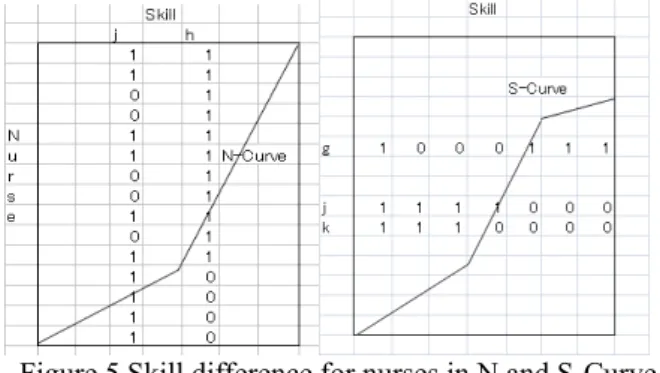
for individual nurses are divided into each educational items. This items are prepared for improving the skill for individual nurses.Table 3 shows an operational situation of the education for individual nurses in the hospital. The table 3 also shows whether the individual nurses take what kind of education items. As shown in Table 3, the educational items and individual nurses data which take the educational items., and S shows Skill and N is Nurse. Educational items are prepared for the individual career development of the nurses. This table is an example for the relationship between 10 educational items and 15 nurses. Table 4 is the N-S table which rearranged the total value of the educational items and individual nurses in Table 3. In the N-S curve, 1 appears at the left side of the curve, and 0 appears under the right. The N curve is a graph rearranged the frequency of the educational items which the nurses take the educational item. The S-curve shows the number of nurses which take the educational items. It is possible to read the distribution of the educational items in which the nurses take the items from the S-curve. The area surrounded by the left side of the N curve shows the ratio of received education items
8.2 Feature of N-H Table
The N curve is the accumulated data of the subject number that the nurses take the lecture.
The N curve become the straight line, when the number of nurses take the educational item is uniformly distributed.
It becomes sigmoid curve ,when the number of nurses take the educational item is normal distribution.
The N-curve and S-curve shows the frequency which the nurses take the individual educational items. The
Figure 3 Frequency distribution of Table 4 S-curve is a distribution of the frequency which take
lecture subject. The item of skill becomes easy when the content of subject in the left side for N-S table. Figures 4 shows frequency distribution of N-curve.
1) Judgment from the curve.
According to the N-S curve, next point become clear.
(1)The judgment from the N curve in Figure 5. :There is a problem on career development plan, when 0 appears in the upper stage of the curve. It is necessary to clarify why such problem is arising in this hospital.
Figure 5 Skill difference for nurses in N and S-Curve (2)The judgment from the S-curve in Figure 5: It is possible to find the subject in which the nurse is not take the educational items. From the S-curve, 0 which appears at the left side on N-S table is the un- completion subject, and the right side of 1 is finished subject. The difference becomes a following equation. Generally as shown in Figures 85 the left side of the S-curve becomes for 1, the right side of curve becomes 0. However, nurse j,k has normally been taken the career course like Figures 85 Nurse g has taken the difficult subject without taking the easy subject. Therefore, it is shown that nurse g is not consistent for the order of the educational items.
8.3 Evaluation of hospitals.
The evaluation of the education systems between hospitals uses following index.
It is possible to evaluate career development systems between hospitals from mean number and standard deviation of average completion subject number.
1)Mean and standard deviation:
Total frequency of dn(i), educational item j is made to be ds(j) in respect of average μN of the nurse, average μs of the educational items, total frequency of nursing teacher i. Total frequency is given as dn(i) for nurse i and ds(j) for educational items j.The average of nurse I is given as μN and standard deviation σ N, the mean is μs and standard deviation σ S for educational items j. From NS-table ,Mean and standard deviation is given next equation. 1 1 1 1 (K ( )) (H ( )) N K S i j dn i ds j H μ μ = = =
∑
=∑
(1) 2)The area ratio method.The ratio of N curve and S-curve is evaluated in the
following equation from the N –S table.
AN=The number of 1 in the left side of the N curve/(number of items of completion)
AS=The number of 1 over the S-curve. /(number of items of completion)
Example: From the Table 4,compute the mean value,
standard deviation, and area ratio rate. μN=4.866 σN=2.247
μS=7.300 σS=2.100
AN=0.40 AS=0.346
It is shown that education plan of the carrer development of the nurse could be evaluated from the NS table. The education plan of the individual hospital can be evaluated from proposed N-S table and N curve and S-curve.
9. Conclusions
1) Training for mid-level nurses is provided by most hospitals, primarily in the form of in-hospital training.
2) More than 90% of the hospitals surveyed provided individual counseling for career development, either as needed or periodically.
3) The proportion of hospitals with fewer than 200 nurses that prepared individual educational plans was 7%; the proportion of hospitals with more than 210 nurses that prepared individual educational plans was 24% on average.
4) By taking into account “nurse development”, job rotation is viewed as part of nursing education.
The results of the present study clarify that most hospitals clearly recognize the necessity of nursing education and development, and although individual counseling is provided for career development, most hospitals do not prepare individual educational plans.
Therefore, at present, CDP has not yet been fully established—there is no system for career development by which nurses can advance their careers over a long period of time within their department while adjusting for personal preference.
Mizuno and colleagues stated that “When improving nurses’ skills and self-awareness, career development stalls without supervisor support, which has a significant impact b(2). In particular, supervisors and learning opportunities make us think about the role of managers in career development. When improving the skills of nurses by CDP, it will be essential to establish a CDP system and improve the skills of supervisors such as chief nurses. N-S table proposed the method for the evaluation of individual nurses CDP. This method also applied for the evaluation of hospital educational systems.
Reference
[1] Medical facilities policy study group, Hospital Directory(2004),Igaku-syoin 2004
[2] Mizuno N. and Mikami R.,A study about the carrier development process of the clinical nurse, Journal of The Japan academy of nursing administration and policies,14(1) 13-22,2000