Some
Numerical
Results of Rising Bubble
Problems
Masahisa Tabata
Department of Mathematics,
Waseda
University
1
Introduction
We consider two-fluid flow problems, where each fluid is governed by the
Navier-Stokes equations and the surface tension proportional to the curvature acts on the
interface. The domain which each fluid occupies is unknown, and the interface
moves with the velocity of the particle on it. While numerical solution of
one-fluid flow problems governed by the Navier-Stokes equations has been successfully
established from the point of stability and convergence, it is not an easy task to
construct numerical schemes solving the two-fluid flow problems. To the best ofour
knowledge there are no numerical schemes whose solutions are proved to converge
to the exact one and there is very little discussion even for the stability of schemes
[1]. Recently we have developed an energy-stable Lagrange-Galerkin finite element
scheme for the two-fluid flow problems [8]. The scheme is anextension of the
energy-stable finite element scheme proposed by us [6, 7] to the Lagrange-Galerkin method.
In this report we present some numerical results of rising bubble problems solved
by it.
2
Two-fluid flow
problems
Let $\Omega$ be
a bounded domain in $R^{2}$ with piecewise smooth boundary $\Gamma$, and $(0, T)$
be a time interval. The domain $\Omega$ is occupied by $m+1$ immiscible incompressible
viscous fluids. Each fluid $k$, whose density and viscosity are
$\rho_{k}$ and $\mu_{k}$, occupies
an unknown domain $\Omega_{k}(t)$ at time $t$. Fluid $k(=1, \cdots, m)$ is surrounded by fluid $0,$
and thesurface tension acts on the interface $\Gamma_{k}(t)$. Let the coefficient of the surface
tension be $\sigma_{k}.$ $\Gamma_{k}(t)$ is expressed as a closed curve,
$\Gamma_{k}(t)=\{\chi_{k}(s, t);s\in[0, 1$
where
$\chi_{k}:[0, 1 ) \cross(0, T)arrow \mathbb{R}^{2}, \chi(1, t)=\chi(0, t) (t\in(O, T))$
is a function to be determined. $\Omega_{k}(t)$, $k=1,$
$\cdots,$$m$, is the interior of $\Gamma_{k}(t)$, and
fluid $0$ occupies
Unknown functions $(u,p)$, velocity and pressure,
$u:\Omega\cross(0, T)arrow \mathbb{R}^{2}, p:\Omega\cross(0, T)arrow \mathbb{R}$
and $\chi_{k}$ satisfy the system ofequations,
$\rho_{k}\{\frac{\partial u}{\partial t}+(u\cdot\nabla)u\}-\nabla[2\mu_{k}D(u)]+\nabla p=\rho_{k}f,$ $x\in\Omega_{k}(t)$, $t\in(O, T)$ (1a)
$\nabla\cdot u=0, x\in\Omega_{k}(t) , t\in(O, T)$ (1b)
$[u]=0, [-pn+2\mu D(u)n]=\sigma_{k}\kappa n, x\in\Gamma_{k}(t) , t\in(0, T)$ (1c)
$\frac{\partial\chi_{k}}{\partial t}=u(\chi_{k}, t) , s\in[O, 1 ) , t\in(O, T)(1d)$
$u\cdot n=0,$ $D(u)n\Vert n,$ $x\in\Gamma,$ $t\in(O, T)$ (1e) $u=u^{0}, x\in\Omega, t=0$ (1f)
$\chi_{k}=\chi_{k}^{0}, s\in[0, 1 ) , t=0, (lg)$
where $k=0,$ $\cdots,$$m$ in (1a) and (1b), $k=1,$ $\cdots,$$m$ in (1c), (1d) and $(lg)$, and
$f:\Omega\cross(0, T)arrow \mathbb{R}^{2}, u^{0}:\Omegaarrow \mathbb{R}^{2}, \chi_{k}^{0}:[0, 1)arrow \mathbb{R}^{2}$
are given functions; $f$ is an acceleration, $u^{0}$ is
an initial velocity, $\chi_{k}^{0}$ is a function
showing the initial interface position. means the difference of the values
ap-proached from both sides to the interface, $\kappa$ is the curvature of the interface, and
$n$ is the unit normal. On the boundary of $\Omega$
the slip boundary condition (1e) is imposed.
Lagrange-Galerkin method has nice features for the approximation of material
derivative terms [2, 3, 4, 5]. Since the basic idea is to approximate the particle
movement along characteristic curves, the method is robust for high Reyonolds
number problems. Recently developed energy-stable Lagrange-Galerkin scheme for
two-fluid flow problems is an extension of the energy-stable finite element scheme
[6, 7] to the Lagrange-Galerkin method. It has the following advanteges. For the
details refer to [8].
$\bullet$ It is stable in the sense of energy if an
integral of the square of approximate
curvature of the interface remains bounded.
$\bullet$ Since the resultant
matrix is symmetric, we can use efficient solvers for
sym-metric system of linear equations, e.g., MINRES.
$\bullet$ Sinceweusetheinterface-trackingmethod, we candistributemuch
more
nodes
on the interface than the level-set method.
$\bullet$ When it is applied to incompressible viscous one-fluid flow problems,
the
sta-bility and convergence is assured.
$\bullet$ Since the main computation part is similar to that of the
Stokes problem, the
computation is light.
We apply this scheme to rising bubble problems to analyse the effect of the
3
Numerical results
3.1
Example 1
Let $m=1$ and set
$\Omega=(0,1)\cross(0,4)$,
$\Omega_{1}=\{(x_{1}, x_{2});(x_{1}-a)^{2}+(x_{2}-2a)^{2}<a^{2}\}, a=^{\underline{1}}$
5’
$\rho_{0}=100,$ $\mu_{0}=0.05$, 0.5, 5.0, $\rho_{1}=0.1,$ $\mu_{1}=1.0,$
$f=(0, -1)^{T}, \sigma_{1}=2.0.$
When the viscosity $\mu_{0}$ of fluid $0$ varies, we observe the change ofthe bubble
move-ment depending on $\mu_{0}$. The mesh for the computation is shown in the left of Fig. 1.
We set the time increment $\triangle t=1/16$
.
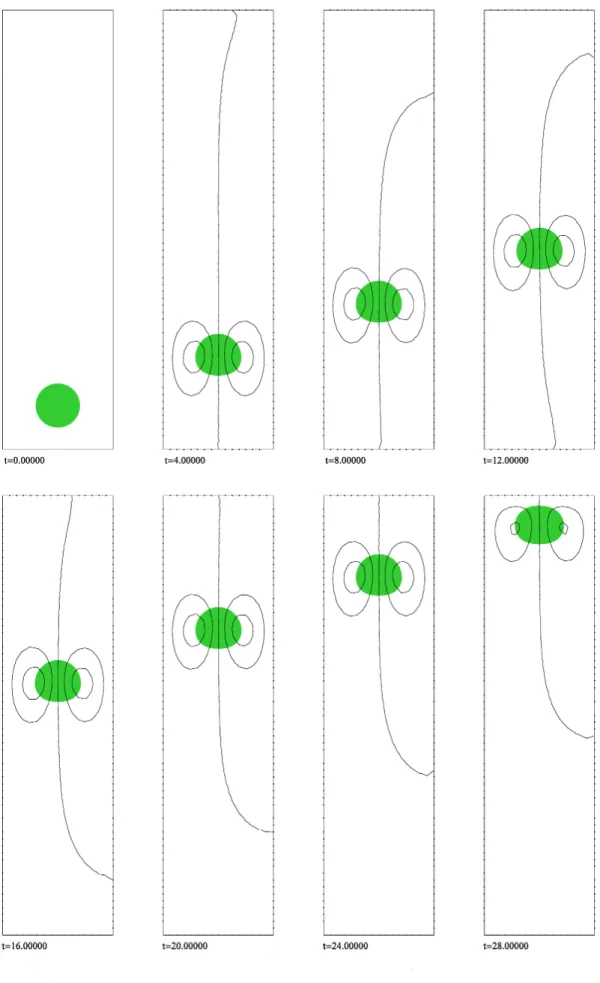
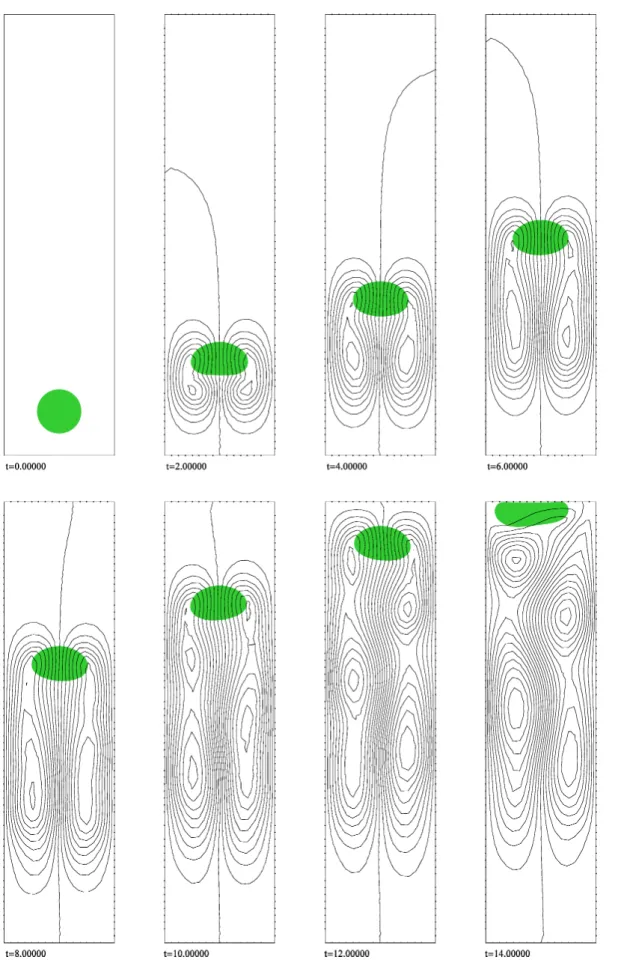
Figs. 2, 3 and 4 show the time histories ofthe interfaces and streamlines when $\mu_{0}=5.0$,0.5,0.05. When $\mu_{0}=5.0$, that is, the
viscosity is large, the rising speed of the bubble is slow and any wakes are hardly
visible after the bubble. When $\mu_{0}=0.5$, that is, the viscosity decreases, the rising
speed of the bubble increases and there appear large wakes after the bubble. When
$\mu_{0}=0.05$, that is, the viscosity is small, the rising speed of the bubble becomes high
and there appears oscillation when the bubble rises up. The wake has a pattern
similar to the K\’arm\’an vortex in the flow past a circular cylinder.
3.2
Example 2
Let $m=1$ and set
$\Omega=(0,1)\cross(0,2)$,
$\Omega_{1}=\{(x_{1}, x_{2});(x_{1}-a)^{2}+(x_{2}-2a)^{2}<a^{2}\}, a=\underline{1}$
5’
$\rho_{0}=100, \mu_{0}=0.05, \rho_{1}=0.1, \mu_{1}=1.0,$
$f=(0, -1)^{T},$ $\sigma_{1}=2.0$, 4.O.
When the coefficient of surface tension$\sigma_{1}$ varies, we observe thechange of the bubble
shape depending on $\sigma_{1}$
.
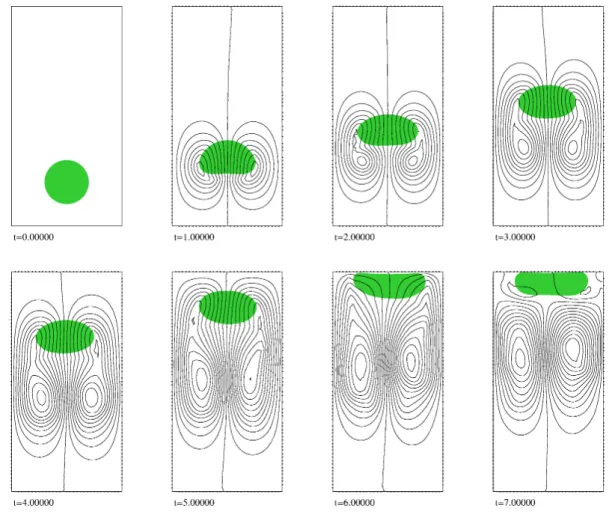
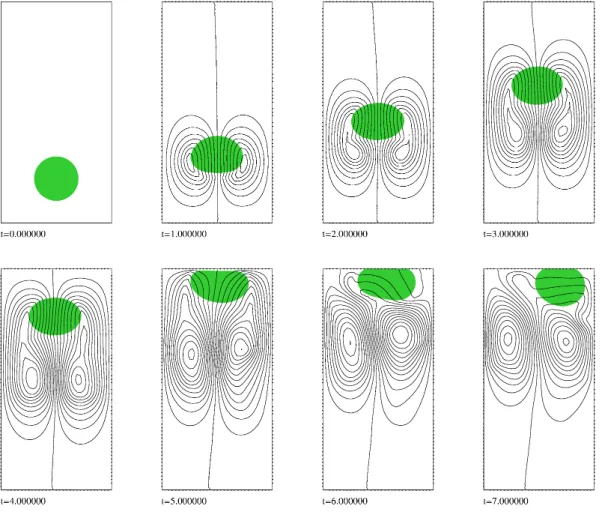
The mesh for the computation is shown in the right of Fig.1. We set the time increment $\triangle t=1/32$. Figs. 5 and 6 show the time histories of
the interfaces and streamlines when $\sigma_{1}=2.0$ and 4.0. When $\sigma_{1}$ increase from 2.0
to 4.0, the shapes ofthe bubbles become more round and the change of the bubble
shapes in the time history becomes smaller.
4
Concluding
remarks
We have analyzed numerically the effect of the viscosity and the coefficient of
sur-face tension on the behavior ofrising bubbles. Our scheme is an interface-tracking
Figure 1: Meshes for Example l(left) and Example2(right).
$N_{e}$ is 2,174 and the number of degrees of freedom $DOF(u,p)$ of the velocity and
pressure is 10,186. In Example 2 $N_{e}$ is 4,564 and $DOF(u,p)$ is 21,021. $DOF(u,p)$
is equal to the size of the system of linear equations solved at each time step. The
$P2/P1/P0$ finite element spaces are used for the approximation of$u,p$ and $\rho.$
References
[1] E. B\"ansch, Finite element discretization of the Navier-Stokes equations with a
free capillary surface, $Numei_{\mathcal{S}}che$ Mathematik, Vol. 88, No. 2, pp. 203-235, 2001.
[2] O. Pironneau. Finite Element Methods
for
Fluids. John Wiley&
Sons,Chich-ester, 1989.
[3] H. Notsu and M. Tabata. Error estimates of a pressure-stabilized chaacteristics
finite element scheme for the Oseen equations. Journal
of
Scientific
Computing.$t=0.00000$ $t=4.00\mathfrak{o}\mathfrak{o}\mathfrak{o}$ $t=8.\mathfrak{o}\mathfrak{o}000$ $t=12.00000$
$)$
$t=16.0\mathfrak{o}\mathfrak{o}00$ $t=20.0000\mathfrak{o}$ $t=24.00000$ $t=2S.$OOOOO
[4] H. Notsu and M. Tabata. Error estimates of a stabilized Lagrange-Galerkin
scheme for the Navier-Stokes equations, to appear.
[5] H. Rui and M. Tabata. A mass-conservative characteristic finite element scheme
for convection-diffusion problems. Journal
of Scientific
Computing, Vol. 43, pp.416-432, 2010.
[6] M. Tabata. Finite element schemes based on energy-stable approximation for
two-fluid flow problems with surface tension. Hokkaido Mathematical Journal,
Vol. 36, No. 4, pp. 875-890, 2007.
[7] M. Tabata. Numerical simulation of fluid movement in an hourglass by an
energy-stable finite element scheme. In M. N. Hafez, K. Oshima, and D. Kwak,
editors, ComputationalFluidDynamics Review2010, pp. 29-50. WorldScientific,
Singapore, 2010.
[8] M. Tabata. Energy-stable Lagrange-Galerkin schemes for two-fluid flow
prob-lems, to appear.
Department of Mathematics
Waseda University
Tokyo, 169-8555
JAPAN
$E$-mail address: [email protected]
$\rangle$
$\mathscr{B}$
$t=0.00000$ $t=2.00\mathfrak{o}\mathfrak{o}\mathfrak{o}$ $t=4.\mathfrak{o}\mathfrak{o}0\mathfrak{o}\mathfrak{o}$ $t=6.00000$
$t=8.00000$ $t=10.00000$ $t=12.00000$ $t=14.00000$
$|=0.00000$ $t=2.\mathfrak{o}\mathfrak{o}0\mathfrak{o}\mathfrak{o}$ $|=4.00\mathfrak{o}\mathfrak{o}\mathfrak{o}$ $t=6.\mathfrak{o}0\mathfrak{o}\mathfrak{o}0$
$t=8.\mathfrak{o}\mathfrak{o}0\mathfrak{o}0$ $t=10.0\mathfrak{o}\mathfrak{o}\mathfrak{o}\mathfrak{o}$ $t=12.0\mathfrak{o}\mathfrak{o}\mathfrak{o}\mathfrak{o}$ $|=14.\mathfrak{o}0\mathfrak{o}\mathfrak{o}0$
$t=0$ooooo $t=1(K)(K)($ $t=20\infty 00$ $t=300000$
$t=4$00000 $t=5(KK)00$ $t=6$00000 $t=7000\alpha)$
$b)$ $d$
$t=0.(KK)(KK)$ $t=1$(KKKK)O $t=2$000000 $t=3$(KKK)(X)
$t=4(($KKKK) $t=5$(KKK)00 $t=6$(KKKK)0 $t=7$(KKK)00