ACTIONS OF HYPERBOLIC THREE-MANIFOLD GROUPS ON
COMPLEX PROJECTIVE SPACE
JOAN PORTI
ABSTRACT. In this paperwe describe adiscontinuitydomain for the natural action of
hyperbolicthree-manifoldgroupsoncomplex projectivespaces of arbitrary dimension.
1. INTRODUCTION
In recent years the study of representations of hyperbolic three-manifold groups into $SL_{n}(C)$ is playing an important r\^ole. Among others,
we
mention the work of WernerM\"uller [17], Jonathan Pfaff[25, 24], W. M\"uller and J. Pfaff, [19, 18, 20], Stavros
Garoufa-lidis, Dylan Thurston, and Christian Zickert [9], S. Garoufalidis, Matthias G\"omer, and C. Zickert [8], Takashi Hara and Takahiro Kitayama, and Pere Menal-Ferrer and myself
[16].
There is
a
distinguished representation in $SL_{n+1}(C)$ constructedas
follows. We startwith the definition ofsymmetric power. Consider $C[X, Y]$ the algebra of polynomials
on
two variables. We have
a
natural action of $SL_{2}(C)$on
$C[X, Y]$ by precomposition$SL_{2}(C)\cross C[X, Y] arrow C[X, Y]$
$A, P \mapsto P\circ A^{t}$
where $A^{t}$ denotes the transpose of $A$
.
Notice that transposing or taking the inverse in $PSL_{2}(C)$ differ by conjugation by a matrix, thus the action $P\mapsto P\circ A^{-1}$ is equivalent.This action restricts to the homogeneous polynomials of degree $n$, which define
a
$n+1$dimensional subspace of$C[X, Y]$:
$C_{n}[X, Y]=$
{
$p(X, Y)\in C[X,$$Y]|p$ is homogeneous and $\deg(p)=n$}.
Definition 1.1. The $n$-symmetric representation
$Sym_{n}:SL_{2}(C)arrow SL_{n+1}(C)$
is defined by the action on homogeneous polynomials
on
two variables of degree $n.$Let $M^{3}$ be
a
closed, compact, hyperbolic and orientable three-manifold. Fix a lift ofits holonomy representation
$\overline{ho}1:\pi_{1}(M^{3})arrow SL_{2}(C)$
.
We consider then the representation
(1) $\rho_{n}=\pi oSym_{n}o\overline{ho}l$ : $\pi_{1}(M^{3})arrow SL_{n+1}(C)arrow PSL_{n+1}(C)$,
where $\pi$ : $SL_{n+1}(C)arrow PSL_{n+1}(C)$ is the natural projection. Notice that $\rho_{n}$ does not
depend on the lift. This induces a natural action of$\pi_{1}(M^{3})$ on complex projective space
$P^{n}$ but also on the flag manifolds of$P^{n}.$
Question 1.2. Find a domain $X_{n}\subset P^{n}$ (or in a flag
manifold
of
$P^{n}$) such that theaction
of
$PSL_{2}(C)$ induced by $Sym_{n}$ is proper and,if
possible, cocompact. Describe thequotients $PSL_{2}(C)\backslash X_{n}$ and$\rho_{n}(\pi_{1}(M^{3}))\backslash X_{n}.$
The question for surfaces has been addressed by Guichard and Weinhart, with the
so
called Anosov representations [10]. In
our
case, when $M$ is compact, $\rho_{n}$ is also anAnosovrepresentation.
Here we
answer
Question 1.2 by finding a domain in complex projective space. Forthe dynamics of discrete groups in complex projective space, see also the work of Cano, Navarrete and Seade in [3] and references therein. This is also addressed in
a
more
general setting in ajoint project with Misha Kapovich and Bernhard Leeb,
as
$P^{n}$ and flag manifolds appear inthe Tits boundary of symmetric spaces ofnonpositive curvature. We mention that $Sym_{1}$ is the identity, and that $\rho_{1}$ is just the lift of the holonomyrepresentation. In this
case
there is no proper action on $P^{1}$.
Thecase
$n=2$ will be addressed in Section 2, by considering the flag manifold. When $n\geq 3$, we will find a domain in complex projective space $P^{n}.$For $n\geq 3$,
we
deal withan
invariantcurve
and the osculating variety. We start withthe Veronese embedding
$P^{1} arrow P^{n}$
(2)
$(a:b) \mapsto (aX+bY)^{n}$
Its image $Q_{n}\subset P^{n}$ is
an
algebraiccurve
(isomorphic to $P^{1}$) invariant under the action of$Sym_{n}(PSL_{2}(C))$, called the rational normal curve [7]. The action
on
$P^{n}-Q_{n}$ is still notproper. For this
we
shallremove a
larger subset of the osculating manifold. Recall thatan affine $k$-plane is osculating toa curveif at one point it contains all derivatives of order
$\leq k$. This is an affine notion that generalizes to the projective setting.
Definition 1.3. The $k$-osculating variety to $Q_{n}$ is the set ofprojective $k$-planes that are
$k$-osculating to $Q_{n}$ and it is denoted by $Osc_{k}(Q_{n})$
.
For all $k,$ $Osc_{k}(Q_{n})$ isinvariantby the action of$Sym_{n}(PSL_{2}(C))$. The good choice will
be $k=[n/2]$, the integer part of$n/2.$
Theorem 1.4. For $n>2$, the action
of
$Sym_{n}(PSL_{2}(C))$ is proper on $X_{n}=P^{n}-Osc_{[n/2]}(Q_{n})$.For$n$ odd, the quotient$PSL_{2}(C)\backslash X_{n}$ is a smooth complex projective variety. For$n$ even,
the quotient$PSL_{2}(C)\backslash X_{n}$ admits a naturalonepoint compactification which is
a
complexprojective variety, smooth
for
$n=4$ and with precisely a singular pointfor
$n>4.$Since $\pi_{1}(M^{3})\backslash PSL_{2}(C)$ is the frame bundle of $M^{3}$, we have the followingcorollary. Corollary 1.5. Let$M^{3}$ be an orientable and hyperbolic
three-manifold.
Then the quotient $\rho_{n}(\pi_{1}(M^{3}))\backslash X_{n}$ is a smooth complex variety thatfibres
over
$M^{3}$ and alsoover
itsframe
bundle (except when $n=3$). Thefiber
is compactfor
$n$ odd, andfor
$n$even
it admits acompactification that consists in adding apoint
for
eachfibre
of
theframe
bundle. The exception when $n=3$ is that it is the quotient of the frame bundle by the action ofthe permutation group on three elements (i.e. the bundle of unordered frames).The paper is organized as follows. In Section 2 we discuss first the action of $Sym^{2}$
on
Then in Section 3
we
prove properness and cocompactness by using standard methods of hyperbolic geometry, namely the the barycenter for configurations of ideal points.To prove that the quotient (or its
one
point compactification) isa
complex projective manifold,we
use
geometric invariant theory in Section 4,as
this examplewas
precisely computed in Mumford’s book [21]. Then in Section 5we
establish smoothness of thequotientand nonsmoothness of its compactification, which is probably the only
new
result of the paper. Finally, Section 6 is devoted to compute explicitlysome
low dimensionalexamples.
Acknowledgements I
am
indebted to the organizers of the RIMS Seminar“Represen-tation spaces, twisted topological invariants and geometric structures of 3-manifolds”, namely to Professors Teruaki Kitano, Takayuki Morifuji, and Yasushi Yamashita.
My work is partially supported by the European FEDER and the Spanish Micinn through grant MTM2009-0759 and by the Catalan AGAUR through grant SGR2009-1207. $I$ also received the prize “ICREA Acad\‘emia’’ for excellence in research, funded by
the Generalitat de Catalunya.
2. THE ACTION OF $Sym_{2}$
Theorem 1.4 only applies for $n\geq 3$. We discuss first $n=2$
as
an exceptional low dimensionalcase.
Notice that $PSL_{3}(C)$ acts naturallyon
the projective space $P^{2}$,so
the stabilizer ofa
point in $P^{2}$ of the action of $Sym_{2}(PSL_{2}(C))$ is a complex manifold of dimension at least one, hence it cannot be proper. To find proper actionswe
shall work in the flag manifold.Definition 2.1. The flag
manifold
of$P^{2}$ is the set ofpairs $(p, L)$ where$p$ is
a
line in $C^{3}$(a point in $P^{2}$) and $L$ a plane in $C^{3}$ (a line in $P^{2}$) containing
$p$. It is denoted by $F(2)$
.
If$(P^{2})^{*}$ denotes the dual to $P^{2}$, then$F(2)=\{(p, L)\in P^{2}\cross(P^{2})^{*}|p\in L\}.$
Using homogeneous coordinates for the points$p=[x_{1} : x_{2} : x_{3}]$ and writing the elements
of $(P^{2})^{*}$ also with homogeneous coordinates $L=[a_{1} : a_{2}:a_{3}]$ corresponding to the line defined by the equation $a_{1}x_{1}+a_{2}x_{2}+a_{3}x_{3}=0$, we have the following remark.
Remark 2.2. The flag manifold $F(2)$ is isomorphic to the hypersurface
$\{([x_{1}:x_{2}:x_{3}], [a_{1}:a_{2}:a_{3}])\in P^{2}\cross P^{2}|x_{1}a_{1}+x_{2}a_{2}+x_{3}a_{3}=0\}.$
In particular it is three-dimensional
Thus $F(2)$ has already the right dimension to find adomain where the action isproper
and cocompact. To find such a domain,
we
must consider and invariant subset. More precisely, $P^{2}$ is the projective spaceon
the vector space of homogeneous quadratic poly-nomials$p(X, Y)=aX^{2}+bXY+cY^{2}$
Consider the quadric $Q_{2}$ defined by the polynomialsthat have
a
double root; namely the polynomialswith zero discriminant:The quadric $Q_{2}$ is isomorphic to $P^{1}$ and it is invariant by the
action of$PSL_{2}(C)$
.
It is infact the mtional normal curve of the introduction, the image of the Veronese embedding (2). The main result for $n=2$ is the following:
Theorem 2.3. Viewing the flag
manifold
$F(2)$ as a subsetof
$P^{2}\cross P^{2},$ $PSL_{2}(C)$ actsproperly and cocompactly on the dense domain
of
genericflags$X_{2}=F(2)\cap(P^{2}-Q_{2})\cross(P^{2}-Q_{2})$
.
The quotient $Sym_{2}(PSL_{2}(C))\backslash X_{2}$ is a point.
For any hyperbolic and orientable
3-manifold
$M^{3},$ $\rho_{2}(\pi_{1}(M^{3}))\backslash X_{2}$ is a sphere bundleover $M^{3}$, obtained by quotienting out its
frame
bundle by $\Sigma_{3}\ltimes(Z/2Z)^{3}$. In particular itis the trivial sphere bundle.
This theorem tells that $X_{2}$
are
the flags generic to $Q_{2}$ and its dual, see Figure 1.$Q_{2}$
FIGURE 1. $A$generic flag:
$p$ does not belong to $Q_{2}$ and $l$ is not tangent to$Q_{2}.$
ToproveTheorem 2.3, weneed theinterpretation of$Sym_{2}$ astheadjoint representation.
Let $\epsilon(_{2}(C)$ denote the Lie algebra. The following result is well known and it is a conse-quence ofthe uniqueness of irreducible representations of$PSL_{2}(C)$ in each dimension.
Proposition 2.4. The adjoint action
of
$PSL_{2}(C)$ on$\epsilon \mathfrak{l}_{2}(C)\cong C^{3}$ is equivalent to $Sym_{2}.$ Moreover it preserves the Killingform
$B:\mathcal{B}\mathfrak{l}_{2}(C)\cross\epsilon \mathfrak{l}_{2}(C)arrow C$ and itdefines
an iso-morphism $PSL_{2}(C)\cong SO(3, C)$. The isomorphism maps the mtional normalcurve
$Q_{2}$ to thezero
setof
the Killingform
as a quadric $\{x\in\epsilon \mathfrak{l}_{2}(C)|B(x, x)=0\}.$Now
we
want to exploit the fact that $PSL_{2}(C)$ is the group of orientation preservingisometries ofhyperbolic space. Let
$P(\mathfrak{s}\mathfrak{l}_{2}(C))\cong P^{2}$
denote the projective space on the Lie algebra. In particular, a point in $P(\mathfrak{s}\mathfrak{l}_{2}(C))$ is
a
line in$\mathfrak{s}\mathfrak{l}_{2}(C)$ to which
one can
associatea
one
parameter group.The following is straightforward.
Lemma 2.5. For$x\in P(\mathfrak{s}\mathfrak{l}_{2}(C))$, the one-parameter group
of
isometries$\{\exp(\lambda x)|\lambda\in C\}$
$\dot{u}$pambolic
if
$B(x, x)=0$ and loxodromicif
$B(x, x)\neq 0.$By mapping
a
loxodromic one-parameter group to its invariant geodesic, we get:Corollary 2.6. There is a natural homeomorphism between
$P(\{x\in\epsilon \mathfrak{l}_{2}(C)|B(x, x)\neq 0\})$
Recall that the boundary at infinity $\partial_{\infty}H^{3}$ is equivalent to $P^{1}$
.
Considering the end-points ofgeodesics, this corollary givesa
homeomorphism$P(\{x\in \mathfrak{s}\mathfrak{l}_{2}(C)|B(x, x)\neq 0\})\cong(\partial_{\infty}H^{3}\cross\partial_{\infty}H^{3}-\triangle)/\Sigma_{2},$
where $\Sigma_{2}$ is the permutationgroup oftwo elements and $\triangle$ the diagonal. This
homeomor-phism extends continuously to an homeomorphism
$P(\{x\in\epsilon \mathfrak{l}_{2}(C)|B(x, x)=0\})\cong\partial_{\infty}H^{3},$
that maps
a
parabolicgroup of isometries toits invariantpoint at infinity. More precisely, we have the followingdefinition:Definition 2.7. The space of unoriented (and possibly degenerate) geodesics is $\mathcal{G}(H^{3})=(\partial_{\infty}H^{3}\cross\partial_{\infty}H^{3})/\Sigma_{2}.$
Corollary 2.8. There is a natuml homeomorphism $\mathcal{G}(H^{3})\cong P(\epsilon \mathfrak{l}_{2}(C))$
which is $PSL_{2}(C)$-equivariant and that maps the degenemte geodesics $\partial_{\infty}H^{3}\subset \mathcal{G}(H^{3})$ to
$Q_{2}=P(\{x\in\epsilon \mathfrak{l}_{2}(C)|B(x, x)=0\})$
.
The previous corollary gives already
a
geometric interpretation ofpoints in $P(B\mathfrak{l}_{2}(C))$.
We aim to extend it to the flag manifold, inparticular to the dual of$P(\mathfrak{s}\mathfrak{l}_{2}(C))$, ofcourse
by means of the Killing form.
Namely, for each $x\in P(\epsilon \mathfrak{l}_{2}(C))$, its $B$-orthogonal $x^{\perp}$ is a projective line in
$P(\mathfrak{s}\mathfrak{l}_{2}(C))$,
and since$B$ is nondegenerate this definesanisomorphism between$P(\epsilon \mathfrak{l}_{2}(C))$ andits dual. Lemma 2.9. Given $l\in P(\epsilon \mathfrak{l}_{2}(C))$, thefollowing hold true.
(1)
If
$B(l, l)=0$ then $l^{\perp}is$ the subspace tangent to a gmup thatfixes
apoint in $\partial_{\infty}H^{3}.$In particular the geodesics corresponding to $l^{\perp}are$ all asymptotic to a
fixed
pointin $\partial_{\infty}H^{3}.$
(2)
If
$B(l, l)\neq 0$ then the set geodesics corresponding to $l^{\perp}is$ a pencilof
geodesics in $H^{3}$ perpendicular to afixed
geodesic.Proof.
When$B(l, l)=0$, by transitivityoftheaction,we
mayassume
that$l=(_{00}^{01})$.
Then$l^{\perp}=(_{0*}^{**})$ and the exponential of $l^{\perp}$ is the set of all
one
parameter groups that fix thepoint with homogeneous coordinates $[$1 : $0]$. Namely we obtain all geodesics asymptotic
to $[1:0]\in P^{1}\cong\partial H^{3}.$
When $B(l, l)\neq 0$,
we
assume
that $l=(_{0-1}^{10})$.
Then $l^{\perp}=(_{*0}^{0*})$.
Thus $l^{\perp}$ containsthe parabolic elements $(_{00}^{01})$ and $(_{10}^{00})$, with respective fixed points in $\partial_{\infty}H^{3}\cong P^{i}$ with
homogeneous coordinates $[$1 : $0]$ and $[0:1]$,
as
wellas
the loxodromic elements $(_{b0}^{0a})$, with$ab\neq 0$. Using the formulas of [26, Appendix] and the formalism of Fenchel’s book [5], since these elements
are
orthogonal to $l$ by the Killingform, the corresponding geodesicsare
orthogonal. Therefore we obtain the family of geodesics thatare
orthogonal to the geodesic with end-points $[$1 : $0]$ and $[0:1]$ in $P^{2}.$ $\square$The dual of$P(\epsilon \mathfrak{l}_{2}(C))$ and $\mathcal{G}(H^{3})$ may be identified to themselves, and
we
get: Proposition 2.10. The flagmanifold
is equivariantly homeomorphic toThisincludes$\partial_{\infty}H^{3}\subset \mathcal{G}(H^{3})$
as
degenerate geodesics, and the perpendicularity relation becomes being asymptotic.Let $Z_{0}\subset Z$ be the nondegenerate subset of$Z$, namely
$Z_{0}=Z\cap((\mathcal{G}(H^{3})-\partial_{\infty}H^{3})\cross(\mathcal{G}(H^{3})-\partial_{\infty}H^{3}))$
.
Remark 2.11. The set $Z_{0}$ isequivariantly homeomorphic to $\mathcal{F}(H^{3})/(\Sigma_{3}\rtimes(Z/2)^{3})$, where
$\mathcal{F}(H^{3})$ is the frame bundle of $H^{3},$ $\Sigma_{3}$ acts by permutation of the vectors and $(Z/2)^{3}$ by
changes of$sign$ of the vectors.
To prove Theorem 2.3, notice that $PSL_{2}(C)$ acts properly and cocompactly on the
frame bundle $\mathcal{F}(H^{3})$, hence it acts properly and cocompactly on $Z_{0}$, the set or pairs of geodesics in $H^{3}$ that are perpendicular. In addition, viewing the
flag manifold $F(2)$
as
a subset of$P^{1}\cross P^{1},$ $Sym_{2}(PSL_{2}(C))$ acts properly and cocompactly the dense domain
$X_{2}=F(2)\cap(B\neq 0)^{2}\cong Z_{0}.$
The quotient $Sym_{2}(PSL_{2}(C))\backslash X_{2}$ is
a
point. For any hyperbolic orientable 3-manifold$M^{3},$ $\rho_{2}(\pi_{1}(M^{3}))\backslash X_{2}$ is a sphere bundle over $M^{3}$, obtained by quotienting out its frame
bundle by $\Sigma_{3}\ltimes(Z/2)^{3}$
.
In particular it is the trivial sphere bundle.This concludes the proof of Theorem 2.3.
3. THE ACTION OF $Sym_{n}$ FOR $n>2$ AND HYPERBOLIC GEOMETRY
Recall that $Sym_{n}(SL_{2}(C))$ acts
on
the space homogeneous polynomials of $C[X, Y]$ ofdegree$n$, thatwe denote by $C_{n}[X, Y]$. We look for adomain in $P^{n}=P(C_{n}[X, Y])$ where
the action is proper and cocompact.
We also recall the Veronese embedding (2)
$P^{1} arrow P^{n}$
(3)
$(a:b) \mapsto (aX+bY)^{n}$ with image $Q_{n}$, the rational normal curve.
Finally recall that the $k$-osculating variety to $Q_{n}$ is the set of projective $k$-planes that are $k$-osculating to $Q$ and it is denoted by
$Osc_{k}(Q_{n})$.
To prove Theorem 1.4, we fist show that the action $Sym_{n}(PSL_{2}(C))$ is proper on $X_{n}=P^{n}-Osc_{[n/2]}(Q_{n})$.
We also show that it is cocompactfor$n$ odd, and has anatural one point compactification
when $n$ is
even.
Naturality shall become clear from the proof.In Section 4 we shall discuss the point of view of Mumford using Geometric Invariant Theory [21], and later the
one
of Deligne and Mostow [4]. In this section we followan
approach that uses mainly hyperbolic geometry. First we need to relate this action with
the action
on
configurations of$\partial_{\infty}(H^{3})\cong P^{1}.$Definition 3.1. The space of unordered configumtions of$n$ points in the projective line
$P^{1}$ is
$Conf_{n}(P^{1})=(P^{1})^{n}/\Sigma_{n},$
where $\Sigma_{n}$ denotes the permutation group.
To
a
polynomial in $C_{n}[X, Y]$we
associate its $n$ (unordered) roots in $P^{1}$, hencewe
have an equivariant isomorphism:where $PSL_{2}(C)$ acts diagonally
on
$(P^{1})^{n}$and $\Sigma_{n}$ is the permutationgroupon
$n$elements. Let $\Delta_{k}\subset P^{n}/\Sigma_{n}$ denote the $k$-diagonal, namely the subset such that (at least) $k$ ofits componentsare
equal.Remark 3.2. The isomorphism (4) identifies$Osc_{k}(Q_{n})\subset(P^{1})^{n}$ with $\triangle_{n-k}\subset(P^{1})^{n}/\Sigma_{n}.$
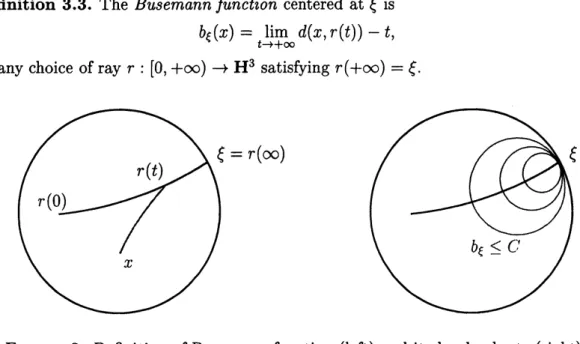
Given
an
ideal point $\xi\in\partial_{\infty}H^{3}$ anda
geodesic ray $r:[0, +\infty)arrow H^{3}$ asymptotic to $\xi,$$\lim_{tarrow+\infty}r(t)=\xi$, for any $x\in H^{3}$ the quantity $t-d(x, r(t))$ is strictly increasing on $t,$
and bounded above by $d(r(O), x)$, by the triangle inequality. Hence, the limit
$\lim_{tarrow+\infty}d(x, r(t))-t$
exists. It defines
a
functionon
$x\in H^{3}$ such that, up tosome
additive constant, dependsonly on the ideal point $\lim_{tarrow+\infty}r(t)=\xi\in\partial_{\infty}H^{3}$ (see for instance [2]).
Definition 3.3. The Busemann
function
centered at $\xi$ is$b_{\xi}(x)= \lim_{tarrow+\infty}d(x, r(t))-t,$
for any choice of ray $r$ : $[0, +\infty)arrow H^{3}$ satisfying $r(+\infty)=\xi.$
FIGURE 2. Definition of Busemann function (left) and its level subsets (right).
In the upper half spacemodel for$H^{3},$ $\{(z, t)\in C\cross R|t>0\}$ equipped with the metric $d|z|^{2}+dt^{2}$
$\overline{t^{2}},$
and with boundary at infinity $\partial_{\infty}H^{3}\cong$ $CU\{\infty\}$, the Busemann function centered at
$\xi=\infty$ is, up to some additive constant,
(5) $b_{\infty}(z, t)=-\log t.$
Then it is straightforward that $b_{\xi}$ is convex, its level sets $b_{\xi}=c$ are horospheres centered
at $\xi$, and its level subsets $b_{\xi}\leq c$
are
horoballs.Given
an
unordered configuration$C=\{\xi_{1}, \ldots, \xi_{n}\}\in Conf_{n}(P^{1})\cong(P^{1})^{n}/\Sigma_{n},$
considerthe sum of Busemann functions:
$b_{C}=b_{\xi_{1}}+\cdots+b_{\xi_{n}}:H^{3}arrow R,$
Lemma 3.4. For $n\geq 3$ and $C\in Conf_{n}(P^{1})$, the
function
$b_{C}$ is proper (has compact sublevelsets)iff
no pointof
$C$ has multiplicity at least $n/2.$Proof.
We first look at the example ofa
configuration consisting of two points. Let$\xi_{-},$$\xi_{+}\in H^{3}$ be different points, Consider
a
geodesic$\gamma$ : $(-\infty, +\infty)arrow H^{3}$ that satisfies
$\gamma(\pm\infty)=\xi_{\pm}$. Then $b_{\xi-}+b_{\xi+}$ is constant (and attains its minimum) along
$\gamma$
.
Even ifbounded below, $b_{\xi_{-}}+b_{\xi+}$ is not proper,
as
the sublevel setsare
noncompact. Inaddi-tion, since Busemann functions are Lipschitz, it is bounded above in the metric tubular
neighbourh$ood\mathcal{N}_{r}(\gamma)=\{x\in H^{3}|d(x, \gamma)\leq r\}.$
To prove one implication of the lemma,
assume
that a point in the configuration has multiplicity $k\geq n/2$.
In particular $\xi_{1}=\cdots=\xi_{k}$. If $k=n$ , obviously $b_{c}=nb_{\chi_{1}}$ isnot proper. Otherwise, $\xi_{k+1},$ $\ldots,$
$\xi_{n}$
are
$n-k\leq n/2$ points in the configuration differentfrom $\xi_{1}$. Consider the geodesics $\xi_{1}\xi_{k+1},$
$\ldots,$
$\overline{\xi_{1}\xi_{n}}$. By the previous discussion, the
function $b_{\xi_{1}}+b_{\xi_{k+1}}$ is not onlyconstant
on
$\xi_{1}\xi_{k+1}$ butitis also boundedon$\xi_{1}\xi_{k+j}$ when approaching$\xi_{1}$, for $j=1,$
$\ldots,$$n-k$, because both $\overline{\xi_{1}\xi_{k+1}}$ and $\overline{\xi_{1}\xi_{k+j}}$ are are asymptotic to $\xi_{1}$
.
Thefunction $b_{C}$ is the
sum
of such pairs $b_{\xi_{1}}+b_{\xi_{k+j}}$, whichare
bounded on$\xi_{1}\xi_{k+1}$ when approaching $\xi_{1}$, added to possibly
some
$b_{\xi_{1}}$, that converges to $-\infty$ when approaching $\xi_{1}$along$\xi_{1}\xi_{k+1}$
.
Hence it is not proper.For the other implication,
assume
that that $b_{C}$ is not proper: let $x_{n}$ bea
diverging sequence in $H^{3}$ such that $b_{C}(\xi)(x_{n})$ remains bounded above.We may
assume
that $x_{n}arrow$$\eta\in\partial_{\infty}H^{3}$. If$\eta\neq\xi_{i}$, then $b_{\xi_{l}}(x_{n})arrow+\infty$, therefore we may
assume
that $\eta=\xi_{1}$. Let $k$ be the multiplicity of$\xi_{1}$, we claim that $k\geq n/2$.
Notice that for $\xi_{j}\neq\xi_{1},$$b_{\xi_{1}}+b_{\xi_{j}}$ is bounded below in the whole $H^{3}$, hence if
$k<n/2$, then $b_{C}(x_{n})$ would decompose
as
the additionof terms $b_{\xi_{1}}(x_{n})+b_{\xi_{j}}(x_{n})$ bounded below and terms $b_{\xi_{2k+j}}(x_{n})$ converging to $+\infty.$ $\square$
Lemma 3.5.
If
$C$ contains at least threedifferent
points, then $b_{C}$ is strictlyconvex.
Proof.
It is straightforward from (5) that $b_{\xi_{i}}$ is convex, and that the second derivative atthe point $x\in H^{3}$ only vanishes in the directionsperpendicular to the ray$\overline{x\xi_{i}}$. If$C$has at
leastthree different points, then there is
no common
perpendicularto the rays emanatingfrom $x$ to the points ofC. $\square$
Corollary 3.6.
If
no pointof
$C$ has multiplicity at least $n/2_{Z}$ then $b_{C}$ has a unique minimum in $H^{3}.$Definition 3.7. When nopointof$C$ has multiplicity at least$n/2$, the unique pointwhere
minimum of$b_{C}$ is reached is called the barycenter or center
of
mass of$C$ and it is denotedby $bar_{C}.$
Thus we have an equivariant map
(6) $P^{n}-Osc_{[n/2]}(Q_{n})roots\cong(P^{1})^{n}/\sum_{n}-\triangle_{[(n+1)/2]}$ barycenter$H^{3}.$
Here
we
have used that $[n/2]+[(n+1)/2]=n$ and Remark 3.2. Notice that $PSL_{2}(C)$acts properly and cocompactly
on
$H^{3}$,so
this construction gives properness of the actionon $P^{n}-Osc_{[n/2]}(Q_{n})$
.
To study cocompactness,
we
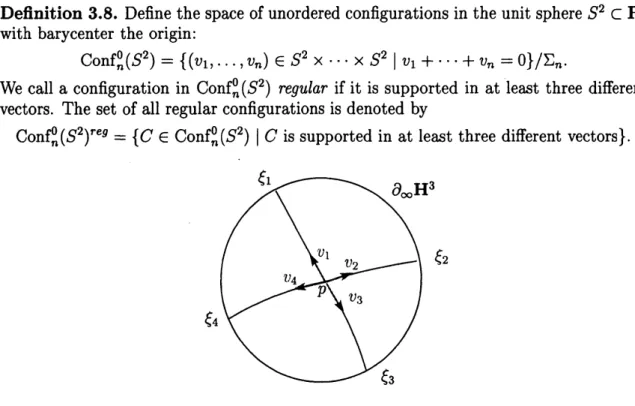
must analyzethe fibre of the barycenter map (6), equipped with the action of $SO(3, R)$, the stabilizer of a point in $H^{3}$. To understand this fibre,look at the tangent vectors from the center of
mass
to the ideal points. They are unit vectors $v_{1},$ $\ldots,$$v_{n}$ and satisfy $v_{1}+\cdots+v_{n}=0$. Thus define:Definition 3.8. Definethe space of unordered configurations in the unit sphere $S^{2}\subset R^{3}$ with barycenter the origin:
$Conf_{n}^{0}(S^{2})=\{(v_{1}, \ldots, v_{n})\in S^{2}\cross\cdots\cross S^{2}|v_{1}+\cdots+v_{n}=0\}/\Sigma_{n}.$
We call
a
configuration in $Conf_{n}^{0}(S^{2})$ regular if it is supported in at least three differentvectors. The set of all regular configurations is denoted by
$Conf_{n}^{0}(S^{2})^{reg}=$
{
$C\in Conf_{n}^{0}(S^{2})|C$is supported in at least three differentvectors}.
FIGURE 3. At the minimum the addition of the unit tangent vectors $v_{i}$ vanishes.
Notice that for $n$ odd, $Conf_{n}^{0}(S^{2})^{reg}=Conf_{n}^{0}(S^{2})$
.
For $n$ even, the difference between$Conf_{n}^{0}(S^{2})^{reg}$ and $Conf_{n}^{0}(S^{2})$ is precisely the $SO$(3)-orbit of configurations supported
on
precisely two vectors, namely two opposite vectors that
occur
precisely $n/2$ times each.Lemma 3.9. The
fibre of
the barycenter map (6) is homeomorphic to $Conf_{n}^{0}(S^{2})^{reg},$equipped with the action
of
$SO$(3).For $n$ odd, this proves cocompactness because $Conf_{n}^{0}(S^{2})^{reg}=Conf_{n}^{0}(S^{2})$ is compact,
and
so
is $Conf_{n}^{0}(S^{2})^{reg}$.
For $n$even
$Conf_{n}^{0}(S^{2})-Conf_{n}^{0}(S^{2})^{reg}$ consists ofa
single orbit,thus $Conf_{n}^{0}(S^{2})/SO(3)$ is the one-point compactification of$Conf_{n}^{0}(S^{2})^{reg}/SO(3)$
.
UsingGeometric Invariant Theory,
we
shall show in next section that $Conf_{n}^{0}(S^{2})/SO(3)$ isa
projective variety smooth at $Conf_{n}^{0}(S^{2})^{reg}/SO(3)$
.
If the configurations where ordered, they would correspond to polygons in $R^{3}$ with sides of length
one.
Thiswas
studied by Kapovich and Millson in [14], where they view configurationsas
atomicmeasures.
These ideasare
further developed by Kapovich, Leeb and Millson in [13]. The idea ofbarycenter ofmeasures is quitecommon
and has manyapplications, as for instance the entropy rigidity of Besson, Courtois and Gallot [1].
4. THE GEOMETRIC INVARIANT THEORY APPROACH
Here we apply the point of view of geometric invariant theory [21]. The actions of
$PSL_{2}(C)$
on
$P^{n}$ and $(P^{1})^{n}$are
algebraic,so
it makessense
to look at the quotients in geometric invariant theory. Geometric invariant theory provides Zariski open subsets$U\subset V$ of$P^{n}$ and $(P^{1})^{n}$ that are $PSL_{2}(C)$-invariant and:
$\bullet$ $A$ categorical quotient $\pi$ : $Varrow Z$
.
Namely this projection is constant on$PSL_{2}(C)$-orbits, and every algebraic map $Varrow Y$ constant on $PSL_{2}(C)$-orbits
$\bullet$ The projection $\pi$ : $Varrow Z$ restricts to a geometric quotient on $U:\pi(U)$ is open
and the fibers of$\pi$ : $\pi^{-1}(\pi(U))arrow U$ are orbits.
The choice of$U$and $V$ is made by
means
of stability. We recall the following definition:Definition 4.1. Let $V\subset C^{n+1}$ be an affine cone, i.e.
an
algebraic variety such that if$x\in V$ then $\lambda x\in V\forall\lambda\in$ C. Let $G$ be a Lie group acting on $V.$ $A$ point $x\in V-\{O\}$ is
called:
$\bullet$ stable ifthe orbit $Gx$ is closed and
$x$ has finite stabilizer,
$\bullet$ semistable if$0$ is not in the closure of the orbit $Gx$, and
$\bullet$ unstable if$0$ is in the closure ofthe orbit $Gx.$
Let $P(V)^{s}$ and $P(V)^{ss}$ denote the subset of stable and semistable points, which
are
Zariski open. Geometric invariant theory provides the following:
Theorem 4.2 ([21], cf. [23], [27]). Let $Z$ be the projective variety whose gmded algebm
is $C[V]^{G}$, the set
of
invariantfunctions of
the algebmof
V. Then;(1) There is aprojection $\pi$ : $P(V)^{ss}arrow Z$ that is the categorical quotient.
(2) The morphism $\pi$ : $P(V)^{ss}arrow Z$ is
affine.
(3) The restriction to $P(V)^{s}$ is a geometric quotient.
Remark 4.3. Notice that the projection on the set of semistable points $P(V)^{ss}arrow$
$PSL_{2}(C)\backslash P(V)^{ss}$ is the standard topological quotient, and that $Z$ is a natural
com-pactification.
Remark 4.4. Notice also that the topology ofthe orbits in $V$ and in $P(V)$ may differ.
In fact, for
an
stable point, its orbit in $V$ is closed but possibly not in $P(V)$.
However itis closedin $P(V)^{ss}$, the semistable part. The orbit ofasemistable point maybe nonclosed
in $P(V)^{ss}$, if not it accumulates to a closed orbit, which is unique in the fibre of$\pi.$ Back to oursetting, $V=C_{n}[X, Y]$, the spaceofhomogeneous polynomialsofdegree $n,$
and to
a
polynomial in $C_{n}[X, Y]$ its roots in $P^{1}$. Thenwe
have:Lemma 4.5. $A$ polynomial in $C_{n}[X, Y]$ is stable
iff
all roots have multiplicity $<n/2.$It $\dot{u}$ semi-stable
iff
the multiplicities $are\leq n/2.$Wedonot provide aproofofthis lemma, which isstated in 1.7 of[22]. It isnot difficult,
by considering the Segre embedding of $(P^{1})^{n}$ in some projective space.
Let
us
try to understand this lemma inour
setting. Notice first that it is coherent with thechoice ofdomainsof$P^{n}$we
have made in the introduction. The action of$PSL_{2}(C)$in the configuration space of roots can bringtogether different points,thus semistableorbits in $P(V)$ accumulate to unstable.The discussion for semistability depends on the parity of $n$:
$\bullet$ Notice that when
$n$ is odd, semistable equals to stable, and this explains why we do not need to compactify in the odd case.
$\bullet$ When $n$ is even the semistable but not stable polynomials have a root of
multi-plicity$n/2$. The orbits ofsuch polynomials
are
nonclosed, and they accumulate toeither unstable orbits or to an orbit with precisely two roots of multiplicity $n/2.$
Thus all the semistable orbits project to
a
single point in the GIT quotient $Z.$Corollary 4.6. The stable and semistable sets are;
$(P^{n})^{s}=P^{n}-Osc_{[n/2]}(Q_{n})$ and $(P^{n})^{ss}=P^{n}-Osc_{[(n-1)/2]}(Q_{n})$. From the previous discussion
we
obtain:Proposition 4.7. The quotient $Y_{n}=PSL_{2}(C)\backslash (P^{n}-Osc_{[n/2]}(Q_{n}))$ is
$\bullet$ a complex projective variety $\hat{Y}_{n}=Y_{n}$
of
dimension $n-3$,for
$n$ odd;$\bullet$ a complex projective variety $\hat{Y}_{n}$
of
dimension$n-3$ minus one point,for
$n$ even.In Section 5 we will prove that $PSL_{2}(C)\backslash (P^{n}-Osc_{[n/2]}(Q_{n}))$ issmooth, but the
com-pactification for even $n\geq 6$ is singular.
5. SMOOTHNESS OF THE QUOTIENT
Weshall show that $Y_{n}$ has
no
singular point, andthat, foreven
$n\geq 6$, the point $\hat{Y}_{n}-Y_{n}$ isa
singular point. Thisuses
essentially the methods of [12].Since the stabilizerof
a
pointin$P(V)^{s}$ is trivial,a
straightforward application of Luna’sslice theorem [15] gives:
Lemma 5.1. Allpoints
of
$Y_{n}=\pi(P(V)^{s})$are
smooth.Lemma 5.2. For$n\geq 6$, the point$\hat{Y}_{n}-Y_{n}=\pi(P(V)^{ss})$ is singular, but regular
for
$n=4.$Proof.
We look at the closed orbit corresponding to the completion, the polynomials of the form $m_{1}^{n/2}m_{2}^{n/2}$, for two different monomials$m_{1}$ and $m_{2}$.
Since this isa
single orbit,we
mayassume
that the polynomial is $X^{n/2}Y^{n/2}$.
The stabilizer of this orbit is theone-parameter group
$H=\{(\begin{array}{ll}\lambda 00 \lambda^{-1}\end{array})|\lambda\in C^{*}\}\cong C^{*}$
We work with homogeneous coordinates
$[a_{-n/2}, a_{-n/2+1}, a_{-n/2+2}, \ldots, a_{n/2}]$
corresponding to the polynomial
$\sum_{i=-n/2}^{n/2}a_{i}X^{n/2+i}Y^{n/2-i}.$
In particular $x^{n/2}Y^{n/2}$ has coordinates $a_{i}=0$ for $i\neq 0$ and $a_{0}\neq 0$
.
To finda
slice,fix first an affine chart determined by $a_{0}=1$, which is invariant under the action of the stabilizer.
We next determine the tangent space to the orbit of$x^{n/2}Y^{n/2}$
.
Consider the action ofthe infinitesimal isometries
$h_{+}=(\begin{array}{ll}0 10 0\end{array})$ and $h_{-}=(\begin{array}{ll}0 0l 0\end{array}).$
The infinitesimal action of$h_{+}$ does notchange$X$ and maps $Y$to $Y+\epsilon X$, forinfinitesimal
$\epsilon$, thus it maps
Thus its tangent vector has coordinates $a_{i}=0$ for $i\neq-1$ and $a_{-1}\neq 0$
.
Analogously, thetangent vector to the action of $h_{-}$ has coordinates $a_{i}=0$ for $i\neq 1$ and $a_{1}\neq 0$. To have atransverse slice, define it by setting $a_{0}=1$ and $a_{-1}=a_{1}=0$:
$S=\{[a_{-n/2}:a_{-n/2+1}:\cdots:a_{-2}:0:1:0:a_{2}:\cdots:a_{n/2-1}:a_{n/2}]|a_{i}\in C\}\cong C^{n-3}$
Byconstruction$S$is transverseto thetangent spaceof theorbit at$x^{n/2}Y^{n/2}$ andinvariant
under the action of the stabilizer$H$. Hence it is the slice constructed in the proof of Luna’s
slicetheorem [15]. It follows that the point in the quotient is singular iff $S/H$ is singular
at $a_{i}=0$, for $i\neq 0.$
The next step will be to compute the quotient $S/H$, but we will have to distinguish
different cases for $n$. Wewilluse thatthe stabilizer is the one-parametergroupthat maps
the coordinate $a_{i}$ to $\lambda^{2i}a_{i}.$
We discuss first the case $n=4$
.
Hence the coordinatesare
$(a_{2}, a_{-2})\in C^{2}$ and thefunctions invariant by $H$ is the ring generated by the coordinate $x=a_{-2}a_{2}$. Hence
$S/H\cong C$ is smooth.
Next
assume
$n=6$. The coordinates are $(a_{3}, a_{2}, a_{-2}, a_{-3})\in C^{2}$. Here the $H$-invariantfunctions are generated by
$\{\begin{array}{l}X=a_{2}a_{-2}y=a_{3}a_{-3}z=a_{2}^{3}a_{-3}^{2}t=a_{-2}^{3}a_{3}^{2}.\end{array}$
They are not independent functions (the dimension of the quotient is 3), and satisfy the relation:
(7) $zt=x^{3}y^{2},$
which defines a hypersurface that is singular at the origin. For larger $n$ even, the $H$invariant functions
are
generated by$x_{I}=x_{i_{1},i_{2},\ldots,i_{k}}=a_{i_{1}}a_{i_{2}}\cdots a_{i_{k}},$ satisfying $i_{1}+i_{2}+\cdots i_{k}=0$. The equations are of the form
$x_{I_{1}}x_{I_{2}}\cdots x_{I_{r}}=x_{J_{1}}x_{J_{2}}\cdots x_{J_{s}},$ where the union of unordered set of indices
are
equal:$I_{1}\cup I_{2}\cup\cdots\cup I_{r}=J_{1}\cup J_{2}\cup\cdots\cup J_{s}.$
Notice that $r,$ $s\geq 2$ (otherwise this function is not required
as
generator), thus thederiv-ative of the equation at the origin vanishes. Moreover, the set ofequations is nonempty,
because it always contains (7). Hence it is singular $\square$
This finishes the proofof Theorem 1.4. Notice that in the proofwe have obtained the followingcorollary.
Corollary 5.3. The moduli space
of
unordered configumtionsof
$n$ unit vectorsin$R^{3}$ with trivial barycenter$SO$(3)$\backslash Conf_{n}^{0}(S^{2})$
is a complex projective variety which is smooth except at the point
$(SO$(3)$\backslash Conf_{n}^{0}(S^{2}))-(SO(3)\backslash Conf_{n}^{0}(S^{2})^{reg})$
6. Low DIMENSIONAL EXAMPLES: $n=3,4,5$
The goal of this section is to compute explicitly
some
quotients $Y_{n}=PSL_{2}(C)\backslash X_{n}$ for$n=3,4$, and 5.
6.1. Case $n=3$
.
The space of ordered triples ofdifferent points is naturally isomorphicto the frame bundle of hyperbolic space. In
our
case,we
consider unordered triples,so
it is the quotientof the frame bundleby the permutation groupactingon the vectors of the frame. In thiscase
the osculating varietywe remove
is just the tangent variety, and the quotient$Y_{3}=PSL_{2}(C)\backslash (P^{3}-Osc_{1}(Q_{3}))\cong*$
consists of just one point. The action of $PSL_{2}(C)$ is not effective, it has kemel $\Sigma_{3}.$
Therefore
$\pi_{1}(M^{3})\backslash (P^{3}-Osc_{1}(Q_{3}))\cong\pi_{1}(M^{3})\backslash PSL_{2}(C)/\Sigma_{3}$
is
a
quotient ofthe frame bundleover
$M^{3}$ (the bundle of unordered frames).6.2. Case $n=4$
.
The space of ordered quadruples of different points hasa
naturalfunction which is $PSL_{2}(C)$-invariant, the
cross
ratio:$[z_{i}:z_{2}:z_{3}:z_{4}]= \frac{z_{1}-z_{3}}{z_{2}-z_{3}}\frac{z_{2}-z_{4}}{z_{1}-z_{4}}.$
This defines
a
functionon
theset of different quadruples of$P^{1}$ that extends when at most two pointsare
equal:(P) $-\Delta_{3} arrow P^{1}$
$(z_{1}, z_{2}, z_{3}, z_{4}) \mapsto [z_{1}:z_{2}:z_{3}:z_{4}].$
To get
a
functiononthe space of unordered configurations,we
consider theaction of threepermutations that span the symmetricgroup
on
4 elements:(8) $[z_{2}:z_{1}:z_{3}:z_{4}]=[z_{1}:z_{2}:z_{4}:z_{3}]= \frac{1}{[z_{i}:_{i}z_{2}\cdot z_{3}:z_{4}],:z_{4}}[z_{1}:z_{3}:z_{2}:z_{4}]=1-[z_{1}:z_{2}:z_{3}.’$ Consider the branched covering $F$ : $P^{1}arrow P^{1}$ of degree 6:
$F(z)= \frac{z^{6}-3z^{5}+3z^{4}-z^{3}+3z^{2}-3z+1}{z^{2}(1-z)^{2}}=z^{2}-z+\frac{3z^{2}-3z+1}{z^{2}(1-z)^{2}},$
It ramifies at
oo
$\in C\cup\{\infty\}=P^{1}$ and satisfies $F^{-1}(\infty)=\{0,1, \infty\}$.
Moreover it is invariant by the transformationson
thecross
ratio (8)$F(z)=F(1-z)=F(1/z)$,
It is then straightforward that
(P) $/\Sigma_{4} arrow P^{1}$ $(z_{1}, z_{2}, z_{3}, z_{4})\mapsto F([z_{1}:z_{2}:z_{3}:z_{4}])$ induces an isomorphism $\hat{Y}_{4}=SL_{2}(C)\backslash (P^{4}-Osc_{1}(Q_{4}))\cong P^{1}.$ In particular $\pi_{1}(M^{3})\backslash (P^{4}-Osc_{1}(Q_{4}))$
6.3. Case $n=5$
.
We start with the discussion of Deligne and Mostow [4] on the space of ordered configurations of 5 points, with at most two ofthem equal. Consider the map(P) $-\triangle_{3} arrow P^{1}\cross P^{1}$
$(z_{1}, z_{2}, z_{3}, z_{4}, z_{5}) \mapsto (\infty, 0,1, \frac{1}{[z_{1}:z_{2}:z3:z4]}, \frac{1}{[z_{1}:z_{2}:z_{3}:zs]})$
.
It induces$\rho:PSL_{2}(C)\backslash ((P^{1})^{5}-\triangle_{3})arrow P^{1}\cross P^{1}$
The map $\rho$ is birregular except at
$L_{13}=\rho^{-1}(0,0) , L_{12}=\rho^{-1}(1,1) , L_{23}=\rho^{-1}(\infty, \infty)$.
Hencethe quotient of the (ordered) configuration space $PSL_{2}(C)\backslash ((P^{1})^{5}-\triangle_{2})$is a
blow-up of$P^{1}\cross P^{1}$ at the three points $(0,0),$ $(1,1)$ and $(\infty, \infty)$. Here
$L_{ij}$ corresponds to the coordinates $i$ and $j$ being equal. These
are
10lines in $PSL_{2}(C)\backslash ((P^{1})^{5}-\triangle_{2})$, the threeexceptional fibers $(\rho^{-1}(0,0),$ $\rho^{-1}(1,1)$, and $\rho^{-1}(\infty, \infty))$ and the $\rho$-lifts of
seven
lines in$P^{1}\cross P^{1}$:
$x=\{\begin{array}{l}01 ,\infty\end{array}$ $y=\{\begin{array}{l}01 ,\infty\end{array}$ $x=y,$
where $x=1/[z_{1} : z_{2}:z_{3}:z_{4}]$ and $y=1/[z_{1} : z_{2}:z_{3}:z_{5}].$
Todetermine$PSL_{2}(C)\backslash X_{5}$
we
consider the actionof thepermutationgroup $\Sigma_{5}$, namely:$PSL_{2}(C)\backslash X_{5}\cong(P^{i}\cross P^{1}\# 3\overline{P^{2}})/\Sigma_{5}.$
We already know that $PSL_{2}(C)\backslash X_{5}$ isa smooth complexprojective surface. We need to
argue that it is simply connected and then look at the homology and apply Freedman’s theorem [6]. We describe the action of $\Sigma_{5}$
.
We look at permutations (li) of the firstcoordinate with the i-th coordinate, and the induced map
on
$P^{1}\cross P^{1}\# 3\overline{P^{2}}$, witha
computation similarto the previous subsection. Notice that these permutations generate
$\Sigma_{5}$. The induced maps
are:
$\bullet$ The permutation (12) induces
$\{\begin{array}{l}x\mapsto 1/xy\mapsto 1/y\end{array}$
$\bullet$ The permutation (13) induces
$\{\begin{array}{l}x\mapsto\frac{x}{x-1}y\mapsto\overline{y}-\overline{1}A\end{array}$
$\bullet$ The permutation (14) induces
$\{\begin{array}{l}x\mapsto 1-xy\mapsto\frac{y(1-x)}{y-x}\end{array}$
$\bullet$ The permutation (15) induces
All these induced maps have fixed points. This implies that $PSL_{2}(C)\backslash X_{5}$ is
simply-connected, because $\pi_{1}(PSL_{2}(C)\backslash X_{5})$ is the quotient of the orbifold group, $\Sigma_{5}$, by the
group
generated by elements with fixed points,see
forinstance [11].On the other hand $\Sigma_{5}$ obviously acts transitively
on
the ten lines $l_{ij}$ defined by twocoordinates being equal. Those lines generate the homology of $P^{1}\cross P^{1}\# 3\overline{P^{2}}$, hence the homology of the quotient has rank one, therefore:
$Y_{5}=PSL_{2}(C)\backslash (P^{5}-Osc_{2}(Q_{5}))\cong P^{2}.$
Hence
$\pi_{1}(M^{3})\backslash (P^{5}-Osc_{2}(Q_{5}))$
is a $P^{2}$-bundle over the frame bundle of$M^{3}.$ REFERENCES
[1] G. Besson, G. Courtois, and S. Gallot, Entropies etrigidit\’es des espaces localement sym\’etriques de
courbure strictementn\’egative, Geom. Funct. Anal. 5 (1995),731-799.
[2] S. Buyalo and V. Schroeder, Elements ofasymptotic geometry, EMS Monographs in Mathematics.
European Mathematical Society (EMS), Z\"urich, 2007.
[3] A. Cano, J. P. Navarrete and J. Seade, Complex Kleinian groups., Progressin Mathematics 303.
Berlin: Springer. xx$+271$ pp.
[4] P. Dehgne and G. D.Mostow, Monodromy ofhypergeometricfunctions andnonlattice integral
mon-odromy, Inst. Hautes\’Etudes Sci. Publ. Math.63 (1986), 5-89.
[5] W. Fenchel, Elementary geometry in hyperbolicspace,Berlin etc.: Walter de Gruyter&-- Co.,1989.
[6] M. H. Freedman, The topologyof four-dimensional manifolds,J. Differential Geom. 17 (1982),
357-453.
[7] W. lfulton and J.Harris, Representation theory,Graduate Texts in MathematicsVol.129,
Springer-Verlag, NewYork, 1991.
[8] S. Garoufalidis, M. Goemer and C. K. Zickert, Gluing equationsfor $PGL(n,C)$-representations of
3-manifolds, ArXiv $e$-prints, July 2012.
[9] S. Garoufalidis, D. P. Thurstonand C. K. Zickert, The complexvolume
of
$SL(n,C)$-fepresentationsof3-manifolds, ArXiv$e$-prints, November2011.
[10] O. Guichardand A. Wienhard, Anosov representations: domains of discontinuity and applications,
Invent. Math. 190 (2012), 357-438.
[11] A. Haefliger and Q. N. Du, Appendice: une pr\’esentation du groupe fondamental d’une orbifold,
Ast\’erisque 116 (1984),98-107.
[12] M. Heusener and J. Porti, The variety of characters in $PSL_{2}(\mathbb{C})$, Bol. Soc. Mat. Mexicana (3),
10(Special Issue) (2004), 221-237.
[13] M. Kapovich, B. Leeb,andJ. Millson, Convex
functions
onsymmetricspaces, sidelengthsofpolygonsandthe stability inequalities for weighted configurations at infinity, J. Differential Geom. 81 (2009),
297-354.
[14] M. Kapovichand J. J.Millson, Thesymplecticgeometryofpolygons in Euclideanspace, J. Differential
Geom. 44 (1996),479-513.
[15] D. Luna. Slices \’etales, Surlesgroupesalg\’ebriques,81-105, Bull. Soc.Math. France, Paris,M\’emoire
33. Soc. Math. France, Paris, 1973.
[16] P. Menal-Ferrer andJ. Porti, Higher dimensionalReidemeister torsion invariants
for
cusped hyper-bolic 3-manifolds, ArXiv$e$-prints, October 2011.
[17] W. Mueller, The asymptotics of the Ray-Singer analytic torsion of hyperbolic 3-manifolds, ArXiv
$e$-prints, March2010.
[18] W. Mueller and J. Pfaff, Analytic torsion ofcomplete hyperbolic manifolds of finite volume, ArXiv
$e$-prints, October2011.
[19] W. Mueller and J. Pfaff, The asymptotics ofthe Ray-Singer analytic torsionforcompact hyperbolic
[20] W. Mueller and J. Pfaff, Analytic torsion and$L^{2}$-torsion of compact locally symmetric manifolds,
ArXiv $e$-prints, Apri12012.
[21] D. Mumford, J. Fogarty and F. Kirwan, Geometric invariant theory. 3rd enl. ed., Berlin:
Springer-Verlag, 1993.
[22] D. Mumford, Stability
of
projective varieties, Enseignement Math. (2) 23(1977), 39-110.[23] P. E. Newstead, Introduction to moduli problemsand orbit spaces, Tata Institute of Fundamental
Research Lectures on Mathematics and PhysicsVol. 51, Tata Institute of Fundamental Research,
Bombay, 1978.
[24] J. Pfaff, Analytic torsion versus Reidemeister torsion on hyperbolic 3-manifolds with cusps, ArXiv
$e$-prints, June 2012.
[25] J. Pfaff, Selberg zeta functions on odd-dimensional hyperbolic manifolds of finite volume, ArXiv
$e$-prints, May2012.
[26] J. Porti, Regeneratinghyperbolic cone 3-manifolds from dimension 2, ArXiv $e$-prints, to appear in
Ann. Inst. Fourier, March2010.
[27] \‘E. B. Vinberg and V. L. Popov, Invariant theory. Algebraic geometry, 4 (Russian), Itogi Nauki $i$
Tekhniki, 137-314,315. Akad. Nauk SSSRVsesoyuz.Inst. Nauchn. iTekhn. Inform., Moscow, 1989.
DEPARTMAMENT DE MATEM\‘ATIQUES, UNIVERSITAT AUT\‘oNOMA DE BARCELONA, 08193
CERDA-NYOLA $DEL$ VALL\‘ES, CATALONIA