AModel
for
Occurrence
of
Turbulence
in Circular Pipe
Flows:
Experimental
Definition of the Problem
会津大・理工 神田英貞 (Hidesada Kanda)
Univ. of Aizu, Dept. of Computer Sci. and Engr.
Abstract
Aconceptual model was constructed for the problem of determining the condi-tions under which the transition from laminar to turbulent flow in circular pipes and between parallel plates occurs, so that it becomes possible to calculate the critical Reynolds number (Re). Up until now this problem has been investigated by stability theory with disturbances. However, the minimum critical Reynolds number (Rc(min)) has not yet been obtained theoretically. Accordingly, the author .took up the problem directly ffom many previous experimental investigations and
found that (i) plotsof the transition length versus the Reynolds number (Re) show
that the transition occurs in the entrance region under the conditions of natural
disturbances, and (ii) plots of ${\rm Re}$ versus the ratio $(\gamma)$ of bellmouth diameter (BD)
to the pipe diameter (D) show that with larger shapes ofbellmouths, laminar flow will persist to higher ${\rm Res}$
.
The problem is thus defined clearly as: Entrance shapedete rmines the critical Reynolds number.
1Kanda’s
Transition
Model
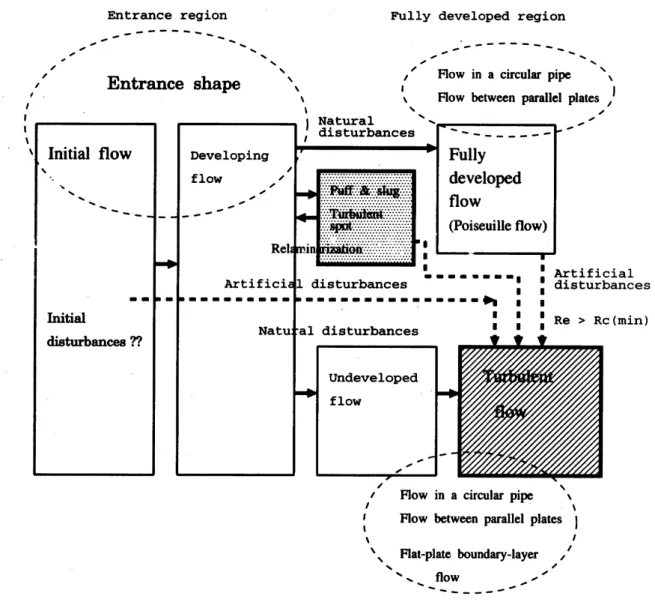
Alayout of the procedure for the modeling and simulation of this problem to determine
${\rm Re}$ is illustrated in Fig. 1on the 7th page. Hence,
we
shall focuson
the transition length,which is the distance between the pipe inlet and the point where transition from laminar to turbulent flow occurs, and
on
the shape of bellmouths fitted at the pipe inlet. Theobjectives of this study
are
to derive and verify the concepts of the model from previousexperimental investigations, especially (1) - (3), and (6) below.
(1) Transition
occurs
in the entrance region under the conditions of natural disturbances(Kanda and Oshima, 1987).
(2) Entrance shape determines ${\rm Re}$ apparently: with larger shapes ofbellmouths, laminar
flow will persist up to higher ${\rm Res}$ (Kanda, $1999\mathrm{a}$).
(3) Rc(min) ofapproximately 2000 is obtained in the
case
of astraight circular pipe, i.e.,when
no
bellmouth is fittedon
the pipe inlet (Kanda, $1999\mathrm{a}$ and $1999\mathrm{b}$).(4) The model holds for flows in circularpipes and between parallel plates, i.e., for internal flows (Kanda, 2001).
(5) For external flow such
as
boundary-layer flow past aflat plate, transition occursnecessarily further downstream since its steady state does not exist (Kanda, $2000\mathrm{a}$).
(6) Disturbances
are
not considered in the current version of the model (Kanda, $2000\mathrm{b}$).数理解析研究所講究録 1285 巻 2002 年 106-113
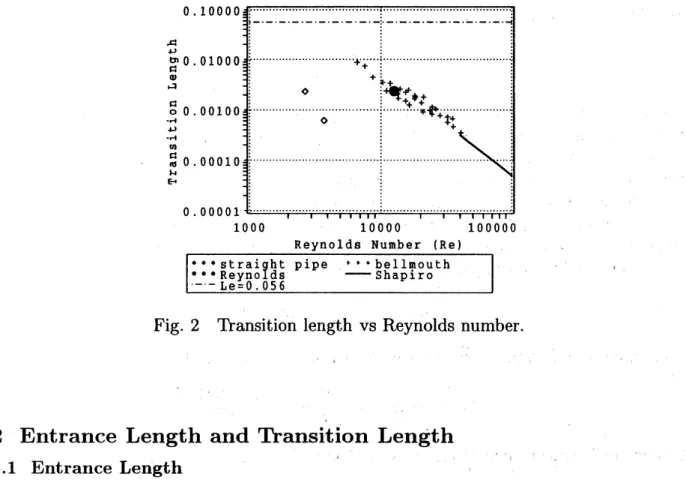
Fig. 2Transition length
vs
Reynolds number.2Entrance Length
and
Transition
Length
2.1 Entrance Length
The transition length should be compared to the entrance length. The uniform velocity
profile at the pipe inlet is gradually transformed further downstream into the parabolic,
Poiseuille-type distribution by the action of viscous forces on the wall. The entrance
length (Ze) is the distance between the pipe inlet and the point where the velocity profile
giow$\iota\backslash \cdot$ into the fully developed, parabolic distribution. The downstream region after the point $7^{\rho},$. is called the fully developed region. The dimensionless entrance length (Le) is
usually expressed as
Le $\equiv\frac{Ze}{D\cross Re}$
Shah and London (1978) defined Le
as
the point where the developing centerline velocityequals 99% of the Poiseuille value $u_{\max}$, and recommended the following correlation for
Le:
Le $= \frac{0.6}{Re(1+0.035Re)}$ +0.056 (1)
From Eq. (1), Le varies for ${\rm Res}$ below about 100; however, it approachesaconstant value
of 0.056 for ${\rm Res}$ above 600 (see the constant line of Le $=0.056$ in Fig. 2).
2.2 Transition Length
When the transition length (Zt) is compared to the entrance length, the
same
dimension-less unit is desirable and the dimensionless transition length (Lt) is thus defined by$Lt$ $\equiv\frac{Zt}{D\cross Re}$
For Reynolds’ color-dye experiments (1883), Lt
can
be estimatedas
$Lt$ $\approx\frac{30}{12,600}=0.00238$ (2)
Figure 2shows the experimental data of Lt, where the diamond and plus symbols show
the transition length for flow in the straight pipe and through the bellmouth entrance,
respectively (Kanda and Oshima, 1987). Theblackdot is the result of Reynolds’ color-dye
experiments. The straight line is drawn according to the result of Shapiro and Smith’s
experiments (1948), in which ${\rm Re}$ (based
on
the pipe diameter) rangedfrom 39,000 to
590,000. Shapiro and Smith found that transition from alaminar to turbulent boundary
layer
occurs
at aReynolds number (Rz, basedon
the distance (z) from the pipe inlet) of about 500,000, which compares well with the corresponding figure for aflat plate, i.e.,$Rz \equiv\frac{zu_{0}}{\nu}=500,000$ (3)
From Shapiro and Smith’s experimental results, Lt is expressed
as
$Lt$ $= \frac{z}{DRe}=\frac{Rz}{(Re)^{2}}=\frac{500,000}{(Re)^{2}}$ (4)
If Reynolds’ critical value of 12,600 is applied to Eq. (4), Lt becomes
$Lt= \frac{500,000}{12,600*12,600}=0.00315$ (5)
Although this value of 0.00315 is to
some
extent larger than the value of 0.00238, whichis calculated using Eq.(2), they
are
of thesame
order ofmagnitude.The majorconclusion for Lt is that under the conditions of ordinary disturbances, the
.transition
should necessarily take place in the entrance region.$Lt<<$ Le $(\approx$ 0.056$)$ (6)
3Effects
of
Bellmouth
3.1 Previous Assumptions
on
the BellmouthBellmouths
are
designed to have the following effectson
the entrance flow:(1) The entrance to the pipe is well rounded, and the fluid enters smoothly from
areser-voir, having
an
almost uniform velocityover
the pipe inletcross
section.(2) The entrance region begins at the pipe inlet, and not at the bellmouth inlet.
Ac-cordingly, the entrance length is measured
as
the distance between the pipe inlet and thepoint at which the velocity profile grows into afully developed parabolic distribution.
(3) The fluidwill alwayshave
some
residualdisturbances carried along with it. Bellmouthsare
used to minimize disturbances prior to flow entering the pipe.The author however showed that abellmouth creates aflow field similar to that in
Fig. 3Reynolds’ bellmouth (a). Fig. 4Reynolds’ bellmouth (b).
the entrance region (Kanda, 1998): (i) At the bellmouth outlet, the axial velocity is not uniform but develops aprofile somewhat similar to Poiseuille’s parabolic profile, because
large vorticities occur on the bellmouth wall and then spread from the wall into the
fluid; (ii) Since radial pressure distributions exist, Prandtl’s boundary-layer assumption
for pressure does not hold for the entire bellmouth region. 3.2 Bellmouth Shapes and Critical ${\rm Re}$
We shall focus on the shape of bellmouths, especially on the ratio (7) of bellmouth
diameter to pipe diameter and consider what determines $\mathrm{R}\mathrm{e}$. Figures 3and 4show the
Reynolds’ bellmouths in his color-dye experiments. Results of previous experimental
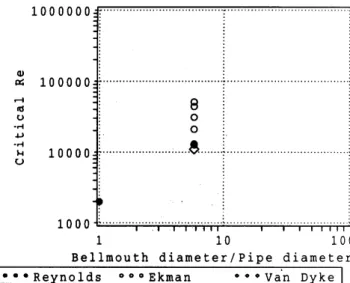
investigations are listed in Table 1. Figure 5is drawn by selecting entrances whose sizes
are well describ $\mathrm{e}\mathrm{d}$: Nos. 1.10 and 16 in Table 1.
The major conclusions for the relation between ${\rm Re}$ and
$\gamma$ are as follows:
(1) ${\rm Re}$ takes the minimum value Rc(min) when
$\gamma$ approaches alimit of one.
$Rc( \min)=$ $\lim_{\gammaarrow 1}Rc\approx$ 2000 (7)
(2) With the same shape as the Reynolds’ bellmouth, ${\rm Re}$ increases proportionally to
$\gamma$
as
Eq. (8).
$Rc \approx\gamma\cdot Rc(\min)$ (8)
For Kanda and Oshima’s value of$5790<\mathrm{R}\mathrm{c}<6690$, ${\rm Re}$ is estimated using $\gamma=2.9$,
$Rc\approx 2.9\cross 2000$ $\approx 5,800$
For Reynolds’ critical value of 12,600, ${\rm Re}$ is estimated using $\gamma=5.78$,
$Rc\approx 5.78\cross 2000$ $\approx 11,560$
For Shapiro’ critical value of $\mathrm{R}\mathrm{c}<113,800$, ${\rm Re}$ is estimated using $\gamma=46.2$,
$Rc\approx 46.2\cross 2000$ $\approx 92,400$
The values calculated above
are
fairly close to their experimental values of ${\rm Re}$$\alpha w_{\mathrm{i}}$ $oe\omega$
Ut.U
$\tilde{\mathrm{U}\mathrm{t}6}$ $.r\prec$ $.\mathrm{d}$ $. \downarrow \mathrm{J}\frac{\mathrm{d}}{\mathrm{U}}$ $\omega$ $. \frac{\mathrm{d}}{\mathrm{o}}$Fig. 5Rc vs bellmouth shape $\gamma$
.
Fig. 6 ${\rm Re}$ using Reynolds’ apparatus.4General
Questions
on
Disturbances
The present situation of the study of the transition in pipe flows is not obvious. The
obscure comprehension may be caused partly by Ekman’s experimental results and partly
by Van Dyke’s introduction of acurrent critical value when using the same Reynolds’
color-dye experimental apparatus. The three different critical Reynolds numbers (Res)
were
presented (see Fig. 6):(i) Reynolds: $11.800<\mathrm{R}\mathrm{c}<14,100$; (ii) Ekman: $12,900<\mathrm{R}\mathrm{c}$. $<51,200$;
$l\mathrm{i}\mathrm{i}_{1}).\backslash ^{\gamma}\mathrm{a}\mathrm{n}$ Dyke: $\mathrm{R}\mathrm{c}<13,000$
.
It is thought that this difference is due to different disturbances in flows. It, however,
may be natural to obtainnearly the
same
results anywhere and anytime if fluid dynamicsis scientifically based, such
as
Rc(min) ofapproximately 2000.(1) Ekman’s
case
(Ekman, 1910)Kanda(2000b) noted that in thefirst section of Ekman’s paper, the word wax wasused five times: “After the trumpet mouth had been rigidly attached to the glass tube, both were
covered inside, in the neighborhood of thejoint, by alayer of soft
wax. .
..
The trumpetmouth
was now
fastenedmore
rigidly, and thewax
jointwas
improved. Apreliminaryexperiment (No. 4).
. .
gave amuch higher value of the critical Reynolds number $\ldots$.”Apparently, the application of
wax
made ${\rm Re}$ increase to 51,000. Then, concerning thewax, is it true that the
wax
coatedon
the joint could directly decrease disturbances? The author considers asfollows using the normal wall strength (Kanda, $1999\mathrm{b}$), whichis the radial component of the curl of vorticity multiplied by $(2/{\rm Re})$ (see Eq.(9)).
normal wall strength $\equiv$ $\frac{2}{Re}[\nabla\cross\omega]_{f}|_{r=R}=$ $- \frac{2}{Re}\frac{\partial(v}{\partial z}|_{r=R}$ $>0$ (9)
where $\omega$ is the vorticity, $\mathrm{r}$ the radial coordinate, and $\mathrm{R}$ the pipe radius
(1) the viscosity of the wax is higher than that ofwater; (ii) ${\rm Re}$ is inversely proportional
to viscosity; (iii) the normal wall strength varies inversely to $\mathrm{R}\mathrm{e}$;(iv) the higher viscosity
of thewax caused the normal wall strength to be much higher than in the
case
of withoutwax (Reynolds’ experiments) and thus ${\rm Re}$ increased, and; (v) in the
case
of withoutwax
(No. 2and 3), Ekman’s results
are
nearly equal to that of Reynolds: ${\rm Re}$ $=\mathrm{a}\mathrm{p}\mathrm{p}\mathrm{r}\mathrm{o}\mathrm{x}\mathrm{i}\mathrm{m}\mathrm{a}\mathrm{t}\mathrm{e}\mathrm{l}\mathrm{y}$$13,000$.
(2) Van Dyke’s
case
Van Dyke (1982) states: “.. . the original apparatus has survived at the University of
Manchester. Using it acentury later, N. H. Johannesen and C. Lowe have taken this
sequence of photographs. .
. .
Modern traffic in the streets of Manchester made ${\rm Re}$ lowerthan the value 13,000 found by Reynolds.”
Professor J. D. Jackson of the University of Manchester kindly allowed the author
to take photographs of the original apparatus on May 25, 1994 (see Figs. 3and 4).
Of
the original apparatus, the bellmouths (trumpet mouths) have been safely kept in the glass
case there. The bellmouth currently used at the University of Manchester differs from the
original ones, so that ${\rm Re}$ observed by Johannesen and Lowe differed from the results of
Reynolds’ experiments.
Conclusions
The following conclusions are derived under the condition of an ordinary disturbance or
anatural one in flow.
(1) The transition from laminar to turbulent flow occurs in the entrance region since the dimensionless transition length (Lt) is less than 0.01 for most experiments.
(2) It is the shape of pipe entrances that determines the critical Reynolds number (Re).
With larger $\backslash ;$] $.\cdot\cdot \mathfrak{v}\mathrm{e}\mathrm{s}$ ofbellmouths, laminar flow
$\mathrm{w}\mathrm{i}1^{1}1$persist upto higher Reynoldsnumbers.
(3) The $\mathrm{m}\mathrm{i}1:\mathrm{i}\mathrm{r}_{-1}\mathrm{u}\mathrm{m}$ critical Reynolds number (Rc(min)) ofapproximately 2000 is obtained
in the following two cases:
(i) The first
case
is from the Reynolds’ pressure experiments; i.e., when fluid is initiallyadmitted in ahigh state ofdisturbance, asthe fluidproceeds along the pipe, the turbulent flow settles down to astable condition. Above Rc(min), the turbulent flow never settles
down to astable condition.
(ii) The second is from the experimental data plotted in Fig. 5; in the case of astraight
circular pipe only, i.e., when no bellmouth is fitted on the pipe inlet.
(4) Although there is apparently amarked difference in phenomena between (3-i) and
$(3- \mathrm{i}\mathrm{i})\backslash$
’the
theory of the occurrence of transition and the theory of the settlement of turbulence should be the same (Kanda, $2000\mathrm{a}$).References
[1] Ekman, V. W., 1910, Arch. Mat. Astron. Fys., bd. 6, no. 12, 1.
[2] Goldstein, S., 1965, Modern Developments in Fluid Dynamics, Vol. 1, 319.
[3] Kanda, H., 2001, ASME FED-Vol. 256, 189.
[4] Kanda, H., 2000a, ASME FED-Vol. 253, 611.
[5] Kanda, H., 2000b, ASME FED-Vol. 253, 619
[6] Kanda, H., 1999a, ASME FED-Vol. 250, 189.
[7] Kanda, H., 1999b, ASME FED-Vol. 250, 197.
[8] Kanda, H., and Oshima, K., 1987, ISAS Report SP No. 5, ISAS Tokyo.
[9] Leite, R. J., 1959, J. ofFluid Mech., Vol. 5, 81.
[10] Reynolds, O., 1883, Trans. Roy. Soc. Lond., Vol. 174, 935.
[11] Reshotko, E., 1958, Jet Propulsion Lab. Progress Report No. 20-364.
[12] Rivas, M. A., and Shapiro, A.H., 1956, Trans. ASME, April, 489.
[13] Senecal, V. E., and Rothfus, R. R., 1953, Chem. Engineering Progress, Vol. 49, 533.
[14] Shah, R. K., and London, A. L., 1978, Laminar Flow Forced Convection in Ducts,
Academic Press, 98.
[15] Shapiro, A.H., and Smith, R.D., 1948, NACA TN No. 1785.
[16] Stanton, T. E., and Pannel, J. R., 1914, Trans. Roy. Soc, Vol. A214, 194.
[17] Van Dyke, M., 1982, An Album of Fluid Motion, Parabolic Press, Stanford, 61.
Entrance region Fully developed region
Fig. 1Modeling and simulation
113
Table 1Critical Reynolds numbers and entrance shapes
[note] Length is in units of cm