Coupling between chemical and dynamic
heterogeneities in a multicomponent bulk
metallic glass
著者
Fujita T., Guan P. F., Sheng H. W., Inoue
A., Sakurai T., Chen M. W.
journal or
publication title
Physical Review. B
volume
81
number
14
page range
140204(R)
year
2010
URL
http://hdl.handle.net/10097/53647
doi: 10.1103/PhysRevB.81.140204Coupling between chemical and dynamic heterogeneities in a multicomponent bulk metallic glass
T. Fujita,1P. F. Guan,1H. W. Sheng,2A. Inoue,1T. Sakurai,1and M. W. Chen1,
*
1WPI Advanced Institute for Materials Research, Tohoku University, Sendai 980-8577, Japan
2Department of Computational and Data Sciences, George Mason University, Fairfax, Virginia 22030, USA
共Received 3 March 2010; published 28 April 2010兲
We performed molecular-dynamics simulation and predicted a strong coupling between chemical short-range order and dynamic heterogeneity in a multicomponent Cu45Zr45Ag10 alloy that possesses excellent glass-forming ability. The intrinsic correlation between the chemical and dynamic heterogeneities leads to significant spatial partitioning and dynamic isolation between Cu-rich slow-dynamics regions and Ag-rich fast-dynamics regions. This characteristic may play an important role in the improved glass-forming ability with Ag addition by retarding crystallization kinetics.
DOI:10.1103/PhysRevB.81.140204 PACS number共s兲: 64.70.pe, 61.43.⫺j, 83.10.Rs
The formation of metallic glasses usually requires rapid cooling in order to freeze the disordered structure of metal melts.1 Recently, numerous multicomponent alloys have
been discovered to possess an unusual capability of forming bulk metallic glasses共BMGs兲 at a very low cooling rate.2In
view of the thermodynamic relationship between structure and phase stability in crystalline materials, the atomic origins of BMG formation have been intensively discussed from a geometrical and topological perspective of the dense atomic packing.3–9 Because BMGs are out-of-equilibrium systems,
their formation involves structural evolution in time and thus cannot be studied in terms of thermodynamics alone.10,11In
general, a superior glass former exhibits slow dynamics and a long␣relaxation time at a temperature above glass transi-tion point, Tg. This concept has been used to empirically
explain the alloying effect in the improved glass-forming ability 共GFA兲 of various glassy materials.12–15Nevertheless,
the intrinsic correlation of the dynamic process with atomic structure and chemistry of metallic glasses has not been well elucidated. In this study, we performed molecular-dynamics simulation in order to investigate the dynamics of a multi-component supercooled liquid. We predicted a strong cou-pling between chemical short-range order and dynamic het-erogeneity in a Cu45Zr45Ag10 BMG, which may offer dynamic insights on the metallic glass formation of multi-component alloys.
An open code software for molecular dynamics simula-tion, LAMMPS,16 was employed to investigate the dynamic
process of Cu45Zr45Ag10 and Cu50Zr50. The many-body po-tentials used in the calculations were developed using the embedded atom method共EAM兲 on the basis of the ab initio calculations derived from the Vienna ab initio simulation package共VASP兲. A force-matching method was used to fit the
predetermined potential energy landscapes.6 The reliability
and accuracy of the EAM potentials have been experimen-tally assessed previously.9 Eight thousand atoms ensemble
for both Cu45Zr45Ag10and Cu50Zr50 were melted at 2500 K
for 0.1 ns共with a time step of 5 fs兲 and then cooled to 300 K at various cooling rates.17 The atomic configurations were analyzed by grouping the nearest-neighbor environments of each atom as Voronoi polyhedra18 and the dynamic process
was characterized by tracking the atomic positions during relaxation at 800 K, i.e.,⬃100 K above Tg.
In both liquid and glass states, chemical inhomogeneity
can be observed in Cu45Zr45Ag10, which is composed of
Cu-rich clusters centered by Cu atoms and Zr- and Ag-enCu-riched interpenetrating clusters centered by Ag pairs or chains.9
Atomic structure evolution during cooling at a quenching rate of 2⫻1010 Ks−1is shown in Fig.1共a兲. We examined the fraction of Voronoi indexes of the representative Cu-centered polyhedra and the average number of the neighboring Ag atoms in Zr-rich interpenetrating clusters. As the temperature approaches Tg 共⬃700 K兲, the population of Cu-centered
具0,0,12,0典 icosahedral short-range order 共ISRO兲 clusters and the average number of neighboring Ag atoms in the form of strings increases dramatically. Figure 1共b兲 shows a cross section of the atomic structure observed at 300 K; only the Cu atoms in the 具0,0,12,0典 polyhedra and Ag atoms are displayed. In this figure, the interpenetrating clusters cen-tered by the stringed Ag atoms are traced with dotted lines. The average number of Ag atoms in the Cu-centered 具0,0,12,0典 polyhedra is only 0.65, whereas the average number of Ag atoms in the Ag-centered interpenetrating clusters is 2.7 without counting the center Ag atoms.
In order to investigate the dynamics of the supercooled liquids, the 8000 atoms ensemble of Cu45Zr45Ag10 and Cu50Zr50 were adequately relaxed at 800 K and the atomic
configurations were used to initialize the individual atom po-sitions. We tracked the atomic structure evolution of the su-percooled liquids during relaxation. As shown in the supple-mental information,17 the fractions of both the Cu-centered
具0,0,12,0典 clusters and Ag-centered interpenetrating clus-ters in Cu45Zr45Ag10 stay dynamically stable during the
re-laxation, i.e., the individual clusters change with the relax-ation time whereas their statistic distribution remains near constant. It is known that the decay of density fluctuations can be described by the self-intermediate scattering function 共SISF兲, Fs共q,t兲=共兺j=1
Naexp关iq·⌬r
j共t兲兴兲/Na, where Nadenotes
the number of atoms and⌬rj共t兲=rj共t兲−rj共0兲 is the
displace-ment vector. The␣ relaxation time t␣ is defined as the time interval in which Fs共q,ta兲=e−1. The value of wave vector q
is fixed at兩qmax兩, which corresponds to the first peak of the
partial structure factor of a specific element a in a multicom-ponent alloy system. The comparison between the SISF of Cu45Zr45Ag10 and Cu50Zr50 glasses is shown in Fig. 2共a兲.
Although the GFA of Cu45Zr45Ag10 is significantly better
in the binary and ternary systems are surprisingly very simi-lar and t␣of Cu and Zr in both systems falls in the range of 0.2–0.5 ns. Moreover, the relaxation dynamics of Ag are even faster than those of Cu and Zr. Generally, the enhanced GFA is associated with the slow structural relaxation. For instance, in Cu46Zr47Al7, the presence of Al results in a high magnitude of t␣ of Cu and Zr as compared to that in a Cu46Zr54 binary alloy.13Therefore, the fact that Ag does not
induce a pronounced slowdown in the dynamics of Cu45Zr45Ag10 is in obvious disagreement with the experi-mental observation that the glass-forming ability of the ter-nary system exhibits a dramatic improvement with the addi-tion of 10 at. % Ag.19 With the aim of exploring the
dynamic mechanism behind the effect of Ag on the enhanced GFA, we analyzed the dynamic susceptibility, which is cor-related with the dynamic heterogeneity, of Cu50Zr50 and
Cu45Zr45Ag10 using the equation20
4共t兲 = N
冋
冓
冉
再
兺
j=1 N exp关iq · ⌬rj共t兲兴冎
冒
N冊
2冔
−冓再
兺
j=1 N exp关iq · ⌬rj共t兲兴冎
冒
N冔
2册
,where N = 8000 at 800 K. Because the peak height at t␣ is approximately proportional to the square of the dynamic cor-relation length,21,22we can conclude from Fig.2共b兲 that the
atomic motion in Cu45Zr45Ag10 becomes less cooperative
than that in the binary Cu50Zr50. Although the addition of Ag does not change the relaxation time of Cu and Zr consider-ably, it notably increases the dynamic heterogeneity of Cu45Zr45Ag10.
To study the spatial distribution of the Cu45Zr45Ag10
dynamic heterogeneity in short and long dynamic propensity of motion at 800 K, isoconfiguration was conducted 1000 times using the same initial configuration and an independent random distribution of initial momenta over a fixed time interval.23 For the short-time dynamic propensity, the time
interval is approximately 1.5 times the  relaxation time,
t, at which the non-Gaussian parameter 共3具⌬r4共t兲典/5具⌬r2共t兲典2兲−1 is maximum. The mean-square
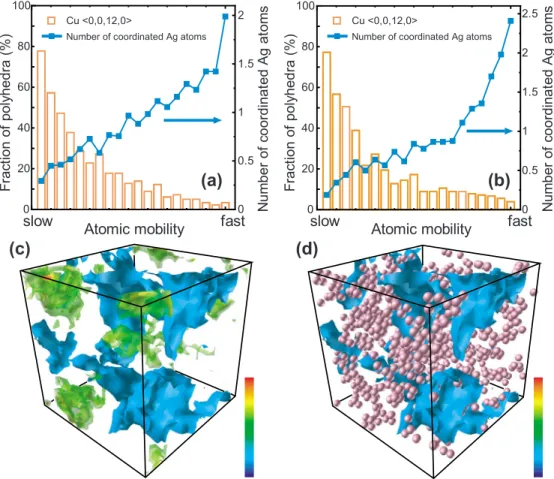
displacements for each isoconfiguration were measured and averaged for each atom in order to correlate the local atomic environments with the measured displacements. The atomic displacements of the Cu atoms were sorted in an increasing order and divided into 20 groups. The fraction of the Cu-centered full icosahedra and the number of coordinated Ag atoms in each group are plotted against atomic mobility for a short time interval in Fig. 3共a兲. Interestingly, a high ISRO cluster population and Ag-fewer environments are respon-sible for slow dynamics. In contrast, a low ISRO cluster population and Ag-rich environments correspond to fast
dy-25000 2000 1500 1000 500 10 20 30 1 2 3 4 5 6 Temperature (K) F rac ti on of Voronoi poly hedra (%) Av erage num ber o f Ag at om s in c h ained c lus te r Cooling rate = 20 K/ns Cu <0,0,12,0> Cu <0,2,8,0> Cu <0,2,8,1> Cu <0,2,8,2> Average number of Ag atoms
(a)
(b)
FIG. 1. 共Color online兲 共a兲 Temperature dependence of a fraction of dominant Voronoi polyhedra centered by Cu atoms in Cu45Zr45Ag10 during cooling from 2500 to 300 K. The average number of Ag atoms in Ag-chained clusters is also plotted against temperature.共b兲 Cross section of atomic structure of glassy Cu45Zr45Ag10at 300 K. The bronze共light gray in printed version兲 and dark blue 共dark gray兲 balls represent Cu and Ag atoms, respectively. The Cu atoms center the polyhedra with a Voronoi index具0,0,12,0典. Zr atoms are not shown in order to clearly illustrate the chemical heterogeneity.
(a) (b) Time (ns) 0.01 0.1 1 0 4 8 12 16 Time (ns) χ4 (t ) Cu50Zr50 Cu45Zr45Ag10 0.01 0.1 1 0 0.1 0.2 0.3 0.4 0.5 0.6 0.7 0.8 S el f inter m ediate s c a ttering func tion Cu in Cu50Zr50 Cu in Cu45Zr45Ag10 Zr in Cu45Zr45Ag10 Zr in Cu50Zr50 e-1 Ag in Cu45Zr45Ag10
FIG. 2. 共Color online兲 共a兲 Self-intermediate scattering functions of Cu, Zr, and Ag in Cu50Zr50and Cu45Zr45Ag10liquids.共b兲 Dy-namic susceptibility of Cu50Zr50and Cu45Zr45Ag10as function of time.
FUJITA et al. PHYSICAL REVIEW B 81, 140204共R兲 共2010兲
namics. The displacement measurements of the Zr atoms also demonstrate that the Zr atoms in Ag-rich regions exhibit faster dynamics compared to those in Ag-fewer regions. For the long-time dynamic propensity with a time interval of 1.5t␣, a similar result was obtained, as shown in Fig. 3共b兲. Moreover, the composition of local clusters in the slowest and fastest groups shown in Fig.3共b兲were determined to be Cu55Zr44Ag1 共at. %兲 and Cu35Zr45Ag20, respectively. Both
the long-time 共␣ process兲 and short-time 共 process兲 dy-namic heterogeneities24 are closely correlated with the atomic-scale inhomogeneity in the structure and chemistry of the BMG. Figure 3共c兲 shows a three-dimensional共3D兲 dis-placement map with dimensions of 53⫻53⫻53 Å3that
vi-sualizes the isosurfaces of slow-dynamic regions where ⌬r2
is less than 25 Å2 and fast-dynamics regions where ⌬r2 is greater than 80 Å2. The slow- and fast-dynamics regions,
corresponding to Ag-poor and Ag-rich regions, respectively, appear to be partitioned from each other. The correlation between dynamic heterogeneity and chemical inhomogeneity is further confirmed by Fig. 3共d兲, in which both isosurfaces of slow dynamics regions and Ag atoms are illustrated. Again, it can be observed that the slow-dynamics regions contain fewer Ag atoms.17
We attempted to analyze the structural origins and relax-ation process in terms of the potential-energy landscape 共PEL兲 by means of a distance matrix 共DM兲 ⌬2共t,t
⬘
兲=N1兺i=1N 兩ri共t兲−ri共t
⬘
兲兩2, where ri共t兲 is the position of atom i attime t along a single trajectory.25The initial positions of the
fastest 180 and slowest 180 Cu atoms shown in Fig. 3共b兲 were selected. Figure 4共a兲 shows the DM for the group of slowest Cu atoms. This DM clearly indicates the transition between local minima in the PEL or the so-called metabasin 共MB兲 transition. In contrast, the DM for the group of fastest Cu atoms does not indicate the MB-MB transition 关Fig.
4共b兲兴. Accordingly, the cooperative rearranging region 共CRR兲 共Ref. 26兲 corresponding to the rich ISRO regions can be
clearly recognized. The Ag-chained clusters and the neigh-boring atoms outside the CRR do not contribute to the dy-namics inside the CRR. It appears that the heterogeneous dynamics are due to inactive domains with rich ISRO re-gions and active domains with a high Ag content. The short-ened dynamic correlation length caused by the addition of Ag关Fig.2共b兲兴 can be reasonably explained by geometrically
partitioning the ISRO regions with the Ag-chained clusters, as shown in Fig.3共c兲. The glass formation of an alloy during rapid cooling is a competitive process between the stability
(b)
(c)
(d)
(a)
Atomic mobility slow fast F rac ti on of poly hed ra (%) N u m ber of c o ordinat ed A g at om s 0 20 40 60 80 100 0 0.5 1 1.5 2 2.5 Atomic mobility slow fast F rac ti on o f poly hed ra (% ) N u m ber of c o ordinat ed Ag at om s 0 20 40 60 80 100 0 0.5 1 1.5 2Number of coordinated Ag atoms
Cu <0,0,12,0>
Number of coordinated Ag atoms
Cu <0,0,12,0>
FIG. 3. 共Color online兲 Correlation between atomic mobility of Cu atoms and their local structural environments in Cu45Zr45Ag10at 800 K. The Cu atoms are sorted into 20 groups in the increasing order of their displacement. In each group, the percentage of具0,0,12,0典 polyhedra and the number of coordinated Ag atoms are plotted with共a兲 a short time interval of 1.5tand共b兲 a long time interval of 1.5t␣. 共c兲 3D mean-square displacement map of all atoms based on propensity motion for the conditions observed in 共b兲. The isosurfaces indicate the slow- and fast-dynamics regions where⌬r2is less than 25 Å2共blue regions, dark gray in printed version兲 and more than 80 Å2共green to red regions, light gray to gray兲, respectively. 共d兲 3D map showing both isosurfaces of slow-dynamics regions and distribution of Ag atoms 共balls兲. The slow-dynamics regions are apparently Ag-poor regions. The cube has the dimensions of 53⫻53⫻53 Å3; the color bars shown in共c兲 and 共d兲 show the range from fast 共top兲 to slow 共bottom兲 dynamics.
of a supercooled liquid and the kinetics of crystallization. Because crystallization requires long-range diffusion, gener-ally, the longer structure relaxation time t␣ results in better glass forming ability, although the direct correlation between the dynamic heterogeneity and GFA is much complex. How-ever, in the Cu-Zr-Ag system, the Ag addition does not result in longer t␣and, instead, a strong coupling between chemical and dynamic heterogeneities. Based on the microscopic dy-namic theory, flow and structure changes in a supercooled liquid involve cooperative atomic motion.26 A strong
dy-namic heterogeneity can induce divergence in the size of the cooperating regions. The coupling between chemical inho-mogeneity and dynamic heterogeneity appears to promote
the partitioning and fragmentation of dynamic processes, sulting in less cooperation between the slow-dynamics re-gions and the fast-dynamics rere-gions. Since both slow- and fast-dynamics regions are much smaller than the critical size of crystallites, the spatial partitioning and dynamic isolation caused by the coupling may significantly retard the kinetics of crystallization of the supercooled liquid and leads to the improved GFA.
In summary, our molecular-dynamic simulation with EAM potentials reveals a strong coupling between chemical and dynamic heterogeneities in a multicomponent Cu45Zr45Ag10 alloy, which appears to play a crucial role in the improved GFA by Ag addition. Because more or less chemical heterogeneity widely exists in multicomponent al-loys, the dynamic coupling observed in this study may be a universal phenomenon in BMGs. This study may have an important implication in elucidating the dynamic origins of the BMG formation at a very low critical cooling rate.
This research was sponsored by Grants-in-Aid for scien-tific research from Kakenhi 共Grant Nos. 20710080, 20226013兲, Global COE for Materials Research and Educa-tion, and the World Premier International Research Center Initiative program by MEXT, Japan. This research was also supported by the U.S. NSF under Grant No. DMR-0907325. We would like to thank the Center for Computational Mate-rials Science, Institute for MateMate-rials Research, Tohoku Uni-versity for providing us with the Hitachi SR11000 共model K2兲 supercomputing system.
*Corresponding author; [email protected] 1A. L. Greer,Science 267, 1947共1995兲.
2A. Inoue,Acta Mater. 48, 279共2000兲. 3D. B. Miracle,Nature Mater. 3, 697共2004兲.
4T. Egami, S. J. Poon, Z. Zhang, and V. Keppens,Phys. Rev. B
76, 024203共2007兲.
5H. W. Sheng, W. K. Luo, F. M. Alamgir, J. M. Bai, and E. Ma,
Nature共London兲 439, 419 共2006兲.
6Y. Q. Cheng, E. Ma, and H. W. Sheng, Phys. Rev. Lett. 102,
245501共2009兲.
7A. R. Yavari,Nature共London兲 439, 405 共2006兲.
8X. K. Xi, L. L. Li, B. Zhang, W. H. Wang, and Y. Wu,Phys. Rev.
Lett. 99, 095501共2007兲.
9T. Fujita, K. Konno, W. Zhang, V. Kumar, M. Matsuura, A.
Inoue, T. Sakurai, and M. W. Chen, Phys. Rev. Lett. 103,
075502共2009兲.
10J. Kurchan,Nature共London兲 433, 222 共2005兲.
11P. G. Debenedetti and F. H. Stillinger,Nature共London兲 410, 259
共2001兲.
12H. Tanaka,J. Phys.: Condens. Matter 15, L491共2003兲. 13Y. Q. Cheng, E. Ma, and H. W. Sheng, Appl. Phys. Lett. 93,
111913共2008兲.
14S. M. Chathoth, B. Damaschke, M. M. Koza, and K. Samwer,
Phys. Rev. Lett. 101, 037801共2008兲.
15Y. T. Shen, T. H. Kim, A. K. Gangopadhyay, and K. F. Kelton,
Phys. Rev. Lett. 102, 057801共2009兲.
16S. J. Plimpton,J. Comput. Phys. 117, 1共1995兲.
17See supplementary material at http://link.aps.org/supplemental/
10.1103/PhysRevB.81.140204for additional information. 18J. L. Finney,Proc. R. Soc. London, Ser. A 319, 479共1970兲. 19W. Zhang and A. Inoue,J. Mater. Res. 21, 234共2006兲.
20C. Toninelli, M. Wyart, L. Berthier, G. Biroli, and J.-P.
Bouchaud,Phys. Rev. E 71, 041505共2005兲.
21O. Dauchot, G. Marty, and G. Biroli, Phys. Rev. Lett. 95,
265701共2005兲.
22A. S. Keys, A. R. Abate, S. C. Glotzer, and D. J. Durian, Nat.
Phys. 3, 260共2007兲.
23A. Widmer-Cooper, P. Harrowell, and H. Fynewever,Phys. Rev.
Lett. 93, 135701共2004兲.
24A. Widmer-Cooper and P. Harrowell, Phys. Rev. Lett. 96,
185701共2006兲.
25G. A. Appignanesi, J. A. Rodriguez Fris, R. A. Montani, and W. Kob,Phys. Rev. Lett. 96, 057801共2006兲.
26G. Adam and J. H. Gibbs,J. Chem. Phys. 43, 139共1965兲. (b) (a) 0.0 0.1 0.2 0.3 0.4 0.5 0.0 0.1 0.2 0.3 0.4 0.5 0.19 0.62 0.0 0.1 0.2 0.3 0.4 0.5 0.0 0.1 0.2 0.3 0.4 0.5 t'(n s) t'(n s) t(ns) t(ns) 0.42 22.6 2 Å Å2
FIG. 4. 共Color online兲 Distance matrix for 共a兲 the slowest and 共b兲 the fastest Cu atoms categorized in Fig.3共b兲. Darker squarelike areas in共a兲 correspond to the atoms that travel a smaller distance and indicate the MB-MB transitions. These transitions are not ob-served for the fastest Cu atoms.
FUJITA et al. PHYSICAL REVIEW B 81, 140204共R兲 共2010兲