Study of νd→μ-pps and νd→μ-Δ++(1232)ns
using the BNL 7-foot deuterium-filled bubble
chamber
著者
Kitagaki T., Yuta H., Tanaka S., Yamaguchi
A., Abe K., Hasegawa K., Tamai K., Sagawa
H., Akatsuka K., Furuno K., Tamae K.,
Higuchi M., Sato M., Kahn S. A., Murtagh
M. J., Palmer R. B., Samios N. P., Tanaka
M.
journal or
publication title
Physical Review. D
volume
42
number
5
page range
1331-1338
year
1990
URL
http://hdl.handle.net/10097/53660
doi: 10.1103/PhysRevD.42.1331
PHYSICAL REVIEW
0
VOLUME 42, NUMBER 5 1SEPTEMBER 1990Study
of
vd
=1Mpp,
and
vd
=p
5,
++(1232)n,
using the
BNL
7-foot
deuterium-filled
bubble
chamber
T.
Kitagaki,H.
Yuta,S.
Tanaka,A.
Yamaguchi,K.
Abe,K.
Hasegawa,K.
Tamai, *H.
Sagawa, *K.
Akatsuka,K.
Furuno, andK.
TamaeTohoku University, Sendai, Japan
M.
Higuchi andM.
SatoTohoku Gakuin University, Sendai, Japan
S. A.
Kahn,M.
J.
Murtagh,R.
B.
Palmer, N.P.
Samios, andM.
TanakaBrookhaven National Laboratory, Upton,
¹w
York 11973(Received 8january 1990)
The weak nucleon axial-vector
(F~)
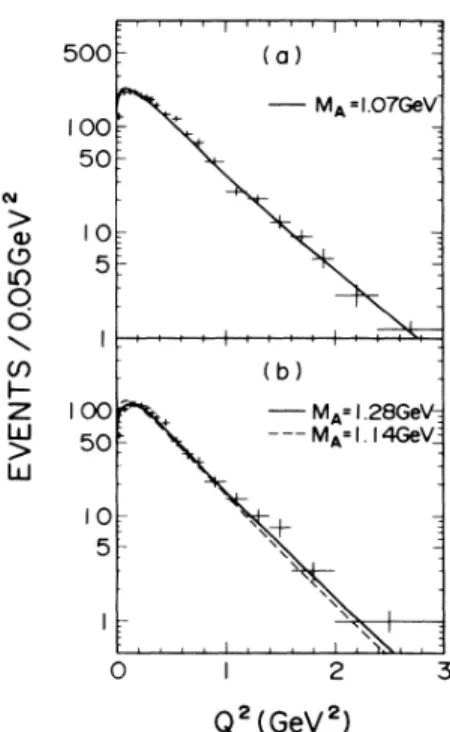
and vector (F&) form factors are determined from the momentum-transfer-squared (Q )distributions using 2538p, p and 1384pb++
events. The datawere obtained from 1800000pictures taken in the BNL7-foot deuterium-filled bubble chamber
ex-posed to awide-band neutrino beam with a mean energy
E
=1.
6GeV. In the framework ofthe conventional V—
A theory with standard assumptions, the value obtained from the p p events for the axial-vector massM„
in the pure dipole parameterization is 1.070+oo45 GeV and from thep
5++
events is 1.28+0loGeV. These results are in good agreement with an earlier measurementfrom this experiment and other recent results. The reaction mechanisms for both processes are compared and found to be very similar. A two-parameter fitfor the quasielastic reaction, using di-pole forms for F& and
F„,
yieldsM„=0.
97+oi& GeV and MV=0.89+007GeV, which is in goodagreement with the conserved-vector-current value ofMv
=0.
84GeV. Possible deviations from the standard assumptions are also discussed.I.
INTRODUCTIONThe weak and electromagnetic structure
of
the nucleon has been studied both theoretically and experimentally for many years. The vector form factorF
v(Q ), whichhas been successfully explored in high-energy elastic elec-tron scattering, is well described by a dipole form factor
A,
(Q
)/(1+Q
/Mv)
with a vector massMz
and acorrection factor A,(Q )to correct for a few-percent
devi-ation from a pure dipole form factor.
The weak nucleon structure has been investigated in
several experiments using both quasielastic neutrino scattering v„n
~p
p,
' and the6
+ production reac-tion,v~~jM
5++.
Both the vector(Fv)
and the axial-vector(F„)
form factors can be measured using ei-ther neutrino quasielastic scattering or5++
production reaction in deuterium bubble-chamber experiments. The form factorF~
is usually parametrized in termsof
the axial-vector mass(M„)
and determined using the V—
Atheory with the standard assumptions
of
conserved vec-tor current (CVC), an absenceof
second-class currents, and time-reversal invariance. While there have been a numberof
studiesof
Mz using thep
p reaction from light-liquid bubble chambers, only one other study using6++(1232)
production in D2has been reported. 'In this paper the final results
of
a detailed studyof
the quasielatic reactionv
+d~p
+p+p
and the
6++
reactionv„+d~@
+b,
++(1232)+n,
, (2)where
p,
and n, are the spectator proton and neutron re-spectively, are presented. The data were taken with the 7-foot deuterium-filled bubble chamber exposedto
the wide-band neutrino beam at the Alternating Gradient Synchrotron (AGS) at Brookhaven National Laboratory. The primary objectiveof
this study was to determine the axial-vector mass(M„)
using the dipole formof
F„and
to compare the mass values obtained from the two reac-tions. Parametrizations
of
F„other
than the convention-al dipole form are considered and the standard assump-tions used in extractingM„are
tested. In the determina-tionof M~,
the effectsof
the deuteron should be taken into account. Since theoretical calculations for the deute-ron effects are only available for reaction (1), caution must be taken in comparing the valuesof M„determined
from the two processes. The results
of
a comparisonof
the two reaction mechanisms are presented. In
Sec.
II
details
of
the experiment are presented while inSec.
III
the procedures used in the form factor analysis are dis-cussed. The results
of
the various analyses are discussedin
Sec.
IV and the conclusions from this study are de-tailed in Sec. V.1332
T.
KITAGAKI etal. 42II.
EXPERIMENTAL PROCEDURE 0,400
The data were obtained from a total
of
1800000
pic-tures taken in the 7-foot deuterium-filled bubble chamber exposed to a wide-band neutrino beam with a meanener-gy
of 1.
6 GeV from the Alternating GradientSynchro-tron at Brookhaven National Laboratory. The final data samples for reactions (1)and (2)are obtained from all ex-posures
of
the chamber and the sample for reaction (1)is approximately twice the sizeof
that used in an earlier analysis. ' Detailsof
the experiment and a full descrip-tionof
the chamber have been given elsewhere. 'The film was scanned for neutral-induced interactions with more than one visible charged track.
Approximate-ly
32% of
the film was rescanned, yielding scanning eScienciesof
0.90+0.
01,
0.95+0.
01,
and0.
93+0.
01 for the two-, three-, and all-prong event topologies, respec-tively. Each event was measured and processed through the geometry progr am TvGp and the kinematic-fitting program sQUAw, and then examined by physicists.Neutrino charged-current events were selected by im-posing the following requirements: (1)the magnitude
of
the total visible momentum vector must be greater than 150 MeV/c; (2) the angle between the total visible
momentum vector and the neutrino-beam direction must be less than 50',and (3) at least one
of
the negative tracks must either leave the chamber without interacting, or stop in aplate with a range consistent with amuon inter-pretation, or decay into an electron. The initial data set contained approximately8100
charged-current and 800 neutral-current event candidates inside a restrictedfidu-cial volume
of
4 m.
The candidates for the reactionsv„1~@,
pp, and v„d~p
pm+n, were selected usingthree-constraint fitting and particle identification.
If
the spectator nucleon was not measured, an initial valueof
0245
MeV/e for each componentof
the spectator momentum(P„,
P,
P,
) was assigned in the fit. A totalof
2684
p
pp, and1610 p
pm+n, events were obtainedwith a
y
fit probability greater than l%%uo and with theparticle identification consistent with the track mass hy-pothesis in the successful fit.
If
an event fit to two reac-tion hypotheses, the hypothesis with a largerg
probabil-ity was accepted. In TableI
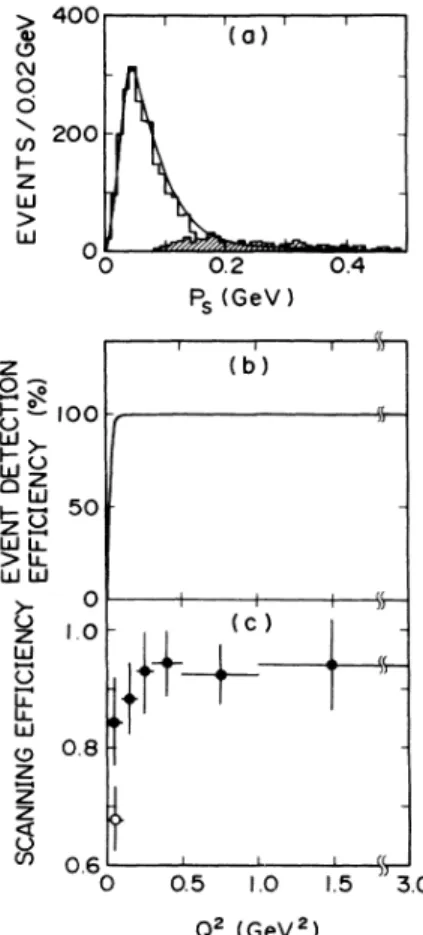
the data used forthe present analysis are summarized.Events in reaction (1)with low-momentum recoil pro-tons and slow spectator protons would appear in the film
as one-prong events and would be lost at the scanning stage. However, it is possible
to
estimate the effectof
this problem on the subsequent analysis. Figure 1(a) shows200— w 0.2 P (GeV)
0.
40
~
g4 t00-clw 50-Wh Wb ww0
Iz
lo-w O 0.8-(c)
I i05
I.O 02 (Gg+2) l.5 .0
FIG.
1. (a) The spectator-proton momentum distributionwith the prediction from the Hulthen wave function. The shad-ed and the unshaded areas correspond to the measured and the
Atted spectator momenta for quasielastic
v„d~p
pp, events.(b) The event detection efficiency as a function of
Q'.
(c)The average scanning efficiencies with the event detection efficiency (solid circle) and without the event detection efficiency (opencircle).
the spectator proton momentum distribution for reaction
(1).
The shaded region in this figure denotes measured spectator protons where the spectator isdefinedto
be the slowerof
the two measured protons. The unshaded area corresponds to the two-prong events in which the mo-menta for the invisible spectator protons are obtained from the kinematic fit. The curve represents the predic-tion from the Hulthen wave function and it describes the data adequately except forI',
)
200 MeV/c, where the re-scattering effects in deuterium become apparent. TheTABLE
I.
Summary ofevents.Reaction vd~|M pps Observed 2684 0.5(E (6.0 GeV 2544
Q'&3.
0 GeV (0.1&Q'&3.
0 GeV') 2538 (2310)vd~p
pn n 1.08(M(mp) + 1.40 GeV 1610 1547 1385 1384 (1232)42 STUDY OF
vd~p
pp, ANDvd~p
200
iso
-I O OIOO--50 .
— LLI0
0
I I I 0.I 0.2 0.3
0.4 0.5 P (GeV)FIG.
2. The fitted spectator-neutron momentum distribution for the5+
events.proton detection efficiency is then the ratio
of
observed spectators topredicted spectators from the distributionof
Fig.
1(a), where one assumes that the proton detection forP,
)
200 MeV/c is100%.
Using this proton detection to-gether with Monte Carlo—
generated events for reaction (1),itis possible to calculate an event detection probabili-ty (i.e.,)
2 prongs visible on the scanning table) as a functionof
Q.
The resulting curve shown inFig.
1(b)in-dicates, as expected, that the losses due to missing 1-prong events are at very low Q and for values
of
Q
)
0.
08 (GeV/c) no correction is required. The effectof
the lossof
1-prong events on the scanning efficiency as afunction Q is clearly visible inFig.
1(c). In addition to these experimental problems, the low-Q region is also most sensitive to nuclear corrections and to Fermi motion corrections. Consequently, in the maximum-likelihood analysisof
the Q distribution todetermine the form factors, only the region Q)
0.
10 (GeV/c) isused.A potentially important experimental problem for the study
of
the6+
reaction isthat the spectator neutron isnot measurable. Since the kinematic fitting procedure constrains spectators to relatively low momenta, this im-plies a cutoff in the neutron spectator momentum. This can be seen by comparing the neutron-spectator momen-tum distribution (Fig. 2) for the b,
++
reaction with the previously discussed proton-spectator momentum distri-bution[Fig.
1(a)]for the quasielastic scattering where the measured high-energy tail isapparent. One way toassess the impactof
this limitation is toconsider the sensitivityof
the quasielastic results toacut onthe spectator-proton momentum. As isdiscussed below there is no evidenceof
a significant change in the value
of M„determined
from the quasielastic scatteringif
only events withP,
&50 MeV/c are used. Consequently, one might not expect the5++
reaction results to be sensitiveto
the lossof
high-momentum spectators.The number
of
selected quasielatic events in the neutri-no energy range0.
5(E„(6.
0
GeV and0.
1(Q2(3.
0
(GeV/c) is
2310.
The primary background comes from the reactionv„d~p
p~
p, .
This background wases-timated to be
—
5%
using three-constraint fitv„d~p
pm+n, events. The overall correction factor was found to be1.
11+0.
04 including the one-prong correctionof
2.3%
estimated from the event detection efficiency shown inFig.
1(b). Table II(a) details the corrections for thev„d~@
pp, reaction.It
should be noted that these corrections only affect the total numberof
quasielastics in the data and they do not affect the shapeof
the Q distribution in the regionof
interest.Figure 3 shows the per+-mass
[M(pm+)]
distri. bution for thep
p~+
state. The curve is the resultof
the bestfit tothe distribution using a relativistic Breit-Wigner
res-TABLE
II.
Corrections for the vd~
p pp, and vd~
p pm.+n, reactions.Correction Correction factor
Scanning efficiency Measuring efficiency One-prong correction proability cut Background vd
~p
p&ps vd~vp&
ps (a) vd~p
pp, g4 gs 1.092+0.025 1.038+0.030 1.023 1.010 0.948+0.008 0.998+0.001 Total correction g,XgzXg3 Xg4XgsXg6 1.110+0.040 Scanning efficiency Measuring efficiencey'
probability cut H2 contamination in D~Loss offast neutron spectator Background
vd~p
pm' 7Tn, vd~vpm m n (b)vd~p
pn+n, gl gz g4 gs 1.092+0.037 1.038+0.040 1.010 0.870+0.020 1.220+0.010 0.977+0.008 0.998+0.001 Total correction gl Xg~Xg3Xg4Xgs Xg6Xg7 1.123+0.0591334 T. KITAGAKI etal. 42 f I I I ( I I I i ] I 1 I I ( I I I I ( I I t I I l l I I I I ) I I I i ~ O IOO-O O (A
so-Z'. QJ LLI P. 0 I i»
i I i»
i I I I.2 I.4 I.6 I.S 2 M(pm-+) (Gev)FIG.
3. The effective-mass distribution for the p pm+n, events.500—
IOO50
0
O
O
M2
IOO 5O Ld IO 5(a)
I ~ I(b}
.07GeV . 28GeV-.14GeV-.onance form with a three-body phase-space background. The phase-space component obtained from the fit was less than
1%.
The numberof
selected )M5++
eventswith the pm.+ mass
of 1.
08&M(pn.
+)
1.
40 GeV, neu-tron energy0.
5&E„&
6.
0
GeV and0.
1&Q2&3.0
(GeV/c) is 1232. The primary background comes from the reactions
v„d~p
pm+n, m andv„d~v~n+m
n,and from a
(13+2)%
H2 contamination in the deuteri-um. ' There isalso a systematic event 1oss from the kine-matic fitting due to fast neutron spectators and the scanning-measuring ineSciency. The overall correction factor was estimated to be1.
123+0.
059 and is describedin detail in Ref.
4.
Table II(b) lists the corrections for the vd~p
p~+n,
reaction. Again, these corrections do not affect the Q distribution in the regionof
interest.Figures 4(a) and 4(b) show the neutrino-energy
(E,
)distributions for the quasielastic and
6++
production re-actions. Both distributions peak at approximately1.
2GeV. Figures 5(a) and 5(b) show the
momentum-0
I I I I I I l I I I I l I 'EwI I 2 Q (GeV )FIG.
5. The Q' distribution for (a) the quasielastic and (b)the
6++
production reactions. The curves are the theoretical predictions obtained from least-squares fits with the fittedM„
values for the Q' &3.0 (GeV/c) .
III.
FORM-FACTOR ANALYSIStransfer-squared (Q-") distributions for reactions (1) and (2). The scanning and measuring efficiencies are included
in these distributions as well as the correction for the one-prong event loss for reaction (1)shown in
Fig.
1(b). The curves inFig.
5are the theoretical predictions whichwill be discussed in
Sec. IV.
400—
e)200—
O V) I-0
200—
LIJ I00—
0
l0
2 4E„(GeV)
F„(g
)= —
1.
254/(1+Q
/M„)
(3)To
extract the weak nucleon form factors from reac-tions (1) and (2), the experimental data are fit to the theoretical predictions using maximum-likelihood method. Denoting the hadronic massM(pn.
+)as8',
thepredictions
of
the cross sections, dcr/dg
and do/dg W,
are formulated from the standard V—
Atheory with the following assumptions: (i) time-reversal invariance and charge symmetry, (ii) partial conservation
of
vector-current, and (iii) conservationof
vector current (CVC). The vector form factorFz(g
)istaken tobe the dipole formFv(g
)=A,(g
)/(1+g
/M~)
whereMV=0.
84 GeV, and A,(g
) is a correction factorac-counting forsmall deviations from apure dipole form ob-tained from electron scattering data. ' Under these as-sumptions, the axial-vector form factor is the only
un-known. A complete description
of
the cross sections may be found elsewhere."'
In quasielastic scattering, the axial-vector form factor
F„(g
)isconventionally parametrized by a dipole form:FIG.
4. The E„distribut&on for (a) the quasielastic and (b)the
5++
production reactions.where M~ is the axial-vector mass. The maximum-likelihood function
L
~ used in this analysis is given byvd~p
pp,vd~p
5++{1232)n, USING.. .
1335 R (Q;)der/dQ; Nf,
'
R(Q')(der/dg')dg'
Qminc;(0)[1+a(g
/(b,+Q
)]
F;"(
)=
(i=3,
4,5),
(1+Q /M„)
(5)where c;(0),
a;,
b; are the model-dependent axial-vectorform-factor parameters determined for the Adler
mod-el:"
c3(0)
=0,
c4(0)
= —
0.
3,c~(0)
=
l.
2,
a3=b3=0,
a4=a5
= —
1.21, b4=b5
=2.
0
. The likelihood functionL
in this case isdefined asL
(MA) dcrldg
dW Q Wf
IIIRxf
ms 2 P 2)d Qmin min co(Q, ) (6) where N is the total numberof
events in the Q range fromQ;„
to
Q,
„,
R (Q;) is the correction factor' forthe free-neutron cross section due to the effects
of
the Pauli exclusion principle and deuteron binding and co(g; )isan event weight based on the scanning efficiency. There are several theoretical models'
'
' for5++
production which are based on the hypotheses outlined above. Detailed comparisons'
of
these predictions to other experimental data have shown that the Adler mod-el' best desc'ribes the data. In this analysis the Adler model as developed by Schreiner etal.
' is used. The axial-vector form factors are parametrized asfor the dipole form in the Q range
0.
1 Q~
3.0
(GeV/c) . This value is more than 4 standard deviations from the equality M~
=M&=0.
84 GeV. The curve inFig.
5(a) is the prediction withM„=1.
07 GeV fitted to the distribution for Q(3.
0
(GeV/c) . There is a good agreement with the data forall Q.
Since there is no theoretical basis for the assumption
of
a dipole form, we have also fit to a quark model with axial-vector-meson dominance {QM-AVMD) suggested by Sehgal
F„(g
)=F„(0)(1+Q
/M„)
Xexp[
—
—,'Q
R/(1+Q
/4M&)],
where R
=6
GeV andM
isthe proton mass. The re-sultof
the fit isM„=
1.
37+0.
13GeV forQM-AVMD.It
is interesting to note that this value is consistent with the mass
of
thea,
(1260) meson' with a full widthof 330
MeV, though the mass value is quite sensitive to the form used for
F„(Q
).A simple monopole form for
F„(Q
)isexcluded at thelevel
of
5 standard deviations based on the likelihood-function analysis.By fitting both
M„and
M~ simultaneously to dipole forms, one can test the CVC predictionof
M&=0.
84 GeV. Figure 6shows the one-standard-deviation contour plotof L
~ in(Mr,
MA ) space. This fit yieldsM„=0.
97+o
&& GeV and My=0.
89+@'7 GeV, inagree-ment with the value
of
Mv=0.
84GeV.'The present results are consistent with a previous re-sult
of
this experiment' as well as the results from other experiments. ' These various results are summarized inTable
III
for the single-parameter fits and in Table IVfor the two-parameter fits. All the errors quoted correspond to a change in the corresponding likelihood functions by0.
5units.In this analysis the deuterium-target effects are taken into account by applying the correction factor' R (Q )
where
8';„and
8',
„are
taken to be1.
08 and1.
4 GeV, respectively.To
compare theM„values
from reactions (1) and (2), we have used events with0.
1&Q~~
3.0
(GeV/c) for both reactions. Maximum-likelihood fits to the data with the dipole axial-vector form factors have been performed for reactions (1)and (2), and the results are given in the next section.
+
OP o.e-(3
X
IV. RESULTS
A. The quasielastic reaction v„d
~
p pp, 0.8 I.O l.2Mq
=
1~070 o(~q GeV (7)With the standard assumptions and
MV=0.
84GeV, a one-parameter fittothe data yieldsMA (GeV)
FIG.
6. The one-standard-deviation contour plot ofL~
in(M&,
M„)
space. The open circle isthe point obtained from the one parameter fit.1336
T.
KITAGAKI etal. 42TABLE
III.
Axial-vector massM„
in the dipole form factor fromv+
H,/D2 experiments.E.
(Gev) 0.5-6.0 0.3-6.
0 0.15—3.0 5.0-200 Raw events 2544 1138 1737 362 M~ (GeV) (a)v+n
~p
p 1070+oo~ 1.07+0.05 1.00+0.05 1.05—0.&6 Reference This expt.This expt., BNL 1981 (Ref. 1)
ANL 1982 (Ref. 2) Fermilab 1983(Ref. 3) 0.5-6.0 0.5-6.0 5.0—100 5.0-200 0.5-6.0 1385 672 138 551 871 (b)
v+p-q-a++
128+0.08 1.14+0.014 1.25+0.15 0.85+0.10 0.98+0.06 This expt.This expt. (P,&50MeV) Fermilab 1978 (Ref. 5)
BEBC 1980 (Ref. 6)
ANL 1982 (Refs. '7,8)
for the free-neutron cross section, which iscalculated us-ing the impulse approximation with the Hulthen wave
function for the deuteron. A number
of
other theoretical calculationsof
these deuteron effects have been madeus-ing various deuteron wave functions with and without final-state interactions, or using different methods such as the closure approximation or the elementary-particle-model approach. ' ' The numerical results are all
com-parable and they all indicate that the deuteron effects are important only for Q
(0.
1 (GeV/c) .To
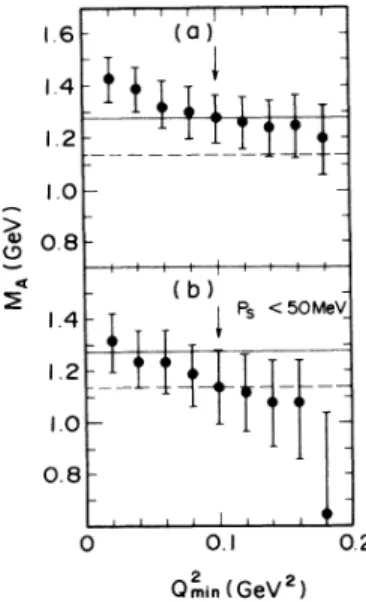
investigate a possible deviation from the pure dipole form factor, theM„values
from the maximizationof
the likelihood function are plotted as a functionof
the Q cut inFig.
7(a). The arrow inFig.
7(a) indicates the lower limitQ;„=0.
1 (GeV/c) used to obtain the valueM
„=
1.
07 GeV (the dashed line).For
Q;„~
0.
06 (GeV/c) the valueof
M„obtained
is insensitive to the actualQ~;„used.
However for lowerQ;„
there isanin-dication
of
a change in theM„obtained.
This may inlarge part be due simply tothe difficulty
of
correction for losses in low-Q (single-prong) events or it could refiect problems in correcting for deuteron effects.The effects
of
the deuteron binding are known to bevery strong at Q
=0
and they reduce the deuteron cross section by40%.
To
study this effect further,Fig.
7(b) shows theM„distribution
as a functionof
theQ;„cut
for events with spectator-proton momentumP,
&50 MeV/c. Events with lowP,
are likely to be less affectedby the deuteron effects. Again there is an indication that the
M„value
rises for very lowQ;„cuts.
However, the likelihood fit for events withP,
&50 MeV yieldsM„=1.
07+0.
07 GeV forQ;„=0.
1 (GeV/c) . This isidentical tothe value
of
M„obtained
forall the events ir-respectiveof
their spectator momentum. These studies suggest that forQ;„&0.
1 (GeV/c) the deuteroncorrec-tions are small and adequate and also that the results ob-tained are not sensitive to the spectator momentum dis-tribution.
B.
The reaction v„d~p
LL++n, l.4— l. 2-y lO—(a)
0.8—0.
6-l.4-
(b}
psiz-(
AE l.o—
&5OMeVUsing the dipole axial-vector form factors given in
Eq.
(5) and the likelihood function
L
defined inEq.
(6), a maximum-likelihood fit was performed for the 1232p
b,++
events with0.
1+Q
3.0
(GeV/c) . Since thecorrection R (Q ) for quasielastic scattering is only significant in the small-Q region
[Q
(0.
1 (GeV/c)],
only the Q region from0.
1 to 3(GeV/c)~ is used for theTABLEIV. Axial-vector mass M~ and vector mass Mv from the two-parameter fitfor reaction
v+n
~p
p. 08-Mv Reference O.l 0.2 0 97+0.14 1.04+0.14 0.80+0.10 0.72+O' 20 089+0'07 0.86+0.07 0.96+0.
04 0.90+0.
05 This expt.This expt., BNL 1981 (Ref. 1)
ANL 1982 (Ref. 2)
Fermilab 1983{Ref.3}
Qmin (Gey )
FIG.
7. The axial-vector massM„as
a function ofQ;„
for the quasielastic events (a) without P, cut and, (b) with P,(50
MeV/c. The dashed lines correspond toM„=
1.07GeV.42 STUDY OFvd +p pp, AND vd +p 6++(1232)n, USING.
. .
1337 l. 6-1 I I I i I I I f(a)
I.2— I,O—fitin reaction (2). The likelihood fittothe data yields
M~
=1.
28+ GeV.
This result is more than one standard deviation larger than that obtained from reaction (1). The axial-vector meson mass
M„
isexpected tobe the same forboth reac-tions (1)and (2).Figure 8(a) shows the dependence
of
the fittedM„on
the
Q;„cut.
As was true in the caseof
the quasielasticprocess, the value
of
M„
is stable for valuesof
Qm;„+0.
06 (GeV/c) and there is an indicationof
anin-crease in
M„
if
a lowerQ;„
isused. As was pointed out earlier the kinematic fitting procedure restricts the spec-tator neutrons to relatively low momentum. This can clearly be seen by comparing the spectator neutron distri-bution in Fig. 2 with the corresponding spectator-proton distribution for the quasielastic channel[Fig.
1(a)],where the high-energy tail from the measured spectator proton is significant. In the quasielastic analysis there was no evidence that the value to Mz was sensitive to the momentum rangeof
spectator momenta. A maximum-likelihood analysis using only the6++
events withP,
(n)&50 MeV/c in the Q range0.
1&Q &3.0
(GeV/c) yields
M„=1.
14+0.
14 GeV. This value islower but consistent with the fit using all the
b++
events. TheQ;„dependence
of
M„
for the events withP,
(n)&50 MeV/c isshown inFig.
8(b). Again the values are consistent forQ;„~0.
06
(GeV/c) but the mean does tend to be lower than in the case when all events are used.The curves in
Fig.
5(b) are the theoretical predictionswith
M„=1.
28 GeV (solid) andM„=
1.
14GeV (dashed) obtained from the least-squared fit to the data for Q &3.
0
(GeV/c).
Good agreement is observed between that data and the predictions for Q~0.
2 (GeV/c).
TheI.
o—
CL I Z' ++ 0.5—
Cl Z,'0
0
I I I 2 4E„(GeV)
difference between the two curves becomes larger for higher Q and amounts to
=15%
at Q=2
(GeV/c),
butthe difference isnot statistically significant. C. Comparison ofthe
p
pandp
6,++channelsIn the naive quark picture the quasielastic and
6++
production reactions are similar toeach other. Bydenot-ing
8'+,
u, and d as the positively charged weak boson and the up and down quarks, respectively, these process-esareW++d
~
u and u+
(du )~p
for thep
p reaction,and
W++d~u
andu+(uu)~b,
++
for the6++
pro-duction reaction. The only difference between the quasi-elastic and the
5++
production reactions is the recom-binationof
the recoiled u quark with different diquark states, resulting in different spin and isospin final states.To
compare these two reactions, the ratiosof
the 2544 quasielastic events and the 13856++
events with the corrections listed in TableII
are used. Figure 9 showsthe
E„distribution
of
the ratioN(p
b,++)/N(p
p)where N stands for the number
of
events. The curves are the ratiosof
the corresponding predictions withM„=1.
28 GeV (solid) andM„=1.
14GeV (dashed) for the b,++
reaction and Mz=1.
07 GeV for the quasielastic reactions, respectively. The dashed curve withM„=1.
14FIG.
9, TheE
distribution for the ratio of N(p5++)/N(p
p). The curves are the ratios ofthecorre-sponding predictions with M&
=
1.28 GeV (solid) andM„=
1.14 GeV (dashed) for the5++
reaction.O (3~
08-I I.4-
"
) 2 Il il I.O— 0.8—(b)
I I I I Ps +5OMeV l.0—
CL I Z,' +0.
50
Qmin2 (Gev2) 0.20
0FIG.
8. The axial-vector mass m„as
a function ofQ;„
for the5++
events (a)without P, cut, and (b) with P,(50
MeV/c.The solid and dashed lines correspond to M
„=
1.28 and M&=
1.14 GeV, respectively.Q {GeV )
FIG.
IO. fhe Q'- distribution for the ratio ofN(p
6+
+)/N (p p). The solid and dashed curves correspond tothe same ratios as stated inFig.9.1338
T.
KITAGAKI etal. 42GeV describes the data well except for the points with
E
&2.
3 GeV where the data points lie above the curve by slightly more than one standard deviation. The solid curve with M~=1.
28 GeV does not describe the data as well.Figure 10 shows the Q distribution
of
the ratio X(lJ.6++)/N(p
p).
The solid and dashed curves cor-respond to the same ratios as described inFig.
9.
The dashed-dotted line isthe average ratioof
0.
55. Again, the dashed curve describes the data well compared to the solid curve for Q(0.
8(GeV/c),
but deviations became apparent for Q)
0.
8 (GeV/c).
The dashed-dotted linegenerally describes the data well for the whole range
of
Q
.
They
values per degreeof
freedom are0.
59,1.
12, and1.
61 for the dashed-dotted, dashed, and solid lines, respectively. These results slightly favor the constant ra-tio which suggests that the Q dependence for the b,++
production reaction is similar to the neutrino quasielastic reaction in spite
of
the different hadronic spin and isospinfinal states.
V. CONCLUSION
The quasielastic reaction v n
—
+p, p and the b,++
pro-duction reactionv~~p
b have been investigated to study the weak nucleon structure.For
the quasielastic reaction, the conventional form-factor analysis yieldedthe axial-vector mass Mg
=1.
070
0'O45 GeV for the di-pole form andM(QM-AVMD)=1.
37+0.
13GeV for the quark model with axial-vector-meson dominance. Using dipole form factors, a two-parameter fit gave M~=0.
97+O'„GeV
andM&=0.
89+OO7 GeV, in good agreement with the CVChypothesis. These results are inagreement with other recent neutrino results. A dipole axial-vector form factor
F„(Q
)adequately describes thedata in the fitted region
[0.
1 Q3.0
(GeV/c)].
Whilethere is some evidence that the Gt is not adequate in the lower-Q region it is unclear, given the experimental un-certainties in this region,
if
this deviation is significant.A likelihood fit
to
the6++
channel yieldsM~
=1.28+o
&0GeV which is consistent with, but a littleover
1.
5 standard deviations, higher than the valueof
M„determined
from the quasielastic reaction. In this5++
analysis no deuteron corrections were applied and the kinematic fitting could not accommodate fast neutron spectators. While the conclusions from the quasielastic analysis are that the analysis is not sensitive to eitherof
these restrictions for the Q and
E„ranges
used the valueof
M„
from the5++
analysis does drop toM„=
l.
14+0.
14GeVif
only events with very slow spec-tators are used.Finally, acomparison
of
the quasielastic and6++
pro-duction reactions indicates very similar Q andE„behav-ior. In both cases the theoretical ratio using
M„=1.
14 GeV from the6++
reaction is preferred. However, the resultsof
they
fits forthe Q dependence favor constant ratio, suggesting a similar Q dependence for the quasi-elastic and6++
production reactions in spiteof
the different hadronic spin and isospin final states.ACKNOWLEDGMENTS
We are grateful tothe AGS staff, the operation crew
of
the
BNL
7-foot bubble chamber,F.
M.
Simes who helpedin the data processing, and to the scanning and
measur-ing personnel at
BNL,
Tohoku University, and Tohoku Gakuin University for their dedicated work. This research was supported by theU.S.
-Japan Cooperative Program in High Energy Physics under the Japanese Ministryof
Education, Science, and Culture and theU.S.
Department
of
Energy under Contract No.DE-AC02-76CH00016.
'Present address: KEK,Ibaraki, Japan.
~Present address: Fujitsu Company, Tokyo, Japan. N.
J.
Baker et al.,Phys. Rev. D 23,2499(1981).~K.L.Miller et al.,Phys. Rev.D26, 537{1982).
T.
Kitagaki et al.,Phys. Rev.D28,436(1983). 4T.Kitagaki et al.,Phys. Rev.D 34,2554(1986).5J. Bell et al.,Phys. Rev. Lett. 41,1008(1978).
P.Allen et al.,Nucl. Phys. B176,269(1980).
7G. M.Radecky et al.,Phys. Rev.D25, 1161(1982). S.
J.
Barrish et al.,Phys. Rev. D 19,2521(1979).9B.Bartoli et al.,Riv.Nuovo Cimento 2, 241(1972). M.G.Olsson et al.,Phys. Rev.D 17,2938(1978).
' C.N.Llewelyn Smith, Phys. Rep. C3,261(1971).
S. L.Adler, Ann. Phys. {N.
Y.
) 50, 189(1968);Phys. Rev. D 12,2644(1975).S.
K.
Singh, Nucl. Phys. B36,419 (1971). '4P.Zucker, Phys. Rev.D 4, 3350 (1971).' P.Salin, Nuovo Cimento A48,506(1967).
J.
Bijtebier, Nucl. Phys. B21,158(1970).P. A. Schreiner and
F.
Von Hippel, Nucl. Phys. B58, 333 (1973);Phys. Rev.Lett. 30, 339 (1973).'sL. Sehgal, in Proceedings ofthe European Physical Society In ternationa! Conference on High Energy Physics, Geneva, Switzerland, 1979,edited by A. Zichichi (CERN, Geneva,
1980),p.98.
Particle Data Group, G. P.Yost etal.,Phys. Lett. B204, 284
(1988).
S.
![Figure 3 shows the per+-mass [M(pm+)] distri. bution for the p p~+ state. The curve is the result of the best fit to the distribution using a relativistic Breit-Wigner](https://thumb-ap.123doks.com/thumbv2/123deta/5936494.1052641/4.918.156.752.753.1119/figure-distri-bution-result-distribution-relativistic-breit-wigner.webp)