平面内の曲線の運動1)
On
motion of
curves
in
the
plane
宮崎大学・工学部 矢崎 成俊 (Shigetoshi Yazaki)
Faculty ofEngineering, University ofMiyazaki2) Contents.
1. Introduction
2. Curvature adjusted tangential velocity 3. Image segmentation
4. Hele-Shaw flow in a time-dependent gap
1 Introduction
In this talk
we
study evolution ofa
family of closed smooth planecurves:
$x$ : $[0,1]\cross[0, T)arrow\Gamma(t)=\{x(u, t)\in \mathbb{R}^{2};u\in[0,1]\subset \mathbb{R}/\mathbb{Z}\}$,
starting from a given initial curve $\Gamma(0)=\Gamma_{0}$, and driven by the evolution law:
$\partial_{t}x=\alpha t+\beta n$,
where $t=\partial_{u}x/|\partial_{u}x|$ is the unit tangent vector, and $n$ is the unit outward normal vector
which satisfies $\det(n, t)=1$. Here and hereafter, wedenote $\partial_{\xi}F=\partial F/\partial\xi$ and $|a|=\sqrt{a}a$
where $a.b$ is Euclidean inner product between vectors $a$ and $b$
.
The solutioncurves are
immersed
or
embedded such that $|\partial_{u}x|>0$ holds.We remark that the tangent velocity $\alpha$ has no effect of shape ofsolution
curves
andaffect only parametrization. Therefore, the shape of solution
curves are
determined bythe normal velocity $\beta$, and
a
nontrivial tangent velocity $\alpha$ will be chosen dependingon
the purpose.
The normal velocity $\beta$ may depend
on
many factors, whichare
arising in variousapplied fields like e.g. the material sciences, dynamics of phase boundaries in
thermome-chanics, computationalgeometry, image processing and computer vision, fluid dynamics,
the field of ice and snow crystal, etc. For the comprehensive overview ofapplications we
refer the book by Sethian [14]. According to the book, $\beta$
can
be writtenas:
$\beta=\beta(\mathcal{L};\mathcal{G};\mathcal{I})$,
where
1$)$
Manuscript for “現象の数理解析に向けた非線形発展方程式とその周辺”, October 13 –15, 2010 at
RIMS, Kyoto University. The author ispartiallysupported byGrant-in-Aid forEncouragement ofYoung
Scientists (No. 21740079).
$\bullet$ $\mathcal{L}ocal$ properties are those determined by local geometric information of$\Gamma$, such as
the curvature $k$ and the normal
or
the tangential direction.$\bullet$ $\mathcal{G}lobal$ properties of$\Gamma$ arethose that depend on the shape and the position of$\Gamma$, such
as
the position vector $x\in\Gamma$, the length of $\Gamma$, and the integrals along $\Gamma$ associatedPDEs, etc.
$\bullet$ $\mathcal{I}ndependent$ properties are those that are independent of the shape of$\Gamma$, such as
an underlying fluid velocity, etc.
Here $k$ is the curvature in the direction
$-n$, which is defined from $\partial_{s}t=-kn,$ $\partial_{s}n=kt$,
and described
as
$k=\det(\partial_{s}x, \partial_{ss}x)$, and $\partial_{s}x=t$ is the unit tangent vector. Here andhereafter,
we
denote $\partial_{\xi\xi}F=\partial(\partial_{\xi}F)/\partial\xi$. Note that $\partial_{s}$ is not partial differentiation. Itmeans
the operator $\partial_{s}F(u, t)=g(u, t)^{-1}\partial_{u}F(u, t)$, where$g(u, t)=|\partial_{u}x(u, t)|>0$ is calledthe local length and $s$ is the
arc
length parameter determined from $ds=g(u, t)du$.In this note, we will focuson the utilization of a nontrivial tangential velocity $\alpha$, and
will mention on two applications in the
case
$\beta=\beta(\mathcal{L};\mathcal{G};\mathcal{I})$: one is image segmentationwith $\mathcal{L}(k, n);\mathcal{G}(x)$ or $\mathcal{L}(k);\mathcal{G}(x)_{)}\mathcal{I}(const.)$, and the other
one
is numerical computationof Hele-Shaw flow in a time-dependent gap with $\mathcal{G}$(integral of a PDE).
2 Curvature adjusted tangential velocity
As mentioned in the previous section, the tangential velocity functional $\alpha$ has
no
effectof the shape of evolving curves [5, Proposition 2.4], and the shape is determined by the
value of the normal velocity $\beta$ only. Hence the simplest setting $\alpha\equiv 0$ can be chosen.
Dziuk [4] studied a numerical scheme for $\beta=-k$ in this
case.
In thecase
general $\beta$,however, such a choice of$\alpha$ may lead to various numerical instabilities caused by either
undesirable concentration and$/or$extreme dispersion of numerical grid points. Therefore,
to obtain stable numerical computation, several choices ofa nontrivial tangential velocity
have been emphasized and developed by many authors. We will present a brief review of
development of nontrivial tangential velocities.
Kimura [7, 8] proposed auniform redistribution scheme in the
case
$\beta=-k$ by usinga
special choice of $\alpha$ which satisfies discretization of an average condition and the uniform
distribution condition:
(U) $r(u, t)= \frac{g(u,t)}{L(\Gamma(t))}\equiv 1$ $(\forall u)$.
Hou, Lowengrub and Shelley [6] utilized condition (U) directly (especially for$\beta=-k$)
starting from $r(u, 0)\equiv 1$, and derived
which
comes
from$\partial_{t}r=\frac{g}{L}(\partial_{s}\alpha+k\beta-\langle k\beta\rangle)\equiv 0$ $(\forall u)$.
It
was
proposed independently by Mikula and\v{S}ev\v{c}ovi\v{c}
[10]. In [6, Appendix 2], Hou etal. also pointed out generalization of (2.1)
as
follows:$\frac{\partial_{s}(\varphi(k)\alpha)}{\varphi(k)}=\frac{\langle f\rangle}{\langle\varphi(k)\rangle}-\frac{f}{\varphi(k)}$, $f=\varphi(k)k\beta-\varphi’(k)(\partial_{ss}\beta+k^{2}\beta)$ (2.2)
for
a
given function $\varphi$. If $\varphi\equiv 1$, then this is nothing but (2.1). (2.2) is derived from thefollowing calculation. Let a generalized relative local length be
$r_{\varphi}(u, t)=r(u, t) \frac{\varphi(k(u,t))}{\langle\varphi(k(\cdot,t))\rangle}$.
Then preserving condition $\partial_{t}r_{\varphi}(u, t)\equiv 0$ leads (2.2).
As mentioned above, in the paper [10] the authors arrived (2.1) in general frame work
of the so-called intrinsic heat equation for $\beta=\beta(\theta, k)$, where $\theta$ is the angle of
$n$, i.e.,
$n=(\cos\theta, \sin\theta)$ and $t=(-\sin\theta, \cos\theta)$. This result
was
improvement of [9] in whichsatisfactory results
were
obtained only in thecase
$\beta=\beta(k)$ being linear and sublinearwith respect to $k$. Afterthese results, in the series ofthepaper [11, 12, 13], theyproposed
method ofasymptotically uniform redistribution, i.e., derived
$\partial_{s}\alpha=\langle k\beta\rangle-k\beta+(r^{-1}-1)\omega(t)$ (2.3)
for quite general normalvelocity $\beta=\beta(x, \theta, k)$, where $\omega\in L_{loc}^{1}[0, T)$ is
a
relaxationfunc-tion satisfying $\int_{0}^{T}\omega(t)dt=+\infty$
.
Their method succeeded andwas
applied to geodesiccurvature flows and image segmentation, etc.
Besides these uniform distribution method, under the so-called crystalline curvature
flow, grid points are distributed dense (resp. sparse)
on
the subarc where the absolutevalue ofcurvatureis large (resp. small). Althoughthis redistribution is far from uniform,
numerical computation is quite stable. One of the
reason
is that polygonalcurves are
restricted in
an
admissible class. To apply theessence
of crystalline curvature flow to ageneraldiscretization model of motion of smooth curves, thetangentialvelocity$\alpha=\partial_{s}\beta/k$
was
extracted, which is utilized in crystalline curvature flow equation implicitly [18].The asymptotically uniform redistributionis quiteeffective and validfor wide
range
ofapplication. However, from approximation point ofview, unless solution
curve
isa circle,thereis
no
reason
to take uniform redistribution. Hence the redistribution will be desiredin
a
way of taking into account the shape of evolution curves, i.e., dependingon
size ofcurvatures. In the paper [15, 16], it is proposed that a method of redistribution which
takes into account the shapeoflimiting curve such
as
If $\varphi\equiv 1$, then this is nothing but (2.3), and if $\varphi=k$ and $\Gamma$ is convex, we have $\alpha=\partial_{s}\beta/k$
in the
case
$\omega=0$.
Therefore, this is a combination of method of asymptotic uniformredistribution and the crystalline tangential velocity
as
mentioned above. Notice thatthis method was applied to an image segmentation and nice results were confirmed [2].
To complete the overview of various tangential redistribution method we also mention
a
locally dependent tangential velocity. For thecase
$\beta=-k$ itwas
proposed byDeckel-nick [3] who used $\alpha=-\partial_{u}(g^{-1})$
.
Then the evolution equation becomesa
simple parabolicPDE $\partial_{t}x=g^{-2}\partial_{u}^{2}x$.
As faras$3D$implementationoftangentialredistribution is concerned, in
a
recent paperby Barrett, Garcke and N\"urnberg [1] the authors proposed and studied
a
new efficientnumerical scheme for evolution of surfaces driven bythe Laplacianof the
mean
curvature.It turns out, that their numerical scheme has implicitly built in
a
uniform redistributiontangential velocity vector.
3 Image segmentation
The gradient flow$\beta=-\gamma(x)k-\nabla\gamma(x).n$isutilizedfor image segmentation
as
follows. Letan
image intensity function be $I:\mathbb{R}^{2}\supset\Omegaarrow[0,1]$. Here $I=0$ (resp. $I=1$) correspondsto black (resp. white) color and $I\in(0,1)$ corresponds to gray colors. For simplicity,
we assume that our target figures are given in white color with black background. Then
the image outline or edge correspond to the region where $|\nabla I(x)|$ is quite large. Let
us
introduce an auxiliary function $\gamma(x)=f(|\nabla I(x)|)$ where $f$ is a smooth edge detector
function like e.g. $f(s)=1/(1+s^{2})$ or $f(s)=e^{-s}$. Hence the solution
curve
$\Gamma(t)$ of$\beta=-\gamma(x)k-\nabla\gamma(x).n$ makes the energy $E_{F}(\Gamma(t))$ smaller and smaller, in other words,
its
moves
toward the edge where $|\nabla I(x)|$ is large. This is a fundamental idea of imagesegmentation, and it has developed to a sophisticated scheme [12, 13].
The following scheme is
more
simple [2]. In the following computations, the targetfigure is given by adigital gray scale bitmap imagerepresented by integer values between
$0$ and255 on
some
prescribed pixels. The values $0$ and 255 correspond to black and white colors, respectively, whereas the values between $0$ and 255 correspond to gray colors.Givenafigure,we can constructitsimage intensityfunction$I$ : $\mathbb{R}^{2}\supset\Omegaarrow\{0, \ldots, 255\}\subset$
$\mathbb{Z}$. Note that $I(x)$ is piecewise
constant in each pixel.
We consider the fiow $\beta=-k+F$ and define the forcing term $F(x)$
as
follows:$F(x)=(F_{\max}-F_{\min}) \frac{I(x)}{255}-F_{\max}$ $(x\in\Omega)$,
where $F_{\max}>0$ corresponds to purely black color (background) and $F_{\min}<0$
corre-sponds to purely white color (the object to be segmented). Maximal and minimal values
curve can
attain. The choice of small values of $F$causes
the finalshape to berounded or
the
curve
can
notpass
throughnarrow
gaps.
4 Hele-Shaw flow in
a
time-dependentgap
The so-called Hele-Shaw flow is flow ofviscous liquid which is contained in the
narrow
gap
between two parallel plates, that is, in the Hele-Shaw cell. Figure 4.1 indicates theHele-Shaw
cell settled in the xyz-coordinate.Figure4.1: Hele-Shaw cell
Let $b$be the gap between two parallel plates in the z-direction. In classical Hele-Shaw
experiments, $b$is fixedand taken around lmm. Shelley,Tianand Wlodarski [17] proposed
a
problem in thecase
where $b$ dependson
the time $t$, i.e., the upper plate is being lifteduniformly at a specific rate. They established the existence, uniqueness and regularity
ofsolutions in the
case
where the surface tension iszero.
They also studied numericalcomputation by
means
ofODE
for the time discretization.In this section, we will propose the boundary element method with
a
curvaturead-justed tangential velocity.
We
assume
that thereare no
effect ofexternalforce like gravity in the Hele-Shaw celland the liquid is govemed by the Navier-Stokesequation:
$\frac{\partial v}{\partial t}+(v\cdot\nabla)v=-\frac{1}{\rho}\nabla p+\nu\Delta v$, (41)
where $\rho$ is density, $\nu$ is kinetic viscosity. Unknown functions
are
the pressure $p$ and thevelocity $v=(\begin{array}{l}uvw\end{array})$
.
In what follows,we
will simplify this equations.Firstly,
we
require the following.(Al) the velocity of water is very slow, and the flow is stationary.
By this assumption, we operate $sorightarrow called$ Stokes approximation for stationary flow,
and theLHS of (4.1) is neglected:
$0=- \frac{1}{\rho}\nabla p+\frac{\mu}{\rho}\Delta v$, (4.2)
Secondly,
we
assume
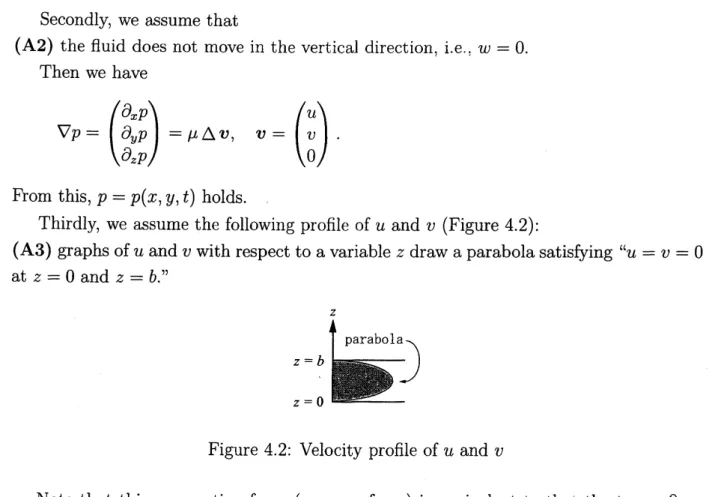
that(A2) the fluid does not
move
in the vertical direction, i.e.. $w=0$.Then
we
have$\nabla p=(\begin{array}{l}\partial_{x}p\partial_{y}p\partial_{z}p\end{array})=\mu\triangle v$, $v=(\begin{array}{l}uv0\end{array})$ .
From
this, $p=p(x, y, t)$holds.
Thirdly,
we
assume
the following profile of$u$ and $v$ (Figure 4.2):(A3) graphs of$u$and $v$ with respect to
a
variable $z$ draw aparabolasatisfying $u=v=0$at $z=0$ and $z=b.$”
$z$
Figure 4.2: Velocity profile of$u$ and $v$
Note that this assumption for $u$ (same
as
for v) is equivalent to that the terms $\partial_{xx}u$and $\partial_{yy}u$
are
negligible and the term $\partial_{zz}u$ is dominant in $\triangle u$. Then $u$ and $v$can
beexpressed
as
$u(x, y, z, t)=\varphi(x, y, t)z(z-b)$, $v(x, y, z, t)=\psi(x, y, t)z(z-b)$
with functions $\varphi$ and $\psi$. Hence
we
have$\partial_{x}p=\mu((\partial_{xx}\varphi+\partial_{yy}\varphi)z(z-b)+2\varphi)$, $\partial_{y}p=\mu((\partial_{xx}\psi+\partial_{yy}\psi)z(z-b)+2\psi)$ .
Since
the pressure is $p=p(x, y, t)$, we obtain$\partial_{xx}\varphi+\partial_{yy}\varphi=0$, $\partial_{xx}\psi+\partial_{yy}\psi=0$.
Therefore from
$\partial_{xx}u+\partial_{yy}u=0$, $\partial_{xx}v+\partial_{yy}v=0$,
we
haveFourthly,
we
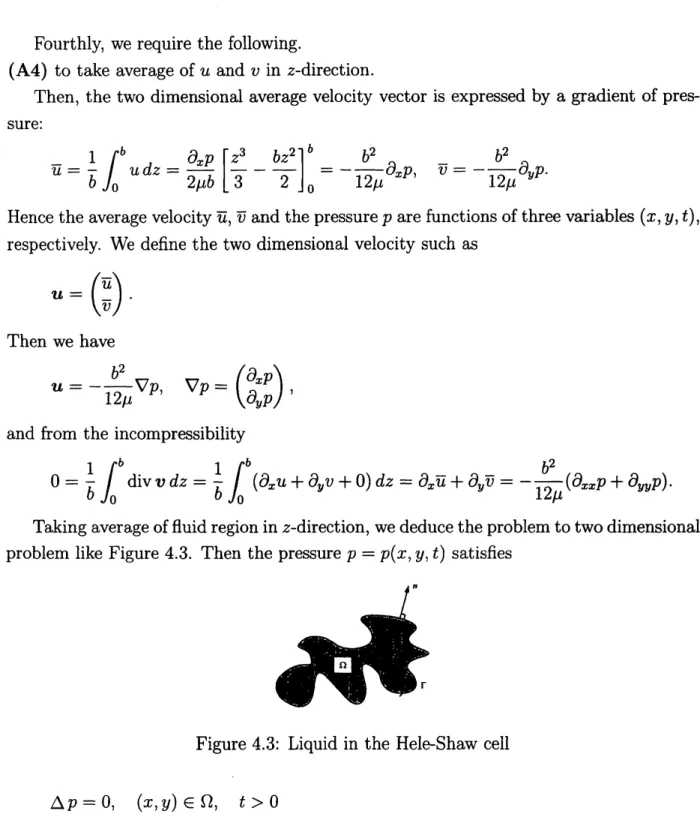
require the following.(A4) to take average of $u$ and $v$ in z-direction.
Then, the two dimensional average velocity vector is expressed by
a
gradient ofpres-sure:
$\overline{u}=\frac{1}{b}\int_{0}^{b}udz=\frac{\partial_{x}p}{2\mu b}[\frac{z^{3}}{3}-\frac{bz^{2}}{2}]_{0}^{b}=-\frac{b^{2}}{12\mu}\partial_{x}p)$ $\overline{v}=-\frac{b^{2}}{12\mu}\partial_{y}p$.
Hence the
average
velocityOf, $\overline{v}$and thepressure
$p$
are
functions of three variables $(x, y, t)$,respectively.
We
define the
twodimensional
velocity suchas
$u=( \frac{\overline u}{v})$ .
Then
we
have$u=- \frac{b^{2}}{12\mu}\nabla p$, $\nabla p=(\begin{array}{l}\partial_{x}p\partial_{y}p\end{array})$ ,
and from the incompressibility
$0= \frac{1}{b}\int_{0}^{b}divvdz=\frac{1}{b}\int_{0}^{b}(\partial_{x}u+\partial_{y}v+0)dz=\partial_{x}\overline{u}+\partial_{y}\overline{v}=-\frac{b^{2}}{12\mu}(\partial_{xx}p+\partial_{yy}p)$.
Takingaverage of fluidregion in z-direction,
we
deduce theproblemto twodimensionalproblem like Figure
4.3.
Then the pressure $p=p(x, y, t)$ satisfiesFigure
4.3:
Liquid inthe
Hele-Shaw
cell$\triangle p=0$, $(x, y)\in\Omega$, $t>0$
inthe interior of two dimensional fluidregion. Here wehavedefiedtwodimensional
Lapla-cian such
as
$\triangle p=\partial_{xx}p+\partial_{yy}p$.
Since the boundary $\Gamma$moves
with the fluid, deformationvelocity $\beta$ in the normal direction $n$ of $\Gamma$ is given
as
$\beta=u\cdot n=-\frac{b^{2}}{12\mu}\frac{\partial p}{\partial n}$, $\frac{\partial p}{\partial n}=\nabla p\cdot n$.
Here the normal velocity of $\Gamma=\Gamma(t)$ is defined
as
Here
and hereafter,we
denote $\dot{F}=\partial_{t}$F.On the boundary $\Gamma$, we
use
the Laplace‘srelation
$p-p_{*}=\tau k$, $\tau>0$
.
Here
$p_{*}$ is the atmospheric pressure and $\tau$ isa
surface tension coefficient. Since $p_{*}$ isa
constant,
we
have $\nabla(p-p_{*})=\nabla p$ and $\triangle(p-p_{*})=\triangle p$. Thenwe can
assume
$p:=p-p_{*}$.
Consequently,
we
have the following classical Hele-Shaw problem:(CHS) $\{\begin{array}{ll}\triangle p=0, (x, y)\in\Omega(t), t>0,p=\tau k, (x, y)\in\Gamma(t), t>0,\beta=-\frac{b^{2}}{12\mu}\frac{\partial p}{\partial n}, (x, y)\in\Gamma(t), t>0.\end{array}$
In our case, the gap $b$ is lifted uniformly at a specific rate. Then instead of (A2), we
assume
that(A2)’ $w$ is
a
linear function with respect to $z$, i.e., $w=\eta(t)z+\xi(t)$.At the bottom $z=0$, the fluid does not move. Then $\xi(t)=0$.
At
the top $z=b(t)$,the fluid
moves
with the plate. Then $\eta(t)=\dot{b}(t)/b(t)$. Hencewe
have$w= \frac{\dot{b}(t)}{b(t)}z$.
In this case, the pressure $p$ does not depend
on
$z$, since$p_{z}=l^{l}\triangle w=0$.
We
can
discuss thesame
argument of$u$ and $v$as
above, except the contribution fromincompressibility:
$0= \frac{1}{b(t)}\int_{0}^{b(t)}divvdz=\frac{1}{b(t)}\int_{0}^{b(t)}(u_{x}+v_{y}+w_{z})dz$
$= \overline{u}_{x}+\overline{v}_{y}+\frac{\dot{b}(t)}{b(t)}=-\frac{b(t)^{2}}{12\mu}(p_{xx}+p_{yy})+\frac{\dot{b}(t)}{b(t)}$.
Hence we
have$\triangle p=12\mu\frac{\dot{b}(t)}{b(t)^{3}}$,
and the following Hele-Shaw problem in
a
time-dependent gap $b(t)$:In the
case
the
platesare
fixed,then
$\dot{b}(t)=0$and the above problem is
nothingbut the
classical
Hele-Shaw problem.Now
we
willarrange
the above problembydimensionalization
as
follows. The variables$x,$ $y$ and $t$
are
scaled by a characteristic rate $l_{0}>0$ and $t_{0}>0$, respectively:$\tilde{x}=\frac{x}{l_{0}}$, $\tilde{y}=\frac{y}{l_{0}}$, $\tilde{t}=\frac{t}{t_{0}}$.
Then the curvature $k$ and the normal velocity $\beta$
are
scaled by $\tilde{k}=k/k_{0},$ $k_{0}=l_{0}^{-1}$ and$\tilde{\beta}=\beta/\beta_{0},$ $\beta_{0}=l_{0}/t_{0}$, respectively. The pressure$p$, the gap $b$and surface tension coefficient $\tau$
are
scaled bya
characteristic rate$p_{0}>0,$ $b_{0}>0$ and $\tau_{0}>0$, respectively:$\tilde{p}(\tilde{x},\tilde{y},$$t \gamma=\frac{p(x,y,t)}{p_{0}},$ $\tilde{b}(t\gamma=\frac{b(t)}{b_{0}},$ $\tilde{\tau}=\frac{\tau}{\tau_{0}}$.
If
we
take$p_{0}= \frac{12\mu l_{0}^{2}}{b_{0}^{2}t_{0}}$, $\tau_{0}=p_{0}l_{0}$,
then retaining the
same
variable names, the nondimensional (TDHS) becomes(NDHS) $\{\begin{array}{ll}\triangle p=\frac{\dot{b}(t)}{b(t)^{3}}, (x, y)\in\Omega(t), t>0,p=\tau k, (x, y)\in\Gamma(t), t>0,\beta=-b(t)^{2}\frac{\partial p}{\partial n}, (x, y)\in\Gamma(t), t>0.\end{array}$
Note that RHS of the Poisson equation depends only
on
time. ThenRHS can
beerasedby
means
ofa
specialsolution$p_{\star}$ satisfying $\Delta p_{\star}=\dot{b}(t)/b(t)^{3}$.
Ifwe
put $\hat{p}=p-p_{\star}$,then (NDHS) becomes
$\{\begin{array}{ll}\triangle\hat{p}=0, (x, y)\in\Omega(t), t>0,\hat{p}=\tau k-p_{\star}, (x, y)\in\Gamma(t), t>0,\beta=-b(t)^{2}\frac{\partial}{\partial n}(\hat{p}+p_{\star}), (x, y)\in\Gamma(t), t>0.\end{array}$
For instance, in the
case
$p_{\star}= \frac{\dot{b}(t)}{4b(t)^{3}}|x|^{2}$,
we
haveHere we denoted $p=\hat{p}$.
Properties. It is easy to check that the time transition of enclosed
area
$|\Omega(t)|$ is$\partial_{t}|\Omega(t)|=\int_{\Gamma(t)}\beta ds=-\frac{\dot{b}(t)}{b(t)}|\Omega(t)|$.
Hence the volume is preserved in the following sense:
$b(t)|\Omega(t)|\equiv b(0)|\Omega(0)|$.
One
more
important property is preserving the center ofmass:
$c= \frac{1}{|\Omega|}\int\int_{\Omega}xd\Omega$.
The time derivative of $c$ is
$\dot{c}=\frac{\dot{b}}{b}c-\frac{b^{2}}{|\Omega|}\int_{\Gamma}x\frac{\partial p}{\partial n}ds$.
Here we have used the solution $p$ of (NDHS) and
$\partial_{t}\int\int_{\Omega}xd\Omega=\int_{\Gamma}x\beta ds$.
Therefore the following equations imply $\dot{c}=0$.
$\int_{\Gamma}x\frac{\partial p}{\partial n}ds=\int_{\Gamma}p\frac{\partial x}{\partial n}ds+\int\int_{\Omega}(x\triangle p-p\triangle x)d\Omega$
$= \int_{\Gamma}pnds+\frac{\dot{b}}{b^{3}}\int\int_{\Omega}xd\Omega$
$= \tau\int_{\Gamma}knds+\frac{\dot{b}}{b^{3}}\int\int_{\Omega}xd\Omega$
$=- \tau\int_{\Gamma}\partial_{s}tds+\frac{\dot{b}}{b^{3}}|\Omega|c$
$= \frac{\dot{b}}{b^{3}}|\Omega|c$.
Remark. In the presentationtalk, weshowed anumerical simulation of(HS) by
means
ofboundary elementmethod (BEM) andtechnique of curvature adjusted tangential velocity.
It is to be desired that numerical scheme should satisfy the above two properties in some
sense, e.g. in discrete
sense.
However, it is still open problem.References
[1] J. W. Barrett, H. Garcke and R. N\"urnberg, A parametricfinite element method for
fourth order geometric evolution equations, Journal of Computational Physics 222
[2] M. Bene\v{s}, M. Kimura, P. Pau\v{s}, D.
\v{S}ev\v{c}ovi\v{c},
T. Tsujikawa andS.
Yazaki,“Appli-cation of
a
curvature adjusted method in image segmentation“, Bull. Inst. Math.Acad. Sin. (New Series) 3 (4) (2008) 509-523.
[3] K. Deckelnick, Weak solutions of the curve shortening flow, Calc. Var. Partial
Dif-ferential Equations 5 (1997),
489-510.
[4] G. Dziuk, Convergence of a semi discrete scheme for the curve shortening flow,
Math. Models Methods Appl. Sci., 4 (1994), 589-606.
[5]
C.
L. Epstein and M. Gage, Thecurve
shortening flow, Wave motion: theory,modelling, and computation (Berkeley, Calif., 1986), Math. Sci. Res. Inst. Publ., 7,
Springer, New York (1987) 15-59.
[6] T. Y. Hou, J. S. Lowengrub and M. J. Shelley, $Rem$ovingthestiffnessfrom interfacial
flows with surface tension, J. Comput. Phys. 114 (1994),
312-338.
[7] M. Kimura, Accurate numerical scheme for the flow by curvature, Appl. Math.
Letters 7 (1994), 69-73.
[8] M. Kimura, Numerical analysis for moving boundaryproblems using the boundary
tracking method, Japan J. Indust. Appl. Math. 14 (1997),
373-398.
[9] K. Mikula and D.
\v{S}ev\v{c}ovi\v{c},
Solution of nonlinearly curvature driven evolution ofplane curves, Appl. Numer. Math. 31 (1999), 191-207.
[10] K. Mikula and D.
\v{S}ev\v{c}ovi\v{c},
Evolutionofplanecurves
driven bya
nonlinear
functionof curvature and anisotropy, SIAM J. Appl. Math. 61 (2001),
1473-1501.
[11] K. Mikula and D.
\v{S}ev\v{c}ovi\v{c},
A direct method for solvingan
anisotropicmean
cur-vature flow of plane curves with an external force, Math. Methods Appl. Sci. 27
(2004),
1545-1565.
[12] K. Mikula and D.
\v{S}ev\v{c}ovi\v{c},
Computational and qualitative aspects of evolution ofcurves
driven bycurvature and externalforce, Comput. Vis. Sci. 6 (2004), 211-225.[13] K. Mikulaand D.
\v{S}ev\v{c}ovi\v{c},
Evolution ofcurves on asurface driven by thegeodesiccurvature and external force, Appl. Anal. 85 (2006), 345-362.
[14] J. A. Sethian, LevelSetMethods and Fast Marching Methods: EvolvingInterfacesin
Computational$G$eometry, FluidMechanics, ComputerVision, and MaterialScience,
[15] D.
\v{S}ev\v{c}ovi\v{c}
and S. Yazaki, $On$a
motion ofplanecurves
witha
curvature adjustedtangential velocity, submitted to Proceedings of Equadiff 2007 Conference,
unpul-ished note $(arXiv:0711.2568vl)$.
[16] D.
\v{S}ev\v{c}ovi\v{c}
and S. Yazaki, Evolution ofplanecurves
With a curvature adjustedtangential velocity, submittedto Japan J. Indust. Appl. Math. (arXiv:1009.$2588v2$).
[17] M. J. Shelley, F.-R. Tian and K. Wlodarski, Hele-Shawflowand pattern formation
in a time-dependent gap, Nonlinearity 10 (1997) 1471-1495.
[18] S. Yazaki, On th$e$ tangential velocity arising in acrystallin$e$ approximationof