Automorphism Classification
of
Cellular
Automata–a
continuation
西尾英之助 (元・京大理)
Hidenosuke
Nishio1
Kyoto University
Abstract
FollowIng the previous studies on the automorphism classification of CA, wetreat here a few
newtopics: (1)We prove firstalemmathat theequivalence/automorphism ofCAisconservedwhen
changing the neighborhood. (2) We recollect the past studIes on the enumeration of equivalence
classes ofBooleanfunctions in 1950-60s andgeneralize thereunderthe automorphismclassification
ofCA.
1
Preliminaries
The
definitions
and previous resultsare briefly
restated,ofwhich details will be found in [1, 2, 3].1.1
CA and local structures
Acellular automaton isdefinedbya 4-tuple $(\mathbb{Z}^{d}, Q, f, \nu)$, where $\mathbb{Z}^{d}$
Is
a
d-dimensionalEuclideanspace,
$Q$ isafiniteset of cellstates, $f$ : $Q^{n}arrow Q$ is alocalfunction and$\nu$ isa neighborhood.
.
[neighborhood] A neighborhoodisan
injectivemap
$\nu$ : $\mathbb{N}_{n}arrow \mathbb{Z}^{d}$, where $\mathbb{N}_{n}=\{1,2, \ldots, n\}$and $n\in \mathbb{N}$
.
Thiscan
equivalently beseen
as
a
list $\nu$ with $n$ components $(\nu_{1}, \ldots, \nu_{n})$, where$\nu_{i}=\nu(i),$ $1\leq i\leq n$, is called the i-th neighbor. The i-th variable of$f$ Is connected to the i-th
neighbor.
.
[local structure] Apair$(f, \nu)$ is called a local structure ofCA. Wecall $n$ the amityofthe localstructure. When the
space
$\mathbb{Z}^{d}$and the state set $Q$ are understood, CA is often identified with its
local structure.
.
[global function] A local structure uniquely inducesa
global function$F$ : $Q^{Z^{d}}arrow Q^{Z^{d}}$.
whichisdefined by
$F(c)(p)=f(c(p+\nu_{1}), c(p+\nu_{2}), \ldots, c(p+\nu_{n}))$, (1)
for
any
globalconfiguration$c\in Q^{\mathbb{Z}^{d}}$ , where $c(p)$ is the stateof cell$p\in \mathbb{Z}^{d}$ in $c$.
Remark1 In [2]the localstructure is
defined more
generally, but in thispaper we
assume, withoutlossofgenerality, a restricted but most usual
case
of reduced localstructures,see
the following definitionandLemma 1.
Definition1 [reducedlocalstructure] Alocal structure is calledreduced,ifandonlyif
.
$\nu$ isinjective, $i.e$. $\nu_{i}\neq\nu_{j}$ for$i\neq j$ in the listofneighborhood$\nu$ and.
$f$ dependsonall arguments.Lemma1 Foreachlocalstructure $(f, \nu)$ thereis
an
equivalent reducedlocal structure$(f’, \nu’)$.
1email: $YRA05$762@nifty
1.2 Permutation
equivalence of local
structures
Definition 2
$[equivalence|$Two
local structures$(f, \nu)$ and$(f’, \nu’)$are
calledequivalent, if andonJyiftheyinduce the
same
global function. In thatcase we
write$(f, \nu)\approx(f’, \nu’)$.
Definition
3
[permutation of localstructures$|$ Let$\pi$ denoteapermutationof the numbersin$\mathbb{N}_{n}$.
Thesetofallpermutations$\pi s$of the numbers from$\mathbb{N}_{n}$ constitutes
a
symmetricgroup
$S_{n}$ ofdegree$n$.
.
For a
neighborhood$\nu$.
denoteby$\nu^{\pi}$ theneighborhooddefined
by$\nu_{\pi(i)}^{\pi}=\nu_{i}$
.
.
For
an
n-tuple$\ell\in Q^{n}$, denoteby$\ell^{\pi}$ the permutation$of\ell$ such$that\ell^{\pi}(i)=\ell(\pi(i))$ for$1\leq i\leq n$
.
For a local function $f$ : $Q^{n}arrow Q$, denote by $f^{\pi}$ the local function $f^{\pi}$ : $Q^{n}arrow Q$ such that
$f^{\pi}(\ell)=f(\ell^{\pi})$for$alJ\ell$
.
Remark 2 As
for thedefinition
of the permutation oflocalfunctions,we
have thefollowinglemma.Lemma 2
Whena
localfunction$f$ : $Q^{n}arrow Q$isexpressed$bya$polynomial$f(x_{1}, \ldots,x_{n})overGF(q),$ $q=$$|Q|$,
we
have another equIvalentdefinition
for thepermutation of local functions –permutation of theorderofarguments.
$f^{\pi}(x_{1}, \ldots, x_{n})=f(x_{\pi(1)}, \ldots, x_{\pi(n)})$ (2)
Example 1 Permutations
$of3$objectsa
$re$usualJy expressed bya
symmetricgroup
$S_{3}=\{\pi_{i}, 0\leq i\leq 5\}$as
isshownbelow$\pi_{0}=(\begin{array}{lll}l 2 3l 2 3\end{array})$ $\pi_{1}=(_{1}^{1}$
$\pi_{3}=(\begin{array}{lll}l 2 32 3 l\end{array})$ $\pi_{4}=(_{3}^{1}$
$32$ $23)$ $\pi_{2}=(\begin{array}{lll}1 2 32 l 3\end{array})$ ,
$21$ $23)$ $\pi_{5}=(\begin{array}{lll}1 2 33 2 l\end{array})$
Neighborhood
$(-1,0,1)$ is$caJled$theelementary neighborhoodanddenoted$ENB$.
Then6
permutationsofENB
are seen
isomorphicto$S_{3}$as
follows.$ENB^{\pi_{0}}=(-1,0,1),$ $ENB^{\pi_{1}}=(-1,1,0),$$ENB^{\pi}2=(0, -1,1)$, $ENB^{\pi}3=(0,1, -1),$$ENB^{\pi_{4}}=(1, -1,0),$$ENB^{\pi}5=(1,0, -1)$
Thelocalfunction ofan$ECA$ iscalled
an
elementary local function denotedELF whichisexpressedbyapoJynomialover$GF(2)$ ora Booleanfunctionin3 variables.
Thelocalfunction ofcomputation universal$ECA$ rule 110isexpressedby$f_{110}(x_{1}, x_{2}, x_{3})=x_{1}x_{2}x_{3}+$
$x_{2}x_{3}+x_{2}+x_{3}$. Then
6
permutations of$f_{110}$are
shownas
follows.$f_{110}^{\pi 0}=f_{110}^{\pi_{1}}=x_{1}x_{2}x_{3}+x_{2}x_{3}+x_{2}+x_{3}$
.
(3) $f_{110}^{\pi_{2}}=f_{110}^{\pi_{4}}=x_{1}x_{2}x_{3}+x_{1}x_{3}+x_{1}+x_{3}$. (4) $f_{110}^{\pi}3=f_{110}^{\pi_{5}}=x_{1}x_{2}x_{3}+x_{1}x_{2}+x_{1}+x_{2}$. (5)1.3 Previous
results
Here
we
extract from the previouspapers
some
basic resultson
theequivalenceof localstructures.Lemma 3
$(f, \nu)$ and$(f^{\pi}, \nu^{\pi})$ areequivalent forany
permutation$\pi$.Lemma 4
If$(f, \nu)$ and$(f’, \nu’)\partial Ie$ two reduced local structures whichare
equivalent, then thereisa
permutation$\pi$ such that$\nu^{\pi}=\nu’$.
Theorem 1 [permutation-equivalence of localstructures]
If$(f, \nu)$ and$(f’, \nu’)$
are
two reducedlocal structures whichare
equivalent, then thereisa
permutation$\pi$ such$that(f^{\pi}, \nu^{\pi})=(f’, \nu’)$
.
Automorphism classification
ofCA
Definition 4 Two$CA$$A$ and$B$
are
calleda
utomorphic, denoted$A\cong B$, ifandonly ifthereisa
pair ofpermutations$(\pi, \varphi)$such that
$(f_{B}, \nu_{B})=(\varphi^{-1}f_{A}^{\pi}\varphi, \nu_{A}^{\pi})$. (6)
The
a
utomorphismnaturallyinducesa classification
oflocal functionsof$CA$, which will be called theautomorphism
classification. Eveiy
$CA$ belonging toan
automorphism class is said to have thesame
behaviorup to permutations.
As
a
typical example of the automorphismclassification, thesetof256
ELFis classified into46
classes,see
k\^oky\^uroku ofRIMS workshop (LASymposium, Feb. 2009) [1].2
Equivalence is
conserved
when changing neighborhoods
We provehere
a
lemma that equIvalence oflocalstructures is conserved whenchangingthepositionofneighborhoods.
Owing
to this lemma, the automorphism classification is not affected by changing theneighborhood. We notice that the mapping$r$ introduced below
conserves
the equivalence, butgenerallynotthe globalproperties ofCA likereversibIlIty.
Consider an
injectivemap
$r$ : $\mathbb{Z}^{d}arrow \mathbb{Z}^{d’},$ $d,$$d’\geq 1$ which is used tochange the positions ofneighbors.
Note that
we are
consideringa
mappinginpossiblydifferent dimensionalspaces, see
the example below.To neighborhood $\nu=(\nu_{1}, \ldots, \nu_{n}),$ $r$ is applied componentwise. For the resulting neighborhood
we
write $r\nu$
.
Thatis $(\forall i)(r\nu)_{i}=r(\nu_{i})$.
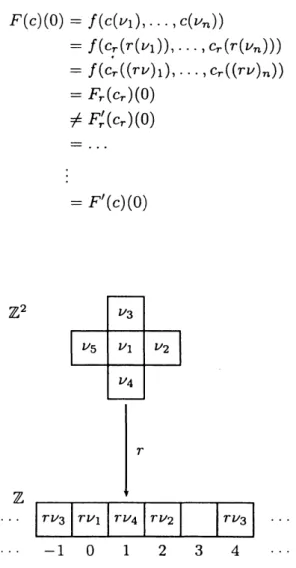
See Fig. 1.Lemma
5
If$(f, \nu)\approx(f’, \nu’)$, then $(f, r\nu)\approx(f’, r\nu’)$.
Proof. For
a
proofby contradiction assume, that $(f, r\nu)\not\simeq(f’, r\nu’)$.
Denote the corresponding globalfunctIons by $F_{r}$ and $F_{r}’$. Then there is a configuration
$c_{r}$, such that $F_{r}(c_{r})\neq F_{r}’(c_{r})$. Without loss of
generality,
we
assume
$F_{r}(c_{r})(0)\neq F_{r}’(c_{r})(0)$.
Define a configuration$c$
as
$c(x)=c_{r}(r(x))$ for all $x\in \mathbb{Z}^{d}$.
We claim that $F(c_{r})(0)\neq F’(c_{r})(0)$$(f, \nu)$
ce
$(f’, \nu’)$.$F(c)(0)=f(c(\nu_{1}), \ldots, c(\nu_{n}))$
$=f(c_{r}(r(\nu_{1})))\ldots,$$c_{r}(r(\nu_{n})))$
$=f(c_{r}((r\nu)_{1}), \ldots, c_{r}((r\nu)_{n}))$ $=F_{r}(c_{r})(0)$ $\neq F_{r}(c_{r})(0)$ $=\ldots$
.
$=F’(c)(0)$ $\square$ $\mathbb{Z}^{2}$ $\ovalbox{\tt\small REJECT}_{\nu_{4}}^{\nu_{3}}\nu_{5}\nu_{1}\nu_{2}$ $|r$ $\mathbb{Z}$ . . $-1$ $0$ 1 2 3 4 . . .Figure 1: Mappingof
von
Neumann neighborhood$r$ : $\mathbb{Z}^{2}arrow \mathbb{Z}$.
Example 2 Consider
an
injectivemap$r$ from$\mathbb{Z}^{2}$to$\mathbb{Z}$. $r$ is defnedby 4partialmaps
$r_{I},$$r_{II},$$r_{III}$ and $r_{IV}$ asgiven below, each of which maps (I) the first quarter $(x\geq 0, y\geq 0),$ $(II)$ the second quarter
$(x\geq 0, y<0),$ $(III)$ the 3rdquarter$(x<0, y<0)$ and (IV) the 4th quarter $(x<0, y\geq 0)$ into (I)
nonnegativeeven, (II) posItiveodd, (III)negatIve evenand (IV) negatIve oddintegers, respectively. Note
$thatr_{I}(0,0)=0$. Itisalso
seen
that$r$ issurjectiveandtherefore bijective.$r_{I}(x, y)$ $=$
$(x+y)(x+y+1)+2y$
, where $x\geq 0,$ $y\geq 0$. (7)$r_{II}(x, y)$ $=$
$(x-y)(x-y-1)-2y-1$
, where$x\geq 0,$$y<0$. (8)$r_{III}(x, y)$ $=$
$-\{(x+y+1)(x+y+2)-2y\}$
, where $x<0,$$y<0$. (9)$r_{IV}(x, y)$ $=$
$-\{(x-y)(x-y+1)+2y+1\}$
, where $x<0,$$y\geq 0$. (10)Bythis$r$, for instance the2-dimensionalvonNeumannneighborhood
$((0,0), (1,0), (0,1), (0, -1), (-1,0))$ ismappedto1-dimensional neighborhood
$(0,2,4,1, -1)$ asiJlustrated inFig. 1.
Ofcourse, as noticed above this example of$r$ : $\mathbb{Z}^{2}arrow \mathbb{Z}$ isindependentfrom the decidabiJityissue of
reversibility: reversibilityisdecidablein$\mathbb{Z}$ butnotin$\mathbb{Z}^{2}$
3
Enumeration
of
symmetry
types of
Boolean
functions
Theequivalence classofBooleanfunctionsdefinedbelowis calledasymmetry typeandtheenumeration
problem ofthe number of symmetry types (equivalence classes)
was
generally solved (for arbitraryn)by D. Slepian (1953) [4] and M.
Harrison
(1963) [5] byuse
ofP\’olya’s enumerationtheorem (1937) [6].One oftheir motivationsfor such a classificationstudyis the costoflogical designs atthe early stage of
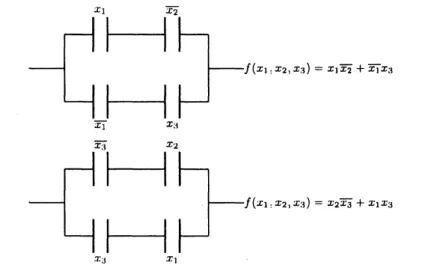
digital computers. Thetwo circuits in Fig.2
are
consideredto be of thesame
cost andthecorrespondingBoolean functions are classifiedinto oneclass.
Figure 2: Logicalcircuits obtained by replacing $x_{2}$ by $\overline{x_{2}}$ and $x_{1}$ by$\overline{x_{3}}$
.
Remake ofFig.2 ofM.Harri-son(1963)
3.1
Basics
.
Boolean logic: $B=(\{0,1\}, \vee, \wedge, \overline{a})$withwell known derivationrules..
Boolean function In$n$ variables: $f(x_{1}, \ldots, x_{n})$.
.
Booleanvs
polynomial: $a\vee b=a+b+ab,$$a\wedge b=ab,\overline{a}=1+a$..
Conjugation
$\varphi^{-1}f\varphi=1+f(1+x_{1}, \ldots, 1+x_{n})=\overline{f(\overline{x_{1}}\overline{x_{2}}\ldots\overline{x_{n}})}$.
.
Any $n$variableBoolean function $f_{u},$ $u=0,$$\ldots,$
$2^{2^{n}}-1$ isexpressed by
a
disjunctive normal form:$f_{u}(x_{1}, \ldots, x_{n})=\sum_{v=0}^{2^{n}-1}\epsilon_{uv}s_{v}$, (11)
where $\epsilon_{uv}\in\{0,1\}$ and$s_{0}=x_{1}x_{2}\ldots x_{n},$ $s_{1}=x_{1}x_{2}\ldots ZZ_{n},$$\ldots,$$s_{2^{n}-1}=\overline{x_{1}}$
Zii5...
$\overline{x_{n}}$.
3.2
Permutation and negation of Boolean functions
$\circ$ Permutation of (variables of)
a
Boolean function is defined in thesame
way as
Definition 3:$f^{\pi}(x_{1}, \ldots, x_{n})=f(x_{\pi(1)}, \ldots, x_{\pi(n)})$
.
Thesetof permutations is isomorphicwith $S_{n}$.
.
Alist$\alpha=(\alpha_{1)}\ldots, \alpha_{n})$expresses a
combined negation of variables ofBoolean function$f(x_{1}, \ldots, x_{n})$:
$\alpha f(x_{1}, \ldots, x_{n})=f(x_{1}^{\alpha_{1}}, \ldots, x_{n}^{\alpha_{n}})$..
Theset $S_{2}^{n}$ ofall $\alpha s$ isa
permutationgroup
oforder$2^{n}$.3.3
Equivalence
relation
defined
by
$(S_{n}, S_{2}^{n})$Thepair$G^{n}=(S_{n}, S_{2}^{n})$ofpermutatIon
groups
$S_{n}$and $S_{2}^{n}$ naturallydefines an
equivalence relation $\approx c^{n}$among
the setofBoolean functionsin$n$variables;$f\approx c^{n}f$’ ニ $f’=\alpha f^{\pi}$,for $\exists\pi\in S_{n},$$\exists\alpha\in S_{2}^{n}$
.
(12)Utilizing
this relation,we can
classifyBoolean
functions.D.
Slepian (1953)uses
P\’olya’s enumerationtheorem for getting the number of equivalence classes for
any
Boolean functionsin$n$variables [4].Example
3 Case
$ofn=2;2^{2^{2}}=16$Boolean functions$f(x, y)$are
classifiedinto
6 equivalenceclasses;$[0],$ $[1],$ $[x,\overline{x}, y,\overline{y}],$ $[xy, x\overline{y})\overline{x}y,\overline{x}\overline{y}],$$[x\vee y,\overline{x}\vee y, x\vee\overline{y},\overline{x}\vee\overline{y}],$ $[x\oplus y, x\equiv y]$
Case $ofn=3:256$
Booleanfunctionsare
classified
into22 classes, whichis compared with46
inour
automorphismclassification ofECA.
4
Generalization
of
the
automorphism of
CA
Inspired bythe aboveequivalence classes ofBoolean functions,
we
generalizethedefinition
ofautomor-phisms ofCA;Thestatesofneighbors$\nu_{i}(i=1, \ldots, n)$ of
a
cellare
permutedindependently and then thefunction value iscomputed. The positions of the arguments (theneighbors)
are
also permutedas
before.Formally,
we
haveDeflnition 5
Let $S_{q}^{n}=S_{q}\cross\cdots\cross S_{q}$ and$\varphi^{(n)}\in S_{q}^{n}$. Denote $G^{n}=(S_{n}, S_{q}^{n})$.
Then two $CA$ $A$ and$B$
are
defined
to be automorphic, denoted$A\cong c^{n}B$, ifandonlyifthereare
permutations$\pi\in S_{n}$ and$\varphi^{(n)}\in S_{q}^{n}$ such that
$(f_{B}, \nu_{B})=(f_{A}^{\pi}\varphi^{(n)}, \nu_{A}^{\pi})$, (13)
where$f_{A}^{\pi}\varphi^{(n)}$ standsfor$f_{A}^{\pi}(x_{1}^{\varphi_{1}}, \ldots, x_{n}^{\varphi_{\mathfrak{n}}})$, where$x_{i}^{\varphi_{i}}$ isapermutation$\varphi_{i}\in S_{q}$ ofthe i-thargument
$x_{t}$
for$1\leq i\leq n$. In this
case
wewrite$\varphi^{(n)}=(\varphi_{1}, \ldots, \varphi_{n})\in S_{q}^{n}$. Thecase
$ofq=2$ isnothingotherthantheequivalenceofBooleanfunctions.
Anotherdefinitionwillbepossible;Anadditionalpermutationofstates$\varphi’\in S_{q}$isappliedtothefuncuon
value.
$(f_{B}, \nu_{B})=(\varphi’f_{A}^{\pi}\varphi^{(n)}, \nu_{A}^{\pi})$
.
(14)If
every
permutation of the states isequal,$i.e$.
$\varphi_{t}=\varphi,$ $1\leq i\leq n$, forsome
$\varphi\in S_{q}$, theautomorphismis
same
as
the originalautomorphism.This generalized automorphism is
an
equivalence relation and inducesa classification
ofCA
like theoriginal
one.
Anytwo local functions ina
class have thesame
global behavior upto permutations. Theclassification
is considered to be a group action of$G^{n}$on
the set of polynomials $\varphi_{n_{J}q}$over
$GF(q)$ in5 Concluding
remarks
and
acknowledgements
In this paper
we
discussed a generalizationof the automorphismclassificationofCA following thepaststudieson the symmetry classes ofBooleanfunctions. A motivation for that is to extract thesymmetric
structure of localfunctions by disregardingtheeffectsof neIghborhoods. The number of the generalized
automorphism classes will be obtained usingtheorbit counting lemmaandlor P\’olya’s enumeration
the-orem as was
done for classifyingBoolean
functions. The computation itself, however, hasbeen left forfuturework.
The author thanksto
Thomas
Worsch fromtheUniversIty
ofKarlsruhe for valuablediscussions,partic-ularly for establIshing
Lemma 5
and to Mitsuhiko Fujio from the KyushuInstitute
ofTechnology forcommenting
on
ther\’esumepresentedat theRIMS workshop (LA Symposium) held inKyotoUniversity
on
February 2,2010.
References
[1] Nishio, H., Worsch,T.: Anote
on
automorphismsof cellular automata. k\^oky\^uroku vol.1649
(2009)121-128,RIMS, Kyoto
University.
[2] Nishio, H., Worsch, T.:
Changing
the neighborhood ofcellular automata:
local structure,equiva-lence and isomorphism. to
appear
inJ.
Cellular
Automata.
[3] Nishio, H.:
AUTOMORPHISM
CLASSIFICATION
OFCELLULAR AUTOMATA.
In:Proceed-ings ofWorkshop onNon-Classical ModelsforAutomataandApplicatIons(NCMA),[email protected].
(2009)
195-208
[4] Slepian, D.: On the number of symmetry types of boolean functions ofn variables. Canadian
J.
Math.
5
(1953)185-193
[5] Harrison, M.A.: ThenumberoftransitivIty sets of boolean functions.
J.
Soc. Indust. Appl. Math. 11(1963)
806-828
[6] P\’olya, G., Read, R.C.:
Combinatorial Enumeration
ofGroups,
Craphs and Chemlcal Compounds(Englishtranslation).