MANY TORIC IDEALS GENERATED BY
QUADRATIC
BINOMIALS POSSESS NO
QUADRATIC
GROBNER BASES(SUMMARY)
HIDEFUMI OHSUGI
DEPARTMENT OF MATHEMATICAL SCIENCES
SCHOOL OFSCIENCE AND TECHNOLOGY
KWANSEI GAKUIN UNIVERSITY
ABSTRACT. This isabriefsummaryofHibi Nishiyama Ohsugi‐Shikama
[6].
LetG be afinite connected simple graphand I_{G} the toric ideal of theedge ring of
G. In the present paper,we studyfinite graphs G with theproperty that I_{G} is
generated by quadratic binomials and I_{G} possesses no quadratic Gröbner basis.
First,wegiveanontrivial infinite series of finitegraphswith theaboveproperty.
Second,weimplement acombinatorial characterization forI_{G}tobegenerated by
quadraticbinomials and, by meansof thecomputersearch, weclassifythefinite
graphsG with the aboveproperty, up to8 vertices.
INTRODUCTION
Let G be a finite connected
simple graph
on the vertex set[n]=\{1, 2, . . . , n\}
withE(G)=\{e_{1}, . . . , e_{d}\}
itsedge
set.(Recall
that a finitegraph
issimple
if ít possesses noloop
andnomultiple
edge.)
Let K be afield andK[\mathrm{t}]=K[t_{1}, . . . , t_{n}]
the
polynomial ring
in n variables over K. Ife=\{i, j\}\in E(G)
, then \mathrm{t}^{e} stands
for the
quadratic
monomialt_{i}t_{j}\in K[\mathrm{t}]
. Theedge ring
([15])
of G is thesubring
K[G]=K[\mathrm{t}^{e}1, . . . , \mathrm{t}^{\mathrm{e}}d]
ofK[\mathrm{t}]
. LetK[\mathrm{x}]=K[x_{1}, . . . , x_{d}]
denote thepolynomial
ring
in d variables over K with each\deg x_{i}=1
and define thesurjective ring
homomorphism
$\pi$ :K[\mathrm{x}]\rightarrow K[G]
by setting
$\pi$(x_{i})=\mathrm{t}^{e_{i}}
for each1\leq i\leq d
. The toric idealI_{G}
of G is the kernel of $\pi$. It is known[17,
Corollary
4.3]
thatI_{G}
isgenerated by
those binomials u-v, where u and v are monomials ofK[\mathrm{x}]
with\deg u=\deg v
, such that$\pi$(u)= $\pi$(v)
. Thedistinguished properties
onK[G]
andI_{G}
in whichcommutativealgebraists
areespecially
interested are as follows:(i)
I_{G}
isgenerated by quadratic
binomialsl;
(ii)
K[G]
isKoszul;
(iii)
I_{G}
possesses aquadratic
Gröbnerbasis,
i.e.,
a Gröbner basisconsisting
ofquadratic
binomials.The
hierarchy
(\mathrm{i}\mathrm{i}\mathrm{i})\Rightarrow(\mathrm{i}\mathrm{i})\Rightarrow(\mathrm{i})
is true.However,
(\mathrm{i})\Rightarrow(\mathrm{i}\mathrm{i})
is false. We refer the reader to[15]
for thequick
informationtogether
with basic literature on these2010 Mathematics Subject Classification: Primary 13\mathrm{F}20. Keywords: toricideal, finitegraph, Gröbner basis.
lEven if
I_{G}=(0)
,we saythat I_{G}is generated by quadratic binomials and I_{G} possesses a(*)
condition
(*)
and if no inducedsubgraph
H(\neq G)
satisfies the condition(*)
. \mathrm{A}(*)
‐minimalgraph
isgiven
in[15,
Example
2.1].
In the present paper, after
summarizing
known results onI_{G}
in Section1,
\mathrm{a}nontrivial infiniteseriesof
(*)
‐minimal finitegraphs
isgiven
in Section2. InSection3,
weimplement
acombinatorial characterizationforI_{G}
tobegenerated by quadratic
binomials
([15,
Theorem1.2])
and, by
meansof thecomputersearch,
weclassify
thefinite
graphs
Gsatisfying
the condition(*)
, up to 8 vertices.1. KNOWN RESULTS ON TORIC IDEALS OF GRAPHS
In this
section,
we introducegraph
theoreticalterminology
and known results.Let G be a connected
graph
with thevertex setV(G)=[n]=\{1, 2, . . . , n\}
and theedge
setE(G)
. We assume that G has noloops
and nomultiple edges.
A walk oflength
qofGconnecting
v_{1}\in V(G)
andv_{q+1}\in V(G)
is afinitesequenceof the form(1)
$\Gamma$=(\{v_{1}, v_{2}\}, \{v_{2}, V3\}, . .., \{v_{q},v_{q+1}\})
with each
\{v_{k}, v_{k+1}\}\in E(G)
. An even(resp. odd)
walkis a walk ofeven(resp. odd)
length.
A walk $\Gamma$ of the form(1)
is called closed if v_{q+1}=v_{1}. Acycle
is a closedwalk
(2)
C=(\{v_{1}, v_{2}\}, \{v_{2}, V3\}, . . . , \{v_{q}, v_{1}\})
with
q\geq 3
andv_{i}\neq v_{j}
for all1\leq i<j\leq q.
A chord of acycle
(2)
is anedge
e\in E(G)\mathrm{o}\mathrm{f}\cdot \mathrm{t}\mathrm{h}\mathrm{e}
forme=\{v_{i}, v_{j}\}
for some1\leq i<j\leq q
withe\not\in E(C)
. Ifacycle
(2)
is even, an even‐chord(resp. odd‐chord)
of(2)
is a chorde=\{v_{i}, v_{j}\}
with1\leq i<j\leq q
such thatj-i
is odd(resp.
even).
Ife=\{v_{i}, v_{j}\}
and e'=\{v_{i'}, v_{j'}\}
are chords ofa
cycle
(2)
with1\leq i<j\leq q
and1\leq i'<j\leq q
, thenwe saythat eande' crossin C if the
following
conditions aresatisfied:(i)
Eitheri<i'<j<j'
ori'<i<j'<j
;(ii)
Either\{\{v_{i},
v_{i}\{v_{j},
v_{j}\subset E(C)
or\{\{v_{i},
v_{j}\{v_{j},
v_{i}\subset E(C)
.A minimal
cycle
of G is acycle having
no chords. IfC_{1}
andC_{2}
arecycles
ofGhaving
no commonvertices,
thenabridge
betweenC_{1}
andC_{2}
is anedge
\{i,j\}
of G withi\in V(C_{1})
andj\in V(C_{2})
.The toric ideal
I_{G}
isgenerated by
the binomials associated withevenclosedwalks.Given an evenclosed walk
$\Gamma$=(e_{i_{1}}, e_{i_{2}}, \ldots, e_{i_{2q}})
of G, wewritef_{ $\Gamma$}
for the binomialf_{ $\Gamma$}=\displaystyle \prod_{k=1}^{q}x_{i_{2k-1}}-\prod_{k=1}^{q}x_{i_{2k}}\in I_{G}.
FIGURE 1. Wheel with 6vertices.
Proposition
1.1. Let G be a connectedgraph. Then,
I_{G}
isgenerated by
all thebinomials
f_{ $\Gamma$;}
where $\Gamma$ is an even closed walkof
G. Inparticular,
I_{G}=(0)
if
andonly
if
G has at most onecycle
and thecycle
is odd.Note
that,
for abinomialf\in I_{G},
\deg(f)=2
if andonly
if there exists an evencycle
C of G oflength
4 such thatf=f_{C}
. On the otherhand,
a criterion for the existenceofaquadratic
binomialgenerators
ofI_{G}
isgiven
in[15,
Theorem1.2].
Proposition
1.2. Let G be afinite
connectedgraph. Then,
I_{G}
isgenerated by
quadratic
binomialsif
andonly if
thefollowing
conditions aresatisfied:
(i)
If
C is an evencycle of
Gof length
\geq 6, then eitherC has an even‐chordorC has three odd‐chordse, e ande' such thate ande' cross inC;
(ii)
If C_{1}
andC_{2}
are minimal oddcycles having exactly
one commonvertex,
thenthere exists an
edge
\{i,j\}\not\in E(C_{1})\cup E(C_{2})
withi\in V(C_{1})
andj\in V(C_{2})
;(iii)
If
C_{1}
andC_{2}
are minimal oddcycles having
no commonvertex,
then thereexist at least two
bridges
betweenC_{1}
andC_{2}.
IfG is
bipartite,
then thefollowing
isshown in[14]:
Proposition
1.3. Let G be abipartite
graph.
Then thefollowing
conditions areequivalent:
(i)
Every
cycle
of
Gof length
\geq 6
has achord;
(ii)
I_{G}
possesses aquadratic
Grobnerbasis;
(iii)
K[G]
isKoszul;
(iv)
I_{G}
isgenerated by quadratic
binomials.IfG is not
bipartite,
then the conditions(ili)
and(iv)
are notequivalent.
Example
1.4.([15,
Example
2.1])
Let G be thegraph
inFigure
1.Then,
I_{G}
isgenerated by quadratic
binomials. On the otherhand,
K[G]
isnot Koszul and henceI_{G}
has noquadratic
Gröbner bases.If a
graph
G' on the vertex setV(G)\subset V(G)
satisfiesE(G')=\{\{i,j\}\in
E(G)|i, j\in V(G')\}
, then G is called an inducedsubgraph
of G. Thefollowing
proposition
is afundamental andimportant
fact on the toric ideals ofgraphs.
Proposition
1.5([13]).
LetG be an inducedsubgraph of
agraph
G.Thenf
K[G']
is a combinatorialpure
subring
of
K[G]
. Inparticular,
\{1, 2, . . . , n\}
and theedge
E(G)
Thesuspension
graph
graph
\hat{G}
whose vertex set is[n+1]=V(G)\cup\{n+1\}
and whoseedge
set isE(G)\cup\{\{i, n+1\}|i\in V(G)\}
. Notethat,
anygraph
G is an inducedsubgraph
ofits
suspension
\hat{G}
. We now characterizegraphs
G such thatI_{\hat{G}}
isgenerated by
quadratic
binomials. Thecomplementary graph \overline{G}
of G is thegraph
whose vertex setis[n]
and whoseedges
are thenon‐edges
of G. Agraph
G is saidto be chordalifany
cycle
oflength
>3 has achord.Moreover,
agraph
Gissaid tobe co‐chordalif
\overline{G}
ischordal. Agraph
G is called a2K_{2}
‐free graph
if it is connected and doesnotcontain two
ìndependent
edges
as an inducedsubgraph,
Fora connectedgraph G,
G is
2K_{2}-
free \Leftrightarrow \mathrm{a}\mathrm{n}\mathrm{y}cycle
of\overline{G}
oflength
4 has achord in\overline{G}
;Gis \mathrm{c}\mathrm{o}-chordal \Rightarrow G is
2K_{2}
‐free,
hold in
general. Moreover,
it is known(e.g.,
[1])
that Lemma 2.1. LetG be a connectedgraph. Then,
(i)
If
G isco‐chordal,
then anycycle of
Gof length
\geq 5 has achord;
(ii)
If
G is2K_{2}
‐free,
then anycycle of
Gof length
\geq 6 has a chord.The toric ideals
I_{G}
of2K_{2}
‐freegraphs
G are studied in[16].
(In [16],
2K_{2}
‐freegraphs
are called in adifferentname.)
On the otherhand,
theedge
idealsI(G)
of2K_{2}
‐freegraphs
G arestudiedby
manyresearchers.See,
e.g.,[10]
and[11]
together
with their references and comments.(In
these papers,2K_{2}
‐freegraphs
are calledC_{4} ‐free graphs
One can characterize the toric idealsI_{\hat{G}}
of\hat{G}
that4aregenerated
by quadratic
binomialsin terms of2K_{2}‐freegraphs.
Theorem2.2. LetG bea
finite
connectedgraph.
Then thefollowing
conditions areequivalent:
(i) I_{\hat{G}}
isgenerated by quadratic binomials;
(ii)
G is2K_{2}
‐free
andI_{G}
isgenerated by quadratic binomials;
(iii)
G is2K_{2}
‐free
andsatisfies
the condition(i)
inProposition
1.2.Example
2.3. Ingeneral,
there is noimplication
between the two conditions(1)
I_{G}
isgenerated by quadratic
binomials and(2)
Gis2K_{2}
‐free. Infact,
(a)
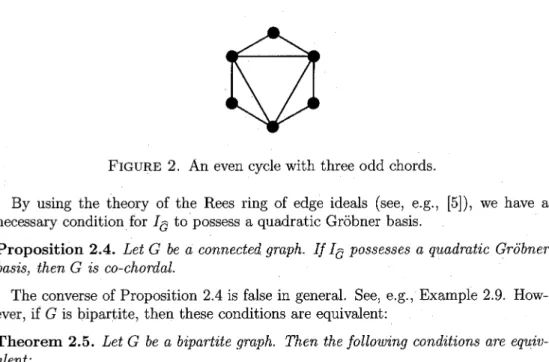
Let G be thegraph
inFigure
2.Then,
I_{G}
is notgenerated by quadratic
binomials. On the otherhand,
G isco‐chordal(and
hence2K_{2}
‐free).
(b)
If G is abipartite
graph consisting
of acycle
C oflength
6 and a chord ofC, then
I_{G}
isgenerated by
twoquadratic
binomials. On the otherhand,
Gis not
2K_{2}
‐free.FIGURE 2. An even
cycle
with three odd chords.By using
thetheory
of the Reesring
ofedge
ideals(see,
e.g.,[5]),
we have anecessarycondition for
I_{\hat{G}}
to possess aquadratic
Gröbner basis.Proposition
2.4. LetG be a connectedgraph. If
I_{\hat{G}}
possesses aquadratic
Gröbnerbasis,
then G is co‐chordal.Theconverse of
Proposition
2.4is false ingeneral. See,
e.g.,Example
2.9. How‐ever, if G is
bipartite,
then these conditions areequivalent:
Theorem 2.5. LetG be a
bipartite
graph.
Then thefollowing
conditions areequiv‐
alent:
(i) I_{\hat{G}}
isgenerated by quadratic binomials_{f}.
(ii)
K[\hat{G}]
is Koszul,(iii)
I_{\hat{G}}
possesses aquadratic Gr\dot{o}bnerbasis_{f}.
(iv)
G is2K_{2}
‐free;
(v)
G is co‐chordal.Remark 2.6.
Bipartite graphs satisfying
one of the conditions in Theorem 2.5 arecalled Ferrers
graphs
(by
relabeling
thevertices).
Theedge
idealI(G)
ofa Ferrersgraph
Gis well‐studied.See,
e.g.,[2].
and[3].
If G is not
bipartite,
then the conditions(i)
and(ii)
in Theorem 2.5 are notequivalent.
Infact,
Example
2.7. Let G be acycle
oflength
5. Then\overline{G}
is also acycle
oflength
5.Hence Gis not \mathrm{c}\mathrm{c}\succchordal but
2K_{2}
‐free.By
Theorem2.2 andProposition 2.4,
I_{\hat{G}}
isgenerated by quadratic
binomials and has noquadratic
Gröbner bases. Note that\hat{G}
is thegraph
inExample
1.4 and thatK[\hat{G}]
is not Koszul.Recall that a finite connected
simple graph
G is called(*)
‐minimal ifG satisfies(*)I_{G}
isgenerated by quadratic
binomials andpossessesnoquadratic
Gröbner basisand if no induced
subgraph
H(\neq G)
satisfies the condition(*)
. Thesuspension
graph
\hat{G}
given
inExample
2.7 is\mathrm{a}(*)
‐minimalgraph.
Wegeneralize
thisexample
andgive
anontrivialinfinite series of(*)
‐minimalgraphs:
Theorem 2.8. LetG be the
graph
onthevertex set[n]
whosecomplement
is acycle
of length
n.If
n\geq 52.
Then,
I_{\hat{G}}
isgenerated by quadratic
binomials since G is co‐chordal(and
hence2K_{2}
‐free)
andI_{G}=(0)
. On the otherhand, computational
experiments
in Section3 show that
\hat{G}
is(*)
‐minimal.3. COMPUTATIONAL EXPERIMENTS
In this
section,
we enumerate all finite connectedsimple graphs
Gsatisfying
thecondition
(*)
up to 8 verticesby utilizing
various software.Proposition
1.2gives
an
algorithm
to determine if a toric idealI_{G}
isgenerated by quadratic
binomials.Since the criteria in
Proposition
1.2 are characterizedby
cycles
of G, we need toenumerate all even
cycles
and minimal oddcycles
of G in order toimplement
thealgorithm.
Weimplement
thealgorithm by utilizing CyPath
[18]
which is acycles
and
paths
enumerationprogramimplemented by
T. Uno. Thealgorithm
is usedatstep
(2)
of thefollowing procedure
to search for thegraphs
satisfying
(*)
.(1) (generating step)
We usenauty
[9]
as agenerator
of all connectedsimple
graphs
withnvertices up toisomorphism.
(2)
(criterion step)
The criteria inProposition
1.2 detectgraphs
G whose toricideals
I_{G}
aregenerated by quadratic
binomials. These are candidates forsatisfying
the condition(*)
.(3) (exclusion step)
For each candidateG,weiteratethefollowing
computation.
(a)
Anewweight
vectorw ischosenrandomly
on each iteration.(b)
Wecompute
a Gröbner basis of the toric idealI_{G}
withrespect
to thechosen
weight
vectorw withRisa/Asir[12].
(c)
If the Gröbner basisisquadratic
then Gis excluded from candidates.(4) (final
checkstep)
We check the Koszul property ofK[G]
withMacaulay2
[4].
Ifit is not Koszul thenI_{G}
possesses noquadratic
Gröbner basis. If it isindeter
\acute{\min}\mathrm{a}\mathrm{b}\mathrm{l}\mathrm{e}
thenwe computeall Gröbner basesby using
TiGERS[7]
orCaTS
[8].
Inour
experimentation,
we take 10000to be the number of iterationsatstep
(3)
inthecaseof 8 vertices.
Then,
there are 214graphs
asremaining
candidates and we can check that 213graphs
of these are not Koszul withMacaulay2.
The last oneisindeterminable
by computational
methods in our environment.However,
Theorem2.8 tells us that it has no
quadratic
Gröbnerbasis,
because it is thesuspension
of the
complement graph
of acycle
whoselength
is 7.Therefore,
wecomplete
classification of the finite
graphs
with 8 vertices. Table 1 shows numbers of(1)
theconnectedsimple graphs,
(2)
thegraphs
whose toric idealsI_{G}
aregenerated by
quadratic
binomials(include
number ofzeroideals), (4)
thegraphs
satisfying
(*)
TABLE 1
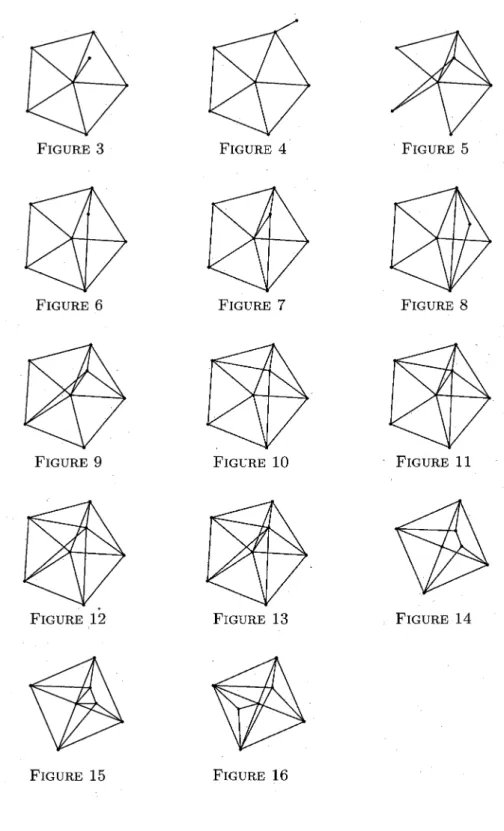
the 14
graphs
(Figures 3−16)
satisfying
(*)
with 7 vertices.Figure
15belongs
tothe infinite series inTheorem 2.8 andFigure
5 isthe(*)
‐minimalgraph
inExample
2.9.REFERENCES
[1]
L.S. Chandran, V.V. Lozin, and C.R. Subramanian, Graphs of low chordality, Discrete Math. Theor. Comput. Sci., 7(2005),
25‐36.[2]
A. Corso and U.Nagel,Monomial and toric ideals associatedtoFerrersgraphs, Trans. Amer. Math. Soc. 361(2009),
1371‐1395.[3]
A. Dochtermann and A. Engström, Algebraic properties ofedge ideals via combinatorialtopology,Electron. J. combin., 16
(2) (2009) (The
BjörnerFestschriftvolume),
\#R2.[4]
D.Graysonand M.Stillman, Macaulay2,asoftwaresystemfor researchinalgebraicgeometry,http://\mathrm{w}\mathrm{w}\mathrm{w}.math.uiuc.edu/Macaulay2/
[5]
J. Herzogand T. Hibi, (Monomial Ideals GTM 260, Springer‐Verlag, Heidelberg,2010.[6]
T.Hibi, K.Nishiyama, H. Ohsugiand A. Shikama, Manytoricidealsgenerated by quadratic binomialspossessnoquadratic Gröbnerbases, J. Algebra408(2014),
138‐146.[7]
B. Huber and R.Thomas,TiGERS,http://\mathrm{w}\mathrm{w}\mathrm{w}.math.washington.\mathrm{e}\mathrm{d}\mathrm{u}/\sim_{\mathrm{t}\mathrm{h}\mathrm{o}\mathrm{m}\mathrm{a}\mathrm{s}}/\mathrm{p}\mathrm{r}\mathrm{o}\mathrm{g}\mathrm{r}\mathrm{a}\mathrm{m}\mathrm{s}/tigers.html
[8]
A.Jensen, CaTS, http://\mathrm{w}\mathrm{w}\mathrm{w}.soopadoopa.\mathrm{d}\mathrm{k}/\mathrm{a}\mathrm{n}\mathrm{d}\mathrm{e}\mathrm{r}\mathrm{s}/\mathrm{c}\mathrm{a}\mathrm{t}\mathrm{s}/cats.html[9]
B. McKay,nauty, http://pallini.di. uniromal.\mathrm{i}\mathrm{t}/[10]
E. Nevo, Regularity ofedge ideals ofC_{4}‐free graphs viathe topology of the lcm‐lattice, J. Combin. TheorySer. A 118(2011),
491‐501.[11]
E. Nevo and I.Peeva, C_{4}‐freeedge ideals, J. Algebraic Combin. 37(2013),
243‐248.[12]
M.Noroetal.,Risa/Asir,
acomputeralgebrasystem,http://\mathrm{w}\mathrm{w}\mathrm{w}.math. kobe‐u.ac.\mathrm{j}\mathrm{p}/\mathrm{A}\mathrm{s}\mathrm{i}\mathrm{r}/
[13]
H. Ohsugi, J. Herzog and T. Hibi, Combinatorial puresubrings, Osaka J. Math. 37(2000),
745‐757.
[14]
H.Ohsugiand T. Hibi,Koszulbipartite graphs, Adv. in Appl. Math.22(1999),
25‐28.[15]
H.Ohsugiand T.Hibi, Toricidealsgeneratedby quadratic binomials, J. Algebra218(1999),
509‐527.[16]
H. Ohsugiand T. Hibi, Indispensablebinomials of finitegraphs, J. Algebra Appl., 4(2005),
421‐434.
[17]
B.Sturmfels, (Gröbner bases andconvexpolytopes Amer. Math.Soc., Providence, RI,1996.[18]
T.Uno, CyPath, http://research.nii.ac.\mathrm{j}\mathrm{p}/^{\sim}\mathrm{u}\mathrm{n}\mathrm{o}/\mathrm{c}\mathrm{o}\mathrm{d}\mathrm{e}/cypath.html[19]
R.Villarreal, Reesalgebrasofedge ideals, Comm.Algebra, 23(1995),
3513‐3524.Department
of MathematicalSciences,
School of Science andTechnology
Kwansei GakuinUniversity
2‐1
Gakuen, Sanda, Hyogo 669‐1337, Japan
E‐‐mail:[email protected]
FIGURE 3 FIGURE 4 FIGURE 5
FIGURE 6 FIGURE 7 FIGURE 8
FIGURE 9 FIGURE 10 FIGURE 11
FIGURE 13 FIGURE 14