
近畿大学学術情報リポジトリ
24
0
0
全文
(2) Vol.. 57,. No.. 3. Introduction. Transportation. has many positive characteristics. and for society as a whole. decades, has experienced tion has undesired. unprecedented. side effects.. cannot be facilitated a situation. why the transport. growth.. The almost unlimited. which leads to congestion.. Governments. (at the regional,. national. challenge,. The challenge. is often presented. are generally. called. and the question. the framework. 'Transition. proach to overcome barriers help public decision makers and to what extent certain. desirable. This article transport.. addresses. Transition. and private. Rotterdam.. is illustrated. Finally,. 1.. transformation. Section. concern. for. transport in Section. in Section 4, conclusions. The. the. and sustainability.. demand. for. transport'. is a new approach. as a management. processes. ap-. strategy. regarding. transport. to how. system.. for sustainable. and the opportuni-. system are explained.. The applica-. case in the port of. are drawn.. burden 2. introduced,. can be guided in a. management. 3 by a concrete. ?. system.. is an innovative. the need to strive. Sustainable. environmental. This is. How can this be materialised. in this case a more sustainable. sustainable. in the. that policy meas-. actors deal with questions. In Section 2, the concept of transition. tion of the concept. aware. management. and can be considered. in the first. ties to reach a (more). The. arises:. of policy making. complex societal direction,. are encompassed. as the need for a 'sustainable. Management'.. con-. mobility.. stakeholders. an enormous. of new infrastructure,. and the global level), safety,. ures are needed to find a balance between accessibility. Evolving within. demand for transportation. These concerns. and sustainable. and other. sector, for several. At the same time, there are serious. issues, and resource management.. concept of sustainability. user. At the same time, transporta-. on an equal basis by the construction. cerns related to emissions health. This explains. both for the individual. ( 492 )—. Transport. caused by. human. action. has. been.
(3) The Introduction of Transition Management to Come to a Sustainable Transport Sector: An illustration from the port extension in Rotterdam (Geerlings) studied for many years and is reflected in numerous The discussion tainable able. has gained. development. development. momentum. in the 1980s. appeared. reports. and policy documents.. by the introduction. of the concept of sus-. One of the first references. to the term sustain-. in UNCED's. Later, in 1987, the World Commission. 1980 World. for Environment. Conservation and Development. described the concept of sustainable development more extensively `O ur Common Future' (the Brundtland Report). In this report, velopment. the ability. that. meets. of future. It is interpreted the exploitation. by Geerlings. the thinking. development. level, the discussion organized. in their report sustainable. de-. to meet. present. their. without. own. compromising. needs".. at al. (2008) as "a process of investment,. of change in which. the orientation. change are all in harmony. of tech-. and enhance both. to meet human needs and aspirations". about sustainable. also received. development. considerable. attention.. in relation. to techno-. On the international. then received a new impetus from the Rio de Janeiro. by UNCED. in 1992, where. adopted in which Sustainable future. of the. the direction. and institutional. and future potential. As a result. the needs. generations. of resources,. nical development,. logical. (WCED). is defined as:. " a development. current. Strategy.. the. Development. action. plan. Agenda. Summit. 21 (1992) was. was chosen as the leading principle. for. development.. There is, however, as yet no universally sustainable. development,. prets sustainable resources,. potential. development. the direction. and institutional. (the exploitation cal development);. transport.. as a process. of investments,. of resources);. The Brundtland. the orientation. systems. of technical. In the WCED report are identified:. system. 3 ( 493 )—. (institutional. of. development, and future on sustain-. the ecological. the economic system (investments. and the social-cultural. report inter-. and enhance both current. needs and aspirations.. three interrelated. of sustainability,. of change in which the exploitation. change are all in harmony,. to meet human. able development,. or sustainable. accepted definition. system. and technologichange).. These.
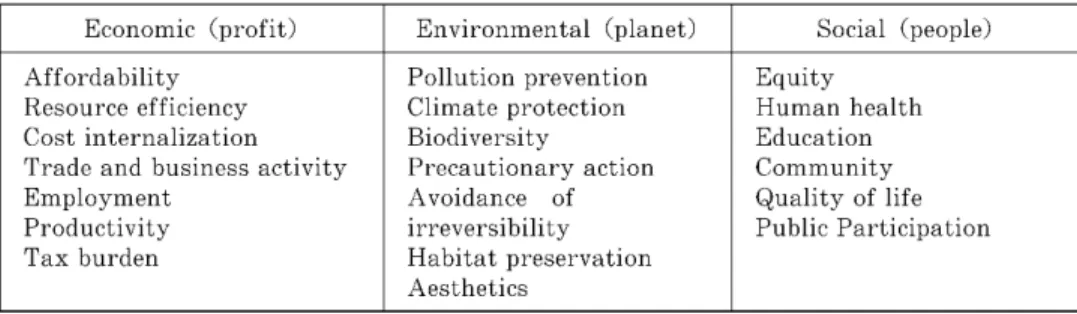
(4) Vol. 57, No. 3 systems. are interrelated. and these interrelations. Two of these are the production Sustainable. development. ing, goals, which these different. and the regeneration distinguishes. hence makes. goals.. several,. it a very difficult. Three interrelated. include the ecological. system. socio-cultural. ( `people').. system. can be expressed function. sometimes. within sustainable. the economic. Especially. system. in matters. ability. is sometimes. will be more difficult. defined. long-term. resource. represent. the greatest. narrowly.. between. ( 'profit'),. and the the right. development. in har-. to put into operation.. Some studies of sustainability. depletion and air pollution. oppos-. development. where finding. balance between ecological and economic aspects is concerned, mony with sustainability. seemingly. task to find synergy. systems. ( `planet'),. as functions.. problems,. on the grounds. Sustainfocus on that they. risk and are prone to being neglected by conventional. plan-. ning (TRB, 1997). Given the serious. impact. concepts of sustainability. of transportation,. and sustainable. transport.. provide social and economic connections, portunities. offered. by increased. ing defined more broadly. Cost. 1. (profit). Sustainability. Pollution. exist to. is increasingly. (planet). protection. Biodiversity. be-. activity. Precautionary. action. Avoidance. Productivity. irreversibility Habitat preservation. burden. Social. (people). Equity Human. health. Education. Employment Tax. systems. in the. Issues. prevention. Climate. efficiency. and business. Transport. But sustainability. Environmental. internalization. Trade. interest. to include the range of issues listed in Table 1.. Affordability Resource. is growing. and people tend to quickly take up the op-. mobility.. Table. Economic. there. of. Community. Quality Public. of life Participation. Aesthetics. It is also important static. situation. above.. that. to stress. that the concept of sustainable. can be described. The concept of sustainability aspects). in the sustainability. mobility. issues. is not a. as presented. has to be achieved over time, and is part of. a process. (temporal. which. also. aspects).. The concept of sustainability. manifest. on a spatial. is being translated. 4 ( 494 )—. scale (spatial. and applied in many.
(5) The Introduction of Transition Management to Come to a Sustainable Transport Sector: An illustration from the port extension in Rotterdam (Geerlings) different. sectors,. conservation. port,. as. agriculture,. production. It is also being applied in the transport. according. to a report. www.VTPI.org. (i). such. by the Transportation. processes, sector.. allows the basic access and development safely and consistent. energy. Sustainable. Research. reference to TRB, 2008), is a transport. and. Board. trans-. (see website. system which:. needs of the people to be met. with human and ecosystem. health, and promotes. eq-. uity within and between successive generations; (ii) is affordable,. operates. mode and supports velopment;. a competitive. or development, generation. while minimizing. rarely occurs.. of the external. effects.. are quite substantial. ways.. (e.g. noise), some are pervasive. ly, there is a clear distinction pact at the place where which are transported. external. to do with the. effects of motorized. In terms. of timescales,. (e.g. hydrocarbons),. and others are cumulative. ef-. some. some are. (e.g. CO2).. Spatial-. between those adverse effects that have a direct im-. they through. Some of the impacts. sector and all its external. This has, for instance,. The negative. in significant. (e.g. visual intrusion),. are generated. (e.g. emissions. the air on a continental. are associated. easily measured. (SO2); others,. quality. life, are more subtle,. of urban. at the level of generation. the impact on the use of land and the. of the transportation. situation. are instantaneous. (CO2).. de-. of noise.. fects, this optimum. permanent. economy, as well as balanced regional. and waste, and uses resources. But in the development. transport. offers a choice of transport. and. (iii) limits emissions. characteristics. fairly and efficiently,. particularly. of lead). and those. or even a global. with direct physical those affecting. and less susceptible. scale. effects and can be. public heath and the to objective measure-. ment, etc. From a societal perspective accessibility creasing. and the increase. congestion.. there is, for instance, of emissions. It is expected. a tension between improving. or between. economic. that the environmental 5 ( 495 )—. growth. interest. and in-. will increase.
(6) Vol. 57, No. 3 in importance,. and will have implications. for the transport. sector. (see also Geer-. lings and Lohuis, 2008).. 2.. The. Traditional. emerging. transport. concept. planning. cles, but may fail to adequately. of transition. management. aims to improve. especially. for vehi-. consider the wider or long term impacts.. This is. also reflected in policy making experiences. mobility,. in modern times.. Initially,. just after. the Second World War there were high hopes, in the U.S., Europe, the Sovjet Union and Japan society. concerning. the potential. (the welfare state).. ed, however system.. differently. Japan. and also the trade success cumulated. to construct. a new and better. The ideology of a welfare state was generally. interpreted,. managed. of mankind. in both the. capitalist. to become one of the leading. relations. with the Netherlands. to the following. trade figures. and the. economies. accept-. communist. in the world,. became very successful.. The. over the last 6 years.. Table 2 Trade between the Japan and The Netherlands in (billion yen) Year. 2004. 2005. 2006. 2007. 2008. 2008. Exports. 1,447. 1,448. 1,713. 2,180. 2,185. 1,260. Import. 214,9. 235. 253. 329. 395. 322. Source: website Embassy of Japan in the Hague, The Netherlands.. There was also a new spirit encouraged. to claim a central. prospects.. Therefore,. science, where governments. role in society to provide. a new policy steering. digm, what we nowadays cal science, identifies. within political. Visited 2010-12-26. paradigm. guidance. the relationship. between. for these new. was developed.. consider to be the 'classical steering. were. This para-. paradigm'. in politi-. the policy maker and the public as. the central object of study. After. all the expectations. raised by new management. tools and the govern-. ment policies developed in the 1950s, 1960s and 1970s, the results were disappointing. types of problems,. The failures. of government. such as the economic -. recession,. 6 ( 496 )—. actually. policies were reflected unemployment,. achieved in new. and environ-.
(7) The Introduction of Transition Management to Come to a Sustainable Transport Sector: An illustration from the port extension in Rotterdam (Geerlings) mental. problems.. dynamics.. It appeared. Consequently,. that. policies. of policies were addressed. policies.. ingly complex. decision process. lated). the problems. an increasing. Thirdly,. group,. there. of each policy. number. took. for the failure. of. society became increas-. of actors became involved in the. was an increasing. interdependence. between. (re-. policy areas.. As a result directing. paradigm. governments. strong. a debate took place on the role of the central. role of government. steering. in society.. The opinion. became. decline in the legitimacy. accepted. these. is also recognisable. of human. settlements. tion, and the availability the transport transport. sector. is often a complex. in the transport. the. transportation.. complexity. agencies,. on. govern-. sector.. The transport. actors and factors,. including. the organization. of produc-. This means that decision-making issue.. Any intervention. in. to make the vision concern-. for people and goods, not least because polia long time to be successfully. because of the need to address. transportation. From this perspective,. have led to a. became apparent.. such as global warming. that focuses on a transition. to. take. we observe, partly. into real sustainable. failures. must be based on a long-term. mobility. character. cated policy challenges. policies of central. level; hierarchically-organized. of infrastructure.. ing the goals of sustainable. Presently. the classical. and governmental. and consumption,. system more sustainable. cies of a structural. and central. was that. effective. sector is a complex system that depends on multiple the pattern. rationale. are less efficient, and are mainly focused on their own. At the same time, new factors. This development. that. of governments. and as the national. ments create bureaucracies, interests.. The conclusion. was not capable of implementing. both the international. due. and legislation. explanations. confronting. has its own. expected, the benefits. procedures. There are various. Firstly,. Secondly,. execution. were less effective than. to the wrong. more time than was expected. government. the. that. implemented.. new and very compli-. and to transform. transportation. is now time for new policy paradigm. management. there of. are increasing. problems. At the beginning. that. demands arise. of the 21st century, 7 ( 497 )—. in. for policy integration, the. wider. context. two OECD reports. of. referred.
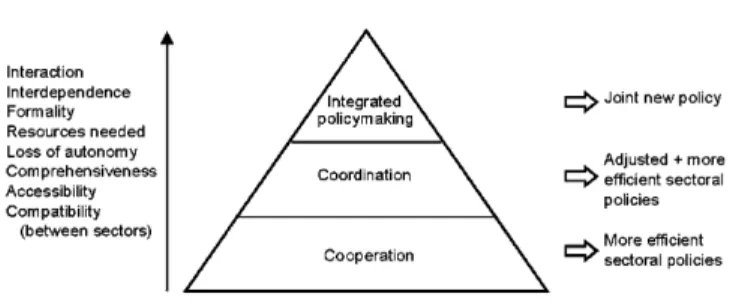
(8) Vol. 57, No. 3 to policy coordination lings, 2005).. and includes analysis. approaches. the critical greater. for the. (OECD,. of sustainable. about. of economic,. It identifies. three. can develop in-. The second discusses. and talks. integration. policies.. integration. 2001a).. development,. and the better. and social goals in different. Stead and Geer-. and advice on how governments. for sustainable. policy coherence. (see for instance. focuses on policies to enhance sustainable. to decision-making. issues. approaches. analysis. The first of these reports. development, tegrated. for a thorough. distinct. development. the need for environmental organizational. into policy. (OECD.. 2001b). Within the literature cepts can be found These include and. concerning. the theory. (for a more detailed. on policy integration. review,. see Geerlings. various con-. and Stead, 2003).. coherent policy-making, cross-cutting policy-making, policy coordination,. holistic government, also. known. as joined-up policy or joined-up. Whilst some authors. see policy coordination. grated. others. policymaking,. OECD (1996), for example, more sophisticated. regard. them. observes. as more or less the same as inteas quite. separate. that policy integration. than policy coordination. government.. and distinct.. The. is quite distinct. and. in two ways: a- the level of interac-. tion; and b- the output.. Interaction Interdependence Formality Resources needed Loss of autonomy Comprehensiveness Accessibility Compatibility (between sectors). Joint new policy. Adjusted + more efficientsectoral policies More efficient "—K sectoral policies. Source: Stead et al., 2004 Figure 1 Different levels of policy cooperation and integration. Other. related. relevance concerning organisational These. related. concepts. in the organizational. policy integration. collaboration, concepts. that. have potential. include inter-organizational coordination, inter-. inter-governmental. primarily. literature. concern. management and cooperation. 8 ( 498 )—. network management.. between. organizations,.
(9) The Introduction of Transition Management to Come to a Sustainable Transport Sector: An illustration from the port extension in Rotterdam (Geerlings) rather. than. cooperation. between. departments. within. nevertheless. also relevant. since inter-organizational. ganizational. policymaking. are to a considerable. integrating ferent own. issues that are cross-sectoral.. sectoral specific. departments. styles,. policymaking extent. similar. but are. and intra-or-. when it comes to. After all, within one organization,. often operate. professional. one organization,. as different. approaches,. organizations. needs,. agendas,. dif-. with their. and. modes. of. operation. The interest documents. in policy integration. on governance,. also has links with various. such as the European. ance (CEC, 2001a), although. the document. recent. White Paper on European. contains. policy Govern-. no specific details about. the. process of policy integration.. 2.1. The application of new leading principles in transportation. New principles. of policy making for the transport. duced should be based on a set of priorities tance to facilitate. transportation,. which are in balance with the impor-. but which also specifies enhance criteria. the point of view of sustainable shift, optimization,. sector that need to be intro-. development.. The priority. is prevention,. from modal. and facilitation.. A Multilayer. Approach. Spatial planning Transport. A. .. prevention. Pricing Stimulating. public. A=k transport. Preference. Mobilitymanagement-.a Modal. from. perspective sustainability. shift. -.. Infrastructure capacity management_.Ak Infrastructure upgrading Infastructure constructing Figure. 2. Priority. The pyramid and types. pyramid. -.. for the development. shown in Figure. of transport. 2 (known as a priority. transport. growth. pansion. infrastructure. policies. ladder) presents. that could help policies to save transportation. The fact that transport of the required. of sustainable. options. problems.. can not be followed at the same speed by the ex-. -. shows that 9 ( 499 )—. coping with the increased. de-.
(10) Vol. 57, No. 3 mand of transport not comply. with the sustainability. congestion. result. by infrastructure. and increased. from the existing. mation. with, for example,. Transition. strategy. processes. management. for public how and. concept. to what. in a fundamental. extent. refers. adopting. transfor-. direction".. process. or more.. in. Transi-. processes as a result. of si-. developments. (Rotmans,. 2003).. Transition. model for sustainable. or innovation. Transition. Transition. man-. in that it. but rather. goals, while acknowledging. are unknown.. development,. management. results,. man-. with orientthat the exact. management. is a govern-. makes the future more clearly manifest in current decisions, by. nues for system innovation. ment requires. that. societal domains and the combined action of. sustainability. longer time frames,. of transition. societal. and as a field of academic research.. outcomes of this development. actors. to a transformation. is not so much concerned with achieving predefined. which. desirable. transformation. from classical management. towards. complex. way. (2003) as:. and private. way over a generation. as gradual in different. makers. in a certain. can also be described as a governance. ance approach. demand. of integrated. is defined by Rotmans. decision. of transitions. meso- and micro-level. ing development. reduced travel. may. transport.. can be directed. developments. differs. planning. and the dynamics. as a specific policy discourse agement. and spatial. perspectives. tions can best be understood. agement. transport. process-oriented. which society changes. multaneous. In fact, it often leads to more. seems to evolve in a natural. the question. The theoretical. does. management. " a management with. of the pyramid). of transition. system innovation.. deals. outcome. also of non motorized. The new approach. (bottom. perspectives.. On the other hand, integrating. in a more sustainable. macro-,. construction. management transitions:. tal system is structurally. exploring. alternative. trajectories,. (as well as system improvement). in both theory non-linear. processes. transformed. these complex societal systems,. is that sustainable. develop-. of social change in which a socieof change in. levels in time and (functional). 10 ( 500 )—. ave-. The basic premise. In order to describe processes. different -. and practice,. and opening. aggrega-.
(11) The Introduction of Transition Management to Come to a Sustainable Transport Sector: An illustration from the port extension in Rotterdam (Geerlings) tion are distinguished, tern'. frameworks. Loorbach,. resulting. applied. 2009).. in the 'multi-phase',. in transition. analysis. 'multi-level' (Rotmans,. This complex system perspective,. phase frameworks. in transition. studies,. and 'multi-pat-. 2005; Rotmans. and the multi-level. form the theoretical. and. and multi-. basis of transition. management. An important only breaks. hypothesis. through. force each other, a particular. in transition. if developments. slow developments. domains. fast developments.. rein-. and the evolutionary. at. of long-term,. This is illustrated. in the concept of transition. change. come together. then is the result of a mixture. ure 3 below, where the classical linear approach ing are combined and integrated. fundamental. meso- and micro-level. within different. A transition. and short-term,. is that. at the macro-,. and if developments. scale level.. theory. in Fig-. way of think-. management.. Macro: Evolving sociotechnical landscapes J Meso: A patchwork of regimes. 1. 2. [1] Novelty, shaped by existing regime [2] Evolves, is taken up, may modify regime [3] Landscape is transformed Source: Figure. Transition. Rip 3. The. ness and citizens). ogy oriented. Kemp. multilevel. management. and to bring together. of sociologists. and. (1998) model. of. innovation. aims to foster. many actors. that ecological modernisation and that it neglects. learning. (technologists,. to work on sustainability. transformation. about. system. designers,. transitions,. innovations. governments,. busi-. taking on board criticism. is often too much supply and technol-. issues of lifestyle 11 ( 501 )—. ^. and. and values.. It is a model for.
(12) Vol. 57, No. 3 working. 2.2. towards. systemic. change and innovation. (Weterings. The meaning of transition management for sustainable transportation. The concept. of transition. such as the energy sector, tion sector is considered. ronment. where. as another. change. But the situation. suitable. is difficult. growth. is being. applied. is considered. to transport. as a relatively. supply.. solutions. It seems quite clear that sustainable. be a promising. and that. technology. approach:. can be gained from the implementation in line with the revaluation place.. of different. problems. technological. for economic. This opinion. sector.. Indeed, it is indisputable. ble the more efficient higher productivity Rotmans. sights. and. widespread. policy support. problem is simply not attainable structures.. Measures. thinks that this is caused by lack of a sustainability. to new perspectives,. Rotmans. with far-reaching. has made possihas led to. in the world.. of the factors. with present. to tackle. or fail to bring true solutions.. In this context,. in the transport. development. improvement. these. 12 ( 502 )—. contrib-. technological. problems. often. inlack. In his opinion, the transport in a sustainable. direction.. objectives, and innovation. calls for change in thinking,. measures. fuels).. to be the motor. and capital that, in turn,. system seems to be locked-in, and is not developing. the system level.. filters, alternative. and, as a direct effect, more transportation that a significant. are. which is seen as. particularly. that technological. amelioration. These prospects. are considered. is expressed. manage-. in society that is presently. (e.g. introducing. use of energy, materials. (2003) states. uting to transport. environmental. with technology,. innovations. on energy. to transition. of new technologies.. fascination. From this perspective, welfare.. a significant. dependency. need to be found for these. in relation. of the role of technology. We observe a certain. key to a number. infrastructures).. in all parts of the world has created problems and a strong. ment might. stable envi-. more and more challenging.. such as the emission of CO2, noise, congestion,. problems,. It is generally. (e.g. cities, road. is becoming. sectors,. The transporta-. sector in this regard.. to achieve. of transport. transportation. in various. and water management.. infrastructure. in relation. The continuous. management. agriculture. accepted that the physical. taking. et al., 1997).. and integrated. solutions. He on. leading based on.
(13) The Introduction of Transition Management to Come to a Sustainable Transport Sector: An illustration from the port extension in Rotterdam (Geerlings) the new theory. of transition. et al, 2010) present. management.. Some authors. the concept of transition. proach to overcome barriers. management. from the past.. abandoned. In this way, a transition traverse.. breakthrough. stead of designed, with technology The above-mentioned. appealing. of the transport. is a methodology. every situation, scriptive,. approach. achievements. and hardly and ideas,. In this paragraph in particular. The. the theory. to in-. sounds ambitious, Past transport. poli-. has not been made, and. in the technological its underlying. of a toolbox applicable. aspects processes. ex-ante oriented. (applicable).. scholars. man-. in every sector, in. In its case studies, the approach. is rather. de-. In advocating. do not acknowledge. the. the practice of individuals. (TRANsition. is a Dutch. platform. governments. experiment. about transition. ences of the Transumo. of knowledge. analysis. Transumo-A15. to sustainable. national. have to be generated. has been created that transition. the different. in the Dutch transition. sumo. in the attempt. achieved in the past.. 3.. practice,. that consists. governance. unspecific.. Specific expertise. and at any moment.. not analytical. a 'radical'. rather. However, the impression. top-down. management. sector is needed in order to understand. and mechanisms.. for the sys-. a role.. but a thorough. are lacking.. solutions. created. solutions. of transition. still remain. as ineffective,. alternatives. agement. approach. implications. cies are described. playing. ap-. and market-developments.. path is not chosen, but rather. In this way possible. but the practical. Therefore,. in favour of user demands. 2003; Grin. as an innovative. They advocate. tem as a whole, instead for parts of the system. needs to be partly. (Rotmans,. with regard. The chapter. SUstainable. Mobility). over 300 companies, institutes. to sustainable. that cooperate. mobility.. 13 ( 503 )—. is translated. and institutions. mobility.. including. and knowledge. management. into. that are involved. discusses the experiA15 project. local,. regional. Tranand. in the development.
(14) Vol. 57, No. 3 3.1. Complexity in the region: the Port and the A15-motorway. The Rotterdam. Port area (Figure. for the Netherlands. (about. 5 per cent of the national. per cent of the GDP is generated logistic and industrial. in this region).. and the North Sea.. nomic perspective. it is seen as important. However, the handling. transport freight. of the available. modalities:. considerably. shippers,. Maasvlakte'. that the ongoing. capacity. largest. is the name. in 1957 between. In the Port there. by road, but increasing. This not only increases. growth. and inland shipping congestion. the transport. the. and from an ecoof the port is. of the Port is bounded. infrastructure.. but also has a negative. was created. The Port is thus growing,. road, rail, coastal. is transported. is Europe's. 10. land in the region of the Port of. areas that. city of Rotterdam. port capacity. and about. because more space was needed in the Europoort. the complex of ports and industrial. facilitated.. 2008).. zone built on reclaimed. It was created. employment,. Rotterdam. hub (Port of Rotterdam,. of the port and industrial Rotterdam.. 4) is an area of major economic importance. by the transare five major. and pipeline. lengthens. Most. travel. time. costs of transporters. impact on the international. competition. and. position. of the Port. As well as longer travel time and congestion, gional environment.. Air pollution. there are also impacts. and noise put pressure. neighbourhood. on the re-. on the quality of life in. the region.. In the. Maasvlakte. eastwards,. areas that suffer. from pollution. and noise.. In the short term, between 2010 and 2015 a large-scale. road expansion. there. are several urban. from two to three lanes is planned al. 2009). ongoing. However, this extra expansion. sustainable. of the A15 motorway. that. runs. for busiest parts of the highway. capacity. of the road capacity. will only be a temporary with additional. from. (Geerlings solution.. capacity. to increase further,. only temporarily.. as the government. Apart. et The. lanes is not considered. solution in the long run: in the light of the expected growth. port it enhances. the. from that,. traffic. in transis expected. has decided to invest in an expansion. of the. Port area. This enlargement. of 400 km2, called Maasvlakte. ing new land from the sea.. This additional. 2, is being achieved by reclaim-. area will provide increased. 14 ( 504 )—. a. growth.
(15) The Introduction of Transition Management to Come to a Sustainable Transport Sector: An illustration from the port extension in Rotterdam (Geerlings) possibilities. for the Port, and hence, increased. extra infrastructure which means. will probably. that. many different. more. solutions,. and inland shipping),. sustainable. increasing. of new technology,. and better. cooperation.. of future. certainty, (Ostrom. solutions. logistical. innovations,. problems. the. et al. 2009),. One could think. of. (e.g. more rail transport infrastructure,. organizational. the in-. innovations,. issues at play in the Port area lead to a. Actors. processes and complicate. the de-. have to make decisions under great un-. while many other actors are also making 1990: 210).. (Geerlings. of existing. in the decision-making. directions.. Furthermore,. are needed.. the efficiency. The combined. high degree of complexity. latent transport. such as the modal shift policy. troduction. termination. attract. transportation.. strategic. decisions and choices. The Port is hence a good example of an area with complex. (or: 'wicked' problems). (see, for instance,. Rittel and Webber 1973, Rot-. mans 2003). A good example. of transition. project. is a project. entitled. 'From Maasvlakte to. Hinterland: Sustainable Freight Transport as Challenge' or the A15-project in short. this project zations,. the. more than 250 stakeholders, Port. Authority,. groups participated for accessibility. including. research. parties,. and environmental. problems. 30 of these stakeholders. part of the project's. consortium.. A15 is the main transport ingly from congestion. ganizational ity system accessibility. in the Rotterdam. suffers. in this joint project considered. measures. and calculated. and the local environment and sustainability. solutions. Port region from. section indicated,. of the ongoing. environment. pressure. were more closely involved, and were. As the previous. as a result. organi-. and. of finding sustainable. vein from and to the hinterland,. the surrounding. The participants. local government. in order to meet the challenge. 2020 and onwards.. Furthermore,. both public and private. transport. at present. increas-. and traffic. growth.. from air pollution. and noise.. a wide range of technical. in 2020 and 2033, in order ahead.. 15 ( 505 )—. the. but suffers. their expected effects on the regional. challenges. In. and ormobil-. to tackle. the.
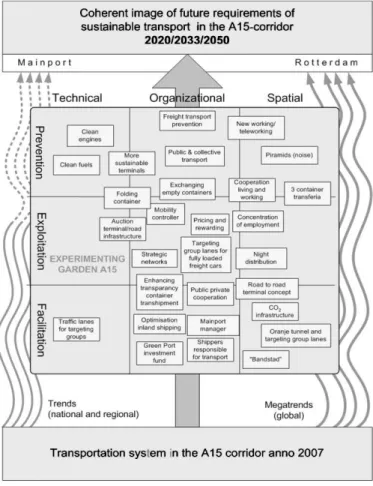
(16) Vol.. Source:. 57,. No.. 3. www.maasvlakte2.com Figure 4. Maasvlakte. 2, planned. development. 3.2 Empirical findings on the innovation impulse The consortium. of participants. cussed many possible solutions, results. in the A15-project. some of which were analysed. of this work were presented. in 'reports. thereof were formalized. ject management. some confidence. were welcomed, Sustainable,. which had been presented. and Daring.. the line of integration Figure. (as presented. 2) and the principles. these are presented. 3.3. The results. explored. on paper.. the three. By then, the proand the results. keywords:. were quite remarkable. management. Dynamic,. and organised. in Figure 1), policy priorities. of transition. (figure. The. in which the pro-. in the trajectory,. under. and dis-. in more detail.. and deliverables'. ject results and visualizations had gained. together. along. as presented 3).. in. In summary. in Figure 5.. Observations in and around the process. One of the general observations of transition. terminology.. were filled with the terms novation'. and. 'transition. in the A15-project. The project documents `sustainability', to sustainable. (proposals,. 'transition mobility'.. relates to the excessive use. management', During. however, these words were used much less, and sometimes provided. a format. in which project. documents 16 ( 506 )—. plans and reports) 'system. the actual not at all.. had to be delivered. in-. meetings, Transumo. (Lohuis. et al,.
(17) The Introduction of Transition Management to Come to a Sustainable Transport An illustration from the port extension in Rotterdam (Geerlings). Coherent sustainable. Transportation. Figure. To be completed. 5. 2008).. system. to sustainable. were involved, and how transition. position treated. anno. 2007. impulse in the Transumo-A15. of the Dutch transport. mobility,. management. of 'people, planet. and profit'.. which system. was applied.. participants,. 'side-effects'. or had. innovations was. the competitive. value of logistics. because of the economic. were impor-. Port.. In order to comply with the 'people-planet-profit-balance', sized the. project. 'sustainability'. In the meetings,. sector and the economic. as a given by most project. tance of the Rotterdam. of. had to specify how their project would contribute,. to the transition. defined in terms. in the A15 corridor. Scheme of the innovation. The participants. contributed,. image of future requirements transport in the A15-corridor 2020/2033/2050. Sector:. of economic optimization. the planet and people. 'Increasing ily leads to cost reduction. efficiency'. and the speeding. participants. that are indirectly. and 'combining up of traffic. 17 ( 507 )—. freight. flows. empha-. beneficial. for. loads' primar-. (good for profit)..
(18) Vol. 57, No. 3 It does, however, also lead to 'less transport' therefore. (in terms. also to 'less noise' (i.e. good for people), and. for the planet). were framed. In this way the goals of accessibility. in terms. of sustainability.. this point in project primary. meetings,. focus of the project,. 'less emissions'. and that. and. (i.e. good. and economic optimization. Both insiders. frequently. of less kilometres),. emphasizing. and outsiders that. the long-term. mentioned. accessibility. sustainability. was the. aspect was. missing. In the discussions the meetings. during. about. of pragmatic. for the ecological. considerations. frame of the project, or strategic ing group.. Moreover,. about the extent perspective.. sultants. during. members. different. While Transumo-projects in an effort. mental. organizations. were confirmed.. objectives,. researchers,. Stakeholders. research. tendency. Another. consultants,. enlarged. was the relatively project goals. cal calculation. feature. stereotypes. had the tendency. technological. during. approach,. especially. measures,. was sometimes. and practice. relates. and stereotypes. to the short. to separate. it. and environ-. term. each other into. We will come back to this. on the. during the interviews 'traditional. in comparison. trajectory'. with the broad. and the use of rather. at odds with the goal of creating. 18 ( 508 )—. closer. of this project. emerged. confirmed. the meetings. The focus on technical methods,. con-. and individu-. businesses. as conflict. later on, as it was explicitly. striking. institutes,. in the reality. ose that think short- term' and 'those that think long-term'.. particular. pro-. and company. representatives,. aim to bring research. One of the most striking. and the long term. `th. explicitly. were actually. between. within one organization.. to reach societal. seemed that the gaps between. tensions. and company. of different. departments. or a short-term. such as researchers. organizations. of the steer-. disagreements. should focus on a long-term to certain. responded. scope and time. there were significant. were related. in. called for more innova-. such as the demands. backgrounds,. environmental. and researchers,. together. the meetings. with differing. als representing. and sustainability. aspects, other participants. considerations. These disagreements. representatives,. innovation. such as the limited budget,. to which the project. ject participants. system. the first round, or when participants. tiveness or more attention in terms. long-term. technologisolutions.
(19) The Introduction of Transition Management to Come to a Sustainable Transport Sector: An illustration from the port extension in Rotterdam (Geerlings) in the Port region. for sustainable. development.. During. workers'. the discussions. predominantly. revolved around. meetings,. to use what data through. the use of what computer. most of the knowledge. model.. who was going. Fundamental. discus-. sions about goals or strategies. in the project were mostly confined to the manage-. ment. group,. team. and the steering. workers.. There was a strong. deliverables,. and hardly. discussed. with the knowledge. division between the production. on the one hand, and the political. of knowledge. and strategic. discussions,. and. on the. other.. 3.4. The relevance for the development of transition management. Many. of the participants. and the short-term. in the A15-project. perspective. as mutually. saw the long-term. exclusive.. They associated. ence between the short and the long term with various dichotomies. were confirmed. and reinforced. This meant that many discussions seemed to be about something ing in dichotomies', A15-project,. can be considered. problematic. between each of these dichotomies. 'short term' versus the. now and the future. long-term. of these dichotomies.. perspective. ture' and everything of transition. project new insights a project, variety working. and suggestions. i.e. how to safeguard of stakeholders, groups,. or faraway).. deliverables. as long as the. that. long-term, transition. abstract,. management. and administrative 19 ( 509 )—. reports.. that. process-oriented,. management. for process management. groups,. (the 'fu-. the associations. offered. in this. at the meta-level. coherence and a sense of unity. steering. be a tool to. In terms of the development. also demonstrated. management:. It ca be concluded. impossible. — in terms. with one side of the dichotomies. the results. in the. In this con-. perspective'. — could theoretically. This is, however,. that is intangible. people have with transition and normative.. is that a 'long-term. is only associated. management,. as observed. and to link them to one another.. of what happens many. This 'think-. if the challenge is to find a middle way. observation. bridge. 'long term'. aspect.. and reinforcement. nection, the most striking between. These. of the participants.. other than the actual temporal. and their confirmation. the differ-. other dichotomies.. by the majority. about the. perspective. teams,. of. in the bewildering expert. Rather,. meetings,. an important.
(20) Vol. 57, No. 3 lesson for applying. the theory. in practice is that the level of abstraction. too high for many professionals Apart. from the problem. ment',. another. normatively. participants associated. that. character. of transition. focus, which deviates from. associated. with transition. The idea of a `sustainability because of its normative. tone.. The 'is' versus. 'ought'. vision' appeared. 'describe' and. 'explain'. and those that. those that call for an understanding the understanding. the distinction. matic understanding. between. 'prescribe'. and. 'is'. versus idealism). in social science, between 'predict',. those. i.e. between. 'should be'.. can also been seen in governmental. in which it is emphasized. dichotomy. of how things 'are' and those that emphasize. of how things. This tendency. to scare off various. (or pragmatism. debates. manage-. is the degree of. This brings us to another. dichotomy. to one of the most fundamental. management. 'common project. management. with the short term versus the long term:. and 'ought'. relates. problem. from the ort community.. of the abstract. and the perceived long-term. might be. that the important. and consultancy. discourse,. thing is to 'act' on the basis of prag-. of the way things go, rather. than taking. a paternalistic. ap-. proach to decide how things should go. This is related to the preoccupation with ` what companies find important', and the tendency to accommodate them instead of 'telling. them' what they should do differently.. ever, aims to go beyond this dichotomy knowing. with absolute. certainty. between. how things. Transition 'is' and. 'ought'.. are exactly. out together. (Avelino and Rotmans This analysis. It is not about. what we can do with regard. It is about a proc-. to our common future. 2009).. demonstrates. ment faces in practice.. First,. the multiple. challenges. that transition. never intended table.. carefully,. thereby. to become only part. However, several practitioners. selves with this right-hand. manage-. it needs to be explicitly rebranded as a tool to break. through dichotomies, instead of being an approach that reinforces dichotomies. the word `rebrand'. how-. at a specific point in ti-. me, nor is it about deciding how things should be in the future. ess of figuring. management,. demonstrating of the right-hand. at the operational. column - as illustrated -. that transition. 20 ( 510 )—. column. We chose. management. of the dichotomy. level do associate. in the A15-project. them-. — and there-.
(21) The Introduction of Transition Management to Come to a Sustainable Transport Sector: An illustration from the port extension in Rotterdam (Geerlings) fore transition. management. needs to become. of these. and. itself explicitly. agement. was considered to mismatch with project management: the two were seen as types. Transition. management. ment actions likely that important. of the two columns.. associations. position. conflicting. as neither. aware. of management,. better. should. with. respond. into the trasition. professionals. guishes stract. management-model.. frame of reference for them.. normatively transition. management. terminology. help to further. emphasize. perspective. that. process tool that can be applied equally to all sectors, reflexive tool that can be designed research.. This reflexivity. sized in numerous. scientific. Kemp and Rotmans of practical. to fit the demands. principle. of transition. publications. that. as. distin-. The degree of abFor this, it would. is not simply. a generic. of the sector or region under which is empha-. et al. 2001, Loorbach communicated. Achieving. and generic. in the approach,. but that it is a flexible and. (Rotmans. by professionals.. can reduce the need for abstract. was consid-. management,. 2009), should be more explicitly. applications. all, it is un-. management. be improved.. management. manage-. as it is an. system theories.. transition. approaches.. project. is one of the things. can, however,. man-. behind,. may be inherent. from other. and thinking. and. After. management. Third, transition. The latter. and an action. objectives. to this by integrating. will leave all project. ered too abstract and too normative. allowing. differing. Second, transition. in the context. a more sector-specific. applicable. 2007,. terminology,. fit. and hence. make it more accessible for professionals.. 4.. Synthesis. In the field of transport,. gional, continental pacts differ methodology. transport. social objectives. accessibility. sector is relevant. addresses. that new approaches. and sustainability. on different. and global, but the spatial-temporal. very strongly. that. Conclusions. there is a general awareness. needed to find a balance between more sustainable. and. The need for a. levels such as local, recharacteristics. The challenge. is to develop a pro-active. the economic. (people), environmental. (people) in one coherent -. strategy.. 21 ( 511 )—. are. of the imand ex-ante (planet),. and. At the same time, it is neces-.
(22) Vol. 57, No. 3 sary to recognize. the need for cooperation. ment and private. firms to fulfil the changing. to develop a sound sustainable gets for the longer term. new and integrated ory of transition plication. transport. management.. tions of transition. policy principles. transition. more sustainable. versity. approaches. rial on the topic. overarching. conclusions. a great. arena in practice.. ess of transition a richness. management. of results,. ceptability. This is not unusual. situation. illustrates. a range of. the variety. needs to address patterns.. and issues provides. challenge.. illustrate. of different. Again, this can also be seen in. this paper. transport. defini-. are being used to investigate. On the other hand, this diversity. search in this paper, illustrated transition. that. management. is to be made towards of definitions,. mobility.. the ap-. are taken.. a wide range of different. mobility.. Thirdly,. that transition. advocates. of the conclusions.. the contributions. approaches. and sustainable. more generally.. sues and challenges. the concept of the-. the author. reveals a similar. Secondly,. and empirical. management. the literature. provides. in the field quickly. theoretical. to introduce. tar-. to come up with. before policy initiatives. and sustainable. terms and concepts being used. different. The methodology. should be made on the content. management. the govern-. policy should be based on developing. is advocated;. that the theory. A review of literature. needs of society.. In the same context,. A few general observations First is the observation. between. In this paper the need for governments. policy principles. of new guiding. and interaction. of is-. if real progress. On one hand, the di-. a richness. of subject mate-. makes the identification. The A15-project,. of. the object under re-. that it is possible to apply the full model of the. It is shown that a coherent. and well structured. proc-. can lead by the end of the day to a wide variety. that include consideration. issues, behavioural. change,. of public engagement,. opinion-shaping,. and. public ac-. and time and monetary. constraints. It s our conviction. that the concept of transition. common basis for understanding the transport filled, this. sector is presently concept. of Transition. the complexities facing.. management. related. to the new challenges. When the necessary. management. change that might lead to a more sustainable. can contribute transport. 22 ( 512 )—. will create a. system.. conditions. are ful-. to a process. of.
(23) The Introduction of Transition Management to Come to a Sustainable Transport An illustration from the port extension in Rotterdam (Geerlings). Biographical. Harry the Erasmus. Geerlings. is professor. University. dam, a new initiative. between. Most of this research. environment. and spatial. Universiteit. Amsterdam.. of Public Administration. and a member of Erasmus. the Port community. Rotterdam.. port, Infrastructure. note. in the Department. Rotterdam. of the research. University. between transport,. He holds a PhD in economics. He is member. at. Smart Port Rotter-. and the Erasmus. is related to the interaction. planning.. Sector:. from the Vrije. school TRAIL. (TRAns-. and Logistics).. During the sabbatical. of Prof. Takahiko. a nice, warm and deep friendship the family of Prof. Geerlings,. developed between Prof. Saito, his wife Yoko and. his wife Patricia. We sincerely hope this friendship. Saito in 1994 and 1995 in Rotterdam,. and the children Jasper. and Laura.. will last forever.. References. Avelino, F. and Rotmans, J. 2009. Power in Transition: An Interdisciplinary Framework to Study Power in Relation to Structural Change, European Journal of Social Theory, 12 (40), 543-569. Commission of the European Communities (CEC). 2001a. European governance: A WhitePaper, COM (2001) 428. Luxembourg: Office for Official Publications of the European Communities. Geerlings, H. 1999. Meeting the challenge of sustainable mobility; the role of technological innovations. Heidelberg: Springer Verlag. Geerlings, H. and Stead, D. 2003. The integration of land use planning, transport and environment in European policy and research. In: Transport Policy, 10, 79-196. Geerlings, H., Lohuis, J. Wiegmans, B. and Willemsen, A. 2009. A renaissance in understanding technology dynamics ? the emerging concept of transition management. TransportationPlanning and Technology,32(5), 401-422. Geerlings, H., Shiftan, Y. and Stead, D. 2011. Transition towards Sustainable Mobility: the Role of Instruments,Individuals and Institutions. Aldershot: Ashgate (forthcoming). Grin, J., Rotmans, J. and Schot, J. 2010. Transitions to sustainable developemment;new directions in ther long term transformative change. New York: Routledge. Kemp, R., and Rotmans, J. 2009. Transitioning policy: Co-production of a new strategic framework for energy innovation policy in the Netherlands, Policy Sciences,42, 303-322. Lohuis, J., Bouma I., Avelino, F., Bressers, N., Vonk Noordegraaf, D., Soeterbroek, F. and Geerlings, H. 2008. Deliverable 16 Uitkomstenvan de innovatie-impuls. Rotterdam: Erasmus University Rotterdam. 23 ( 513 )—.
(24) Vol.. Loorbach,. D. 2007.. 57,. No.. 3. Transition management: New mode of governance for sustainable development.. Utrecht: International Books. Organisation of Economic Cooperation and Development (OECD) 1996. Building Policy Coherence: Tools and Tensions. Paris: OECD. Organisation of Economic Cooperation and Development (OECD) 2001a. Policies to enhance sustainable development. Paris: OECD. Organisation of Economic Cooperation and Development (OECD) 2001b. Governance in the 21st century. Paris: OECD. Ostrom, E. 1990. Governing the Commons. The evolution of institutions for collective action. Cambridge: Cambridge University Press. Port of Rotterdam (2008) website: www.portofrotterdam.com Rip, A. and Kemp, R. 1996. Technical Change. In: Human Choice and Climate Change. An International Assessment. Vol. 2. edited by Rayner, S. and Malone, E. L. Washinton Batelle Press, Washington. Rittel, H. W. J. and Webber, M. M. 1973. Dilemmas in a General Theory of Planning.. DD: Pol-. icy Sciences, 4(2), 155-169. Rotmans, J. 2003. Transitiemanagement: sleutel voor een duurzame samenleving. Assen: Van Gorcum. Rotmans, J. 2005. Societal Innovation: between dream and reality lies complexity. Inaugural Address. Rotterdam: Erasmus Research Institute of Management, Erasmus University Rotterdam.. Rotmans, J. and Loorbach, D. 2009. Complexity and Transition Management, Journal of Industrial Ecology, 13, 184-196. Stead, D., Geerlings, H. and Meijers, E. 2004. Integrating transport, land use planning and environment policy in Denmark, Germany and England: from theory to practice. Delft University Press. Stead, D. and Geerlings, H. 2005. Integrating transport, land use planning and environment policy in Denmark, Germany and England: from theory to practice. Innovation, 18 (4), 443-453. Transportation Research. Board. (TRB). 1997.. A Guidebook for forecasting freight transport. demand. NCHRP Report 388. Washington DC: Transportation Research Board. United Nations Commission on Environment and Development (UNCED) 1980. World Conservation Strategy. UNCED, New York. United Nations Commission on Environment and Development (UNCED) 1992. The declaration of Rio: Agenda 21. UNCED, New York. Weterings R., Kuijper J., Smeets E., Annokkee G. J. and Minne B. 1997. 81 mogelijkheden: Technologie voor duurzame ontwikkeling (81 possibilities: Technology for sustainable development). Delft: TNO report for the Ministerie van Volksgezondheid, Ruimtelijke Ordening en Milieuhygiene (VROM). World Commission on Environment and Development (WCED). 1987. Our Common Future. Oxford, Oxford University. Press.. 24 ( 514 ).
(25)
図

関連したドキュメント
In the second computation, we use a fine equidistant grid within the isotropic borehole region and an optimal grid coarsening in the x direction in the outer, anisotropic,
Keywords: continuous time random walk, Brownian motion, collision time, skew Young tableaux, tandem queue.. AMS 2000 Subject Classification: Primary:
[Tetali 1991], and characterises the weights (and therefore the Dirichlet form) uniquely [Kigami 1995]... RESISTANCE METRIC, e.g. equipped with conductances) graph with vertex set V
Then it follows immediately from a suitable version of “Hensel’s Lemma” [cf., e.g., the argument of [4], Lemma 2.1] that S may be obtained, as the notation suggests, as the m A
Review of Lawson homology and related theories Suslin’s Conjecture Correspondences Beilinson’s Theorem More on Suslin’s (strong) conjeture.. An Introduction to Lawson
This paper presents an investigation into the mechanics of this specific problem and develops an analytical approach that accounts for the effects of geometrical and material data on
While conducting an experiment regarding fetal move- ments as a result of Pulsed Wave Doppler (PWD) ultrasound, [8] we encountered the severe artifacts in the acquired image2.
Thus, it has been shown that strong turbulence of the plasma waves combines two basic properties of the nonlinear dynamics, viz., turbulent behavior and nonlinear structures.
