
近畿大学学術情報リポジトリ
37
0
0
全文
(2) Cognitive Models of Humor and Metaphor. ~tJ1\. In Kitazume (2006) 1, cognitively-based models of humor were presented based on the pragmatic models illustrated in Kitazume (1998, 1999a, 1999b) 2. This paper attempts to compare cognitive models of humor and metaphor by additionally illustrating cognitive models of metaphor. Section 2 reviews the three groups of theories of laughter along with the elements of humor proposed by various scholars. Section 3 explains the cognitive models of humor presented in Kitazume (2006). Section 4 reviews contemporary theories of metaphor and section 5 attempts to illustrate cognitive models of metaphor. In section 6, metaphorical humor, which is characterized as a mixture of both humor and metaphor is presented as an evidence of the similarities between the two linguistic forms. This paper argues that both humor and metaphor are creative linguistic forms consisting of two contrasting domains and the domain which connects them. It will be also argued that understanding humor and metaphor is an imaginative work which requires. both pragmatic and cognitive efforts to interpret the contrasting meanings.. 2. Theories of Humor First of all, we have to inquire into humor. Since the time of Aristotle, humor research has witnessed numerous discussions about the cause of laughter. A great number of philosophers, psychologists and linguists have tried to explain what causes laughter and have expressed a variety of views on the subject. These can be summarized into three theories of humor: the incongruity theory, the superiority theory and -2-.
(3) )(~. . ;;:~r . )(1t. 18~. 1%. 2006. 7. the relief theory. The incongruity theory claims that laughter comes from a sudden surprise. It argues that humor is created out of a conflict between what is expected and what actually emerges. This view, which was first hinted at by Aristotle 3, was proposed in detail by Kane who claimed that laughter arises from a sudden juxtaposition of incongruous situations. These theories are supported by many scholars such as Koestler (1964) 5, Raskin (1985) 6 and Ziv (1984) 7 who presents an example of incongruous humor, as seen in (1) :. (1) A young man looking for a wife went to a computerized marriage agency. Filling out the form, he wrote, "I'd like someone who likes lots of company, water sports, and formal dress, and is preferably rather short." The agency sent him a penguin. 8. The hearer of the joke is led to form a certain expectation: the young man is looking for a girl who possesses the qualifications. The interpretation is possible when the inference is made based on the stereotypical scenarios of a marriage agency. This expectation is then turned upside down by the punch line and an unimaginable scenario emerges. The incongruity arises from what is not explicitly mentioned in the form, yet what the hearer takes for granted: she must be a human being. The superiority theory presents humor as an expression of deformities and/or misfortunes. Plato explained the essence of laughter as an attack on personal weakness, and indirectly, on the person. 9 Aristotle presented a theory that laughter comes from the pleasure of humiliating and belittling someone else.lO Hobbes (1650) 11 characterized laugh-3-.
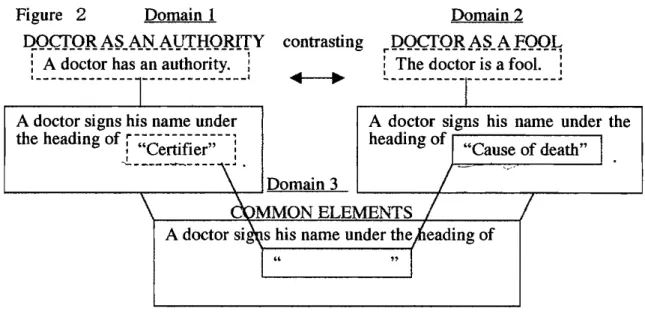
(4) Cognitive Models of Humor and Metaphor. ~tJ1\. ter as a "sudden glory" at a triumph of our own or at an indignity by someone else. Canter and Zillman (1973). 12. conclude from the results of. an experiment that aggression aimed at those who possess authority is more amusing than aggression aimed at someone of similar or lower status. The doctor is a familiar victim of this type:. (2) A doctor fills out a death certificate and signs his name under the heading "Cause of death" .13. The doctor, who is expected to sign his name under the heading of "Certifier's signature", mistakenly signs it under the heading "Cause of death". This means that the doctor is, contrary to his intention, certifying that he was the cause of death. The joke, by making fun of the doctor for his stupidity, achieves superiority over someone who possesses authority. The contrast between what is expected of a doctor and a foolish scenario also creates laughter. The relief theory explains that laughter comes when people are liberated from social taboos, such as sex, death, religion and so on. Freud (1905). 14. emphasizes that one of the important functions of humor is to. approach the subject of sex in a socially acceptable fashion. An example of humor of this type is seen in (3) :. (3) "Is the doctor at home?" the patient asked in his bronchial whisper. "No," the doctor's young and pretty wife whispered in reply. "Come right in." 15 The short conversation between the patient and the doctor's wife, "Is -4-.
(5) x~. . ~1iJiJ . xft. 18~. 1~. 2006. 7. the doctor at home?" "No," "Come right in," involves the mixture of two utterances of contrary purposes: seeing a doctor by the former and seeing a lover by the latter. The script of seeing a doctor is interpreted based on a prototypical scenario inferred from the words, "doctor", "patient" and "bronchial whisper". The script of "seeing a lover", on the other hand, represents sexual delinquency, which is regarded as a taboo. Having studied the three groups of theories of laughter, let us review the elements of humor argued by a number of scholars. Freud (1905). 16. proposes not less than 20 different techniques of jokes, all of. which consist of two distinctive meanings. Koestler (1964). 17,. who. ar~. gues that the creative process is a process of bisociation, further contends that humor is based on "bisociation". Ziv (1984). proposes a. 18. technique of switching from one level to another. Raskin (1979, 1985) 19, in the explanation of his script-based semantic theory, describes joke (3) as involving an overlap of two scripts, DOCTOR and LOVER. He claims that the two overlapping scripts are perceived as opposite in a certain sense, and it is this oppositeness which creates the joke. In addition to the oppositeness of two meanings, a number of scholars have presented "implication" as one of the peculiar characteristics of humor. Freud (1905) emphasized from Shakespeare's Hamlet:. "brevity of wit" citing a phrase. "Brevity is the body and the soul of wit". and the account of Lipps (1989): "A joke says what it has to say, not always in few words, but in too few words - that is, in words that are insufficient by strict logic or by common modes of thought and speech. It may even actually say what it has to say by not saying it". -5-. 20.
(6) Cognitive Models of Humor and Metaphor. ~tJ1\. Raskin (1985) notes the importance of implication in humor by saying that "if implicature is construed as using a sentence not in its literal meaning, many jokes can be explained in terms of implicature" .21 In example (3), we must interpret the implication of amorous design from the punch line "Come right in", to understand and appreciate the humor.. 3. A cognitive model of humor N ow we shall review the cognitive models of humor which are presented in Kitazume (2006). 22.. The revised models, which are cognitively-. based models, in the strict sense of the word, can clearly show the main characteristics of humor argued in the previous sections. In the following figures, we will use the term conceptual domain (abbreviated as domain) as a cover term for a world which represents structured background knowledge. Minsky (1975, 1980) 23 used the term frame for a data structure used to represent stereotyped situations. Coul-. son (1997, 2001) 24 argued the importance of frame-based inference in language interpretation using the notion of frame. The conceptual domain proposed in Kitazume (2006) represents not only stereotyped. situations, but also quixotic scenarios that can be interpreted by employing an imaginative ability like the local logic proposed by Ziv (1984) 25. In jokes interpretation, the frame-based inference based on the data structure of stereotyped situations is insufficient to interpret contrasting scenarios. The conceptual domain also includes a quixotic world that is inconceivable, improbable, inexperienced and socially unacceptable which cannot be interpreted in the frame of a stereotypical situation. -6-.
(7) Jt~. . ;;:q;r.j • Jt1t. 18~. 1%. 2006. 7. The figure shows that humor consists of three conceptual domains: the two contrasting meanings are characterized as a meaning in conceptual domain 1 (abbreviated as domain 1) , shown on the left, and that of conceptual domain 2 (abbreviated as domain 2) on the right. Domain 1 represents a stereotypical script, while domain 2 depicts a quixotic. script. Domain 3 is a common domain that connects domains 1 and 2 in that it has elements commonly found in the two domains. A phrase in capital letters under a domain name indicates the title of each domain. In order to illustrate another characteristic of humor, the technique of implication, an implication is shown in a dotted square, while what is explicitly said (henceforth called "explication") is outlined by a solid line. A straight line indicates that the two meanings outlined by a square are connected. Let us start with a case of humor whose effect can be best explained by the incongruity theory. A cognitive model of example (1) is illustrated in Figure 1. The context that "a young man is looking for a wife" leads us to assume that he expects "a girl with the required qualifications", as shown in the second square from the bottom in domain 1. The assumption is made based on our presupposition that he naturally wants a human being as a wife. The context "looking for" and "wife" (in the second square from the top) gives us a picture that the man has an expectation (in the top square), thus building a conceptual domain of EXPECTING. A WIFE. What actually was sent is a pengum (in the second square from the top in domain 2) that meets all the qualifications that the man required. The only difference is that the received item is "an animal with -7-.
(8) Cognitive Models of Humor and Metaphor. Domain2 RECEIVING A PENGUIN r----------------~ contrasting : bewilderment :. Figure 1 Domain 1 EXPECfING A WIFE. ----------------,. I. •. I. : expectatIon 1-- - - - -. looking for. :. -r ----.----. ~. ~. I a wife . I. •. ____ l _________. r----:::::::J[:::::::::~----... 1. •. :. r-~gi~i;ith------l. :. r-~-a~i~~i-~ith--:. :. 1 _ _ _ _ _ _ _ _ _ _ _ _ _ _ _ _ _I. :. 1. _ _ _ _ _ _ _ _ _ _ _ _ _ _ _ _,. I , I I. L____________ ______ j. .. i___~;;~;:}:!:I~~:~:}::!. I. ~--------. ~tJ1\. I I I I. Domain 3 COMMON ELEMENTS ------- ------ ---------------------- ------- ----I r-. -.------------------. •. •L _________. --I I. ~. _______________ •I. I I I. •I I I I. who likes lots of company, water sports, and formal dress, and preferably rather short. I I I I. , I. I I I. --------------------------------------------------~. qualifications" (in the third square from the top). The incongruity occurs due to the presupposition that is left unsaid: she should be a human being. The empty slot in domain 3 leads to a big twist that leads to the two contrasting scenarios. Here, pragmatic factors such as context and presupposition work to interpret the hidden matter-of-course requirement that is ignored by the computerized marriage agency. The offbeat scenario gives us the pleasure of imagining the bewilderment (in the top square) of the man receiving a penguin, creating a conceptual domain of RECEIVING A PENGUIN. The figure clarifies that understanding the humor reqmres both pragmatic efforts to interpret the hidden meanings (shown in a dotted square) and cognitive efforts to construct the structure that contains two contrasting domains and the domain that connects them (domain 3). The figure also illustrates the psychological cause of laughter that -8-.
(9) ::st~. . ~1jlJ • ::st1t. 18~. 1%. 2006. 7. arises in making fun of the man who was sent a penguin by implicitly describing his bewilderment (in the top square). It should· be noted that recognizing the incongruity between the young man's expectation and his bewilderment creates and enhances the laughter. The figure successfully shows the mechanism, elements and causes of humor and that in understanding and appreciating this humor we need cognitive, pragmatic and psychological points of view. Next we will attempt to illustrate a cognitive model of example (2) in Figure 2. Figure 2 Domain 1 DOcrOR AS AN AUTHORITY ~----------------------~----1 : A doctor has an authonty. :. contrasting. 1 ___________________________ •. ... [~i~~~~~~t~!~~~~!~~~~~l. ... A doctor signs his name under the heading of i------.-------, ,"Certifier" 1 I. A doctor signs his name under the heading of "cause 0 f death". 1. _ _ _ _ _ ... _ _ _ _ _ .... _ _ _ _ . I .. ~----------~------~~. Domain 2 DocrOR AS A FOOL. Domain 3 s his name under the. ". A hearer of the joke expects a scenano. In. which a doctor signs his. name under the heading of "Certifier", as seen in the middle square in domain 1, until the last phrase, "Cause of death". This interpretation is based on the pre-existing knowledge about the job of a doctor and the underlying perception of a doctor as an authority, as seen in the top square in domain 1 under the title, "DOCTOR AS AN AUTHORITY". The punch line, however, evokes an unimaginable scenario: the doctor signs his name under the heading of "Cause of death", as seen in the -9-.
(10) Cognitive Models of Humor and Metaphor. ~tJl\. middle square in domain 2. The hearer can figure out that the doctor, who intended to sign his name under the heading of "Certifier", mistakenly certifies that he is the cause of death. The speaker, by expressing the doctor's foolishness with implication, successfully achieves a inconceivable conceptual domain in which the doctor is described as a fool, as shown in the top square in domain 2, under the title, "DOCTOR AS A FOOL". In order to understand the humor, the hearer has to make a pragmatic interpretation by making the inference that the doctor intends to sign his name under the heading of "Certifier", as shown in a dotted square. The hearer also needs to get· to the implicit message that the doctor is a fool, as is illustrated in a dotted square. In addition to the pragmatic perspectives, understanding humor requires cognitive perspectives. The hearer needs to recognize the contrast between the two conceptual domains DOCTOR AS AN AUTHORITY and DOCTOR AS A FOOL. The incongruity contributes to raise laughter as well as enhancing the laughter created by making fun of the doctor's foolishness. The cognitive model shows that the meanings in the two domains contrast with each other, although domain 3 involves elements commonly found in the two contrasting domains. A small difference in the last phrase functions as a big twist that leads to the two distinguished scenarios: the common scenario of a doctor in domain 1 and an unimaginable scenario in domain 2. The recognition of the incongruity between the two contrasting domains that bear common elements, gives us a cognitive pleasure of solving a puzzle. The figure shows that a lot of meanings are left unsaid, as are shown in dotted squares, and understanding humor requires pragmatic efforts to interpret implicated mean-10-.
(11) X¥ . ~1;f1j' . xiI:. 18~. 1~. 2006. 7. mgs. The illustration successfully shows that interpreting humor requires both pragmatic and cognitive efforts to interpret an implication and construct a cognitive structure as shown in Figure 2. The illustration can also describe the main cause of laughter that arises from making fun of the doctor, as is expressed in "The doctor is a fool", in the top square in domain 2. The psychological pleasure is skillfully enhanced by the mechanism and elements of humor that can be explained from cognitive and pragmatic points of view. Next we will illustrate a cognitive model of (3), by which Raskin (1985) proposes his script-based semantic theory in Figure 3. Figure 3. Domain 2. Domain 1. SEEING A LOVER. SEEING A DOCTOR contrasting. i--------------------i. : seeing a doctor. ,r-'== == 1, ,. r- -- - - -- - - ---- -- - - I. : seeing a lover. :. :. ,-----~::::::::[::::::::~--------,,. ====I===========~_,, 11,. I. _____________. t. I. I. I. I. I. I , 1_ _ _ _ _ _ _ _ _ _ _ _ 1. II I. I,. lover'. ,,. .....----------, :. I I. L..-_ _ _ _ _ _ _ _- J. I. doctor's young pretty wife. , ,,. j--------------------not to be heard :. I. I. ::. , ,,, I. , ,, j--------------------: doctor's absence , --------------------_. _______________________________ 2 ~-------------- _ _ _ _ _ _ I. I. t. I. The patient's inquiry "Is the doctor at home?" (in domain 3) and "bronchial whisper" (in domain 3) lead us to expect that the patient is expecting the "doctor's presence" (in the middle square in domain 1). The -11-.
(12) Cognitive Models of Humor and Metaphor. ~t;J1\. words, "patient", "bronchial whisper" and "the doctor's presence" (in the middle square), lead us to construct a common scenario of "seeing a doctor", as shown in the top square in domain 1, SEEING A DOCTOR. The doctor's wife is regarded as a receptionist in this domain and all of these lead to a perfect scenario of seeing a doctor until the last comment of the doctor's wife. The answering comment by the doctor's wife "No" (in domain 3) indicates the doctor's absence (in the middle square in domain 2), which will make the patient's visit useless. The wife's invitation "Come right in" during the doctor's absence twists the common seeing-a-doctor scenario into a totally different scenario "seeing a lover", (in the top square in domain 2), a socially unacceptable sexual relationship. "The patient" (in the middle square in domain 1) is turned into "a lover" (in the middle square in domain 2). In the same manner, "the wife working as a receptionist" is now perceived as "a young pretty woman", The patient's inquiry about "the doctor's presence" has a new interpretation, a confirmation expecting "the doctor's absence" and "bronchial whisper" is reinterpreted as "a whisper for secrecy, not to be heard". Pragmatic inference coupled with cognitive perspectives can construct a structure consisting of two contrasting scenarios: SEEING A DOCTOR and SEEING A LOVER from the conversation between the patient and the doctor's wife. The cognitive models we have attempted to illustrate show that humor, regardless of the cause of laughter and its techniques, basically consists of two contrasting scenarios in domains 1 and 2, connected by common elements but twisted in domain 3. Understanding humor, therefore, requires cognitive efforts to construct a cognitive structure where -12-.
(13) )c~. . ~1iIij. . )cit. 18~. 1 i} 2006. 7. there are two contrasting domains that have common elements. The cognitive models also clarify that what is really meant is left unsaid, as are shown in dotted squares. Humor is a way to implicitly express what we really mean in a socially acceptable fashion. For example, we can enjoy an extraordinary scenario which goes beyond the boundary of logic, as the incongruity theory claims. Humor enables us to express our superiority in a socially accepted way, as the superiority theory suggests. Humor also serves to liberate us from social taboos, for it allows us to express social taboos implicitly, as the relief theory argues. The cognitively-based models can illustrate the main cause of laughter by presenting an implicit message that is interpreted from pragmatic and cognitive perspectives. In summation, it has been shown that the cognitive models reviewed here can clearly show the mechanisms, elements and causes of laughter which are essential in understanding humor.. 4. Previous analyses of metaphors (Ortony (1979)). 26. Having illustrated the cognitive models of humor, we may now go on to consider metaphor. We will begin by reviewing traditional theories of metaphor. Aristotle was interested in the relationship of metaphors to language and the role of metaphors in communication. He believed metaphors to be implicit comparisons, based on the principles of analogy. As to their use, he believed that it was primarily ornamental. In modern times, this view was translated into the comparison theory of metaphor. The comparison view takes metaphor to be a statement of some similar-13-.
(14) Cognitive Models of Humor and Metaphor. ~tJ1\. ity or analogy and so takes every metaphor to be a condensed or elliptic simile. Another traditional theory of metaphor is the substitution theory. Searle (1969/1979)?:l says that if you hear somebody say, "Sally is a block of ice", you are likely to assume that the speaker does not mean what he says literally but that he is metaphorically saying that Sally is unemotional. Searle calls what a speaker means by uttering words, sentences and expressions "speaker's utterance meaning" and what they literally mean "literal sentence meaning". He argues that one arrives at a metaphorical interpretation of a sentence by starting with the literal meaning. When a literal interpretation is rejected, a metaphorical interpretation must be sought. Morgan (1979) 28 objects that such an account is too vague because it fails to distinguish between metaphors, mistakes, irony and a host of other indirect speech acts. Black (1979). 29. criticizes the comparison theory and the substitu-. tion theory by saying, "The reader will notice that both of these views treat metaphor as unemphatic, in my terminology - in principle, expendable if one disregards the incidental pleasures of stating figuratively what might just as well have been said literally." A great influence on theoretical study of metaphor is that of Richards (1936) 30. He proposed a set of useful terms for talking about metaphor: "tenor", "vehicle" and "ground". "Tenor" indicates "what is really being said or thought of", while "vehicle" means "what it is compared to". The resemblance or analogy between the two ideas is called "ground". Richards argues that vehicle and tenor working in co-operation give a meaning of more varied powers than can be ascribed to either. This view was further developed into the semantic interaction -14-.
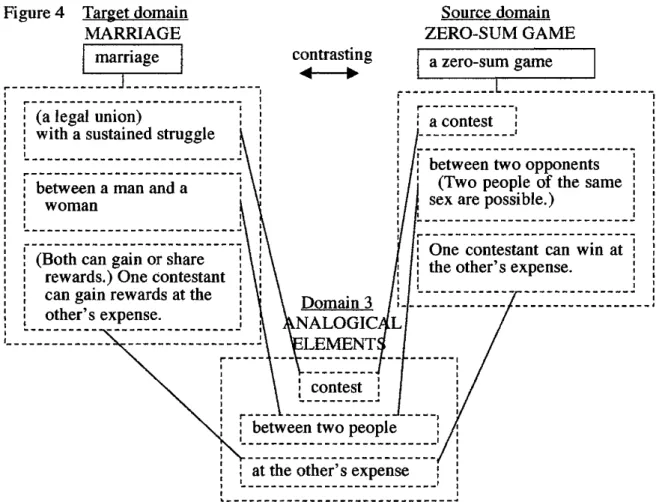
(15) )Clift • ;:;f,\lJ • )Cit. 18~. 1 -1}. 2006. 7. theory. The semantic interaction theory, which was first argued by Richards (1936), was discussed in detail by Black (1962/1979) 31. Black argues that something new is created when a metaphor is understood and that metaphors afford different ways of viewing the world. The semantic interaction view claims that a metaphorical statement has two distinct subjects, to be identified as the "primary" subject and the "secondary" one and metaphor involves a verbal opposition or interaction between two semantic contents, that of the expression used metaphorically and that of the surrounding literal context. Black explains his theory using the following example:. (4) Marriage is a zero-sum game.. He argues that in (4) "marriage" is the primary subject and "a zerosum game" is the secondary subject. The presence of the primary subject "marriage" incites the hearer to select some of the properties of a zero-sum game; such as "a contest", "between two opponents", "in which one player can win only at the expense of the other". The primary subject then invites him to construct a parallel implication-complex (a system of relationships) that can fit marriage; "A marriage is a sustained struggle", "between two contestants" ,"in which the rewards of one contestant are gained only at the other's expense". The two subjects, in this way, interact and create a new meaning that gives different ways of viewing marriage and a game. The idea that metaphors create different ways of perceiving the world is argued by Schon (1979) and Reddy (1979) 32.. -15-.
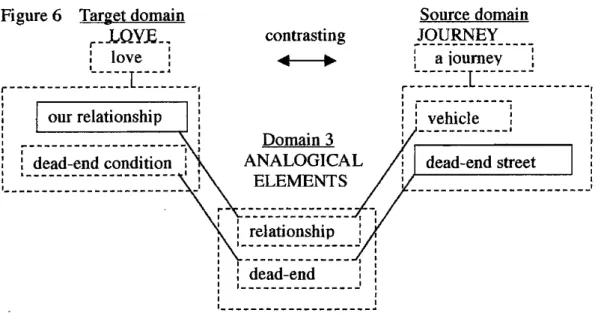
(16) Cognitive Models of Humor and Metaphor. ~tJf\. Reddy's great contribution to the study of metaphor is the presentation of the conduit metaphor. This metaphor is based on the idea that language is a carrier of ideas, thoughts, aspirations and so on, so that all a hearer needs to do is to unpack the message and take out what was in it. Reddy further argues that the locus of metaphor is thought, not lan-. guage and that metaphor is a major and indispensable part of our ordinary, conventional way of conceptualizing the world. 33 Lakoff and Johnson (1980) 34, developing Reddy's conduit metaphor, present a detailed account of metaphor, saying that metaphor plays a central role in the way in which we think and talk about the world. Many of our most mundane concepts, such as those of time, states, change, causation, and purpose, are represented metaphorically, that is, in terms of other concepts. They present various metaphorical concepts like TIME IS MONEY: Lakoff (1979) and Lakoff and Turner (1989) explain a system of conventional conceptual metaphors presenting examples (5) and (6). 35:. (5) Love is a journey. (6) Our relationship has hit a dead-end street.. In (6), "love" is being conceptualized as "a journey", with the implication that the relationship is stalled, that the lovers cannot keep going the way they've been going, that they must turn back, or abandon the relationship altogether. Lakoff argues that the metaphor involves understanding one domain of experience, love, in terms of a very different domain of experience, a journey. More technically, the metaphor can be understood as a mapping from a source domain (in this case,· a journey) -16-.
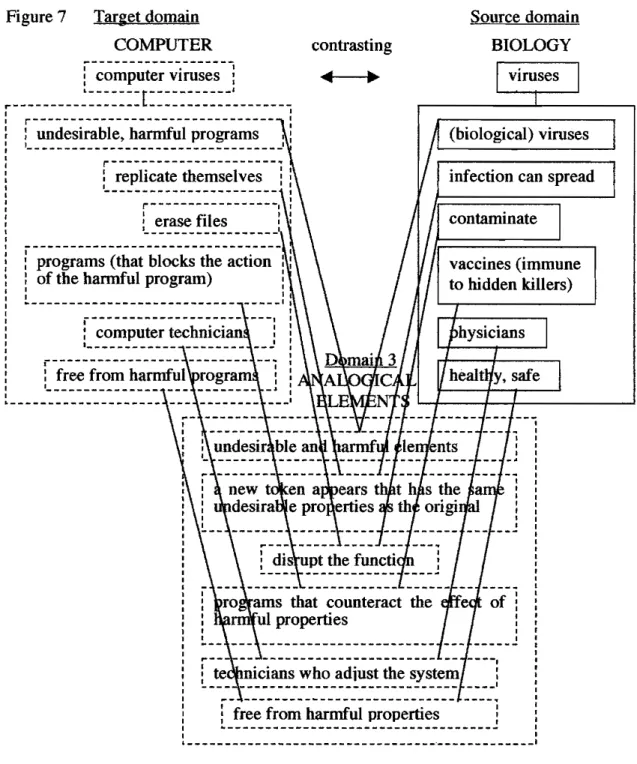
(17) x.'¥- . ~Wj . x.1t. 18~. 1~. 2006. 7. to a target domain (in this case, love). He further says that there are ontological correspondences, according to which entities in the domain of love (e.g., the lovers, their common goals, their difficulties, the love relationship, etc.) correspond systematically to entities in the domain of a journey (the travelers, their common destinations, impediments to travel, the vehicle, etc.). Fauconnier (1997). 36. and Turner (1994,. 1996,. 1998) and. Fauconnier. argue that analogical and metaphorical mappings playa key. role in the synchronic construction of meaning and its diachronic evolutions, citing the recent emergence of the notion "computer virus". It is manifested linguistically in expressions like the following:. (7) Viruses are programs developed by renegade computer operators. who covertly implant them in other programs. (8) Infections can spread from computer to computer as fast as the Hong Kong flu.. (9) Files are contaminated by infectious bytes. (10) Compuserve can never be completely immune to hidden killers. (11) Data physicians develop vaccines, disinfectants, ... (12) The only way users can be assured that their programs are healthy is through safe interface.. We can all see that vocabulary from the domain of health, biology, and medicine is being used to talk and reason about the domain of computers and programming. Biological viruses are mapped onto undesirable and harmful computer programs that replicate themselves, erase files, and so on. Vaccines in the domain of medicine are then projected onto -17-.
(18) Cognitive Models of Humor and Metaphor. ~t)f\. the computer programs that counter these VIruses. Physicians are mapped onto computer technicians, attempting to block the action of the harmful programs.. 5. A cognitive model of metaphor So far we have seen the main theories of metaphor. What we find common in all the theories above is that metaphor involves a verbal opposition or interaction between two semantic contents, that of the expression used metaphorically (in a source domain) and that of the surrounding literal context (in a target domain) and that there are resemblances or analogies which relate the two. Now, we will attempt to illustrate cognitive models of metaphor by adapting the same rules that we used to illustrate cognitive models of humor. The models consist of target domain, shown on the left, and source domain, on the right. Domain 3 is a domain where analogies that connect the two domains are presented. In order to illustrate another characteristic of metaphor, explication is outlined by a solid line, implication by a dotted line. A straight line indicates that the two meanings outlined by a square are connected. Let us start with the metaphor presented by the semantic interaction theory, as seen in Figure 4, that illustrates a cognitive model of (4). The figure illustrates "marriage" in the target domain under the title MARRIGE on the left and "a zero-sum game" in the source domain under the title ZERO-SUM GAME on the right. Black (1979) argues that the presence of the primary subject "marriage" incites the hearer to select some of the properties of a zero-sum game; such as "a contest" , -18-.
(19) Jt$ . ~1;Ilj • Jtft. Figure 4. Target domain MARRIAGE marriage. I. I. 18~. 1 % 2006.7. Source domain ZERO-SUM GAME. .. I a zero-sum game. contrasting. .... ~--------------]-----------------~. I. ~----------------------------. : (a legal union) ,: with a sustained struggle. :. : : a contest. :. :. L___________________________ _. : (Both can gain or share : : rewards.) One contestant : , can gain rewards at the ' : _________ other's expense. _________________ J: ,. I. I. I. I. _________________ ~___________. ,. I. I. I. I. I. -----------------------------. I J. I f. j---------------------------j. :. _____________ ,. I. : : :. ,: woman. ~. :. 1. ~---------------------------i. I. : ,...------------1 I. L ___________________________ _. l between a man and a. I. _____________ L___________________ _ I I. between two opponents :: (Two people of the same: : sex are possible.) : :. r----------------------;----i. I. J. : One contestant can Will at: : :I the other's expense. :I :I ~. Domain 3 NALOGIC LEMENT I I. contest. ____________ ______________ 2. : I. -----------------_. ------1. I I. I I. !..---------~. r---- -------------- -----, : between two people ~------------------------~. :L_________________________ at the other's expense :t. "between two opponents", "in which one player can win only at the expense of the other". The New Oxford American Dictionary defines "marriage" as "the formal union of a man and a woman, typically recognized by law, by which they become husband and wife" and "zero-sum game" as "a situation in which a gain by one individual or party must be matched by a loss for another individual or party". Considering the contrasting definitions of a marriage and a zero-sum game, it does not seem natural that the hearer jumps to the properties of a contrasting domain without any intermediate process. The figure illustrates that the analogies m domain 3 connect both elements in the two contrasting domains. For instance, "contest" in do-19-.
(20) Cognitive Models of Humor and Metaphor. ~tJR. mam 3 connects the contrasting elements: "a legal union with a sustained struggle" in domain 1 and "a contest" in domain 2. The analogical element "between two people" connects the distinguished elements "between a man and a woman" in domain 1 and "between two opponents" in domain 2. The analogy "at the other's expense" in domain 3 connects descriptions on rewards in the two contrasting domains. It should be noted, however, that only partial meanings of both domains are focused, while there are many hidden elements that are not commonly found in the two domains. It should be also noted that in contrast to the models of humor. shown above, in figures 1, 2 and 3, the cognitive model of metaphor in figure 4 has no twist in domain 3. What are found in domain 3 are analogical elements, which lead to connect the two contrasting domains. The analogical elements construct the metaphor consisting of the target domain and the source domain both of which represent a world that can be interpreted based on the data structure of stereotyped situations. Having illustrated the cognitive model of (4), it is important to point out that all the properties, which Black calls "implication-complex", are left unsaid, as shown in dotted squares. Understanding the metaphor requires an imaginative effort on the side of a hearer to get to implied. elements which are. prerequisite in understanding the. metaphor. Next, we will attempt to represent a cognitive model of the conceptual metaphor of Reddy's (1979) conduit metaphor, Lakoff (1979), Lakoff and Johnson (1980), and Lakoff and Turner (1989). A cognitive model of (5) is illustrated in Figure 5. -20-.
(21) x~. Figure 5. . ~{ij\j • xft. 18~. 1~. Source domain. Target domain. JOURNEY. contrasting. LOVE. ~. 'III. -----~----~---T r ---.- ---_.,. I. ~. I. : lovers. :. I. ,. :. : f-l~-;; ~~i;ti~~;hi-p --1 I I. I. : : i. ,,. ~ __________________ _. ~. ________________ _. :. , I I. r - -- - - - -- -- -- -- -. I. _____________ ~. ,. r-------------~. !. ______________ ••. 1 II. r----------------------~. I. : vehicle' : common destination. Domain 3 ANALOGICAL. I. t t. ! J'. I. I. r-----------------,. : common goal. I. ,~ 'r-------------~ traveI e r s : !:. •. , ,•. I. ajourney ____________ J_______________ _. I. I I. 2006. 7. --I. ___ ~~f:_~NT$_____ .. : Difficulties in: L_~_t>:. !~~~t~?~_s!t!~__:. ---------~------~. :L ________________ companies :. I. ,----------------------. 1. _ ______________________ ~. i t. ,. .------------------------1 ! :, ________________________ impediments to travel J:: I. •. --------------------------,. ~. -----------------,. : ________________ relationship J: ~. : :L________________ goal J I. J I. - - - -- -- --- -- --- --,. : : difficulties ! ! ~----------- ______ I. ~----------------------~. In understanding the conceptual metaphor "LOVE IS A JOURNEY", a hearer has to find implied analogy between the two conceptual domains, the domains of LOVE and JOURNEY, on the basis of the structured background knowledge. One of the basic elements in the domain of LOVE is "lovers", which is transferred to "travelers" in the domain of JOURNEY through an analogical element, "companies" in domain 3. While "lovers" and "travelers" have analogical properties in that they both involve "companies", that is, "persons who are going the same way", the two words represent distinguished properties of their own in that "lovers" are "two persons in love", while "travelers" are "persons who are traveling together" and the number of persons involved is not limited to two. It is important to point out that the hearer does not jump from the element in the LOVE domain to the element in -21-.
(22) Cognitive Models of Humor and Metaphor. ~tJ1\. the contrasting domain JOURNEY, but the analogical elements in domain 3 work as an intermediate cognitive process. 37 In the same way, "love relationship" corresponds to "vehicle" by going through the intermediate process of "relationship" in domain 3. Lovers' "common goal" is transferred to their "common destination" on the journey through the analogical element "goal". "Difficulties in the relationship" is projected to "impediments to travel" through "difficulties" as an intermediate process. The important point to be noted here is that although the metaphor has the two contrasting domains, LOVE and JOURNEY, the meaning in both domains can be interpreted based on the stereotypical data of each domain. The presence of a twist in humor leads to two contrasting domains, one domain which are based on the stereotypical knowledge and another domain representing a world that cannot be interpreted based on the data structure of stereotyped situations. It is important to bear in mind that the properties of both "love". and "journey" in domains 1 and 2 as well as the analogies shown in Figure 5 are implicit and a hearer has to find the implication-complex and the analogy in understanding the metaphor. There is one further example that is related to the conceptual metaphor (5), LOVE IS A JOURNEY shown above. A cognitive model of (6), a metaphorical description based on the conceptual metaphor (5) is illustrated in Figure 6. Although the domain names "LOVE" and "JOURNEY" are the same in both Figures 5 and 6, entities in both domains are different between (5) and (6). Another point to be noted is that while the domain names LOVE and JOURNEY are explicit in Figure 5, they are only im-22-.
(23) x?!f: . ~1iI\r . xiI: 18:§ 1 ~ 2006.7. Figure 6. .. Target domain. contrasting. r-LQY.E-.,. : love. r - -- -- ----,. :. _'~ ~ ~~ ~C~~~~ ---,. ~. our relationship. I. : I. I. : i--------------------j: :I : dead-end condition : 1 ____________________. I~. _______________________. I. r-~~-~~~~t~~~~~~~~-------I : : :_:..e_~~c~~____ l : I. I. I. I. J. I. I. :. Source domain JOURNEY ~---~----------I a Journey ,. Domain3 ANALOGICAL ELEMENTS. ,. JI. r- 1-----------------------·-·--- , I. : , I. relationship : 1 ________________,. I. :. :. I I. I. dead-end street. ,. ________________________:. -:. :. .. 1--------------. : : dead-end :. : ,-----------i. f I. J. :. ::. 1______ - - - - - - - - - - ,. :. I ___________________ ..I 1-. plicitly expressed in Figure 6. It comes from this result that understanding metaphors like (6) requires more effort than understanding metaphors like (5) in that a hearer has to go through the process of interpreting the conventional metaphor LOVE IS A JOURNEY before finding out the corresponding entities. Lastly, let us illustrate a cognitive model of "computer viruses" from (7) to (12), which are exemplified in Fauconnier and Turner (1994, 1996, 1998) and Fauconnier (1997). Figure 7 shows that "viruses", a vocabulary from the domain of BIOLOGY, is used to talk about "undesirable, harmful programs" in the domain of COMPUTER. The features of computer viruses of "replicating themselves" and "erasing files" are talked about in terms of vocabulary from the domain of BIOLOGY, such as "infection can spread" and "contaminate", by inducing generic features: "a new token appears that has the same undesirable properties as the original" and "disrupt the function" in domain 3. A biological word "vaccines" is used to refer to "computer programs that blocks the action of the harmful pro-23-.
(24) Cognitive Models of Humor and Metaphor. Figure 7. ~tJR. Source domain. Target domain contrasting. COMPUTER. BIOLOGY. i-----------~------l. : computer viruses :. r---------~====::=[=====:=::::~------r--------------------------------. I. I I. I. : :. ~. ________________________________ undesirable, harmful programs J. (biological) viruses. :. ,----------------------.. : replicate themselves. infection can spread. ::. I. I. -----------------------. f. r-----------------I :. contaminate. : ________________ erase files L J: : I----------------------------~----. t. : programs (that blocks the actIOn: : : : of the harmful program) I. vaccines (immune to hidden killers). I. I. I. ----------------------------. r--------------------. : computer technician. -----, I I. 1____________________. ---I __. J:. : I. :. I I. I. I ~. ____________________. I _ _ _ _ _ _ _ _ _ _ _ _ _ _ I1. .--. ----- --- --I. I I I. I I I I I I. I. I I I. I I I I I I I I. I I I. , I I. I. , I. ~--. -- ----------------------- -- ----I. : te nicians who adiust the system. :. _____________________________________ 1. I I I I I I I. I I. I I I4 _________________________________ -_____________ I1. gram" by inducing an analogy "programs that counteract the effect of harmful properties". "Physicians", a vocabulary of BIOLOGY indicates "computer technicians" attempting to block the action of harmful programs due to the analogy "technicians who adjust the system". It should be noted that the vocabularies from the domain of biology. are being used to refer to the entities in the computer domain instead -24-.
(25) )C~ • ~1iIiJ. • )Cit 18§ 1 ~ 2006.7. of inventing new words for the new entities. The figure clearly shows that the analogical elements, though they are implicit, play an important role in naming and description. The cognitive models we have attempted to illustrate show that metaphor consists of two contrasting domains (target domain and source domain) and the analogical elements in domain 3. The absence of a twist in Domain 3 lead to construct the two domains representing the stereotypical situations. They also clarify that what is really meant is left unsaid, as are shown in dotted squares. In understanding metaphor, a hearer starts with target domain recalling entities which are in many examples left unsaid, and searches for corresponding entities, which are in many cases implicitly expressed, in source domain, by inducing implicitly expressed generic features from both domains. Metaphor skillfully conveys what it has to say by not saying it explicitly. To sum up, understanding metaphor is an imaginative work that requires cognitive efforts to conceive contrasting domains and pragmatic efforts to get to implications.. 6.. cognitive model of metaphorical humor Having illustrated the cognitive models of humor and metaphor, we. will compare characteristics of humor and metaphor that are made explicit in the cognitive models. The cognitive models we have attempted to illustrate show that there is a strong resemblance between humor and metaphor, in that both humor and metaphor consist of two contrasting domains (do-25-.
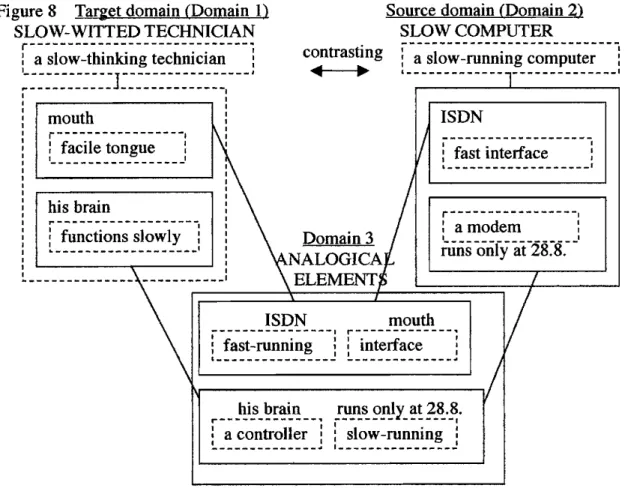
(26) Cognitive Models of Humor and Metaphor. ~tJ1\. mains 1 and 2) and the domain (domain 3) that connects the two domains. The difference lies in domain 3. In humor it involves a twist that leads to two distinguished scenarios: a common, stereotypical scenario in domain 1 and a quixotic or socially unacceptable script in domain 2. In metaphor the domain 3 has analogy that is commonly found in the two contrasting domains. It can be safely said that understanding humor and metaphor requires cognitive efforts to conceive the three domains. Another characteristic common to humor and metaphor is that there are many implications involved. A hearer has to interpret implied meanings to understand and appreciate them. Understanding the two linguistic forms is an imaginative work that requires pragmatic efforts by a hearer to get to implications. It seems reasonable to suppose that both linguistic forms are skillful methods by which a speaker says what he/she has to say by not saying it explicitly. In short, both humor and metaphor are creative linguistic forms consisting of three domains and the clever use of implications. The analogies between the two forms make it possible to create metaphorical humor, a mixture of humor and metaphor, with characteristics of both forms. Example (13) is a case of metaphorical humor whose laughter can be explained by the superiority theory:. (13) ISDN Mouth "You'll have to excuse our field technician, he has an ISDN mouth, but his brain only runs at 28.8.". A cognitive model of (13) is shown in Figure 8. -26-. 38.
(27) ;t~. .. ~f,liJ. 18~. . ;tit. Figure 8 Target domain (Domain 1) SLOW-WITTED TECHNICIAN. r-----------------------------·. : a slow-thinking technician : '- -::::::::::1:::::::::::::~---·. ,,. r----------------~. I. facile tongue. .. 2006. 7. Source domain (Domain 2) SLOW COMPUTER. ----------------------------i. contrasting : a slow-running computer. .... I I I I I I I. mouth L I ________________. 1 -f}. '-------------l--------------. : I. ISDN. /. ~. I I I. ,, ,~------------------I fast interface I, __________________ .1. I. I I. his brain. I I. I. : functions slowly : .. --- -- -- -- ---- -- ----,. -------------. ,r-----------------,. I. r-------------------. I ·. I I. , I. I I ___________ J. Domain 3 NALOGICA ELEMENT. I. I. mouth ISDN ----------------1 r-------------,, : fast-running : interface ,---------------- !..-------------~ I I. I. his brain ~!1Jy_~! ~~.~. ,------------.., ,!~_~~ I . I a controller :1 _______________ s ow-runmng 2 !...-------------~ I I. I. I I I. a modem. runs onfy at-28~8.-I. /. /. I. The figure shows that the metaphorical humor is made of three domains: two contrasting domains of SLOW-WIITED TECHINICIAN and SLOW COMPUTER and the domain that connects the two contrasting domains (domain 3). "ISDN mouth" in domain 3 is a metaphorical phrase made by the blending of two words, "ISDN" in the COMPUTER domain and "mouth" in the TECHINICIAN domain.. His. "mouth" corresponds to "ISDN" through the analogous elements of "fast-running" and "interface" in domain 3. The description "his brain only runs at 28.8" is produced by blending two expressions, "his brain" in the TECHINICIAN domain and "only runs at 28.8" in the COMPUTER domain. "His brain" in domain 1 corresponds to "a modem" in domain 2 because of the analogy of "a controller". The expression. -27-.
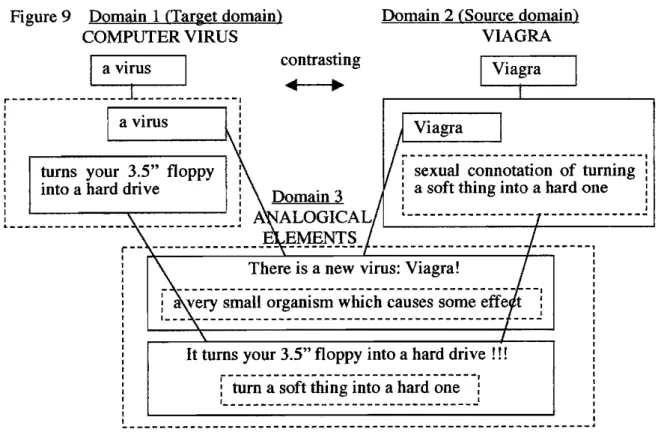
(28) Cognitive Models of Humor and Metaphor. ~tJl\. "runs only at 28.8" in domain 2 is transferred to "functions slowly". III. domain 1 through the analogy of "slow-running" in domain 3. From the phrase "ISDN mouth", a hearer will get to the implication "a facile tongue", while from the clause "his brain runs only at 28.8", the hearer will understand the implicit meaning that the technician's brain functions slowly. A hearer will get to the implication that while the technician has a facile tongue, he is slow in thinking. Although it is socially unacceptable to ridicule the technician as a slow-witted person with a facile tongue, as seen in SLOW-WIlTED TECHNICAIAN domain, the unexpected analogy expressed in the metaphorical expressions make it socially acceptable. The example creates humor because the speaker can ridicule the technician with the metaphorical expressions. The laughter also is created and enhanced by the incongruity of the contrasting images between a slow-witted technician and a slow computer. Next we will examine an example of metaphorical humor which can be most appropriately' explained by the relief theory. (14). IS. an ex-. ample of a computer joke which implicitly expresses sex.. (14) WARNING!!! III There is a new virus: Viagra ! It turns your 3.5" floppy into a hard. drive !l!. 39. Although sex is not directly mentioned, example (14), with a word "Viagra", prepares a reader for a sexual joke and the expectation helps to find a sexual meaning in the phrase "turns your 3.5" floppy into a hard drive". Figure 9 shows a cognitive model of (14). -28-.
(29) )(~. Figure 9. • ;':1iJlf . )(11::. 18~. Domain 1 (Target domain) COMPUTER VIRUS contrasting a virus. I. ~--------------_J_-------------l. :. a virus. 4111. ... :. Viagra. I. I I I. I I. f-. turns your 3.5" floppy into a hard drive. I. I I. -------------~. -. I. ~----------------- -------------~. I. ~----------------. -. ;;~~;d -~~~;;~Utti~~ ~f-t~;~i-~g-l : a soft thing into a hard one l. I. I I. Domain 2 (Source domain) VIAGRA. I. I. I. 2006. 7. I. I. I I. 1~. ---------------------------------------------. --I. :i _______________________________________________ very small organism which causes some effe t _: I. I. It turns your 3.5" floppy into a hard drive!!!. r-~~~-;~it-thi~gi~t~-~h~d ~~~ --1 ,_________________________________ J. ______________________________________________________ -. ______ 4. Figure 9 illustrates that the joke consists of two contrasting domains, the domains of COMPUTER VIRUS and VIAGRA. The expression "There is a new virus" in domain 3 is inherited from the COMPUTER VIRUS domain, while "Viagra!" in domain 3 is transferred from the VIAGRA domain. The induced meaning "a very small organism which causes some effect". functions as an intermediate process to connect the two contrasting domains. The description "It turns your 3.5" floppy into a hard drive!!!" contains two contrasting interpretations: a literal interpretation in the COMPUTER VIRUS domain and a sexual implication in the VIAGRA domain. In the metaphorical humor above, the analogies open the way for a sexual domain that is unacceptable in a normal conversation. It is important to point out that there are many implications in the. model and the joke requires an effort to find out the implied sexual -29-.
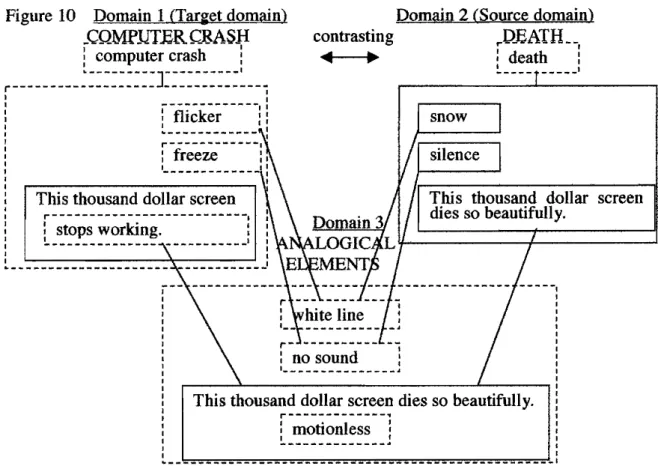
(30) Cognitive Models of Humor and Metaphor. ~tJl\. meamngs. As Ziv (1984) explained, indirect sexual humor, the kind that only hints at sex, contributes to fantasy much more effectively than direct stimuli, at least for some people. 40 Lastly we will study an example of metaphorical humor whose laughter can be explained by mixture of the three theories, the incongruity theory, the superiority theory and the relief theory. Examples (15) and (16) are cases of metaphorical humor written in Haiku form, a short Japanese poem in 17 syllables:. (15) What if errors were written in the form of haikur 1 First snow, then silence. This thousand dollar screen dies so beautifully. (16) Windows NT crashed. I am the Blue Screen of Death. No one hears your screams.. The laughter arises from the incongruity between the topic and the artistic style of haiku in which it is presented. (15) metaphorically expresses a crash in a computer as "snow", "silence" and "death" and in (16) a computer crash is described as "the Blue Screen of Death". The incongruity between a computer crash and what it is compared to causes the laughter. The laughter is enhanced by other causes. The superiority theory dictates that we feel superior to a superb machine by pointing out its weakness. It is also important to remember that talking about death releases the tension we find in our life, as the relief theory explains. -30-.
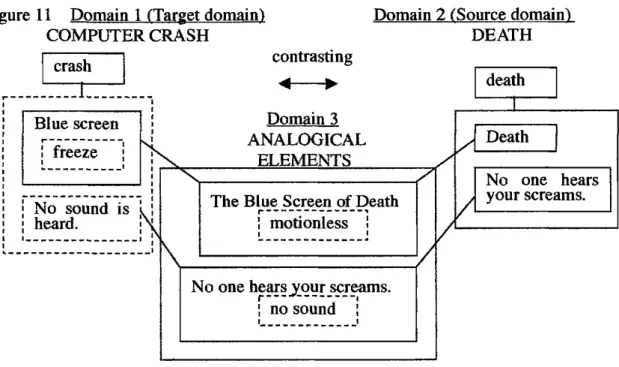
(31) X$ . ;:;:Wi . x1t. 18~. 1 i}. 2006.7. A cognitive model of (15) is illustrated in Figure 10. Figure 10 Domain 1 (Tariet domain). Domain 2 (Source domain). _CQMPJlTER CMS}.I : computer crash. contrasting. :. ~... ,r---------~:::::::::J::::::::::~---,, ... -------------. I. :. : flicker. :. t. ~. ____________. This thousand dollar screen r-------------------------~. :L ______________ stops working. __________ : ~. ,..Q.EATH __ ,,death:'. !.. _________ 1. ::. This thousand dollar screen dies so beautifully.. :: •. ,. ~ __ '_ _-___-___-___-___-___-_....l.o_,..-__-_-_ _-_ -_--' _ ___:. ,j - ,,. ------------ ---. -----. --- ---------------. ,. ' ,'. ··, ·, ,. 1. ,, ,. I. ,. I. :I. ,,,. -----,. ,. This thousand dollar screen dies so beautifully.. :. t. r-------------'f. I 1. :. :!.. _____________ motionless !:. :. · I I. I ,. ,. ~--------------------------------------------- ______ I. As is shown in Figure 10, "snow" and "silence" in domain 2 are mapped to. "flicker" and "freeze" because of the analogies such as. "while line" and "no sound", as are illustrated in domain 3. The description "This thousand dollar screen dies so beautifully," is projected to the description "This thousand dollar screen stops working" because of the analogous feature "motionless" in domain 3. The analogies open the way to DEATH domain, which are regarded to be a taboo subject. Next we will illustrate a cognitive model of (16) in Figure II. The metaphorical phrase "The Blue Screen of Death" in domain 3 connects "blue screen" in the domain of COMPUTER CRASH and "Death" in the domain of DEATH. The description "No one hears your screams" -31-.
(32) Cognitive Models of Humor and Metaphor. Figure 11 Domain 1 (Target domain) COMPUTER CRASH. : :. i f. ,. Domain 2 (Source domain) DEATH. contrasting. ~. r--------- --------j. ,. .. ~tJT\. ... death. f. Blue screen. I. I. :. Domain 3 r-ir~~~-;---: { ANALOGICAL ~ Death ~----------,! ~....--,, -=E~L~E~ME~NT~~S____ /-:K/ r - - - - - - - - , No one hears f-N~-;~~~d-i~-j~ The B~l!~~~~~~I!~J~eath your screams. heard. :' :!.. _____________ motionless ~: I''-_ _ _ _ _ _- - J /. I. i," __. i. V. I. t. I. I. -':::::::::::::::~-: I\'r-----'-----ry No one h~~~'y"~~!_~!~s. : no sound : , ___________ ... _1. in domain 2 is an expression connected to "no sound is heard" in domain 1 through the analogy of "no sound" in domain 3. Although a computer crash and death have quite different images, there are analogies such as "motionless" and "no sound". The figures above show that in the examples of metaphorical humor, the analogy is implied and it requires an effort on the part of a hearer to figure out the implicit meanings to understand the metaphorical humor. We have illustrated examples of metaphorical humor covering typical examples of the three theories of humor and the mixture of the three theories. We have shown that the similarities between humor and metaphor have contributed to the creation of a large number of instances of metaphorical humor.. -32-.
(33) X$ . ;;1iI\j .. xit. 18~. 1 % 2006. 7. 7. Conclusion In this paper we have attempted to illustrate cognitive models of humor and metaphor on the basis of the pragmatic models presented in Kitazume (1998, 1999a, 1999b) and the cognitive models illustrated in Kitazume (2006). We have illustrated that the cognitively-based models presented here can clearly show the main characteristics of humor and metaphor which require both cognitive and pragmatic efforts to understand. First we have studied humor, reviewing the three groups of theories of humor as well as various types of techniques and the mechanism of humor. In an attempt to visualize the mechanism and elements that are commonly found in the theories above, we have illustrated cognitive models of humor. Next, we have inquired into metaphor by introducing contemporary theories of metaphor, as well as traditional theories. We have illustrated cognitive models of metaphor to visually demonstrate the mechanisms and elements of metaphor. The cognitive models show that there is a strong resemblance between humor and metaphor, in that both humor and metaphor consist of two contrasting domains (domains 1 and 2) and the domain that connects the two (domain 3). The difference lies in domain 3. In humor, a stereotypical script in domain 1 is connected but twisted in domain 3, leading to a quixotic or socially unaccepted script in domain 2. In metaphor, domain 3 involves analogies that open the way to two apparently distinguished domains. -33-.
(34) Cognitive Models of Humor and Metaphor. ~t.JJ\. Another characteristic common to humor and metaphor is that there are many implications involved both in humor and metaphor, as are illustrated in dotted squares and understanding them requires pragmatic efforts to interpret implied meanings. To sum up, it has been argued that although humor and metaphor are classified into different categories, both humor and metaphor are creative linguistic forms consisting of two contrasting domains and the clever use of implications. Understanding humor and metaphor, therefore, is an imaginative work that requires cognitive approaches to build up three domains as well as pragmatic efforts to interpret implied meanmgs.. Notes. *. 1 2. 3 4 5 6 7. This is a revised version of a paper I presented at the 7th International Pragmatics Conference of the International Pragmatics Association on July 13, 2000. I am grateful to Deirdre Wilson for her valuable comments and Salvatore Attardo for his kind comment and encouragement. lowe greatly to Michiko Takeuchi and Tomoko Matsui for their friendly advice and helpful comments. I am also indebted to Robert Kowalczyk and Miyagi Sadamitsu for their valuable comments and suggestions. I wish to express my sincere gratitude to Michael T. Wescoat for his valuable comments on an earlier draft. Finally, I want to thank the participants of the conference for their comments. The author's e-mail address is <[email protected] >. See Kitazume (2006) pp.125-50 which illustrates cognitive models of humor. The cognitively-based models have been developed based on the basic models presented in Kitazume (1999, 1999a, 1999b) in which various jokes including a large number of Tyson jokes are analyzed according to causes of laughter. See Aristotle, Rhetoric III, 11 for details. See Kant, Kritik of judgement, trans. 1. H. Bernard (London:Macmillan, 1892), p.223 for details. See Koestler (1964) pp.1-3. See Raskin (1985) pp.99-127. See Ziv (1984) pp.70-80.. -34-.
(35) )c~ .. 8 9. 10 11 12 13 14 15 16 17 18 19 20 21 22 23 24 25 26 27 28 29 30 31 32 33. ;;:1iIIf . )cft. 18~. 1 {j-. 2006.7. See Ziv (1984) p.88. See Plato, Philebus, 48-50 and Republic, V, 452. See Aristotle, Poetics 5 and Rhetoric, II, 12 for details. See Thomas Hobbes (1650), Human nature, English works, ed. W. Molesworth (London: Bohn, 1840), voL 4, ch.9. See Canter and Zillman (1973) pp. 321-9 for details. See Ziv (1984) p.1l. See Freud (1905), lokes and their relation to the unconscious for details. See Raskin (1985) p.100. See Freud (1905) pp.16-89. See Koestler (1964) pp.32-8. See Ziv (1984) pp.91-2. See Raskin (1979), Raskin (1985) pp.99-127 and Linguistic theories of humor by Attardo, pp.195-229. See Freud (1905) p.13. See Raskin (1979) p.327. See Kitazume (2006) pp.134-158. See Minsky (1980) AI Memo No. 603 See Coulson (1997) pp.31-81 and Coulson (2001) pp.33-70. See Ziv (1984) p.76 and p.90. See Ortony (1979) pp.1-37 for details. See Searle (1979) pp. 83-9 for details. See Morgan (1979) pp.124-34 for details. See Black (1979) p.27 for details. See Richards (1936) pp. 95-6 for details. See Black (1979) pp.27-30 for details. See Schon (1979) pp.137-63 and Reddy (1979) pp.164-201 for details. See Reddy (1979) pp.166-71 for details and Ortony (1979) pp.5-7 for the summary.. 34 35 36 37. See Lakoff and Johnson (1980) pp.7-9 for details. See Lakoff (1979) pp.206-8 and Lakoff and Turner (1989) for details. See Fauconnier (1997) pp.18-25. See Fauconnier (1997) p.19. Fauconnier explains this process as "schema induction". 38 and 39 They are quoted from New York Com Search, http://www.jokes.com//. 40 See Ziv (1984) p.22 for details. 41 This is quoted from New York Com Search, http://www.jokes.com//.. References. Aristotle (1954) Poetics In: Aristotle, Rhetoric, poetics, Random House, New York.. -35-.
(36) Cognitive Models of Humor and Metaphor. ~tJ1\. Black, Michael (1962) Metaphor, In Max Black (ed.) , Models and metaphors, Cornell University Press, New York. Black, Michael (1979) More about metaphor, In Andrew Ortony (ed.), Metaphor and thought, Cambridge University Press, New York. Cantor, Joanne R. and Dolf Zillman (1973) Resentment toward victimized protagonists and severity of misfortunes they suffer as factors in humor appreciation, lournal of experimental research in personality, 6, 321-9. Coulson, Seana (1997) Semantic leaps: The Role of frame-shifting and conceptual blending in meaning construction. University of California, San Diego, Ph.D. Dissertation. (2001) Semantic leaps: The role of frame-shifting and conceptual blending in meaning construction. Cambridge: Cambridge University Press.. Fauconnier, Gilles and Mark Turner (1994) Conceptual projection and middle spaces, UCSD Cognitive Science Technical Report. Fauconnier, Gilles and Mark Turner (1996) Blending as a central process of grammar, In Adele Goldberf (ed), Conceptual structure, discourse, and language, Cambridge University Press, Stanford. Fauconnier, Gilles and Mark Turner (1998) Conceptual integration network, Cognitive science 22.2:133-187.. Fauconnier, Gilles (1997) Mappings in thought and language, Cambridge University Press, Cambridge. Freud, Sigmund (1905) lokes and their relation to the unconscious (Strachey trans.), The Hogarth Press, London. Gruner, Charles R. (1978) Understanding laughter: The workings of wit and humor, Nelson Hall, Chicago. Hobbes, Thomas (1650) Human nature. In William Molesworth (ed.), The English works of Thomas Hobbes of Malmesbury (Vol.4), John Bohn, London. Hobbes, Thomas (1651) Leviathan, Grooke, London. Kant, Immanuel (1892) Kritik of judgement, J.H. Bernard (trans.). London: Macmillan. Kitazume, Sachiko (1998) A pragmatic study of Tyson jokes, Conference handbook 16, English Linguistic Society of Japan. Kitazume, Sachiko (1999a) A pragmatic study of Tyson jokes, lELS 16 Papers from the sixteenth national conference of the English Linguistic Society of Japan.. Kitazume, Sachiko (1999b) A pragmatic study of jokes, Where there's a "Hear hear" here! Abstracts for 1999 international humor conference, International Society for Humor Studies. Kitazume, Sachiko (2006) Cognitive models of humor, Literature, arts and cultural studies 3, Kinki University. Koestler, Arthur (1964) The act of creation, Hutchinson Press, London. Lakoff, George (1979) The contemporary theory of metaphor, In Andrew Ortony (ed.) , Metaphor and thought, Cambridge University Press, New York.. -36-.
(37) Lakoff, George and Mark Johnson (1980) Metaphors we live by, University of Chicago Press, Chicago. Lakoff, George & Mark Turner (1989) More than cool reason; A field guide to poetic metaphor, University of Chicago Press, Chicago. Mikes, George (1970) Humor: in memoriam. Routledge & Kegan Paul, London. Minsky, Marvin Lee (1975) Fram System Theory, In P. N. Johnson-Laird, P. C. Wason Ceds.) Thinking: Readings in cognitive science. Cambridge, UK: Cambridge University Press. Minsky, Marvin Lee (1980) Jokes and the logic of the cognitive unconscious, AI Memo No. 603 Massachusetts Institute of Technology. Morgan, Jerry L. (1979) Pragmatics of metaphor, In Andrew Ortony (ed.), Metaphor and thought, Cambridge University Press, New York. Ortony, Andrew (1979) Metaphor, language, and thought, In Andrew Ortony (ed.) , Metaphor and thought, Cambridge University Press, New York. Plato Philebus. In Edith Hamilton and Huntington Cairns (eds.) The collected dialogues of Plato, Bollingen Series LXXI, Princeton: Princeton University Press, 1989, 1086-150. ---- Republic. In Edith Hamilton and Huntington Cairns (eds.) The collected dialogues of Plato, Bollingen Series LXXI, Princeton: Princeton University Press, 1989, 575844. Rapp, Albert (1949) A phylogenetic theory of wit and humor, Journal of social psychology 30, 81-96. Raskin, Victor (1979) Semantic mechanisms of humor, In C. Chiarello et al. (eds.) Proceedings of the fifth annual meeting of the Berkeley Linguistic Society. 325-35. Raskin, Victor (1985) Semantic mechanisms of humor, D. Reidel, Dordrecht. Reddy, Michael (1979) The conduit metaphor, In Andrew Ortony Ced.) , Metaphor and thought, Cambridge University Press, New York. Richards, I. Armstrong (1936) The philosophy of rhetoric, Oxford University Press, London. Searle, John R. (1969) Speech acts, Cambridge University Press, Cambridge. Searle, John R. (1979) Metaphor, In Andrew Ortony (ed.) , Metaphor and thought, Cambridge University Press, New York. Schon, Donald A. (1979) Generative metaphor and social policy, In Andrew Ortony (ed.) , Metaphor and thought, Cambridge University Press, New York. Ziv, Avner (1984) Personality and sense of humor, Springer Publishing Co., New York.. -37-.
(38)
図


+7
Outline
関連したドキュメント
The Mathematical Society of Japan (MSJ) inaugurated the Takagi Lectures as prestigious research survey lectures.. The Takagi Lectures are the first series of the MSJ official
I give a proof of the theorem over any separably closed field F using ℓ-adic perverse sheaves.. My proof is different from the one of Mirkovi´c
Keywords: continuous time random walk, Brownian motion, collision time, skew Young tableaux, tandem queue.. AMS 2000 Subject Classification: Primary:
n , 1) maps the space of all homogeneous elements of degree n of an arbitrary free associative algebra onto its subspace of homogeneous Lie elements of degree n. A second
Then it follows immediately from a suitable version of “Hensel’s Lemma” [cf., e.g., the argument of [4], Lemma 2.1] that S may be obtained, as the notation suggests, as the m A
This paper presents an investigation into the mechanics of this specific problem and develops an analytical approach that accounts for the effects of geometrical and material data on
The object of this paper is the uniqueness for a d -dimensional Fokker-Planck type equation with inhomogeneous (possibly degenerated) measurable not necessarily bounded
In the paper we derive rational solutions for the lattice potential modified Korteweg–de Vries equation, and Q2, Q1(δ), H3(δ), H2 and H1 in the Adler–Bobenko–Suris list.. B¨
