Culture
著者
Diep Dinh HOA
journal or
publication title
南太平洋研究=South Pacific Study
volume
17
number
1
page range
83-101
New Findings on Zhang in the
Phung Nguyen Culture
Diep Dinh H
OA1)Abstract
In Vietnam, the Dong Son civilization flourished throughout the early Bronze Age to the early Iron Age, from the third millennium B.C. until the first century A.D. The ancient Yue were indigenous dwellers in the Red River delta. In the early Bronze Age on the coastal area the stepped adzes were characteristics. This is the tradition of the Ha Long culture. In the northern border of this delta, the microlith drills were discovered. In the area called the ancestral land, two archaeological traditions, one with shouldered adzes and the other with quadrangular adzes, co-existed interlockingly. Four zhangs were discovered from the sites of the cultural tradition of quadrangular adzes; two from the Phung Nguyen site of the Phung Nguyen phase, and two from the Xom Ren site of the Go Bong phase. Zhang artifacts were characteristic of the Shang Yin Dynasty(2000 B.C.). The appearance of zhang
indicates cultural interaction from the North to the South. Cowrie shells were related with the ancient dwellers in prehistoric times having more than 10,000 years of history. Considering their distribution in China and South Siberia, we can see the extensive South to North interrelation in ancient Eurasia.
Key words: Phung Nguyen period, Go Bong period, Dong Son civilization, zhang, cauris moneta, square adze, shouldered adze, stepped adze, microlith drill head, split ring.
Introduction
In 1924 the Dong Son remains were discovered. Afterwards, the name of those remains was used to call the archaeological culture the Dong Son culture. At the same time, the Xiaotun under the Yin of the Chinese culture and the Harappan of the Indian culture were brought to light. Those findings contributed to forming the concept of the countries of the Ancient Orient. With the Dong Son culture, the concept on Far East has progressively changed into a new concept of an ancient South East Asia area.
However, in Viet Nam, till after 1954, with the help of new archaeological findings, the Dong Son culture was gradually demonstrated to be the last phase of evolution belonging to the early stage of the Iron Age. In the northern provinces of Viet Nam, that was a period of the Dong Son civilization throughout the early Bronze Age to the early Iron Age from the third millennium B.C. until the first century A.D., more than 2000 years. In the delta of the Red River, Vietnamese researchers have divided into archaeological civilizations which incessantly developed, succeded to each other or into development phases of a unique
civilization. The beginning period was called the Phung Nguyen period or the Phung Nguy en culture. I don’t share the opinion on the existence of a Phung Nguyen archaeological culture. Nevertheless in this study, I also make use of the Phung Nguyen culture concept for presenting the general problems as long as the scientific nature of the above mentioned concept has not been approached.
I Findings on the zhang in the Phung Nguyen culture,
the early Bronze Brass Age in Viet Nam
Four zhangs were discovered in Viet Nam, two in the Phung Nguyen remains (Nguyen
Loc 1985), two in the Xom Ren remains (Ha Van Tan Han Van Khan 1981) Those three
authors called them strange objects. Pham Minh Huyen (1992a) called exactly by their
names and divided them into three patterns. All the four zhangs were found in Vinh Phu province(Fig. 1).
1. Sites where the zhangs in the Phung Nguyen culture were found
Two in the Phung Nguyen remains in Kinh Ke commune, Phong Chau district.
a) The first was found in February 1985, in a black soil hole in the northwest of the Phung
Nguyen remains. The zhang is 24 cm long(Fig. 2-1).
The handle is 4.5 cm long, 3.8 cm large and 0.7 cm thick with a hole of 1 cm diameter on the stem. The knot 0.5 cm large is shaped as a shield hand. A line horizontally carved on its surface seems cutting the two ends of the knot into two unequal parts. That zhang belongs to the kind of zhangs having one knot with several small ones. The blade is 19 cm long, its upper part is 4.7 cm wide while the lower part is only 4.2 cm. The blade is bevelled in a V form. Near the knot on the two faces an ornamental picture on the front is created by a carved line. On one face there are five carved lines, and on the other three carved lines run transversally on the blade of the zhang. On the two sides of the blade, another carved line runs horizontally thus forming a hem around it.
The vestige was made from jade with ivory white colour having brown veins, carefully polished and broken out into three pieces. The other findings were earthen cauldrons and jars and ten beads of 4 mm diameter, 2 mm thick and pierced on the two sides.
b) The second zhang was found in September 1985 in an ash hole 5 m distant from the
above mentioned hole. According to a report, when found it measured 0.50 m. But at the time of arrival of the experts, only a fragment of 13 cm long remained (Fig. 2-2). The
handle of the remaining part is 5 cm long, 5.6 cm wide, 0.4 cm thick and has a hole of a 0.9 cm diameter. The knot: on the remaining part of the knot, there are four groups slanting to each other with oblique and parallel lines.
group 1: nothing is clear owing to a loss but a carved line remains.
on the lower.
group 3: two pairs of small knots, one long pair on the upper part and the other short pair on the upper.
group 4: one pair long on the upper part and short on the lower, thus forming a shieldhand. At the two ends of the knot there are small drilled holes. Between the trunk and the handle, there are two other small drilled holes. It is probable that that zhang belongs to the kind of zhangs having a single knot with many blades. The trunk is larger and longer than the handle, the upper part is 7 cm wide, the lower 6 cm and fringed by a frame of a carved line. The zhang was made from soft jade with light yellow colour and brown veins. At the same site was discovered a white blue jade with a 18.5 cm exterior diameter and a 3.2 cm interior diameter. Its section has a triangular form and its interior bottom is 4 cm thick. The top is the border of the jade and is 1.9 cm thick. It has two faces, one is plane and the other is inclined. It is bi(璧) ritual disc.
2. The two zhangs in the Xom Ren remains, in Gia Thanh commune, Phong Chau district
Khan informed the Archaeology Department of Hanoi University.
Together with those two zhangs, were found nine pieces of bracelet in letter T form, five pieces whose section is rectangular, five eardrops in turban rim form(spliting) and three
beads.
a) The first zhang is 32.2 cm long (Fig. 2-3)
Its handle is 6.3 cm long, 4.5 cm wide and 0.8 cm thick. Its knot is 6.0 cm large with a concave head. It has the hand shield form. Between the blade and the handle we see a drilled hole on one side; the diameter of the entering extremity is 1 cm and the exit extrem-ity is 0.3 cm. On the knot, fine lines run parallel. This zhang belong to the one knot cate-gory. The blade is 20 cm long, wide in the upper part and the lower part stretches 5 to 6 cm. The blade is 0.7 cm thick with a concave extremity and is whetted on one side in pen
( ) form. On the blade trunk a hem is carved in the bottom of the frame. One of its sides
is bevelled. The zhang was made from jade in grey colour with white ornamental veins.
b) The second zhang was broken into five pieces (Fig. 2-4)
Its handle is 14 cm long, 0.7 cm thick, 4 cm large and is divided into two parts : The part of the handle without the knot measures 8 cm.
The part of the handle with the knot measures 6 cm.
Those two parts are separated by a drilled hole. The entering extremity is bigger with a 0.7 cm diameter and the exit extremity is smaller. This zhang belongs to the two knots category with many smaller knots: two big knots, five small knots in the middle and the other secondary knots are between the handle and the blade. The blade is 33 cm long, the upper part is 5 cm wide, the middle part 4.5 cm and the lower part whets and measures 7 cm. The blade is 0.3 cm thick.
II The zhangs in ancient China’s civilization
In the history of Chinese archaeology, the zhangs are objects made from jade having existed since two milleniums and having been cherished by many people. Before archae-ology developed as a modern science in the 20th century, the zhangs had been studied and described in many well-known works. The zhangs have been kept in private collections, in the collections of Chinese museums and other countries in the world. Minao Hayashi’s book
(1991) has tried to gather the real state of the zhangs and other objects made from jade. Of
the objects studied by archaeological means, a bibliography of Ancient Chinese jades
(1982) (Zhong guo guyu shumu), has gathered 2,066 articles. In the jade carvings in
Chinese archaeology(1987) (Zhong guo chutu guyu) (Yang Jiang Fang) has divided their
evolution into four periods : neolithic age, Xia Erlitou culture, Shang and Western Zhou. The zhangs began their appear ance in the third stage of the neolithic age(2700 2000 B.C.)
1. Distribution in space
The zhangs were found in eight provinces and in Hong Kong.
a) Shaanxi
In the Shimao remains 28 zhangs were found, one of which has deeply carved ornaments
(Kaogu, 3-1977; Prehistoric studies, 2-1983; Kaogu yu Wenwu 5-6-1988)
In Shang Kang, one zhang was discovered(Kaogu 8-1960)
b) Henan
Erlitou culture: two were found(Kaogu 4-1976 and Kaogu 4-1983)
Erligang period, early Shang: one zhang was found(Wen Wu 1-1966)
Xiao Tun period, late Shang.
Before 1969 and 1977, 400 tombs were discovered; 41 of them contained 138 zhangs One of those contained 12 zhangs and another 13. (Kaogu Xuebao 1-1970). One zhang
was kept in the tomb No.10 (Kaogu 4-1976). One zhang was found intact in a tomb (Kaogu 3-1977) which is believed to be a King’s tomb.
c) Shanxi
One zhang was found(Minao Hayashi 1991)
d) Sichuan
Many zhangs were found. Feng Hanji and Tong Engheng carried out studies on 3 zhangs
(Wen Wu 2-1979) in the Sansingdui remains where they found a big bronze statue holding
a zhang which looks like a stone made zhang in the vestige(Wen Wu 5-1981)
e) Fujian (Hayashi 1991)
f) Guandong (Hayashi 1991)
g) Hong Kong
Daiwan vestige, Lamma, Hong Kong, at the beginning of the era(Tang 1991)
h) Hopei
i) Shandong
j) Honan
2. On the dates: Chronological dating
Minao Hayashi has divided the zhangs in nine categories in order to define their dates. 1-Category in the Japanese wa letter(ワ), the category of zhangs having a knot.
2-Category in the Japanese wa letter having a small knot. 3-Category in the Japanese wa letter, complex category. 4-Category in the Japanese wa letter with a changed form. 5-Category in the form of the Chinese character " ". 6-Category with the knot in chicken head form. 7-Category in the letter V.
8-Category in the form of halberd. 9-Category without a knot.
the category of zhangs having the Japanese wa(ワ) letter form constitutes the basic
num-ber. Afterward in their evolution they followed different directions. That of zhangs without knots has incessantly developed. That development indicates that the simplification process went throughout the diachronicle. Another direction followed the tendancy to complexity and created new forms under the impact of time and evidently of space. Those factors are connected with kinship.
About the distribution through their forms, we can say that the zhangs appeared in a simple form. In its development process, we notice several influences, i.e. that of localiza-tion, and the kin factor. The zhangs developed from one knot category to that of two knots with several small knots. In each category they became more and more complicated.
On the diachronic aspect, the complexity is not continuous. The forms of the zhangs followed a new development cycle, returning back to a simplified state and constituted a spiral development. That is why in Han times, Shuowen defined the zhangs as a half of gui. Such a definition is only a generalization, aiming at giving a form to the zhang in linking two categories of objects which do not have the same shape.
On the archaeological angle, gui and zhang appeared at the same time. But in the Longshan Shandong culture, gui might appear before zhang. In the Shimao vestige belong-ing to the Shimao form of the Shanxi Longshan culture, 11 guis were discovered at the same time with 28 zhangs. When the zhangs had achieved their historic role the guis went on developing especially from the first centuries of the era: the conception on the six jade objects, i.e. liu rui yu was defined by confucianist scholars in a system of feudalist rites. Anyway from the Chou dynasty, the guis were made of ceramics, shell and so forth(Kaogu
1-1976).
3. The zhangs in the ensemble of the archaeological cultures
A particularity of the neolithic age in China is the appearance of jade objects. The new concept was the abundance of jade tools, weapons, jewels and so forth.
Jade objects were discovered in great number in the Yangtse River in the archaeological cultures: Hemude culture(5000 4800 B.C.), Majibang culture (4750 3900 B.C.), Songge
culture(3900 2700 B.C.) and Liangghu culture (2700 2350 B.C.).
In the north, jade objects were also found in the Dawenkou culture(4500 2300 B.C.) in
Shandong, and in the Hong Shan culture(3500 2200 B.C) in Liaoning province.
In the South in the catchment area of the Yangtse River, jade objects were discovered in the Shisia culture(2700 2500 B.C.), and in Hong Kong and so forth.
The above mentioned facts lead to the remark on a second particularity, that is the gen-eralization of jade objects in the immense West Pacific area. when speaking of those par-ticularities, one cannot omit the jade objects in the Daisi culture(4000 3300 B.C.) in the
catchment area of the Yangtse River and the Yangshao culture(4800 3070 B.C.) in the
middle and upper the Yellow River. However, the jade objects which existed in those two archaeological cultures were few in number and poor in shape and form. The systems of the above mentioned archaeological cultures evidently differ from each other (Huyen Nam
1992) for many reasons.
Through researches on ancient jade objects, we can overcome that difficulty and deal with something bearing the most common nature and having a generalizing character on the ancient geoculture of the ancient people who lived in the region.
The zhang existed in the Bronze Age and appeared since the Longshan culture. In fact, that culture shows a unique view of the concept but its content has many forms according to the geography of the area. The Shandong Longshan culture took its root from the Dawenkou culture. The Henan Longshan culture and the Shanxi Longshan culture took theirs from the Yangshao culture in various local cultural forms.
The above facts allow us to notice that the appearance of the zhangs bears the nature of a social law when the men of those times were prepared to cross the civilization threshold around the third millennium B.C. In the Erlitou culture(1900 1600 B.C.) the zhangs were
connected with the Xia dynasty according to the legend.
The ensemble of the objects found in the tombs helps us to know more or less about the social positions of their owners.
According to Zhao Zhiquan(Kaogu Xuebao 1-1986), the Erlitou culture comprises five
periods: the late period of the Henan Longshan culture and the periods 1, 2, 3 of the Erlitou culture corresponded to the Xia dynasty. The periods 4, 5 of that culture corresponded to the Erligang type, early Shang(1600 1400 B.C.). Leaving apart doctrinal discussions, we can
conclude that historical continuation was a real and irreversible feature. From those re-marks, we can assert that the inhabitants of the Zhongyuan (The Central Plains) when
entering civilization under the form of an absolutist nation, possessed very few zhangs as shows by the number of zhangs found in the vestiges which can be counted on our finger-tips.
In the Shu nation in Sichuan corresponding to the Xia and the Shang dynasties in the Central Plains (Zhongyuan) there was the Sansingdui culture (Kaogu Xuabao
2-1917). The zhangs discovered in that area were not only in great number but had many
original features. According to Lin Xiang, the Sansingdui culture comprised four periods : the first was the pre-Zhou culture. The fourth period ended at about 2876± 80 years B.P.,
thus the periods 2, 3, 4 belonged to the early Zhou culture(Lin Xiang 1987)
The zhangs that appeared from many sources were probably connected with various systems of archaeological cultures of the whole immense West Pacific area. Under the Xia and Shang dynasties, the zhangs were propagated in the Central Plains and the Zhou zone in Sichuan. According to Xia Nai, the zhangs became a determined institution, not only in China, but had a great influence in the neighbouring countries under the Han dynasty.
III The zhangs in the Phung Nguyen culture
The early Bronze(Brass) Age in the delta of the North comprises two periods of
devel-opment: that of Phung Nguyen and that of Go Bong. According to the researchers who believe in the existence of Phung Nguyen culture, the early period was that of Go Bong and the late period was that of Phung Nguyen. I do not share that view. The Phung Nguyen period was that of early development and the Go Bong period was that of late development. Why shouldn’t one share the point of view on the existence of a Phung Nguyen culture?
In fact, the constitution of the delta in the North happened after the Holocene. The Bronze Brass Age corresponded to the period when the ancient Yue developed and flowed into and progressively invaded the delta after the retreat of the sea. Archaeological docu-ments have provided us with an understanding of the water rice planting process in the delta of the North which was recently formed from various directions.
1. North West South East direction after the constitution of the Red River delta
After that direction of development, to dominate the delta of the North, the Phung Nguy en people had to conquer the supreme occupation. Archaeological remains bearing the Phung Nguyen character were classified in statistics according to different points of view. Their number raised up from 50 to 100.
Phung Nguyen remains measuring 3,960 m2
were found in 1959(Nguyen Loc 1969) and
were excavated three times(Hoang Xuan Chinh, Nguyen Ngoc Bich 1978). Among 1,138
adzes, there were three shouldered adzes, one shouldered and stepped adze, and one trunnion adze. All the remaining adzes were in a square form. What is called trunnion? In Chinese and Japanese archaeology it is usually called cog in Vietnamese or ya in Vietnamese transcription from Chinese. The Phung Nguyen remains to belong to a form of vestige where the square adzes were predominant.
The Xom Ren remains were discovered in 1968 and excavated in 1973. Occupying 187 m2
, they comprise remains and tombs. When they were discovered they were called not after their hamlet name but that of the hill(Han Van Khan 1976).
About the Xom Ren site, the remains belonged to the Go Bong period while the tombs dated from the Dong Dau period, the middle Bronze Brass Age. Beside the sites where square adzes were predominant, there was another one in which shouldered adzes were the largest quantity.
The Quang Huc site was studied since 1965 and became known as the Dong Ba Tram site
(Nguyen Loc 1976). That site was known as having existed in the Phung Nguyen period
of which the retrieved stone tools comprised all shouldered adzes. Until 1974, among 14 retrieved stone adzes, we found only 6 rectangulars and 8 shouldered.
The Go Con Lon site wholly excavated in the early 1960s has not been reported because of many objective as well as subjective reasons. The documents about it are still kept in the museum of the Vinh Phu office of culture and information. At that site the shouldered adzes
predominate.
Thus at the end of the third millennium and the beginning of the second millennium B.C. in the area called the ancestral land two categories of sites having different characters existed in parallel, and interdigitated.
2. Coming from the East sea
The Trang Kenh site belonging to the Go Bong period has been studied since 1966. It was excavated many times and remained almost intact(Le Trung Kha-Vu The Long: 1970;
Phan Truong Thi, 1970, Nguyen Duc Tung 1970) The influences having come from the
East, were related to the Ha Long culture.
The influence of that culture lay not only in its site belonging to the Bronze Brass Age as the Trang Kenh’s but even in the same aged site inside the country as Nui Xay, Lung Ho a, Chua Gio and so forth in Vinh Phu province.
Many studies were carried out on that influence on the whole Phung Nguyen Dong Son system(Ha Van Phung 1983). The Trang Kenh tomb dates can be referred to
C 14, i.e. 3405± 100 B.P. (See Additional Notes). 3. "Invasion" of the delta from the North
The site on the ancient alluvial terraces of the catchment area of the Red River which were excavated and often studied dated from the Go Bong to the Dong Dau periods.
At the site of the Bai Tu stone workshop 150 m2
wide excavated in 1974 (Nguyen Kim
Dung, Tran Quoc Vuong 1976), 211 microlith drill heads and 49 drilled objects were
found. In the second excavation in 1983(Nguyen Kim Dung 1985) 632 drill heads and 175
drilled artifacts were found. On 1 m2
wide and 0.70 m deep excavated surface, nearly ten thousand small pieces were found. The microlith drills were discovered only at Bai Tu and Trang Kenh sites. Finding microlith artifacts constitutes a new and strange phenomenon deserving consideration not only in Viet Nam but in an immense area of South East Asia. In Guangdong were also discovered microlith artifacts in Xigiaoshan, Namhai(Zhu Feisu
1984). The bracelet found at Bai Tu was made from lead (Diep Dinh Hoa 1978)
4. "Invasion" of the delta from the South
Beside the sites belonging to the Go Bong period such as Go Hen(Diep Dinh Hoa 1974)
and Dong Cho(Ha Van Tan 1974) existed that of Go Ma Dong (Pham Ly Huong, 1972)
which can be dated to the third millennium B.C.(See Additional Notes). The Go Ma Dong
monolithic site had some features similar to the Halong culture while ceramics belonged to the category of the Hoa Loc culture(Museum of History of Viet Nam, 1977). The third
excavation at Hoa Loc proved the existence of bronze brass-bronze lead alloy(Diep Dinh
Hoa 1978). The Go Ma Dong site belonged to the category in which shouldered adzes were
predominant.
Hung Kings and the Ancient Viet descended from the Au, the Lac. Archaeological docu-ments provide us with a multifaced, more complicated and plentiful panorama of events.
We can summarize the process of invasion of the Northern delta by the Ancient Viet in the Early Bronze Brass Age. The appearence of zhangs at the Phung Nguyen and Xom R en sites only shows the influence on a certain number of people who went northwards and invaded the delta. The process of invasion of the deltas in Viet Nam resulted from the actions by many ethnic groups materialized through nuances in the content of various archaeological cultures. In the plains along the Ma River, apart from the Dong Khoi Dong Son system at the beginning we know the existence of the Hoa Loc culture. The first exca-vation undertaken at the Con Chan Tien brought to light the presence of the Go Bong people(Diep Dinh Hoa, La Xuan Dinh 1981).
In the whole country, at that period, rectangular adzes found at the sites in the North were predominant. And the shouldered adzes discovered at the sites in the South were in biggest number. With such a background, despite their existence over the whole country, the Go Bong traditions had different degrees, i.e. they were very accentuated in the North and become less and less accentuated in the East of the Southern part of the country. Therefore, if the two zhangs having appeared in the Erlitou culture were not strange artifacts, the appearance of each pair of zhangs at the Phung Nguyen and Xom Ren sites were also not strange phenomena in the Go Bong traditions.
Among the four zhangs that appeared in Viet Nam, the Phung Nguyen zhang found in 1985, despite its belonging to the category of one knot accompanied by many small ones, belonged to the most complicated fashion. The Xom Ren zhang belonged to the two knot category accompanied by many small knots, belonged also to the most complicated fashion. The complicated evolution of the zhang knots could only happen in what can be called the Longshan culture.
In the concrete geographic situation of North Viet Nam, it was a tradition that the moun-tain people came down and invaded the delta. Nevertheless in the common tendancy of the geoculture that event was connected with the tradition having existed in the whole West Pacific area. The appearance of zhangs in the Erlitou culture was related to the legendary period of the Xia’s dynasty as well as the appearance of zhangs in Viet Nam was related to the legendary period of the Van Lang country. Both bore the influence of the socio-economic law, the most common law on the way to the threshold of civilization. The Old History (1697) related that Van Lang comprised 15 "departments". Could it be that the
appearance of zhangs as confirmed by archaeological proof demonstrate the role of the leader topping all the others at the head of what was called "department". It is impossible to omit one possibility; as long as the three powers−divine power, ruling power, and
mili-tary power−were not unified, the appearance of zhangs was then connected with the people
who controlled the divine powers.
The resistance helping the settlement for development purposes started up an understand-ing on the process of the invasion of the delta as confirmed in the documents firstly pro-vided by archaeological science. Such a rich development process built with the
contribution of many ancient Vietnamese families, if framed in the narrow sphere of an archaeological culture, would mean dressing the Hero Giong with a baby cloth. The zhangs found at the sites probably belong to a group of families who went from the North West to the South East to invade the delta. Such a discovery, despite its modest contribution to quantitative research methods, has nevertheless deepened the above understanding.
IV Certain problems on historic corollaries
On the process of crossing the civilization threshold, titles, official standings, institutions were summed up in China’s history since the Eastern Zhou dynasty and were institutional-ized under the Han dynasties. Such a summing up naturally had great influence on the Vietnamese scholars under the feudalist regime, espacially since Le Thanh Tong (1442
1497) gave predominance to Confucianism. Archaeological documents have contributed to
point out the imposing and subjective nature of such a summing up. On the other hand, the summing up established by the Confucianist scholars under the Eastern Zhou’s dynasty did nothing but base themselves on the actual realities in the Central Plains. The appearance of the zhangs in the Red River delta can help explain some more about some particularities.
Following the point of view of Confucianist scholars the first leaders were successively called King(hoang) then Emperor (De) and then Representative (Da・i). But until the Tam
Da・i period, the concept "quoc" meaning country didn’t exist yet and there were only cardi-nal points(phu’o’ng). Under the Eastern Zhou dynasty, more concepts appeared as those of
hegemony(ba), power (hung), Kingdom (vu’o’ng) with the unification of the Central Plains
by the Tan dynasty, the Emperor(Hoang De) concept appeared. That of King (vua) went
along with that of nation(quoc). The word King put into a frame showed an area governed
by a leader. The Old History of Viet Nam relates legendary times when the leader was called King and his governed area "nation"; it is there a report done afterward and influ-enced by the above mentioned conception: the Hung Kings and the nation Van Lang. The discovery of zhangs in Viet Nam shows that the leader topping the 15 "department" leaders or the Van Lang concept might appear much sooner in history before those of king and nation.
It is obvious that the appearance of zhangs confirms the exchange relations starting from the north. That is not surprising. Nevertheless, saying that the connection between these exchange relations and the Central Plains would not be as accurate as confirming the rela-tions which had influenced the system of archaeological cultures in an immense west Pacific area in which the Super Viet families played an essential role.
According to the Viet concept itself, it was primarily a kind of weapon or tool. It could only be shouldered adzes in the Neolithic Age. After they were made of jade, then of bronze or brass. Under the Han dynasties, such a concept became an outside family concept used
to call the inhabitants who used those tools and weapons. In those mutual relations, there was another kind of weapons called halberd which was propagated from the West to the East. In Viet Nam at the early Bronze Brass Age, stone halberds or jade halberds were found and were also studied(Pham Minh Huyen 1992).
In Viet Nam the zhangs were often found at the same time when the stone bracelets of which the most remarkable were those having the letter T shape. In China such a category was earliest dated in the Xiaotun period in the tomb of Lady Hao in tomb No. 25 Dasikongcun nandi. In Guang Han, Sichuan, five zhangs were discovered. A bit later more than 40 others were found in Yunnan (Shizhaishan, Lijiashan) and Hong Kong. Chinese
scholars are inclined to claim that the influence of the bracelets in letter T shape started from the Central Plains. Vietnamese archaeological documents create doubts about the accuracy of such a hypothesis. The key point of the discussions doesn’t lay upon that prob-lem which will be postponed to a further opportunity. Various kinds of jade bracelets from the early Bronze Brass Age in Viet Nam and those in the letter T shape under the Yin period in tomb No. 25.
A peculiarity of the Ancient Viet culture is that the eardrops had a slit, forming a split
ring (jue). They were made from ceramic, stone, jade or bronze. The shapes and forms
were diverse, multisort and multifashion. On the duration of utilisation, they were continu-ally used by the ancient inhabitants of sea coasts and islands throughout the Bronze Age till the Iron Age.
Would a slit on a perfect circle reflect an omission? It would be there a manifestation of the conciliatory philosophy, philosophy on the perfection of the number 9 and not overall perfection. 9 × 2 = 18 Hung Kings, 11 × 9 = 99 elephants of the ancestral land, 99
mountains over the entire Viet Nam, 99 islands in the Phu Quoc, Ha Tien zone, Kien Giang province, 99 hills in the Changsha region of the Chu country and so forth. At the same time with zhangs in the Xom Ren site, were found five eardrops with a slit which were not noticed by the authors who informed that discovery. At the Phung Nguyen site eardrops with a slit were also found. In Hong Kong two similar eardrops and zhangs were found at the same time(Tang Chung 1991).
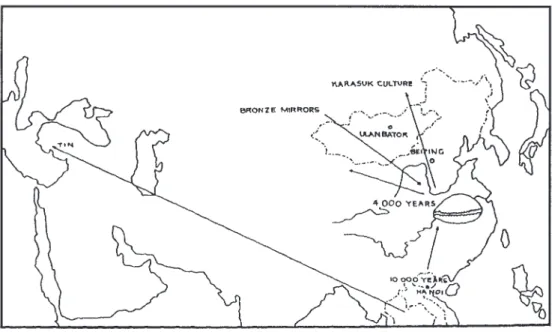
A slit on a perfectly circular object doesn’t only express conciliatory philosophy but also refects a glutton’s philosophy. That feature is materialized through the cauris moneta. Those small artifacts rarely drew archaeologists’ attention, but ethnologists are more interested in them. The glutton’s conception was linked with the cauris moneta and commonly existed with many populations over the world. But first of all it is obvious that it bears the character of the maritime culture. In Viet Nam, at the sites of Hoa Binh and Bac Son cultures, were also found many cauris moneta in various culture strata. The cauris moneta were related with the ancient inhabitants in Viet Nam having more than 10,000 years of history. Until now many ethnic minorities, especially the Kho Mu, regard the cauris moneta as a dowry given to girls at marriage.
Considering the shellfish we can see the broad South North relations. The cauris moneta came to the Qijia culture in Qing Hai(Kaogu 4-1986). In the Erlitou culture on the Central
Shang dynasties, the cauris moneta became money(Chia Ku Wen 1976). According to the
Chinese calligraphy the word "bao" means "precious" and comprises the cauris moneta. The cauris moneta showed the precious artifacts which were accumulated and distributed. At the end of the Xiaotun period they were moulded from bronze(Kaogu Xuebao 9-1955) The
contemporaries of the Shang period, paralled to the Erligang’s, the people belonging to the Karasuc culture in South Siberia used with satisfaction the cauris moneta made of stone.
Under the Western Zhou period, the cauris moneta were used throughout the country. Among 47 tombs discovered in Fengxi(Kaogu 4-1987), 27 contained cauris moneta. That
kind of money was described as made of stone (Kaogu 1-1976) and existed in Gan Su (Kaogu 1-1985) and even in Sinkiang (Kaogu 6-1986). Under the Eastern Zhou dynasty,
the cauris moneta were made from bronze and plated with gold gilt. Only in a tomb in Shangmacun No. 13, 1,600 copper cauris moneta and 32 others made from copper and plated with gold gilt were discovered(Kaogu 5-1963). In the Zhan Quo period, that kind
of money was made from silver(Cai Yung Zhang 1987) and gold. See Fig. 4 which relates
the exchange relations from the South to the North 4000 years ago.
Archaelogical evidence also provides more understanding on the position of a civilization culture. In the Central Plains, although they had not orginated from there, the cauris moneta played an activer role as currency among the ancient people of that area. Six other artifacts−bronze mirrors−were also discovered: four in the tomb of Lady Hao, one
in tomb No. 25 and one found in 1934.
The merit of inventing that kind of artifact belongs to the nomadic people of South Siberia. That event had some connections with their leather clothes which could never be washed, thus making their copper buttons shine like mirrors. Those artifacts were imported to the Central Plains with silk clothes and other commodities. Then owing to developed copper smelting techniques they became fine and high grade art products which were cher-ished by the contemporary people.
Like jade artifacts having come from the East to the Central Plains in the contemporary socio-conomic environment and with help of those discovered in the tomb of Lady Hao, we can say that they reached a very high degree of art and attracted public admiration which has lasted until now. The Central Plains were not the place of the first inventions, the first creations, but the place which knew how to gather the best contemporary artists, how to attract, up-grade and perfect the creations of those times in order to distribute them. By those means they allowed a historic epoch to flourish. So I think it gives a lesson in history by archaeology on a generalized law when we are prepared to enter the 21st century.
Obviously in the spread of exchange relations having existed on the two continents of
Asia and Europe between the end of the third millennium and the second millennium B.C. many problems ought to be clarified. A kind of object such as "pottery fork" or ceramic horn existed in the whole country, at the sites in the Bronze Age and the early Iron Age in Viet Nam. But they were recently discovered in the Daixi culture(4000 3300 B.C.) and
even in the cultures earlier than the Yangshao culture(Huyen Nam 1992).
Other artifacts that deserve our interest in East West relations were the ceramic stamp seals. A great number of those seals were discovered in the Hoa Loc culture and afterward in the Xom Con culture in Khanh Hoa(Vu Quoc Hien 1983). It is probable that those seals
existed until the Dong Son stage(Diep Dinh Hoa 1987). In that late stage, those artifacts
also existed at Ban Chieng, Thailand. According to Janos Makkay, those stamp seals also existed in great number in South Europe between the fifth and first millennium B.C.(Janos
Makkay 1984). Should the existence of those stamp seals have some connection with the
road used for transporting tin from the East to the West in the Bronze Age. With an overall view, we can say that not only the ceramic seals but also zhangs were the artifacts which were representative of the sea factor in the Dong Son civilization.
Additional Notes
In Viet Nam alongside the archeological sites of the Metal Age in the Red River Basin many other well-known sites show a great diversity. There are Phung Nguyen Duong Co system and hors system. Phung Nguyen and Xom Ren sites are not C14 dated. These sites developed within restricted systems. The early Bronze Age then begins with the Phung Nguyen period from which only one of the earliest sites having C14 analysed is Dong Cho. C14 dated: Bln 3081: 3800± 60 BP, calibrated to 2350 2140 B.C. Go Ma D
ong is the earliest site of hors system C14 dated : Bln 1277: 4150± 60 BP, calibrated to
2900 2580 B.C.
The terminal dates for the early Bronze Age were achieved with samples from Thanh Den, Trang Kenh and Dong Dau(earliest level).
Thanh Den site is C14 dated as follows :
Bln 3263 2630± 50 B.P. Bln 2957 3000± 60 B.P. R 975511 2650± 130 B.P. Bln 3261 3090± 60 B.P. Bln 3262 2730± 50 B.P. Bln 2956 3350± 50 B.P. Bln 2981 2860± 70 B.P. R 9755 3 3390± 70 B.P. (Wellington) Bln 2953 2920± 70 B.P. R 9755 2 3530± 100 B.P. (Wellington) Bln 2955 2940± 60 B.P. Bln 3264 3650± 70 B.P.
Bln 2954A 2960± 60 B.P.
This system of C14 dates ranging from the early to the late belongs to the typical Dong Dau period, middle Bronze Age in the Red River Basin.
Trang Kenh is C14 dated as follows:
Bln 891 3405± 100 B.P. Bln 3710 3260± 160 B.P.
ZK 387 3005± 90 B.P.
University of Arizone AMS method:
3280± 55 B.P. cal. 1684− 1497 B.C.
3340± 70 B.P. cal. 1732− 1527 B.C.
Trang Kenh is a regional variant in coastal area. Dong Dau site is C14 dated as follows :
The earliest level− Go Bong period:
Bln 830 3330± 100 B.P. calibrated to 1650 B.C.
Dong Dau period :
Bln 3811 2830± 80 B.P.
Bln 3810 2960± 150 B.P.
Bln 3711 3050± 80 B.P.
They lie directly in the second half of the second millennium B.C. at the time when the middle Bronze Age began. This provides good grounds for believing that the early Bronze Age in the Red River delta might have existed from the third millennium B.C. to the latter half of the second millennium B.C.
Concurrently with the Phung Nguyen Duong Co system, in the Ma River basin was the Dong Khoi Dong Son system. Hoa Loc culture and Con Chan Tien site belong to the hors system. The cultural complex at Con Chan Tien site comes very near the Go Bong site.
Reference Materials
I. In Vietnamese
Quang Van Cay. 1984. The Con Chan Tien archaeological site. Scientific Informations. Institute of Viet Nam History Museum. 39-45
Hoang Xuan Chinh, Nguyen Ngoc Bich. 1978. The Phung Nguyen archaeological site. Social Sciences Publishing House. Hanoi.
technique. Archaeology Review. 2: 63-80.
Nguyen Kim Dung, Tran Quoc Vuong. 1976. The stone workshop at Bai Tu Ha Bac prov-ince. Archaeology Review. 17: 70-71.
Complete works on The Great Viet History (1647). Social Sciences Publishing House.
Hanoi. 1983 Tome I. 118.
Diep Dinh Hoa. 1974. The Go Hen site(HaT ay). Archaeology Review. 16: 74-76.
. 1977. Some reflexions on the Dong Son Pottery. Social Sciences Review. 3: 57-71. . 1978. On the metal artifacts from the beginning of the Bronze Age in Viet Nam. Archaeology Review. 2: 10-20.
Diep Dinh Hoa and La Xuan Dinh. 1981. People of the Go Bong type in Thanh Hoa about 4,000 years ago. New Archaeological Finds. 68-71.
Vu Quoc Hien. 1983. The Xom Con archaeological site Khanh Hoa province. Scientific Informations: Institute of Viet Nam History Museum. 39-44.
Pham Ly Huong. 1972. Excavation of the Ma Dong site Son Tay city. New Archaeological Finds. 150-163.
Pham Minh Huyen. 1992. The second excavation at the Con Chan Tien site Thanh Hoa province. Best thanks to Dr Pham Minh Huyen for the amiability of her materials dona-tion and publicadona-tion permission.
. 1995. Stone halberds and zhangs on the Bronze Age in the North Viet Nam. Scientific Information. Institute of Viet Nam History Museum. 22-38.
Huyen Nam. 1992-1993. The Viet in the South and Viet Nam. South East Asia Studies 4(9),5 (10).
Le Trung Kha and Vu The Long. 1970. The fauna at the Trang Kenh site. Archaeology Review 7-8: 141-142.
Han Van Khan. 1976. The Go Dien site Vinh Phu province. Archaeology Review. 16: 79-80.
Vu Tu Lap et al. 1991. Culture of Vietnamese nation in the Red River delta. Hanoi. Nguyen Loc. 1969. How did I find the Phung Nguyen site. Archaeology Review. 1: 97-100.
. 1976. A test dig at Dong Ba Tram. Archaeology Review, 17: 60-61.
. 1985. The strange artifacts recently found at the archaeological Phung Nguyen site. New Archaeological Finds. 73-74.
Ha Van Phung 1983 Ha Long culture in the Phung Nguyen Dong Son system. Archaeology Review. 1: 34-36.
Ha Van Tan. 1974. The Dong Cho site Ha Tay province. Archaeology Review 16: 77-78. Ha Van Tan and Han Van Khan. 1981. Two strange artifacts at one of the sites of the
Phung Nguyen culture. New Archaeological Finds. 62-65.
Phan Truong Thi. 1970. Nephrite and jade in the hands of the ancient people at Trang Kenh site. Archaeology Review. 7-8: 139-140.
Nguyen Duc Tung. 1970. Nature and people of the Hung Vuong period through palynological analysis at Trang Kenh. Archaeology Review. 7-8: 143-144.
Institute of Viet Nam History Museum. 1977. Hoa Loc culture. Hanoi. II. In English and other languages
Minao Hayashi. 1991. Studies of Chinese ancient jades.
Janos Makkay. 1984. Early stamps seals in South-East Europe. Budapest. Yang Jian Fang. 1982. A bibliography of Ancient Jade. Hong Kong.
. 1987. Jade carvings in Chinese archaeology-I. Hong Kong.
Tang Chung. 1991. Archaeological finds from the Pearl delta in Guangdong. Hong Kong. Zhu Feisu. 1984. Several Problems related to the Archaeology of neolithic Guangdong. In
"Archaeological finds from Pre Qin sites in Guangdong". Hong Kong. 30-63.