
Do granivorous insects invade fallen acorns of Pasania edulis (Makino) Makino through exit holes of curculio weevil larvae?
7
0
0
全文
(2) Sone, Oishi and Hata. 2. Methods. The field study was conducted in an evergreen broad-leaved forest of the Takakuma Experimental Forest of Kagoshima University (TEFKU) (31º31′N, 130º46′E, and 550 m in altitude) in Kagoshima Prefecture, southern Japan. The annual mean temperature and precipitation of this area during the last decade were 14.3 °C and 3,460 mm, respectively. The crown layer of the forest was closed, and P. edulis was the most dominant species of tree, occupying about 50% of the canopy. Other dominant tree species were Castanopsis cuspidata, Machilus thunbergii, Neolitsea sericea, Distylium racemosum, Quercus acuta, and Q. salicina. The understory vegetation was composed of Cleyera japonica, Symplocos lucida, Camellia japonica, and Illicium anisatum. On the floor, vegetation was poor, and 3–5 cm thick leaf litter had accumulated uniformly through the forest. In October and November 2014, we collected fallen P. edulis acorns, wrapped them in wet paper towels and stored them in a refrigerator (5 °C, dark conditions). In April 2015, we classified these acorns into W-acorns and S-acorns. We made H-acorns by drilling a hole 2 mm in diameter and 5 mm long in the area about 1/3 from the bottom of half of the S-acorns. On April 9, 2015, we put the 100 S-, W-, and H-acorns in 30×30×10 cm cages,. and buried them about 5 cm. deep in the soil in TEKFU’s evergreen, broad-leaved forest. These cages were made of 4 mm wire mesh to prevent the buried acorns from being pilfered by granivorous Apodemus mice and predation by large or medium-sized omnivorous mammals such as the wild boar (Sus scorofa leucomystax), the badger (Meles meles anakuma), and the raccoon dog (Nyctereutes procyonoides viverrinus). We buried one cage each of S- and W-acorns and two cages of H-acorns at intervals of 3–10 m; a total of 100 S-, 100 W-, and 200 H-acorns were buried. Sone et al. [10] and Nakamura et al. [7] reported that the acorn borer attacked the germinated P. edulis acorns in the soil, and attacked acorns were observed here and there in the forest, suggesting that the acorn borer uniformly inhabited the forest and the probability of the buried acorns being attacked by the acorn borer did not differ with the cages. On November 2, 2015, we collected the buried acorns and examined them for appearance, the emergence of shoots and roots, cracks at the top of the acorn, and cracks at parts other than the top (nutshell cracks). In this study, acorns with an emerged root or shoot and root and those with a crack at the top were regarded as germinated acorns. We dissected each acorn and examined the degree of invasion by the acorn borer or the Bell moth and the condition of the cotyledons. The condition of the cotyledons was recorded as being sound, rotten/deteriorated, or absent (acorns were empty because the cotyledons were completely consumed), and any other alterations were also noted. The cotyledons of some H-acorns had deteriorated around the artificial hole or were rotten in limited sections along the artificial hole. We recorded the condition of these cotyledons as sound..
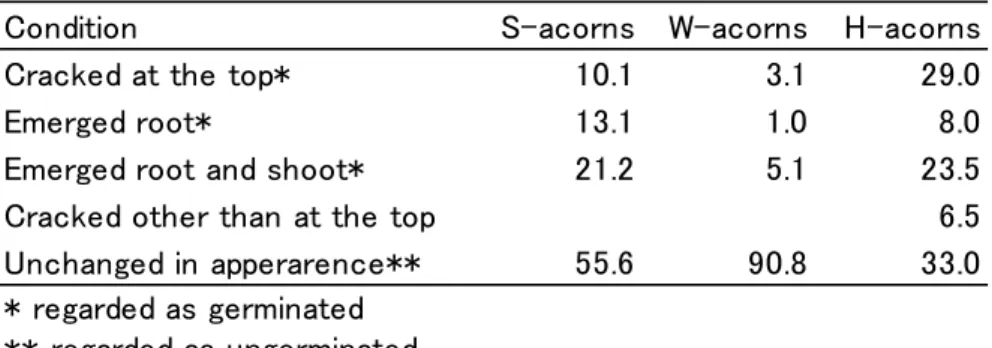
(3) Weevil’s exit holes and acorn borer attack. 3. Data analysis. We compared the percentages of ungerminated acorns with sound cotyledons in the three categories of acorns using Fisher’s exact probability test. We conducted Bonferroni’s correction to examine the significance of the difference between the values of each pair of acorn categories.. Results. In October, we collected a total of 99 S-, 98 W-, and 200 H-acorns and examined their conditions (Table 1). Of the S-acorns, 34.3% had an emerged root or root and shoot and 10.1% had a crack at the top. Of the W-acorns, 6.1% had an emerged root or root and shoot and 3.1% had a crack at the top. Of the H-acorns, 31.5% had an emerged root or root and shoot and 29.0% had a crack at the top. In addition, the nutshell of 6.5% of the H-acorns was cracked vertically (nutshell crack).. Table 1 The percentage of acorns in various conditions Condition S-acorns W-acorns Cracked at the top* 10.1 3.1 Emerged root* 13.1 1.0 Emerged root and shoot* 21.2 5.1 Cracked other than at the top Unchanged in apperarence** 55.6 90.8 * regarded as germinated ** regarded as ungerminated. H-acorns 29.0 8.0 23.5 6.5 33.0. Attacks by the acorn borer were confirmed in 34 (25 germinated and nine ungerminated) S-acorns and 18 (13 germinated and 5 ungerminated) H-acorns. The acorn borer had bored into all 25 germinated S-acorns and 11 of the 13 H-acorns through a top crack. The acorn borer made its own entrance hole in two H-acorns. The acorn borer made an entrance hole on five of the nine ungerminated S-acorns and two of the five ungerminated H-acorns. The acorn borer did not use the artificial holes to enter the acorns (Table 2).. Table 2 the number of S- and H-acorns attacked by the acorn borer through different sites Entrance site S-acorns H-acorns Germinated Ungerminated Germinated Ungerminated Crack at the top 25 0 11 0 Entrance hole made 0 5 2 2 by the borer Artificial hole 0 0 0 0 Others/unknown 0 4 0 3.
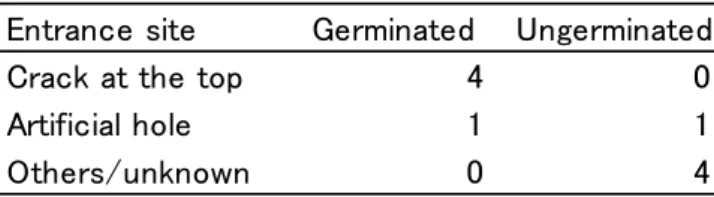
(4) Sone, Oishi and Hata. 4. The Bell moth attacked only the H-acorns (five germinated and five ungerminated acorns). The larvae entered through the crack at the top of four of the germinated H-acorns and the artificial hole of the other germinated H-acorn. The larvae entered one of the ungerminated H-acorns through the artificial hole and through an undetected path in the other four ungerminated H-acorns (Table 3).. Table 3 The number of H-acorns attacked by the Bell moth through different sites Entrance site Crack at the top Artificial hole Others/unknown. Germinated Ungerminated 4 0 1 1 0 4. Cotyledons in the acorns attacked by the acorn borer and the Bell moth were completely rotten or absent. The cotyledons of 21.7% of the ungerminated S-acorns were completely rotten and 78.3% were sound. Cotyledons were completely rotten and/or absent in 97.8% of the ungerminated W-acorns and only 2.2% were sound. The cotyledon deterioration present in some of the H-acorns had progressed around the artificial hole. The cotyledons were completely rotten and/or absent in 58.9% of the ungerminated acorns and were sound in 41.1%. The percentage of ungerminated acorns with sound cotyledons varied significantly according to the category of the acorns, and the difference in the percentage of ungerminated acorns with sound cotyledons was significant for any combination of acorn categories (in all cases, Fisher’s exact probability P < 0.01).. Discussion. Curculio weevil attacks have detrimental effects on the seedling establishment of acorn-producing tree species [3, 5, 6, 9]. In this study, 44.4%, 9.2%, and 60.5% of the S-, W- and H-acorns were regarded as germinated and 21.2%, 5.1%, and 23.5%, had emerged shoots and roots, respectively. These results indicate that, as reported by Sone et al. [9], curculio weevil attacks greatly suppress the seedling establishment of P. edulis while the artificial holes did not. After the acorns drop to the ground, insects attack the acorns before and after germination [1, 2, 4–8, 10–12]. Four species of insects have been reported to attack the acorns of P. edulis: the acorn borer, the Tipulidae sp., the Nitidulid beetle, and the Bell moth [12, 13]. The acorn borer uses the crack at the top of germinated acorns or makes an entrance hole and the Bell moth larvae attacks through a crack made during germination on the nutshell or a hole made by other insects [12]. In this study, the acorn borer attacked S- and H-acorns and the Bell moth larvae attacked only the H-acorns. The cotyledons in the acorns attacked by these two insects were completely consumed or absent. These results suggest that the attacks of these insects have devastating effects on seedling establishment, which is consistent.
(5) Weevil’s exit holes and acorn borer attack. 5. with the report by Sone et al. [10] and Nakamura et al. [7] that suggests the attack by the acorn borer is a mortality factor. The acorn borer attacked both germinated and ungerminated acorns. This insect used the crack at the top or made an entrance hole for its entry, but it did not use the exit holes of the weevil larvae or artificial holes, as has been reported by Ueda et al. [12]. The Bell moth larvae entered some H-acorns through the artificial holes. This suggests that although we did not verify the entry of the Bell moth larvae through the exit holes of the weevil larvae, this possibility may remain. However, the ratio of acorns attacked by the Bell moth was very low in this study. Therefore, in the forest, the exit holes of the curculio weevil larvae may be used for invasion only by a few granivorous insects on the ground. The percentage of ungerminated acorns with sound cotyledons was significantly higher in S-acorns than in either W- or H-acorns. The deterioration of the cotyledons of H-acorns progressed around the artificial hole. These results show that the fungal and arthropod decomposers invaded the acorns through the exit holes of weevil larvae. In conclusion, the exit holes of the weevil larvae are not necessarily used by granivorous insects to invade the acorn on the ground, but may facilitate the deterioration of cotyledons due to the invasion of fungal and arthropod decomposers, resulting in the inhibition of germination and seedling establishment.. Acknowledgement. This study was financially supported by a Grant-in-Aid for Scientific Research (No.25660119).. References. [1]. Akashi, N.: Dispersal pattern and mortality of seeds and seedlings of Fagus crenata Blume in a cool temperate forest in western Japan. Ecol. Res., 12, 159 – 165 (1997). [2]. Andersen, A.N.: How important is seed predation to recruitment in stable populations of long-lived perennials? Oecologia, 81, 310 – 315 (1989). [3]. Fukumoto, H. and Kajimura, H.: Effects of insect predation on hypocotyl survival and germination success of mature Quercus variabilis acorns. J. For. Res., 5, 31 – 35 (2000). [4]. Gurnell, J.: Tree seed production and food conditions for rodents in an oak wood in southern England. Forestry, 66, 291 – 315 (1993). [5]. Maeto, K.: Relationship between size and mortality of Quercus mongolica var. grosseserrata acorns due to pre-dispersal infestation by frugivorous insects. J. Jpn. For. Soc., 77, 213 – 219 (1995). [6]. Matsuda, K.: Studies on the early phase of the regeneration of konara oak (Quercus serrata Thumb.) secondary forest. 1. Development and premature abscission of konara oak acorns. Jap. J. Ecol., 32, 293 – 302 (1982).
(6) Sone, Oishi and Hata [7]. 6. Nakamura, M., Hirata, R., Oishi, K., Arakaki, T., Takamatsu, N., Hata, K. and Sone, K.: Determinant factors in the seedling establishment of Pasania edulis (Makino) Makino. Ecol. Res. 28, 811 – 820 (2013). [8]. Nilsson, S.G.: Ecological and evolutionary interactions between reproduction of beech Fagus silvatica and seed eating animals. Oikos, 44, 157 – 164 (1985). [9]. Sone, K., Oishi, K., Shibato, T. and Hata, K.: Effects of acorn attack by curculio weevils on the germination and early growth of Pasania edulis (Makino) seedlings. J. For. Res., 21, 185 – 192 (2016). [10] Sone, K., Hiroi, S., Nagahama, D., Ohkubo, C., Nakano, E., Murao, S. and Hata, K.: Hoarding of acorns by granivorous mice and its role in the population processes of Pasania edulis (Makino) Makino. Ecol. Res., 17, 553 – 564 (2002) [11]. Ueda, A.: Insect infestation on acorns of Japanese chestnut, Castania crenata Sieb. et Zucc., in natural forest. Trans. Jpn. For. Soc., 107, 233 – 236 (in Japanese) (1996). [12] Ueda, A., Igarashi, M. and Ito, K.: Acorn infestation by insects on three evergreen oaks, Quercus glauca, Q. myrsinaefolia and Pasania edulis. (II). Their invasion term and level after acorn dropping. Trans. Jpn. For. Soc., 104, 681 – 684 (in Japanese) (1993) [13] Ueda, A., Igarashi, M., Ito, K. and Koizumi, T.: Acorn infestation by insects on three evergreen oaks, Quercus glauca, Q. myrsinaefolia and Pasania edulis. (I). Their invasion term and level before acorn dropping and comparison with the deciduous Q. serrata. Trans. Jpn. For. Soc., 103, 529 – 532 (in Japanese) (1992).
(7) Weevil’s exit holes and acorn borer attack. 7. Do granivorous insects invade fallen acorns of Pasania edulis (Makino) through exit holes of curculio weevil larvae?. Sone Koichi 1) † , Oishi Keita 2) and Hata Kunihiko1) 1) 2). Laboratory of Forest Protection, Kagoshima University. The United Graduate School of Agricultural Sciences, Kagoshima University. Summary. Pasania edulis (Fagacea) is a dominant tree species in evergreen broad-leaved forests in southern Japan. Predation by insects is harmful to seedling establishment. The larvae of the acorn weevil, likely Curculio hilgendorfi, feed on the acorns of P. edulis and exit the fallen acorns to overwinter in the ground. The fallen acorns are then invaded by other granivorous insects. To examine whether the exit holes of the weevil larvae are used for invasion by other insects, we buried the acorns in the ground in April 2015 and compared the germination ratio, the condition of the cotyledons, and the invasion of the acorn borer, Coccotrypes graniceps, and the Bell moth, Cryptaspasma trigonata, in acorns in November 2015. The germination ratio was significantly higher in acorns without holes (S-acorns) and acorns with artificial holes mimicking the exit hole of weevil larvae (H-acorns) than for acorns with an exit hole (W-acorns). The acorn borer did invade S- and H-acorns, but not through the exit holes or the artificial holes. The Bell moth attacked some H-acorns through the artificial holes. The percentage of ungerminated acorns with intact cotyledons was significantly higher in S-acorns than in H- or W-acorns. These results show that the exit holes of the curculio weevil larvae may contribute only slightly to invasion by other granivorous insects, but may significantly facilitate the invasion of fungal and arthropod decomposers into the fallen acorns.. Key words: Curculio weevil-attacked acorns, Exit holes, Pasania edulis acorns, The acorn borer, The Bell moth. †. : Correspondence to:Koichi Sone (Laboratory of Forest Protection Laboratory, Department of Environmental Sciences and Technology, Faculty of Agriculture, Kagoshima University) Phone:099-285-8580, E-mail:[email protected].
(8)
図
関連したドキュメント
An easy-to-use procedure is presented for improving the ε-constraint method for computing the efficient frontier of the portfolio selection problem endowed with additional cardinality
(Construction of the strand of in- variants through enlargements (modifications ) of an idealistic filtration, and without using restriction to a hypersurface of maximal contact.) At
The periodic unfolding method for the classical homogenization was introduced in Cioranescu, Damlamian and Griso [4] for fixed domains (see [5] for detailed proofs) and extended
It is suggested by our method that most of the quadratic algebras for all St¨ ackel equivalence classes of 3D second order quantum superintegrable systems on conformally flat
Keywords: continuous time random walk, Brownian motion, collision time, skew Young tableaux, tandem queue.. AMS 2000 Subject Classification: Primary:
This paper develops a recursion formula for the conditional moments of the area under the absolute value of Brownian bridge given the local time at 0.. The method of power series
Then it follows immediately from a suitable version of “Hensel’s Lemma” [cf., e.g., the argument of [4], Lemma 2.1] that S may be obtained, as the notation suggests, as the m A
Definition An embeddable tiled surface is a tiled surface which is actually achieved as the graph of singular leaves of some embedded orientable surface with closed braid
