The Japanese and Chinese models of industrial
organisation : fighting for supremacy in the
Vietnamese motorcycle industry
著者
Fujita Mai
権利
Copyrights 日本貿易振興機構(ジェトロ)アジア
経済研究所 / Institute of Developing
Economies, Japan External Trade Organization
(IDE-JETRO) http://www.ide.go.jp
journal or
publication title
IDE Discussion Paper
volume
420
year
2013-06-01
INSTITUTE OF DEVELOPING ECONOMIES
IDE Discussion Papers are preliminary materials circulated to stimulate discussions and critical comments
Keywords: industrial organisation, Vietnam, China, Japan, motorcycle industry JEL classification: L10, L22, L62
* Deputy Director, Southeast Asian Studies Group II, Area Studies Center, IDE ([email protected])
IDE DISCUSSION PAPER No. 420
The Japanese and Chinese Models of
Industrial Organisation: Fighting for
Supremacy in the Vietnamese Motorcycle
Industry
Mai Fujita*
June 2013
Abstract
This paper explores the consequences of the emerging rivalry between Japanese and Chinese manufacturers. It focuses specifically on industrial organisation, one of the key factors that underlie the competitiveness of manufacturing industries. The question to be asked is what happens when distinctive models of industrial
organisation, coming from Japan and China, clash in a developing country. An in- depth longitudinal analysis of the Vietnamese motorcycle industry adopting a modified version of the global value chain governance theory shows that a decade- long industrial transformation resulted in organisational diversity. The implications of the analysis for the literature on industrial organisation are discussed.
The Institute of Developing Economies (IDE) is a semigovernmental, nonpartisan, nonprofit research institute, founded in 1958. The Institute merged with the Japan External Trade Organization (JETRO) on July 1, 1998. The Institute conducts basic and comprehensive studies on economic and related affairs in all developing countries and regions, including Asia, the Middle East, Africa, Latin America, Oceania, and Eastern Europe.
The views expressed in this publication are those of the author(s). Publication does not imply endorsement by the Institute of Developing Economies of any of the views expressed within.
INSTITUTE OF DEVELOPING ECONOMIES (IDE), JETRO 3-2-2, WAKABA,MIHAMA-KU,CHIBA-SHI
CHIBA 261-8545, JAPAN
©2013 by Institute of Developing Economies, JETRO
No part of this publication may be reproduced without the prior permission of the IDE-JETRO.
1
The Japanese and Chinese Models of Industrial Organisation:
Fighting for Supremacy in the Vietnamese Motorcycle Industry
1Mai Fujita
1. Introduction
In the 1980s, the Japanese manufacturing industry was at the forefront of research on economic development and competitiveness. In an attempt to determine the sources of Japanese competitive advantage, researchers examined how the distinctive models of intra- and inter-firm organisation – characterised by lean production and trust-based supplier relations – contributed to the sustainment of superior product development and manufacturing performance (Smitka 1991; Clark and Fujimoto 1990, 1991; Nishiguchi 1994; Dyer 1996; Fujimoto 1999; Lecler 2004). It is now acknowledged worldwide that the hierarchical, captive model of inter-firm organisation consisting of a powerful lead firm and closely aligned suppliers helped Japanese manufacturing firms to achieve superior product development and productivity performance; thus, establishing leading positions on major world markets, where consumers valued high quality, product differentiation, and fast product innovation.
The influence of the Japanese model was not restricted to the domestic market. As Japanese firms expanded abroad via FDI, the original model was transferred and adapted to different country contexts. As Japanese and local firms engaged in rounds of organisational competition and adaptation in the host country environment, various hybrid forms of industrial organisation emerged, which resulted in increased
organisational diversity (Cusumano and Takeishi 1991; Sako 1992; Helper and Sako 1995; Guiheux and Lecler 2000; Ernst 2002; Sturgeon 2007). The Japanese model was also adopted independently in both developed and developing countries by local producers seeking to improve the productivity of their operations (Kaplinsky 1995; Posthuma 1995a, 1995b; Harriss 1995; Humphrey et al. 1998).
Two decades later, the global industrial landscape has changed. As the growth centres
1
This research was partially supported by Grant-in-Aid for Scientific Research (C) on “Assembler- Supplier Relationship and the Growth of Local Component Suppliers in the Vietnamese Motorcycle Industry” (Project No. 20510243) of the Japan Society for Scientific Research.
2
of the world’s leading manufacturers have shifted to developing countries, Japanese manufacturers face major challenges from Chinese firms, which have attained overwhelming cost advantages by means of a distinctive form of industrial
organisation. The existence of a uniquely Chinese model of industrial organisation has not been recognised widely. In a separate paper (Fujita 2013a), based on the literature and my own analysis, I sought to establish the key features of the Chinese model of industrial organisation, which I found to be characterised by intense price-based competition between a large number of lead firms and suppliers engaged in
arm’s-length transactions. Such an organisational model has enabled Chinese firms to attain remarkable levels of price-based competitiveness that challenge the Japanese industry leaders.
This paper investigates the new patterns of rivalry emerging out of the rise of the Chinese model of industrial organisation. It does so by examining what happens when the two models of industrial organisation, coming from Japan and China respectively, clash in a third Asian developing country that seeks to establish its competitive industry. Which model is more adaptable to local conditions? Is one superior to the other? Do they exist side by side? Does competition open up space for a distinctively different model of industrial organisation? How do firm responses vary over time? These are the questions that this paper seeks to address.
Indeed, the aforementioned questions are at the forefront of research on economic development and competitiveness. There has long been a discussion on the relevance of models of industrial organisation for the pace and patterns of economic development. This line of research asks: how important have models of industrial organisation been in their countries of origin; how relevant are they for other countries; can they be transferred; and, if so, what adjustments need to be made? These and similar questions were raised by a group of researchers in a special issue of World Development in 1995.2
The overall conclusion reached was that research on industrial organisation needs to extend beyond models to analyse the trajectories of diffusion and adaptation (Humphrey 1995).
However, although the importance of analysing trajectories of organisational change is widely recognised, this has rarely been done systematically. One of the major obstacles in this regard has been the lack of a conceptual device for systematically explaining the
2
Special issue on ‘Industrial Organization and Manufacturing Competitiveness in Developing Countries’, Vol. 23 No.1.
3
complex processes of organisational transformation, which are shaped by a myriad of factors – technological, strategic, institutional, and social. Nevertheless, recent theoretical development in the field of global value chain (GVC) governance perhaps offers a way forward (Gereffi et al. 2005).
The present paper utilises an adapted version of Gereffi et al.’s (2005) framework of GVC governance developed by Fujita (2013a) to describe and explain the short- and medium-term dynamics of organisational adaptation arising from the clash of Japanese and Chinese models. In so doing, it seeks to highlight the challenges and tensions that firms might face in the process of organisational transformation, and how such
problems could be overcome.
In examining the clash of the Japanese and Chinese models in a third country context, the paper takes the context of Vietnam and examines the case of its motorcycle industry. The rationale for focussing on this sector is because the motorcycle industry is the one in which a direct clash between the two models is most prominent, and Vietnam was the first locality outside China in which they clashed head-on and fought for supremacy. It is now well known that the massive imports of low-priced Chinese motorcycles into Vietnam in the early 2000s had a huge impact on the Japanese industry leaders (Cohen 2002). What is less well known is that there were repeated rounds of organisational adaptation triggered by the emergence of Vietnamese motorcycle assemblers inheriting the Chinese organisational model. The ensuing competitive adaptation of both Japanese and Chinese organisational models generated enormous industrial dynamism, eventually leading this latecomer developing country to emerge in a decade as one of the world’s major motorcycle producers.3
This paper examines how the Japanese and Chinese models were transformed through competitive adaptation in Vietnam over a period of a decade. Specifically, it addresses the following main research question:
How has the clash between Japanese and Chinese organisational models affected the organisational transformation of the Vietnamese motorcycle industry?
3
Production of motorcycles in Vietnam began in 1996 (General Statistics Office 1999). In 2006, domestic production and sales recorded 2.1 and 2.4 million units, respectively, making the country the world’s fourth largest producer of and market for motorcycles after only China, India and Indonesia (General Statistics Office 2009; Honda Motor Co., Ltd. 2008).
4
This research question is explored through an examination of the Vietnamese
motorcycle industry over the decade following the late 1990s. The focus is on two sets of value chains representative of the Japanese and Chinese models of industrial
organisation respectively. Drawing on data collected at different periods from
interviews and surveys of lead firms and suppliers, this study engages in an in-depth, longitudinal analysis of how the two sets of value chains were transformed as the respective lead firms competed for supremacy in the Vietnamese market.
The remainder of the paper is structured as follows. Section 2 reviews the existing literature, identifies research gaps, and elaborates questions and corresponding hypotheses derived from previous research. Section 3 presents the conceptual
framework. Section 4 discusses the research methodology and operationalises the key concepts. Sections 5 and 6 comprise the empirical core of the paper, presenting analyses of the dynamic transformation of the Japanese and Chinese models of industrial organisation respectively in the Vietnamese motorcycle industry. Section 7 summarises the findings of the paper and discusses its contribution to the literature on organisational models and trajectories.
2. Literature Review
The purpose of this section is to review the existing literature of direct relevance to the research question explored in this paper. This covers three main strands of literature: the literature on models and trajectories of industrial organisation in general; the literature on Japanese and Chinese models of industrial organisation in particular; and the emergent literature on the Vietnamese motorcycle industry. Based on gaps
identified in the course of this review, the section concludes by refining the research question and presenting resultant hypotheses.
2.1 Industrial Organisation: From Models to Trajectories
The 1980s and 1990s saw a flourish of research on industrial organisation. Spurred by the varieties of patterns by which industries were organised – from large and vertically integrated business corporations to clusters of small, networked firms, or hierarchical networks consisting of a dominant lead firm and layers of smaller suppliers,
researchers looked into the origins of different patterns and their implications for economic competitiveness (Chandler 1977; Dore 1983; Smitka 1991; Womack et al. 1990; Clark and Fujimoto 1991; Sako 1992; Nishiguchi 1994; Piore and Sabel 1984;
5
Langlois and Robertson 1995; Sturgeon 2002). Those patterns recognised as
particularly successful were codified into models of industrial organisation (Humphrey 1995).
Research did not stop at codifying established practices into models but went on to analyse how such models were applied in practice. While a model essentially defines the key elements of successful experiences, “the experiences upon which the model is constructed continue to change” (Humphrey 1995: 151). Moreover, when models are transferred, the contexts in which they operate often differ markedly from those upon which the experiences were based.
The existing body of research has looked into how models evolved over time in the country of origin in response to changes in external economic conditions, technological change, or competitive pressure (Lecler 1999, 2004; Lamming 2000; McCormick 2004; Sturgeon 2007), and how models transferred to different contexts have gone through processes of hybridisation, adaptation, or localisation (Cusumano and Takeishi 1991; Helper and Sako 1995; Guiheux and Lecler 2000). Very often the result was “neither a copy of the original model nor a replica of existing local patterns, but something different” (Westney 1999: 387). The varieties of country and industry experiences analysed in the literature clearly demonstrate the importance of going beyond models to analyse the trajectories of diffusion and adaptation (Humphrey 1995). However, although the importance of analysing trajectories is widely acknowledged, this has rarely been done systematically.
First, few previous studies have illuminated the actual processes by which organisations change. What they have done is either to compare the status of an organisation at a given point in time in a given setting – often after successful
transformation has been completed – with the defining features of the original model; or to compare prevailing practices among different groups of companies, for example, firms of different nationalities located in a certain country or firms of the same
nationality but located in different countries (Cusumano and Takeishi 1991; Sako 1992; Helper and Sako 1995).
As a result, the actual processes of organisational diffusion and adaptation, which is where insights relevant for firms and policy makers originate (Humphery 1995), remain largely underexplored. With what timing and in what sequence do key features of the model change? What tensions and challenges do organisations face in the
6
process, and how do they overcome them? Very little of the existing literature examines these issues.
Second, there have been limited attempts to systematically explain why organisations evolve in the way they do. On the basis of the existing literature, there seems to be a broad consensus that the driver of organisational change typically comes from a lack of fit between the elements of organisation and the environment (Westney 1999). The problem with such a line of argument is that there has been no incisive debate on what precisely is meant by the ‘environment’.
Existing empirical research mainly refers to the following three dimensions of the environment: (1) local market conditions, for example, producer competition and consumer preferences (Helper 1991; Lecler 1999, 2004; Humphery 2000; Sturgeon and Van Biesebroeck 2010); (2) competence levels and the existence or absence of a local component supply base (Sadler 1994); and (3) institutional factors such as legal and regulatory environments, capital markets, employment systems, culture, and social and moral norms (Dore 1983; Sako 1992).
However, given the lack of a systematic attempt to deconstruct the concept of the environment into a series of concrete, operational variables, we still do not know which factors are most important, how they interact with each other, or how they shape the processes of organisational change. Unless these questions are tackled, research can hardly be expected to pin down the fundamental factors that trigger (or impede) the transformation of industrial organisation. Thus, the mechanisms by which variables interact in shaping the processes of organisational transformation remain
underexplored.
The above two research gaps seem to stem at least in part from the lack of an appropriate theoretical framework for categorising the various forms of inter-firm organisation or explaining the circumstances under which they emerge in terms of a series of concrete, operational variables. Recent theoretical development in the field of GVC governance has made important contributions in this regard. This paper adopts the revised version of the GVC governance framework for conducting systematic analysis of trajectories of organisational change.
7
2.2 Japanese and Chinese Models of Industrial Organisation in the Motorcycle Industry
In studying industrial organisation, particularly illuminating are the industries in which contrasting models of industrial organisation coexist because interactions between different models often create new dynamics of organisational transformation.4
With the long dominance of the Japanese model and the rise of a new organisational model emerging from China, the motorcycle manufacturing sector became an example of such industries (Fujita 2013a).
The Japanese model of industrial organisation was developed out of the need to effectively achieve incremental product and process improvements in a proprietary product. Since motorcycles had an integral product architecture, lead firms took the lead in fine-tuning component designs and providing a quality guarantee to their consumers for the product system as a whole (Otahara 2009a, 2009b). Accordingly, they adopted a combination of centralised control and generous assistance in governing long-term relations with a fixed group of suppliers, which were expected to endeavour to achieve performance targets set by the lead firms, often by ceding autonomy (Fujita 2013a).
As Japanese manufacturers started to set up overseas production bases from the 1960s onwards, the organisational model established in Japan was replicated abroad. Lead firms sought to develop long-term relations with local suppliers. Where the local component supply base was lacking, this entailed provision of technical assistance to the suppliers.5
Compared to the long-established prominence of the Japanese model, the rise of its Chinese counterpart is a recent phenomenon. This model emerged in the early 1990s, driven by a large number of indigenous motorcycle manufacturers producing
low-priced imitations of Japanese models. Contingent on de facto standardisation of a few dozen popular Japanese models, large numbers of assemblers and suppliers, both of whom were equipped with limited levels of technological competence, engaged in arm’s-length transactions. With its strength lying in low costs and flexibility, the
4
This seems to explain why the car industry, in which contrasting models of industrial organisation have emerged in the US and Japan, has been studied so widely.
5
This occurred not only in developing countries such as Thailand (Higashi 2006) and Indonesia (Thee 1997; Sato 2011) but also in developed countries such as Italy (Horiuchi 1998).
8
arm’s-length organisational model enabled Chinese motorcycle manufacturers to capture the lion’s share of the huge yet volatile domestic market where consumers put priority on low prices and intellectual property rights are only weakly protected.
The above summary of the existing literature suggests that we now know that the Japanese model of industrial organisation rose to prominence in the 1980s, and that it was transferred to both developed and developing countries – with manufacturers taking the lead in nurturing the pool of competent component suppliers demanded by this model. We also know that a second discrete model emerged in China. However, we know less about what is emerging out of the rivalry between the two models. Which model is superior? Which is more adaptable to third-country conditions; especially in the developing world, where the bulk of global motorcycle sales are concentrated (Fujita 2007)?
Such an overarching enquiry can be deconstructed into a series of more specific questions. In terms of the Japanese model, the key question is whether it can meet the Chinese challenge. Whilst the Japanese model has exhibited extraordinary strength in catering to sophisticated customers in the developed world, can it be adapted to compete with the Chinese model in developing country markets? With regard to the Chinese model, there has thus far been no attempt to study whether it can be successfully transferred. What changes are required if it is to work in different contexts? This paper attempts to answer these questions.
2.3 The Dynamics of Organisational Adaptation: The Vietnamese Motorcycle Industry
The Vietnamese motorcycle industry provides an excellent case through which to address the research gaps identified above. Vietnam was the first locality – after China itself – in which the Japanese and Chinese models clashed head-on. Because Vietnam is a new context for both models, neither has an advantage over the other; both must adapt to local Vietnamese conditions and fight for supremacy in this emerging market.
On the basis of the existing research on the Vietnamese motorcycle industry (Fujita 2005, 2006, 2007, 2008, 2011, 2012; Intarakumnerd and Fujita 2008, 2009; Pham Truong Hoang and Shusa 2006; Pham Truong Hoang 2007; Nguyen Duc Tiep 2006, 2007; The Motorbike Joint Working Group 2007), its development was process can be broadly divided into three stages.
9
In Stage I (mid-1990s to the end of the decade), three Japanese motorcycle
manufacturers were the key players. Following the Vietnamese government’s decision to launch an import substitution policy to promote the domestic production of
motorcycles, Honda, Yamaha, Suzuki and Taiwan’s Sanyang established local factories (Fujita 2006). As their sophisticated products were priced substantially higher than what ordinary Vietnamese consumers could afford, motorcycle sales as a whole stagnated, but Japanese–brand motorcycles still accounted for the bulk of the market (Figure 1). This small, protected market hardly attracted any scholarly attention at this stage.
It was during Stage II (2000–2004) that the Vietnamese motorcycle industry attracted wide interest from businesses, researchers, and policymakers in Vietnam and abroad. In the early 2000s, massive volumes of low-priced imitations of Japanese-brand motorcycles were imported from China – a phenomenon often dubbed the ‘China shock’ (Fujita 2007). Since the Vietnamese government had prohibited the import of assembled vehicles, Chinese imports arrived in the form of knockdown component kits that were assembled by more than 50 local firms (hereafter referred to as ‘local
assemblers’). With prices as low as a third to a quarter of foreign-brand models, these imitations quickly penetrated the medium- and low-income consumer markets that had hitherto been unexploited by Japanese firms. The market expanded four-fold in the late 1990s, and local assemblers of Chinese motorcycles commanded roughly 80% of these extended sales (Figure 1).
The China shock provoked a series of reactions from incumbent producers and policymakers. As Vietnam became a symbol of an expanded Chinese threat that had already become apparent in China, Japanese companies initiated company-wide efforts to regain market shares. This culminated in the launching of a new, low-priced model by Honda Vietnam (HVN) in 2002. The new model, named Wave Alpha and priced at approximately one-third of its previous models, quickly gained popularity as the low-quality of Chinese motorcycles had by now become apparent to Vietnamese consumers (The Motorbike Joint Working Group 2007).
The Vietnamese government responded by enacting a series of policy changes to restore order and promote the sound development of the industry. However, the
uncoordinated, sudden, and often arbitrary ways in which policy changes were enacted – frequently running contrary to previously announced plans and/or discriminating against foreign motorcycle manufacturers (Fujita 2011) – created serious side effects.
10
Figure 1. Motorcycle Sales in Vietnam by Manufacturers
Notes:
(1) VMEP (Vietnam Manufacturing and Export Processing Co., Ltd.) is a 100% invested
subsidiary of Taiwan’s Sanyang Motors, and Lifan Vietnam is a joint venture between China’s Lifan Group and a Vietnamese SOE.
(2) Data on “Honda (Imported)” was available from the Motorbike Joint Working Group (2007) up to 2005 but the figures were zero from 2002 onwards. Data on “Imports” was provided by General Statistics Office (various years).
Source: Prepared by the author on the basis of the Motobike Joint Working Group (2007), Industrial Research Institute (2011) and General Statistical Office (various years).
First, restrictions on the importation and registration of motorcycles were introduced. In September 2002, the Vietnamese government suddenly announced that imports of motorcycle components for the year should be limited to 1.5 million units (Cohen 2002). This was followed by restrictions on motorcycle registration6
and limits on investments in expansion of production capacity by foreign motorcycle manufacturers7
from 2003. Whilst these measures were intended to prevent the uncontrolled
proliferation of motorcycles on Vietnam’s streets, the consequence was stagnation of the overall market growth, with annual sales of motorcycles declining from over 2 million in 2002 to less than 1.5 million in 2003–4 (Figure 1).
6
Circular 02/2003/TT-BCA by the Ministry of Public Security dated 13 January 2003 limited motorcycle registration to one vehicle per person. Decision 98/2003/QD-UB by the Hanoi People’s Committee dated 14 August 2003 prohibited new motorcycle registration in four central districts of Hanoi.
7
Prime Minister’s Decision 147/2002/QD-TTg dated 25 October 2002. 0 0.5 1 1.5 2 2.5 3 3.5 U n it: m illio n v eh ic le s Local Assemblers Imports Lifan Vietnam VMEP Vietnam Suzuki Yamaha Vietnam Honda (Imported) Honda Vietnam
11
Second, in an attempt to encourage the development of local assemblers into fully fledged motorcycle manufacturers, the government stepped up the enforcement of local content rules, which hitherto had been circumvented by local assemblers,8
and instituted standards for motorcycle manufacturers, with the requirement that a minimum of 20% of local content had to be achieved by in-house manufacturing of key components.9
Notably, some of the aforementioned policies were implemented in ways that explicitly favoured local assemblers. When the government suddenly introduced quantitative restrictions on component imports in September 2002, local assemblers received favourable allocation of import quotas, whilst insufficient quota allocation to HVN and Yamaha Vietnam (YVN) even drove these companies to temporarily suspend their production.10
From 2003 onwards, as noted above, the government restricted foreign motorcycle manufacturers from investing in the expansion of production capacity beyond the original proposals granted by the Vietnamese authorities upon the issue of FDI licences. This turned out to be damaging to foreign motorcycle manufacturers because the rapid expansion of the market in the 2000s had not been envisaged in the 1990s. HVN, in particular, suffered because this policy hampered the company’s ambitions to use the Wave Alpha to regain lost market shares.
A new phase of industrial development (Stage III; 2005–2008) began as the end of the policy turbulence brought about rapid, FDI-driven growth. Diminishing academic interest in the industry notwithstanding, this was in fact the time in which the most dynamic development occurred (Fujita 2011). In 2005, the Vietnamese government abandoned restrictions on motorcycle registration11
together with the policy that had prevented foreign motorcycle manufacturers from investing in additional production capacity.12
As a result, domestic motorcycle sales climbed to 2.8 million units in 2007, far exceeding figures during the China shock (Figure 1).
8
The local content rules were originally announced at the end of 1998 for implementation from the beginning of 1999 (Decision of the Ministry of Finance 1994/1998/QD-TTg dated 25 December 1998). Its full implementation was delayed until the beginning of 2001 due to opposition from local assemblers (Ishida 2001).
9
Prime Minister’s Decision No.38/2002/QD-TTg dated 14 March 2002.
10
Of the total of 1.5 million motorcycle component imports permitted for the whole year, local assemblers were allocated 900,000 units whilst foreign motorcycle manufacturers only received 600,000 (Cohen 2002).
11
Circular No. 17/2005/TT-BCA of the Ministry of Public Security dated 21 November 2005 rescinded legislation limiting motorcycle registration to one vehicle per person and only in the locality for which each held household registration.
12
12
Japanese firms chose to satisfy the growing market in Vietnam via FDI for local production, following their conventional approach to the localisation of production in countries with large demands for their products.13
Accordingly, they actively invested in expansion of production capacity, capturing an increasing share of this fast-growing market. In the meantime, local assemblers lost their market share but still held roughly one-third of the sales as of 2006 (Figure 1); surviving by catering to low-income consumers in the rural areas where Japanese-brand models had still not penetrated.
Of the three stages of development, the existing literature on industrial organisation focuses almost exclusively on Stage II, the period immediately following the China shock. Previous studies have emphasised the major changes that both HVN and local assemblers implemented to their sourcing practices immediately after the initial clash. Pham Truong Hoang (2007), Mishima (2007), and Otahara (2009a) all argue that HVN responded to the China shock by significantly diversifying its component sources to include non-Japanese suppliers in Vietnam and even local suppliers in China. Pham Truong Hoang (2007) also analyses the manner in which local assemblers responded to policies requiring local sourcing and investment in in-house manufacturing of
components. On the basis of case studies of four assemblers, he argues that they shifted away from arm’s-length supply systems towards those based on long-term, trust-based relations with suppliers.14
Nevertheless, the above discussion on the stages of Vietnamese motorcycle industrial development suggests that analysing the short-term impact of the China shock may not be sufficient for an understanding of the dynamics of the competitive adaptation of the two models. First, the existing literature acknowledges that the reactions of HVN and local Vietnamese assemblers were devised as emergency measures to cope with the immediate competitive threat (to HVN) and policy requirements (for local assemblers). It remains to be seen whether these adaptations prove to be sustainable in the longer term.
13
From its early years, “to explore the world market, to produce where the demand is” has been at the core of Honda’s mission (http://www.honda.co.jp/50years-history/009.html, accessed 2 October 2011).
14
The four case studies nevertheless indicate varieties of ways in which local assemblers responded to market and policy challenges: maintaining arm’s-length linkages, vertically
integrating component manufacturing, and spurring cooperative relationships with suppliers (Pham Truong Hoang 2007). However, the author does not discuss which of these patterns is dominant, a shortcoming that is probably due to a failure to provide the reasons as to why the four assemblers were selected in the first place. In any case, this research did not include the two assemblers that the present study refers to as A1 and A3 – firms it found to be increasingly dominant in Stage III.
13
Second, the period immediately following the China shock was one of policy
turbulence. Such a distorted and arbitrary legislative environment hardly enabled firms to implement long-term, sustainable adaptations to their sourcing practices. Given that the period of turmoil was immediately followed by a more stable phase (Stage III), it is essential that an analysis of industrial organisation in the Vietnamese motorcycle industry should be extended to cover this period. However, no previous studies have done this.
The temporal aspect of observation also raises the question of what factors cause industrial organisation to evolve. Virtually all of the previous studies cited above assume, explicitly or implicitly, organisational patterns are determined by that lead firms depending on the characteristics of the products they produce – whether design architecture, prices, or quality levels. Accordingly, their focus has been exclusively on the lead firms, whilst suppliers – the other key actor in the value chains – have been left out of the analyses.
In Japanese chains, it was the need for radical cost reduction that compelled HVN’s adjustment to sourcing practices (Mishima 2007; Otahara 2009a). In respect of local assemblers, the need to raise product quality and policy requirements eventually led some assemblers to invest in in-house production of components and/or to adopt long-term, trust-based relations with their suppliers (Pham Truong Hoang 2007).
Owing to its almost exclusive focus on product characteristics, research has hitherto overlooked the very essence of industrial organisation, that is, power relations between firms, which in turn are determined by the nature and levels of capabilities possessed by the respective parties (Sturgeon 2008; Palpacuer 2000; Humphrey and Schmitz 2008). A lead firm has the capacity to enforce particular types and levels of
requirement on suppliers. However, such capacity has its limits because some suppliers may acquire power as they accumulate new competencies that are difficult to replace or explore new customers (Schmitz 2004; Sturgeon 2008). The relative power relations of lead firms and suppliers are central to research on the dynamics of industrial
organisation but no previous studies have analysed them.
2.4 Research Questions and Hypotheses
In view of the research gaps identified above, this paper will examine the evolutionary dynamics of the Japanese and Chinese models of industrial organisation in the
14
Vietnamese motorcycle industry. It addresses the following overarching research question:
How has the competition between Japanese and Chinese organisational models affected the organisational transformation of the Vietnamese motorcycle industry?
For the purpose of analysis, this question is divided into two sub-questions.
Sub-question 1: How did the Japanese and Chinese organisational models evolve in Vietnam?
The literature suggests that the two models converged within a few years of their direct clash, as Japanese motorcycle manufacturers expanded their component sources to include non-conventional sources for the purpose of spurring competition between suppliers, and local assemblers developed long-term, trust-based relations with their suppliers.
Hypothesis: The two models converged within a few years of their initial clash in Vietnam.
The second sub-question is concerned with explaining the organisational transformation that eventually occurred.
Sub-question 2: What factors drove the organisational transformation of the Vietnamese motorcycle industry?
Existing empirical research emphasises that the nature of the products, which the lead firms adjust in order to cope with competitive pressure, is the key variable in
explaining the dynamics of an organisational model.
Hypothesis: Organisational transformation is explained primarily by product characteristics determined by the lead firm.
3.
Conceptual Framework and Operationalisation of Key Concepts
This section develops a theoretical framework for describing and explaining different forms of industrial organisation, which is based on a revised version of Gereffi et al.’s
15
(2005) theory of global value chain (GVC) governance developed by Fujita (2013a). The section begins by introducing the concept of value chain governance, followed by a consideration of five dominant governance types. It then discusses the two key variables that determine value chain governance and presents a revised framework that uses these two variables to explain the emergence of the five aforementioned types of value chain governance. The section concludes with operationalisation of the key concepts.
3.1 Industrial Organisation: Meaning and Type
An industry comprises (groups of) firms engaged in one or more value-adding function that is required to bring products to market – typically referred to as a value chain (Sturgeon 2001). The literature on industrial organisation has evolved around the broad question of how the upstream to downstream functions surrounding a product are aligned to different (groups of) firms, and how relations between these firms are coordinated. Starting with the literature on large integrated corporations (Chandler 1977) and transaction cost economics (Williamson 1979), through to theories on network forms of organisation (Powell 1990) and the GVC approach (Gereffi et al. 2001; Schmitz 2004; Gereffi et al. 2005; Sturgeon 2008), the resultant large body of work has demonstrated the range of market and non-market mechanisms through which inter-firm relations are coordinated. These mechanisms – referred to by the GVC approach as types of value chain governance – are important because they influence competitive performance of industries and development prospects for local firms participating in value chains (Sturgeon 2002; Schmitz 2004).
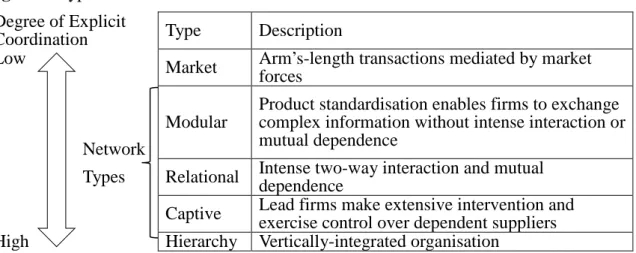
While there are myriad patterns of value chain governance, Gereffi et al. (2005)
classified value chain governance into five dominant types, which were mapped onto a spectrum running from low to high levels of explicit coordination (Figure 2). At one end of the spectrum is the arm’s-length market in which transactions are mediated by market forces. At the other end of the spectrum there is a hierarchy in which
coordination takes the form of an internal command structure within a vertically integrated corporation. In between these two extremes, there are intermediate or network forms of organisation that are neither based on markets nor a hierarchy (Powell 1990; Jones et al. 1997). In ascending order of explicit transactional governance, these are:
16
intensity of interaction, as well as the level of mutual dependence between a lead firm and its suppliers
Relational chains, which are characterised by complex and intense interaction between mutually dependent parties
Captive chains, in which a powerful lead firm makes extensive intervention and exercises control over smaller and dependent suppliers
Figure 2. Types of Value Chain Governance
Degree of Explicit
Coordination Type Description Low
Market Arm’s-length transactions mediated by market forces
Network
Modular
Product standardisation enables firms to exchange complex information without intense interaction or mutual dependence
Types Relational Intense two-way interaction and mutual dependence
Captive Lead firms make extensive intervention and exercise control over dependent suppliers High Hierarchy Vertically-integrated organisation
Source: The author, based on Gereffi et al. (2005).
3.2 Determinants of Value Chain Governance
Why do different forms of governance such as those discussed above exist? And under what circumstances do particular governance forms emerge? The strength of Gereffi et al.’s (2005) formulation of GVC governance theory is that it provides a systematic device for answering these questions. Specifically, they seek to explain the dynamics of value chain governance in terms of three variables: (1) the complexity of
information exchanged in a transaction; (2) the degree to which such information can be codified; and (3) the supplier’s capability level relative to the requirements of a transaction.
This study follows the overall structure of this framework, but makes the following adaptations. First, for the sake of simplicity, the first two variables are grouped into one broader category: the nature of product and process parameters exchanged in transactions.
Second, whereas Gereffi et al. (2005) concentrate on the codifiability of parameters, this study focuses on the degree to which these parameters are standardised, a related yet distinct concept. This is because degrees of product and process standardisation
17
constitute one of the essential factors that differentiate the Japanese and Chinese models of industrial organisation in the motorcycle industry.15
Third, the present study’s framework incorporates lead firm capability in addition to supplier capability. Because the primary focus of Gereffi et al. (2005) is on the global value chains that are coordinated by major transnational corporations (TNCs), they implicitly assume that lead firms possess the sophisticated capability necessary to coordinate value chains. On the contrary, the present study does not take lead firm capability as a given in view of the fact that it addresses the organisational model emerging in a developing country context. Rather, it acknowledges that a lead firm may be constrained by a shortage of capability in its attempt to establish certain types of chain governance.
Fourth, rather than narrowly focussing on relative levels of capability, that is, whether or not supplier capability meets the level required by lead firms, the present study highlights the various types of capability that different governance mechanism models impose on both lead firms and suppliers.
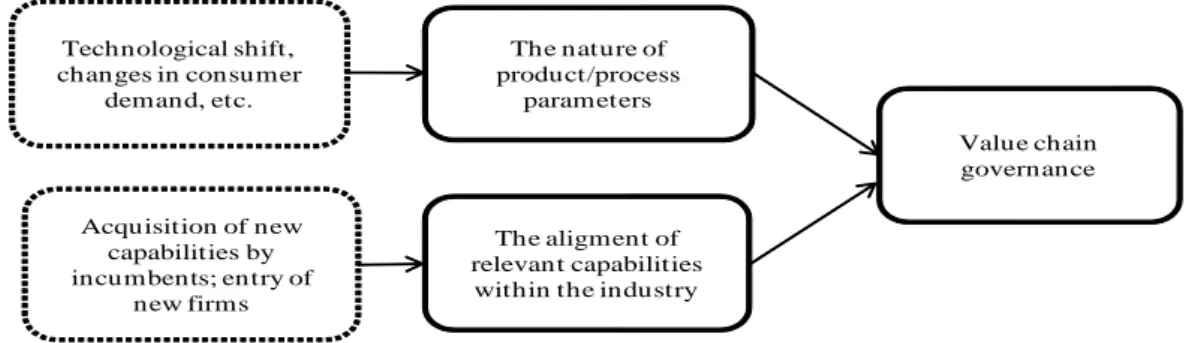
The basic structure of this adapted framework is shown in Figure 3, in which value chain governance is determined by two variables: the nature of product and process parameters communicated in transactions; and the alignment of relevant capabilities within the industry. The following subsections examine the two variables individually.
Figure 3. Value Chain Governance: An Explanatory Framework
Source: The author, adapted from Gereffi et al. (2005) and Langlois and Robertson (1995).
15
This adaptation becomes critical in formulating the conditions under which captive chains emerge. Whereas Gereffi et al. (2005) focus on the codifiability of parameters in the form of lead firm instructions, the non-standard nature of product and process parameters turned out to be critical in explaining why Japanese motorcycle manufacturers had instituted explicit governance mechanisms in coordinating transactions with their suppliers.
The nature of product/process
parameters
The aligment of relevant capabilities within the industry
Value chain governance Technological shift, changes in consumer demand, etc. Acquisition of new capabilities by incumbents; entry of new firms
18
3.2.1 The Nature of Product and Process Parameters
The nature of product and process parameters determines the need for transactional governance. It is not the case that every transaction requires explicit coordination; the extent to which transactional governance is required depends primarily on the type of product being traded (in this case, motorcycle components). The specific focus will be on levels of complexity and degree of standardisation, both of which are influenced by factors such as technological innovation and changes in consumer demand.
In respect of simple products, which also tend to be standardised, there is limited need for instituting explicit transactional governance: if components are simple and
standardised, product/process parameters can be specified and communicated with ease. Supplier performance is easily observable in the form of delivered outputs and thus detailed monitoring mechanisms are not required. Moreover, as standard products do not require transaction-specific investment, there is no need to implement safeguards against the risks of opportunism (Williamson 1979). Standard products can also be produced by a range of suppliers, sold to a variety of lead firms, or produced for stock and supplied as necessary (Gereffi et al. 2005).
The need for coordination increases as products become complex and differentiated, that is, as they start to take on new demands beyond price level (Schmitz 2006; Humphrey and Schmitz 2008). Examples include differentiated components that are more difficult to design and/or manufacture; higher quality levels; tighter delivery requirements in terms of either frequency or punctuality; and additional functional requirements (e.g. suppliers take on design responsibilities in addition to
manufacturing). Implementing new requirements such as these often constitutes an additional burden with regard to the communication of product and/or process parameters between the lead firm and its suppliers. It also necessitates additional mechanisms to ensure that parameters are adhered to, for example, detailed monitoring (Schmitz 2006).
The need for explicit governance also depends on the extent to which parameters are standardised. On the one hand, non-standard parameters require explicit coordination because they incur additional coordination costs and transaction-specific investment in physical and/or human resources (Williamson 1979). This is particularly the case for products with integral design architecture. Because such products are characterised by complex mapping from functional elements to physical components and tightly
19
coupled interfaces among interacting physical components, they call for fine-tuning between the whole product and its component parts if overall product performance is to be maximised (Ulrich 1995; Baldwin and Clark 2000). Designing these products requires the coordination of detailed design tasks (Ulrich 1995), and their manufacture necessitates transaction-specific investment, both of which call for explicit governance mechanisms to be in place.
On the other hand, even when the product is complex, industry-wide product and/or process standards may reduce the need for explicit governance (Gereffi et al. 2005). In industries that produce products with modular architecture, standards make it possible to communicate product and/or process parameters without intense interaction, which releases firms from being locked into particular trading relationships (Langlois and Robertson 1992, 1995).
3.2.2 The Alignment of Relevant Capabilities
The need for transactional governance, however, does not mean that such mechanisms can necessarily be implemented in practice. This is where the second variable of the alignment of relevant capabilities within the industry comes into play. Governance means that a given firm enforces parameters over other firms, a dynamic that demands the ability to wield power (Schmitz 2006; Sturgeon 2008). The relative power relations between a lead firm and its suppliers, in turn, are determined primarily by the types and levels of capability enjoyed by the respective parties (Sturgeon 2008; Schmitz 2006; Palpacuer 2000).
A lead firm’s capacity to impose parameters on its suppliers usually stems from their core competencies in strategic value chain functions (Palpacuer 2000; Schmitz 2006). In capital-intensive sectors such as the automotive industry, such strategic functions typically include product development, marketing, and manufacturing of core
components. These functions often constitute the key sources of competitive advantage enjoyed by the lead firm because they require knowledge- and experienced-based assets that are difficult for others to imitate, and because they provide economies of scale for the firms that control these functions (Palpacuer 2000: 378).
A lead firm’s control over strategic value chain functions matters because it tends to create two types of dependence on the part of the suppliers. First, lead firm control over strategic functions leaves suppliers with non-core functions (Palpacuer 2000),
20
rendering them functionally dependent on the lead firm in marketing their products. Second, because dominance in respect of product, marketing, and/or branding often enables lead firms to gain a high degree of control over the market (Gereffi 1999; Kaplinsky and Morris 2000), they often overwhelm suppliers with huge purchasing power (Sturgeon 2008), rendering them financially dependent.
The size of orders takes on particular importance in industries in which product and process parameters are non-standard. Because non-standard products often impose the additional cost of product-specific investment in physical and human resources, a lead firm will face difficulty enforcing non-standard parameters on its suppliers unless orders are large enough to make production economically viable.16
However, it is necessary to analyse lead firm competency in relative terms. Because power is relational, suppliers may also acquire it by building core competencies, that is, technical or service capabilities that are difficult to replace and become indispensable to the lead firm (Schmitz 2006; Sturgeon 2008; Palpacuer 2000). Suppliers can also gain the generic capability to assume responsibility for a bundle of functions, such as product design, process development, purchasing, and production, which enables them to serve a diverse pool of customers and switch customers if necessary (Sturgeon 2008). In contrast, where suppliers only possess capabilities that are easily substituted and/or are embedded in relations with specific customers, the lead firm retains the capacity to choose and replace suppliers, thus keeping supplier power under control (ibid.).
3.3 The Revised Framework
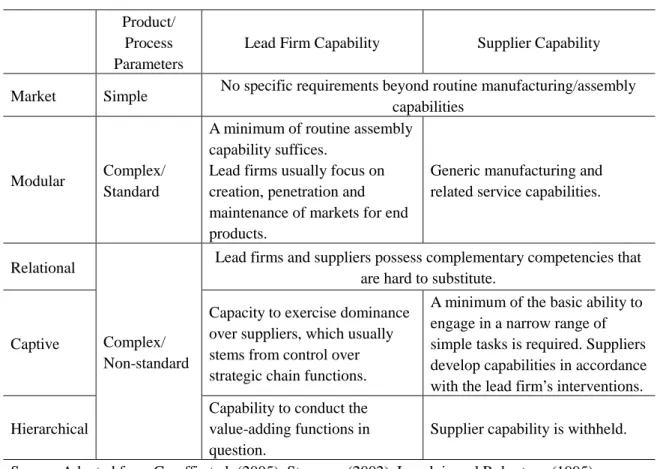
Table 1 shows how the five governance types mentioned in Section 2.1 can be explained in terms of different combinations of the two variables outlined in the
previous subsection. When product and process parameters are simple and standardised, market-based chains emerge. This type of chain makes limited capability demand of lead firm and suppliers alike, the minimum requirements being that they possess routine assembly capability and routine component manufacturing capability respectively.
When industry-wide standards of compatibility enable complex parameters to be
16
Sturgeon et al. (2008) corroborate this point in arguing that the concentrated structure of the car manufacturing industry helps each firm to impose its own idiosyncratic standards on suppliers.
21
exchanged without explicit coordination, modular chains emerge whereby suppliers acquire generic manufacturing capacity and related service capabilities that enable them to serve multiple lead firms simultaneously. On the other hand, while the minimum requirement of the lead firm is routine assembly capability using mutually compatible components sourced from suppliers, modular chains enable it to focus on creation, penetration and defence of markets for its end products (Sturgeon 2002).
As product and process parameters become complex and non-standard, three types of chain governance may emerge depending on the alignment of relevant capabilities. The first case is one in which the lead firm and its suppliers are equipped with
complementary competencies that cannot easily be sourced elsewhere. Such a situation gives rise to a relational chain whereby the lead firm and its suppliers are engaged in intense two-way interaction; the two parties are mutually dependent and the power relation is symmetrical (Gereffi et al. 2005).
Table 1. Types of Chain Governance and their Determinants
Product/ Process Parameters
Lead Firm Capability Supplier Capability
Market Simple No specific requirements beyond routine manufacturing/assembly capabilities
Modular Complex/ Standard
A minimum of routine assembly capability suffices.
Lead firms usually focus on creation, penetration and maintenance of markets for end products.
Generic manufacturing and related service capabilities.
Relational
Complex/ Non-standard
Lead firms and suppliers possess complementary competencies that are hard to substitute.
Captive
Capacity to exercise dominance over suppliers, which usually stems from control over strategic chain functions.
A minimum of the basic ability to engage in a narrow range of simple tasks is required. Suppliers develop capabilities in accordance with the lead firm’s interventions.
Hierarchical
Capability to conduct the value-adding functions in question.
Supplier capability is withheld.
Source: Adapted from Gereffi et al. (2005), Sturgeon (2002), Langlois and Robertson (1995), Sturgeon et al. (2008), Schmitz (2006), Sturgeon (2008), and Palpacuer (2000).
22
a large, competent lead firm and smaller, less competent suppliers. Competence and power asymmetry lead to a captive chain whereby the lead firm engages in extensive intervention, such as active monitoring and technical assistance; while suppliers develop their capabilities – typically, in a narrow range of tasks – under the lead firm’s guidance (Schmitz 2004, 2006).
The last case is one in which limited available external capability makes outsourcing unfeasible, meaning that the lead firm is compelled to conduct the required function(s) in-house, that is, to create a hierarchy. A hierarchy may also result from cases of substantial asymmetry in competence levels (i.e. the second case discussed above) but where the lead firm is either unwilling or unable to engage in extensive intervention.
3.4 Operationalisation of Key Concepts
For the purpose of empirical analysis, indicators have been developed for the key concepts (Table 2). Given the lack of quantifiable indicators for key variables, the analysis of trajectories focuses primarily on the direction of change in the status of the key variables over time, for example, an increase or decrease in the degree of
complexity of product parameters.
The indicators of supplier capability require further explanation. Drawing on the technological capability (TC) literature (Lall 1992; Bell and Pavitt 1995), this study focuses on the type and level of capability possessed by suppliers. With regard to type, reflecting the capability requirements that the Japanese and Chinese organisational models impose on suppliers, the key distinction is between new product introduction (product development and design) and production. The latter is further divided into the equipment-related and production management dimensions (Sato and Fujita 2009). In terms of level, the focus will be on whether suppliers starting at routine operation for the domestic market (operational level) can progress to the level at which they are able to maintain stable and continuous operations that fulfil the requirements of foreign customers (assimilative level), and further to level at which suppliers are able to make minor yet original improvement to the existing products or production activities (adaptive level) (ibid.).
23
Table 2. Operationalisation of Concepts
(a) Determinants of Governance Types
Key Concepts Indicators
Nature of Product/ Process Parameters Level of Complexity
General product characteristics (e.g. price levels)
The way in which the lead firm specifies product/process requirements to suppliers
Level of Standardisation
General product features (e.g., whether product designs are proprietary or standardised)
The way in which the lead firms specifies product/process requirements to suppliers Structure of Relevant Capabilities within the Industry Lead Firm Capability
Whether or not the lead firm engages in key functions, e.g. product development, marketing, and production of core components The scale of orders placed to suppliers
The capacity to switch suppliers
Supplier Capability
Changes in the number of suppliers, and types and levels of capability possessed
(For new suppliers) Suppliers’ experience prior to entry into respective value chains
(b) Governance Types
Pattern of Dependence Coordinating Mechanism
Types of Data Required
Lead firm: availability of alternative sources of components
Suppliers: number of
customers; percentage of sales to respective lead firms; size of orders
Mechanisms used to communicate product/process parameters and ensure that they are met
Markets
Neither side is dependent on the other
Limited communication of information beyond price levels
Modular
Communication of complex parameters without intense interaction enabled by industry-wide standards
Relational Mutual interdependence Intense two-way exchange of information
Captive Small suppliers dependent on a
large lead firm
Lead firm takes the lead in sharing of long- and short-term targets;
performance monitoring; regular sharing of information on products and
processes; provision of technical/financial assistance
Hierarchy Vertically integrated
corporation Firm’s internal command
Source: The author, with reference to Palpacuer (2000), Schmitz (2006), Sturgeon (2008), Kaplinsky and Morris (2000), and Sako (1992).
24
4. Methodology
This section explains the methodology adopted in the empirical research project, that is, the retrospective case study method, criteria for selection of cases, and methods of data collection and analysis.
4.1 Research Design: Retrospective Case Study
In order to analyse the decade-long dynamics of change in industrial organisation, this paper adopts the retrospective case study method (de Vaus 2001; Glick et al. 1995; Tuma and Hannan 1984). In the present context, this method involves tracing the processes of organisational transformation by observing the sequence of historical events occurring in specific sets of value chains with several intervals. Table 3 provides a summary of the overall case study design. In an attempt to illuminate how and why the Japanese and Chinese models of industrial organisation were transformed in the Vietnamese context over time, this study analyses two sets of value chains representative of the Japanese and Chinese models in Vietnam respectively. Each of them are analysed by means of an embedded case study design, which combines the analysis of the overall context with that of embedded subunits (Yin 2003). In
accordance with the conceptual framework presented in the previous section, the focus is on the lead firm(s) and its/their main first-tier suppliers.
The transplanted Japanese model is represented by value chains independently developed and governed by HVN for the following reasons. First, HVN remained the single most important motorcycle manufacturer in the Vietnamese motorcycle industry throughout the period of investigation (Figure 1). Second, among Japanese motorcycle manufacturers in Vietnam, HVN was the hardest hit by the China shock but also reacted with the most fundamental adjustments. By contrast, YVN’s consistent focus on the high-end market limited direct Chinese competition (Fujita 2005); and Vietnam Suzuki (VNS)’s market shares were too small for the China shock to have an
25
Table 3. Case Study Design
Japanese Model Chinese Model
Cases HVN chains Vietnamese–Chinese chains as a whole
Case Study Design
Embedded case study design Analysis of context: Analysis of HVN value chains as a whole Analysis of embedded subunits: HVN as the lead firm, and major Japanese (keiretsu and
non-keiretsu) and Vietnamese suppliers
Embedded case study design
Analysis of context: Analysis of the local motorcycle assembly industry as a whole Analysis of embedded subunits:
(Stage II) Four major lead firms (Assemblers A1, A2, A4, and A5) and their Vietnamese, Taiwanese, and Korean suppliers
(Stage III) Five major lead firms (Assemblers A1, A3, A4, A5, A6) and their Vietnamese, Chinese, Taiwanese and Korean suppliers
Data Sources
Context: interviews with Honda’s various units in Vietnam, Thailand and Japan; published and
unpublished statistics; company website
Embedded cases: interviews, factory visits, company websites, reports, newspapers
Context: published and unpublished Vietnamese government statistics; reports; newspapers Embedded cases: interviews, factory visits, questionnaire surveys, company websites
Source: The author.
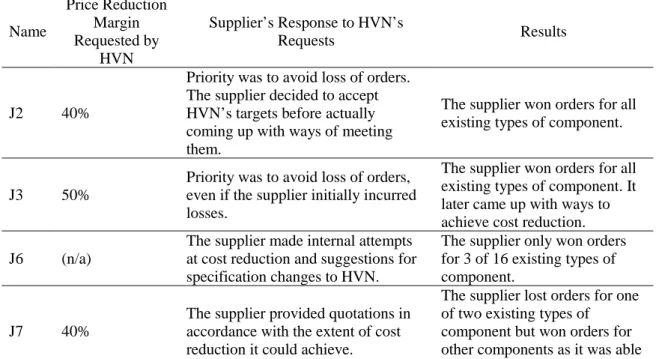
The case study of HVN’s value chain combined investigation of the overall context and that of embedded subunits including HVN as the lead firm, and major Japanese and Vietnamese suppliers. A total of 11 Japanese and 10 Vietnamese suppliers were purposefully selected as embedded subunits on the basis of the following criteria. First, cases were limited to suppliers of components that usually had model-specific designs, which, therefore, required close coordination between lead firms and suppliers. These included suppliers of metal and plastic components, dies, and moulds. Second, for the purpose of highlighting structural changes within the chains, cases were selected based on the requisite level of diversity: keiretsu and non-keiretsu suppliers among Japanese suppliers; state-owned and private companies among Vietnamese suppliers; and
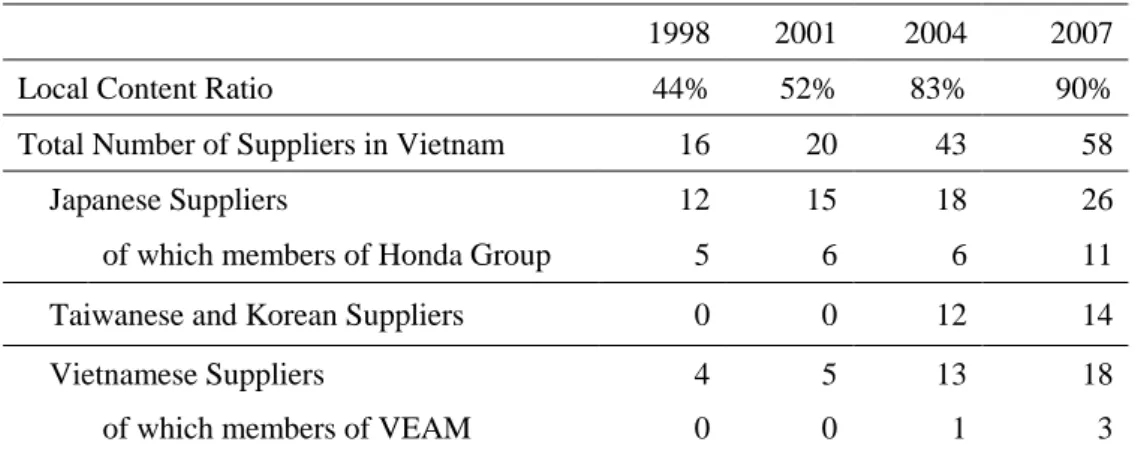
suppliers that had joined HVN value chains at various stages of industrial development. Third, an attempt was made to ensure that a sufficiently large number of cases were covered. The study ultimately selected 10 out of a total of 18 Vietnamese suppliers and 11 out of a total of 26 Japanese suppliers operating in HVN's value chain as of 2007.17
The Chinese model is represented by Vietnamese–Chinese chains developed by local Vietnamese motorcycle assemblers.18
Unlike the analysis of the Japanese model, the
17
These include Vietnamese suppliers V1-9 and V13 and Japanese suppliers J1-11.
18
Lifan Vietnam, the only Chinese-invested motorcycle manufacturer, was not selected on account of its small market shares and its focus on engine production rather than motorcycle assembly (The Motorbike Joint Working Group 2007: 27).
26
focus is not limited to those value chains developed by specific lead firm(s) because their small size, repeated entry into and exit from the market, and the emergence of a shared supply base serving the local motorcycle assembly industry at large (see Section 6.2) calls for coverage of Vietnamese–Chinese chains as a whole.19
Analysis of the Chinese model also combines that of context and embedded subunits. The former relies on analysis of the local motorcycle assembly industry as a whole. In respect of the latter, six local assemblers were selected from lists of those operating as of 2000 and 2006 respectively20
according to the following criteria. The first one was the critical case criterion, in which priority was given to assemblers that were
sufficiently large in terms of the scale of production.
Second, selection was based on two types of replication logic in case study research: literal replication (predicting similar results across cases) and theoretical replication (predicting contrasting results but for predictable reasons) (Yin 2003). Since
assemblers’ product strategies and performance started to diverge at a late stage of industrial development, cases were selected to include assemblers adopting different product strategies and sourcing practices. On the basis of the author’s previous research (Fujita 2006), the key distinction was between one group of assemblers that concentrated on the production of low-priced imitations of Japanese-brand motorcycles, and another group that prioritised quality improvement, and the development of own designs and brand names often at the expense of higher prices.
Third, cases were selected so as to make use of data obtained from the author’s
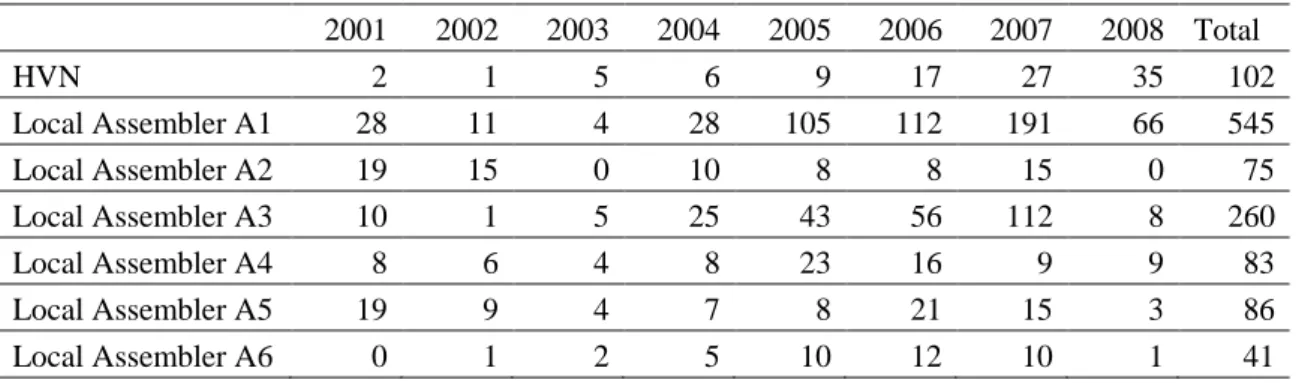
previous fieldwork, and accessibility to assemblers for additional rounds of fieldwork. Since data from previous fieldwork only included information on three assemblers (A1, A4 and A5), attempts were made to incorporate additional embedded case assemblers that were known to have played major roles in stages II and III. Assembler A2, which in 2000 had had the largest turnover of 51 local assemblers,21
and assemblers A3 and A6, which were found to be expanding sales in Stage III, were added as embedded
19
The distinction between Japanese and Vietnamese–Chinese chains is similar to the contrast drawn by Sturgeon and Lee (2005: 35) in reference to supplier networks in the automotive sector whereby Toyota’s supplier network competes with that of General Motors’ and the electronics industry, in which strategic outsourcing by groups of lead firms has led to the rise of a shared supply network. A striking feature of the present case is that contrasting supplier networks have emerged within a single industry.
20
The 2000 list was provided by the Vietnamese Ministry of Industry, and the 2006 list was provided by the General Statistics Office.
21
27 cases.
As a result of the selection process, the author ended up with six assemblers (A1-6) as embedded subunits. Assemblers A1, A2 and A3 belonged to one category of
assemblers concentrating on the production of low-priced imitations of Japanese-brand motorcycles. Assemblers A5 and A6 were typical examples of the other category of assemblers prioritising the development of own designs and brand names and quality improvement. Assembler A4 fell somewhere in between the two categories.
Suppliers were also analysed as embedded subunits in the Vietnamese–Chinese chain. Data were obtained for a total of 24 suppliers of different nationalities (5 Chinese, 7 Taiwanese, 1 Korean, and 11 Vietnamese).22
Attempts were made to ensure that cases included suppliers playing key roles in value chains developed by both of the
aforementioned emergent groups of assemblers.
4.2 Data Collection and Analysis
In an attempt to analyse the trajectories of organisational transformation over the decade from the late 1990s, this study combined three main sources of data. The first dataset derived from the author’s previous fieldwork conducted in 2001, 2002, 2003, 2004 and 2005. Since the industry in question had undergone dramatic transformation involving many entries and exits, high staff turnover, and the frequent personnel changes typically observed in foreign affiliate, the present study would not have been possible without data from these previous rounds of fieldwork. Although they were driven by different research questions, they provided a great deal of information on lead firm production strategies and sourcing practices, lead firm–supplier relations, and the development of suppliers’ capabilities.
Data obtained in previous rounds of fieldwork were compiled in the form of interview recordings, transcriptions, and notes (mainly from Vietnamese companies); interview notes (mainly from Japanese, Taiwanese, Korean, and Chinese companies);
questionnaire surveys; notes taken during factory visits; company brochures and presentation materials; and other materials provided by firms. The present study therefore commenced with the interpretation and coding of existing materials in accordance with the operationalised indicators presented in Section 3.
22
These include Chinese suppliers C1-5, Taiwanese suppliers T1-7, Korean supplier K1 and Vietnamese suppliers V13-23.
28
Second, additional rounds of fieldwork were conducted specifically for the present study in order to collect data on new developments after 2005 and, wherever possible, to obtain retrospective data on earlier years. The basic strategy was to follow up with lead firms and suppliers approached in previous fieldwork, but attempts were also made to incorporate those that had not been included in the earlier studies but had come to play important roles in Stage III.23
Additional interviews with HVN and local assemblers, as well as their key suppliers, were also conducted between 2007 and 2009.
The fieldwork study of local assemblers requires further explanation. A major
challenge was the difficulty in accessing assemblers for additional rounds of fieldwork (A3, A4, and A6 agreed to be interviewed whilst A1 and A5 refused). The challenges were addressed by the following measures. One was to conduct questionnaire surveys of local assemblers in collaboration with the Vietnam Institute of Economics, Vietnam Academy of Social Science in 2007, to which A1, A3, A4, A5 and A6 agreed. Another was to access a former employee. Since access could be made to the former
procurement manager (2002–4) of assembler A2, a series of interviews was conducted to obtain information on the company in the early 2000s.
In order to complement limited amount and quality of data on local assemblers, the author also interviewed Taiwanese, Korean, Chinese and Vietnamese suppliers that had worked closely with these local assemblers over the years. The former transpired to be easier to access and became precious sources of information on Vietnamese–Chinese chains. Towards the last stage of the fieldwork, the author presented the main lines of argument on Vietnamese–Chinese chains to these suppliers and other industry experts and asked for their feedback. This exercise helped to confirm the validity of arguments and indicate where adjustment was necessary.
The third source of data was that on local supplier capability which was collected for a different part of this research project focussing on trajectories of supplier capability formation.24 Of the 21 suppliers covered in the fieldwork on local suppliers, data for 18 of them were revealed to be suitable for the present study.25
In-depth interviews were
23
Examples include local assemblers A3 and A6, and suppliers J10, J11, C1, V7, V9, and V16. Information on newly-emerging companies was obtained from newspapers and interviews with firms and industry experts.
24
See Paper III in Fujita (2013b).
25
The remaining three were second-tier suppliers to Japanese motorcycle manufacturers, which were beyond the scope of this study.