The EU's reform in rules of origin and
international trade : evidence from Cambodia
著者
Tanaka Kiyoyasu
権利
Copyrights 2020 by author(s)
journal or
publication title
IDE Discussion Paper
volume
770
year
2020-03
INSTITUTE OF DEVELOPING ECONOMIES
IDE Discussion Papers are preliminary materials circulated
to stimulate discussions and critical comments
Keywords:
Rules of origin, GSP, trade, FDI, Cambodia, EUJEL classification:
F13, F14, F15, O14, O24* Research Fellow, Economic Integration Study Group, Development Studies Center,
IDE ([email protected])
IDE DISCUSSION PAPER No. 770
The EU’s Reform in Rules of Origin and
International Trade: Evidence from Cambodia
Kiyoyasu TANAKA*
March 2020
Abstract
The European Union (EU) has unilaterally granted developing countries with preferential access to the EU markets under the Generalized System of Preferences (GSP). To obtain preferential access, exporters in beneficiary countries must follow rules of origin (ROO) in the EU’s GSP. The previous ROO were criticized as restrictive because production costs increase with a restriction on imported inputs from the lowest-cost third countries and the administrative process of proving origin. To simplify the restrictive ROO, the EU’s reform process started in 2003, and a new regulation came into force on January 1, 2011. This paper estimates the causal impact of simplifying ROO on garment exports in a beneficiary country, Cambodia, during the period 2007-2015.
The Institute of Developing Economies (IDE) is a semigovernmental,
nonpartisan, nonprofit research institute, founded in 1958. The Institute merged
with the Japan External Trade Organization (JETRO) on July 1, 1998.
The
Institute conducts basic and comprehensive studies on economic and related
affairs in all developing countries and regions, including Asia, the Middle East,
Africa, Latin America, Oceania, and Eastern Europe.
The views expressed in this publication are those of the author(s). Publication does not imply endorsement by the Institute of Developing Economies of any of the views expressed within.
INSTITUTE OF DEVELOPING ECONOMIES (IDE), JETRO 3-2-2, WAKABA,MIHAMA-KU,CHIBA-SHI
CHIBA 261-8545, JAPAN
©2020 by author(s)
No part of this publication may be reproduced without the prior permission of the author(s).
3
The EU’s Reform in Rules of Origin and International Trade:
Evidence from Cambodia
†Kiyoyasu Tanaka§
(Institute of Developing Economies) March 2020
Abstract
The European Union (EU) has unilaterally granted developing countries with preferential access to the EU markets under the Generalized System of Preferences (GSP). To obtain preferential access, exporters in beneficiary countries must follow rules of origin (ROO) in the EU’s GSP. The previous ROO were criticized as restrictive because production costs increase with a restriction on imported inputs from the lowest-cost third countries and the administrative process of proving origin. To simplify the restrictive ROO, the EU’s reform process started in 2003, and a new regulation came into force on January 1, 2011. However, the impact of the EU’s reform on beneficiary economies remains largely unexplored. This paper estimates the causal impact of simplifying ROO on garment exports in a beneficiary country, Cambodia, during the period 2007-2015. In the new ROO, garment exporters in least developing beneficiaries such as Cambodia can use imported fabric from any third country and still maintain preferential access. I adopt a difference-in-differences method and provide evidence to support the parallel trends assumption. I find that garment exports to the EU increased by 112% after 2011, which coincided with a sharp increase in textile imports from China to Cambodia. FDI inflows increased sharply after 2011 in a garment sector, but decreased in a textile sector. Thus, simplifying ROO in GSP programs should have substantial impacts on the participation of developing economies into global value chains.
Keywords: Rules of origin, GSP, trade, FDI, Cambodia, EU JEL Classification: F13, F14, F15, O14, O24
† I acknowledge the financial support of JSPS Grant-in-Aid for Young Scientists (B) Grant Number
16K17129 and for Scientific Research (A) 18H03637. For useful comments and suggestions, I would like to thank Mari Tanaka, Fukunari Kimura, Hisamitsu Saito, Jaerim Choi, Kazunobu Hayakawa, Kozo Kiyota, Tadashi Ito, Takahiro Fukunishi, Tatsufumi Yamagata, Theresa Greaney, Toshihiro Okubo, Toshiyuki Matsuura, Yoko Asuyama, and seminar participants at Keio University, Hiroshima University, Hokkaido University, IDE-JETRO, Kushiro Public University of Economics, University of Hawai‘i at Manoa, and the 2019 Japan Society of International Economics. All remaining errors are my own.
§ Research fellow, Institute of Developing Economies, JETRO; address: 3-2-2 Wakaba, Mihama-ku,
4
1. Introduction
Preferential trade access to developed economies helps to promote an export industry in developing economies. By reducing duties on import in developed economies in favor of developing economies, trade preferences increase export earnings and investment, thereby contributing to poverty reduction and sustainable development. Since the Generalized System of Preferences (GSP) was introduced in the 1970s, the GSP programs were considered to produce uneven effects on export success in favor of richer developing economies (Brenton, 2003). To support least developing countries (LDCs), the European Union (EU) introduced the Everything But Arms (EBA) initiative in 2001. However, expected benefits were not fully realized at the outset. In 2001, exports to EU from EBA beneficiary countries were 6.18 trillion EURO, but exports to EU requesting preferential access were merely 4.20 trillion EURO. Only 68.0% of
exports from EBA beneficiaries requested duty-free access (EUROSTAT).1
Stringent rules of origin (ROO) in the EU GSP had been considered as a key reason for the low utilization rate of trade preferences. The cost of complying with the origin requirements may exceed the benefit of using preferential access because production costs increase with a restriction on imported inputs from the lowest-cost third countries and the administrative process of proving origin (Brenton and Manchin, 2003). In 2003, the European Commission (EC) launched consultation processes on origin requirement issues to assess various interests at stake from EU members, private sectors, industry associations, and civil society. Following a series of internal debates with stakeholders, the EC adopted a new regulation to simplify the restrictive origin requirements under the EU GSP on November 18, 2010. The new regulation came into effective on January 1, 2011. Consequently, exports from EBA beneficiaries to EU requesting preferential access increased substantially from 9.41 trillion EURO in 2010 to 13.3 trillion EURO in 2011, with a sharp increase in the utilization rate from 84.3% to 93.7%.
In this paper, I seek to assess the effects of the EU’s reform in the GSP’s ROO on trade and foreign direct investment (FDI) in a beneficiary country by addressing three interrelated questions. (i) Does simplifying ROO have a causal impact on exports to the EU markets? (ii) What is the consequent impact on imports of intermediate inputs? (iii) How did the reform affect inward FDI? These questions are critical to assess the policy objectives in GSP programs because preferential market access aims to support the participation of developing economies into the world trading system (Cadot and de Melo, 2007). However, there is limited empirical work to assess how simplifying ROO in GSP programs promote trade and investment in LDCs. This paper empirically evaluates the role of ROO in GSP programs on the beneficiary country.
1 Using the Eurostat data, I aggregate the import of good for final use in the EU eligible for
GSP/preferential tariffs from EBA beneficiary countries except for Myanmar and calculate a share of the import actually entered under preferential regimes.
5
To examine these questions, I focus on garment exports because knitted and woven garments are major export products from EBA beneficiaries to EU. These products accounted for 61.0% of the total exports to EU requesting preferential access in 2010. Moreover, I focus on Cambodia for analysis because the previous ROO were considered as restrictive for the garment sector in Cambodia. In general, the previous ROO in the EU GSP stipulates that garment producers in Cambodia must use domestically produced fabric and/or imported fabric from EU/ASEAN countries in certain conditions to qualify for duty-free access to EU. Meanwhile, garment producers used mainly imported fabric from China, Hong Kong, Taiwan, and South Korea because domestic textile production was severely limited (Asuyama et al., 2013; Bargawi, 2005; Yamagata, 2006). Under the new ROO, garment exporters in LDCs such as Cambodia can use imported fabric from any third country and still maintain preferential access. Because fabric manufacture is not required, the origin requirement was relaxed from two-stage processing to one-stage processing (UNCTAD, 2013). Additionally, the reform processes of origin rules applicable to the EU GSP suggest that Cambodia had no direct influence in determining specific revisions in the GSP’s ROO. In this respect, the EU’s reform in ROO is an exogenous policy change for garment exporters in Cambodia, providing an ideal natural experiment to identify a causal effect of ROO on trade.
This paper adopts a difference-in-differences (DD) method based on a standard gravity model of international trade. For identification, I exploit two sources of variations in garment exports: (i) a difference between exports to EU markets (treatment groups) and exports to non-EU markets (control groups); (ii) a difference in exports before and after the non-EU’s reform in 2011. By comparing changes in exports to EU markets before and after 2011 with changes in exports to non-EU markets before and after 2011, I seek to identify a causal effect of simple ROO on garment exports. The identification for the DD method relies crucially on the assumption that both exports to the EU and to non-EU markets would exhibit parallel trends in the absence of the reform. Without the reform, export trends would need to move in tandem between treatment and control groups. To assess this assumption, I that garment export trends for treatment and control groups exhibit similar export trends in the pre-reform period before 2011. After 2011, the treatment group shows a sharp increase in the export whereas the control group does not exhibit any apparent change in the export. The graphical evidence supports the validity of the parallel trends assumption for identification.
To shed light on consequent effects of the export expansion due to the EU’s reform, I examine imported intermediate inputs and inward FDI in Cambodia. In the wake of the reform, garment producers in Cambodia could use imported fabric from any market to qualify for preferential access to EU. As described in Natsuda et al. (2010) and Staritz (2011), China is a key import market for yarn, fabric, and accessories used for garment production in Cambodia. This
6
suggests that the reform could bring about a large expansion of sourcing from highly competitive textile industries in China. To examine this implication, I describe a trend in imported textiles in Cambodia and estimate the extent to which textile imports from China increased after 2011.
In terms of investment effects, the EU’s reform may encourage foreign investors in a garment sector, but discourage those in a textile sector. The reform improved input sourcing flexibility for garment manufacture in Cambodia to benefit from preferential market access. As discussed in Krishna (2006), the removal of the binding ROO allows producers to use the best mix of inputs to minimize the level of production costs. A decline in the unit cost of local production may strengthen an incentive for foreign investors to produce garment products in Cambodia. Meanwhile, garment exporters do not need to use locally produced textiles for preferential access, thereby reducing an incentive for foreign investors to produce textile inputs in a local market. Thus, inward FDI flows after 2011 would increase for the garment sector and decrease for the textile sector.
Main findings are summarized as follows. First, the total export in knitted and woven garments to the EU markets increased significantly by 112% after 2011. In the larger EU markets, the garment exports increased by 219%. Robust to alternative specifications, the results point to the positive causal impact of the EU’s reform on garment exports in Cambodia. The export trends in EU and non-EU markets support that the estimated impacts of the reform should be a causal effect in a DID estimation. There is little evidence of trade substitution effects because redirection of exports to non-EU markets would not account quantitatively for the export expansion. The export price of garment products from Cambodia to EU declined significantly after 2011, suggesting that the bulk of the export impacts represents a quantity increase. Export variety also significantly increased for the larger EU markets. Second, Cambodia’s textile imports such as fabric from China increased significantly by 90% after 2011. The result is consistent with the hypothesis that simplifying ROO in the EU GSP encouraged the use of competitively priced inputs to qualify for preferential access. Additionally, FDI inflows in a garment sector increased by 153% after 2011, whereas FDI inflows in a textile sector decreased by 68%. These results suggest that greater flexible sourcing to obtain preferential access improves an investment climate for foreign investors in the garment sector, but removes an incentive for foreign investors to engage in local textile production. Taken together, the EU’s reform in ROO brought about a substantial impact on trade and inward FDI in Cambodia.
This paper contributes to related literature in several manners. Prior work on a relationship
between ROO and trade flows is closely related to this paper.2 Augier et al. (2004) exploit the
2 Inama (2009) provides a comprehensive account of ROO issues from both academic and policy
perspectives. Cadot et al. (2006) provide a collection of related papers on ROO issues in regional trade agreements.
7
Pan-European Cumulation System (PECS) in 1997 as a natural experiment to estimate the impact of greater sourcing flexibility on textile exports in the southern Mediterranean countries. Augier et al. (2005) adopt a DD method to examine whether the introduction of cumulation rules affects bilateral trade flows in manufacturing and intermediate goods. Additionally, Andersson (2016) exploits the introduction of southern Mediterranean countries in the PECS for the middle 2000s to investigate the impact of better access to foreign intermediate inputs on final-goods export in these countries. While these studies generally show a positive effect of more liberal ROO on trade flows, a plausible concern is an endogeneity issue because countries and industries with greater economic interests could influence an institutional change in rules of cumulation. By contrast, I argue that Cambodia had no direct influence in the reform processes of origin rules applicable to EU GSP, so that the EU’s reform is plausibly as an exogenous policy shock to garment exports in Cambodia. By focusing on a small beneficiary country, I can better identify a causal effect of
ROO on trade flows.3
An alternative approach in the literature is to measure the restrictiveness of ROO as a categorical index (Estevadeordal, 2000; Estevadeordal and Suominen, 2004). Such an index is constructed at the product level based on the origin-conferring criteria such as a change in tariff classification, a regional value content, and technical requirements, with the larger values indicating more stringent origin requirements. Based on this approach, Anson et al. (2005) shows a negative relationship between the ROO index and trade flows. Conconi et al. (2018) show that the NAFTA ROO on final goods decreased the growth rate of intermediate inputs in Mexico from third countries relative to NAFTA partners. However, Inama (2009) points out difficulties in this approach because similar drafting styles of rules may imply considerably different levels of restrictiveness for actual production chains. Specifically, the specific origin requirements may be restrictive for exporting countries that rely heavily on imported inputs, but may be liberal for other countries with extensive domestic supply chains. In this respect, this paper focuses on a clear change in the origin requirements from two-stage processing to one-stage processing for garment production in Cambodia, thereby reducing possible measurement errors inherently involved in mapping the complex origin-conferring criteria into the categorical index.
My empirical strategy exploiting a change in ROO is similar to the analysis in de Melo and
Portugal-Perez (2013), but differs in an important dimension.4 Specifically, they exploit a
difference in ROO between U.S. and EU preferential regimes during the period 1996-2004; some African countries could use fabric of any origin to obtain preferential treatment under the U.S.
3 Curran and Nadvi (2015) argue that a change in ROO was a key reason for a sharp increase in
garment exports from Bangladesh to EU after 2011. However, their analysis is limited to descriptive statistics.
4 Hayakawa (2019) exploits a change in ROO for knitted garments in 2015 under the Japanese GSP
8
Africa Growth Opportunity Act (AGOA), but must meet double transformation for preferential
access to EU.5 However, different preferential regimes induce an endogenous export response,
as AGOA encouraged Asian firms to invest in African beneficiary countries for duty-free access to the U.S. market (Lall, 2005; Phelps et al., 2009). By sourcing inputs from Asia, they exported the large volume of simple garment products to improve manufacturing efficiency (Morris and Staritz, 2014). Meanwhile, I exploit a change in ROO of the EU’s GSP to alleviate a possible endogeneity bias arising from a comparison of different exporting countries under different preferential regimes.
Taken together, the main contribution of this paper is to identify a causal impact of ROO on trade by exploiting the EU’s reform as a natural experiment. My empirical strategy helps to alleviate an endogeneity bias in ROO arising from a political-economy motivation of ROO changes and a measurement error in quantifying the restrictiveness of ROO. Additionally, I extend the literature by demonstrating that the export expansion due to simple ROO has consequent impacts on intermediate input imports and FDI inflows in a beneficiary country. Thus, this paper presents credible evidence from Cambodia to assess the policy objectives in trade preferences granted by developed countries for development.
The rest of this paper is organized as follows. Section 2 presents background on the EU’s reform in ROO. Section 3 provides an empirical framework to estimate the impact of the EU’s reform in ROO on exports, with data description. In section 4, I check a parallel trends assumption for identification in a DD method, and discuss the estimation results and robustness checks. Section 5 discusses the impact on imported intermediate inputs for garment manufacture. Section 6 discusses the impact on inward FDI. Section 7 concludes.
2. Background
This section presents a brief summary of the EU GSP and the origin-conferring criteria for preferential market access, followed by a review of the EU’s reform processes in the GSP’s ROO. Finally, I discuss implications of the reform for garment export in Cambodia.
2.1. The European Union’s Trade Preferences
The EU has unilaterally granted developing countries with preferential access to EU markets
under the EU GSP since 1971.6 The provision of preferential access aims to promote sustainable
5 While Frazer and Van Biesebroeck (2010) and Ito and Aoyagi (2019) estimate the impact of
duty-free access on imports in the U.S. and Japan, respectively, but they do not explicitly analyze origin requirements.
6 Not all developing countries have been eligible for the EU GSP and the EU may suspend the GSP
status. For instance, GSP preferences were withdrawn from Myanmar/Burma in 1997 and reinstated for application from June 13, 2012.
9
development and good governance in developing countries through international trade. To be consistent with a multilateral trading agreement, the GSP was introduced under the Enabling Clause, which allows an exception to the Most-Favored Nation (MFN) principle in the WTO law.
The EC describes three preferential trade schemes under the EU GSP as of December 2015
(European Commission, 2016).7 First, the standard GSP grants low or lower-middle income
countries with duty reductions for 66% of all EU tariff lines. Second, the special incentive arrangement for sustainable development and good governance, the so-called ‘GSP+’, grants duty-free access in the same 66% tariff lines as the standard GSP for countries with vulnerable economic structures. Beneficiary countries are in return required to follow international conventions such as human and labor rights, environmental protection, and good governance. Third, the EBA arrangement was introduced in 2001 to grant LDCs with duty-free and quota-free
access for all tariff lines except for arms and ammunition.8 Brenton (2003) highlights that trade
preferences under the EBA are granted for an unlimited period and not subject to periodic review, thereby substantially improving the certainty of preferential market access for beneficiaries.
While preferential trade access is given only to products originating from beneficiary countries, it may cause trade deflection in which products originating from non-beneficiary
countries are transshipped to EU markets through beneficiary countries.9 Traders can avoid the
payment of higher tariffs imposed on products originating from non-beneficiary countries. To prevent such trade deflection, preferential arrangements stipulate the conditions under which a product must meet to qualify for preferential access. Thus, ROO are established to address a legitimate concern of the trade deflection.
Under the EU GSP, there are general conditions to determine origin of products (UNCTAD, 2013). First, products wholly obtained in a beneficiary country are considered as originating in the country. Examples include mineral products extracted from its soil, plants and vegetable products grown there, and live animals born and raised there. Wholly obtained products are produced without using imported input. Second, if products are manufactured using imported inputs, these non-originating materials must be sufficiently worked or processed to satisfy origin-determining criteria. Origin-origin-determining requirements for not wholly obtained products are generally based on a change of tariff heading, addition of domestic value, and specific processing requirements. Additionally, rules of cumulation allow beneficiary countries to consider inputs
7
In addition to the GSP regime, the EU has granted trade preferences to African, Caribbean, and Pacific (ACP) countries and Mediterranean countries. See Persson and Wilhelmsson (2016) for a brief review of these regimes.
8 Liberalization came into effect immediately except for gradual reductions to zero tariffs for bananas
in 2006 and for rice and sugar for 2009.
9 Rotunno et al. (2013) show that liberal ROO under AGOA may allow for a large volume of
10
from other countries as originating content.10
The previous ROO under the EU GSP had been considered as restrictive, thereby leading to the low utilization rate of EU trade preferences. Brenton and Manchin (2003) argue that product-specific origin requirements are stringent by restricting the use of imported input from the lowest-cost third countries. Such stringent rules may be further complicated by the potentially high lowest-costs of proving origin, including documentation procedures and accounting systems. In the previous ROO, garment products must be made from domestically manufactured fabric or imported fabric from EU. Although rules of cumulation allow for the use of qualifying inputs from other countries, two-stage processing requirements generally restricts the use of imported fabric from third countries. Consequently, stringent ROO increase the cost of complying with the ROO, which may exceed the benefits of using preferential access.
2.2. The EU’s Reform in Rules of Origin
In 2003, the EC adopted a Green Paper on ‘the future of rules of origin in preferential trade arrangements’ to evaluate the issues in the GSP’s ROO. The consultation process was launched to assess various interests at stake from EU members, private sectors, industry associations, and civil society. The findings show that the previous ROO were too complex and restrictive to fit global manufacturing processes, thereby giving a call for simplification and relaxation of the origin rules and procedures. In 2005, the EC adopted a communication on ‘the rules of origin in preferential trade arrangements: orientations for the future’. By setting general principles of simplification and development-friendliness, the EC supported a draft regulation for a reform of the ROO in the EU GSP.
In summarizing the background of the reform processes, Inama (2011) explains that the EC proposed a value-added criterion in the origin-determining criteria as a method to evaluate sufficient processing across the board for most products. This approach was in contrast with the previously used criteria based on a change of tariff heading, a maximum allowance of non-originating materials, and specific processing requirements. However, this proposal was met by strong oppositions from stakeholders such as the consulted European Federations representing agricultural and industrial interests. Consequently, the reform processes followed a series of
internal debates and discussions with stakeholders for a long period.
On November 18, 2010, the EC adopted a new regulation on the ROO for the EU GSP. This
regulation came into effective on January 1, 2011.11 Three major changes in the new regulation
10 Other provisions stipulate the conditions of origin determination related to insufficient working or
processing, working or processing outside the territory of beneficiary countries, and non-manipulation principle.
11 For details, see Commission Regulation (EU) No. 1063/2010 of 18 November 2010 amending
11
are pointed out by Inama (2011). First, product-specific origin requirements are relaxed for a number of products, with more lenient treatment for LDCs than developing beneficiary countries. The tolerance rule is relaxed with an increase from 10% to 15% for agricultural products in terms of the weight and for manufacture products in terms of the ex-works price. Second, rules of cumulation include Mercosur and the allocation rule of origin among regional partners is relaxed. Extended cumulation is applied to EU free trade agreement (FTA) partner countries under certain conditions. Finally, the system of registered exporters and self-certification are introduced, which became effective on January 1, 2017.
2.3. Implications for Garment Export in Cambodia
Garment product has been a leading export commodity in the Cambodian economy for recent decades. Garment exports in HS Chapters 61 and 62 accounted for 69.3% of total commodity exports in 2000, which subsequently increased to 77.7% in 2014. The garment exports amounted to 5.31 billion USD in 2014, where the EU and U.S. markets accounted for 40.7% and 34.3% of the total garment exports, respectively (UN COMTRADE).
Cambodia is a beneficiary country under the EBA regime since 2001. In the previous ROO, originating status is given to garment products manufactured using domestically produced fabric in Cambodia. Manufacturing fabric from yarn or natural fibers is required. Although rules of cumulation allowed for the use of imported fabric from EU or ASEAN, garment producers in Cambodia must add the larger value added in garment production than the highest customs value
of any of imported materials to benefit from regional cumulation.12 Since domestic production
capacity of textiles was limited, most garment producers exploited mainly imported materials from major textile exporters such as China, Hong Kong, South Korea, and Taiwan (Bargawi, 2005; Yamagata, 2006). The garment products manufactured from fabric in these countries were not qualified for EU preferential access under the previous ROO.
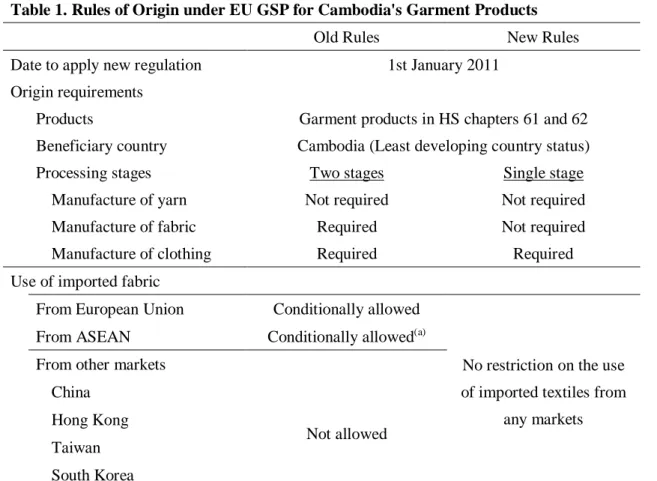
The new regulation in the ROO came into effective on January 1, 2011. The use of imported fabric produced anywhere is allowed for garment products originating in Cambodia. Because local manufacture of fabric is not required, the origin requirement is relaxed from two-stage processing to one-stage processing (UNCTAD, 2013). These changes are summarized in Table 1. The new ROO in the EU GSP has a significant implication for garment exports to EU in Cambodia. As a simple check, Figure 1 presents the utilization rate as measured by a share of duty-free import
(EEC) No. 2913/92 establishing the Community Customs Code.
12 The EC granted the derogations from the GSP ROO for certain textile products originating from
Cambodia, which allowed for the use of woven fabric (woven items) or yarn (knitted items) imported from countries belonging to the South Asian Association for Regional Cooperation (SAARC) or to the African, Caribbean and Pacific (ACP)-EC Partnership Agreement under certain quantitative restrictions. For details, see the Commission Regulations (EU) No 1063/2010 of 18 November 2010.
12
in the total import that entered EU markets under duty-free and MFN rates (EUROSTAT). The utilization rate for knitted garments increased sharply from 72% in 2010 to 89% in 2011, whereas the utilization rate for woven garments increased more substantially from 56% in 2010 to 89% in 2011.
[Table 1 and Figure 1 here]
Another implication for analysis is that Cambodia played little role in the reform process of origin rules applicable to EU GSP. While the low utilization of EU trade preferences in export from developing countries provided a motivation for the reform, it is documented that domestic stakeholders in the EU yielded a dominant influence on the reform process, as described in Inama (2011). Cambodia could not yield a strong political influence on policy-making processes in the EU. This view is indeed reflected in the policy report by the Royal Government of Cambodia (2014, p. 44) as follows. “The rules of origin applicable to GSP and DFQF (duty-free quota-free) programs are determined unilaterally by the countries offering Cambodia those programs.
Cambodia has no influence over these rules, except through moral suasion.”13
Origin-conferring criteria are also relaxed for other products, including fishery products, leather products, electrical machinery, motorcycles, and bicycles. The reform in product-specific origin requirements is not limited to garment products, which are the most significant export commodities in Cambodia. In this respect, it is reasonable to consider that Cambodia had no direct influence in determining the product-specific origin requirements in EU GSP. Thus, I argue that the EU’s reform in ROO is an exogenous policy shock to garment exports in Cambodia, providing an ideal natural experiment to identify a causal effect of simple ROO on exports.
3. Empirical Framework
In this section, I discuss a theoretical relationship between liberal origin requirements and export. I describe an empirical framework to assess the causal impact of the EU’s reform in ROO on garment exports from Cambodia, followed by data description.
3.1. Liberal Rules of Origin and Export
To examine a linkage between liberal ROO and export, a starting point is to distinguish between non-binding and binding ROO for garment export during the pre-reform period. In the case of the non-binding ROO, garment producers already satisfy the product-specific origin requirements in the EU GSP to qualify for duty-free access to the EU markets. This implies that more liberal ROO during the post-reform period would not affect export decisions for the garment
13 While the report also implies that Cambodia seeks to leverage its moral suasion to draw an attention
to the need to improve DFQF programs, there is little evidence for its effective influence on the EU’s reform process in ROO.
13
producers. However, the previous ROO required that garment producers in Cambodia use
domestically produced fabric and/or fabric imported from the EU or ASEAN countries in certain conditions to obtain duty-free access to the EU markets. Some Cambodian garment producers did not utilize the preferential access because textiles from EU and ASEAN sources were not cost effective as compared with those from China, Hong Kong, Taiwan, and South Korea (Bargawi,
2005; Yamagata, 2006). As domestic production of competitively priced textiles was limited,
input sourcing was a fundamental constraint on garment production in Cambodia.14 Thus, many
garment producers would need to rely importantly on imported textiles, making the non-binding case unlikely to hold for garment manufacture in Cambodia.
Origin requirements for preferential treatment are binding for producers when the origin-conferring criteria prevent them from using the most competitively priced inputs from third markets. As discussed in Krishna (2006), producers can use the best mix of inputs to minimize the level of production costs when the choice of inputs is not restricted. However, the binding ROO constrain the choice of inputs used in manufacturing processes, so that the unit cost of production must increase with the restrictiveness of the origin requirements. Additionally, producers must obtain a certificate of origin to prove that their products meet the origin requirements. This procedure involves documentation of sourcing to keep track of the origin of inputs and their usage. Thus, the binding ROO would generally increase the production costs for producers.
In the binding case, the decision to export under preferential treatment also depends not only on the cost of meeting specific origin requirements, but on the margin of preference for export products in the foreign markets, i.e., the absolute difference between the MFN rate of duty and the preferential rate of duty. In the case of garment exporters in Cambodia, the average MFN tariff rates on garment products in the EU markets are 12%, implying that duty-free access gives the preferential margin of 12%. As is formally modelled in Demidova et al. (2012), exporters can choose not to use preferential access, but to pay the MFN tariff. They do not need to incur the costs of meeting ROO, but they do not benefit from the preferential margin. If the costs of meeting ROO exceed the benefit of the preferential margin, they would pay the MFN tariff to export. Thus, more liberal ROO during the post-reform period would induce a higher fraction of potential
exporters to use preferential access, rather than to pay the MFN tariff.15
Taken together, these discussions suggest that liberal ROO after the EU’s reform in 2011 allowed garment producers to use the most competitively priced inputs from third markets, thereby reducing production costs of garment manufacture in Cambodia. Because garment
14 Asuyama et al., (2013) report that material inputs accounted for 45.6% of the gross product for
garment firms in 2002.
15 Since firm-destination-level data on export in Cambodia are not available, it is not possible to
14
producers in Cambodia were likely to face the binding ROO in the EU GSP during the pre-reform period, more liberal ROO should increase garment exports from Cambodia to the EU markets under duty-free treatment. This prediction is consistent with a sharp increase in the utilization rate of duty-free access for garment imports in the EU markets from Cambodia after 2011 in Figure 1.
3.2. Empirical Specification
To estimate the impact of the EU’s reform in ROO on export, I specify a following model for export market i, export product j, and year t:
ln 𝐸𝐸𝐸𝐸𝐸𝐸𝑖𝑖𝑖𝑖𝑖𝑖= 𝛽𝛽1𝐸𝐸𝐸𝐸𝑖𝑖× 𝑃𝑃𝑃𝑃𝑃𝑃𝑃𝑃𝑖𝑖+ 𝒁𝒁′𝑖𝑖𝑖𝑖𝑖𝑖𝜷𝜷2+ 𝑓𝑓𝑖𝑖+ 𝑓𝑓𝑖𝑖𝑖𝑖+ 𝜀𝜀𝑖𝑖𝑖𝑖𝑖𝑖 (1)
where 𝐸𝐸𝐸𝐸𝐸𝐸𝑖𝑖𝑖𝑖𝑖𝑖 is the value of knitted or woven garment exports from Cambodia to export market
i.16 𝐸𝐸𝐸𝐸
𝑖𝑖 is a dummy variable that takes on unity for EU markets, and zero otherwise. 𝑃𝑃𝑃𝑃𝑃𝑃𝑃𝑃𝑖𝑖 is
a dummy variable that takes on unity after the year 2011, and zero otherwise. An interaction term
between 𝐸𝐸𝐸𝐸𝑖𝑖 and 𝑃𝑃𝑃𝑃𝑃𝑃𝑃𝑃𝑖𝑖 takes on unity for EU markets after 2011, and zero otherwise. 𝒁𝒁𝑖𝑖𝑖𝑖𝑖𝑖 is
a vector of variables on export-market characteristics, such as GDP, GDP per capita, and product-specific tariff rates. Since Cambodia participated in regional trade agreements (RTAs) during the
sample period, a dummy variable for new RTAs is included.17 𝑓𝑓
𝑖𝑖 is a country-level fixed effect
to control for unobserved time-invariant country characteristics. 𝑓𝑓𝑖𝑖𝑖𝑖 is a time-varying
product-level fixed effect to control for time-varying product-specific unobserved characteristics and
aggregate shocks of global and domestic economies on exports across years. Finally, 𝜀𝜀𝑖𝑖𝑖𝑖𝑖𝑖 is an
error term.
𝛽𝛽1 is the coefficient of my main interest. As explained previously, the EU introduced new
ROO in 2011 to grant duty-free access to EU markets for garment producers in beneficiary countries that manufacture garment products using imported fabric from anywhere. Since imported fabric from the lowest-cost markets helps to reduce the cost of garment manufacture in Cambodia, the change in EU ROO should increase garment exports from Cambodia. Thus, I
predict that 𝛽𝛽1 should be positive in sign.
To identify the impact of simplifying ROO on export, my specification is based on a standard difference-in-differences (DD) method. Specifically, I exploit two sources of variations in exports from Cambodia. The first is a difference between exports to EU markets (a treatment group) and exports to non-EU markets (a control group). The second is a difference in exports before and after the 2011 reform in ROO. By comparing changes in exports to EU markets before and after the year 2011 with changes in exports to non-EU markets before and after the year 2011, the DD method allows me to estimate the causal impact of liberal origin requirements on exports from
16 Knitted and woven garment exports are in HS Chapters 61 and 62, respectively.
17 These include ASEAN-Australia-New Zealand in force from 2010, ASEAN-India in force from
15
Cambodia. Additionally, potential confounding factors are controlled for in my empirical model by including time-varying country characteristics, country fixed effects, and time-varying product fixed effects. These control variables help to isolate a variety of confounding factors from the impact of the reform on exports. Finally, the identification strategy relies on the assumption that both exports to EU markets and to non-EU markets would exhibit parallel trends in the absence of the EU’s reform in 2011. In section 4.1, I provide a graphical assessment to support the validity of the parallel trends assumption.
3.3. Data Sources
Data on export in Cambodia are from the UN COMTRADE Database. I use trade statistics reported by Cambodia for the period 2007-2015. Data on GDP and GDP per capita come from the World Development Indicator by the World Bank. Data on simple average tariff rates come from UNCTAD TRAINS database. In the World Integrated Trade Solution (WITS) database by the World Bank, I use data on effectively applied tariff rates, which are the lowest available tariffs such as preferential tariff rates. Otherwise, the MFN applied tariff rates are used. Information on RTAs are from the RTA database by the World Trade Organization (WTO).
4. Estimation Results
This section presents the estimation results for exports in Cambodia. I start to describe export trends in treatment and control groups to check a parallel-trends assumption. After the main estimation results, I present a variety of robustness checks.
4.1. Export Trends in Treatment and Control Groups
By employing a DD method in a regression model, I can disentangle a variety of confounding factors from a causal impact of simple ROO in the EU GSP after 2011. Nevertheless, the identification strategy relies crucially on the assumption that both exports to EU markets and to non-EU markets would exhibit parallel trends in the absence of the EU’s reform. Without the EU’s reform, export trends would need to move in tandem between treatment and control groups. If export trends are different between treatment and control groups in the absence of the EU’s reform, the DD method may not produce a valid estimate because export trends in non-EU markets may not well represent counterfactual export trends in the EU markets that would have prevailed in the absence of the EU’s reform. Although the parallel trends assumption is critical for the DD method, it is not generally possible to prove the validity of the assumption because the counterfactual export trends in the EU markets are not observable.
To assess the empirical validity of the parallel trends, it is useful to describe export trends in treatment and control groups. To this end, we plot trends in the total values of garment exports
16
from Cambodia to treatment and control markets, respectively. The export values are normalized to take on a value of 100 in year 2010. Figure 2 shows export trends for knitted garments in HS chapter 61. Before the EU’s reform in 2011, both treatment and control groups exhibit similar export trends during the period 2007-2010. After 2011, the treatment group shows a sharp increase in the export trend over time. Although the control group also shows an upward export trend after 2011, the export growth is substantially higher in the treatment group than in the control group after 2011. Additionally, Figure 3 presents export trends for woven garments in HS chapter 62. Before 2011, there is no apparent difference in export trends between both treatment and control groups. After 2011, the treatment group exhibits a substantially larger increase in the export trend than the control group does. Taken together, the graphical analysis lends considerable support for the parallel trends assumption, suggesting that export trends should be likely to move in tandem between treatment and control groups in the absence of the EU’s reform.
[Figures 2 and 3 here]
A plausible critique is that the export trends may simply capture an unobserved positive shock to imported consumer goods in the EU markets after 2011. If there were unobserved shocks to consumers’ tastes for apparel goods and/or consumer movements to buy imported products from developing economies, these shocks might sharply increase garment exports to the EU markets from Cambodia after 2011. To check the presence or absence of the unobserved positive shocks, I can use footwear exports as a fake treatment group. Since garment and footwear products are similar consumer goods, the unobserved positive shocks in the EU markets should also affect Cambodian footwear exports. On the other hand, the EU’s reform made little change in the product-specific origin-conferring criteria for footwear, implying that the EU’s reform should not have any discernable impact on footwear exports.
If there were unobserved positive shocks to similar consumer goods in the EU markets, footwear exports would exhibit a sharp increase in the EU markets only after 2011. An alternative prediction is that export growth would be higher in the EU markets than in non-EU markets after 2011. Figure 4 shows that footwear exports to EU and non-EU markets appear to move in tandem for the period 2007-2010. After 2011, the treatment group exhibits an upward export trend, but does not show a sudden increase over time. Moreover, the export growth is smaller in the treatment group than in the control group after 2011. These findings are not consistent with the hypothesis that unobserved positive shocks in the EU markets brought about a sharp increase in imported consumer goods such as garments and footwear. Thus, the observed export patterns for garment products should not be driven by the unobserved positive shocks to imported consumer goods in EU markets, thereby supporting the parallel trends assumption in garment exports.
17
4.2. Main Results
This section presents the results of equation (1) estimated by an Ordinary Least Squares (OLS) method. The summary statistics of the sample for garment exports are provided in Table 2. The baseline sample includes 28 EU countries in a treatment group and 85 non-EU countries in a control group. A list of these countries is in Appendix Table 1. I report standard errors that are corrected for clustering within the export market.
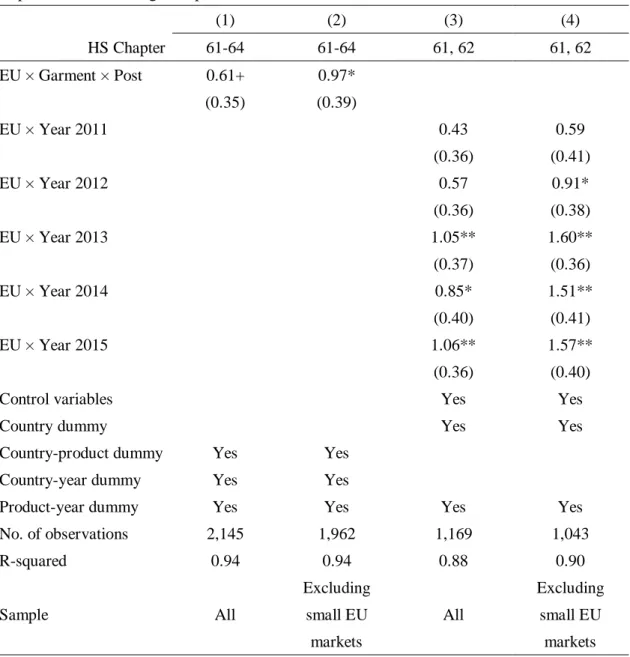
[Tables 2 and 3 here]
Column (1) of Table 3 shows the baseline result for knitted and woven garment products. The
coefficient of 𝐸𝐸𝐸𝐸𝑖𝑖× 𝑃𝑃𝑃𝑃𝑃𝑃𝑃𝑃𝑖𝑖 is significant and positive, consistent with the hypothesis that
simplifying ROO in the EU GSP promoted significantly exports from a beneficiary country. The
estimated coefficient suggests that garment exports to EU increased by 112% after 2011.18 The
impact of the EU’s reform is substantially large in magnitude. Additionally, the coefficient of real GDP is not significant, but the coefficient of GDP per capita is significant and positive. The coefficient of tariff rates in export markets is significant and negative. The coefficient of RTAs is significant and positive. These results imply that garment exports are larger in higher income
markets with RTAs and lower tariff rates.19
Among EU member countries in the sample, Croatia participated in the EU for 2013. Since exports from Cambodia to Croatia may capture the effects of the new EU membership, I exclude
Croatia from the sample.20 The result in column (2) shows that the coefficient of 𝐸𝐸𝐸𝐸
𝑖𝑖× 𝑃𝑃𝑃𝑃𝑃𝑃𝑃𝑃𝑖𝑖 is significantly positive and similar in size, consistent with the fact that garment exports to Croatia were relatively small. Additionally, there might be a potential attrition issue caused by the differential loss of export observations between treatment and control groups. In column (3), I remove the observations in which export data are missing at least one year in each country and product pair. The specification is estimated for only country and product pairs with non-missing
export data. The coefficient of 𝐸𝐸𝐸𝐸𝑖𝑖× 𝑃𝑃𝑃𝑃𝑃𝑃𝑃𝑃𝑖𝑖 remains significant and positive, implying that the
results are robust to attrition. Finally, some small EU markets do not appear to support the parallel
trends assumption.21 In column (4), I estimate the specification by excluding these small EU
markets from the sample, thereby focusing on the impact of ROO on exports to larger EU markets.
The coefficient of 𝐸𝐸𝐸𝐸𝑖𝑖× 𝑃𝑃𝑃𝑃𝑃𝑃𝑃𝑃𝑖𝑖 remains significant and positive, suggesting that garment
exports increased by 219% in the larger EU markets. As I can reject statistically the equality of
the coefficients of 𝐸𝐸𝐸𝐸𝑖𝑖× 𝑃𝑃𝑃𝑃𝑃𝑃𝑃𝑃𝑖𝑖 between columns (1) and (2), the EU’s reform would have the
18 A marginal effect in percentage changes is calculated by 100 × (exp(0.75) − 1).
19 The results are robust to using trade-weighted tariff rates, as reported in Appendix Table 2. 20 The value of garment exports from Cambodia to Croatia was merely 2.7 million USD for 2013. 21 These countries include Luxembourg, Netherlands, Ireland, Greece, Cyprus, Estonia, Hungary,
Latvia, Lithuania, Malta, and Bulgaria. Their export trends are shown in Appendix Figures 1 and 2. These markets accounted for 8.3% of total garment exports from Cambodia to EU in 2010.
18
larger positive impact on exports to the larger EU markets, which imported a substantial share of garment products from Cambodia. Thus, the main results support the positive impact of the EU’s
reform on garment exports in Cambodia.22
Table 4 shows the results for exports by product. Specifically, I distinguish between knitted and woven garments and estimate the regression model separately for these products. Column (1)
for knitted garments shows that the coefficient of 𝐸𝐸𝐸𝐸𝑖𝑖× 𝑃𝑃𝑃𝑃𝑃𝑃𝑃𝑃𝑖𝑖 is significant and positive,
suggesting that knitted garment exports to EU increased by 166% after 2011. Column (2) for
woven garment goods indicates that the coefficient of 𝐸𝐸𝐸𝐸𝑖𝑖× 𝑃𝑃𝑃𝑃𝑃𝑃𝑃𝑃𝑖𝑖 is significant and positive,
suggesting that woven garment exports to EU increased by 310% after 2011. Although I cannot reject the parameter equality of these estimated coefficients between columns (1) and (2), the larger marginal effect for woven garments is consistent with the prior finding that woven garment exports to EU from Bangladesh increased more rapidly than knitted garments (Curran and Nadvi, 2015). The reason is that domestic supply tends to be more limited for woven textiles than for
knitted textiles in developing economies.23 Since the input choice may be more binding for
woven garments than for knitted garments, simplifying ROO in the EU GSP had a larger impact on woven garment exports.
[Table 4 here]
As discussed previously, there is a concern that the positive impact of the EU’s reform on garment exports may capture unobserved positive shocks to imported consumer goods in EU,
possibly leading to the positive coefficient of 𝐸𝐸𝐸𝐸𝑖𝑖× 𝑃𝑃𝑃𝑃𝑃𝑃𝑃𝑃𝑖𝑖. To address this issue, I estimate the
regression model for footwear exports, which were not affected by the EU’s reform in terms of
origin requirements. Column (3) shows that the coefficient of 𝐸𝐸𝐸𝐸𝑖𝑖× 𝑃𝑃𝑃𝑃𝑃𝑃𝑃𝑃𝑖𝑖 is not significant,
implying that footwear exports to EU markets did not increase significantly after 2011. Additionally, I estimate the model for cereal products such as rice, which are major agricultural export products in Cambodia. Since the EU’s reform made little change in origin requirements for wholly obtained products such as domestically produced rice, agricultural exports should not
be affected by the EU’s reform. Column (4) shows that the coefficient of 𝐸𝐸𝐸𝐸𝑖𝑖× 𝑃𝑃𝑃𝑃𝑃𝑃𝑃𝑃𝑖𝑖 is positive,
but not significant. Taken together, the positive impact of the EU’s reform on garment exports should not represent unobserved positive shocks in EU.
22 The results are robust to including country-product-level dummy variables, as reported in Appendix
Table 3.
23 Production of woven textiles requires relatively large capital investment for dyeing processes of
woven fabric in order to mitigate an environmental impact of dyeing effluents and chemicals. Meanwhile, producers can use small circular knit machines to manufacture knitted textiles at a
small scale, but may not need dyeing processes for the use of pre-dyed yarns. Thus, woven garment
19
4.3. Robustness Checks
For a robustness check, I adopt a triple difference-in-differences (TD) method. An endogeneity critique is often made for a standard DD method to exploit only country-by-country differences in data (Besley and Case, 2000). By carefully documenting the EU’s reform processes, I argue that the policy change is plausibly exogenous to garment producers in Cambodia. Nevertheless, it is useful to check the robustness of main results to alternative specifications. Specifically, I estimate a following model for export market i, export product j, and year t:
ln 𝐸𝐸𝐸𝐸𝐸𝐸𝑖𝑖𝑖𝑖𝑖𝑖= 𝛾𝛾1𝐸𝐸𝐸𝐸𝑖𝑖× 𝐺𝐺𝐺𝐺𝐺𝐺𝐺𝐺𝐺𝐺𝐺𝐺𝑃𝑃𝑖𝑖× 𝑃𝑃𝑃𝑃𝑃𝑃𝑃𝑃𝑖𝑖+ 𝑓𝑓𝑖𝑖𝑖𝑖+ 𝑓𝑓𝑖𝑖𝑖𝑖+ 𝑓𝑓𝑖𝑖𝑖𝑖+ 𝜀𝜀𝑖𝑖𝑖𝑖𝑖𝑖 (2)
where 𝐺𝐺𝐺𝐺𝐺𝐺𝐺𝐺𝐺𝐺𝐺𝐺𝑃𝑃𝑖𝑖 is a dummy variable that takes on unity for knitted and woven exports, and
zero otherwise. 𝑓𝑓𝑖𝑖𝑖𝑖 is country-product-level fixed effects. 𝑓𝑓𝑖𝑖𝑖𝑖 and 𝑓𝑓𝑖𝑖𝑖𝑖 are time-varying country
and product fixed effects, respectively.24 While garment exports are treated products, similar
consumer products in HS chapters 63 and 64 are included as unaffected products in terms of ROO
changes in the EU’s reform. The coefficient of the triple interaction term, 𝛾𝛾1, measures a change
in garment exports to EU after 2011 as compared to the baseline level of country-by-product exports during the pre-reform period.
Column (1) of Table 5 shows that the coefficient of the triple interaction is significant and positive. A marginal effect of the reform for garment exports is 84%. In column (2), I estimate equation (2) for the sample excluding smaller EU markets, as explained above. The result shows that the coefficient of the triple interaction remains significant and positive. Consistent with the results in Table 3, garment exports to the larger EU markets increased more significantly after 2011. Taken together, I find that the baseline results are robust to a wide range of unobserved determinants of garment exports from Cambodia across products, export markets, and years.
[Table 5 here]
The previous results measure the average effect of the EU’s reform during the post-reform period. By interacting a dummy variable for EU markets with year dummy variables in equation (1), I can examine the timing of the effects. Column (3) of Table 5 shows that the coefficients of the interaction between EU markets and year dummies are positive and significant for 2013, 2014, and 2015. In column (4), I exclude smaller EU markets from the sample. The coefficients of the interaction terms remain positive and significant after 2012. The results indicate that the positive impacts tend to grow significantly over time. For instance, column (4) shows that the positive impact increases from 148% in 2012 to 381% in 2015.
4.4. Trade Substitution Effects
An implicit assumption in a DD method is that there is no interference between units
24 As product-specific tariff rates in export markets are insignificant, I exclude the variable from the
20
(Rosenbaum, 2007). Specifically, the assumption is that the EU’s reform did not affect Cambodian exports to non-EU markets, implying that exports to EU markets were not replaced by exports to non-EU markets in the wake of the reform. If there were substitution effects, an increase in exports to EU markets might partly originate from redirection of exports to non-EU markets. As a result, the estimated impact of the reform measures a causal impact of ROO changes on exports to EU markets as well as the substitution effects of exporting between EU and non-EU markets. From an assessment perspective, this issue indicates that the estimated impact should be interpreted
more broadly.25 Nevertheless, it is not clear whether trade substitution effects are quantitatively
important.
I address this question in two ways. First, prior surveys on garment exporters in Cambodia show that exporters were not likely to shift their export markets over time, as shown in Appendix Table 4 (Asuyama et al., 2013; Yamagata, 2006). Any firm exporting to only Europe in 2002 did not export to North America in 2008, whereas any firm exporting to only North American in 2002 did not export to Europe in 2008. Alternatively, firms exporting to multiple markets might shift the relative volume of their exports between markets. If capacity constraints were binding, they might replace product orders across markets to increase profits. However, the capacity expansion was unlikely to be binding because of small-scale capital investment in garment factories and an abundant supply of unskilled workers in Cambodia. Thus, firm-level surveys suggest that the EU’s reform would not strongly induce exporters to replace their product orders from non-EU markets.
A second approach is to test the hypothesis that garment exports from Cambodia to non-EU markets would decrease after the EU’s reform in 2011. Specifically, I estimate a following model for export market i, export product j, and year t:
ln 𝐸𝐸𝐸𝐸𝐸𝐸𝑖𝑖𝑖𝑖𝑖𝑖𝑛𝑛𝑛𝑛𝑛𝑛𝑛𝑛𝑛𝑛 = 𝛿𝛿1𝑃𝑃𝑃𝑃𝑃𝑃𝑃𝑃𝑖𝑖 + 𝛿𝛿2𝑇𝑇𝐺𝐺𝐺𝐺𝐺𝐺𝑇𝑇𝑖𝑖+ 𝒁𝒁′𝑖𝑖𝑖𝑖𝜹𝜹3+ 𝑓𝑓𝑖𝑖+ 𝑓𝑓𝑖𝑖+ 𝜀𝜀𝑖𝑖𝑖𝑖𝑖𝑖 (3)
where 𝐸𝐸𝐸𝐸𝐸𝐸𝑖𝑖𝑖𝑖𝑖𝑖𝑛𝑛𝑛𝑛𝑛𝑛𝑛𝑛𝑛𝑛 is the value of garment exports from Cambodia to non-EU export market i.
𝑃𝑃𝑃𝑃𝑃𝑃𝑃𝑃𝑖𝑖 is a dummy variable that takes on unity after the year 2011, and zero otherwise. 𝑇𝑇𝐺𝐺𝐺𝐺𝐺𝐺𝑇𝑇𝑖𝑖
is a time-trend variable.26 If there were substitution effects, redirection of exports from non-EU
to EU markets should lead to a relative decrease in exports to non-EU markets after 2011. This
suggests that the coefficient of 𝑃𝑃𝑃𝑃𝑃𝑃𝑃𝑃𝑖𝑖, 𝛿𝛿1, should be negative in sign.
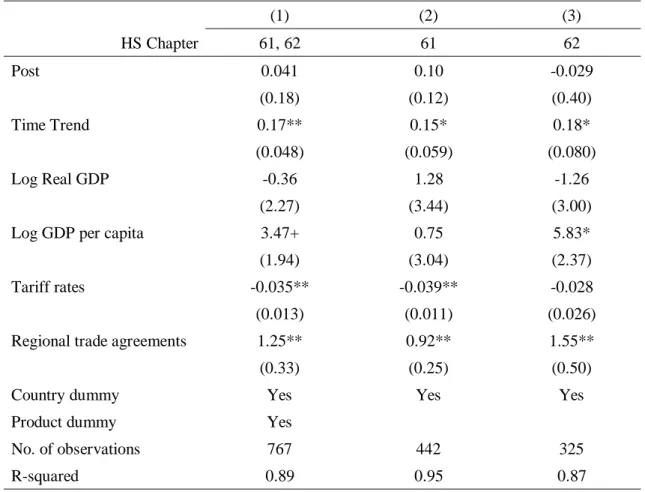
Table 6 presents the estimation results of equation (3). In column (1) for knitted and woven
garments, the coefficient of 𝑃𝑃𝑃𝑃𝑃𝑃𝑃𝑃𝑖𝑖 is positive, but not significant. The coefficient of 𝑇𝑇𝐺𝐺𝐺𝐺𝐺𝐺𝑇𝑇𝑖𝑖 is
significant and positive, implying that exports to non-EU markets increased generally over time.
25 In a similar sense, other beneficiary countries affected by the EU’s reform would have an export
response, so that competition effects in the EU markets affect garment exports from Cambodia, Such effects are part of the measured impact on Cambodia.
26 This specification is similar to an empirical strategy in Heilmann (2016) to examine trade
21
Column (2) for knitted garments shows that the coefficient of 𝑃𝑃𝑃𝑃𝑃𝑃𝑃𝑃𝑖𝑖 is not significant. In column
(3) for woven garments, the coefficient of 𝑃𝑃𝑃𝑃𝑃𝑃𝑃𝑃𝑖𝑖 is negative, but not significant. These results
suggest that exports to non-EU markets did not decline significantly after 2011. Taken together, I conclude that a sharp increase in garment exports to EU after 2011 should not be caused importantly by the redirection of exports that had been previously going to non-EU markets.
[Table 6 here]
4.5. Export Variety and Price
While the previous analysis has focused on an aggregate export response, there remains a question of whether increased exports are due to an increase in export variety and/or price. To address this question, I re-estimate equation (1) by using an export dummy variable and unit values as a dependent variable, respectively. These dependent variables are defined at the HS 6-digit level of aggregation for garment exports in Cambodia. The sample includes 106 and 112 product categories in HS Chapters 61 and 62, respectively. In this dataset, the export dummy variable takes on unity if garment exports at the 6 digit-level are positive, and zero otherwise. I define the unit values as a natural logarithm of the ratio of export values and the quantity of shipments in weight.
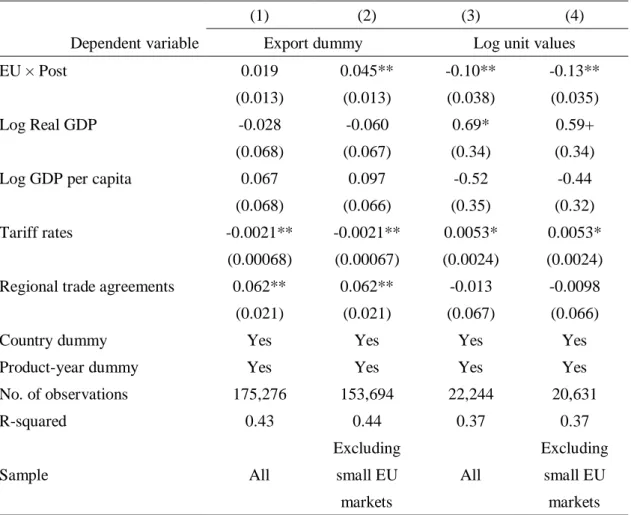
Table 7 shows the results for these dependent variables. In column (1) for the export dummy,
the coefficient of 𝐸𝐸𝐸𝐸𝑖𝑖× 𝑃𝑃𝑃𝑃𝑃𝑃𝑃𝑃𝑖𝑖 is positive, but not significant. The probability to export garment
goods to EU did not significantly change after 2011. In column (2), I exclude smaller EU markets
from the sample. The coefficient of 𝐸𝐸𝐸𝐸𝑖𝑖× 𝑃𝑃𝑃𝑃𝑃𝑃𝑃𝑃𝑖𝑖 is significant and positive, suggesting that there
was a significant increase in the probability to export garment products to larger EU markets after 2011. The aggregate impact on export values are larger for the larger EU markets, an increase in export variety should partly contribute to the larger export impacts. Additionally, column (3) for
the unit values shows that the coefficient of 𝐸𝐸𝐸𝐸𝑖𝑖× 𝑃𝑃𝑃𝑃𝑃𝑃𝑃𝑃𝑖𝑖 is significant and negative. Column (4)
shows the result for excluding smaller EU markets. The coefficient of 𝐸𝐸𝐸𝐸𝑖𝑖× 𝑃𝑃𝑃𝑃𝑃𝑃𝑃𝑃𝑖𝑖 remains
significant and negative. The price of Cambodian garment exports to the EU markets decreased by 9.5% after 2011. In the larger EU markets, the export price declined by 12.2%. Taken together, these results suggest that the EU’s reform significantly increased a quantity of garment exports from Cambodia to EU, with a pronounced increase in export variety for the larger EU markets.
[Table 7 here]
5. The Impact on Imported Intermediate Inputs
Discussions up to this point have demonstrated that Cambodian garment exports to EU markets significantly increased after the EU’s reform in ROO for 2011. A main channel is the flexible use of intermediate inputs imported from any market, which should reduce the costs of
22
garment manufacture in Cambodia. This finding raises an important question of how the EU’s reform affects international sourcing patterns of intermediate inputs for garment manufacture in Cambodia. In this section, I seek to shed light on this issue.
5.1. Descriptive Analysis
I start to describe an import pattern of textiles in Cambodia.27 Table 8 presents the value of
textile imports to Cambodia from major exporters, including China, Hong Kong, South Korea, Taiwan, ASEAN, and EU. Among these markets, China accounted for the largest textile imports in Cambodia. For instance, fabric imports from China increased from 695 million USD in 2010 to 2,161 million USD in 2015. The share of fabric imports from China increased from 42.1% in 2010 to 62.6% in 2015. The share of yarn imports from China also increased from 24.9% in 2010 to 76.3% in 2015. As discussed in Staritz (2011), China is a key market for imported intermediate inputs used to manufacture clothing in Cambodia. Meanwhile, there was an increase in fabric imports from other markets such as Hong Kong, South Korea, and Taiwan. However, the relative importance of these markets declined over time, suggesting that textile industries in China should be more competitive in supplying textile inputs for foreign markets. The key implication is that the EU’s reform in 2011 might bring about a sharp increase in textile imports from China. In the previous ROO, duty-free access to EU markets was given in certain conditions to the garment products that use imported textiles from EU and ASEAN markets. More liberal ROO in the EU GSP should have little impact on textile imports from these markets. Meanwhile, preferential treatment under the new ROO was given to the garment products that use imported textiles from third markets such as China. Thus, a sharp increase in garment exports to EU would lead to a larger increase in textile imports from China than those from other markets applicable to rules of cumulation.
[Table 8 here]
To check this implication, I plot trends in textile imports to Cambodia, with the value of imports being normalized at a value of 100 in 2010. Figure 5 shows import trends for fabric. Fabric imports from China increased sharply after the EU’s reform in 2011. This change is in stark contrast with a moderate change in fabric imports from Hong Kong, South Korea, Taiwan, and ASEAN. Additionally, Figure 6 shows a rapid increase in yarn imports from China. While the EU’s reform should reduce a demand for yarn imports to produce textiles at a local plant, an increase in yarn imports may be due to the fact that yarn and fabric are jointly used to manufacture clothing. Taken together, the descriptive analysis suggests that the EU’s reform led to a substantial
27 Following Staritz (2011), I compute the value of fabric imports by aggregating the commodities in
HS codes 5208-12, 5309-11, 5407-08, 5512-16, 56, 57, 58, 59, and 60. The value of yarn imports is the sum of the commodities in HS codes 50, 51, 5201-07, 5301-08, 5401-06, and 5501-11.
23
increase in textile imports from China.
[Figures 5 and 6 here]
5.2. Regression Analysis
To formally assess the role of China in textile imports for Cambodia, I estimate a following model for import market i, textile product j, and year t:
ln 𝐼𝐼𝐺𝐺𝐸𝐸𝑖𝑖𝑖𝑖𝑖𝑖= ∑ 𝜃𝜃𝑚𝑚 1𝑚𝑚𝐷𝐷𝑖𝑖𝑚𝑚+ ∑ 𝜃𝜃𝑚𝑚 2𝑚𝑚𝐷𝐷𝑖𝑖𝑚𝑚× 𝑃𝑃𝑃𝑃𝑃𝑃𝑃𝑃𝑖𝑖+ 𝑿𝑿′𝑖𝑖𝑖𝑖𝜽𝜽3+ 𝐹𝐹𝐺𝐺𝐹𝐹𝐺𝐺𝐹𝐹𝐹𝐹𝑖𝑖+ 𝑓𝑓𝑖𝑖+ 𝐺𝐺𝑖𝑖𝑖𝑖𝑖𝑖 (4)
where 𝐼𝐼𝐺𝐺𝐸𝐸𝑖𝑖𝑖𝑖𝑖𝑖 is the value of imports in Cambodia from import market i; m indicates major
import markets including (i) China, (ii) Hong Kong, South Korea, and Taiwan, (iii) ASEAN, and
(ⅳ) EU. 𝐷𝐷𝑖𝑖𝑚𝑚 is a dummy variable that takes on unity for import market m. 𝑃𝑃𝑃𝑃𝑃𝑃𝑃𝑃𝑖𝑖 is a dummy
variable that takes on unity after 2011. 𝑿𝑿𝑖𝑖𝑖𝑖 is a vector of variables on import-market
characteristics, including GDP, GDP per capita, RTAs, geographic distance, and geographic
contiguity. 𝐹𝐹𝐺𝐺𝐹𝐹𝐺𝐺𝐹𝐹𝐹𝐹𝑖𝑖 is a dummy variable that takes on unity for fabric goods, and zero for yarn
goods. 𝑓𝑓𝑖𝑖 is a year fixed effect. Finally, 𝐺𝐺𝑖𝑖𝑖𝑖𝑖𝑖 is an error term.
The coefficients of interest are 𝜃𝜃1𝐶𝐶ℎ𝑖𝑖𝑛𝑛𝑖𝑖 and 𝜃𝜃2𝐶𝐶ℎ𝑖𝑖𝑛𝑛𝑖𝑖. The former measures the relative size
of textile imports from China, and the latter measures a change in textile imports from China after 2011. Table 9 presents the results of equation (4) estimated by OLS for the sample period 2007-2015, with standard errors corrected for clustering in the import market. Appendix Table 6 presents the summary statistics of textile imports. Column (1) of Table 9 shows that the coefficient of 𝐷𝐷𝑖𝑖𝐶𝐶ℎ𝑖𝑖𝑛𝑛𝑖𝑖 is significant and positive. The coefficient of the interaction term 𝐷𝐷𝑖𝑖𝐶𝐶ℎ𝑖𝑖𝑛𝑛𝑖𝑖× 𝑃𝑃𝑃𝑃𝑃𝑃𝑃𝑃𝑖𝑖 is also significant and positive. These results implies that China is a key market for textile imports in Cambodia and accounted for a significant increase in textile imports after the EU’s reform in 2011. The coefficient of the import market dummy for Hong Kong, South Korea, and Taiwan is
significant and positive, but the coefficient of the interaction term 𝐷𝐷𝑖𝑖𝐻𝐻𝐻𝐻𝐻𝐻× 𝑃𝑃𝑃𝑃𝑃𝑃𝑃𝑃𝑖𝑖 is not
significant. As the coefficients of the interactions for other markets are not significant, textile imports from other markets did not increase significantly after 2011.
[Table 9 here]
Columns (2) and (3) present the results separately for fabric and yarn goods. The coefficients of 𝐷𝐷𝑖𝑖𝐶𝐶ℎ𝑖𝑖𝑛𝑛𝑖𝑖 and 𝐷𝐷𝑖𝑖𝐶𝐶ℎ𝑖𝑖𝑛𝑛𝑖𝑖× 𝑃𝑃𝑃𝑃𝑃𝑃𝑃𝑃𝑖𝑖 are significant and positive in both specifications. The estimated coefficients suggest that fabric and yarn imports from China increased by 90% and 348% after 2011, respectively. Taken together, I find that imported textiles from China significantly increased after 2011. The results are consistent with the hypothesis that more liberal ROO in the EU GSP encourage the use of most competitively priced inputs imported from third markets such as China when garment exporters exploit preferential market access.
24
6. The Impact on Inward FDI
A sharp increase in demand for garment exports to EU after 2011 could be met by an increase in production capacity for existing garment factories through an expansion of production lines and hiring more garment workers. However, the expansion of garment production can be driven not only by the existing garment factories in 2011, but by newly-established garment factories after 2011. Given that many garment factories were owned by foreign investors (Yamagata, 2006), it is a crucial question whether the EU’s reform contributes to attract inward FDI projects and how the impacts differ by sectors. This section sheds light on the response of inward FDI in Cambodia.
6.1. Descriptive Analysis
The EU’s reform in ROO for 2011 removed restrictions on intermediate input sourcing for garment manufacture in Cambodia. Garment producers could exploit a wide range of intermediate inputs imported from most efficient markets after 2011 and still maintain preferential market access to the EU markets. Since the flexibility in input sourcing should improve an investment climate in Cambodia, the reform would attract foreign investors in a garment sector. On the other hand, the previous ROO generally required the use of locally manufactured fabric from yarn to qualify for preferential access, although rules of cumulation allowed for the use of imported fabrics from certain markets such as EU and ASEAN. The content requirement for local inputs provided an incentive for foreign investors to manufacture textiles at a local production plant in Cambodia. However, the removal of the local input requirements should reduce an incentive for foreign producers to invest in a textile sector and build up the manufacturing base of textile suppliers. Consequently, simplifying ROO should produce two contrasting effects on inward FDI flows across these sectors; (i) FDI inflows should increase in the garment sector after 2011, and
(ii) FDI inflows should decrease in the textile sector after 2011.28
To examine whether these hypotheses are consistent with a pattern of FDI inflows in Cambodia, I use data on the factory registration by the Cambodian Ministry of Industry and Handicraft. There is information on registered factories after the year 1994, including main products, the year of establishment, location, country of investors, and capital. Figure 7 presents a trend in FDI flows for the period 2007-2015. The total amount of capital investment by foreign investors is shown for garment and textile sectors, respectively. As a benchmark, I also show the average capital investment in all manufacturing sectors. As compared with the average FDI inflows, FDI inflows in the garment sector increased sharply after 2011. By contrast, FDI inflows in the textile sector remained at a lower level after 2011 than the average FDI inflows. These findings are consistent with the predicted impacts of simplifying ROO on inward FDI.