Border Industry in Myanmar: Turning the
Periphery into the Center of Growth
著者
Kudo Toshihiro
権利
Copyrights 日本貿易振興機構(ジェトロ)アジア
経済研究所 / Institute of Developing
Economies, Japan External Trade Organization
(IDE-JETRO) http://www.ide.go.jp
journal or
publication title
IDE Discussion Paper
volume
122
year
2007-10-01
INSTITUTE OF DEVELOPING ECONOMIES
IDE Discussion Papers are preliminary materials circulated
to stimulate discussions and critical comments
IDE DISCUSSION PAPER No.122
Border Industry in Myanmar:
Turning the Periphery into the
Center of Growth
Toshihiro KUDO*
October 2007
Abstract
The Myanmar economy has not been deeply integrated into East Asia’s production and distribution networks, despite its location advantages and notably abundant, reasonably well-educated, cheap labor force. Underdeveloped infrastructure, logistics in particular, and an unfavorable business and investment environment hinder it from participating in such networks in East Asia. Service link costs, for connecting production sites in Myanmar and other remote fragmented production blocks or markets, have not fallen sufficiently low to enable firms, including multi-national corporations to reduce total costs, and so the Myanmar economy has failed to attract foreign direct investments.
Border industry offers a solution. The Myanmar economy can be connected to the regional and global economy through its borders with neighboring countries, Thailand in particular, which already have logistic hubs such as deep-sea ports, airports and trunk roads. This paper examines the source of competitiveness of border industry by considering an example of the garment industry located in the Myanmar-Thai border area. Based on such analysis, we recognize the prospects of
Keywords: Myanmar (Burma), Greater Mekong Sub-region (GMS), regional cooperation, border
industry, cross-border trade, migrant workers, logistics, center-periphery
JEL classification: F15, F22, J31, L67
* Director, Southeast Asian Studies Group II, Area Studies Center, IDE ([email protected])
The Institute of Developing Economies (IDE) is a semigovernmental,
nonpartisan, nonprofit research institute, founded in 1958. The Institute
merged with the Japan External Trade Organization (JETRO) on July 1, 1998.
The Institute conducts basic and comprehensive studies on economic and
related affairs in all developing countries and regions, including Asia, the
Middle East, Africa, Latin America, Oceania, and Eastern Europe.
The views expressed in this publication are those of the author(s). Publication does not imply endorsement by the Institute of Developing Economies of any of the views expressed within.
INSTITUTE OF DEVELOPING ECONOMIES (IDE), JETRO 3-2-2, WAKABA,MIHAMA-KU,CHIBA-SHI
Border Industry in Myanmar:
Turning the Periphery into the Center of Growth
[Contents] Introduction 1. Background
2. Factors that Promote and Retard Border Industry (1) Economic Integration and Border Industry (2) Infrastructure and Logistics
(3) Government Policy on Business Activities
3. Border Industry Example: the Garment Industry in Mae Sot (1) Outline
(2) Labor (3) Logistics (4) Electricity
Conclusion: Turning the Periphery into the Center of Growth References
Tables and Figures Maps
Introduction
The chairman of the Myanmar Garment Manufacturers Association (MGMA) deplores the fact that the garment industry in Yangon and its suburbs has been losing workers, experienced ones in particular, to Mae Sot, a Thai border town opposite Myawaddy on the Myanmar side. His own factory, employing 150 workers, has recently lost ten sewing-machine-operators to Mae Sot.1 Why did Myanmar workers leave
Yangon, the former capital and business center of the country, for a small border town on Thai soil? They went there to work at garment factories clustered in Mae Sot.
The garment industry in Yangon was severely damaged by the United States’ sanctions of July 2003, which banned all imports from Myanmar. The industry exported nearly half of its products to the United States, and more than eighty percent of United States’ imports from Myanmar were clothes. Myanmar’s garment exports declined sharply from US$ 829.0 million in 2001 to US$ 312.4 million in 2005, a 62.3% decline.2
1 Personal communication with the chairman on September 4, 2007.
Many factories were closed and many workers lost their jobs.3 Some garment workers
who were made redundant went to Mae Sot to seek employment. Such a migration reflects the poor business situation and serious unemployment in Myanmar, as well as a gap in wages between the two countries. It is natural that Myanmar workers migrate to Thailand, attracted by abundant job opportunities and higher wages.
Regarding the location of the garment industrial cluster to which Myanmar workers flock, the question is: why are many garment factories located in a small Myanmar-Thai border town and not in a bigger city like Bangkok or Chiang Mai? The labor-intensive garment industry has clustered in a border town mainly because Myanmar migrant workers are available only in border areas.
Another question arises regarding the location of the garment industry. Why is the industry located on the Thai side and not the Myanmar side? Mae Sot and Myawaddy are separated by a small river called the Moei. The friendship bridge constructed in 1997 by the Thai government connects the two towns. The Thai garment industry could easily cross the bridge and geographically relocate to Myawaddy, where it could probably employ more Myanmar workers at lower wages. In reality, it does not. The absence of border industry in Myawaddy implies some hindrance or difficulty preventing the Thai garment industry from operating on Myanmar soil.
Nevertheless, the flourishing border industry in Mae Sot indicates the possibility of border industry on the Myanmar side, once such hindrances have been removed and a favorable environment has been created. This paper examines factors that promote industrial clustering in the Myanmar-Thai border area, and at the same time identifies factors that push factories to the Thai side instead of the Myanmar side. We use the garment industry in Mae Sot as an example. Based on such analysis, we propose certain policy measures to promote border industry on Myanmar soil.
The first section reviews the historical, political and economic relationship between Myanmar and neighboring countries. Such a review will provide readers with background knowledge on how border industry has become possible along Myanmar and its neighbors’ boundaries, the Myanmar-Thai border in particular. The second section will examine factors that promote and retard border industry. Some may suggest that border industry will decline as economic integration in East Asia proceeds and border barriers disappear. Nevertheless, in reality, border industry is growing the European Union (15 member countries only), Japan, Korea, Malaysia, Singapore and the United States.
3 Regarding the impact of United States’ sanctions on the garment industry in
rather than diminishing. What is the rationale behind, and sources of competitiveness of, border industry? This section addresses this question. The third section will consider the garment industry in Mae Sot as an example. Based on firsthand information from the field and a questionnaire survey, we identify the advantages of the garment industry in Mae Sot in terms of labor, logistics and infrastructure. In conclusion, we consider the possibility of border industry on the Myanmar side and suggest certain policy measures to promote this.
1. Background
Myanmar shares long borders with five neighboring countries, namely China (a border of 1357 miles), Thailand (1314 miles), India (857 miles), Bangladesh (152 miles) and Laos (128 miles) and shares coastal waters with Malaysia and Singapore. There are differences in natural resource endowments and industrial development stages among them. It should be natural for Myanmar to have stronger economic ties with its neighbors.
In reality, however, Myanmar’s national borders have been closed, for all practical purposes, throughout its socialist period (1962-1988). 4 Myanmar pursued a strict
non-aligned foreign policy and operated on an economic strategy of self-reliance and self-sufficiency. The military government (SLORC/SPDC)5 that came into power in
1988 drastically changed policy, introducing open-door actions such as the liberalization of external trade, legalization of cross-border trade with neighboring countries and acceptance of foreign investment by enacting the Foreign Investment Law (FIL).
The open-door policy adopted by Myanmar’s newly-established military government was welcomed by neighboring countries, China and Thailand in particular. Following the end of the Cold War, China ceased its dual-track foreign policy toward Myanmar, in which it endorsed party-to-party relations between the China Communist Party (CCP) and Burma Communist Party (BCP), in addition to state-to-state relations (Tin Maung Maung Than [2003:194]). Thailand abandoned its secret strategy of using the Karen and other ethnic insurgents deployed alongside the border areas as a buffer against the Myanmar army and the BCP.6 Chatichai Choonhavan, the Thai Prime Minister from
1988 to 1991, coined the famous phrase: “Change Indochina from a battlefield to a
4 See Liang [1990] for Myanmar’s foreign policy during the socialist period.
5 The military took power in a coup in September 1988 and established the State Law
and Order Restoration Council (SLORC), which was re-constituted as the State Peace and Development Council (SPDC) in November 1997.
commercial field.” The newly-established military government in Myanmar also initiated a ceasefire policy with ethnic insurgents, most of whom occupied the border areas, in 1989.7 Thus, peace was realized in these areas for the first time.
Moreover, Myanmar joined the Greater Mekong Sub-region (GMS) Economic Cooperation in 1992, which was a significant departure from its traditional neutralist foreign policy. Following this, Myanmar joined the Association of Southeast Asian Nations (ASEAN) and the Bay of Bengal Initiative for Multi-Sectoral Technical and Economic Cooperation (BIMSTEC) in 1997, the Mekong-Ganga Cooperation in 2000 and the Ayeyawady-Chao Phraya-Mekong Economic Cooperation Strategy (ACMECS) in 2003. Myanmar’s open-door policy was well received by East Asian regionalism throughout the 1990s, a situation that prevails today.
Accordingly, Myanmar has strengthened its trade relations with neighboring countries. The trade shares of its five neighboring countries, China, India, Malaysia, Singapore and Thailand accounted for 70.4% of Myanmar’s exports and 79.5% of its imports in 2006 (Table 1). The five countries are also leading investors in Myanmar, accounting for 70.2% of the total amount of approved foreign investment, as of March 2006.
On the other hand, Myanmar’s economy has been sluggish for some time, although the official GDP recorded eight consecutive years of double-digit growth since Fiscal Year 1999. The per capita monthly household expenditure in US dollar terms was extremely low and stagnated between US $10.9 in 1997 and US $9.9 in 2001.8 Engel’s
coefficient recorded 71% in 1997 and 72% in 2001, suggesting no significant improvement in household incomes. Industrial structural changes are underway, albeit slowly. The manufacturing share of Myanmar’s GDP increased from 7.8% in 1990 to 11.6% in 2004, while that of Cambodia increased from 5.2% to 19.6% during the same period (ADB KI).
Moreover, Myanmar has been subjected to various economic sanctions by the United States, the European Union (EU) and other western countries. The hostile international environment surrounding the military government and underdeveloped infrastructure prevented the Myanmar economy from participating in global and regional production and distribution networks. Combined with Myanmar’s open-door policy, geographical
7 See Smith [1999] for details.
8 The per capita monthly household expenditure was 2626 kyat in 1997 and 5458 kyat
in 2001 (CSO SY [1998;2004]), which was converted at the prevailing exchange rates of 240 kyat/dollar and 550 kyat/dollar, respectively. The official exchange rate, however, has been pegged at about 6 kyat/dollar.
vicinity, economic complementarities, cultural closeness and western countries’ hostile attitudes against the military regime, Myanmar has eventually strengthened its economic ties in trade, investment and regional cooperation with neighboring countries. The opening of the Myanmar border to neighbors has made border industry possible. 2. Factors that Promote and Retard Border Industry
(1) Economic Integration and Border Industry
There are several factors affecting the competitiveness of border industry. Borders divide nations and create differences in resource endowments and price structures, which are sources of economic complementarities. All border industry advantages arise from the availability of complementary resources, which exist side-by-side in the geographical proximity of border areas. However, these must be transported across borders and utilized for production in a border town in one of the countries. In that sense, a certain degree of cross-border mobility of productive factors is required for the birth and growth of border industry.
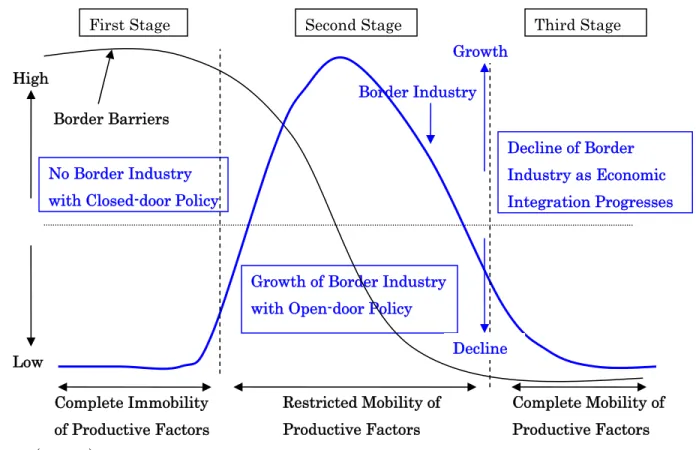
Figure 1 shows the relationship between mobility of productive factors and the growth of border industry. The Myanmar borders were closed during the socialist period, for all practical purposes, and border industry was not possible (the first stage). The open-door policy and peace in border areas, which was realized by ceasefire agreements between the Myanmar military and ethnic insurgents, lowered border barriers and allowed border industry to grow (the second stage). As economic integration progresses in the region, cross-border mobility of people, goods and services, capital and information will be enhanced. Complete mobility of all goods and services, productive factors and other economic elements such as market information and technology across nations will ultimately eliminate border industry, because any location in either country will then have an equal access to productive factors and there will probably be no reason for a remote border town to be chosen as a competitive production base (the third stage).
In reality, borders still exist and create barriers to the movement of productive factors and other economic elements. For example, borders prevent people from moving freely, divide labor markets and facilitate a gap in wages. There is little possibility of the region reaching the stage of a completely integrated economy in the foreseeable future. Border industry in this region still has growth potential for a certain period. It is therefore worthwhile considering how to promote border industry in the region and how the Myanmar economy as a whole can benefit from it.
(2) Infrastructure and Logistics
In East Asia, service link costs, connecting remotely located production blocks, have become low enough to take advantage of differences in wages and other location advantages (Kimura [2006:17]). Multi-national corporations (MNCs) aggressively exploited non-integrated elements such as wage differences and eventually developed sophisticated production and distribution networks in East Asia.
However, the Myanmar economy has not been deeply integrated into such networks in spite of its abundant, reasonably well-educated and very cheap labor force: an apparent location advantage. Underdeveloped infrastructure, logistics in particular, hinders the Myanmar economy from joining production and distribution networks in East Asia. Service link costs, connecting firms located in Myanmar and other fragmented production blocks and markets, have not become low enough to realize a total cost reduction accrual from location advantages due to wage gaps.
Border industry could offer a solution to overcome such high service link costs embedded in the Myanmar economy. The Myanmar economy can connect itself to the regional and global economy via borders with neighboring countries, Thailand in particular, which have logistic hubs such as deep-sea ports, international airports and trunk roads. The required infrastructure investment to connect its border areas with the pre-existing infrastructure of neighbors may be far smaller than that for developing a nation-wide infrastructure system. On the contrary, a massive investment would be required to connect the proper or central part of the Myanmar economy regionally and globally. For example, it would be costly to construct a new deep-sea port somewhere on the Myanmar coast. Worse still, the new port may not be fully utilized because it would be located off the major marine transportation routes, resulting in a shortage of cargoes and expensive shipping costs. Firms in Myanmar-Thai border areas, however, can gain access to the well-developed Bangkok Port and/or Laemg Chabang Port via well-connected road networks in Thailand.
In border areas, firms will be able to have better access to other infrastructure services such as electricity, telecommunications and water, which can be provided by neighboring countries. Thus, firms, including MNCs located in border areas, can exploit location advantages such as wage differences, and at the same time enjoy lower service link costs.
On which side of nations should border industry locate itself? In terms of service link costs accrual from geographical distance, there should be no difference, in theory, on which side of nations firms locate themselves. However, border industry could exploit more non-integrated advantages, notably wage differences, if it is located on the side of less-developed nations. For example, firms in the Myanmar-Thai border areas could employ more workers at lower wages on the Myanmar side than the Thai side, as they do not need to follow the minimum wage regulations and restrictive migrant workers policies that the Thai government has stipulated.
In reality, no border industry is located on the Myanmar side. All factories are located on the Thai side, and Myanmar migrant laborers move to the Thai side and work there. This is due to an inferior business and investment climate on the Myanmar side. Thai firms have to make foreign investments to locate themselves in Myanmar, where many restrictive regulations, both explicit and implicit, are imposed on foreign firms by the host government. The Myanmar government controls external trade strictly, particularly cross-border trade, by means of export and import licenses, an export-first policy, trade bans on certain items and unexpected closure of border gates. It also restricts foreign currency transactions, which create large differences in exchange rates, from the official rate of about six kyat to the US dollar, to the market rate of about 1350 kyat to the US dollar as of mid-September, 2007. Moreover, the Myanmar government frequently changes rules and regulations without prior consultation with the business sector or even prior notice, which seriously undermines the stability and predictability of the business environment in Myanmar. Such unfavorable government policies hinder Thai firms from crossing a small river, onto Myanmar soil.
3. Border Industry Example: the Garment Industry in Mae Sot
This section considers an example of a Myanmar-Thai border industry, that is, the garment industry in Mae Sot. Based on discussions in the previous section, we will examine how this border industry exploits the location advantages of border areas and identify its sources of competitiveness.
(1) Outline
Mae Sot is a small town in Tak Province in the north of Thailand (Map 1).9 A small
river called the Moei separates Mae Sot and Myawaddy, a small town in Karen State in
9 The population of Mae Sot was 106,413 in 2000 according to Wikipedia (available at
Myanmar. The two towns form a border gate that is located on the GMS’s East West Economic Corridor (EWEC), connecting Da Nang in Vietnam in the east and Mawlamyine in Myanmar in the west, through Laos and Thailand.
For nearly ten years, many factories have been established in, or relocated to, Mae Sot. There were 464 factories with 36,821 workers in Tak Province in 2005 (Table 2).10
Among them, 235 factories, or 51%, were located in Mae Sot, employing 31,876 workers or 87% of the total laborers in Tak Province. These figures imply that most labor-intensive industries are concentrated in Mae Sot. The textile and garment11
(hereafter called “garment”) sector is labor intensive. There were 113 garment factories in Tak Province in 2005, and most of them were located in Mae Sot. These factories employed 26,889 workers or 73% of the total number of laborers in Tak Province. The capital-labor ratio of the garment industry was also among the lowest.
The Institute of Developing Economies, JETRO (IDE-JETRO) conducted a joint study with the Economic Research and Training Center (ERTC) of Thammasat University on the economic and social aspects of migrant workers, on the garment industry in Myanmar-Thai border areas in August and September, 2006.12 A questionnaire survey
was conducted, covering ten garment factories and 100 Myanmar migrant workers.13
According to the survey, the garment industry in Mae Sot is quite young. Six out of ten garment firms were established after 2001, while two were set up in 1998, and one firm in each of 1995 and 1990 (Table 3). Seven garment firms were under sole Thai ownership and the remaining three were joint ventures with Chinese investors. Nine of them were sub-contractors that produced garments to order for exporters in Bangkok. Only one firm in this survey exported its products directly overseas.
The average number of employees was 423, which is greater than the official statistics shown in Table 2, i.e. 298 for the textile industry and 175 for the garment industry. The number of workers may be under-reported. Myanmar workers constituted 86% of the total number of employees, ranging from 83% to 97%, except for one firm that had no
10 Figures are from the Tak Chapter of the Federation of Thai Industries.
11 The textile sub-sector here indicates in most cases knitwear apparel production,
while the garment sub-sector includes woven apparel production. There is almost no textile yarn and fabric production, which is more capital intensive, in Mae Sot (interviews with the Tak Chapter of the Federation of Thai Industries in September 2006). In this paper, the author uses “garment industry” to include both sub-sectors.
12 The author joined a field trip to Mae Sot and Myawaddy with the Thammasat team
in September 2006. He wishes to thank Dr. Chanin Mephokee, Associate Professor at Thammasat University, and Mr. Jarin Cholpaisal, Lecturer at Rangsit University, for their cooperation with the survey. See ERTC [2007] for the detailed survey results.
13 Samples are small and were selected for convenient interviewing. A careful
Myanmar workers.14 The firms operated for 296 days in 2005, or 25 days per month on
average.
When we asked the garment firms to cite reasons for relocating to Myawaddy, only two firms out of eight explicitly stated that they did so because of the abundance of Myanmar labor. Four firms answered that they just followed their headquarters’ policy and the remaining two firms built factories there because the owners were Mae Sot residents. The headquarters’ policy must have taken account of the availability of Myanmar workers in Mae Sot. Entrepreneurs in Mae Sot started garment factories because of the existence of Myanmar workers, and the garment industry there is totally dependent on Myanmar workers. The availability of Myanmar migrant workers is obviously the main reason why the garment industry has clustered in this small border town.
(2) Labor
The Thai government has responded to requests from employers to allow them to hire foreign workers to fill labor shortages in industry, in particular for work called the three Ds, i.e. Difficult, Dirty and Dangerous. Following a Cabinet Decision in April 2004, the most comprehensive registration to date took place in that year, when the Thai Ministry of Interior registered 1,280,000 foreigners during the month of July; 814,000 of those had applied for work permits by mid-December (Huguet and Punpuing [2005:30-34]). Of the 814,000 persons, 610,000 persons, or three-quarters, were from Myanmar. Of the number of work permits issued to Myanmar nationals, Tak Province with 50,932 permits ranked third, following Bangkok with 98,308 permits and Samut Sakhon with 67,799. Tak Province is one of the places where abundant Myanmar workers are available and employable.
We examined the workers’ profiles in the questionnaire survey. Out of the 100 Myanmar workers interviewed, 61 were female. The female ratio of the sample is lower than the 74% for the textile and garment industry in Tak Province (Table 2). The average age of the workers was 27 years old, ranging from the youngest at 18 years old, to the oldest at 36 years old. Out of 61 females, 44 were single and out of 39 males, 20 were single.
Regarding their hometown, 23 were from Myawaddy, 20 were from Pa-an, the capital of Kayin State, 11 were from Mawlamyine, the capital of Mon State, 9 were from
14 This firm answered that it employed no Myanmar workers out of a total of 390
employees. However, it responded to a question in the same questionnaire on why Myanmar should be employed. It is doubtful that it does not employ Myanmar workers.
Yangon, the former national capital, 6 were from Thaton, the former center of the ancient Mon Kingdom, and 4 were from Bago, the capital of Bago Division (Map 2).15
Many of them were naturally from nearby towns like Myawaddy and Pa-an. It is noteworthy however that quite a few were from rather distant places, like Yangon and Bago. Ninety-six workers were Burmese and the rest were Kayin, Kachin and Akha. These figures indicate that the labor market for the garment industry in Mae Sot encompasses quite a large spatial area alongside the main road that connects Myawaddy and Yangon.
Out of 100 Myanmar workers, 74 of them entered Thailand after 2002 (Table 4). In particular, 2004 and 2005 recorded 25 and 27 persons, respectively. The increase in those two years may be related to the relaxation of the Thai government’s policy on migrant workers. It may also be related to the collapse of Yangon’s garment industry after the United States’ sanctions of July 2003. The garment factories in Yangon may have actually lost their workers to factories in Mae Sot, as the MGMA chairman said.
It is astonishing to note that there were 43 workers who had received no formal education, while 36 workers had received an elementary and/or junior-high school education (4 to 8 years), 18 workers had a high school education (10 to 11 years) and only four workers had obtained a college and/or university level education (12 years or more). According to a survey of the garment industry in Yangon in 2005, only 0.8% of workers had not received formal education, while 50.5% had been educated for up to 8 years, 26.7% studied for 10 to 11 years and 21% obtained a college/university level education (Kudo [2006:113]). Considering that Myanmar’s gross primary school enrollment ratio was 99% for males and 101% for females in 2005 (ADB KI), the education level of Myanmar workers in Mae Sot was extraordinarily low. The reasons for this gap are unknown. Their work experience in the garment industry was also quite poor. Fifty-seven workers had no experience in the garment industry, while 13 had worked in garment factories for one year or less, 18 had worked for three years or less and only 12 had more than four years’ work experience. Most of those without work experience are probably recent entries into Thailand.
Employees worked for eight hours per day, six days per week. Ninety-two workers earned only the minimum wage of 143 baht (equivalent to US $3.8 at the exchange rate of September 2006) per day, six workers earned 150 baht per day and two workers earned 160 baht or more per day. Their basic monthly wage amounted to 3,575 baht
15 Some places indicated by interviewees were not identified because of incorrect
(143 baht/day x 25 days) or US $94. On the other hand, garment workers in Yangon earned, on average, 17,800 kyat per month, equivalent to about US $20 per month in 2004 (Kudo [2005b:23]). Most workers in Mae Sot also received overtime pay with the higher rates being 23-27 baht per hour (equivalent to 184-216 baht per day). Nominal wage differences between the garment industry in Yangon and that in Mae Sot were almost five-fold and this wage gap was a strong attraction for Myanmar workers, even from distant places.16
Out of the 100 workers, 79 of them had remitted money to their hometown. According to the 30 respondents, the average remittance was 2,393 baht or US $63 per month, representing 67% of the minimum wage. Fifty-four respondents answered that their remittance was, on average, 16,407 baht, equivalent to nearly seven months’ wages during the last few years. All workers lived in Thailand and no one commuted between Myawaddy and Mae Sot. Ninety-one workers lived in company dormitories and 71 workers did not pay for accommodation, while 29 workers paid 645 baht per month, on average. Ninety workers were also provided with meals at subsidized prices by their employers. Such an inexpensive way of living for Myanmar migrant workers in Mae Sot made it possible for them to remit a substantial share of their wages home. Thus, 72 workers had no intention of returning to Myanmar permanently.
(3) Logistics
The garment industry in Mae Sot has an advantage in logistics over, for example, that industry in Yangon. Suppose one manufactures garments in Mae Sot and exports them to Tokyo. The 490-kilometer road connecting Mae Sot and Bangkok is well paved and developed, and vehicles can traverse it in 12 hours at a cost of about US $290 (Table 5). In Bangkok, there are two major ports: one is Bangkok Port or Klong Toey Port and the other is Laem Chabang Port, the latter of which is one of Asia’s leading ports and the most important commercial deep-sea port in Thailand. It takes eight or nine days from Laem Chabang Port to Tokyo/Yokohama Port and costs US $1,340 to ship a 40-foot container.17 Products made in Mae Sot arrive in Tokyo in about 10 days at an
approximate cost of US $1,630.
Suppose that instead one manufactures garments in Yangon and exports them to Tokyo. Most factories in Yangon have good access to Yangon Port, in one or two hours,
16 If their education background indicates the workers’ skill level, the wage gap
becomes wider because workers in Yangon had a better educational background than those in Mae Sot.
at an approximate cost of US $50. However, no vessels sail directly to Japan and cargoes have to be transshipped via Singapore Port. It takes four to five days from Yangon Port to Singapore Port and costs US $650 to ship a 40-foot container.18 Only
two vessels are available every three days. Transshipment takes at least another day. It takes seven days from Singapore to Tokyo/Yokohama Port and costs US $940 to ship a 40-foot container. In total it takes 13 days from Yangon to Tokyo and costs US $1,740, plus transshipment charges in Singapore Port.
In reality, the latter route takes more time and expense. Garment firms in Yangon need to apply for export and import licenses for each transaction and in order to do so they have to go as far as Naypyidaw, the new capital, located about 300 kilometers north of Yangon. It usually takes about two weeks to obtain one export and/or import license, as the Trade Policy Council chaired by General Maung Aye, Vice-Chairman of the SPDC sanctions each license individually. Moreover, cargoes are often kept in port for a considerable time for inspection and customs clearance. On the contrary, Bangkok Port or Laem Chabang Port apparently provides much more efficient services.
The garment industry in Mae Sot has an advantage in the procurement of raw materials as well. According to the survey, four of the eight respondent firms used only Thai domestic raw materials. One respondent used 73% domestic material with the remaining 27% being imported, and three used imported material only. Conversely, the garment industry in Yangon has been completely dependent on imported raw materials. They import everything: fabrics, accessories, threads and even plastic bags, except perhaps cardboard boxes. As already stated, in Myanmar it takes time to import materials of any kind. Garment firms in Yangon need a longer lead time for production because of the procurement of raw materials from abroad. A longer lead time hinders Myanmar’s garment industry from sewing seasonal and/or fashion apparel items, which requires quick responses (QR). It is an advantage for garment factories located in Mae Sot to be able to use both domestic and foreign raw materials.
In order to reduce transportation time and costs in Myanmar, road transport has recently attracted attention. Table 5 shows a comparison between road and marine transport from Bangkok and Yangon (Map 3). 19 Road transport could offer
advantageous alternative logistics to the marine route, in terms of both time and cost. However, the road route is not yet available for commercial transportation of cargo. The road conditions on some parts of the route are dangerous for large vehicles to traverse.
18 Personal communication with the MGMA chairman on September 4, 2007.
19 Road transportation figures are based on a trial run by a truck operated by Sankyu
The 38-kilometer road between Kawkareik and Thingannyinaung crosses the Dawna Range and a hilly part of it is restricted to one-way traffic, i.e. odd days for ascending vehicles and even days for descending vehicles. In addition, the border crossing through Myawaddy requires tedious and time-consuming negotiations with the Myanmar authorities in advance.
This route constitutes part of the EWEC and road construction is planned to be completed in 2008, with Thai assistance. The Memorandum of Understanding (MOU) for the Cross-Border Transport Agreement (CBTA) between Myawaddy and Mae Sot is being finalized, and this will promote smoother border crossings through this border gate in the near future. Possible reduced transportation costs resulting from the completion of the EWEC may benefit Yangon more than Myawaddy-Mae Sot. However, border industry can strengthen its industrial linkages with that in Yangon, and stand a good chance of enhancing its competitiveness.
(4) Electricity
Myanmar has experienced a long-standing national power shortage since the late 1990s. A shortage of electricity is one of the most serious problems in the garment industry as well as in other manufacturing sectors in Myanmar. In the garment industry survey in Yangon in 2005, we asked garment firms to rate how severely poor infrastructure services obstructed their operations regarding telecommunications, electricity and transportation (Kudo [2006:113]). Table 6 shows that electricity is regarded a severe problem in garment production. In the same survey, 69 firms among the 139 respondents answered that they had experienced power interruptions more than three times a day and that these had often lasted for more than three hours. Therefore, most manufacturers had to use their own and/or share generators. Out of 141 garment factories, 134 factories had used their own or shared generators.
The State-owned Economic Enterprises (SEEs) Law, promulgated in 1989, stipulates 12 economic enterprises that SEEs continue to monopolize, including many infrastructure services such as post and telecommunications, air and rail transport, banking and insurance, broadcasting and television and electricity.20 Myanmar Electric
and Power Enterprise (MEPE), a SEE that falls under the jurisdiction of the Ministry of Electric Power, is the sole legal provider of electricity in Myanmar.
However, in Myawaddy many households are provided with power by a Thai company
20 Some of the 12 sectors are, however, in reality, open to private enterprises, provided
located in Mae Sot, which is deemed illegal according to SEE law. The Myanmar consumers pay electricity charges in baht, the use of which is also illegal, as possession of foreign currency by Myanmar citizens is prohibited by law. The provision of electricity to households in Myawaddy through the power grid from Mae Sot seems to be based on an understanding between the regional authorities in both countries, although the precise arrangements remain unclear. This example shows that cross-border transmission of electricity is possible between the two border towns. Once legal and institutional arrangements have been finalized between the two governments, factories located in Myawaddy could be officially and regularly provided with electricity from the Thai side of the border.
Conclusion: Turning the Periphery into the Center of Growth
Contrary to the general impression that border areas are remote and backward regions, they are better off than the proper or central region of Myanmar. It is rather surprising to see that the four regions with the highest per capita household expenditure share borders with Thailand, China and Bangladesh (Table 7). These regions are also growing more rapidly in Myanmar, widening the gap between border areas and other regions. The Myanmar economy is thus characterized as a “poor center and rich periphery”.21
The periphery, as defined by views from Yangon and Mandalay, is no longer the periphery viewed from a wider geographic perspective, such as the GMS. Myanmar’s border area is closer to more dynamic economies like Thailand and China than to the proper and central part of Myanmar. It could be regarded as a conduit that relays economic vitality into the proper part of Myanmar, where the economic situation has long been depressed. Border industry could function as such.
In this paper, we firstly examined the prospects of border industry along Myanmar’s neighboring boundaries. Border industry has a good chance of growing, as it can exploit the location advantages in Myanmar, notably an abundant and cheap labor force, while avoiding high service link costs accrued mainly from underdeveloped infrastructure and restrictive and cumbersome red tape on business activities, which are embedded in the Myanmar economy.
Among the location advantages in Myanmar, human resources are the most important. The Thai population of prime labor, aged 15-39 years, is no longer growing
21 Kurosaki et al. [2004] also described Myanmar’s rural economy as a “rich periphery
but Myanmar’s is still increasing by 1.3 per cent per annum (Huguet and Punpuing [2005:5]). The wage difference between Mae Sot and Yangon is as much as five-fold, as discussed in this paper. Unemployment and underemployment are widespread in Myanmar, while Thai laborers are no longer willing to work in the “three D” jobs. On one hand, creating jobs for the young population is a compelling task for the Myanmar government: on the other hand, filling the gap between demand and supply in labor markets is an urgent task for the Thai government.
It is therefore important to legalize and formalize Myanmar migrant workers in Thailand. The Thai government signed a MOU on Cooperation in the Employment of Workers with the Myanmar government in June 21, 2003. As part of MOU implementation programs, the Myanmar government opened border passport centers in Myawaddy, Tachileik and Kawthoung in November 2006, which issue temporary passports to Myanmar workers who have Thai work permits.22 As mentioned before,
the Thai government has also tried to control and regularize migrant workers by registration, issuance of work permits, provision of protection and repatriation of workers who have completed their terms and conditions of employment. However, the results of interviews with Myanmar workers in Mae Sot showed that most of them have no intention of returning home permanently. Legal and due repatriation will continue to be difficult to enforce.
An effective alternative to migrant workers in Thailand is to relocate the industrial cluster to the Myanmar side. Secondly, in this paper, we examined why garment factories in Mae Sot have not crossed the small river to Myawaddy, where more abundant and cheap workers are available. This is mainly because of the Myanmar government’s restrictive policies on businesses, foreign ones in particular.
The establishment of special economic zones (SEZs) can be an effective policy tool to promote an industrial cluster on the Myanmar side. SEZs that include export processing zones (EPZs) and free trade zones (FTZs) have been widely established in East Asia and export-oriented industries that led the developing economies in the region were typically located in such zones. SEZs are designed to insulate themselves from the rest of the economy, where the business and investment climate is unfavorable, as is the case in Myanmar. SEZs are also provided with better infrastructure services such as transportation, telecommunications and energy.
On October 19, 2004 the Thai Cabinet endorsed the Mae Sot Border Economic Zone Project, which covers Myawaddy as well (Huguet and Punpuing [2005:35]). In such
special zones, the cutting, making and packing (CMP)23, a type of production on
consignment, through cross-border trade should be allowed, for example. In this system, garment firms located in a special zone in Myawaddy can import raw materials through cross-border transactions via Mae Sot free of duties and without tedious import controls, sew and knit clothes, and export products through the same border gate. The CMP system is currently applicable only to overseas transactions via the seaport in Yangon. As another example, owners and managers of firms located in an SEZ in Myawaddy can be given access to both countries without visas, since they frequently need to travel between factories in Myawaddy and head offices in Yangon, Bangkok or other cities. Because Myawaddy does not have an airport, factories’ owners and managers, either Myanmar or foreigners, should have free access to the airport in Mae Sot. All these schemes will enhance the attractiveness of SEZs and could eventually form an industrial cluster on the Myanmar side.
Border areas in Myanmar are no longer regions that depend on assistance from the center. On the contrary, they are frontiers and conduits that absorb the economic energy of emerging countries, such as Thailand and China at present and India and Bangladesh in future, into the core part of the Myanmar economy. The Myanmar government needs to recognize the significance of a vibrant border industry and to place it properly in Myanmar’s national industrial development strategy.
REFERENCES
English
Battersby, Paul [1998-1999] “Border Politics and the Border Politics of Thailand’s International Relations in the 1990s: From Communism to Capitalism,” Pacific Affairs, Vol.71, No.4, Winter, 1998-1999, pp.473-488.
Economic Research and Training Center (ERTC), Thammasat University [2007] “Joint Study for Economic and Social Aspects of Migrant Workers of Garment Industry in Thai-Myanmar Border Area,” March 2007.
Huguet, Jerrold W. and Punpuing, Sureeporn [2005] International Migration in Thailand, Bangkok: International Organization of Migration (IOM).
(http version is available at
http://www.old.iom.int/documents/publication/international_migration_thailand_23_a ug_05.pdf).
Kimura, Fukunari [2006] “The Development of Fragmentation in East Asia and its Implications for FTAs,” in Hiratsuka, Daisuke ed. East Asia’s De Facto Economic Integration, New York: Palgrave Macmillan and IDE-JETRO, pp.16-31.
Kudo, Toshihiro [2005a] “Stunted and Distorted Industrialization in Myanmar.” IDE Discussion Paper Series No.38, Institute of Developing Economies, JETRO,
available at http://www.ide.go.jp/English/index4.html.
--- [2005b] “The Impact of United States Sanctions on the Myanmar Garment Industry.” IDE Discussion Paper Series No.42, Institute of Developing Economies, JETRO, available at http://www.ide.go.jp/English/index4.html.
Kurosaki, Takashi, Ikuko Okamoto, Kyosuke Kurita, and Koichi Fujita [2004] "Rich Periphery, Poor Center: Myanmar's Rural Economy under Partial Transition to Market Economy," COE Discussion Paper No.23, Institute of Economic Research, Hitotsubashi University, Tokyo. March 2004.
Liang, Chi-shad [1990] Burma’s Foreign Relations: Neutralism in Theory and Practice, New York: Praeger Publishers.
Myanmar Economic and Management Institute (MEMI) [2007] Study on the Possibility to Improve the Transportation and Industrial Infrastructure and Trade between Myanmar and Thailand which will Develop the East West Economic Corridor: Survey Report, The Surveys Commissioned by the Ministry of Economy, Trade and Industry (METI) and Prepared by Myanmar Marketing and Research Development (MMRD), February 2007.
Bangkok and London: The University Press, White Lotus and Zed Books.
Tin Maung Maung Than [2003] “Myanmar and China: A Special Relationship?” in
Southeast Asian Affairs 2003, Singapore: Institute of Southeast Asian Studies, pp.189-210.
Japanese
工藤年博 [2006]「ミャンマー縫製産業の発展と停滞:市場、担い手、制度」(『後発 ASEAN 諸国の工業化:CLMV 諸国の経験と展望』研究双書 No. 553、アジア経済研究所、101~ 139 ページ)。
Kudo, Toshihiro [2006] “Growth and Decline of the Garment Industry in Myanmar: Market, Firms and Institutions,” in The Experiences and Prospects of Late-Comer ASEAN Countries, IDE Research Series No. 553, Institute of Developing Economies, JETRO, pp.101-139.
JETRO [2006] 『ジェトロセンサー』2006 年 2 月号。 JETRO [2006] JETRO Censor, February 2006.
JETRO [2007]『ASEAN 物流ネットワーク・マップ』日本貿易振興機構。
JETRO [2007] ASEAN Logistics Network Map, Tokyo: Japan External Trade Organization (JETRO).
Newspapers
Myanmar Alin (the state-run daily Burmese newspaper)
New Light of Myanmar (the state-run daily English newspaper)
The Irrawaddy Online News (available at http://www.irrawaddy.org/) Statistics
Asian Development Bank (ADB), Key Indicators (KI).
Central Statistical Organization (CSO), Selected Monthly Economic Indicators (SMEI). ---, Statistical Yearbook (SY).
Figure 1: Relationship between Mobility of Productive Factors and Border Industry
Border Industry
Growth of Border Industry with Open-door Policy No Border Industry
with Closed-door Policy High Complete Mobility of Productive Factors Restricted Mobility of Productive Factors Complete Immobility of Productive Factors Border Barriers Low Growth Decline
(Source) The author.
Decline of Border Industry as Economic Integration Progresses
MAPS
Map 1: Tak Province and Mae Sot
(Source) wikipedia (http://en.wikipedia.org/wiki/Mae_Sot).
Myanmar
Mae Sot
Mueang Tak
Umphang
Wang Chao
Phop Phra
Tha Song Yang
Mae Ramat
Sam Ngao
Map 2: Yangon and Myawaddy Route
Map 3: Road and Marine Routes for Transport Between Bangkok and Yangon