Integration under 'One Country, Two Systems'
-The Case of Mainland China and Hong
Kong-著者
Takeuchi Takayuki
権利
Copyrights 日本貿易振興機構(ジェトロ)アジア
経済研究所 / Institute of Developing
Economies, Japan External Trade Organization
(IDE-JETRO) http://www.ide.go.jp
journal or
publication title
IDE Discussion Paper
volume
70
year
2006-08-01
INSTITUTE OF DEVELOPING ECONOMIES
Discussion Papers are preliminary materials circulated to stimulate discussions and critical comments
Keywords: Hong Kong, China, integration, politic, FTA JEL classification: F15, H77, K00, N45, P16
* Research Fellow, East Asia Study Group, Area Studies Center, IDE ([email protected])
DISCUSSION PAPER No. 70
Integration under ‘One Country,
Two Systems’ - The Case of
Mainland China and Hong Kong-
Takayuki TAKEUCHI*
Abstract
Ever since the handover of the territory in 1997, Hong Kong has had its own unique law and its own economic system and international legal personality, and has not been integrated with Mainland China. The Basic Law guarantees the uniqueness of the Hong Kong SAR until 2047. But close economic ties between Hong Kong and the Mainland will promote closer economic integration. The Basic Law limits only a customs union and the introduction of a single currency, but not the formation of a Free Trade Agreement (hereafter FTA) and monetary union. FTA has already been realized in the form of the Closer Economic Partnership Arrangement (hereafter CEPA). The Hong Kong SAR government, including the bureaucrat as well as the Chief Executive Tung Chee Hwa, was opposed to, and hesitant towards, the formation of a regional trade agreement with the Mainland, but the business community made them to adopt a positive attitude towards the CEPA. It is unclear how much integration can been deepened, but it can be argued that the current policy of the Hong Kong SAR is too supportive of business, and an excessive degree of economic integration may threaten the uniqueness of Hong Kong. But if Hong Kong achieves democracy and enjoys complete autonomy, it will be easy for economic integration to co-exist with the ‘One Country, Two Systems’ approach, in the interests of the business community and of the citizens of the SAR.
The Institute of Developing Economies (IDE) is a semigovernmental, nonpartisan, nonprofit research institute, founded in 1958. The Institute merged with the Japan External Trade Organization (JETRO) on July 1, 1998.
The Institute conducts basic and comprehensive studies on economic and related affairs in all developing countries and regions, including Asia, Middle East, Africa, Latin America, Oceania, and Eastern Europe.
The views expressed in this publication are those of the author(s). Publication does not imply endorsement by the Institute of Developing Economies of any of the views expressed.
INSTITUTE OF DEVELOPING ECONOMIES (IDE), JETRO 3-2-2, WAKABA,MIHAMA-KU,CHIBA-SHI
Introduction
The ‘One Country, Two Systems’ formula of the People’s Republic of China (hereinafter referred to as the PRC) has been advanced as the solution for the reunification of Hong Kong with the PRC without the need for integration(1). Under the ‘One Country, Two Systems’ policy, gradual change, including progress towards integration, can continue even after unification. In this paper, the author argues that integration between Mainland China and Hong Kong will be implemented after reunification.
‘Unification’ means that two or more states form a new sovereign state with a single central government, which has jurisdiction over diplomacy. ‘Integration’ means integration of the functions of states, and integration of sovereignty except for the conduct of diplomatic relations.
Integration is not a necessary requirement for unification. In the case of a federal state, there can be large differences among the various states and only a shallow degree of integration, and each of the constituent states can possess its own political, legal, and economic system. Sovereignty and integration are different concepts, as is evident in the relationship between a colony (such as Hong Kong) and its suzerain, (the United Kingdom before the handover of Hong Kong to the PRC). Integration is not necessary in cases where there is geographical remoteness, and where large differences occur in the socio-economic composition and economic relations of the territories concerned.
But the need for integration of economic and legal systems can increase if distances are smaller and if economic relations between states or territories are close. That is true as regards the relationship between Hong Kong Special Administrative Region (hereinafter referred as Hong Kong SAR or Hong Kong) and Mainland China. In fact
(1)
In this paper, ‘integration’ refers to the theory of international integration, including economic integration as argued by Béla Balassa. ‘Political integration’ in this paper means the integration of state functions concerning political fields and government organizations, and differs from issues of social integration such as the ‘unity of the people’.
the integration of Hong Kong SAR with Mainland China is inevitable. The Basic Law of the Hong Kong SAR, Article 5, stipulates that “the previous capitalist system and way of life will remain unchanged for 50 years” following 1997. But Mainland China is bound to move closer to becoming a ‘capitalist system’ in the future, and legal obstacles preventing a change in the system of the Hong Kong SAR will disappear. For this reason, it is difficult to envisage anything other than a transition from ‘One Country, Two Systems’ to ‘One Country, One System’ after the year 2047.
Furthermore, the integration between Hong Kong SAR and Mainland China is likely to be accelerated by the increasing trend for regional integration, and may even be completed before 2047. First, the preferential treatment in Mainland China that Hong Kong companies have enjoyed should be abolished gradually following China’s accession to the World Trade Organization (WTO), unless Hong Kong and the Mainland sign an FTA. Second, the trend of FTA formation has spread into Northeast Asia, one of the last vacuums of FTAs in the world. Once Hong Kong and Mainland China each signs an FTA with third countries, the creation of an FTA between the two territories will become desirable (2).
In the past, there has been little mention of economic integration between the two territories, and on the few occasions when integration has been discussed, commentators have pointed out the large disparity in economic levels between the two territories, and have argued that this disparity prevents economic integration. Sung Yun Wing has identified two obstacles. First, to be successful, an FTA should be mutually beneficial, but Mainland China would be unable to derive benefits from an FTA with the free port of Hong Kong. Second, the formation of a customs union, usually the next step after the signing of an FTA, requires a unified customs system. But Mainland China would not be able to remove its entire customs system, and Hong Kong would be unable to abolish its free trade policy that has been ordained by the Basic Law of the Hong Kong SAR. Third, a common market would require free internal migration of labor, which would also conflict with the Basic Law. Therefore, Sung concluded,
(2)
Bank of China (Hong Kong). 2001. The Impacts of Asia Pacific Free Trade Zones on Hong Kong and Our Strategy, BOC Economic Review Monthly Vol. I No.3, 2001, Bank Of China (Hong Kong).
economic integration will not be deepened by institutionalization (3).
But in late November 2001, it was made known that the Hong Kong Chief Executive Tung Chee Hwa had proposed the formation of an FTA with Mainland China to the PRC central government. The first step of economic integration became the government’s policy. This paper analyzes the integration that is occurring under the “One Country, Two Systems” formula, focusing mainly on the consistency of economic integration with the Basic Law, the changes to the “One Country, Two Systems” formula, and the transparency (the balance between business interests and the citizen) that needs to accompany integration.
(3)
Yun-wing Sung(宋恩榮). 1998. Hong Kong and South China: The Economic Synergy(香港
1. One Country, Two Systems” and Integration
The PRC government proposed One Country, Two Systems” as the solution for achieving unification with Taiwan. Deng Xiao Ping, leader of the PRC at the time, said that One Country, Two Systems” provides a model for a federal system(4)
, although he denied this subsequently. But the central government of the PRC gives “One Country” priority over “Two Systems”, and insists that the “One Country, Two Systems” formula adopted for Hong Kong is different from a federal system. The author tentatively accepts this official position of the PRC and will attempt in this paper to justify his view by examining the current status of Hong Kong, and by considering the consistency of the One Country, Two Systems” system with the international status of Hong Kong.
Sovereignty and two economic systems
A federal system (5)
means a system in which sovereignty and jurisdiction are divided among federal (central) and state (local) governments. In federal systems, the central government has jurisdiction over foreign affairs (6)
, but cannot intervene in domestic affairs, over which state governments have jurisdiction. This seems close to the “One Country, Two Systems” system. But the Hong Kong SAR was established under the “One Country, Two Systems” formula by a “basic law” which was legislated by the National People’s Congress (the central parliament of PRC) (7)
, and which differed from
(4)
Winston L. Yang(楊力宇). 1983. “Deng Xiaoping’s latest idea on peace reunification (鄧小平 對和平統一的最新構想)”. Seventies Monthly(七十年代月刊), August 1983, pp19 (in Chinese)
(5)
The origin of the federal system of government is the Swiss Confederation, but the first example of a transfer from a confederation into a federation was the United States of America.
(6)
Confederations of states do not have a central government responsible for diplomacy, and are not sovereign states.
(7)
Laws legislated by the National People’s Congress are called “basic laws”. Laws legislated by the Standing Committee of NPC are called “laws”.
constitutional law (Article 31 of PRC Constitution). The PRC Constitution does not stipulate the functions of the SAR and has not vested any jurisdiction in the SAR.
The Basic Law of Hong Kong SAR makes provision for administration (Article 16) except for diplomacy (Article 13), and defense (Article 14), and the arrangements needed to maintain Hong Kong’s unique economic system (including customs, currency and the legal system). Moreover Hong Kong SAR is also permitted, as an economic entity independent from Mainland China, to sign treaties and to become a member of international organizations relating to economic and social issues.
However, the fundamental purpose of the “Two Systems” part of the formula is to maintain the original economic system of Hong Kong (8). Some of articles of the Basic Law of Hong Kong SAR control the direction of the policies that may be taken by the government of the Hong Kong SAR. These include:-
• Fiscal Policy:keeping the balance of the treasury budget (Article 107), maintaining low tax rates (article 108);
• Finance and monetary policy:
maintaining Hong Kong’s status as international financial center (Article 109) maintaining by the bank issuing the currency the reserve fund system (Article 111) maintaining a free flow of capital within, into and out of the Region (Article 112)
• Custom policy:the SAR is not allowed to impose any tariff unless otherwise prescribed by law (Article 114)
As will be made clear below, the articles of Section 1 (Public Finance, Monetary Affairs,
(8)
Deng, Xiaoping, “Yi ge guojia, lian ge zhidu (One Country, Two Systems).”, In Deng
Xiaoping wenxuan (Selected works of Deng Xiaoping) Volume II.ed. Zhonggong zhongyang
wenxian bianji weiyuanhui (Editorial Committee on Party Literature, under Central Committee of the Communist Party of China). Beijing: Renmin chubanshe (People’s Publishing House), pp59 (in Chinese).
Trade, Industry and Commerce), Chapter V (Economy), determine the basic direction of the economic policy of the Hong Kong SAR. Insofar as the Hong Kong SAR is unable to change its system independently, its autonomy is incomplete.
Moreover, several policies of the Hong Kong SAR are controlled by the PRC central government. Section 3 (Shipping) and Section 4 (Civil Aviation) stipulate that international negotiation on these issues by the Hong Kong SAR government cannot be carried out without the permission of the central government. What is more, Hong Kong SAR has not established its own examining authority on patents, even though it formulates policy with respect to patents (Article 139). Issuing a patent in Hong Kong can only be done if the patent has first been issued in the United Kingdom, Europe or the PRC (an amendment added just before the handover) (9). So even as regards the SAR’s economic system, separation between Hong Kong and Mainland China does not always take priority over the maintenance of the territory’s status before the handover.
So far as political aspects are concerned, there is a conflict between the current ‘One Country, Two Systems’ formula and the realization of complete autonomy and democracy within Hong Kong SAR. In other words, it is not possible to exclude interventions by the central government of the PRC. Thus the current ‘One Country, Two Systems’ approach limits the freedom of activity of Hong Kong’s political community to the Legislative Council. Moreover the Chief Executive and the major Secretaries of bureaus are appointed by the PRC central government (Articles 15 and 48). In this context, Hong Kong is a Special Administrative Region but with incomplete autonomy. Universal suffrage election of the Chief Executive will in future make it difficult to intervene in the appointments of Secretaries, and to influence other political issues in the Hong Kong SAR, and if democracy develops, the autonomy of Hong Kong SAR can be accomplished. Deng Xiao Ping worried that complete autonomy in the Hong Kong SAR would threaten the ‘One Country’ framework (10). But concerns such
(9)
For detail, see the web site of the Intellectual Property Department. (http://www.info.gov.hk/ipd/b5/information/publication/ip/iphk_c.htm#pat)
(10)
Deng, Xiaoping, “Zhongguo dalu he Taiwan heping tongyi de shexiang (An idea for the peaceful reunification of the Chinese Mainland and Taiwan).”, In Deng Xiaoping wenxuan (Selected works of Deng Xiaoping) Volume II., p.30.
as this seem groundless, because the future status of Hong Kong SAR with complete autonomy will be no more than the autonomy of Japanese local government units (the prefectures), whose governors are elected by the votes of residents, not by the central government appointment. Thus it is apparent that in the case of Hong Kong, the obstacles to autonomy are not only issues relating to the political system, but are also questions relating to the ‘Two Systems’ part of the formula. The PRC central government seems to fear that ‘One Country’, namely the PRC, could be caused to disintegrate by a federal system in which there is a different economic and legal system that is being operated by an autonomous government(11). It follows that the maintenance of different economic systems on the one hand and complete autonomy and democratization on the other are mutually exclusive issues so far as Hong Kong SAR is concerned.
Furthermore, there is a second reason why the PRC central government is reluctant to give Hong Kong SAR complete autonomy. China fears that the development of democracy might create political damage in the form of initiatives taken by business leaders, causing a transformation of the current socio-economic situation and system of Hong Kong. Under British colonial rule, British colonial capital exerted a strong influence on the Hong Kong SAR government as a result of lobbying activities in London. After the handover, ethnic-Chinese capital became a source of political support for the PRC central government, and replaced the political status of British colonial capital in Hong Kong politics. The PRC central government and the leading ethnic Chinese capitalists had a common interest in ridding the Hong Kong economy of colonial privilege as well as in encouraging investment in Mainland China by ethnic Chinese capital. Moreover the PRC central government and ethnic Chinese capitalists were also agreed that Hong Kong should emphasize economic development, not politics or democracy (12). Leading ethnic Chinese capitalists were willing to compromise on
(11)
Yugoslavia is a good example of a situation in which vesting each republic with economic sovereignty can lead to the collapse of a federal state. Yugoslavia’s experience, as well as the collapse of former Soviet Union, has provided lessons to the PRC.
(12)
On the relationship between the PRC central government and Hong Kong ethnic Chinese capital, see Takayuki Takeuchi. 2003. “The Relationship between Big Businesses and Government in Hong Kong SAR (香港における財閥と政治の関係)” Doshisha policy and
the democratization of the Legislative Council election with the Democrats(13) following the military crackdown on pro-democracy protests in Tiananmen Square(1989). But they preferred stability rather than autonomy or separation from Mainland China, and in various ways worked to maintain their ties with the PRC central government, with an eye to advancing their investment in Mainland China supporting the Drafting Committee for the Basic Law, and assisting in other processes that were preparatory to the handover of Hong Kong. Considering these realities, it is highly unlikely that the PRC central government will be willing to change the status quo in the Hong Kong SAR.
The Status of Hong Kong SAR in the international community and
integration with Mainland China
The PRC did not integrate the economic and legal systems of Hong Kong with those of Mainland China, and did it permit the Hong Kong SAR to join the international community. Indeed the current status of Hong Kong SAR is that of a local government of the PRC, and one that has only ‘incomplete autonomy’, and is controlled by the PRC central government. Usually, territories or political entities that have a distinct international personality are separated from the suzerain state or from the mainland. Their political attributes, including independence, should depend on the free will of the local residents; otherwise colonial rule cannot be justified.
The PRC government considered Hong Kong under British rule to be a part of the PRC’s territory that was occupied illegally, and claimed the retrocession of Hong Kong in complete disregard of the will of Hong Kong residents( 14 ). Under the PRC
management review(同志社政策科学研究). Vol.4 No.1 (in Japanese)
(13)
For detail, see Kazuhito Nakazono(中園和仁). 1998. Sino-British Negotiations on the Status
of Hong Kong (香港返還交渉:民主化をめぐる攻防). Tokyo: Kokusai Shoin (国際書院),
pp.161. (in Japanese)
(14)
Ibid., the second paragraph, the second section ‘British colonial rule (イギリスの植民地統 治)’
Constitution, the status of Hong Kong SAR differs only slightly from that of the Chinese provinces.
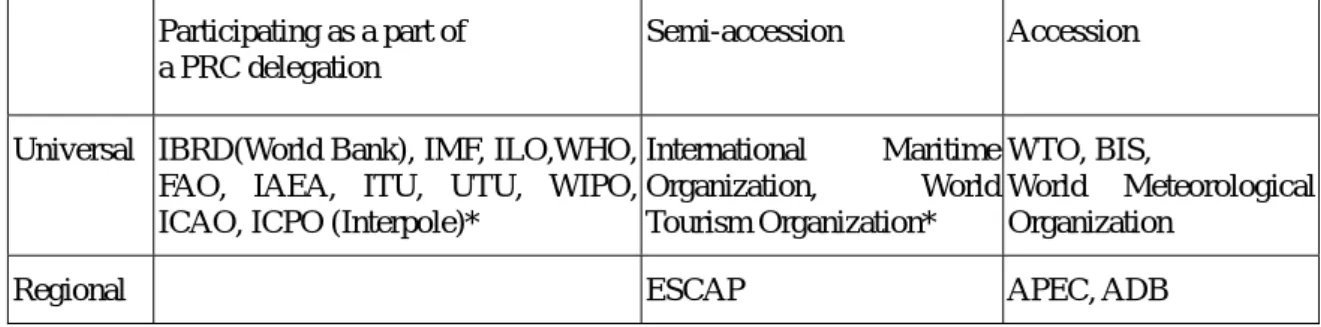
Why does the lack of autonomy of Hong Kong not have a negative effect on the international personality of Hong Kong? The first reason is that dependent territories are subject to more limitations than sovereign states (see Table 1). Only a few international organizations on the socio-economic files of the United Nations allow the accession of dependent territories such as Hong Kong. The WTO is one such organization. But Hong Kong is allowed to gain access indirectly to the IMF and the World Bank via the PRC central government, even though Hong Kong has its own currency, the Hong Kong Dollar. The second reason is that the United Kingdom, the former suzerain state of Hong Kong, and the United States, hope that Hong Kong will keep the status quo and remain separate from the Mainland. The United Kingdom has signed the Sino-British Joint Declaration, by which China and Britain promise to maintain the status quo of Hong Kong, and also sponsored Hong Kong for access to GATT in 1986 (15). The United Sates supported Hong Kong’s accession to APEC simultaneously with the access of the PRC and Taiwan. The United Kingdom and the United States are appreciative of the rule of the Hong Kong SAR government and of the importance of Hong Kong economy.
Table 1. The accession to inter-governmental organizations by Hong Kong SAR
Participating as a part of a PRC delegation
Semi-accession Accession
Universal IBRD(World Bank), IMF, ILO,WHO, FAO, IAEA, ITU, UTU, WIPO, ICAO, ICPO (Interpole)*
International Maritime Organization, World Tourism Organization* WTO, BIS, World Meteorological Organization
Regional ESCAP APEC, ADB *:Organization not within the UN System
Source: Website of the Hong Kong SAR government
(15)
For details, see Takayuki Takeuchi (竹内孝之). 2001. "The Political Meaning and Barriers preventing Cross-Taiwan Straits Economic Integration.(両岸経済統合の政治的意義と障壁)",
The integration between Hong Kong SAR and Mainland China may perhaps be analyzed as a case of integration between or among sovereign states. But there is another key element, namely the will of Hong Kong SAR. In international relations, integration means that each sovereign state releases part of its sovereignty (or transfers it to a supranational institution) as an expression of their intent to integrate the functioning or organization of states, or as a means of abolishing the obstacles and borders that hinder transnational activities. Hong Kong SAR is a local government of the PRC without any sovereignty, and the borders and institutions of Hong Kong SAR can be abolished or changed by the PRC central government. Moreover Hong Kong SAR has no democratic means, such as a referendum, by which the people’s opinion might be expressed. In these circumstances, it is difficult to determine the will of the Hong Kong SAR.
However, the PRC central government has no intention of integrating Hong Kong into Mainland China. So the demand on the Hong Kong side, and especially that of the Hong Kong ethnic Chinese capitalists who are the PRC’s political partners in Hong Kong SAR, is an important key factor promoting integration. It is easy for the political system in Hong Kong to reflect the intentions of the business community. And it is difficult for the PRC central government to ignore the opinion of ethnic Chinese capitalists, regardless of whether they wish to promote or retard the process of integration. In the current political system of the Hong Kong SAR. the demand from the business community promotes the integration with the Mainland, regardelles the will of the Hong Kong residents.
Feasibility of integration between Hong Kong and Mainland China
The Basic Law of the SAR, established in 1990, did not assume the existence of economic integration between Hong Kong and Mainland China. In the late1990s, arguments on the formation of an FTA became popular in East Asia. FTA is merely the first step towards economic integration. What kind of linkages exist between the issues that predominate among East Asian countries and those that link Hong Kong with the Mainland? Section 2 reviews economic cooperation under ‘One Country, Two Systems’
formula and considers the dynamics of this cooperation. Section 3 examines the legal feasibility of integration under the ‘One Country, Two Systems’ formula, and Section 4 examines the remaining issue, namely democracy.
Political integration can be classified into integration of political fields (diplomacy and defense) and the establishment and development of supranational institutions. Since the PRC central government is responsible for issues of diplomacy and defense that relate to Hong Kong SAR, these are matters that we need not consider further. So far as the establishment and development of supranational institutions is concerned, the socio-economic context in which supranational institutions may be established in Hong Kong will be discussed in Section 3.
2. Trigger of the policy change towards an FTA in
Hong Kong
This section examines the bilateral relationship between the Mainland and Hong Kong, and the external, East Asian environment, and discusses which of these was the key factor influencing Hong Kong’s decision to negotiate for membership of a Free Trade Agreement.
Economic cooperation between Hong Kong and the Mainland
The Basic Law of Hong Kong SAR prohibits the departments of the State Council (central government) and local governments in Mainland China from intervening in the Hong Kong SAR (Article 22). But, in Mainland China, some of local authority (government and Communist party) leaders also hold posts in central government. Moreover personnel exchanges frequently occur between local and central government. In this context, the State Council has established the Hong Kong and Macao Affairs Office (HMO) to monitor the relations between the departments of central government and local governments and the Hong Kong SAR. Senior officers of the HMO have participated in all of the schemes for economic cooperation between Hong Kong and the Mainland. But they are sometimes criticized for hindering rather than promoting economic cooperation.
Before the handover, the few areas of cooperation between Hong Kong and the Mainland included the following:-
Hong Kong/Guangdong Cross Border Liaison System (1982 onwards)
Hong Kong-Guangdong Environmental Protection Liaison Group (1990~99)
Joint Working Group on Sustainable Development and Environmental Protection (1999 onwards) British and Mainland Cross-Boundary Major Infrastructure Coordinating Committee (1994~97) Hong Kong and Mainland Cross-Boundary Major Infrastructure Coordinating Committee (1997
onwards)
In these examples of cooperation, except for the British and Mainland Cross-Boundary Major Infrastructure Coordinating Committee, the partner representing the Mainland has been Guangdong Province. From the point of view of Mainland China, cooperation between the two territories is merely an issue on the periphery.
After handover, the situation underwent little change, the two main areas of cooperation being:-
HK/Guangdong Co-operation Joint Conference (1998 onwards)
Mainland and Hong Kong SAR Joint Commission on Commerce and Trade (1999 onwards)
The Hong Kong/Guangdong Co-operation Joint Conference follows an aggressive policy with regard to the administration of customs and immigration. It has expand the operation time of customs and immigration procedures (its final goal is 24 hours operation) and has established the ‘co-location of immigration and customs facilities’ (一地兩檢) (16). Moreover the State Council’s HMO, a body that is under the jurisdiction of the Chinese central government, has joined the Conference, and has assisted it in the implementation of its policies. So far, the Conference has discussed only local issues relating to Shenzhen City and Guangdong Province.
The Mainland and Hong Kong SAR Joint Commission on Commerce and Trade is the first project for comprehensive economic cooperation between two territories. It was started by the Ministry of Trade and Economic Cooperation (currently the Ministry of Commerce) of the State Council of China and the Commerce and Industry Bureau (currently the Commerce, Industry and Technology Bureau) of the Hong Kong SAR. The Joint Commission holds an annual conference, and has four working groups, respectively on ‘Trade’, ‘Investment’, ‘Contract Works and Labour Management’ (17),
(16) ‘
co-location of immigration and customs facilities’(一地兩檢) doesn’t mean the exchange or linkage of data base of Hong Kong SAR and Mainland immigration.
(17)
This working group changed the name to Working Group on Economic Corporation, at the third meeting of joint committee.
and ‘Technology Trade and Treaty/Law’. The meetings of each of the working groups are more frequent than those of the Joint Commission. But the Joint Commission has no standing organization, and the governments of the two territories only exchange opinions and information, and sometimes harmonize their policies. The Joint Commission has not proposed a new common policy, nor has it discussed economic integration.
In fact, the Hong Kong SAR government has not been willing to engage in economic cooperation with Shenzhen City and Guangdong Province. After the 1980s, economic relations between Hong Kong and Guangdong Province were mutually complementary. But, recently, Hong Kong and other cities in Guangdong Province have become competitors (18). It should be noted, moreover, that the development of transportation and of the logistic infrastructure in Guangdong Province may reduce the competitiveness of Hong Kong as a regional hub. What is more, Shenzhen City is aggressively upgrading its industry, and is scrambling in competition with Hong Kong to attract hi-tech human resources and foreign direct investment. Furthermore, the retailing businesses in these two cities compete strongly to attract Hong Kong consumers. Shenzhen City government insistes to implement cross-border passage for 24 hours, but the government of Hong Kong SAR, egged on by retailers in Hong Kong, has considered introducing a ‘land departure tax’ (19).
East Asian Regionalism
The main trigger for economic integration should be sought outside of Hong Kong and the PRC.
“Third Meeting of the Mainland and HKSAR Joint Commission on Commerce and Trade”
Press Release of Hong Kong SAR Government. December 5, 2001.
(18)
Joseph Yu-Shek Cheng (鄭宇碩) and King-Lun Ngok(岳經綸). The Interactions Between
Hong Kong, Mainland China and Taiwan and Their Impacts-May 1998-May 1999(香港與両岸 互動及其相互影響:香港回歸兩年來的觀察與評估). Taipei:Cross-Strait Interflow
The Hong Kong SAR government has shown a negative attitude towards any regional trade agreement, including proposals for an FTA. New Zealand government proposed negotiations for the formation of an FTA with Hong Kong, but could make no progress with the Hong Kong SAR government. Moreover on a visit to Japan in March 2000, Chief Executive Tung, when asked about the possibility of an FTA with Japan, said that he gives priority to multilateral trade negotiations within the WTO. (20). Further, Joseph Yam, the Chief Executive of Hong Kong Monetary Authority, speaking in November 2000, said that “regionalism isn’t the solution for the problems created by globalization. At the same time, regional cooperation sets a regional standard, which is not appropriate for a global standard. So regionalism is very dangerous” (21).
Except for the ASEAN Free Trade Area (AFTA), East Asian countries did not give thought to any type of economic integration until the early 1990s (22). So far as the region’s major economies were concerned, only Japan, South Korea, the PRC, Taiwan, and Hong Kong, had not signed an FTA. Since the major export market of these countries is the United States, they have no need to consider East Asian regionalism. But the development of the EU and the change in U.S. trade policy towards promoting FTAs such as the North American Free Trade Area (NAFTA) and the Free Trade Area of the Americas (FTAA), and towards transforming APEC into an FTA, provided the stimulus for the formation of an AFTA, the East Asian Economic Caucus, and later also led to the grouping ASEAN+3 (23). Meanwhile Japan, South Korea and Singapore energetically sought to sign a bilateral FTA in the late 1990s. The PRC also proposed an FTA, to counter ASEAN, in November 2000. At that time, the ASEAN side suggested the formation of ASEAN+3, but in the following year agreed to begin with ASEAN+1, an FTA project that links ASEAN with the PRC.
Hong Kong, however, is excluded from the ASEAN+3 FTA. And Hong
(19)
Ibid., pp.44.
(20)
Mainichi Daily News, 17 March, 2000 (in Japanese)
(21)
“Communist China needs FTA with ASEAN(中共將東協合組自由貿易區).” Commercial
Times (工商時報)(Taipei). November 3, 2001. (Chinese)
(22)
APEC is not scheme for economic integration.
(23)
Kong-Mainland China relations run the risk of being sidelined compared with relationships between the PRC and other members of ASEAN+3. Some commentators in Hong Kong insist that the SAR’s free trade policy means that there is little merit in Hong Kong signing and negotiating FTA with other countries (24). In any case, the Hong Kong SAR government hesitated to negotiate an FTA with Japan in March 2000, New Zealand in August 2000, and Mainland China after the Asian economic crisis of 1997. In all of these cases, the major obstacle was the Hong KongSAR government’s bias against joining an FTA.
It cannot be denied that the major developed countries have reduced their tariff rates. However the merit of an FTA lies not just in the reduction of tariff rates, but in more dynamic aspects, such as the promotion of cross-border activities by companies, and the improvement of productivity. The formation of an FTA should be accompanied by progress on matters such as taxation, investment, customs procedures, government procurement, and the cross certification of standards, all of which improve the dynamism of an FTA (25). It follows that the isolation of Hong Kong from regional projects, including FTAs, may impair the status of Hong Kong as a center for international trade and investment(26). In that sense, an FTA is already inevitable so far as Hong Kong is concerned.
China’s accession to the WTO
Accession to the WTO caused China to change its investment policy with regard to foreign companies. The PRC defines Hong Kong, Macao, and Taiwan as “special domestic” areas under local legislation. But WTO rules require the abolition of all preferential policy to foreign companies including these three territories, all of which
(24)
Bank of China (Hong Kong) op. cit. and Yun-wing, Sung op. cit., pp.155-156
(25)
Ippei Yamazawa(山澤逸平). 2001. “Asia-Pacific Regionalism and Japanese Strategy (アジ ア太平洋地域主義と日本の戦略).” International Affairs(国際問題). No.494. May 2001,
pp7-9
(26)
are also members of the WTO. After accession to the WTO, Zhang Mingqing, at that time the spokesman for the Taiwan affairs office of the State Council of China said “the treatments of Taiwanese companies will depend on WTO rules” (27). However Zhu Rongqi, who at that time was Prime Minister of China, said “the preferential treatment of Hong Kong companies is a domestic issue and will be continued in the future” (28). It seems that the PRC did not take the WTO rule seriously, for the central government of China announced new preferential treatment of foreign companies, to promote its Western Development plan (29). But a PRC officer emphasized the WTO rules with respect to Taiwanese companies, so Hong Kong companies showed that they considered an FTA as an alternative to preferential treatment.
Under the WTO system, Mainland China and Hong Kong SAR are respectively a “mainland customs territory” and a “separated customs territory” of the PRC, with equal membership of the WTO (Article 24(a) and (h) of GATT 1947). The Basic Law of the SAR also authorizes the SAR government to participate in a Regional Trade Agreement (RTA). In fact the formation of an FTA between Mainland China and the Hong Kong SAR would not encounter any obstacle in the WTO system, although it would certainly constitute a very rare case for customs territories within the same sovereign state to sign an FTA.
Nevertheless the formation of an FTA remains a sensitive issue for the PRC. The central government of China considers an FTA to be the equivalent of an “international” treaty, which should be reported to the RTA Committee of the WTO. Moreover the Taiwan government and the ruling Taiwanese party, the Democratic Progress Party, are pursuing a ‘Strengthen the Base and Go West’(強本西進) policy,
(27)
“Taiwan Affairs Office, State Council: Triple linkage across the Taiwan Strait does not need the help of a WTO scheme (國台辦:兩岸三通緝無需借助 WTO 架構解決)” Commercial
Times (工商時報)(Taipei). November 1, 2001. (Chinese)
(28)
“Zhu Rongji: Preferential treatment for Hong Kong companies will be continued (朱鎔基: 繼續優惠港商).” Mingpao Daily News (明報) (Hong Kong). November 11, 2001.
(29)
State Council, People’s Republic of China. 2000. Circular of the State Council on Policies
and Measures Pertaining to the Development of the Western Region (国务院关于实施西部大 开发若干政策措施的通知国務院関於実施西部大開発若干政策措施的通知)’ October 26.
and aim to equalize the cross-straits relationship by signing an FTA. Thus the central government of China refers to an FTA with Hong Kong SAR as ‘an arrangement similar to an FTA’ (30) and in the later negotiations with the government of the Hong Kong SAR for the Closer Economic Partnership Arrangement (CEPA), it emphasized the compliance of an FTA with the ‘One Country, Two Systems’ formula.
Summary
The trigger that pushed the government of the Hong Kong SAR government into negotiating an FTA with mainland China was the PRC’s accession to the WTO and the favorable nature of the international environment, a factor that influenced other East Asian countries, too. The government of the Hong Kong SAR ignored allegations from Guangdong Province and Shenzhen city that it was delaying progress towards cooperation before negotiating the CEPA with the Mainland. This suggests that the key trigger for economic integration is not to be found within the current nexus of economic relationships between Mainland China and Hong Kong.
Inter-territorial relations within the Chinese Area(31) as a whole have depended on the separation of economic and political issues. But an FTA is a kind of trade treaty, and so far as China is concerned combines economic and trade issues with other politically sensitive problems. In any case, the Hong Kong SAR and the central government of China have begun to use the FTA as an alternative for preferential treatment.
(30)
“FTA: Central authority is studying the set-up” (自貿區:中央拍版研設).”Wenweipo(文匯
報) (香港). December 20, 2001
(31)
3. Integration under “One Country, Two Systems”
How far can integration be further developed under the current “One Country, Two Systems” formula? And are there differences between the integration of territories within a sovereign state and integration between sovereign states?
Major obstacles that hinder economic integration include concerns over intensifying competition and changes in the economic environment. Béla Balassa has classified types of economic integration by fields and has arranged them in order of increasing difficulty. The categories are: [1]trade policy and customs, [2]movement of productive elements, such as labor and capital, and [3]economic policy, including finance, monetary policy and currencies. Category [1] includes FTA formation and the establishment of customs unions( 32 ). The implementation of Category [2] after completing Category [1], in other words a customs union, means the realization of a common market. Balassa’s Category [3] implies the creation of a economic union after the achievement of common market ([1] and [2]). Economic policies often need the formulation of new laws and/or amendments of existing laws. In fact the integration of economic policy, including decision-making and the implementation of policy, needs harmonization of the legal systems and integration of the legislative process. The last step of economic integration, ‘complete economic union’, requires a complex harmonization of policy that is impossible without supra-national organization. Balassa also suggests the possibility of a transfer from supra-national organization to federal government following complete economic union (33).
The author considers the current Basic Law of the Hong Kong SAR as a given condition, and considers as the only dynamic element some degree of change in ‘economic reasonableness’. First, the central government perceives the need to pursue
(32)
A preferential trade agreement might be sorted out at the previous level of the FTA, but a PTA is prohibited by GATT/WTO in general, except for cases of PTAs between or among developing countries.
(33)
a policy of ‘economic reasonableness’ and has the political will to maintain the ‘Two Systems’, or the original system of Hong Kong that differs from that of Mainland China (as mentioned above, under ‘Sovereignty and two economic systems’, Chapter 1). Second, the SAR Basic Law also embraces issues of human rights and democracy in Hong Kong, so any amendment of the SAR Basic Law could cause trouble in the Hong Kong SAR Legislative Council. The central government is aware that such a situation could damage the overseas reputation of the ‘One Country, Two Systems’ approach, and could impair Hong Kong’s economic advantage.
The following analysis examines the possibility of integration and the consistency of integration with the SAR Basic Law, and considers each of the main economic strands, topic by topic.
Integration of trade policy and customs
Hong Kong, at the time a free port under British colonial rule, became a member of GATT as a separate customs territory (34) in 1986, and has been a founding member of the WTO since 1995. Hong Kong, even after handover in 1997, does not collect customs (Article 114), maintains the status of a separate customs territory and participates in international organizations and trade agreements, including preferential trade arrangements (PTA) (35) (Article 116).
An FTA is a kind of PTA to which the exact conditions of GATT/WTO rules apply. Hong Kong is entitled to sign an FTA by itself. But the Basic Law prohibits the collection of customs dues except for those on tobacco and liquor, and Hong Kong
(34)
A territory with enough autonomy on unique customs and related economic policies can gain access to GATT/WTO. At first, it was assumed that colonies could gain access to GATT as separated territories, but in fact they gained access to GATT immediately after independence, as sovereign countries. So there are only three examples of customs territories with access to WTO in the Chinese Area, namely Taiwan, Hong Kong SAR and Macao SAR. For more, see Takayuki Takeuchi op. cit.
(35)
cannot join a customs union, because Hong Kong has to maintain its own customs system.
Before the CEPA became a subject of discussion, there was some debate over whether or not it would be feasible to create an FTA consisting of Hong Kong and Mainland China. Sung Yun Wing believed that Mainland China would not be able to benefit from the formation of a Hong Kong Mainland FTA (36). In fact there is no serious obstacle hindering free trade in products between Hong Kong and Mainland China. Most of Hong Kong’s manufacturing has already moved to the Pearl River Delta area of Guangdong Province, an industrial migration that has contributed to the economic development of Mainland China. On the other hand, Hong Kong has failed to advance its own industry, has experienced a hollowing out of domestic manufacturing, and has come to depend on factories in Mainland China. Hu Angang has insisted that a Northeast Asia FTA, including Mainland China and Hong Kong, would have no negative impact on the Chinese economy. A fundamental problem is the consistency and transparency in customs administration in China. But the average of the effective rates of customs in Mainland China is only 2-3%, which is quite different from the nominal rate of customs (17.9%) in 1998 (37).
In an FTA based on trade in services, established by the General Agreement on Trade in Services (GATS) in 1995, Hong Kong could offer concessions for Mainland China and other countries and customs territories, and could realize mutual benefits. The CEPA contains an FTA based on GATS rules, and also includes reference to the promotion of trade and investment and the movement of people. Hong Kong has already signed many bilateral investment agreements with third countries (38), and the
(36)
Yun-wing Sung. op. cit.
(37)
Hu, Angang(胡鞍钢). 2001. “Establishing a Four-Party Free Trade Zone among China, China's HK SAR, Japan and South Korea (建立中国、中国香港特区、日本、韩国 三国四方 自由贸易区设想).” International Economic Review (国际经济评论). 3-4, 2001: 17-20.
(38)
Hong Kong has signed BIT with Japan, South Korea, Australia, New Zealand, and major members of EU. See Department of Justice. 2006. List of Investment Promotion and Protection
Agreements. Hong Kong: Department of Justice, Hong Kong SAR government.
movement of people within an FTA doesn’t imply complete freedom of movement, but can mean merely economic deregulation of the movement of labor and talent. In this sense, therefore, the CEPA stipulations do not conflict with the Basic Law of the SAR.
Moreover in the CEPA negotiations, the will of the Hong Kong people has been recognized as a major factor. In the autumn of 1997, just after the economic crisis in East and Southeast Asia, the Ministry of Foreign Trade and Economic Cooperation of the People’s Republic of China (MOFTEC) commissioned a study on ways in which an FTA could assist the Hong Kong economy, but the Hong Kong SAR government at that time was unwilling to enter into an FTA, and the idea was dropped (39). In early 2000, the Hong Kong General Chamber of Commerce (HKGCC) published a summary of a report on the impact of the PRC’s accession to the WTO and the resulting effect on business fields in Hong Kong. This report proposed an FTA with the Mainland as an alternative to the provision of preferential treatment of foreign capital. (40) HKGCC submitted the report to the Chief Executive, Tung Chee Hwa, and on several occasions also lobbied the senior officials of the PRC central government in an attempt to obtain their support for the proposal(41). As the result of the lobbying, Chief Executive Tung officially proposed the formation of an FTA and the PRC central government promised to support the plan for supporting the Hong Kong economy, regardless of the resulting benefits or losses to the economy of Mainland China(42).
(39)
“FTA will be signed next year at the earliest (自貿區最快明年設立).” Wenweipo(文匯報)
(Hong Kong). December 19, 2001
(40)
Hong Kong General Chamber of Commerce(香港總商會). 2000. China's Entry into the
WTO and the Impact on Hong Kong Business: A Business Perspective (從商界角度看 中國加 入世貿對港商的影響), pp.12. (Chinese Edition)
And “Annex III the feasibility of Mainland and Hong Kong Regional Trade Agreement (附件三 中國內地與香港特區訂立地區性貿易協定的可能性)” Ibid.
(41)
“Hong Kong and the Mainland need an FTA(香港内地宜自由貿易區)” Wenweipo(文匯報)
(Hong Kong) . November 23, 2001.
(42)
“Jian Zhemin: Central authority will help Hong Kong to break out from recession(江澤民:中 央將助港脱困).” Wenweipo(文匯報) (Hong Kong). December 20, 2001.
Deregulation of the mobility of productive factors
Productive factors mean labor and capital. The latter of these raises currency issues which will be examined in the next paragraph.
The mobility of labor is not only an economic issue, but also gives rise to social issues. Large differences in economic development or in income can cause mass migration, which might mean a search for the best allocation of labor, but also serious social problems. In the case of Europe, completely free mobility of people (abolition of immigration controls and customs houses) was realized by the Schengen Convention, as an issue separate from economic integration. A major challenge in the integration of the European market is harmonization and mutual recognition of products, educational qualifications and professional specifications. Similar issues could well develop between Hong Kong and Mainland China, too.
Hong Kong residents may easily visit China with a ‘Mainland Travel Permit for Hong Kong and Macao Residents’(港澳居民來往內地通行證). In late 2004, the Hong Kong SAR government introduced the ‘e-Channel’(e-道), which is an ‘Automated Passenger (Vehicle) Clearance System’(旅 客(車輛司機)自助出入境檢查系統) for holders of new Hong Kong ID cards that incorporate IC chips. Further easing of cross-border travel, including for example, free passage for 24 hours, is also being considered.
So far as immigration is concerned, Hong Kong SAR limits the number of immigrants from the Mainland to 150 people a day. But, in 2004, the total number of immigrants from the Mainland amounted to only 38,100, only 69% of the total allocation for the year (43). The Hong Kong SAR government has started some projects for (44)accepting engineers of hi-tech industries and scientists from the Mainland.
匯報) (Hong Kong). December 20, 2001.
(43)
Information Services Department of Hong Kong SAR Government. 2005. Hong Kong Year
Book 2004. Hong Kong: Information Services Department of Hong Kong SAR Government.
http://www.yearbook.gov.hk/2004/en/20_03.htm (accessed June 27, 2006)
(44)
CEPA and further similar future projects will promote the mutual recognition of products and professional specifications. But the unlimited mobility of labor across the border is not really feasible.
Financial and Monetary Integration
Both financial and monetary integration have strong linkages with sovereignty. Full financial integration is not yet realized even in the EU. In any case, the Basic Law of the Hong Kong SAR virtually prohibits financial integration between Hong Kong SAR and the People’s Republic of China (Article 106).
There are two types of monetary integration. One is the Euro type, in which a single currency is introduced, and a central bank (in the case of the EU the European Central Bank) established as a supra-national institution with authority over the central banks of the member states. Another type is the mutually agreed and cross-border circulation of currencies. The Basic Law prevents only the first of these types of monetary integration (Articles 111 and 113).
Some economists and business leaders have been puzzled by the continued existence of the Hong Kong Dollar, and believe that it ought to be integrated with the Renminbi (the currency of the PRC, hereinafter RMB).
Milton Friedman predicted that the PRC central government would abolish the Hong Kong Dollar within two years of the handover, believing that the PRC would feel uncomfortable over the existence of two currencies within a single sovereign
was introduced in 1999. Subsequently, an Admission of Talents Scheme (輸入內地專業人才計 劃) was begun, in 2001. These two schemes were combined and renamed as the Admission Scheme for Mainland Talents and Professionals (輸入內地人才計劃) in 2003.
The Admission of Mainland Students Graduated from the University Grants Committee
(UGC)-Funded Institutions in Hong Kong (輸入在本港大學教育委員會資助的院校畢業的內 地學生) has been effective since 2001.
state, and, because the RMB was cheaper than the Hong Kong Dollar (45). Friedman assumed that the PRC would strive to convert the RMB into as hard a currency as possible, and would then replace the Hong Kong dollar with the RMB.
Steven N.S. Chueng, whose position is close to Friedman’s, predicted that the RMB would become a major currency within a year after becoming a hard currency, and in a speech made in Macao in November 2001, insisted that “Hong Kong and Macao should abolish the Hong Kong Dollar and the Macao Pataca, and use the RMB ”when he made a (46).
In June 2006, David Li Kwok Po, the Chairman and President of the East Asia Bank and a non-official member of the Executive Council of the Hong Kong SAR government, said “the Hong Kong Dollar is available until 2047, but most people in Hong Kong will be using the RMB by around 2020” (47). The EAB is the largest bank established by ethnic Chinese capital in Hong Kong,
In fact, there is good evidence to show that the PRC central government is not obsessed with the RMB as a symbol of sovereignty. In 1981, the Shenzhen City government considered introducing a local currency that would be available only in Shenzhen Special Economic Zone (SEZ), their aim being to prevent the circulation of the Hong Kong Dollar within Shenzhen SEZ. Moreover in 1984, Deng Xiaoping and the State Council of China for a while authorized the Shenzhen SEZ currency plan and even decided the designs of the bills and coins that would be used (48). But, at the final
(45)
Nigel Holloway 'Paradise Lost: Friedman predicts China will scrap Hong Kong Dollar' "Far Eastern Economic Review" February 23, 1995, p.55.
(46) “
Steven Chueng says “Leave Hong Kong Dollar, Use RMB” (張五常:棄港元用人民幣)”.
Hong Kong Economic Daily (香港経済日報), 15 November, 2001 (in Chinese)
(47)
“Hong Kong can be off-shore RMB center. David Li says “RMB will be used by all of Hong Kong people with 20 years” (港可離岸人民幣中心 李國寶:20 年内港人全部使用人民幣)”,
Hong Kong Commercial Daily(香港商報), June 3, 2002 (in Chinese)
(48)
“A valuable document on “SEZ currency” was rescued while city history was edited(編修市 誌搶救一批珍貴重資料 “特区貨幣”史実際公諸于世)” Daily Sunshine(晶報) (Sheng Zhen),
moment they abandoned the plan. They hesitated only because to go ahead would have made the Chinese monetary system too complex, for the SEZ currency would have been the third currency to be introduced, following the RMB and the Foreign Exchange Certificate (外汇兑换券).
The government of the Hong Kong SAR is relatively conservative as regards the continued existence of the Hong Kong Dollar. The Hong Kong Monetary Authority (hereinafter called as HKMA) once explained that the existence of the Hong Kong Dollar would not be threatened, even if the RMB were to become a hard currency in the future. However the HKMA seems to be positively against the simultaneous circulation of the RMB and Hong Kong Dollar, and is developing a new settlement system with the People’s Bank of China.
On the whole, majority opinion in Hong Kong expects that the raison d'etre of the Hong Kong Dollar will be called into question after the RMB becomes a hard currency. Some observers consider the Hong Kong Dollar to be indispensable, for the RMB has been not yet been a hard currency. Except for the HKMA, the opinions quoted above agree that there is a linkage between the existence of the Hong Kong Dollar and the convertibility of the RMB. The critical question is when will the RMB become a hard currency. The time could well be earlier than 2047, 50 years after the handover in 1997.
Since the Basic Law of the Hong Kong SAR prohibits the abolition of the Hong Kong Dollar, it will be impossible to introduce a single currency for the whole of the PRC. But Article 111 of the Basic Law orders deposits for the reserve fund to issue Hong Kong Dollars, but does not refer to the denomination(49). The Hong Kong Dollar can be pegged with the RMB in the future, although the RMB would be expected to function as an alternative to the Hong Kong Dollar, which means the RMB being pegged with the US Dollar, for the stability of Hong Kong as an international financial center (50).
(49)
In the case of Macao, the Hong Kong Dollar is the reserve currency for the Macao Pataca (Article 108, Basic Law of Macao SAR).
(50)
Kazumasa Iwata(岩田一政). 1998. “Economics of Keynes: The External Aspect (ケインズ の経済学:対外的インプリケーション)”. Financial Review Vol.45:105-122. Tokyo: Policy
But using the peg on its own does not mean the realization of monetary integration. The key element for monetary integration is mutual currency circulation and the legal support for it. In parts of Mainland China such as Shenzhen and Macao, there is currency substitution by the Hong Kong Dollar.
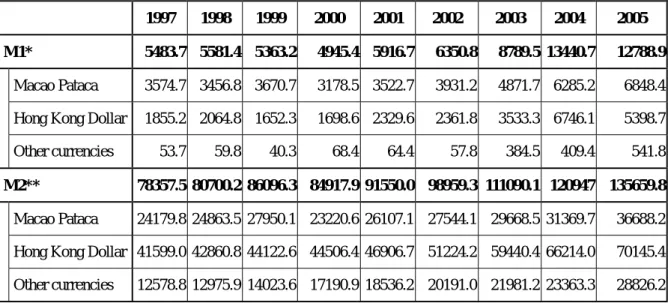
Table 5. Money Supply in the Macao SAR (Unit:million Macao Pataca)
1997 1998 1999 2000 2001 2002 2003 2004 2005
M1* 5483.7 5581.4 5363.2 4945.4 5916.7 6350.8 8789.5 13440.7 12788.9
Macao Pataca 3574.7 3456.8 3670.7 3178.5 3522.7 3931.2 4871.7 6285.2 6848.4
Hong Kong Dollar 1855.2 2064.8 1652.3 1698.6 2329.6 2361.8 3533.3 6746.1 5398.7
Other currencies 53.7 59.8 40.3 68.4 64.4 57.8 384.5 409.4 541.8
M2** 78357.5 80700.2 86096.3 84917.9 91550.0 98959.3 111090.1 120947 135659.8
Macao Pataca 24179.8 24863.5 27950.1 23220.6 26107.1 27544.1 29668.5 31369.7 36688.2 Hong Kong Dollar 41599.0 42860.8 44122.6 44506.4 46906.7 51224.2 59440.4 66214.0 70145.4 Other currencies 12578.8 12975.9 14023.6 17190.9 18536.2 20191.0 21981.2 23363.3 28826.2 *M1: Cash+ordinary & checking deposit **M2: M1+fixed-term deposit
Source:Bureau of statistics and censuses, Macao SAR
http://www.dsec.gov.mo//chinese/indicator/c_mon_indicator_1.html (accessed 27 June 2006)
The circulation of the Hong Kong Dollar in Macao accounts for between 30 and 40% of money supply (M1), or over a half of M2 (see Table5). The government of the Macao SAR at one time tried to exclude the Hong Kong Dollar from the settlement of business dealings in Macao, but the attempt was in vain(51). The Hong Kong Dollar has reduced
Research Institute, Ministry of Finance, Japan. (in Japanese)
http://www.mof.go.jp/f-review/r45/r_45_105_122.pdf (accessed July 13, 2006)
Iwata considers RMB pegging with US Dollar difficult, because of the high inflation rate in Mainland China.
(51)
Ricardo Chi Sen Siu (粛志成). 1999. A Theory of Multiple Currency: Including a Discussion
on the Theory and Strategy of the Currencies under “One Country, Two Systems(多元貨幣論:
the raison d'etre of the Pataca as the legal currency of Macao. Meanwhile, the supply (M1) of other currencies has increased significantly since 2003. A possible reason for this is that the introduction of the Individual Visit Scheme (港澳自由行) under the CEPA led to an increase in the number of tourists visiting Macao from Mainland China, and the consumption in Macao by such tourists, using the RMB.
Approximately 30% of all Hong Kong Dollars circulate in the Mainland, while a considerable amount of RMB circulates in Hong Kong, although there are no official data for this, and there is no estimate of the quantity(52). In the Hong Kong SAR, the Individual Visit Scheme has also promoted consumption by tourists visiting from Mainland China using RMB. The mutual circulation of the RMB and the Hong Kong Dollar is not supported legally. Even before 2005, when the RMB was pegged with a basket of currencies and revalued, the difference of rates between the Hong Kong Dollar and the RMB was only 6% (see Table 6).
Table 6. Rates among the Renminbi, the Hong Kong Dollar, and the Macao Pataca (before 2005)
RMB HK$ Macao Pataca
1US$ 8.3Yuan (managed floating system) 7.8HK$ (pegged) (8MOP)
100HK$ (106.4Yuan) 103.2MOP (pegged)
It would in fact be easy to support the mutual circulation of the Hong Kong Dollar and the RMB with legislation, which would simply confirm the current situation and which would not necessarily conflict with the Basic Law of the Hong Kong SAR. In the past, there have been some examples of monetary union (53) which relied on the
Chinese)
(52)
According to the People’s Daily, between 50 and 70 billion RMB was circulating in Hong Kong in August 2003, cited from a report of UBS Warburg.
“Hong Kong: Where's the 'Outlet' for RMB 70 Billion?” People’s Daily English Edition. August 14, 2003.
http://english.people.com.cn/200308/14/eng20030814_122302.shtml (accessed June 26, 2006).
legal support of the mutual circulation of currencies and the settlement system between the central banks – arrangements which failed to continue over the long term, because each state possessed sovereignty over its own currency and its own financial policies. However, Hong Kong SAR and Mainland China exhibit close economic ties and a high level of cooperation between monetary authorities. Thus there are no obstacles standing in the way of monetary union between the Hong Kong SAR and the Mainland except for the convertibility of the RMB.
Possibility of Integration under ‘One Country, Two Systems’
The Basic Law of the Hong Kong SAR does not prevent the formation of an FTA and some kind of monetary union. But a customs union would violate the original customs system of the Hong Kong SAR. Moreover a common trade policy and a single currency with a supra-territorial central bank is also impossible, for the Basic Law of the Hong Kong SAR prevents the establishment of a common organization between the Hong Kong SAR and Mainland China. The most difficult issue for Hong Kong is the free movement of labor, which would be the key to the creation of a common market. We can therefore conclude that there is a difference between the degree of difficulty of integration under the One Country, Two Systems’ formula and the assumption central to Balassa’s theory.
4.
Current Status of Integration: Problems concerning the
CEPA
Integration under the ‘One Country, Two Systems’ formula is only just beginning, and so far, the CEPA is the only form of institutional integration between the Hong Kong SAR and Mainland China. This section provides an overview of the political process underlying the initiation and negotiation of the CEPA, and clarifies the position concerning the stake holders of the CEPA and attendant problems.
CEPA: the motives underlying its formation, and the processes
involved
The CEPA was proposed as a response to the PRC’s accession to the WTO by the HKGCC, as mentioned above. Before the official announcement of negotiations on the formation of an FTA (later referred to as the CEPA), the PRC central government and the government of the Hong Kong SAR seemed to have reached some degree of consensus by way of informal negotiations. But, before the negotiations, there was no feasibility study concerning an FTA (or CEPA), except for HKGCC’s summary of the opinions of the industrial sectors. Moreover the negotiations for an FTA or CEPA were such a sensitive issue for the central government that An Min, the Vice Minister of Foreign Trade and Economic Cooperation, denied that FTA negotiations were underway with the Hong Kong SAR after another Vice Minister of MOFTEC, Long Yongtu, had indicated the existence of the discussions.
On 26 December 2001, the Macao SAR government also announced its intention to take part in the CEPA negotiations. However, the two CEPA negotiations between the Mainland and Hong Kong and between the Mainland and Macao were held separately, with the former preceding the latter. The first negotiations were held on 25 January 2002, in Beijing, and it was agreed that the CEPA should be the title of “some form of FTA” (54)
so as to avoid the political sensitivity of the discussions for the PRC’s
(54)
relationship with Taiwan. The participants also agreed that the CEPA should include an FTA covering goods and services, as well as arrangements concerning investment - in other words a series of arrangements essentially similar to the FTAs that have been established by developed countries.
The HKGCC and the Hong Kong business community hoped that the CEPA negotiations would be completed within a year. They saw the purpose of the CEPA as providing preferential treatment for Hong Kong companies in the service sector, with the formation of an FTA on the GATS rules (55)
. The PRC made concessions by agreeing to begin opening the China market to foreign capital after 2003-07. This means that after 2007, the preferential treatment provided by CEPA will have lost its meaning.
But, there nevertheless remained some obstacles to the creation of the CEPA. First, the PRC had just joined the WTO, and had begun to open up the Mainland market. It was therefore impracticable to open the market only for Hong Kong companies. Second, the PRC was uneasy over the definition of a “Hong Kong company” (a service supplier and investor from Hong Kong). If the definition were too strict, the CEPA might attract only a few foreign companies to invest in Hong Kong, and might give little encouragement to multi-national companies who might otherwise see Hong Kong as an appropriate location for their regional headquarters. On the other hand, if the definition were too loose, the CEPA might pose a serious economic threat to indigenous companies on the Mainland.
An FTA based on the GATT rules (on trade of goods) is relatively easy to operate in the case of Hong Kong and Mainland China. Only a few factories and farmers are located in Hong Kong. But in the case of CEPA, the PRC central government’s interpretation of the rule of origin is a strict one. Meanwhile the Hong Kong side has insisted on a low rate of local content requirement. The HKGCC suggested two alternatives for local content: less than 30%, and 20% from Hong Kong with 20% from
Hong Kong SAR Government Press Release, January 25, 2002
http://www.info.gov.hk/gia/general/200201/25/0125310.htm (accessed June 26, 2006).
(55)
Christopher Cheng. 2002. Regional Trade Agreement with Mainland, not Preferential
Treatment. Hong Kong: Hong Kong General Chamber of Commerce.
the Mainland (added value standard). The former suggestion was incorporated into the CEPA, and the latter one was rejected.
The CEPA negotiations were not as straightforward as had been predicted, and were not completed until the end of June 2003. Details such as the rule of origin and the definition of suppliers in Hong Kong, were not settled until the end of September 2003. The final implementation of CEPA exceeded the target set by the Hong Kong business community by a year, and came into operation on 1st January 2004.
The Background of CEPA : political elements in Hong Kong
A power-shift in Hong Kong politics, from bureaucrats to business leaders, signaled a sudden change of policy towards the creation of an FTA by the Hong Kong SAR government. Before the handover, the highest authority in Hong Kong was the Governor, and before being appointed, most Governors had served ascolonial administrators or diplomats. Most of the Secretaries were also former bureaucrats, except for a few individuals who were appointed from the business community. But since the handover, the Chief Executive has been elected by an election committee, not a few members of which are from the business community. The first Chief Executive, Tung Chee Hwa, began making political appointments, of the three major secretaries, after his accession, and in 2002 introduced the Principal Officials Accountability System (主要官員問責 制) to politically appoint other secretaries. Tung himself had been the chairman of Orient Overseas, the largest shipping company in Hong Kong, and he appointed secretaries who were also originally from the business community(56)
.
(56)
The former Financial Secretary, Antony Leung Kam-chung (梁錦松) (he resigned in 2002 over the Lexusgate scandal) is former Asia-Pacific chairman, Chase Manhattan. His successor as Financial Secretary and the former Secretary for Commerce, Industry and Technology, Henry Tang Ying Yen (唐英年), is the former chairman of Peninsula Knitters(半島針織廠) and a former member of the Liberal Party, which represents the interests of the business community. The Secretary of Financial Services and Treasury, Frederick Ma Si-hang (馬時亨) is also from the world of business, and is a former financial officer of Pacific Century Cyber Works (電訊盈