
PERSONAL CHARACTERISTICS OF YOUNG CONSUMER IN THE SAFETY IMAGE EXPRESSION Important Factors of Taiwan's Religious Cultural Creative Products to Improve Sustainability of Societies
10
0
0
全文
(2) of promoting religious tourism, the most important reasons are to achieve belief expansion and increase income. However, many religious cultural creative products are often based on practical considerations such as cost and convenience, original temples characteristics and meanings of religious are often lost. They are deliberately created or even reduced to cultural relics of inadequate form and depth for commercial considerations [7], while popular religious cultural creative products in temple shops are often imitated by other temples due to their low identification. Facing the dilemma encountered in the marketing of religious cultural. create their own belief brands, so that improve sustainability of societies. The visual symbols used for image delivery in Taiwanese religious articles are mainly symbols of wealth and safety [9]. "Safety" is an important image of Taiwanese traditional beliefs, an aspiration of religious spirits, and a reflection of Taiwanese people's desire to use the power of faith to transcend the limits of life and overcome the challenges brought about by the living environment [10]. "Safety" is the main emotion that people expect from their beliefs, while religious organizations deliver their teachings and. creative products, the religious groups fail to properly integrate consumer information in marketing. As a result, religious cultural creative products cannot meet consumer expectations. Relevant researches showed that young people are often early adopters of new products and trendsetters of market trends [8]. To improve sustainability, efforts should be made. beliefs through various media to make people feel "Safety". The visual media plays an important role in religious belief. Sculptures and drawings of religious buildings and gods,. to fight for recognition and support of young people. Nowadays, more and more Taiwanese temples are developing creative, lovable and practical products aimed at young people. Although these products show religious cultural creativity, they are over-supplied, resulting in negative demand. Popular products are prone to be copied for lack of identification. For the current dilemma and. parade of deities, though involved in religious ritual activities, is still dominated by vision, which allows people to feel the religious atmosphere. Besides, the spiritual effect formed by social-cultural edification and accumulation of learning, memory and knowledge in daily life can produce religious sacredness, awe, safety image and spiritual transcendence [11]. The media of religious beliefs in. waste of resources encountered in the development of religious cultural creative products in Taiwan, it is even more important to effectively grasp the characteristics of. Taiwan giving people religious experience mainly focus on the visual forms of characters, mantras, symbols, images, objects and rituals [12]. These visual media have also been. young people. Personal characteristics allow each temple to effectively understand consumer information without violating the sacred nature of religion, and to focus. used in the design of religious cultural creative products.. resources on the development of cultural creative products with its own characteristics. When sacredness and secularity are balanced, religious cultural creative products can. but they are also the most secular ones, which have the characteristics of religious media, but not necessarily have the ability of spirituality. However, because of people's. improve momentum for sustainable development and contribute to religion and religious creative industries. The design and marketing priority of religious organizations must conform to the wishes of consumer and bring happiness, which are rooted in the knowledge of safety.. religious piety, they will also produce a kind of religious healing effect [11]. Main items of religious cultural creative products in Taiwan's temples are shown in table 1. The Taiwanese government expects that the improvement of marketing of religious cultural creative products will. Therefore, the purpose of this study is as follows: 1) To understand the personal characteristics of young consumer in the expression of safety images as a reference for the. bring considerable economic benefits. Religious groups are also eager for the added benefits of religious cultural creations. Sustainability of societies has become an issue. improvement of design of religious cultural creative products. 2) Put forward a difference analysis of the personal characteristics of different young groups, so that. that Taiwanese religious creative industries must pay attention to today. Therefore, religious cultural creative. religious groups can use it to make product designs for market segmentation. Make effective use of resources and. 2. 30. Journal of the Science of Design Vol. xx No. x 20xx. Journal of the Science of Design. Vol. 4 No. 2 2020. religious symbols, charm, scripture, and whatever religious objects you can carry, tend to drive out evil spirits in a visual manner to soothe believers. Also, burning incense to worship the Buddha, participating in the temple fair or. Among the religious beliefs of the Taiwanese people, the religious cultural creative products are related to religion,. products in marketing , must be able to meet consumer expectations, so it is important that consumer information can be properly used in design Sustainable development may meet immediate needs without.
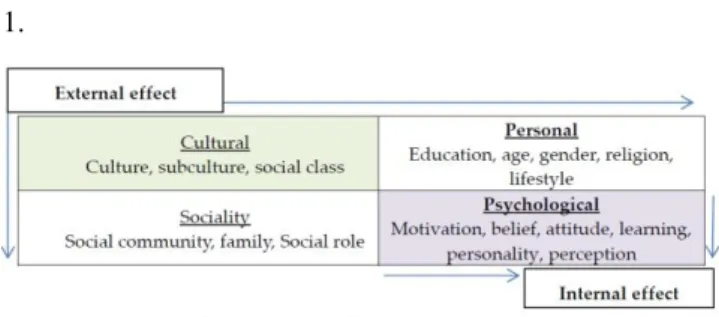
(3) Table 1. Main item of religious cultural creative products in Taiwan's temples Product image. Illustrate Mugs with images of deity or charm Portable charger, Wallet and pillow with images of deities, temples or charms, piggy bank Backpack and bag with images of deities, temples. intrinsic psychological response, which form the basis of consumer decision-making. These consumer characteristics are the main factors that form the consumer's black box and influence consumer decisions over time. As shown in figure 1.. Key ring with images of deity or charm. Image source: Yuandao Guanyin Temple, Shou Xuan Taoist Temple, Chaotien Temple, Dai Tian Temple, Jenn Lann Temple, Fuan Temple, Wufu Temple, Chiayi City God Temple. compromising needs of future generations [13]. Its objectives cover three core areas: economic prosperity, social equity and environmental protection. To achieve sustainable development, it is necessary to strike a balance among economic, social and environmental needs and objectives [14]. Religious cultural creative products bear the goal of the continued development of religious organizations, and at the same time bring about the prosperity of the religious cultural creative industry. To enable religious communities to design goods that satisfy needs of target population, obtain development opportunities and environmental resources in a fair fashion, and face up to the challenges of the actual environment, it is necessary to focus on consumer of the religious cultural creative products. To win recognition of consumer and reflect religious characteristics, efforts should be made to understand deeply the safety image of consumer and explore personal characteristics that can be combined in design and marketing. Only in this way can we design religious cultural creative products for sustainability of societies according to their needs and understanding. Consumer behavior is the psychological process and physical behavior of people involved in purchasing, using and disposing of products or services [15], including obvious observable behavior, and the psychological state and process of supporting and influencing outward behavior [16], consumer behavior is a stimulus-response model. Marketing incentives and main force in the environment enter a consumer black box to produce a specific reaction [17]. Once entering the black box, the stimulus invested by the marketing unit will generate obvious marketing response. Intrinsic characteristics are the mediating process of consumer' response to sales stimulus and environmental stimulus, and the influencing factors of consumer behavior include intrinsic knowledge from extrinsic stimulus, and. Figure 1. Consumer characteristics〔18,19〕 〕. Personal characteristics of consumer behavior have an important self-influence on consumer decisions. These are the information that religious organizations must understand but cannot directly acquire and control when designing and selling religious products. In this regard, efforts should be made to analyze this information to facilitate design decisions instead of making assumptions or subjective preferences, so as to produce products that are more in line with consumer expectations. To date, "Consumer behavior" are centered on products of private sectors, which is rarely used to explore the relationship between products of religious groups and behavior of recipients. Religious products are products that explore the relationship with the divine power. Although they are different from ordinary goods, they all share a common attribute, that is, to provide certain services or ideas to consumer. As discussed above, there is a certain similarity between consumer behavior property of enterprises and that of religious organizations, and we can use the consumer behavior principle to explain the phenomenon that religious organizations provide consumer services or ideas. Therefore, in order to achieve designing religious cultural creative products for sustainability of societies, it is necessary to understand the influencing factors of consumer behavior so as to improve the design of products and focus on the comprehensive planning and implementation of the target consumer. 2. Research Method 2. 1. Research Steps According to the purpose of the research, select appropriate research methods and representative samples for investigation, and collect the data for analysis to obtain the research results. The research steps in this study are. Journal of the Science of Design Vol.Vol. 4 No. Journal of the Science of Design xx 2 No.2020 x 20xx 31 3.
(4) shown in figure 2.. reliability requirement for open coding. Based on the above discussion, in order to understand the safety image knowledge of young people and to estimate the individual characteristics of consumer of religious cultural creative products, this study adopts the methods of open coding, descriptive statistical analysis and difference analysis. Cross - comparisons were made in a qualitative and quantitative manner to obtain the results of the study. Therefore, data. Figure 2. Research steps. 2.2 Questionnaire Design As one of the main images of religious cultural creative products in Taiwan, the image of safety is an important image conveyed by religious media for a long time. As this study regarded the safety image as one of the religious cultural creative products consumer characteristics, the questionnaire consists of two parts: 1) The basic data include education and religious survey, and the question "Do you think that a religious cultural creative product must be accompanies by a safety image?" 2) Participants were asked to think about "Safety" and simply draw images of things, events, people, and scenes, and simply explain the reasons for drawing this image. 2. 3. Sampling and Testing This study adopted the purposive sampling method, but the method, though based on objective reality, is decided by subjective perception. To reduce its deviation, this study took stratified sampling as the criterion of purposive sampling, and made a certain amount of sampling according to the educational level of the group. According to the domestic and foreign studies, the key subject concerning the religious groups' survival and sales is young people, so this study took youth students between the ages of 16 and 23 as the subject and the paper-based questionnaires were distributed using. The survey time was from October 2018 to May 2019. 300 questionnaires were issued. A total of 272 questionnaires were collected and 264 valid questionnaires (including137 valid questionnaires of college students and 127 valid questionnaires of high school students). 2. 4. Data Analysis Through quantitative and qualitative research, consumer behavior can be understood and predicted. Open coding in qualitative research is the decomposition, viewing, comparison, conceptualization, and categorization of data [20]. Analyzer triangulation is a requirement for reliability of qualitative data analysis in scientific research. This study refers to Gerbner 1966 Cultural Indicator Setting, which used 0.80 as the reliability criterion to serve as the 4. 32. Journal of the Science of Design Vol. xx No. x 20xx. Journal of the Science of Design. Vol. 4 No. 2 2020. recovered in Part II of the questionnaire into is divided into image and text. In the image part, one picture and one card were shown. A total of 594 pictures and cards were produced by 264 people. Because of the complexity and particularity of the card contents, the KJ method was adopted for grouping. KJ method is a kind of systematic skill that can summarize different data and reports, and can fully grasp the contents of the facts that cannot be collected [21]. Hence, three graduate students of design major were invited to group "Pictures" according to the KJ method, rendering 25 picture card groups from No.1 to No.25. In the text part, a text description was deemed as a card, with a total of 594 text cards. A total of 25 groups of picture cards and 594 text cards those were sent to 2 university lecturers and senior high school teachers with more than 10 years of professional experience. Based on the original research questions and objectives, they respectively carried out conceptual coding of safety image and conceptual coding of motive description text. The two specialists triangulated the results. The study employed the analyst triangulation. In terms of coding of safety image "Picture card", the mutual agreement is 0.81, average mutual agreement 0.81, and composite reliability 0.9; in terms of "Text card", the mutual agreement is 0.84, average mutual agreement 0.84, and composite reliability 0.91. Reliability of data analysis in this study was 0.9 and 0.91 respectively, which met the reliability requirements. Therefore, the main idea, trend and deep-level concept of open coding of picture cards and text cards were found. The basic data were analyzed by SPSS software, and the chi-square check was performed to analyze the personal data of consumer. Finally, the conceptual code of qualitative research was transformed into a variable, which was used as quantitative data and consumer personal data for cross-analysis, so as to understand the differences of individual characteristics affecting different consumer groups. 3. Survey Results and Discussion 3.1. Basic Data Religious beliefs of the subjects in this study would.
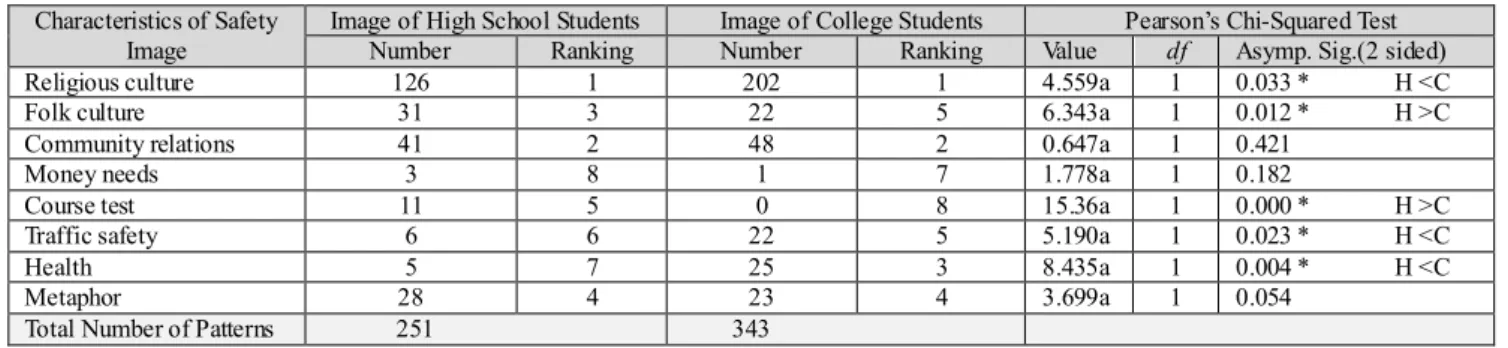
(5) affect the representativeness of the survey data if it is limited to a specific religious belief. Therefore, a religious belief analysis is carried out. As a result, there are 74 people. survey of "Identification with Safety image of Religious cultural creative products" shows that 93% (244 people) of the subjects deemed that religious cultural creative products. who believe in Taoism, 33 people who believe in Buddhism, 118 people who believe in folk beliefs, 12 people who believe in Christianity, 25 people who have no religious. should have "Safety image ", which indicates that young consumer have a common understanding that "Safety" is the main image of religious cultural creative products.. beliefs, and 2 others. There are 264 people in total. Religious beliefs survey results show that about 85% of. Furthermore, the collected data of safety images are openly coded to analyze the concepts of "Image" and "Text", and to. young people are Taoist, Buddhist, and folk religions, and about 80% of foreign and domestic scholars are Buddhist, Taoist, and folk religions, indicating that folk religions are. extract the personal characteristics of consumer' safety images, which are explained in the following sections. 3.2.1. Background Characteristics - External Stimuli. generally accepted among young people. This also means that the subjects of commercial sales of religious cultural creative products in traditional temples are not limited to traditional believers, but include young people in general. In. Causing Cognition of Safety image Based on the results of open coding and category coding, this paper explored the relationship between codes and carries out related coding and naming-external stimuli.. order to design products that meet the needs of consumer without losing their religious and cultural connotations and the characteristics of their temples, the influence of religious and cultural beliefs among the people on consumer must not be neglected. 3.2. Personal Characteristics of Young Consumer Revealed from "Safety Vision Image". There are eight categories of external stimuli causing safety imagery: religious culture, folk culture, metaphor, community relationship, health, traffic safety, examinations, and money demand. These eight categories present the background characteristics. The coding systems for each external stimulus-related coding are shown in table 2. "Religious culture" picture card accounts for 0.55 of the. The Safety Vision Image is the main image [8] in the design of religious cultural creative products, and an important basis for discovering the personal characteristics. total (328 times), showing that consumer use religious culture to express their knowledge of the safety image. There are more than half of the consumer choose "Safety. of young consumer. It is also of great importance to enable the survey data to reflect the actual situation, and to enhance the representativeness of the results. Therefore, the. decorations" (134 times) to express their safety images. Thus, the meaning of religious blessing and portable nature of safety decoration enhance its connection with the safety. Table 2. Coding system of background characteristics Relevance /Axial coding Religious culture /Safe ornaments Religious culture /Safe intermediary Religious culture /Religious activities Folk culture /Safe intermediary. Samples of coded pattern. Open coding/Number of patterns Amulet/134, Bead/6 Building & Deity / 89 Religious articles & Symbol /18 Pray /69, Religious ritual /12 New Year celebration items /27. Folk culture /Folk activities. Sky lantern/26. Metaphor /Safe intermediary. Homophonic pun /34,Shape & Color /14. Metaphor/ Landscape Community relationship /Safe objects - Self Community relationship/ Safe objects -Family Community relationship/ Safe objects- Friends Health /Safe objects - Self Health /Safe objects –Family Traffic safety /Safe objects Self Examination /Safe objects - Self Money needs /Safe objects - Self. Anping castle /3 Family & Friends cares about me /17 Family safety & Had dinner together / 65 Friend's safety / 7 Don't go to the hospital. Don't take medicine /20 Family health/10 Going home by bicycle, car and flight safely /28 Pass exam and get a good grade /11 Allowance /4. Journal of the Science of Design Vol.Vol. 4 No. Journal of the Science of Design xx 2 No.2020 x 20xx 33 5.
(6) image. Safety media include religious buildings, deity, symbols of religious representatives, religious articles, and so on. These media are all religious visual objects that are. "Money demand" is less than 0.01 being the lowest, reflecting the fact that the stability of the Taiwan economy, and the economy did not caused problems for many young. imparted to the sacredness of religion, to the teaching of religious doctrines, or to the rituals of religious safety. They have gained spiritual stability through religious practices. people. In Taiwan, where the pressure for further studies is high, sees 2% of "examination" cards, which expressed students’ wish for the success in the examinations.. and activities such as worship, prayer, and ritual rituals, and have been one of the ways that many people resort to when. 3.2.2. Psychological Characteristics-individual Internal Factors Causing Cognition of Safety Image. they are in trouble or unable to cope with problems. Both folk culture and metaphor cards account for 0.09 of the total, indicating that approximately 0.1 of consumer. According the category and related coding of the "Text card" have been carried out, and it is found that the psychological factor causing safety cognition is the internal. regard the two as a symbol of safety. The "New Year celebration items" are all items used by the traditional people to drive evil spirits and pray for safety. In the early days of the Taiwanese custom of releasing sky lantern, they. reaction in the consumer behavior and the key of the final decision. Based on the previous unit image coding analysis, participants' safety images are generally influenced by people's beliefs, and the internal driving factors reflect the. were used to indicate safety and connect people. Now, besides the meaning of safety, there are also wishes and prayers, which are all media for the traditional system to deliver safety. Homophonic is not only a common linguistic phenomenon in Chinese, but a cultural phenomenon related to folklore. In view of the Chinese people's tendency to. internal, external, human and natural pursuit of safety and harmony, which confirms the theory that Taiwanese's beliefs are individuals' pursuit of optimal state of health for themselves or their families [24]. Therefore, the category coding was classified into four parts: Internal, human (object), interpersonal relationship, and harmony of natural relations; the relevance coding of psychological. avoid adversity [22], apples and oranges with "Double meaning" in the coding system of "Metaphor" have the same pronunciation in Chinese as "Peace" and "Good luck".. characteristics was divided into the system of internal demand, external stimulus response, community relationship and natural relationship. The coding system is. They are often the fruits of sacrifices and important ceremonies, and are considered to bring blessings, including the sound of "An Ping" in landscapes, giving people the. shown in table 3. According the Table 3 showing that expectations for safety fully reflect people's pursuit of their own or family's. impression of safety. The pigeon is believed to be a messenger of peace who brings safety because of the Holy Bible. China is a nation that believes in red. It believes that. optimal health and harmony. Nearly 90% of encodings is based on the pursuit of individual harmony and harmony with nature. In open encodings, "Blessing of divine power". red has the function of driving away evils, representing good fortune and happiness [23]. Community relationship and health cards account for 0.15 and 0.05 of the total, showing that a certain proportion of consumer regard the image of "Health" and "Community. (146 times) is the highest number of encodings, followed by psychological relief (121 times), indicating the profound influence of traditional beliefs on people. In life, people are constantly seeking for harmony and balance between themselves and the outside world. It is not easy to find. relationship" as a symbol of safety, it shows that in the digital age, when it comes to personalization, community relations are still valued by young people, especially family. explanations for the deepest layers of natural operation and cultural systems. However, in times of crisis, the deepest layers of explanations become the framework on which. ties, which play an important role. This reflects China's people-oriented philosophy and its people-to-people relations. Also, the traditional family-centered culture has. people's minds depend. Facing the rapid changes in modern society, many things can hardly be controlled, and people are easily frustrated and anxious about it. At this time,. its influence. At the same time, it also shows youth concern for the health of themselves and families. Whether this also reflects the concern about high pressure and deterioration of. traditional beliefs will play a role in their thoughts and minds. Through some visual media, they may obtain certain psychological relief.. the quality of the environment needs to be explored again.. 6. 34. Journal of the Science of Design Vol. xx No. x 20xx. Journal of the Science of Design. Vol. 4 No. 2 2020.
(7) Table 3. Coding system for internal factors of consumer psychological characteristics Relevance coding/ Coding name Intrinsic needs of individuals / Inner harmony Individual external stimulus response / Harmony of human (or object) with me Social relationship system / Interpersonal harmony Natural relationship system / Harmony of natural relations. Open coding / Number of cards Mind relaxation / 118, With a symbol of safety / 31, Self experience / 51. Proportion of total cards 0.34. Economic worries /3, Studying pressure/17, Uncertain social environment /16 Care for relatives and friends /67, Friends and relatives gave /5. 0.06. Blessing of Divine Power /146*, Traditional customs / 107, Sound similar /33. 0.48. 0.12. 1. Total number of cards: 594. * Indicates the maximum number Table 4. Difference analysis of educational and background characteristics Characteristics of Safety Image Religious culture Folk culture Community relations Money needs Course test Traffic safety Health Metaphor Total Number of Patterns. Image of High School Students Number Ranking 126 1 31 3 41 2 3 8 11 5 6 6 5 7 28 4 251. Image of College Students Number Ranking 202 1 22 5 48 2 1 7 0 8 22 5 25 3 23 4 343. Value 4.559a 6.343a 0.647a 1.778a 15.36a 5.190a 8.435a 3.699a. Pearson’s Chi-Squared Test df Asymp. Sig.(2 sided) 1 0.033 * H <C 1 0.012 * H >C 1 0.421 1 0.182 1 0.000 * H >C 1 0.023 * H <C 1 0.004 * H <C 1 0.054. a. Asymp. Sig. < 0.05 was significant differences, b. * Indicated significant difference, c.” H”: Number of patterns of high school students, “C”: Number of patterns of college students. 3.3. The Influence of Educational Level On the. that there were significant differences in religious relics,. Performance of Personal Characteristics As to whether there are differences in the decision making factors of different sub-cultural groups in the. safe trip, health, folk culture, and exam, except for group relationship and money demand, which showed no significant differences between the two sub-cultural groups.. process of consumption, it is necessary to carry out design and market positioning of religious cultural creative products. Therefore, according to the educational level and. Among them, religious relics, safe trip, and health are more recognized by college students than by high school students. Most college students deemed that religious relics convey. the image representation of safety vision, this paper conducted a difference analysis on the image and motivation to clarify the differences in personal characteristics of sub-cultural groups in the educational level, as shown below.. the image of safety. College students often need to live on their own, so they pay more attention to safe trip and health. This fact is reflected in their images. High school students have higher cognitive strength in folk culture, curriculum examination and metonymy than college students. The high. 3.3.1. Difference Analysis of Educational and Background Characteristics Cross-analysis of background characteristics expressed. strength of folk culture shows that high school students are still influenced by traditional culture. Under the pressure of Taiwan's competition for higher education, high school. with different educational attainment by safe visual image representation is shown in table 4. The cards of Safety Vision Image show that high school. students pay more attention to the curriculum examination, reflecting the social phenomenon of Taiwan. Because of the different social atmosphere and pressure, college students. students and college students have the same background characteristics in the first, second and fourth places, and other ranking characteristics are different. It can be seen. and senior high school students in Taiwan differ in the recognition of safety image. 3.3.2 Difference Analysis of Education and Psychological. that Taiwanese people's beliefs and social and family. Characteristics. culture have a certain impact on the two groups. Whether other external influence will lead to internal recognition differences shall be checked through chi-square test of difference analysis. The results of chi-square test showed. Cross-analysis of psychological characteristics expressed with different educational attainment by drawing motivation for Safety Image, as shown in table 5. The study shows that the college students and the high. Journal of the Science of Design Vol.Vol. 4 No. Journal of the Science of Design xx 2 No.2020 x 20xx 35 7.
(8) Table 5. Difference analysis of educational and psychological characteristics Education Intrinsic Motivation Mind relaxation Self experience With a symbol of safety Individual external Economic worries stimulus response Studying pressure Uncertain social environment Social relationship Care for relatives and friends system Friends and relatives gave Natural relationship Blessing of divine power system Traditional customs Sound similar Total Number of Intrinsic Motivation Psychological Characteristics Intrinsic needs of individuals. High School Number Ranking 43 3 22 5 20 6 2 11 13 8 4 9 24 4 3 10 65 1 56 2 17 7 269. College Number Ranking 75 2 29 5 11 8 1 11 4 9 12 7 43 4 2 10 81 1 51 3 16 6 325. Pearson’s Chi-Squared Test Value df Asymp. Sig.(2 Sided) 2.110 1 0.146 0.021a 1 0.885 6.687a 1 0.010 * H >C 0.741a 1 0.389 8.435a 1 0.004 * H >C 1.580a 1 0.209 1.254a 1 0.263 0.656a 1 0.418 0.433a 1 0.511 5.513a 1 0.019 * H >C 1.247a 1 0.264. a. Asymp. Sig. < 0.05 was significant differences, b. * indicated significant difference, c. “H”: Number of intrinsic motivation of high school students, “C”: Number of intrinsic motivation of college students. school students are still deeply influenced by the folk beliefs culture, this phenomenon is reflected by the highest number of blessings of divine power in the painting. vision image, in which the safe media contain religious relics, folk cultural relics and metaphors, showing that religious beliefs and culture are conveyed through some. motivation analysis. High school students and college students are similar to each other in terms of the open coding sequence of safety drawing motivation, indicating. specific media, affecting the young generation's psychological knowledge of safety. These hidden and invisible psychological responses are the black boxes in. that both parties share similar understanding of internal and external relations, community relations, and pursuit of harmony in natural relations. However, there are some. consumer behavior. "Object" is the most successful medium of delivering safety image, in which the safety image of the safe symbol is deeply rooted in the hearts of the people, and. differences in life challenges due to different educational stages. They are significant different from each other in terms of further study, exam pressure、safety symbol and traditional culture . Representation intensity of high school. the knowledge that the temple itself can bring about the image of safety is universal. In terms of "activities", the religious activities of worship at incense are similarly regarded by many as an image of safety. This activity is not. students is higher than that of college students, indicating. confined to the space of temples. At home, a large number. the limitations of lives of high school students, and making them more susceptible to traditional customs. In addition, reflecting the unease felt by high school students as a result. of people choose a media-based approach to expressing the image of safety, showing that certain lifestyles of the younger generation are influenced by traditional beliefs,. of the pressure on them to pursue further study in higher schools in Taiwan. 3.4 Discussion. that their lifestyles are related to personal behavior, and that their lifestyles have an impact on the consumption behavior of religious cultural creative products.. A total of 93% of the above-mentioned young consumer considered that "Safety" was the main image of religious cultural creative products. Regardless of religious affiliation,. Natural relationships and harmony are the ways in which the most consumers choose to maintain their individual mental health. The blessing of divine power is the most. educational level, and the media used to express the safety image are all related to traditional beliefs among the people. The study took safety vision image as a personal feature of. important belief of the younger generation in the "Safety image" in this relationship system. Some popular traditional belief activities and objects are generally considered as life. the younger generation so as to truly reflect the personnel characteristics of young consumer of the religious cultural creative products of Taiwan's traditional temples. The results of the survey on religious beliefs are similar to those on the attribution of religious beliefs of the Taiwanese people by scholars at home and abroad, showing that folk religion is still generally accepted by young people. Such situation is also reflected in the survey of safety. part by the younger generation, which shows that traditional belief has penetrated into the lives of the common people and brought about a stable safety image. "Bobi" is a specific word for folk beliefs in Taiwan, and it has the meaning of protection and safety. Yuandao Guanyin Temple invites artist to draw images for a set of religious cultural creative products named "Bobi". The images are a composition of auspicious animals (dogs) that are popular. 8. 36. Journal of the Science of Design Vol. xx No. x 20xx. Journal of the Science of Design. Vol. 4 No. 2 2020.
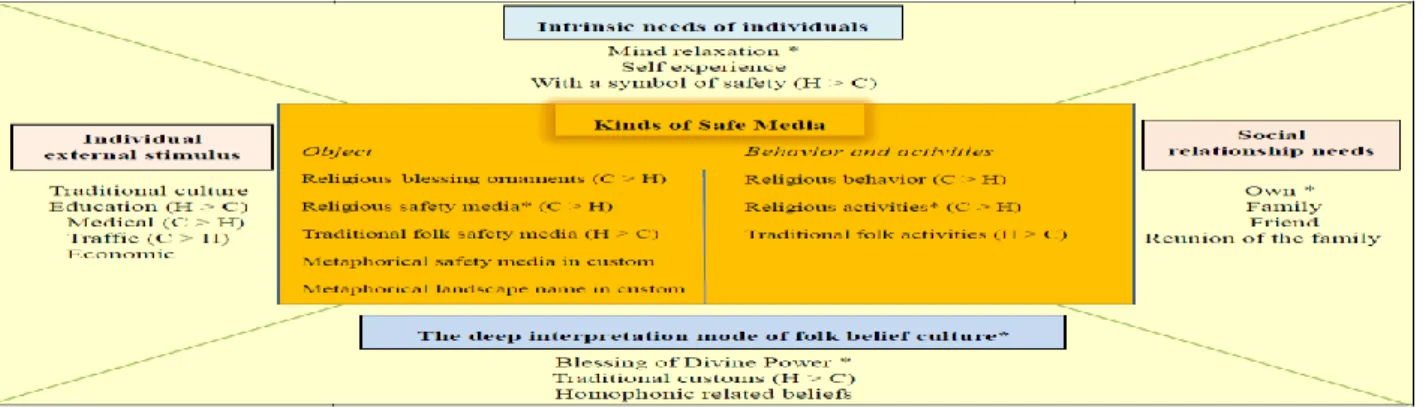
(9) among young people with temple names, buildings and Buddha statues, and are designed for daily necessities used by young people (Figure 3). It conveys the "safe image" of. of their specific lifestyles, which in turn affects the degree of consumption of religious cultural creative products. 2) Personal characteristics such as external environmental. religion in an interesting way, and has succeeded in promoting temples and attracting young people's attention. It is one of the few temples that can successfully build its. stimuli and community relationships have caused younger generations to have anxiety and expectation of “Safety” and to form a demand for religious cultural creative products.. own belief brand. This successful model is attributed to the effective understanding of the "Safety image". 3) "Safety" is the young generation's psychological response to the pursuit of optimal health and personal. characteristics of young consumers and professional design, which also validates the results of this study.. harmony with the outside world. It is also the key to maintain the existence of religious cultural creative products and create value.. Figure 3: The religious cultural creative products of "Bobi" bags, coin holder wallet, drawstring bag, pencil cases, fans Image Source: Yuandao Guanyin Temple. 4. Conclusion and Suggestions The study showed that the main medium that brings peace of mind is religious relics, indicating that designing religious cultural creative products for sustainability of. 4) Religious cultural creative products with positive driving force are attractive to younger generations. 5) The characteristics of consumer those were the two subculture groups (high school students and college students) are as follows. a. "Examination" is the cause of high school students' concern and expectation of "Safety". As the delivery. with temple. medium of safety image, objects with safety image and implied meaning of safety in folk tales are more acceptable by high school students than college students. b. "Safe trip and health" are the reason why college students. characteristics and depth of religious culture are recognized. Information such as consumer characteristics can be used to design religious cultural creative products that meet the. are anxious about and expect "Safety". Religious relics are more accepted as safety image by college students than high school students.. needs of the target population and have their own characteristics, reduce the cycle of product exchange and obtain fair development opportunities and proper use of. The consumer characteristics proposed in this study can be used as indicators for the design and market setting of religious cultural creative products, allowing religious. environmental resources. The study proposes consumer characteristics to improve designing religious cultural creative products for sustainability of societies are. groups to focus on specific youth consumer groups and identify characteristics and behavioral patterns that belong to their own consumer. Based on the results of the study of. described below. 1) The younger generation is deeply influenced by the traditional beliefs. The lifestyle of belief culture is a cycle. consumer characteristics, this study established a framework for young consumer to help religious groups master the target population profile and as a reference for. societies cannot deviate from the essence of religious. In order. to help people. and. products. Figure 4: Framework for improving sustainability of societies - The characteristics frame of young consumers of religious cultural creative products Note: 1. * Represents the most people to choose;2. (H > C) indicates that the intensity of high school students is higher than that of college students. (C > H) indicates that the intensity of college students is higher than that of high school students.. Journal of the Science of Design Vol.Vol. 4 No. Journal of the Science of Design xx 2 No.2020 x 20xx 37 9.
(10) strengthening diversity of religious cultural creative products, as shown in figure 4. In the face of the diverse and complex consumer. and Taoism in Taiwan of IEEE ICASI 2018 (2018), 13-17 [10] Zhuang, J. Q., How does the Taiwanese mind depend. response, to improve consumer acceptance and market introduction opportunities, efforts should be made to break away from the previous religious group-based model of. on religion? - A preliminary introduction to the methodology, The New Messenger, 48, 21-24, 1998 (in Chinese). thinking and maintenance, and re-think from the perspective of consumer. This study is aimed at the. [11] Chang, H., Cultural Creative Products in Taiwan: the Deity Figurines. Journal of general education TPCU, 6,. characteristics of consumer. To obtain more consumer behavior information of religious cultural creative products, it is recommended that subsequent researchers may import. 237-250, 2017 (in Chinese) [12] Liu, Y. C., Mediating Religion: A Book Review, Chinese Journal of Communication Research, 35,. site data for analysis, and conduct religious cultural creative product preference survey, consumer feedback design and so on to obtain more consumer behavior data, in order to optimize the product consumer service, simultaneously. 201-215, 2019 (in Chinese) [13] Filser, M., Kraus, S., et al., Entrepreneurship as Catalyst for Sustainable Development: Opening the Black Box. Sustainability, 11, 4503, 2019. reduce consumer conversion restrictions, tap more potential demand, and create more opportunities to improve designing religious cultural creative products for sustainability of societies. References [1] Ministry of the Interior, 1997-2018 Official Statistics of. [14] Elkington, J., Partnerships from cannibals with forks: The triple bottom line of 21st-century business. Environ. Qual. Manag., 8, 37-51, 1998 [15] Blackwell, S.A., Szeinbach, S.L., et al., The Antecedents of Customer Loyalty: An Empirical Investigation of the Role of Personal and Situational Aspects on Repurchase Decisions, Journal of Service. General Conditions of Religions of County and City Government. Ministry of the Interior: Taipei, 1, 2019 (in Chinese). Research, 1, 362-375, 1999 [16] Jacoby, J. and Morrin, M., International Encyclopedia of the Social & Behavioral Sciences, 2nd ed., Elsevier:. [2] Cheng, C.B., A Review of Folklore and Derivation Religion During a Century of Republic of China. Journal of Religion and Culture of National Cheng. Amsterdam, 738-743, 2015 [17] Kanagal, N. B., An Extended Model of Behavioral Process in Consumer Decision Making, International. Kung University, 18, 1- 44, 2012 (in Chinese) [3] Wang, Z.Y., Temples and Villages-Analysis of the History and Culture of the Chinese Society,. Journal of Marketing Studies, 8, 87-93, 2016 [18] Wells, W.D. and Prensky, D., Consumer Behavior, John Wiley & Sons: New York, 44-46, 1996.. Wenchin:Taipei, 2-6, 2008 (in Chinese) [4] Einstein, M., Brands of faith: marketing religion in a commercial age, Routledge: New York, 193, 2008 [5] Cosgel, M. M., Hwang, J., et al., Religiosity: Identifying the effect of pluralism. Journal of Economic Behavior. [19] Wu, S.I., The relationship between consumer characteristics and attitude toward online shopping. Marketing Intelligence & Planning, 21, 37-44, 2003 [20] Chang, S.S., Research methods, revised, Tsang Hai: Taichung, 246, 2001(in Chinese). & Organization., 158, 219-235, 2019 [6] Ministry of the Interior: https://religion.moi.gov.tw/ReligionSys/FileStore/527. [21] Xu, N. L., Nursing Administration and Management, 2nd ed., Farseeing: Taipei, 552-553, 2004 (in Chinese) [22] Wang, J. W., Harmonics and Chinese Folk. Chinese. B07E3A7214B64898D7817AD624923.pdf , 3, 2013 (Accessed 10 May 2019) [7] Ibid., 4-8. Traditional Culture, 2, 37-45, 2014 (in Chinese) [23] Hu, Z.M., Chinese colors and their meaning-Toward a modern integration of creativity in Chinese of 1998. [8] Kotler, P., Kartajaya, H. and Setiawan, I., Marketing. Color & Life academic Conference (1987), 233-254 (in Chinese) [24] Li, Y.Y., Image of Culture, Part Two, 1st ed.,. 4.0: Moving from Traditional to Digital (Liu, Y. J.Trans.), Commonwealth: Taipei, 74-75, 2017 (in Chinese) [9] Lin, F.S. and Lin, H.L., A Semiotic Analysis of designing cultural and creative product for Buddhism 10. 38. Journal of the Science of Design Vol. xx No. x 20xx. Journal of the Science of Design. Vol. 4 No. 2 2020. Asianculture: Taipei, 84-90, 1992 (in Chinese).
(11)
図
関連したドキュメント
The method employed to prove indecomposability of the elements of the Martin boundary of the Young lattice can not be applied to Young-Fibonacci lattice, since the K 0 -functor ring
Keywords: continuous time random walk, Brownian motion, collision time, skew Young tableaux, tandem queue.. AMS 2000 Subject Classification: Primary:
The stage was now set, and in 1973 Connes’ thesis [5] appeared. This work contained a classification scheme for factors of type III which was to have a profound influence on
Then it follows immediately from a suitable version of “Hensel’s Lemma” [cf., e.g., the argument of [4], Lemma 2.1] that S may be obtained, as the notation suggests, as the m A
This paper presents an investigation into the mechanics of this specific problem and develops an analytical approach that accounts for the effects of geometrical and material data on
While conducting an experiment regarding fetal move- ments as a result of Pulsed Wave Doppler (PWD) ultrasound, [8] we encountered the severe artifacts in the acquired image2.
We show that formulae of Gessel for the generating functions for Young standard tableaux of height bounded by k (see [2]) satisfy linear differential equations, with
p≤x a 2 p log p/p k−1 which is proved in Section 4 using Shimura’s split of the Rankin–Selberg L -function into the ordinary Riemann zeta-function and the sym- metric square
