INTRODUCTION
The narrow host range of human immunodefi-ciency virus type 1 (HIV-1) has been a major obsta-cle for establishing the animal model system for studies of viral replication and pathogenesis in vivo (1). HIV-1 infects and causes disease only in hu-mans. To conquer this difficulty, we have recently generated a monkey-tropic HIV-1 designated NL-DT5R (1-3). Its genome contains a gag sequence en-coding simian immunodeficiency virus from rhesus monkeys (SIVmac) capsid (CA) element, corre-sponding to the HIV-1 cyclophilin A (CypA) - bind-ing loop, and the entire SIVmac vif gene (2). How-ever, by subsequent studies, NL - DT5R was found
to grow in simian cells more poorly both in vitro and
in vivo than a standard SIVmac designated SIVmac
239, which induces the AIDS in monkeys and is widely used for model studies of HIV-1/AIDS. As a result of its biological property, NL -DT5R was un-able to induce AIDS in the animals (3). Extensive at-tempts to improve the growth ability of NL-DT5R in simian cells through modification of Gag-CypA re-gion and Vif by recombinant DNA techniques have been so far unsuccessful (4, 5). Another research group has also reported that a monkey cell-tropic HIV-1 designated stHIV-1 is successfully generated by genetic manipulation and virus adaptation in cells (6). It was suggested that three amino acid muta-tions in gag might be important for the ability of HIV-1 to grow in simian cells (6).
In this study, to potentiate growth capability in simian cells of a prototype monkey-tropic HIV-1 clone, various SIVmac sequences and mutations were introduced into the gag of NL-DT5R, and the resultant recombinants/mutants were monitored for
ORIGINAL
Amino acid alterations in Gag that confer the ability to
grow in simian cells on HIV-1 are located at a narrow
CA region
Tamiko Nagao*, Kazuki Hatcho*, Naoya Doi, Sachi Fujiwara, Akio Adachi, and
Masako Nomaguchi
Department of Virology, Institute of Health Biosciences, the University of Tokushima Graduate School, Tokushima, Japan
Abstract : We previously generated a prototype monkey-tropic human immunodeficiency virus type 1 (HIV-1) designated NL-DT5R. This viral clone has a small region of simian im-munodeficiency virus (SIV) within Gag capsid (CA) protein and also SIV Vif protein, but displays a poor growth phenotype in simian cells. To improve the growth potential of NL-DT5R, we have constructed a series of its gag variant viruses. Out of fourteen viral clones generated, five were infectious for simian HSC -F cells, and two of the infectious variants grew similarly with NL - DT5R. Taking their genome structures into considera-tion, our data here clearly show that a narrow CA region within the Gag protein, i.e., the domain around cyclophilin A (CypA)-binding loop, is critical for the growth ability of HIV-1 in simian cells. J. Med. Invest. 56 : 21-25, February, 2009
Keywords : HIV-1, Gag, CA, CypA, TRIM5α
Received for publication November 17, 2008 ; accepted Decem-ber 12, 2008.
*equal contribution
Address correspondence and reprint requests to Masako Nomaguchi, Department of Virology, Institute of Health Bi-osciences, the University of Tokushima Graduate School, Kuramoto cho, Tokushima 770 8503, Japan and Fax : +81 88 -633 - 7080.
their growth properties in simian HSC-F cells. We show here clearly that any viruses without the SIVmac CypA region do not grow in HSC-F cells, and demonstrate the importance of CypA region for the species tropism of HIV-1.
MATERIALS AND METHODS
CellsA human monolayer cell line 293T (7) was main-tained in Eagles’s minimal essential medium con-taining 10% heat-inactivated fetal bovine serum. A simian lymphocytic cell line HSC-F (8) was main-tained in RPMI-1640 medium containing 10% heat-inactivated fetal bovine serum.
Transfection
Sub-confluent 293T cells in 90 mm dishes were transfected with 20 μg of proviral clones by the cal-cium-phosphate co-precipitation method, and on day 2 post-transfection, cell-free virus samples for infection experiments were prepared as previously described (9).
Infection
HSC-F cells (1-10
!
106) were infected with anequal amount of viruses [1-10
!
106 reversetran-scriptase (RT) units] prepared from transfected 293T cells, and monitored for RT production at in-tervals as previously described (9).
RT assay
Virus production in transfected 293T cells and vi-ral growth property in infected HSC-F cells were de-termined by monitoring RT activity of the culture su-pernatants. RT assay using32P-dTTP has been
pre-viously described (10).
DNA constructs
Full-length infectious molecular clones of HIV-1 and SIVmac, designated pNL4-3 (9) and pMA239 (11), respectively, have been previously described. A monkey- tropic infectious DNA clone of HIV -1 designated NL-DT5R has been previously described (2). An infectious clone designated NL-DT5R/4-3 is a derivative of NL-DT5R carrying CA of NL4-3, and grows more poorly than NL-DT5R in simian HSC-F cells (4). Various gag recombinants and mutants of NL-DT5R were constructed by the QuikChange site-directed mutagenesisi kit (Stratagene, La Jolla, CA, USA) as previously described (12).
RESULTS AND DISCUSSION
Our previous results have indicated that modifi-cations in gag (encoding CypA-binding loop) and
vif genes of NL-DT5R do not improve its growth
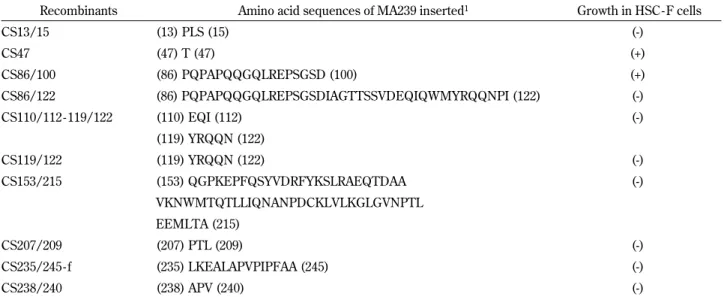
ability in simian cells (4, 5). We, therefore, con-structed new gag recombinants between NL-DT5R and MA239 of SIVmac to obtain HIV-1 type viruses which would be more replication-competent than NL-DT5R in simian cells. We previously reported that recombinants between HIV-1 NL4-3 and SIVmac MA239 within five regions of CA-p2 are viable and infectious for human M8166 cells (12). Based on these results, recombinants in this study were carefully designed as shown in Fig. 1 and Table 1.
To examine growth potentials in simian cells of new viral clones (10 clones in Fig. 1 and Table 1), they were transfected into 293T cells, and cell-free virus samples were prepared on day 2 post-transfection. Vi-ruses obtained were then inoculated into HSC-F cells, and viral growth was monitored by RT assay. Representative results are shown in Fig. 2 and all the data are summarized in Table 1. As shown in Fig. 2, NL-DT5R readily established a spreading in-fection albeit grew more poorly than SIVmac239. The peak infection day for SIVmac239 and NL-DT 5R were 6 and 18, respectively. In contrast to NL-DT5R, eight of ten recombinants (Fig. 1 and Table 1) were not infectious at all for HSC-F cells (Fig. 2 Figure 1 Structure of Gag CA- p2 region of various recombi-nant clones derived from a monkey - tropic HIV- 1 NL- DT5R. Se-quences of SIVmac239 are indicated by black areas (for details, see Table 1). Structural domains of HIV- 1 Gag CA- p2 (19, 20) are shown at the top. Amino acid sequence PQPAPQQ represents the region of SIVmac239 corresponding to the CypA- binding loop of HIV- 1 CA (PVHAGPIAP). H,α-helix.
and Table 1). Even the two infectious recombinants (CS47 and CS86/100) did not grow better than NL-DT5R. In particular, CS47, which actually is a point mutant of NL-DT5R, grew much more poorly than NL - DT5R similarly with DT5R/4 - 3 carrying the HIV-1 type CA (4).
Recently, Hatziioannou, et al. reported that their monkey cell-tropic HIV-1 designated stHIV-1 differs from the parental HIV-1 clone in only minor ways other than the genetically engineered CA and Vif substitutions (6). They found three coding muta-tions in gag (K110I, A209V and P371L) and six si-lent mutations in gag and pol (6). Based on this re-port, we introduced the three nonsynonymous mu-tations into NL-DT5R to have viral clones that would grow better than NL-DT5R in simian cells (Fig. 3A).
Table 1. Amino acid sequences of SIVmac inserted into CA- p2 region of NL- DT5R, a derivative of HIV- 1 NL4 - 3
Recombinants Amino acid sequences of MA239 inserted1 Growth in HSC - F cells
CS13/15 (13) PLS (15) (-) CS47 (47) T (47) (+) CS86/100 (86) PQPAPQQGQLREPSGSD (100) (+) CS86/122 (86) PQPAPQQGQLREPSGSDIAGTTSSVDEQIQWMYRQQNPI (122) (-) CS110/112 - 119/122 (110) EQI (112) (-) (119) YRQQN (122) CS119/122 (119) YRQQN (122) (-) CS153/215 (153) QGPKEPFQSYVDRFYKSLRAEQTDAA (-) VKNWMTQTLLIQNANPDCKLVLKGLGVNPTL EEMLTA (215) CS207/209 (207) PTL (209) (-) CS235/245 - f (235) LKEALAPVPIPFAA (245) (-) CS238/240 (238) APV (240) (-)
1The first and last amino acid numbers of HIV- 1 NL4 - 3 CA- p2 replaced with sequences of SIVmac MA239 are indicated in
parenthe-ses. GenBank accession numbers for pNL4 - 3 and pMA239 are AF324493 and M33262, respectively.
Figure 2 Growth kinetics in HSC - F cells of Gag CA- p2 recom-binants. Input cell - free viral samples were prepared from 293T cells transfected with the clones indicated, and an equivalent RT units were inoculated into HSC - F cells. Viral growth was moni-tored at intervals by RT activity in the culture supernatants. As a negative control (Cr), pUC19 was used.
A A B B C C
Figure 3 Growth kinetics in HSC - F cells of Gag mutants. (A) Locations of mutations in Gag. Mutations at the indicated positions are introduced into NL- DT5R and NL4 - 3 (mutants in panels B and C, respectively). Amino acid sequence PQPAPQQ represents the region of SIVmac239 corresponding to the CypA- binding loop of HIV- 1 CA (PVHAGPIAP). MA, Gag matrix protein ; NC, Gag nucleocapsid protein ; SP1 and SP2, Gag spacer proteins 1 (p2) and 2 (p1), respectively. (B) and (C) Growth kinetics of various mutants clones in HSC - F cells were determined as described in the legend to Fig. 2. Results obtained in one experiment are shown separately in (B) and (C) for clarity.
Proviral clones containing each and all the three mu-tations were constructed for this purpose. Cell- free virus samples derived from these clones were pre-pared as described above, and inoculated into HSC-F cells. As shown in HSC-Fig. 3B, while control viruses SIVmac239 and NL-DT5R grew in a consistent man-ner, two (A209V and P371L) out of the four mutants displayed retarded growth phenotype. Although K 110I grew similarly well with NL - DT5R, the triple mutant K110I/A209V/P371L did not at all. To know whether the three mutations can confer the ability to grow in simian cells on HIV-1 type CA, four mu-tant clones in the context of NL4-3 were constructed as above and monitored for their growth potentials in HSC-F cells. As clearly seen Fig. 3C, the growth of the four mutants were undetectable or negligible during the observation period, indicating the re-ported coding mutations in gag (6) are biologically inactive or meaningless in simian cells.
In this study, we have constructed ten new recom-binants between the NL - DT5R clone of monkey-tropic HIV-1 and the standard pathogenic clone SIVmac239, and four new gag mutants of NL-DT5R in anticipation of improved growth potentials in sim-ian cells. In addition to the changes relative to HIV-1 (Gag - CypA region and Vif) which the prototype monkey-tropic virus NL-DT5R carries, the new vi-ral clones contain alterations in scattered regions of Gag-CA and in the other parts of Gag. Our results here clearly showed that region(s) around the CypA-binding loop of HIV-1 is critical for viral growth abil-ity in simian cells. Cellular TRIM5α is well known to interact with this region and restrict retroviral rep-lication (13-18). In this regard, it is interesting to note that NL-DT5R does not overcome the barrier imposed by TRIM5α (4). Virological studies to evade the TRIM5α restriction are in progress in our laboratory.
ACKNOWLEDGMENTS
We thank Ms. Kazuko Yoshida for her excellent editorial assistance. This work was supported in part by a Grant-in-Aid for Scientific Research on Prior-ity Areas (19041051) from the Ministry of Educa-tion, Culture, Sports, Science and Technology of Japan (to A. A.), and by a Health Sciences Research Grant [Research on HIV/AIDS (2007-2009)] from the Ministry of Health, Labour and Welfare of Japan (to A. A.).
REFERENCES
1. Nomaguchi M, Doi N, Kamada K, Adachi A : Species barrier of HIV-1 and its jumping by vi-rus engineering. Rev Med Virol 18 : 261-275, 2008
2. Kamada K, Igarashi T, Martin MA, Khamsri B, Hatcho K, Yamashita T, Fujita M, Uchiyama T, Adachi A : Generation of HIV - 1 derivatives that productively infect macaque monkey lym-phoid cells. Proc Natl Acad Sci USA 103 : 16959-16964, 2006
3. Igarashi T, Iyengar R, Byrum RA, Buckler-White A, Dewar RL, Buckler CE, Lane HC, Kamada K, Adachi A, Martin MA : An HIV-1 derivative with 7% SIV genetic content is able to establish infections in pig-tailed macaques. J Virol 81 : 11549-11552, 2007
4. Kamada K, Yamashita T, Hatcho K, Adachi A, Nomaguchi M : Evasion from CypA - and APOBEC-mediated restrictions is insufficient for HIV-1 to efficienctly grow in simian cells. Microbes Infect, (in press)
5. Hatcho K, Kamada K, Yamashita T, Adachi A, Nomaguchi M : Replication potentials of vif vari-ant viruses generated from monkey cell-tropic HIV -1 derivative clones NL - DT5/NL - DT5R. Microbes Infect 10 : 1218-1222, 2008
6. Hatziioannou T, Princiotta M, Piatak Jr M, Yuan F, Zhang F, Lifson JD, Bieniasz PD : Gen-eration of simian-tropic HIV-1 by restriction factor evasion. Science 314 : 95, 2006
7. Lebkowski JS, Clancy S, Calos MP : Simian vi-rus 40 replication in adenovivi-rus-transformed human cells antagonizes gene expression. Na-ture 12 : 169-171, 1985
8. Akari H, Fukumori T, Iida S, Adachi A : Induc-tion of apoptosis in Herpesvirus saimiri - immor-talized T lymphocytes by blocking interaction of CD28 with CD80/CD86. Biochem Biophys Res Commun 263 : 352-356, 1999
9. Adachi A, Gendelman HE, Koenig S, Folks T, Willey R, Rabson A, Martin MA : Production of acquired immunodeficiency syndrome - associ-ated retrovirus in human and nonhuman cells transfected with an infectious molecular clone. J Virol 59 : 284 -291, 1986
10. Willey RL, Smith DH, Lasky LA, Theodore TS, Earl PL, Moss B, Capon DJ, Martin MA : in
vitro mutagenesis identifies a region within the
envelope gene of the human immunodeficiency virus that is critical for infectivity. J Virol 62 :
139 -147,1988
11. Shibata R, Kawamura M, Sakai H, Hayami M, Ishimoto A, Adachi A : Generation of a chi-meric human and simian immunodeficiency vi-rus infectious to monkey peripheral blood mononuclear cells. J Virol 65 : 3514-3520, 1991 12. Kamada K, Yoshida A, Khamsri B, Piroozmand A, Yamashita T, Uchiyama T, Fujita M, Adachi A : Construction of gag-chimeric viruses be-tween HIV-1 and SIVmac that are capable of productive multi-cycle infection. Microbes In-fect 8 : 1075-1081, 2006
13. Stremlau M, Owens CM, Perron MJ, Kiessling M, Autissier P, Sodroski J : The cytoplasmic body component TRIM5alpha restricts HIV-1 infection in Old World monkeys. Nature 427 : 848-853, 2004
14. Yap MW, Nisole S, Lynch C, Stoye JP : Trim5 alpha protein restricts both HIV-1 and murine leukemia virus. Proc Natl Acad Sci USA 101 : 10786 -10792, 2004
15. Perron MJ, Stremlau M, Song B, Ulm W, Mulligan RC, Sodroski J : TRIM5alpha medi-ates the postentry block to N - tropic murine
leukemia viruses in human cells. Proc Natl Acad Sci USA 101 : 11827-11832, 2004
16. Song B, Javanbakht H, Perron M, Park DH, Stremlau M, Sodroski J : Retrovirus restriction by TRIM5alpha variants from Old World and New World primates. J Virol 79 : 3930 - 3937, 2005
17. Luban J : Cyclophilin A, TRIM5, and resistance to human immunodeficiency virus type 1 infec-tion. J Virol 81 : 1054 -1061, 2007
18. Takeuchi H, Matano T : Host factors involved in resistance to retroviral infection. Microbiol Immunol 52 : 318-325, 2008
19. Gamble TR, Vajdos FF, Yoo S, Worthylake DK, Houseweart M, Sundquist WI, Hill CP : Crystal structure of human cyclophilin A bound to the amino-terminal domain of HIV-1 capsid. Cell 87 : 1285 -1294, 1996
20. Gamble TR, Yoo S, Vajdos FF, von Schwedler UK, Worthylake DK, Wang H, McCutcheon JP, Sundquist WI, Hill CP : Structure of the carboxyl!terminal dimerization domain of the HIV-1 capsid protein. Science 278 : 849-853, 1997