Shimura curves as intersection of Humbert surfaces
and defining equations of QM-curves of
genus
two
早大理工数学科 橋本 喜一朗 (Ki-ichiro HASHIMOTO)
早大理工数学科 村林 直樹 (Naoki MURABAYASHI)
1
Introduction
Let $A$ be asimple principally polarized abelian variety of dimension two over the complex
number field $C$, and let End$(A)$ be the algebra of endomorphisms of $A$. Then, as is well
known, the Q-algebra $End^{O}(A)$ $:=End(A)\otimes zQ$ belongs to either one of the following
types:
(i) a CM field ofdegree four,
(ii) an indefinite quaternion algebra,
(iii) a real quadratic field, or
(iv) the rational number field Q.
Let $A_{2,1}$ be the moduli space of the isomorphism classes of $A$ with principal polarization.
The moduli of $A$ in each case has dimension 0,1,2,3, respectively, whose components in the
first three cases are called (i) CM-points, (ii) Shimura curves, (iii) Humbert surfaces. On
the other hand, it is also well known that the Torelli mapgives a birational morphismfrom
$A_{2,1}$ to the moduli space $\mathcal{M}_{2}$ of curves ofgenus two.
In this paper, we are interested in constructing, in concrete way, an $al$gebraic family of
curves of genus two whose jacobian varieties belong to the case (ii) above. Namely we
wish to find out an equation of a fibre space, the base space of which is a Shimura curve
and fibres are curves of genus two whose jacobian have quaternion multiplications. Call
such curves simply “QM-curves”. We shall give defining equations of algebraic family of
QM-curves in the case where the endomorphism ring is, generically, a maximal order $\mathcal{O}$ of
the indefinite quaternion algebra over $Q$ which ramifies exactly at
{2,3}
or{2,5}.
To thebest of our knowledge, not a single example of such curve has been known before. Here we
should point out that examples ofdefining equations ofShimura curves have been given by
Kurihara [15], Jordan-Livn\’e [11]. However, they are not moduli-theoretic, hence are not
helpful for our purpose.
[7], one can find general approach, as well as concrete solutions in
some
cases, to thesimilar problem for the case (iii), i.e., to construct families of curves of genus two whose
jacobian varieties have real multiplication ofgiven discriminant. (cf. $[2],[16]$). Especially,
Humbert gives explicite form of “modular equations” for discriminant 5 and 8, in terms of
the coefficients ofthe curves $y^{2}=f(x)$. Our idea is simply to combine these twoequations
in a suitable way. Indeed, if one can arrange the coordinate system in such away that the
two real multiplications generate $\mathcal{O}$, then the fibre space we are looking for will be obtained
asa component oftheintersection ofthe two Humbert’s families. The determination of the
possible components are carried out by studying quaternion modular embeddings of the
upper half plane to the Siegel upper half plane of degree two. Although the calculations
needed to find out the components are quite complicated, they can be perfomed by using
computer symbolic manipulation.
The main results are given as theorems 2.1 in
\S 2.
As an application, we can give anequation of a family ofsupersingular curves of genus two over the field $\overline{F}_{p}$ ofcharacteristic
$p=3,5$
.
The proofs will be given in the latter sections. In \S 3, we recall brieflysome resultsof Humbert [7] which are needed for our constructions. In
\S 4,
we study, in some detail,quaternion modular embeddings of the upper half plane to the Siegel upper half plane of
degree two, in the case of the maximal orders of the quaternion algebra with discriminant
6 and 10. A more general treatment is given by [5].
2
Statement of
main
results
Let $B$ be anindefinite division quaternion algebra over$Q$, andlet $\mathcal{O}$ be a maximal orderof
B. We denote by $D_{B}$ the product of primes at which $B$ ramifies, and call it the discriminant
ofB. Let $\alpha\alpha’$ be the canonical involution on $B$, and let$Tr(\alpha)$ $:=\alpha+\alpha’,$ $Nr(\alpha)$ $:=\alpha\alpha’$
be the reduced trace, reduced norm on $B$, respectively. Then $\mathcal{O}^{(1)}$
$:=\{\alpha\in \mathcal{O}|Nr(\alpha)=1\}$
is regarded as a Fuchsian group of $SL_{2}(R)$ and the compact Riemann surface $\mathcal{O}^{(1)}\backslash \mathfrak{H}$ is
identified with the C-valued points ofthe Shimura curve $S_{B}$ (cf. [19],[20]). $S_{B}(C)$ has the
following interpretation. Let $\rho$ be an element of
$\mathcal{O}$ such that $\rho^{2}=-D_{B},$
$\rho \mathcal{O}=\mathcal{O}\rho$. The
existence of such element can be shown byusingstrong approximationtheorem, orby direct
construction of$\mathcal{O}$ (cf. $[8],[5]$). Then the involution of $B$ defined by $\alpha-\alpha$“ $:=\rho_{1}^{-1}\alpha’\rho_{1}$ is
positive, and it satisfies $O^{*}=O$
.
Then we have$S_{B}(C)\underline{1:1}\{(A, i, \Theta)|(A, \Theta)$
: principally polarized abelian
$surface\}$ $i:\mathcal{O}=*\rangle End(A)$
Rosati involution w.r.$t\Theta_{1\mathcal{O}}=*$
Hence we have a ratinal map
$S_{B}arrow A_{2,1}(C)\cong Sp(4, Z)\backslash \mathfrak{H}_{2}$ $\approx$ $\mathcal{M}_{2}(C)$
Now the problem we are interested to solve is to describe the image of the Shimura curve
$S_{B}$ in $\mathcal{M}_{2}$. More precisely, we look for an equation of the following form:
where $f$ is separable ofdegree 5 or 6 in $X$, and $\overline{Q}(s, t)=\overline{Q}(S_{B})$ is the function field of $S_{B}$
over Q.
Here we shall give an answer to this problem in the two cases where $D_{B}=6,10$. Our
results are:
Theorem 2.1 (i) Case
of
$D_{B}=6$.$S_{6}$ : $Y^{2}=X(X^{4}-PX^{3}+QX^{2}-RX+1)$, with $g(s, t)$ $=$ $s^{2}+(7t^{4}-8t^{3}+18t^{2}-8t+7)=0$, $RP$ $=$ $\ovalbox{\tt\small REJECT}\pm(3t^{2}-2t+3)\{(5t^{4}+4t^{3}-2t^{2}+4t+5)\pm(t^{2}+1)s\}8t(t^{2}+1)(t^{2}-t+1)$ $Q$ $=$ $\ovalbox{\tt\small REJECT}(t^{4}+1)(2t^{8}-6_{2}t^{7}+3t-6t-2t_{2}-6t+2t(t-1)^{6_{2}}(t^{2}+^{5}1)^{2}(t^{4}-t+^{3}1)^{3t^{2}-6t+2)}$ (ii) Case
of
$D_{B}=10$.
$S_{10}$ : $Y^{2}=X(P^{2}X^{4}+P^{2}(1+R)X^{3}+PQX^{2}+P(1-R)X+1)$, with $g(s, t)$ $=$ $s^{2}-(t^{2}.-2)(2t^{2}+1)=0$, $P$ $=$ $\frac{4(2t^{2}+1)(t^{4}-t^{2}-1)}{(t^{2}-1)^{2}}$ $R=$ $\frac{(t^{2}-1)s}{t(t^{2}+1)(2t^{2}+1)}$ $Q$ $=$ $\frac{(t^{4}+1)(t^{8}+8t^{6}-10t^{4}-8t^{2}+1)}{t^{2}(t^{2}-1)^{2}(t^{2}+1)^{2}}$Remark 2.2 The genera
of
Shimura curves $S_{B}$ are zerofor
$D_{B}=6,10$.
Soone
couldobtain the
families
of
QM-curves over $P^{1}$, while ourfamiles
are over the elliptic curve$g(s,t)=0$. Indded, our
families
are reduced to those over $P_{f}^{1}$ since the twofibres
on$(s, \pm t)$ are easily seen to be isomorphic.
By specializing $(s, t)$ to those points $(s_{0},t_{0})\in\overline{Q}^{2}$ such that $g(s_{0}, t_{0})=0$, one canobtain as
many QM-curves defined over $\overline{Q}$ as one wishes. However, one should note that the curve
$Y^{2}=f(X;s_{0},t_{0})$ may be a split curve, i.e., the jacobian can split to a product of two
elliptic curves with complex multiplication.
Finally, we note that the reduction of a Shimura curve at the prime where $B$ ramifies
gives a moduli of supersingular abelian varieties (cf. [18]). Moreover, it is known that the
number of irreducible components of the moduli of such curves is one for $p\leq 11$ (cf. [12]).
Corollary 2.3 For $p=3,5$, a family
of
supersingular curvesof
genus two over thefield
$\overline{F}_{p}$
of
characteristic$p$ is given by the following equation:
(i) For$p=3$ $\overline{S}_{6}$ : $Y^{2}=X(X^{4}-PX^{3}+QX^{2}-RX+1)$, with $P$ $=$ $\pm 1-\sqrt{-1}$ $R$ $Q$ $=$ $\frac{(t^{4}+1)^{3}}{t^{2}(t^{2}-1)^{2}(t^{2}+1)^{2}}$ (ii) For $p=5$ $\overline{S}_{10}$ : $Y^{2}=X(P^{2}X^{4}+P^{2}(1+R)X^{3}+PQX^{2}+P(1-R)X+1)$, with $P$ $=$ $\frac{-(2t^{2}+1)(t^{4}-t^{2}-1)}{(t^{2}-1)^{2}}$ $R=$ $\frac{(t^{2}-1)}{\sqrt{2}t(t^{2}+1)}$ $Q$ $=$ $\frac{(t^{4}+1)(t^{8}-2t^{6}+2t^{2}+1)}{t^{2}(t^{2}-1)^{2}(t^{2}+1)^{2}}$.
3
A
work of Humbert
Let$\tau=(\begin{array}{ll}\tau_{1} \tau_{2}\tau_{2} \tau_{3}\end{array})$
be a element of the Siegel upper halfspace $\mathfrak{H}_{2}$ of degree 2. Put $A_{\tau}=C^{2}/L_{\tau}$ with $L_{\tau}$ the
lattice generated by the columns of the matrix $(\tau 1_{2})$. Put $a=(11t_{2}^{2})$ and $b=(\begin{array}{l}11/2\end{array})$ .
For $z=(\begin{array}{l}z_{1}z_{2}\end{array})$ in $C^{2},\cdot$the 2-dimensional holomorphic theta function with characteristic
$\{\begin{array}{l}ab\end{array}\}$ is defined by
$\theta(z)=\sum_{n\in Z^{2}}e^{\pi i^{t}(n+a)\tau(n+a)+2\pi i^{2}(n+a)(z+b)}$,
where $n$ is written
as
a column vector and ${}^{t}v$ denotes the transpose of a column vector$v$.
The following lemma is well known:
Lemma 3.1 Let$p,$ $q$ be column vectors in $Z^{2}$. Then
$\theta(z+\tau p+q)=e^{-\pi i^{t}p\tau p-2\pi i^{t}p(z+b)+2\pi i^{t}aq}\theta(z)$.
We denote by $\Theta$ the divisor of zeros of $\theta(z)$ on$A_{\tau}$. Then $(A_{\tau}, \Theta)$ is aprincipally polarized
abelian surface. From now on, we assume that $\Theta$ is isomorphic to a curve $C$ ofgenus two.
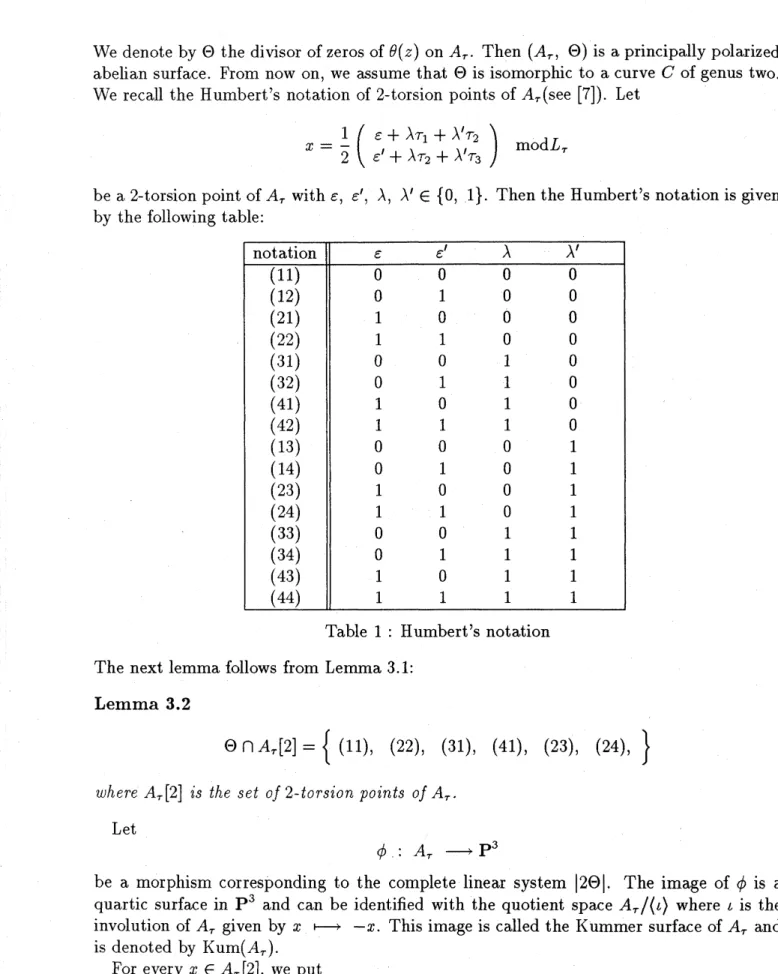
We recall the Humbert’s notation of 2-torsion points of$A_{\tau}$(see [7]). Let
$x= \frac{1}{2}(\begin{array}{l}\epsilon+\lambda\tau_{1}+\lambda’\tau_{2}\epsilon’+\lambda\tau_{2}+\lambda’\tau_{3}\end{array})$ $mod L_{\tau}$
be a2-torsion point of$A_{\tau}$ with $\epsilon,$ $\epsilon’,$ $\lambda,$ $\lambda’\in\{0,1\}$. Then the Humbert’s notation is given
by the following table:
Table 1 : Humbert’s notation The next lemma follows from Lemma 3.1:
Lemma 3.2
$\Theta\cap A_{\tau}[2]=\{(11)$, (22), (31), (41), (23), (24), $\}$
where $A_{\tau}[2]$ is the set
of
2-torsion pointsof
$A_{\tau}$.Let
$\phi$ : $A_{\tau}arrow P^{3}$
be a morphism corresponding to the complete linear system $|2\Theta|$
.
The image of $\phi$ is aquartic surface in $P^{3}$ and can be identified with the quotient space
$A_{\tau}/\{\iota\rangle$ where $\iota$ is the
involution of$A_{\tau}$ given by
$x-x$
. This image is called the Kummer surface of$A_{\tau}$ andis denoted by $Kum(A_{\tau})$.
For every $x\in A_{\tau}[2]$, we put
and
$\overline{\Theta_{x}}$
$:=\phi(T_{x}(\Theta))$
where $T_{x}$ denotes the traslation by $x$
.
Since $2T_{x}(\Theta)\in|2\Theta|$, there exists aunique hyperplane $H_{x}$in$P^{3}$ such that theintersection
divisor of$H_{x}$ and $Kum(A_{\tau})$ is equal to the divisor $2\overline{\Theta_{x}}$.
$H_{x}$ is called the singular plane of $Kum(A_{\tau})$. From $now$ on, we denote $\phi((ij))(1\leq i,j\leq 4)$ by the same notation $(ij)$ and
call themdouble points of$Kum(A_{r})$. Then singular planes can be uniquely represented by
sixteen symbols $kl(1\leq k, l\leq 4)$ such that the following conditions are satisfied:
1. The set of the six double points lying on the singular plane $kl$ is
{
$(ij)|i=k,$ $j\neq l$ or $i\neq k,$ $j=l$}
2. The set ofthe six singular planes passing through the double point $(ij)$ is
{
$kl|k=i,$ $l\neq j$ or $k\neq i,$ $l=j$}
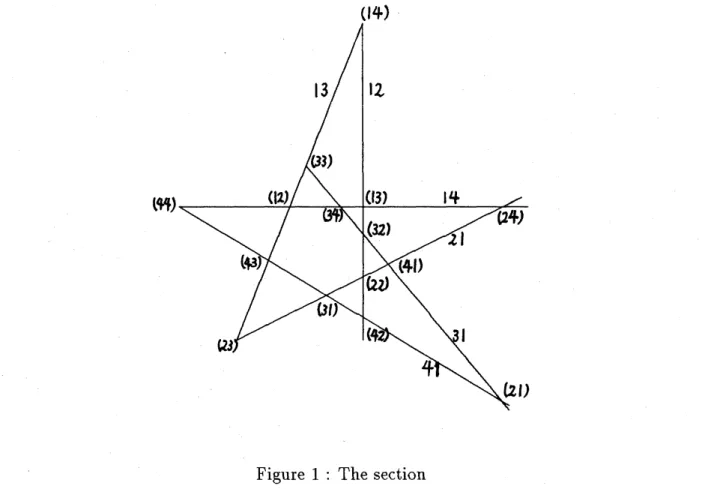
We take a hyperplane fi in $P^{3}$ which does not contain (11) and fix it. Figure 1 represents
the section by $\Pi$ of the six singular planes of$Kum(A_{\tau})$ passing through (11).
Figure 1 : The section
On each line in the figure we mark the symbol of the corresponding singular plane : 12,
13, 14, 21, 31, 41 ; on the intersection oftwo lines we markthe symbol ofthe double point, different from (11), lying on the two corresponding singular planes. Therefore, the point
Remark 3.3 Let $D$ be a curve on $Kum(A_{\tau})$, Then the projection
of
$D$from
(11) on IIintersects to six lines in Figure 1 at$po\underline{in}ts(ij)$ or touches them because the singular plane
$H_{x}$ touches $Kum(A_{\tau})$ along the conic $\Theta_{x}$.
Proposition 3.4 There exists a conic $\Gamma$ in II which touches six lines in Figure 1.
PROOF. Consider the tangent cone to $Kum(A_{\tau})\subset P^{3}$ at the double point (11) and let $\Gamma$
be the section of it by II. Then it follows that $\Gamma$ satisfies the above condition. $\square$
We can take a homogeneous coordinate $x,$ $y,$ $z$ of II $\cong P^{2}$ such that. $\Gamma$ is given by the
equation $yz=x^{2}$ and any three among six contact points are given by
$(x ; y ; z)=(0$ ; $0$ ; 1 $)$, (1 ; 1; 1), $(0$ ; 1; $0)$.
So it may be assumed that the line 14, 21, 12, 13, 31, 41 are given by the equation
$y+2a_{1}x+a_{1}^{2}z=0$, $y+2a_{2}x+a_{2}^{2}z=0$, $y+2a_{3}x+a_{3}^{2}z=0$,
$y=0$, $y+2x+z=0$, $z=0$
respectively.
Proposition 3.5 $C$ is isomorphic to the curve given by the equation $y^{2}=x(x-1)(x-$
$a_{1})(x-a_{2})(x-a_{3})$.
Now we consider the endomorphism ring End$(A_{\tau})$ of$A_{\tau}$
.
Analytically,End$(A_{\tau})=\{\alpha\in M_{2}(C)|\exists M\in M_{4}(Z)$ s.t. $\alpha(\tau 1_{2})=(\tau 1_{2})M\cdot\cdot(*)\}$. Let $M=(\begin{array}{ll}A BC D\end{array})$ . Then we have that
$(*)\Leftrightarrow\tau B\tau+D\tau-\tau A-C=0\cdots(**)$
.
We let $E$be the Riemannform associated to the polarization O. $E$defines aninvolution on End$(A_{\tau}),$ $\alphaarrow\div\alpha^{o}$, called the Rosati involution. It is determined by$E(\alpha z, w)=E(z, \alpha^{o}w)$
for all $z,$ $w\in C^{2}$
.
We have that$\alpha^{Q}=\alpha\Leftrightarrow A={}^{t}D,$ $B=(\begin{array}{ll}0 b-b 0\end{array}),$ $C=(\begin{array}{ll}0 c-c 0\end{array})$ .
Put $A=(\begin{array}{ll}a_{1} a_{2}a_{3} a_{4}\end{array})$. Under the assumption $\alpha^{O}=\alpha$, it follows that
$(**)\Leftrightarrow a_{2}\tau_{1}+(a_{4}-a_{1})\tau_{2}-a_{3}\tau_{3}+b(\tau_{2^{2}}-\tau_{1}\tau_{3})+c=0$
.
Then
Tr $\alpha=a_{1}+a_{4}$, $\det\alpha=a_{1}a_{4}-a_{2}a_{3}+bc$.
So the discriminant of the characteristic polynomial of$\alpha$ is
Definition
3.6 (Humbert [7]) For an element $\tau=(\begin{array}{ll}\tau_{1} \tau_{2}\tau_{2} \tau_{3}\end{array})$of
$\mathfrak{H}_{2}$, it is said that $\tau$has a singular relation with invariant $\triangle$
if
there exists an element $(a, b, c, d, e)(\neq 0)\in Z^{5}$such that:
1. $a,$ $b_{i}c,$ $d,$ $e$ are relatively prime
2. $a\tau_{1}+b\tau_{2}+c\tau_{3}+d(\tau_{2^{2}}-\tau_{1}\tau_{3})+e=0$
3. $\Delta=b^{2}-4ac-4de$.
As we have stated above, asingular relation of$\tau$ withinvariant $\triangle$ corresponds to
endomor-phisms of$A_{\tau}$ fixedby the Rosati involution such that the discriminant of their characteristic
polynomial is $\triangle$. Define
$N_{\Delta}=\{\tau\in \mathfrak{H}_{2}|\tau$ has a singular relation with invariant $\triangle\}$
and
$H_{\Delta}=image$ of$N_{\Delta}$ under the canonical map $\mathfrak{H}_{2}arrow Sp(4, Z)\backslash \mathfrak{H}_{2}$
where $Sp(4, Z)$is the symplecticgroup over $Z$ and $Sp(4, Z)\backslash \mathfrak{H}_{2}$ denotes the quotient space
for the well known $ac$tion. $H_{\triangle}$ is called the Humbert surface of invariant $\triangle$. The following
result, which is stated explicitly in [2], p.212, is essentially due to Humbert:
Proposition 3.7 Each point
of
$H_{\triangle}$ can be represented by $\tau\in \mathfrak{H}_{2}$ satisfying an equation$a\tau_{1}+b\tau_{2}+\tau_{3}=0$ with $b^{2}-4a=\Delta,$ $b=0$ or 1.
Proposition 3.8 (Humbert [7])
If
$\tau\in \mathfrak{H}_{2}$ has a relation$-\tau_{1}+\tau_{2}+\tau_{3}=0$,
there exists a conic $D$ in $\Pi$ which passes through
five
points(34), (14), (33), (22), (24)
and touches the line 41 (see Figure 1). Conversely,
if
the latter holds, $\tau$ has a singularrelation with $\triangle=5$.
Using this proposition, Humbert calculated a modular equation of $H_{5}$.
Theorem 3.9 (Humbert [7]) there exists a conic in $\Pi$ which
satisfies
the conditions inTheorem 3.8
if
and onlyif
the identity4$(a_{1}^{2}a_{3}-a_{2}^{2}+a_{3}^{2}(1-a_{1})+a_{2}-a_{3})(a_{1}^{2}a_{2}a_{3}-a_{1}a_{2}^{2}a_{3})$
$=$ $(a_{1}^{2}a_{3}(a_{2}+1)-a_{2}^{2}(a_{1}+a_{3})+a_{2}a_{3}^{2}(1-a_{1})+a_{1}(a_{2}-a_{3}))^{2}$
Humbert $al$so calculated a modular equation of$H_{8}$.
Proposition 3.10 (Humbert [7])
If
$\tau\in \mathfrak{H}_{2}$ has a relation$-2\tau_{1}+\tau_{3}=0$,
there exists a curve
of
degree 4 and genus 1 in$Kum(A_{\tau})$ which passes through double points(32), (34), (42), (44).
Projecting
from
(11) on II, there exists a conic in $\Pi$ which passes through thefour
pointsin $\Pi$ corresponding to the above double points and touches the line 21 and 13. Conversely
if
such a conic exists in II, $\tau$ has a singular relation with $\triangle=4$ or 8.Theorem 3.11 (Humbert [7]) Consider a conic $y=x^{2}$ and its six tangents
$l_{\delta}$ : $y+2\delta x+\delta^{2}=0$,
$\delta=\infty,$ $0,$ $b_{1},$ $b_{2},$ $b_{3},$ $b_{4}$. Then there exists a conic which passes through the
four
points$l_{b_{1}}\cap l_{b_{2}}$, $l_{b_{2}}\cap l_{b_{3}},$ $l_{b_{3}}\cap l_{b_{4}},$ $l_{b_{4}}\cap l_{b_{1}}$
and touches $l_{\infty}$ and $l_{0}$
if
and onlyif
the identity$(b_{1}b_{3}-b_{2}b_{4})^{2}-\cross$
$(4b_{1}b_{2}b_{3}b_{4}((b_{1}+b_{3})(b_{2}+b_{4})-2b_{1}b_{3}-2b_{2}b_{4})^{2}-(b_{2}-b_{4})^{2}(b_{1}-b_{3})^{2}(b_{1}b_{3}+b_{2}b_{4})^{2})=$
holds. Moreover, the
first factor
corresponds to $\triangle=4$ and the latter corresponds to $\triangle=8$.4
Modular
embedding of
quaternion
algebras with
$D=6$
and
10
4.1
The
case
of
$D=6$Let
$B_{6}=Q+Qi+Qj+Qij,$ $i^{2}=-6,$ $j^{2}=2,$ $ji=-ij$
be the quaternion algebra over $Q$ with discriminant 6 and let
$\mathcal{O}_{6}=Z+Z\frac{i+j}{2}+Z\frac{i-j}{2}+Z\frac{2+2j+2ij}{4}$
be a maximal order of $B_{6}$. Put $\rho_{1}=i$ and consider an involution on $B_{6},$ $\alpha\alpha^{*}$ $:=$
$\rho_{1}^{-1}\alpha’\rho_{1}$, where ’ is the canonical involution on $B_{6}$. Then it holds $\mathcal{O}_{6}^{*}=\mathcal{O}_{6}$. Since $\rho_{1}^{2}=$
$-6<0$, it is positive : $Tr(\alpha\alpha^{*})>0$ (if$\alpha\neq 0$) where Tr denotes the reduced trace of $B_{6}$
It is known that the complex upper half plane $\mathfrak{H}$ can be embedded into $\mathfrak{H}_{2}$ by using
$(B_{6}, O_{6}, \rho_{1})$. We shall state this process. We fix an isomorphism$bfB_{6}\otimes_{Q}Rarrow M_{2}(R)$
given by
$i(\begin{array}{ll}0 -16 0\end{array})$ , $j(\sqrt{2}0-\sqrt{2}0)$
and identifying them. For an element $z\in \mathfrak{H}$, we define the map
$f_{z}$ : $B_{6}\otimes_{Q}Rarrow C^{2},$ $\alpha\alpha(\begin{array}{l}z1\end{array})$ .
Put $D_{z}=f_{z}(\mathcal{O}_{6})$
.
It follows that $D_{z}$ is a lattice in $C^{2}$.
Define a pairing$E$ : $D_{z}\cross D_{z}arrow Z$
by $E(f_{z}(\alpha), f_{z}(\beta))=Tr(\rho_{1}^{-1}\alpha\beta’)$. It is well known that $E$is an alternatingRiemann form
on $T_{z}$ $:=C^{2}/D_{z}$
.
So $T_{z}$ is an abelian variety. By selecting a symplectic basis of $D_{z}$ andchanging the coordinate of $C^{2},$ $T_{z}$ is isomorphic to $C^{2}/<(\Omega(z)1_{2})>where$
$\Omega(z)=(-\frac{3\sqrt{2}}{4}z-\frac{1}{2}-\frac{\sqrt{2}}{8z}\frac{3}{2}z-\frac{1}{4z}$ $- \frac{3\sqrt{2}}{4}z-\frac{1}{2}-\frac{\sqrt{2}}{8z}\frac{3}{4}z-\frac{1}{2}-\frac{1}{8z})\in \mathfrak{H}_{2}$.
and $<(\Omega(z)1_{2})>=L_{\Omega(z)}$. Thus we get an embedding $\Psi$ : $\mathfrak{H}arrow \mathfrak{H}_{2},$ $z\Omega(z)$. It is
easy to check the lemma:
Lemma 4.1.1 $\Omega(z)$ has two singular relations:
$-\tau_{1}+2\tau_{3}+1=0$ with $\Delta=8$,
$\tau_{2}-\tau_{3}+(\tau_{2^{2}}-\tau_{1}\tau_{3})-1=0$ with $\Delta=5$.
On the other hand, the following theorem is well known:
Theorem 4.1.2 (Shimura) Let $A$ be a principally polarized abelian variety
of
dimension2 such that
1. End$(A)\supseteq \mathcal{O}_{6}$
2. The Rosati involution coincides with the involution $*$
on $\mathcal{O}_{6}$.
Then there exists $a$ element$z\in \mathfrak{H}$ such that$T_{z}$ is isomorphic to$A$ asprincipally polarized
abelian variety.
By Lemma 4.1.1 and Theorem 4.1.2, we have
Proposition 4.1.3 Let $A$ be as above. Then there is $\tau=(\begin{array}{ll}\tau_{1} \tau_{2}\tau_{2} \tau_{3}\end{array})\in \mathfrak{H}_{2}$ such that
2. $\tau$ has two singular relations in Lemma 4.1.1
To combine the modular equations for $\triangle=5$ and 8, we prepare some lemmas.
Lemma 4.1.4 Let $\tau$ be an element
of
$\mathfrak{H}_{2}$ which has two singular relations in Lemma 4.1.1.Set
$M_{1}=(\begin{array}{llll}0 0 -1 00 0 0 -11 0 1 00 1 0 0\end{array})$ , $M_{2}=(\begin{array}{lll}1 11 21 21 13 24 4-1 0-2 1\end{array})\in Sp(4, Z)$
an$d$
$\tau’=(\begin{array}{ll}\tau_{1}’ \tau_{2^{/}}\tau_{2} \tau_{3}’\end{array}):=\tau\cdot M_{1}$, $\tau^{u}=(\begin{array}{ll}\tau_{1}^{n} \tau_{2’’}\tau_{2}^{\pi} \tau_{3}^{u}\end{array}):=\tau\cdot M_{2}\in \mathfrak{H}_{2}$
where $\tau\cdot N=(\tau B+D)^{-1}(\tau A+C)$
for
$N=(\begin{array}{ll}A BC D\end{array})\in Sp$($4$, Z), Then the singular$relation-\tau_{1}+2\tau_{3}+1=0$ is changed by $M_{1}$ to
$-2\tau_{1’}+\tau_{3}’=0(\triangle=8)$
and $\tau_{2}-\tau_{3}+(\tau_{2^{2}}-\tau_{1}\tau_{3})-1=0$ is changed by $M_{2}$ to
$-\tau_{1}’’+\tau_{2}^{u}+\tau_{3’’}=0(\triangle=5)$.
This lemma can be checked by a direct calculation. Putting $M=M_{1}^{-1}M_{2}=(\begin{array}{ll}A BC D\end{array})$,
$\tau’\cdot M=\tau$
“.
Consider the isomorphism
$\Phi$ : $A_{\tau’}$ $=$ $C^{2}/<(\tau’1_{2})>$
$=$ $C^{2}/<(\tau’A+C\tau’B+D)>arrow C^{2}/<(\tau^{u}1_{2})>=A_{\tau’’}$
induced by the mateix $(\tau’B+D)^{-1}$
.
Lemma 4.1.5 For an element
$Q= \frac{1}{2}(\epsilon_{1}\epsilon_{1}I_{\lambda_{1}^{1}\tau_{2’}^{1}+\lambda_{1}^{1}\tau_{3}^{2’}}^{\lambda\tau+\lambda’\tau},$$)$ mod $L_{\tau’}\in A_{\tau’}[2]$,
we put
$\Phi(Q)=\frac{1}{2}(\epsilon_{2}’+\lambda_{2}\tau_{2}\epsilon_{2}+\lambda_{2^{\mathcal{T}}1’’,\prime I_{\lambda_{2}\tau^{2}}^{\lambda_{2}’\tau_{3}^{u_{/}}}})$ mod $L_{\tau’’}\in A_{\tau’’}[2]$
where $\epsilon_{i},$ $\epsilon_{i}’,$ $\lambda_{i},$ $\lambda_{i}’(i=1,2)\in\{0,1\}$. Then
Theorem 4.1.6 Put
$F_{1}(X, Y,. Z)$ $=$ 4
(
$X^{2}Z-Y^{2}+Z^{2}(1-X)+(Y-Z))(X^{2}YZ-XY^{2}Z)$$-(X^{2}Z(Y+1)-Y^{2}(X+Z)+YZ^{2}(1-X)+X(Y-Z))^{2}$
$F_{2}(X, Y, Z)$ $=$ $4XYZ((X+Y)(Z+1)-2XY-2Z)^{2}$
$-(Z-1)^{2}(X-Y)^{2}(XY+Z)^{2}$
.
Let $C$ be a curve
of
genus 2defined
over $C$ such that $Jac(C)$satisfies
the two conditionsin Theorem 4.1.2. Then $C$ has a model
$y^{2}=x(x-1)(x-a_{1})(x-a_{2})(x-a_{3})$ such that
$F_{1}(a_{1}, a_{2}, a_{3})=F_{2}(a_{1}, a_{2}, a_{3})=0$.
PROOF. By Proposition 4.1.3 and Lemma 4.1.4,
$Jac(C)\cong A_{\tau’’}arrow^{\Phi}A_{\tau’}$.
We shall consider on $A_{\tau’’}$
.
$C$ has a model in Proposition 3.5 for $\tau=\tau’’$. ByThe-orem 3.10 there exists a curve of degree 4 and genus 1 in $Kum(A_{\tau’})$ passing through
(32), (34), (42), (44). Using Lemma 4.1.5, we see that $\Phi$ induces
{(32),
(34), (42), (44)} $arrow^{\Phi}${(34),
(41), (13), (22)}.So wehave acurveof degree 4 andgenus 1 in$Kum(A_{\tau’’})$ passing through(34), (41), (13), (22).
Projecting from (11) on \ddaggerI, we obtain a conic in $\Pi$ which passes through
$14\cap 12,12\cap 21,21\cap 31,31\cap 14$
andtouches 13 and 41. Hence the second factor of the left side of the equation in Proposition
3.11 vanishes at $b_{1}=a_{1;}b_{2}=a_{3},$ $b_{3}=a_{2},$ $b_{4}=0$
.
Therefore$F_{2}(a_{1}, a_{2}, a_{3})=0$.
On the other hand, by Theorem 3.8 and Proposition 3.9 we have
$F_{1}(a_{1}, a_{2}, a_{3})=0$
4.2
The
case
of
$D=10$ Put$B_{10}=Q+Qi+Qj+Qij,$ $i^{2}=-10,$ $j^{2}=13,$ $ji=-ij$
$\mathcal{O}_{10}=Z+Z\frac{1+j}{2}+Z-\frac{i+ij}{2}+Z\frac{30j+ij}{13}$
and consider an involution on $B_{10},$ $\alpha-\alpha^{**}$ $:=\rho_{2}^{-1}\alpha’\rho_{2}$, where $\rho_{2}=i$. We identify
$B_{10}\otimes_{Q}R$ with $M_{2}(R)$ by
$i(\begin{array}{ll}0 1-10 0\end{array})$ , $j\mapsto(\sqrt{13}0-\sqrt{13}0)$ .
We have
$\Omega(z)=\frac{1}{13z}(1_{-360z-\frac{1-\sqrt{2}}{2}+5(1+\sqrt{2})z^{z_{2^{2}}}}80z+\frac{3-2\sqrt{2}}{4}-\frac{5(3+2\sqrt{2})}{2}$ $-360z_{1-60z-10z}- \frac{1-\sqrt{2}}{2}+5(1_{2}+\sqrt{2})z^{2})$
Lemma 4.2.1 $\Omega(z)$ has two singular relations:
$-4\tau_{1}+56\tau_{2}+12\tau_{3}+(\tau_{2^{2}}-\tau_{1}\tau_{3})+830=0$ with $\triangle=8$, $-5\tau_{1}+55\tau_{2}+15\tau_{3}+(\tau_{2^{2}}-\tau_{1}\tau_{3})+830=0$ with $\triangle=5$.
Lemma 4.2.2 Let$\tau$ be an element
of
$\mathfrak{H}_{2}$ which has two singular relations in Lemma 4.2.1.Set
$N_{1}=(\begin{array}{llll}1 1 0 01 1 -1 117 18 -26 2731 30 -4 4\end{array})$ , $N_{2}=(\begin{array}{llll}1 1 0 01 1 1 -114 13 27 -2631 32 5 -5\end{array})$
and
$\tau’=(\begin{array}{ll}\tau_{1’} \tau_{2^{/}}\tau_{2^{/}} \tau_{3}’\end{array}):=\tau\cdot N_{1}$ , $\tau’’=(\begin{array}{ll}\tau_{1}^{u} \mathcal{T}_{2}^{//}\tau_{2}^{u} \tau_{3}’’\end{array}):=\tau\cdot N_{2}$.
Then the
first
singular relation in Lemma 4.2.1 is changed by $N_{1}$ to$-2\tau_{1’}+\tau_{3’}=0(\triangle=8)$
and the second is changed by $N_{2}$ to
$-\tau_{1’’}+\tau_{2’’}+\tau_{3’’}=0(\triangle=5)$.
Set
$N=N_{1}^{-1}N_{2}=(\begin{array}{ll}A BC D\end{array})$
Lemma 4.2.3 Let notations be as in Lemma 4.1.5. Then
$(\begin{array}{l}\epsilon_{2}\epsilon_{2}’\lambda_{2}\lambda_{2}’\end{array})=$
.
$(\begin{array}{llll}1 0 1 10 1 1 11 1 1 01 1 0 1\end{array})(\begin{array}{l}\epsilon_{1}\epsilon_{1}\lambda_{1}\lambda_{1}\end{array})$ .Theorem 4.2.4 Let $C$ be a curve
of
genus 2defined
over $C$ such that1. End(Jac(C)) $\supseteq O_{10}$
2. The Rosati involution coincides with the involution $**$
on $\mathcal{O}_{10}$.
Then $C$ has a model
$y^{2}=x(x-1)(x-a_{1})(x-a_{2})(x-a_{3})$
such that
$F_{1}(a_{1}, a_{2}, a_{3})=F_{2}(a_{1}, a_{2}, a_{3})=0$.
PROOF.
{(32),
(34), (42), (44)} $arrow^{\Phi}${(23),
(12), (31), (44)} $\frac{T_{(21)}}{}${(34),
(41), (13), (22)}. 口References
[1] H.-G. Franke : Kurven in Hilbertschen Modulf\"achen im Siegelraum. Bonner Math.
Schriften 104 (1978).
[2] G.v.$d$. Geer: Hilbert modular surface. Springer-Verlag, Berlin, Heidelberg, 1988.
[3] R. Hartshorne : Algebraic geometry. Springer-Verlag, New York, 1977.
[4] K. Hashimoto : Base change of simple algebras and symmetric maximal orders of
quaternion algebras, Memoirs ofSci.
&Eng.
Waseda Univ., 53 (1989) 21-45.[5] K. Hashimoto : Explicit form of quaternion modular embeddings, (preprint).
[6] R. W. H. T. Hudson : Kummer’s quartic surface. Cambridge University Press, 1990.
[7] G. Humbert : Sur les fonctions ab\’eliennes singuli\‘eres, (Euvres de G. Humbert 2, pub.
par les soins de Pierre Humbert et de Gaston Julia, Paris, Gauthier-Villars (1936),
[8] T. Ibukiyama: A basis and maximal orders in quaternion algebras over the rational
number field (Japanese), Sugaku 24 (1972), 316-318.
[9] J.Igusa: Arithmetic variety of moduli for
genus
two, Ann ofMath.72 (1960), 612-649.[10] B.Jordan : On the diophantine arithmetic of Shimura curves. Thesis, Harvard Univ.
1981.
[11] B.Jordan and R.Livn\’e : Local Diophantine properties of Shimuracurves, Math.Ann.,
270 (1985), 235-248.
[12] T.Ibukiyama, T.Katsura, and F.Oort : Supersingular curves of
genus
two and classnumbers, Comp. Math. 57 (1986), 127-152.
[13] A. Krazer : Lehrbuch der Thetafunctionen, Chelsea, New York, 1970.
[14] R.M.Kuhn: Curves of genus 2 with split jacobian. Trans. Am. Math. Soc. 307 (1988),
41-49.
[15] A.Kurihara: On some examples of equations defining Shimura curves and the
Mum-ford uniformization, F.Fac.Sci.Univ. Tokyo, 25 (1979), 277-301.
[16] F.Mestre : familles de courbes hyperelliptiques $\grave{m}$ultiplications
re\’elles,
ArithmeticAl-gebraic Geometry, Birkh\"auser, (1991), 193-208.
[17] D. Mumford : Abelian varieties. Oxford University Press, London, 1970.
[18] M.Ohta : On $\ell$-adic representations of Galois groups obtained from certain two
di-mensional abelian varieties, J.Fac.Sci. Univ. Tokyo, 21 (1974), 299-308.
[19] G. Shimura: Introduction to the arithmetic theory of automorphic functions.
Prince-ton Univ. Press, 1971.
[20] G. Shimura : On the zeta-functions of the algebraic curves uniformized by certain
automorphic functions, J.Math.Soc. Japan, 13 (1961)
275-331.
[21] G. Shimura: Construction ofclass fields and zeta functions ofalgebraic curves. Ann.