New
Observations
of Shiroishi-ohsawa,
Mt. Yokokura,
Kochi PI!efecturewith Pa!aeontological Studies on the
Cephalopods
and Trilobites from
the Locality・
Teiichi K OBAYASHI * and Jiro K,ATTo** and Takashi Hama・A***
Abstract
This scientific report consists of three sections. Section l is new observations of Shiroishi-ohsawa by Katto. Lithofacies of Silurian rocks in this location is
‘composed of massive to brecciated limestone, limestone breccia, acidic tuff and siliceous shale. Limestone is interpreted as resedimentation in origin. ;
Section n is description of Silurian cephalopods from the locality by Kobayashi.
This cephalopod faunule comprising five new species of Michelinoceras.Arionoceras, Orthocycloceras and(?)Protofeionoceras isUpper Silurian and ・most probably
early Ludlovian in age. As a result of its comparison with other Asian cephalopods. . it is found that the faunal connection was ・maintained from Central Europe to Eastern Asia through Middle Asia and Southern Tibet in the age・
Section Ⅲ is an advance report on a new trilobite collection from the locality by Kobayashi and Hamada. Among the trilobites eight species in six genera and five families including three new species of召乙£mαs£uswere distinguished The early Upper Silurian age of the Ccrauroides orientalis horizon at Gomi limestone quarry is further confirmed with this collection.
INTRODUCTION
This paper・ is a “ omnibus” paper in which three independent sections are included : the geology of Shiroishi-ohsawa in Mt. Yokokura, Shikoku and two palaeontological papers
on cephalopods and trilobites。
The fossils described in this paper were originally collected and offered to Katto by Messrs. Yukio Sako of Kushimoto・Wakayama Prefecture and Tomihiro Mizobuchi of Kochi City. Katto examined the outcrop where the fossils were obtained and
a ・brief account of observation is presented in the first section. The cephalopod
fossils ・from Shiroishi-ohsawa were studied by Kobayashi and is described in the second section. Trilobite fossils were examined by Kobayashi and Hamada and an advanced report is presented in the third section.
We would like to express our gratitude to Dr. Asahiko Taira ■ ■d 〃〃■・- for his assistance in the field work and Messrs.・Yukio Sako and ’fo‘rproviding their fossil collections.
*The
Japan
Academy,
Tokyo
**Department
of Geology, Kochi University
***The
University of Tokyo
of Kochi
Tomihiro
University
Mizobuchi
236
Res. Rep. Kochi Univ., Vol. 32, Nat. Sci
Section,I.‥・一白 ”
New
Observations
of Silurian
i‘ocks in
Shiroishi-ohsawa,
Mt.
Yokokura,
Kochi
Prefecture,
Shikoku
by Jiro Katto
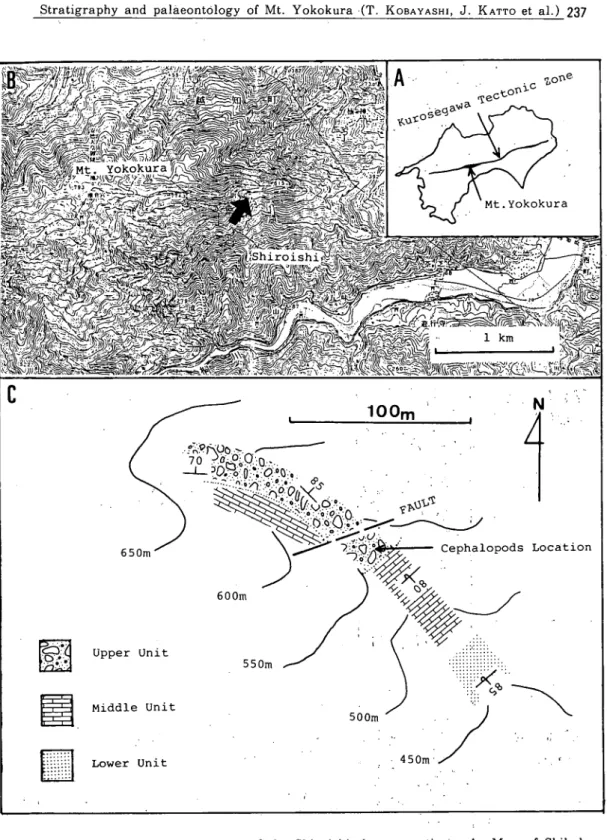
Mt. Yokokura is situated in the Kurosegawa tectonic zone which eχtends along
the outer zone of southwest Japan (fig. lA)。It is famous for various Paleozoic and Mesozoic fossils found within a few square kilometers djl・ea ( fig. IB; pi. n, figs. 1∼
2‘).Thegeology and paleontology of this area has been described by many authors (e. g。 ■ ● ・ . i l ● ・ Kobayashi and Hamada, 1974)。 \ 。’・
Shiroishi-ohsawa, a mountain stream, has been known as one of the most fossiliferous locations in Mt. Yokokura ( fig.‘IB). It is situated in the eastern side of Mt.
Yokokura starting from about 700m of altitude down・ to the village of Shiroishi at 200m altitude. ご.
The section along this route is composed of massive to` brecciated limestone,
limestone breccia, acidic tuff and siliceous 油a!Q,・There is a structural discontinuity at the altitude of 540 meters where an east-west trending fault is inferred. Below this, the beds strike N70゜E and dip 85°S while beds strike N40°'E and dip 70°E in the route
above the fault (fig. lC). The beds below the fムult is皿obably overturned.
Columnar section of the route below the fault is shown in Fig. 2.A sequence of 100 meter thick is observed and divided into three lithofacies units : lower, middle and upper units. The lower unit is about 13 meters thick and composed of massi゛e limestone, bedded acidic tuff and siliceous shale with slump structures. The limestone includes a block of red sandstone. The middle unit is むomposed of interbedded massive limestone and brecciated limestone which includes bl:ocks and lenses of granitic rocks
and red clastic rocks. Brecciated limestone and l・limestone breccia with tuffaceous shale and red clastic matrix are major constituents ・of the。。upper unit (pi. I , fig. 2). Cephalopods occur from the upper units. j 。 バ し I
The limestone exposed in this route is ap皿aritly resec!imentation origin. Kobayashi
and Hamada (1974) pointed out that the Cerauroid.es oricntali,s horizon of breccia-type limestone represents submarine talus deposits along the outer slope・ of the wave resistant reef front. The limestone in this yroute probably is a similar origin。 jl ir‘Recently Kuwano ( 1983 ) reported reworked Ordovician conodonts from this section.
As the limestone is resedimentation origin, such reworking can be interpretable. Red clastic sediments contain quartz, plagioclase, sedimentary rock fragment and
minor amount of volcanic rock fragments arid heavy miりerals. They also contain calcareous fossil fragments and are cemented by carbona‘te crystals。
1●
・● F●
It is noted that the basement rock of Silurian reef 。limestone included Mitaki granites・ possible Ordo゛ician strata and red beds of uりknown age. ’
237
Fig. 1.
Location map
and route map
of the Shiroishi-ohsawa section.
B= Map
of Mt. Yokokura. C = Route
map
of the Sirulian rocks
A = Map of Shikoku, of Shiroishi-ohsawa.
238 100・ m
UPPER
UNIT
MIDDLE
UNIT
LOWER
UNIT
○
Res . Kochi Univ
−---匹四
ヌS〉COVERED
1. 32Limestone
ous shale
Nat. Scibreccia
with tufface-matrix
Limestone brタ(?cia with red shale
matrix
←Cephalopodsニloca七ion
Red sa・ndstone・
lense
Massive limestoneBrecciated limestone
with granite
and red sandstone b:Locks
Greenish acidic
,tuff and sili-ceousブshale
Massive iim‘estone with red sand-
= a ・ し
^ ン ・ . , D
-・゛、
PI. I
Fig. 1. A view of Mt. Yokokura (744.3m) from Ochi Town. The arrow indicates the fossil location at Shiroishi-ohsawa.
へ χ
PI. IJ
Fig. 1. An air view of the southern side of Mt. Yokokura.
The Shiroishi-ohsawa
tributaryis shown
by an arrow to the right and Bakadameshi
cliff to the left.
Fig. 2. An air view of Mt. Yokokura
looking toward ENE
direction. Arrows
from left to right indicate Ohira (Devonian
plant location), Bakadameshi
References
Hirata, S. (1966):Yokokurayama, Shikoku, Japan (in Japanese)Chigafeu-kenkyu, vol. 17, no. 10, 11, 12, pp. 258―273.
Kawai, M. (1971):Geologic stracture of the Yokokura-yama area, Shikoku-Late Mesozoic crustal movements in Shikoku, Outer Zone of Southwest Japan. Part l - Prof. H. Ma£sはsんi£aMem. vol., pp. 91―101.
Kobayashi, T. and Hamada, T. (1974):Silurian trilobites of Japan in comparison with Asian, Pacific and other faunas. Palaeont.Soc.Japa几,Spec.Pap., no. 20, 202 PP, 13 pis. .
Kuwano, Y (1983):Reworked Ordovician conodonts from Yokokurayama, Shikoku, Japan. Jour.Geol. Soc,Japan,vol. 89, p. 245―248.
Noda, M. (1955):Stratigraphy and Geological Structure of the Palaeozoic Formations in the Vicinity of Yokokura-yama, Kochi Prefecture (In Japanese with English Summary). Rep.Earth Sci.,Kjiushu U几dv.,vol. 1, pp. 47―60.
(1964): Some Silurian
Brachiopods from
Yokokura-yama,
Kochi Prefecture,
240 Res. Re Kochi Univ.,・Vol. 32, Nat. Sci
Section n
Silurian Cephalopods from Yokoku陽一yama,
Kochi Prefecture, Japan*
● I . I ・・1 4 . ByTeiichi KOBAYASHI
TheJapanAcademy,Tokyo‥‥‥
Little has been known of the pre-Carboriiferous ‘ cephalopoc!S in Japan. In fact, Michelinoceras hidense Kobayashi, 1958 was solitary for ・ a, long・time. Its age' was first presumed late Silurian, because it was derived from the Fauosites u几iforme subzone. of the Favosi£es hidense zone in the Fukujiヽμjrmatioりand because the zone was considered Ludlovian `or Upper ・Silurian・at that time. Subsequently, Hamada (1959) placed the zone in the Lower and Mi・(!(叫 !:Devonian・ or probably Gedinnian-Siegenian. As the result of study on a rich trilobitむ・faりna of the formation by Kobayashi and Hamada (1977), it is now w辰!・anted that. the Fukuii fauna is within
the range from Gedinnian to Eifelian and pぴjbably 印 e尽rly Eifelian. Thus MicKeli-noceras 扇面“se 16 now pro゛ed to be 8 De゛onian ceph叫opod.
The cephalopods described in this article were collected from . the Cerauroidcs・ orientalis horizon at Gomi quarry of Mt.Yokokura in the up-stream of Shiroishi-ohsawa。 1 ’ 1 200m to the north northwest of Gomi village. The age of the horizon was determined at late Silurian by trilobites (1974) and this age is now further confirmed in the
following article. It was about a half-century ago since I had studied Plectronoceras, the oldest cephalopod (1935). It is indeed a greatトpleasure for me ・to describe here
the oldest cephalopod faunule in Japan. I wish to record my cordial thanks to
Professor Jiro Katto of the Kochi University and Messrs. Tomihiro Mizobuchi and Yukio Sako, two collectors and at the same time Professor Tetsuro ‘Hanai and ’ Associate Professor Itaru Haya万『’万i of the Univer万考ty
。of TO kyo fl`万〇m `″万horn 1 ha゛万e received assistances in the course・ of this studyレ
l s l ●・I
Hirata (1956) was first to discover (:^thoceras sp. at the Gomi quarry of Mt. Yokokura. Later Koizumi (1975) suggested for this cephalopりdKailoceras(?) sp. rather than Parahelni£es from its external view, but this suggestion is superfluous, because nothing is known of its internal structure.!n view of the present collection containing none of the Actinocerida, it is 1鴎鴎 probable that Hirata's cephalopod belongs to either Kailocerasor Para九eZ㎡£es. ”
the following species are distinguishable in the φllection before hand.
of Mt. Yokokura
(T. Kobayashi, J. Katto et al.)
41Family Orthoceratidae
Subfamily Michelinoceratinae 。・ , Genus Michelinoceras
j哨cんelinoceras al£icamera£um Kobayashi, sp. nov・ ルiichelinoceras mizobuc九a Kobayashi, sp. nov. Genus A八〇noceras
・, Arionoceras densisep£um Kobayashi, sp. nov・ Subfamily Leurocycloceratinae
Genus Leurocvcloceras Leurocycloceras(?)sp. indet. Genus Orthocvcloceras
(:^rthocycloceras gomiense Kobayashi, sp. nov. Orthocycloceras aff. gomiense Kobayashi
Family Geisonoceratidae
Genus Protohio几oceras
Protohionoceras(?)fessicancella£um Kobayashi, sp. nov
Beside them there are several indeterminable specimens. Two small ones probably
belong to Ario几ocerasd£Tisiseptura.One of them is cut obliquely to the siphuncle and the other off the siphuncle. Three others are large conchs. One of them which is the largest in the collection has high camerae. It represents probably an undescribed Speφes of Micんelinoceras, although its internal structure is ill-preserved. In
the remaining two large conchs one tapers more slowly and the other more rapidly. The septal distance is comparatively short in the former, but fairly long in the latter. Both of them belong evidently to the・ Michelinoceratinae.
Thus
・the leading group of the Mt. Yokokura cephalopods is the Michelinoceratinae and the second is the Leurocycloceratinae・ All of them are straight or nearly straight conchs, but there are a gentle cyrtocone and a more curved conch, both polished sections
“ot through the siphunclesヽin the collec,tio「1.(pi・E, figs・ ,8 and 9).
. It is noteworthy that three conchs in medium size, ● ゝ .and several small ones are contained on a polish surface of a limestone slab。about 9cm by 12cm (pi. 1V・fig. r l l
4), because it is an example of gregarious occurrence of cephalopods at this locality. ・According to Moore's Treatise ( 1964). the generic range is from Ordovician to Triassic for Michelinoceras ,and from Middle Ordovician to Middle Silurian
■ ● ●
forヽLeuroりcloceras.While the former is a cosmopolitan genus known from North r ● jl ● ・゛ I I ● i
America, Eur-Asia and Australia, the latter's へdistributior! was restricted to 1Middle (?・), and Upper Ordovician of Europe ( Estonia ) to Middle Silurian
of ・ Europe ( Czechoslovakia ) and North America at ; that time. 。However, its occurrences were !ater reported from ,リpP叩 Sil町i叩 of` Middle Asia ( Barsko゛・ 1972) and Ganzhou (,i. e. Kansu), China (Chen et al., 198!). Thus either one of ●“! I I ● . 1
the two genera suggests any definite age・
should be splitted into more ex-242 Res . Kochi・Univ.√Vol. 32 Nat. Sci
actly defined genera. As stated later, Arionoceras・ Barskov, 1966, inclusive of PedenocKonoceras Chen, 1981 is a Silurian-Devonian geniis of
Eurasia. The dis-tribution of or£hocycloceras Barskov, 1972 inclusive of Eut hyrocycloceras T. W. Chen, 1981 is more restricted to the Upper Silurian of Asia. Because
Arionoceraslas well as or£hocycloceras are better represented than other genera in the Yokokura cephalopod faunule, its age must be late ・ Silurian. `。
Now the Yokokura cephalopods are compared with those of lother Asian and Western Pacific areas. Silurian cephalopods were describeリ by R叩d (1906) from Northern Shan States, Burma as follows: ・j
OΓthoceras aff. commu£a£um Giebel from the Zebingyi &dS 07ヽthoceras afi. mocktreense Sowerby ?, ditto.
C)r£hoceras aff. 「cんolianum Blake ?, ditto.
Orth,oceras aff. £enuiannula£um M'Coy from the Namhsim sandstones * Orthoceras sp. indet. from the Zebingyi beds
These Burmese cephalopods are comparedニwith European species chiefly from
the external view. Leurocvcloceras(?) sp. inc!et. from Gomi somewhat resembles Or£九〇ceras aff. nichoUa几um and O. aff.£enuia几nulatum. `So is OrtKocンcloceras gomiense to the latter Burmese species. The resemblances ’in some aspects may, ・however, be superficial.
The Namhsim sandstones are considered middle Wenlockian or younger and the Zebingyi beds late Silurian and possibly early Devdr!ian. As discussed elsewhere
(1977), it is now ascertained that Lower Devonian rocks are included within the Zebingyi beds. 宋
丿Michelinoceras is rep6rted by Myint Lwin Thein (1973)- to occur in the so-called Orthoceras beds in the Lower Silurian Lin we beds 'in the Southern Shan http://www.. ・ ● ● ●although l have not seen'any palaeontological description.
“Fossil C伊仙1叩ods o/(:xu”, 1965.
includes 190 species of Upper Cambrian-Ordovician cephalopods and 10 Devonian species (レe. Nautilina 2, Ammonoidea 8 ) , but no Silurian cephalopod. One year before this publication, however, Lai Chaigeen described two species of Ja4がceras from the Middle Silurian of Sichuan
and Guizhou (Kweichow). ・
In 1974 Chen and Liu described 21 species in」3 genera including 19 new species and 4 new genera from the Middle Sil‘nrian of Sichuan and Guizhou in the Palaeon-tological Atlas of Southwest China. Subsequently in 1978 the Silurian fauna
was further amplified respectively from Sichuan by Wang Ruzhi and from Guizhou by Yang Shengwu. Additional descriptions were made from ’South Tibet by Chen Junyuan (1975) and Chen Tingen (1981). At length Chen Junyuan, Liu Genwu ・ and Chen Tingen ( 1981 ) monographed “ Silurian ・ Nautiloids of Central and .Southwest China” in which they distinguished six nautiloid assemblages as follows:
1 2 3 4 5 6
y of Mt. Yokokura (T. KOBAYASHI, J. KaTTO et aU_243
Medeaval ・Lower Silurian Songんanoceras assemblage Late Lower Silurian yinha几gocerasassemblage Medea val Middle Silurian Sichuanocerasassemblage Late Middle Silurian HeyuTicunocerasassemblage Early Upper Silurian Euthvocyclocerasassemblage Late Upper Silurian Yunnanocerasassemblage.
、Michぷnocer゜s ・「」1ぐ叩゜ninoceras )″li昭1“昭e″ise is a Middle Silurian species in Yunnan. Five species of Pedanochonoceras are all described from the medeaval
Middle Silurian χinshan formation in Sichuan and . Guizhou and four species ,of Euthvrocvcloceras from the early Upper Silurian Miaogao formation in Yunnan.
Because Ped/inochoTioceras and £u£hyrocycloceras are no more than subgenera of ●
Arionoceras and Orthocvcloceras respectively,the Yokokura cephalopod faunule is
allied to the Middle and Upper Silurian ones of Southeast China, if considered in the generic level, although there is no identical species.
Of Michelinoceras there are further one species from Hubei‘, another from Sichuan and two others from South Tibet, all Middle Silurian in・ age, in addition to two Middle Silurian species and one late Silurian species of M. (Kopaninoceras) from South Tibet. Among them one species of Michelinoceras and all three
species from South Tibet are identified with Barrande's species , from' Czecho-Slovakia, showing the Eurasiatic faunal connection.
In Kazakhstan and Middle Asia cephalopods well flourished in the Silurian period. The michelinoceratids are represented by four genera including Arionoceras and≒the
leurocycloceratids by three genera including or£/loりcloceras. Michelinoceras al£icamera£lz肌 closely resembles Barskov's Michelinoceras Mic九elini from the Upper
Silurian of Afghanistan. 0r£hoceras michelini Barrande,・ the type species' of
Micんelinoceras, is more similar to M. mizoろl£chii. Their association with ArioTioceras and Orthocyclocerasreveals intimate relationship of cephalopods between Japan' and・ Middle Asia in the early Upper Silurian °age. The tra ns-Eurasiatic faunal connection must have been maintained during the middle and late Silurian period from Central Europe to the Far East through Kazakhstan and Afghanis‘tan. ’.
Finally, several Silurian species of cephalopods I ゛were reported ‥to occur in Australia and Tasmania already in the latter・ part of last century. According to Teichert and Glenister ( 1952 ) Cycloceras £enuiann 「a£um M'Coy var. aus£ralis Chapman, 1912 is a distinct species of Geisorioceras. Four Silurian species
in four genera of the Cephalopoda are described ’from Tasmania ( Teichert and Glenister, 1953). They belong to er!demic genera except for £μφμor£んoceras which is distributed in ・Eur-America and Tasmania. Little is known as yet of the
relation of Silurian cephalopods between the northwestりern and southwestern Pacific areas. ,. ,.
244 Res. Re . Kochi Univ., Vol. 32, Nat. Sci.
Description of Cephal・bpoda
Family Orthoceratid'ae M'Coy, ■1944,
The essential distinction of the Orthoceratinae⊃from the Michelinoceratinae lies
in the possession of longitudinal furrows on the body chamber. Such depressions are two on the ventral side in OrthocerasBruguiere, 1789, two on each lateral side in BifoueocerasBalashov, 1956, and one on the dorsal side一一and two on the ventral side in CtenocerasNoetling・1884. These three genera ゛e 911 Midd!e Ordovician in age. Mo几o/oueocerasT. E. Chen, 1981 is an Upper Silurian .genus from Yunnan having one longitudinal depression. Thus the distritution of the subfamily extends from
Middle Ordovician to Upper Silurian in Eurasia.
Subfamily Michelinoceratina・e Flower, 1905
Among the genera of this subfamily which are known ‘to occur in Silurian rocks, Arkoceras Flower, 1945 is quite aberrant in the ・ subquadrate cross section of the conch with a subventral siphuncle. j)lagiostomoceras・ Teichert and Glenister, 1952 1S distinctive in the oblique lirae parallel to the sinuous aperture. The oblique
sculpture is stronger in MerocyclocerasRistedt, 1968. レ
Hemicosmorthoceras Ristedt,1968 was originally instituted as a genus of the Sphaerorthoceratidae Ristedt, 1968, while Barsko√(-1972) placed it in the Michelino-ceratinaeSiaoceras cfiinense(Foord)wasprimarily presumed a Devonian cephalopod, but it is warranted at present that this species and Sinoceras rudum (Yu ) are two ti ● l
indices to the Upper and Middle Ordovician `in , Central China. Sinoceras apparently died out later in China, although two Devonian species were described in the USSR by Zhuravleva (1978). This is an unexpected recurrence devoid of any
Silurian link. ●・
A八〇noceras Barskov, 1966, Kopaninoceras Kisselov,・1969・ and Pedanochonoceras Chen, 1981 are three close allies to ルlichelindceras s. str., as Chen has already
● 1
accepted the second as a subgenus of 財必helinoceras. . Ar・ionoceras isdistinguishable ■ ¶ ■ 11from Micheliixocerasby its rapid tapering of the CO叩h with1 apical angle of 7 to li ●10 degrees and its short cameraePedanocho几oceras may be its su been us having the
expanded
connecting ring.
i l 〃Genus Michelinoc。as Foerste,。1932。
This genus is divisible into two subgenera. The septum is contracted at the mural part in subgenus Kopaninoceras Kisselev, 1967, but not in jぼichelinoceras s. str. The former subgenus has generally large conchs; circular or oval in cross section and tapering very slowly ; siphnucle central ; septal りeck orthochoanitic ; connecting ring cylindrical ; camera deposit may be present in th"e apical part. Its type-species is or£hoceras jucundum Barrande, 1870. It was distributed in the Silurian period
from
Central Eiu-ope to Middle Asia and Pamii-・
through Podolia and the Urals.
Nine・species
of A石cんelinoceras
are known
now
from
the Middle
Silurian of China
as
follows:
Michelinoceraseaolue几seχu,1977, Hobei 。. Michelinocerasmoodtease(Foerste, 1928) by Wang, 1978, Sichuan Michelinocerastransiens(Barrande, 1968) by Chen, 1975, South Tibet Michelinoceras chai£ouense Chen, 1975,ぷ£a)/
Michelinoceras。lens (Barrande, 1867) by T. E. Chen, 1981,ぷ££0. 。, Michelinoceras(Ko paninoceras)μicundum(Barrande, 1870) by Chen, 1975,ぷ£to. Michelinoceras (Kopaninoceras)capax(Barrande,1868) by Chen, 1975,。ぷ££o。 ミMichelinoceras (Kopan伍oceras)。dorsatum(Barrande, 1968) by Chen, 1975,ぷμo. /Michelinoceras (Kopaninoceras:)ninがane。eT. E; Chen, 1981, Yunnan
Michelinoceras al£icamera£um Kobayashi, sp. nov。
PlateⅢ, Figure l ,.
Descrip£泌4:− Michelinocχ3ratid with non-annulate ・eonch 6f moderate tapering, circular in cross section ; siphuncle subcentral,・narrow and tubular ; septum ゛fairly convex ; septal‘ neck orthochoanitic ; connecting ring cylindrical ; organic deposit absent in camera and siphuncle. Further details of the species is represented by the holotype
specimen.
Observa£i。:- The holotype specimen is a conch of about 65mm in length wh‘ichis polished through the siphuncle. The shell is not annulated. The terminal part of the conch ・in the polished section belongs 'to the body chamber. Therefrom eight camerae are distributed in 57mm of the siphuncular length. Theがphuncle ・is slightly excentric and・one-siχth to one-seventh as wide as the conch. The diameter of the conch increases from 6mm to 9mm・through the phragmacone. The septal concavity corresponds to 1/2.5 of the camera-height. The septal neck is short and orthochoanitic, foriiiing ah obtuse 4・ .Si ` angle. The connecting ring is tubular and much thinner・ than the"septum. The camera is encrusted all around the walls with calcareous deposits of similar thickness and the
remaining space is filled up with dirt, both inorganic.
Compariso几:-This species resembles Mic加linoceras michelini Barrande, the type-species of the genus, but the conch is evidently expanding more rapidly.
づ MichclmocerasTTiizobitchiiKobayashi, sp. nov。
Plate m。Figure 2
DescrφUo几ご− Michelinoceratid tapering very slowly and having high camerae and septa with very weak convexity; outer shell non-annulate.
Obserひa£ion: − The type specimen 'isa phragmocone 57mm long on which eight camerae are countable. ' The first and eighth camerae measure 5mm and fimm in height
respective-246 Res
. Kochi Univ., Vol. 32
Nat. ScilyレThe conch is obliquely cut and a little displaced l at the seventh camera where a calcite vein penetrates. The siphuncle is excentric, at about two-fifths ・from one side and very narrow, as seen in the Siχth camera. The septal conveχity corresponds to one-third the camera-height or less. The septal neck is orthochoanitic and very short. The connecting ring is tubular and thin. The episeptal and mural deposits ゝ ●11 い・ . i are present. 卜. ト
Comparison: − This conch tapers more slowly .than Michelinoceras aZ£icamera£um. This species has also high camerae. Because the .septa are」ess convex backward in this species, the camerae look higher than those of that spむcies:
I F I
Among the Silurian nautiloids in Asia, this species looks most similar to Michぷnoceras michelini (Barrande, 1870) by Barskov, 1872 ,in figs. 1 ― 3, pi. 2 | ●・ . s1from the Upper Silurian of Afghanistan in the cylindrical・ conch and.1 ● high camerae, but the conch tapers more distinctly and the septa are less conveχ in this species.
Genus /1,・lonocerasBarskov, 1966, em√Kobayashi
Diagnosis: − Conch longiconic, straight or .nearly so, non-annulate, circular or subcircular in cross section and expanding rapidly with apical angle of 7 t0 10
degrees; siphuncle central or subcentral, narrow, .tubular l arid empty; septum moderately cOncave; septal neck short, orthochoanitic or suborthochoanitic; annulosiphonate deposit absent 'at neck; camera short; intracameral deposit大男ay be present: body chamber about twice as long as diameter of ultimate camera. ,
Tタpespecies:- OrthocerasarionBarrande, 1866・\・ ‥
・Remarfes: , The surface of the conch is smooth or SO 「ewKat undulate, but not distinctly annulate. The septal neck varies from orthochoanitic to suborthochoanitic. The a r・; t jsiphuncle is typically cylindrical, but the connecting I・ing is slightly expanded −in the
subeenus PedenOcho几oceras Chen, 1981 (Type: P.edenocん04-oceras contractum Chen, 1981). Compared to this genus the conch is'sul?cylindrical and the camera much higher ・in Micんelinoceras. j, ・ ・
瓦s£riろution・:- Silurian; Eur‘asia. 丿
ArionocerasdensiseptumKobayashi,sp. nov. I
PlateⅢ, Figures 3−5 い,・
Description:-Arionoceratid having straight longicone with apical angle of g degrees or so and circular in cross section ; siphuncle narrow, tubular, slightly eχcentric, about one-siχth as wide as conch's diameter ; septa! neck short, suborthochoanitic ; connecting ring straight ; septal concavity correspoりding∧to about a half of camera-height; septal distance about a half to ・one-third of conch'‘Sdiameter ; camera short ;
body chamber fairly long. 呂'ンー ブ ‥
Obse。a£ion : − The holotype specimen is aいphragmocone, 45.5mm long and polished through the siphuncle. The conch is a, straight loiigicone・which is tapering rapidly,
of Mt. Yokokura (TごKOBAYASHI, J. KaTTO et al.)
circular in cross section and not annulated on the surface. Its siphuncle is subcentral, one-sixth as wide as the conch and ‘tubular, but more or less contracted at the septal neck. The septal concavity corresponds to about a half of the camera-height. The septum is suborthochoanitic, more or less rounded ; septal neck short ; connecting ring slender and straight. Some camerae in the middle part reveal the growth of the episeptal-mural and hyposeptal deposits which are quite distinct . from the secondary calcareous filling.
The paratype specimen is another polished conch through the siphuncle, about 90mm in length where its body chamber occupies 23mm. In the grown stage five camerae are distributed in the length of 24mm. The ultimate camera measures 12mm in diameter. The septum is convex as much as a half of one septal distance. The siph uncle is slightly excentric, tubular and narrow. The internal structure is not so well
preserved as the holotype phragmacone. The septal neck looks short and subrectangular; connecting ring slender. The camerae are filled with calcareous material.
The third specimen is a small straight conch, 37mm long, whose body chamber is 11mm long and the last camera 7min in daimeter. Fourteen camerae are countable in 26mm of Ssiphuncular length. The septal neck is suborthochoanitic. Organic deposits are absent in the siphuncle and camerae. The fourth specimen is a longicone, about 11cm long, and a very little arcuate., The ultimate camera is 17mm in diameter and the body chamber no less than 20mm in length. The siphuncle is a little excentric, narrow。tubular and empty. Intracameral deposits are absent.
Subfamily Leurocycloceratinae Sweet, 1964
This family was best represented in the Silurian period by seven genera as follows :
Leuroc\clocerasFoerste, 1928 。 MetaspyrocerasFoerste, 1932 召0んe肌i£es Zhuravleva, 1962 Orthoc-yclocerasBarskov, 1972 EutH-yrocjiclocerasT. W. Chen, 1981 ObicyclocerasT.E. Chen, 1981 χlanoxiangocerasT. E. Chen, 1981 . ’
Among them the diagnoses for Orthocyclocerasand Euthyrocvcloceras,bothUpper Silurian in age,・agree with e戸ch other in most items, although the correspondence of an annulus to each camera is emphasized for the former and the siphuncle is said either central or excentric in the latter, instead of central ‘in the ・former. Their difference is no more than a subgeneric value. ・ .. ・.
248 Res. Re
Kochi Univ., Vol. 32, Nat. Sci
Genus£euroりicloceras Foerste, 1928。
£eurocycloceras (?) sp. indet. ” ● i l ll`・ ` PlateⅣ, Figures la-lb
A stout slowly tapering orthocone, about 85mm in length, with annulation and fine longitudinal lirae. Ten annuli are countable through the adoral 29mm and adapical 16mm. They are nearly straight, transversal low bands separated from one another by shallow interspaces and both crossed by very fine regular and numerous longitudinal
lirae. At the broken end of the conch it is seeii that the transverse section is subelliptical and the siphuncle is a little eχcentric and nearly as wide as one-fifth the shorter diameter. Because little is known of the internal structure, its exact
taxonomic position is indeterminable. \
Leurocycloceras tushufee几se Barskov,1972 ( pi. 3, fig. 2) from the Upper Si-lurian of Fergana closely resembles this form in ,the low transverse annulation. Leuroc-ycloceras raymondi Foerste,1928, from the Niagaran of Wisconsin which
is the type-species of £eurc Cvcloceras is annulated obliquely and the annul us is sinuated ventrally. Among American cephalopods SoNToceraschaleurense Foerste, 1936, from the Niagaran of Quebec has the more similar sculpture to this species. although the annulation and longitudinal liniation appear less prominent.
Among the oriental cephalopods Orthoceras aff. nicholidnum Blake (?)by Reed, 1906 from the Zebingyi beds of East Burma has the cancellate sculpture, but the rings are very narrow. Orthoceras aff. tenuiannula£um fi・om Burma, later mentioned,
has also the cancellate ornaments, but not very simlar to this species.
Genus or£んocycloceras!Barskov, 1972 ■
Three specimens at hand are referable to this genus。
OrthocンclocerasgomienseKobayashi,new species。
PlateμI, Figure 6, Plate IV, Figure 2
・Description,: − Annulated longicone, nearly straight, but more or less sigmoidally undulated and circular in section ; siphuncle snbcentral, narrow, tubular and empty ; septum moderately convex and orthochoanitic ; sepfal neck very short ; connecting ring straight; camera・short and eχpanded laterally in accordance with annulation: camera-height comparatively reduced in grown stage; body chamber about three times as long
as diameter of ultimate camera.
Observation : − The holotype specimen is .a polished section of an annulated orthocone, 44mm long, in which its body chamber occupies 17mm. The conch is slowly
tapering, more or less arcuate in adapical part, circu!ar in・ cross section with a narrow slightly excentric siphuncle ; each annulation‘ corresponding to a camera・ The diameter of the conch at the contraction measures 4mm, 5mm and 7min at the
or less the diameter of the conch and empty ; septal neck orthochoanitic, very short; connecting ring straight; 10 camerae countable in the length of 18mm of phragmacone ; septal convexity approximate to a half of camera-height ; camera filled up with calcareous material except for the last two. The ultimate camera is unusually tall whereas the penultimate camera is much shorter than earlier one. This irregularity
is prol?ably due to senility.
The paratype specimen is another annulated conch, 48mm in length with a narrow subce‘htral siphuncle. It has 24 annuli which are all transversal, non-sinuate and slanting from crest more on the adapical side than the other side ; ヽンery fine lirae visible on the adoral slope of the annulation. ..
Compariso几: − This species is . closely allied to Orth-ocvcloceras alayense and O. fergane几se,particularly to the former species which is the type-species of the
genus, but the conch tapers more rapidly in this species than those two species.
Compared to this all of the four species of Eutりroc^iclocerashave more dense camerae and their annulations 100k less prominent.
0r£hoceras aff. £enuiann 「a£um M'Coy by Reed, 1906, from the Namhsim sandstones in East Burma whose internal structure is unknown, is a coarsely annulated cycloceroid having, in addition, longitudinal lirae. It is compared to M'Coy's Ludlovian
species. This Burmese species differs from the Japanese species in the much wider concave interspace and slightly ・oblique annulation.
0r£/zoりclocerasaff. gomiense Kobayashi
PlateⅢ,・ Figure 7 ’
This specimen is a long straight conch about 12cm in length which is displaced along a calcite vein between the adapical and the middle-adoral parts. It is camera ted all through the specimen except for the broader terminal part which belongs to the body chamber. The apical angle is about 。10 degrees. It is recognizable at the narrow end that the conch is circular in section and the siphuncle located at or near the centerグ Compared to the preceding species the siphuncle is a little broader as seen in the middle part. The camera is encrusted by the episeptal and mural deposits in the
adapical part, but not the middle and adoral parts. Like the preceding, the conch is annulated in the adapical part, althoリgh the annulation is ill-preserved in the other part. ● ●,
Family Geisonoceratidae Zhuravleva, 1959 ・
Genus ProtofeionocerasGrabau and Shimer, 1910
1 ダ j)rotokio几oceras(?)fessicancella£um Kobayashi, sp. nov. ’・
' Plate IV, Figures 3a and 3b
250
Res. Rep. Kochi Univ., Vol. 32, Nat..・Sci.
tapering quite reduced on the other side of thS・ donch: she!i surface marked with fine lattice of lirae. 尚
Septal suture transversal as seen in the 。.exfoliated apical part. Because the broken end of the other side is non-septate, the part must b9・!ong to the body chamber. Little is known of the interior of the phragmacone. I S
The lattice of lirae in this species is riot 斗D distinct as in Protofeionoceras crooki Foerste, 1928 and even weaker than that of ?rd£o后ohoceras medullare (Hall), the genotype species. The cancellate・ornamentation isしtypica! of・ Protohionoceras,
but the conch is longiconic and orthoconic inニthe genus, whereas it is breviconic and somewhat cyrtoconic in the apical part of this speeies.' In the shape of the ‘conch it resembles polyelasmoceratids。Turoceras Zhuravieva, 1959へfor e又良mpie. ‥
References
Barrande, J. (1865―1877), System silurien de centre de 。la Bo臨me. Primiere Partie : Classe de Mollusques, Ordre de Cephalopodes, pts. 1−9。恥pβlement, pts.卜2.
Barskov, J. S. ( 1972 ) , Late Ordovician and Silurian cephalopod Molluscs of Kazakstan and Middle Asia. 107 pp.(12 pis.) ‥
Chan Chin-k' K'e, Laing Hsi-luo, Tsou HsiごP'ing.・ Lai T'sai-ken and Chang Jih-tung (1965), Fossil Cephalopoda of China. 389pp∠85 pis.
Chen, Yuan-chen ( 1975) , Fossil Nautiloids from Mount Jolmo Lungma Region. p・ 267 ― 309, (9pls.). Tibetan Scientific Expediti・n Team, Academia Sinica : Report of Scientific Expedition in the Mount ,Jダ)lmo Lungma Region ( 1966 − 1968)・ Palaeontology, Fasc. 1,423 pp. ▽ /, ト
and Liu Genwu (1974), Silurian nautiloids,・p.190 ―194, pis. 87-90. Naniin
and Chen Tingen (1981 ) , Silurian Nautiloid Faunas of C e n t r a l S i n i c a ,
(1943), Annulated orthoceraconic genera of Paleozoic Nautiloids. Bull. Am. あ .・.OD −.,lnn .I ,’二j ,: ’・. ’, ’
(1943)・Some
Silurian cyrtoconic cephalopoc!・lfrom Indiana with notes on strati-7
De几・ison
(1934), Silurian cyrtoconic cephalopods
from
Ohio, Ontario
and other areas.
・ W ’ ・ − 皿
. ″ i
( 1 9 5 8 ) , A G o t l a n d i a n n a u t i l o i d f r o m t h e H i d a p l a t e a u i n J a p a n . T r a n s . P r o c . ● f 啄 ’ f ・ 4 ・
Instituteof Geology
and Palaeontology, Academia
Sinica: Hand-Book
of Stratigraphy
and Palaeontology of South-West Region.
454 pp. 202 pis.
and Southwestern China. Mem. Ndnjin j,!St. GcoL Palaeont。・Acad. No.13., 104 pp. 40 pis. ’‘ レダ’
Chen Tingen (1981), Some Nautiloids from Xizang・ (261 − 282, 5 pis. Tibet叩 Fossils,Fasc. 3, 354 pp. ” ・
Flower, R. H. (1939), Study on the Pseudorthoceratidae.Paleont. Amer.,リ'. 2, no. jθ p●253―142, pis. 23-31. ∧ ;
Paleont., V.28, no. 10タ.
graphic problems. Ibid:. no. 10タ.. , ・
Foerste, A. F. (1928), A restudy of American orリloconic‘Silurian cephalopods・ U几iv. Bull.J. Sci.Lab. V.23, P- 236−320, pis. 48-75. 7
Ibid。V. 29, p』07-194. ・ .・
‘ − (1936),
Silurian cephalopods
of the Port ’
Daniel
Areas
on
the Gaspe
Pe- ninsula,in eastern Canada.
Ibid. v.31, p. 29―92, pis. 4-26.
Hamada,
T. (1959), On the taxonomic
position of Favosites hidense and its Devonian
age. Japan. J. Geol. Geogr.
V.30,p. 201―212,・pi-15ン 二 ご
Hirata, M. ( 1965) , Discoveries of Orthoceras and Graptblites from the Gotlandian
System of Mt. Yokokura, Ochi Town, Takaok!1 County, Kochi Prefecture. Chigakv^kenkyu, v』6,no. 8,p. 247―248. /
Kobayashi, T. (1935), On the phylogeny of the primitive nautiloids with description of Plectronocerasliaotungense, new species and Iddi几lesia(?)shantungensis,new species.
1
Palacoat. Soc. Japan,N. S., no. 31, p. 248―252, pi. 37.
IVI--●WVw● wミr"'Z ̄ 一一 −, _
and Hamada, T. (1974), Silurian trilobites of Japan in comparison with Asian
and
-jUQI J.iJ.l'lJ-りり●-VIWvw・ vミJ""● 'j- '-・-・ ' 一一
(1977), Devonian trilobites of Japan etc.Ibid・, no. 20・202 pp. 13
b●・¶Ww ’一一F  ̄ ̄ , - ̄ (1953), Ordovician and Silurian cephalopods from Tasmania, 一 一 一 一 一 一 一 一 ‥ P a c i f i c a n d o t h e r f a u n a s . P a l a e o n £ . S o c . J a p a n , S p . P a p . , n o . 1 8 , 1 5 5 p p . 1 2 p l s ・ − − ニ゛ ● 八 j
and Igo. H. (1956), On the occurrence of (>otalocephalus,Devonian trilobites
and Glenister, B. F. (1952), Fossil nautiloid faunas from Australia. Jour
and
pis
in Hida, West Japan. Jopan. J..Geol. Gcogr・,u. 27. p. 143-155, pi. 10. Koizumi, H. (1975), Paleozoic cephalopods of Japan. 149 pp. Teiseki Bunko.
Lai, Chaigeen ( 1964 ) ,Jongziceras− a new Silurian nautiloid genus. Acta Palaeont, Sinica,V.12, no. 1. p. 116―128, (pi-
D-Reed, F. R. C. (1906), The Lower Palaeozoic fossils of the Northern Shan States, "Burma. Palaeont.」Indica, N. S.,ミ:;.2, mem. no. 3, 154 pp., 8 pis.
uui 111a. J LX(/LAりV●●w●』●-w。-,ミl°” ∼’i゛ ̄● −− _
Ristedt, H. (1968), Zur Revision der Orthoceratidae. Abh. Math。Nat. Kl,Afead. Wiss. Li£. Mai几4 Jahrg・。 Nr.4 , 287, pp. 5 pis.
Shimansky, V. N., Balashov, Z. L. and Zhuravleva. F. A. ( 1962) . SuDerorder Nau- tiloidea, p. 33 ― 169, pis. 1―44- Orlov's Osnoby Paleon£ologii, 438 pp. 89 pis.
Shimizu, S. and Obata, T. (1935), New genera of Gotlahdian and Ordovician nautiloids。 。−
ShanghaiScレInst,Jour.,ser. 2,り. P, p. 1-10 kJI゛゛゛Wic.ttp://www.J .w..ミ.-lww’∼・ ̄ ・a
Teichert, C. et al. ( 1964 ) , Cephalopoda. Moore's Treatise on Invertebrate Pal-eontology, Part K,Mollusca, 3, 519 pp・
Paleont., v. 26,几.0. 5, p. 730―752, pis. 104―108.
Australia. Bui£Am. Paleont.,u. 24 , no」'44, p. 5-54, 6 pis. Thein, M. L. ( 1973 ) , The Lower Paleozoic stratigraphy of western part of the Southern Shan State, Burma. GeoL S()c.Mala-ysui,BulL6. p. 143-163.
Troedsson, G. ( 1931 ) , Studies on Baltic fossil cephalopods. I . On the nautiloid genus Orthoceras. Lunds Uaiu. Arsssferift, N. F. Aud. 2 . Bd. 27 , Nr. 16 , p. 5-34,4 pis.
Wang, Ruzhi ( 1978 ) , Nautiloidea, p. 402 − 431, pis. 153 − 164. Southwest China Institute of Earth Sciences : Fossil Atlas of Sout九wes£ C九ma, Fasc. Sichuan Region (1), Silurian-Devonian. 617 pp. 185 pis.
Yang, Shengwu (1978), Nautiloidea, p. 358 − 383, pis. 132 ― 142. Guizhou Research Tea 「・ of Geology and Palaeontology : Fossil Atlas of Southtuest China, Fasc. Guizhou(l), Cambrian -Devonian. 843 pp. (214 pis.)
Zhuravleva, F. A. ( 1978), Devonian Orthoceroids of Superfamily Orthoceratoidea. Trudi Paleont,last。torn. 168, 222 pp. (23 pis.)
Postscript
As an advance report,“On the Silurian Cephalopod Faunule from Mt.Yokokura,
Kochi Prefecture, Japan” was communicated by the author at the Japan Academy
meeting, November 12, 1983. It was pointed out that the route of migration for the Silurian cephalopods was extended from Japan to Central Europe through
China,
Pamir, Central Asia and Podolia, and two new speciesArionoceras densiseptum and Or仇oc%icloceras gomienesewhich occur in association with Mic九elinoceras cc and β, n. Spp・Leuroorthoceras(?)sp. indet. and Protofeiorvoceras (?)n. sp. were briefly described in Proc. Japa几AcaA Vヽ59一且p. 293-295,!983.
Explanation of Plate Ⅲ
MichclinocerasalticameraturaKobayashi, sp. nov・ ‥‥‥‥ Figure 1. Holotype conch, X 1, KGS3580
Mi.nh.p!.i,ROcerasmt2r)buch,iiKobayashi, sp. nov Figure 2. Holotype conch, ×1, KGS 3581
Arionocerasdensiseptum.Kobayashi, sp・ Orthocycloceras a!i. goiniense Kobay Gen. et sp. indet. a Gen. et sp. indet. p ・ p , p ・ p p p p 245 245 246 248 249 241 241 Figure 3. Holotype conch, ×1.5, KGS3582
Figure 4. Paratype conch, ×1, KGS 3583 Figure 5. Small conch.×2
OrthocyclocerassoTTiienseKobayashi, sp. nov‥‥‥‥ Figure 6. Holotype conch,×2, KGS 3585
Figure 7. Large conch X 1, KGS 3586
Figure 8. Gently curved conch, ×2
2 6 8 丁 卜 ・ ・ 9 PI.Ⅲ r 卜 卜 ″ t j ・ ぢ
Explanation of Plate IV Leurocycloceras(?)sp. indet. Figure l a. Lateral view of Figure l b. Transverse annuli samespecimen, ×5 一一一一-ミミミ=●・・・・●■●●●●●●●●●●●● annulated conch, KGS 3584 and longitudinal lirae of the
Orthocyclocerasgomiense Kobayashi, sp. nov
Figure 2. Lateral view of the paratype conch, with annuliand longitudinal lirae, ×1, KGS 3588
p. 248
.... p. 248
transverse Protofeionoceras(?)/essicancellatum Kobayashi, sp. nov・
・,‥‥‥.‥‥‥ p. 249 TiJFigure 3 a.り_ T j l ・ 聶.● ● − −Lateral view of the holotype conch,×1, KGS 3587
Figure 3 b. Lattice of lirae on the surface of the same conch, ×7 Cephalopod-bearing- limestone .slab‥‥‥‥,
…‥p. 241
Figure 4. Three medium-sized conchs and several small
ones
on the polished surface. ’
Repository of the specimens
2
1b
SectionⅢ
Advance
Report on anew
Trilobite
Collectionof the Silurian
Yokokura-Yama
Fauna, Shikoku Island,Japan*
by Teiichi KOBAYASHI and Takashi Hamada The Japa几Academy & the Uniuersity of Tokyo
Mt.Yokokura is one of the richest trilobite areas in Japan.・ As shown in
the Table l the authors have described already in 1974, 27 species in 14 genera and seven families of trilobites, that is, the Illaenidae,‘Th ysanopeltidae, Proetidae, Cheiruridae, Encrinuridae, Phacopidae and Lichidae. Beside them,
there were several forms exact!y indeterminable. They were collected by M. Hirata and others from three localities of the mountains, i. e., Mt. summit, Sugihara
shrine and Gomi, but most of them were procured at Gomi limestone quarry. These !type specimens are stored either in the Kochi Prefectural Fossil Museum
( KPFM ) or the University Museum of the University of Tokyo(PAt). As
the result of that study the age of the £几crinuri£Snodai horizon at the summit was determined to be late Middle Silurian, and those of the Encrinurus£osensis horizon at Sugih・ara shrine and the Ccrauroides orientalis horizon at Gomi quarry to be early Upper Silurian, but the former being slightly older than the latter
horizon.
Recently, a small collection comprising eleven trilobite specimens from the Gomi quarry was sent to the ・senior author from Professor Jiro Katto of the Kochi University for examination and the joint authors' study is now in progress. By request of Prof. Katto they prepared an advance report of their study herein.
Putting .aside a cranidium which is too poorly preserved the following eight species in six genera within five families are distinguishable at present.
I. Illaenidae Hawle and Corda, 1847
1. 召1μnas£usagmakros Kobayashi & Hamada・ sp. nov・ 2. Bumas£us ka££oiKobayashi & Hamada, sp. nov. 7 3.召umast us sakoi Kobayashi & Hamada, sp. nov. ` ‥
n. Cheiruridae Salter, 1864 `● `
4,Pseudocheirurussp● ゛ .バ ダ 「
t ・
254 Res.
Table l
. Kochi Univ., Vol. 32, Nat. Sci
Silurian trilobitesfrom Mt. Yokokura
CKobayashi
& Hamada,
1974)
Locality
Trilobites l
ji
白
白
J
匈 k4 吻 .£] ・F叫 tM) コ C/つ ・r4 臼 ○ ○1. Bumas£us (Bumastus) glomerosus 2. Bumastus aff. 6αΓiensis
3. Bumastus (Bumastus) subquadratus 4、Bumastus (Buraastella) spiculus
5.召umas£us (Bumas£dlり1)φa4c£α£us χ’ X X X X
6. Bumastus (Bumastella) as per 7. Japonoscu£ellu脚力ipon必乙im . 8. Tosacepfialus Junが,/orrriis 、、 9. Illaenoscutellum platiceps 10.Kosouopeltis a几gusticostatus X X X X X X X
11. Microscu£ellum primigenium
12、Proetus (Proetus) suboualis
13..Proetus (Gerastos) subcarinatus
14. Proetus (Geastos) s昭iharensis
15. Proetus (Bo八emiproetu幻magnicerviculus
X X X X X16. Iニ^ecoroproetus
granulatus
T7、Cerauroidesorientalis
18. Cerauroideselorigatus・7 /
19. Sphaerexochus hiratai
20. SpKaerexohusplanirachis
X X X X X 21. Encrinurus yofeofeurensis 22、Encrinurus mamelo几 23. Encriaurus nodai ∠ 241 Encrinurus tosensis 25. Staurocephalits(?)sp・ X X X X X26.Phacops
metacernaspis
習、Apolichas truncatus
X XHI. Encrinuridae Angelin, 1854 5, Encriaurussp・ 6. Staurocephalussp.
IV. Phacopidae Hawle and Corda, 1847 7. Eophacops(?)sp.
V. Lichidae Hawle and Corda, 1847 8. Apo瓦chas (?) sp.
One of the significant characteristics for the Gomi faunule is the abundance of
召lμnas£us in species and individuals. In adding three new species, the genus is now represented by eight species. In South China the family Illaenidae include
?£ぷllaenus and two endemic genera, Mei£anillaenus and Wuchuanella in the Lower
Silurian fauna, but 召umas£us is unknown from the Silurian rocks ( Yin and Li, 1978), although it is contained in the Ordovician fauna (Lu, 1975).
The find ・of Pseudocheirurus at Gomi is particularly important, because it is an additional evidence for the Upper Silurian age of the Gomi faunule.
Pseudocheirurus bりrichi (Barrande, 1846 ) occurs in Bohemia, Czechoslovakia
in the lower Ludlovian Kopanina formation ( Horny and Bastl, 1970 )。 It is noted further that Nan's Cheirurus strabo ( 1976 ) from the Upper Silurian
of Inner Mongolia is ‘ possibly congeneric with this species, although original Cheirurus strabo・Weber, 1932 which was described from the Lower Devonian of . Ferghana, Turkestan, is distinct from the Japanese species・。
■ ・ ● ● ● ●
As clarified by Wu Hongji ( 1979 ) , encrinuroids greatly flourished in Southwestern China in the Middle Silurian period, as well represented by Encr伍uroides Reed, 1931, Coronocephalus Grabau, 1924 ( Coronocephal。 and Coronocephalina Ji.
1979 )Kailio Chang, 1974 (尺aぷa and Parahailia Ji, 1979 ) , Senticuculus Xia, 1974 and 7?ongxiella Chang, 1974. Encrinuroides has been known from Middle and Upper Ordovician of Eur-America, but in China it occurs in the range of the late Ordovician-middle Silurian age. All other genera and subgenera above
cited a陀 indigenous to China except for one species, Coronocephalus kobayashii Hamada, 1959, which must be revised in further study, from the late or medeaval Middle Silurian G2 stage of the GioriTyama group in Kyushu.
Thus the ages of the trilobite horizons in the Gion-yama・ and Yokokura-yama al‘eas are further confirmed through this study. The absence りf 召zμnastus and rarity of
Encrinurus in the Silurian fauna of Southwest China 尽re probably・ due to the
state that little is "as yet known of the .Upper Silurian trilobites there, notwith-standing the fact that the copious trilobite fauna of the older Silurian age has already been described therefrom.
0f the remainder of the new trilobite ・ collection it is still premature for the
authors to express any definite opinion. A few words, however, may be added as to StaurocepKali↓s・SP; ltン is evidently distinct specifically from Staurocephalus(?)
sp. which the authors have described previously. This species looks to the authors particularly interesting palaeontologically in showing an example of homoeomorphic
convergence with Paraphillipsinella Lu, 1974 which thrived in China in the late Ordovician age, as summarized by Ji Zailiang (1982)。
256 Res . Kochi Univ. Vol. 32
Description
of Trilobites
Family Illaenidae Hawle and Cord a, !847
Genus召umastus
Murchison, 1839
召zμnas£us agmakros Kobayashi and Hamada, sp. nov. ’
Plate v。Figures l a,b
An unusually long pygidium, 29mm long, a little narrower than long, semiparabolic in outline, very regularly and moderately convex toward its centre ; articulating margin very gently arcuate: axial lobe nearly half al; wide as pygidium ; axial furrows completely effaced; marginal border absent; test smooth.
Such an elongate outline of the pygidium and its simple convexity are two charac-teristics which easily distinguish this species from most of the Illaenidae. Its
broad axis and obsolete axial furrows reveal its being ’a member of Bumastus rather than S£enoparia. It resembles Ulaeaus Lueben Warburg, 1925 from the Leptaena limestone, but the Swedish pygidium is not S0 long as this, steeply slanting near the margin and ’surrounded by a less slanting narrow border. Weber's召umastus Sp・
2 from the Ordovician of Kazakhstan (1948) is another resembling pygidium in simple warping up toward centre, but its outline is quite different from this species.
Bumas£us kat£oi Kobayashi and Hamada, sp. nov。
Plate V, Figures 2a・−b, 3 a-d.
Cephalon strongly convex, most elevated between eyes and most expanded laterally through eyes; axial furrows obsolete; occipital' margin about half as wide as posterior margin ; genal margin well rounded ; eyes prominent, very large, nearly half as long as cephalon and located fairly posteriorly ; facial suture extending forward from eye,
describing a gentle arc, and posteriorly cutting the posterior cheek margin at the limit of eye; test smooth. ●
This species is represented by two cephala. One in figures 2a-b is the holotype and the other in figures 3a-b the paratype. It is inti・mately・ ・related to the Burれas£as(召umas£ella)'bφunc£a£us from which it can be readily distinguished by the
absence of the median tubercle and a pair of pits oh the axial furrows. Otherwise, however, these two species are almost identical.
召umastus sakoi Kobayashi
and Hamada,
sp. nov.
Plate
V,
Figures 4 a−d’゛
This cranidium is fairly well convex
toward
its centre.
Axial furrows
are absent,
but in the posterior view
the fixed cheek is seen to t!eslightly depressed below
the
between the eyes equals to the length of the cranidium. Facial sutures are relatively 畑ng. almost straight and a little divergent, but they do not extend beyond the limit of the eyes. Their posterior branches are very short and cut the posterior margin on the parallels of the eyes・ ...
¶ I I- ds‘ ’ 1● .
The preceding species can be easily distinguished from this species by the greater convexity of the cephalon and the larger and prominent eyes. Among the Yokokura-Yama trilobites the nearest to this species is Bumas£aS(召umas£司a)asper which, however, disagrees with that species in the possession of a fine median Carina on the cranidium and the smaller eyes. ,
References
Hamada, T. (1959):Gotlandian shelly fauna from Southwest Japan 出,Coronocephalus kobayashii, a new species from the Kuraoka district, Kyushu, Japan. Japan. ・Jour.Geol. Geogr・,vol. 30, pp. 71-88, pi. 6.・ ,
Harrington, H. J. et al. ( 1959 ): Arthropoda 1, Moore's Treatise on Invertebrate Paleontology, Part 0,560 pp.
Horny, E. and Bastl, F. (1970): Type specimens of fossils in the National Museum, Prague, vol. 1, Trilobita. 154 pp・, 20 pis. ..
Ji, Zailiane (1982):StratierraDhical distribution and range of the trilobite family Phil- lipsinellidae in South China. Bull. Geol. Inst., ChineseAcad.,57-68. pi. 1.
Ko・bayashi, T. and Hamada, T. (1974):Silurian trilobites of Japan in comparison with Asian, Pacific and other faunas. Palacont.Soc. Japan,・Sp.Pap., no.20, 202 pp・ 13 pis.
Lu, Yenhao (1975): Ordovician trilobite faunas of Central and Southwestern China. PalaeoatologicaSinica,no. 152, 463 pp., 50 pis.
and Chang, Wentang (1974): Ordovician trilobites. pp. 124-136.Nanjin. last.
Chu
Chaoling,
Chien Yiyuan and
Hsiang Leewen
(1965): Trilo-( 1946 ): Trilobites of Silurian formation of USSRMonog r. Palaeoat.
0/ pp・
Southu)pst China, Fasc. Guizhou (1) , Cambrian-Devonian, Acad 843, 214 pis.
Geol. PalaeoRt.. Acad. Sinica: Handbook. 0/ the stratigraphy and palaeontology of Southujest (:フlina. 454 pp., 202 pis.
bites of China. 2 vols. 766 pp・, 135 pis. Nanjin Inst. Geol. Palaeont., Acad. Sinica.ChineseFossilsof All Groups・
Nan, Runshan ( 1976 ): Trilobita. pp. 333 − 352 in Palaeontological Atlas o/ North. China.Inner Mongolia, Volume (1), Palaeozoic. 502 pp., 232 pis.
Warburg, W. (1925): The trilobites of the Leptaenalimestone in Dalarne, etc. Bull. Geol. Inst,Upsala,vol. 17, 446 PP-.」l pis.
Weber, V. N. (1932):Trilobites of the TurkestanMem. Comm. Geol,USSR,N. S., 178, 157 pp. 4 pis.
USSR, vol. 69, 113 pp., 11 pis.
Wu, Hongji (1979): Silurian Encrinuroides( Trilobita ) from Southwestern China. Acta PalaeontSinicQ,vol. 18, no. 2, pp. 147―150, pis. 1,2.
Yin, Gongzheng and Li, Shanya (1978): Trilobite. pp. 385 ― 595 in Palaeo几tological A£1αS