Developing a Post-disaster Sustainable Tourism Model
For Tourism Revitalization:
Analysis of Sichuan's Response to the Wenchuan
Earthquake in 2008
Li Ying 51210001
Fall 2011
Thesis Presented to the Higher Degree Committee Of Ritsumeikan Asia Pacific University
In
Partial Fulfillment of the Requirements for the Degree of Master of Science in International Cooperation Policy
DECLARATION
I hereby affirm that this research in its entirety is my work through study and inspiration and not a reproduction of previous works towards the Master Degree in International Cooperation Policy from Ritsumeikan Asia Pacific University (APU), Japan and has not been submitted for another degree at any other university.
This thesis contains my own work except where due acknowledgement has been made, that ideas and concepts were borrowed from other sources which have been duly referenced accordance with the standard referring practices.
LI Ying
ABSTRACT
It has been three years since the 2008 Wenchuan earthquake (Sichuan Province, PR China). From the government perspective the year 2011 is the last year for the reconstruction phase, and restoration and reconstruction work in most cities has been basically completed. In addition, the people's basic living conditions and the overall level of socio-economic development has surpassed pre-disaster levels. As the only sector which was suspended completely in the disaster area right after the earthquake, but nevertheless identified and cultivated as the leading industry for the reconstruction, tourism has played a major role in the economic recovery of Sichuan Province in the three years. From the devastating earthquake until now, the industry has seen a leap forward in development. The total tourism revenue of the province in 2008 fell to 109.15 billion RMB but rapidly increased to 188.61 billion RMB in 2010, and it is likely that it will continue to follow this pattern in the coming years. At the recent Sichuan International Cultural and Tourism Festival (Chengdu, Sichuan, 18-22 April, 2011), UNWTO Executive Director, Zoltan Somogyi, said "...tourism has been a strong driver of the economic recovery in the province” (WTO, 2011b). Granted, tourism is a good business, and yet people cannot ignore the uncertainty and vulnerability attribute of this industry, especially in an increasingly disaster prone world. However, good post-disaster management can help mitigate the negative impacts to a large extent. The successful tourism response management of the Wenchuan earthquake provides practitioners and theorists of crisis and disaster management of tourism with much to consider. In Zoltan Somogyi’s speech, he also stated that “the success of Sichuan confronting the quake will by all means contribute to the global wisdom of crisis management” (WTO, 2011a).
This thesis begins by reviewing current tourism crisis and disaster management models before raising authority's statement of a three-phase separation of Sichuan tourism industry's response to the Wenchuan Earthquake. With making use of evidence-based analysis to test whether the response in the real world corresponded to authority assertions. The thesis then identifies Sichuan’s post-disaster framework for tourism revitalization based on comprehensive analysis of government, local community and tourists' responsive behavior in three phases. Finally, the thesis discusses the reasons for their successes and points out possible shortcomings, and aims to contribute to future crisis management.
ACKNOWLEDGEMENTS
To Prof. Dr. Cooper M.J.M., my deeply respected advisor and mentor. In the one and a half years, this wise and profound scholar who is aged between my father and grandfather has been given to me grandfather's affability and kindness as well as father-like earnest guidance. Despite his tight schedule with heavy administrative and academic load, his careful revising for my thesis even reached the details of punctuation. I could not have finished this thesis without his patience, insightful suggestions and unfailing encouragement.
To the Sichuan Research Institute of Tourism Planning, Vice-President Dr. Wen Xueju, my appreciation is due for her acceptance of my interview at her Chengdu office in March, 2011. I would like to record my heartfelt thanks to her for continually offering me valuable official permitted data and sharing her discerning view regarding the government response to the Wenchuan Earthquake. Our communication has been kept up by email since I left Chengdu, and her professional attitude, knowledgeable ideas, patience and encouragement in her response emails have inspired me throughout this study.
It was my genuinely great honor to join the ENVOL Program in second semester. For one year, this splendid program of the APU Graduate School has offered me countless opportunities to enlarge my views by listening to ENVOL guest lectures, broaden my horizons by participating in domestic field studies, and cultivate my self-confidence by presenting papers in many symposia, seminars and workshops. In addition, my sincere gratitude is due to the ENVOL laboratory for providing me with a very quiet environment for writing which enabled me to focus on the completion of this thesis. Many thanks to Prof. Dr. Sanga Ngoie for his great efforts in bringing ENVOL to APU, and making this program vigorous and fruitful.
The field work and interviews for this research were conducted during Mar 15 to Mar 21 2011 when I was able to make use of the RCAPS Master's Students Field Research Program of APU. My sincere appreciation is due to this program for sponsoring my visit to the study area to better my research.
To the following people who in various ways kindly supported me in the completion of this thesis. I would like to express my sincere appreciation to Prof. Jeremy S. Eades, as an observer student in his class, my questions about my research out of the class always got his generous help and profound suggestions. I also felt thankful to Prof. SATO Yoichiro, as a previous student and current teaching assistant for him, I truly appreciated his recommendation on reference books on political topics. Special thanks to my friend Seo Bo Kyung, her calling almost every night to share funny things and puzzles in our daily life greatly relieved my writing stress. Also I would like to show my appreciation to ENVOL classmates and Assistant Prof. Kobayashi Shoko and Assistant Prof. MAHICHI Faezeh for their encouragement and advice. I also owe my appreciation to Mianzhu New Year Painting Village's community for kindly accepting my interview and my special thanks to the Sichuan Tourism Administration (SCTA) for their arrangement in scheduling an interview with Dr. Wen, and also my appreciation goes to two senior volunteers in the Kobe Disaster Reduction and Human Renovation Institute for guiding my visit and providing me with reading materials. In addition, I would like to give my big hand to my cousin JIN for delivering one of reference books from China to Japan when I need it most.
Last but not least, I wish to extend my deepest appreciation to my beloved parents, their warm concern, even be separated by thousands of miles, thanks to Internet can warm my heart, always.
PREFACE
Prior to studying in APU for a Master's degree, I had a desire to write an article about the Wenchuan earthquake, so that as one of the witnesses to this disaster, it would not just leave me with bad memories of that cold, horrible afternoon which was the first time in my life I felt the threat of death. More importantly, throughout this disaster, I learned that to love, cherish and giving a helping hand to the people who need you remains the true value of human existence.
The City of Chengdu is my second home; in the three years from when the earthquake happened until now I am glad and gratified to see her gradually recover. I hope this optimism and positive development will continue into the future. In the process of recovery, tourism has played a pivotal role which greatly stimulated the post-earthquake economic recovery and growth. I generated the idea based on seeing those significant changes and wished to explore the successful parts of the Sichuan model that could contribute to future crisis management. Although there is no existing ideal model of tourism post-disaster management which can be replicated everywhere, summing up each disaster's experience can provide us with basic and effective strategies which will greatly reduce life and property losses in affected areas in face of future disasters.
We are living in an increasingly disaster-prone world. The Great East Japan Earthquake in March 2011 greatly encouraged me as a student who had majored in tourism to write this thesis. I hope through my research the successful experience of Sichuan to some extent could be shared with more people. I wanted to illustrate the efforts made by tourism practitioners in Sichuan, and to analyze the reasons for their successes, point out possible shortcomings, and hopefully identify a post-disaster tourism revitalization model of Sichuan that could provide a reference for the Japan Northeast area and other regions for the future revival of the tourism industry.
TABLE OF CONTENTS
TITLE PAGE / I DECLEARATION / II ABSTRACT / III ACKNOWLEDGEMENTS / IV PREFACE / VI LIST OF TABLES / IX LIST OF FIGURES / X LIST OF ABBREVIATIONS / XI CHAPTER I. INTRODUCTION /1 1.1 Background of Study1.1.1 Tourism, Crisis and Disaster / 1
1.1.2 The Wenchuan Earthquake and Its Impacts on the Tourism Industry / 3 1.1.2.1 Impacts on the Local Tourism Industry / 4
1.1.3 Overview of Sichuan Province and the Tourism of Sichuan / 9 1.2 Research Questions / 11
1.3 Significance of the Research / 11 1.4 Methodology / 12
1.5 Limitation of the Study / 15
CHAPTER II. LITERATUE REVIEW /17 2.1 Definitions of Crisis and Disaster
2.1.1 Crisis Definitions / 17 2.1.2 Disaster Definitions / 21
2.2 Tourism Post-disaster Management / 23 2.2.1 Tourism Disaster Management / 24 2.2.2 Tourism Post Disaster Management / 28
CHAPTER III. A DESCRIPTIVE ANALYSIS OF TOURISM CRISIS RESPONSE BY GOVERNMENT, LOCAL COMMUNITY AND TOURISTS TO THE WENCHUAN EARTHQUAKE /31
Wenchuan Earthquake
3.2.1 Government Response in the First Phase / 33 3.2.2 Local Community Response in the First Phase / 36 3.2.3 Tourist Response in the First Phase / 39
3.3 Tourism Crisis Response by Different Sectors in the Second Phase after The Wenchuan Earthquake
3.3.1 Government Response in the Second Phase / 41
3.3.1.1 Sichuan Tourism Planning for Wenchuan Earthquake Restoration and Reconstruction / 44
3.3.1.2 Market Recovery Strategies / 47 3.3.1.2.1 Stages of Market Recovery / 48 3.3.1.2.2 The Strategy of Lower Pricing / 50 3.3.1.2.3 Information Media / 52
3.3.1.2.4 "Government-led, enterprise-majored, market-oriented" Operational Model / 57
3.3.1.3 One-to-one Aid Mechanism / 58
3.3.2 Local Community Response in the Second Phase / 63 3.3.3 Tourist Response in the Second Phase / 69
3.4 Tourism Crisis Response by the Three Sectors in the Third Phase after the Wenchuan Earthquake / 73
CHAPTER IV. SICHUAN’S TOURISM POST-DISASTER MANAGEMENT FRAMEWORK AND PRELIMINARY DISCUSSIONS ON TWO IMPORTANT MECHANISM AND POLICY /78
4.1 Sichuan’s Tourism Post-disaster Management Framework / 78 4.2 Preliminary Discussion on the One-to-one Aid Mechanism / 91
4.3 Preliminary Discussion on the Policy of "Identify Tourism as the Leading Industry for Reconstruction" / 94
CHAPTER V. CONCLUSIONS AND SUGGESTIONS /96 5.1 Conclusions / 96
5.2 Suggestions / 99 5.3 Future needs / 102 REFERENCES / 103
LIST OF TABLES
Table 1.1 Direct Financial Loss of Tourism Owing to the Wenchuan Earthquake / 6
Table 1.2 Tourism Resources of Sichuan Province / 10
Table 2.1 a Review of Crisis Definitions (1972-2005) / 18
Table 3.1 Sichuan Tourism Marketing Strategies and Results 2008~2009 / 56
Table 3.2 Arrangement of Supporters and Recipients in the One-to-one Aid Mechanism / 60
Table 3.3 Sichuan Province, 2007-2010 Statistics of Tourist Reception / 71
Table 4.1 Sichuan's Tourism Post-disaster Management Framework / 79
Table 4.2 First Phase: Emergency and Immediate Response / 80
Table 4.3 Second Phase: A Limited Phase of Recovery / 84
LIST OF FIGURES
Figure 1.1 the Epicenter and Spread Range of the Wenchuan Earthquake / 4 Figure1.2 the Comparison of Part of the Tourist Attractions before and after
The Wenchuan Earthquake / 6
Figure 1.3 the Map of Jiuhuan Route in Sichuan Province / 8 Figure 1.4 Framework of this Research Stage Management / 16 Figure 2.1 Threats and Opportunity in Two Chinese Characters / 20 Figure 2.2 Faulkner's Tourism Disaster Management Framework / 26 Figure 2.3 Ritchie's Crisis and Disaster Management Framework / 27 Figure 2.4 Scott's Elaborated Framework for the 5thPhase / 30
Figure 3.1 Total Tourism Revenue of Sichuan Province (2005-2010) / 32
Figure 3.2 Jiuzhaigou and Huanglong Natural Reserves in Sichuan Province / 53 Figure 3.3 Comparison of Shuimo Chanshou Ancient Street after the Wenchuan
Earthquake and after Reconstruction / 61
Figure 3.4 The Comparison of Mianzhu New Year Painting Village right after The Wenchuan Earthquake and after Reconstruction / 64
Figure 3.5 Mianzhu Wood-cut New Year Painting and Wall Painting / 65 Figure 3.6 Happy Farmhouses at Mianzhu New Year Village / 66
Figure 3.7 the Banner for Encouraging Social Capital Investment at Mianzhu New Year Village / 67
Figure 3.8 a Villager Afforesting and Beautifying the Environment of His "Happy Farmhouse" (L) & the Author Standing At the Entrance of the Village (R) / 68
LIST OF ABBREVIATIONS
AP - The Associated PressCCTV - China Central Television CEA - China Earthquake Administration
CNTA - National Tourism Administration of PRC CPG - The Central People’s Government of the PRC CRI - China Radio International
ESDOR - Economic and Social Development Official Report of Sichuan Province FT - The Financial Times
GFHS - the Global Forum on Human Settlements ISDR - International Strategy for Disaster Reduction MLD - Modern Life Daily
NMP - National Master Plan for Wenchuan Earthquake Restoration and Reconstruction
PATA - Pacific Asia Travel Association PRC - The People's Republic of China SASS - Sichuan Academy of Social Science SCTA - Sichuan Tourism Administration
SDRC - Sichuan Development and Reform Commission SPPG - Sichuan Provincial People’s Government
SRITP - Sichuan Research Institute of Tourism Planning UNEP - United Nations Environment Programme
UPI - United Press International WBP - World Best Practices Magazine
WEPT - Wenchuan earthquake restoration and reconstruction plan for tourism of Sichuan
CHAPTER ONE INTRODUCTION
1.1 Background of the Study
1.1.1 Tourism, Crisis and Disaster
Tourism plays a vital role in world business. According to the World Travel and Tourism Council (WTTC)’s forecast: this industry is expected to contribute 9.6% to the world's GDP and employ around 323.8 million people globally by 2021 (WTTC, 2011). Owing to its huge revenue potential, foreign exchange attraction, as well as employment opportunities, more and more nations have been attaching importance to increasing investment in the tourism industry. Huang, Tseng and Petrick (2008, p203) have suggested that from the other side, the importance of tourism indicates that usually one of the most significant effects of a natural disaster is an immediate impact on a destination’s tourism industry. In addition, due to the fact that “the tourism industry is one of the most susceptible and vulnerable industries to crises” (Santana, 2003), the nature of susceptibility and vulnerability can increase the likelihood of more losses.
With global climate change, rapid economic development and accelerated urbanization, the pressures from resources, environment and ecology have been intensified on most countries in the world. Faulkner (2001) noted that “we live in an increasingly disaster prone world”. In recent years, frequent world-wide natural
disasters have brought about huge devastation to human society, life and property. To name a few major events, the Indian Ocean Tsunami, the earthquake in Chile and Haiti, and the most recent devastating earthquake and tsunami that hit northern Japan, such natural disasters have become a common challenge facing the world. Moreover, as Somogyi stated that all those “crisis-ridden events… have impacted on the performance of tourism and continue to do so” (WTO, 2011a). Many sectors of tourism, such as visitor arrivals, employment, private sector profits, and government revenues and eventually further investment, can be impacted negatively when a disaster occurs in a tourism destination (Huang, Tseng and Petrick, 2008).
Therefore, a promising sunrise industry that inevitably has to grow with disasters if it is to succeed has been attracting increasing scrutiny about its crisis management from the academic perspective. For many years scholars and experts have been constructing generic models of tourism crisis and disaster management, specifically since “models suggest that a strategic management and planning approach to crisis and disaster management can be beneficial for tourism planners and managers” (Ritchie, 2004). Although chaotic and complex situations are always found in crises or disasters and this makes them difficult to predict or to control, Ritchie still insisted that “chaos and change are an important part of public and private sector management which should be embraced and considered in modern tourism
suggests that a holistic and proactive approach for risk preparedness is better than feeling helpless or at a loss over how to respond to disasters. Through developing a general model for tourism crisis management, planners and practitioners are able to understand how to reduce the impact of the next disaster and keep losses in the tourism industry to a minimum if such disasters happen.
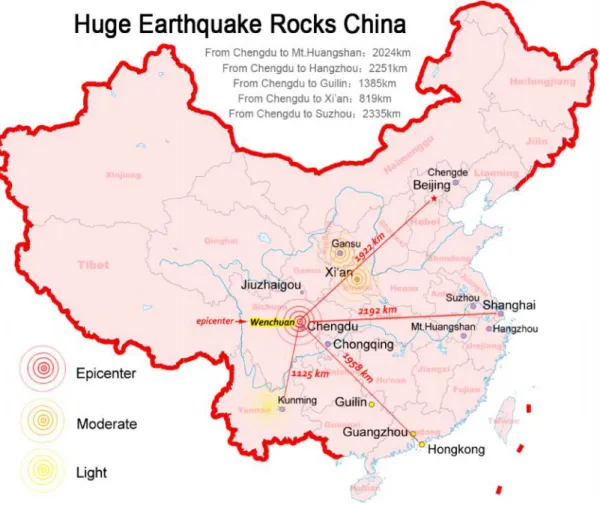
1.1.2 The Wenchuan Earthquake and Its Impacts on the Tourism Industry The Great Sichuan Earthquake (henceforth called The Wenchuan earthquake) was a deadly earthquake with a magnitude of 8.0 on the Richter scale, which shocked the county of Wenchuan in the Sichuan Province of China and also affected many other provinces in the Country on 12 May 2008 at 2:28pm (Figure 1.1). This was the most devastating and widespread earthquake which generated the biggest losses since the founding of the People’s Republic of China. It left over 69,222 people dead, 18,176 people missing and numerous injured and homeless. Within Beichuan County, Yinxiu Town and many small villages, buildings and houses collapsed completely. Public services like schools, hospitals were also damaged extensively. The infrastructure, such as transportation, electricity, telecommunication, water supply, and gas supply system was undermined seriously, which paralyzed city services for several days. The direct financial loss has been estimated at 843.7 billion RMB. Secondary and tertiary losses in the province and other provinces were much higher (NMP, 2008).
Figure 1.1 the Epicenter and Spread Range of the Wenchuan Earthquake
(Source: http://www.chinaodysseytours.com/maps/sichuan-earthquake-maps.html)
1.1.2.1 Impacts on the Local Tourism Industry
Sichuan’s tourism industry went through a terrible nightmare as a result of the Wenchuan Earthquake. The direct financial loss of tourism industry was estimated at Figure 1.1 the Epicenter and Spread Range of the Wenchuan Earthquake
(Source: http://www.chinaodysseytours.com/maps/sichuan-earthquake-maps.html)
1.1.2.1 Impacts on the Local Tourism Industry
Sichuan’s tourism industry went through a terrible nightmare as a result of the Wenchuan Earthquake. The direct financial loss of tourism industry was estimated at Figure 1.1 the Epicenter and Spread Range of the Wenchuan Earthquake
(Source: http://www.chinaodysseytours.com/maps/sichuan-earthquake-maps.html)
1.1.2.1 Impacts on the Local Tourism Industry
Sichuan’s tourism industry went through a terrible nightmare as a result of the Wenchuan Earthquake. The direct financial loss of tourism industry was estimated at
tremendous losses. One year before the earthquake, tourism created 121.73 billion RMB and brought USD 0.512 billion foreign exchange to Sichuan Province. However, total tourism revenue decreased to 109.15 billion RMB and foreign exchange to USD 0.214 billion in 2008 after the Wenchuan Earthquake happened.
Scott et al. (2008) made the point that "understanding the impact of crisis on organizations and destinations is the key to effective post event recovery". Thus, in order to find the key to conduct an effective post-disaster recovery, this thesis analyzes and summarizes the negative impacts of the Wenchuan Earthquake on the local tourism industry from five perspectives:
First of all, the earthquake severely affected tourist attractions in Sichuan Province. As can be seen from Table 1, the losses from this sector came to 33.853 trillion RMB, accounting for 72.66% of tourism total losses. The number of damaged tourist attractions was 361, 56 of these were completely destroyed;
Secondly, the earthquake entirely shocked the travel agencies and relevant hospitality businesses in Sichuan Province. The earthquake occurred in May during the boom season for travelling. After the earthquake, the National Tourism Administration of PRC (CNTA) issued an emergency announcement to all the travel agencies in China that suspended all group travel activities to Sichuan. This information immediately impacted on those travel agencies who operated “Sichuan Tours”.
Table 1.1 Direct Financial Loss of Tourism Owing to the Wenchuan Earthquake
Figure 1.2 the Comparison of Part of the Tourist Attractions before and after the Wenchuan Earthquake
The vast majority of tour guides in Sichuan were almost immediately unemployed, one staff working at travel agency described that “It was really a tough time for people who live on tourism. Many people around me tried to change their jobs at the time since they felt hardly able to survive”. The tragic situation which the travel agencies faced also affected their intimate partners. The hospitality industry in Sichuan was not only damaged a lot in terms of their accommodation buildings but also the business got from travel agencies was almost zero. The average room occupancy rate of hotels was less than 20% right after the earthquake;
Thirdly, the earthquake heavily destroyed the tourism towns and villages in Sichuan Province. There are more than 100 small towns and villages mainly dependent on tourist revenue in Sichuan Province. It is worth mentioning that the Sichuan area is the origins for Chinese rural tourism, which has a very extensive and distinctive position. After the Wenchuan earthquake, most tourism infrastructure and service facilities in those towns and villages were largely destroyed and basically lost their reception function. The rural tourism in Sichuan Province thus suffered massive losses;
Fourthly, the earthquake brought about huge destruction of the tourism transportation system, including access paths to the tourist attractions and the roads connecting cities and towns.
One of the backbone roads called the Jiuhuan route1, has the most significant
meaning for Sichuan tourism (Figure 1.3). Unfortunately, the epicenter of the Wenchuan Earthquake happened on this route and what was worse, the very complex and unstable natural situation on the way made this route became much more unsafe after the earthquake;
Figure 1.3 the Map of Jiuhuan Route in Sichuan Province
Lastly, the earthquake had a severe impact on related industries including travel media, tourism planning organizations and tourism suppliers. For instance, most clients of the travel media prefer to put advertisements in newspapers or magazines at a peak season. Nevertheless, due to the earthquake, new clients hesitated to input money for advertising tourism products and the previous customers terminated contracts with the travel media, which created a huge financial loss for them. Other tourism planning organizations or suppliers also suspended all or part of their services after the earthquake.
1.1.3 Overview of Sichuan Province and the Tourism of Sichuan
Sichuan, a western province, has the 5thlargest land area and possesses the 4thlargest
population in China. More than 80 million people are living in this area. What is more, it is one of the major agricultural production bases and also an industrial center of China. In recent years, the government of Sichuan has been endeavoring to develop the tourism industry and making efforts to upgrade it to a new level.
Sichuan has been historically known as the "Province of Abundance" since it has an extremely rich natural environment and profound history, which includes five representative World Heritage Sites and many fabulous tourist attractions (Table 1.2) as well as a splendid culture of ethnic minorities.
Table 1.2 Tourism Resources of Sichuan Province
Items Amount
World Heritage Sites 5
World Geological Park 1
State-level Tourist Attractions 15
National Nature Reserves 18
National Forest Parks 28
National Geological Parks 11
National Key Cultural Relics 62
Historical and Cultural City of China 7
(Data Source: ESDOR, 2007)
Further, Sichuan was the first province in China to create a Provincial Tourism Master Plan with UNWTO in 1998. In 2006, the capital city of Sichuan Province was recognized by CNTA and UNWTO jointly as “the Best Tourism City of China”, sharing the honors with other two cities of Hangzhou and Dalian (WTO, 2011a). According to the 2010 Economic and Social Development Official Report of Sichuan Province, the total provincial tourism revenue was188.6 billion RMB, up by 54.9% over that of the year before the Wenchuan Earthquake; accounting for 11.1% of the province's GDP. More than 270 million domestic tourists visited Sichuan in 2010 and it received1.04 million tourists from overseas.
1.2 Research Questions
While basing on the analysis of Sichuan's response to the Wenchuan Earthquake in 2008, this thesis aims to develop a post-disaster sustainable tourism model by exploring the successful parts of tourism post-disaster management strategies of Sichuan's experience. The results of this research are expected to answer the following questions:
1. In different phases, what responsive behaviors by different sectors of government, local community and tourists respectively in the tourism industry apply to the Wenchuan earthquake?
2. Based on analyzing Sichuan’s responses to the Wenchuan earthquake, what is Sichuan’s framework for developing post-disaster sustainable tourism?
3. Is Sichuan's model of practically developing a generic model of crisis management and worthy to be promoted worldwide?
1.3 Significance of the Research
It is widely accepted that tourism is a vulnerable, complex and uncertain industry to crisis and disaster (Laws, Prideaux and Chon, 2007). However, people cannot deny the resilience of tourism and its ability to help mitigate the negative impacts if it is organized by good crisis management. As Laws, Prideaux and Chon (2007, p10) suggested, an exchange platform for international knowledge as well as organized and complete documentations about crisis management processes to benchmark or
learn the experience from comparable examples in tourism destinations is compulsory to explore more effective tools and develop future research on crisis management.
Sichuan’s response to the Wenchuan earthquake has been identified as a successful example, however, in academia, there hasn’t been enough systematic research to document the process of post-disaster tourism management of Sichuan and specify Sichuan’s model as integrating and developing a generic model of crisis management. This thesis is designed to be an objective and evidence-based documentation of this process and is dedicated to develop a post-disaster tourism revitalization model of Sichuan that could provide a reference for other countries and regions for the future revival of the tourism industry.
1.4 Methodology
This thesis is a comprehensive description and analysis of Sichuan’s response to the 2008 Wenchuan earthquake. Various data sources of both a qualitative and quantitative nature are used in this research. First of all, the data originates from the National Master Plan for Sichuan’s reconstruction and recovery, associated policy documents and the provincial guidelines for implementing this plan, as well as some additional specific rules released by the Central People’s Government of the PRC
were collected from the Sichuan Research Institute of Tourism Planning (SRITP) and statistics published by the Sichuan Tourism Administration (SCTA). Additionally, interactive formal and informal interviews with officials working at the SCTA and the SRITP as well as with some casual pass-by travelers and villagers are also incorporated into the research. Furthermore, a review of books, journals and electronic databases found through Google Scholar, CNKI and EBSCO Host on the subject area fundamentally supported this research.
This study is basically conducted from a qualitative research perspective, using content analysis, analytic induction and logical analysis to analyze data (Figure 1.4). The field work was conducted in Chengdu City and Mianzhu New Year Painting Village of Sichuan Province during Mar 15 to Mar 21, 2011, when I was able to make use of the RCAPS Master's Students Field Research Program of APU. Vice President Dr. Wen of the SRITP was interviewed in Chengdu city using a set of predetermined questions and other officials working at the SCTA were randomly and informally interviewed. These standardized and unstandardized interviews aimed to pinpoint the Sichuan tourism authorities' attitudes, opinions, and thoughts regarding government responses to the Wenchuan Earthquake. In addition, the communication with Dr. Wen has been kept up by email since I left my field study area. Moreover, I conducted field observations at Mianzhu New Year Painting Village for one day on the recommendation of Dr. Wen.
The field study was designed to gain additional information about local community responsive behavior, especially in the second phase of post-disaster recovery, by asking questions of a small number of villagers (9 of 300 people) and one statistician working at local committee. As Berg (1998, 61) points out, "when researchers are unfamiliar with respondent’s life styles, religious or ethnic cultures or customs, and similar attributes", asking a number of participants questions about the various phenomena they observed can be useful in cross-checking government official’s statements. The data obtained from interviews and field observation was organized into textual form through transcription of tape-recorded interviews, photographic records, and field notes.
This thesis is based on testing Sichuan Tourism Officials’ statements about there being a three-phase separation in the Sichuan tourism industry's response to the Wenchuan Earthquake; using evidence-based analysis to test whether the actual response process in the real world corresponded to authority assertions. If, as originally suspected it did not, this thesis should provide the information to revise the post-disaster recovery model used by the authorities.
Owing to the large number of people involved and the length of time since the Wenchuan Earthquake happened, the study of post-disaster response in the first
and some representative surveys completed by other scholars to see what themes had already emerged relating to disaster recovery and those which were implicit. Finally, this thesis uses flow charts to pictorially summarize and represent the extensive post-disaster response by the tourism industry of Sichuan province, as well as written descriptions.
1.5 Limitation of the Study
In analyzing the responses to the Wenchuan earthquake, one perspective is from the tourist side. It was initially thought to conduct an extensive survey in order to better understand the tourists’ behavior that responds to the earthquake in different phases and especially in the third stage. According to the sampling frame formula, this survey should be distributed to more than 380 people, and the sites would also need to be well selected based on the calculation of the daily flow of people in each tourist attraction. A study of this magnitude is very time consuming work, and this was a limitation for my current research. As a result the methodology outlined above was chosen.
CHAPTER TWO LITERATUE REVIEW
This chapter reviews previous research regarding tourism crises and disaster management. The review begins by discussing definitions of the disaster related terms before understanding general disaster tourism management. It then provides two models for looking at the current academic achievements in the framework construction of tourism crisis management, and finally stresses post disaster tourism management which is the aim of this research.
2.1 Definitions of Crisis and Disaster
2.1.1 Crisis Definitions
Defining “crisis” can be traced back to the last century. Hermann (1972) first proposed three dimensions of crisis characteristics: high threat, short decision time, and an element of surprise. After that, subsequent discussions around the definitions have been continued for many years (Table 2.1).
Table 2.1 A Review of Crisis Definitions (1972-2005)
Author Definitions
Hermann (1972) in
McMullan (1997) Crisis is characterized by three dimensions: high threat, short decision time,and an element of surprise. Wiener & Kahn (1972)
in McMullan (1997) Crisis is often a turning point in an unfolding sequence of events andactions.
Miller & Isacoe (1972) in McMullan (1997)
Crisis:
• is acute rather than chronic, although the length of the crisis is usually unspecified;
• produces changes in behavior that are frequently “pathological”, such as inefficiency, frustration and scapegoating;
• is characterized by threat to the goals of the person involved;
• is relative in that what is a crisis for one party or participant may not be for another;
• produces tension in the organism, including physical tension and anxiety. Lentner (1972) in
McMullan (1997)
Compared to the high threat, the element of short decision time and surprise had little empirical backing as necessary constituents of a crisis while the former is the most important element in determining when a problem becomes a crisis.
Brady (1974) in McMullan (1997) Selbst (1978) in Faulkner (2001)
Any action or failure to act that interferes with an (organization’s) ongoing functions, the acceptable attainment of its objectives, its viability or survival, or that has a detrimental personal effect as perceived by the majority of its employees, clients or constituents.
Billings et al. (1980) in McMullan (1997)
Firstly, perceiving an event in the environment which triggers the crisis and then this triggering event must be perceived, attended to and evaluated against some standard or measure of how things should be in order for a problem to be sensed. The degree of perceived crisis is a function of the perceived value of possible loss, probability of loss and time pressure. Fink (1986) in
McMullan (1997)
A crisis is an unstable time or state of affairs in which a decisive change is impending – either one with the distinct possibility of a highly undesirable outcome or one with the distinct possibility of a highly desirable and extremely positive outcome.
Reilly (1987) in McMullan (1997)
A crisis implies elements of magnitude, the need for taking action and the necessity of a timely response. Moreover, organizational crisis is a situation which potentially threatens the existence of the affected organization. Shrivastava & Mitroff
(1987) in McMullan (1997)
Corporate crises threaten a company’s most important goals of survival and profitability.
Brewton (1987) in McMullan (1997)
Two criteria generally define whether a situation is a crisis. The first characteristic is the potential for injury to guests or staff and damage to company assets. The second criterion is one of urgency – that is, how fast events are occurring and how quickly major decisions have to be made. If one or other criterion is not present, even a bad situation is not really a crisis. Crisis is (i) a major failure in the company’s system, serious accident or
efficient operations; and (iii) something that could seriously affect the company’s image, undermine its commitment to social responsibility and its right to operate and affect its earnings and therefore its financial well-being.
Darling (1994) in Ritchie (2009, pp5-6)
What defines a crisis in international business depends on a number of variables: the nature of the event; importance of the issue to foreign and US government; impact on other firms and industries; how many and how quickly people inside and/or outside of a particular firm need to be helped or informed; who and how many individuals need interpretation of the events, and how accessible those people are; how much interaction with the media is necessary; what the media choose to emphasize; who and how many people needs to assert control and demonstrate that it is capable of responding; and how quickly the firm needs to respond. A crisis may also be defined by feelings of panic, fear, danger or shock.
Sonmez et al. (1994) in Ritchie (2009, pp5-6)
Any event which creates negative publicity and the period of time after a disaster occurrence which lasts until full recovery is achieved and pre-disaster conditions resume.
Bland (1995) in McMullan (1997)
At its simplest, a crisis can be defined as unexpected
bad publicity … it is the publicity element that usually gives the most trouble and needs most careful handling. In terms of management time and resources, communicating
with the many outside agencies involved, especially
the media, could involve much more time and effort than the crisis itself ... it is usually the publicity that would harm the company or brand rather than the other ramifications arising from the incident.
Augustine (1995) in McMullan (1997)
As a result of this flawless sense of timing, I have assembled ample evidence that there is no magical 9-1-1 number you can call to extricate yourself from such predicaments… If the solution were easy, it would not be a crisis. Mitroff et al. (1996) in
Shaluf et al. (2003)
There is no single, universally accepted definition of crisis, although there is general agreement that a crisis is an event that can destroy or affect an entire organization.
Keown-McMullan (1997) in Ritchie (2009, pp5-6)
Contrary to popular opinion, a crisis is not always bad or negative for an organization. A crisis could, therefore, be considered as a turning point. To qualify as a crisis, the entire foundation of an organization or business must be threatened. The idea of urgency and the speed with which decisions must be made are key components.
Beeton (2001) in Ritchie (2009, pp5-6)
Crises occur at all levels of tourism operations with varying degrees of severity, from much publicized environmental, economic and political disasters through to internally generated crisis such as accidents and sudden illness.
Faulkner (2001) A crisis describes a situation where the root cause of an event is; to someextent, self-inflicted through such problems as inept management structures and practices or a failure to adapt to change.
Prideaux et al. (2003) in Ritchie (2009, pp5-6)
Crises can be described as the possible but unexpected result of management failures that are concerned with the future course of events set in motion by human action or inaction precipitating the event.
Laws and Prideaux (2005) in Ritchie (2009, pp5-6)
1. An unexpected problem seriously disrupting the functioning of an organization or sector or nation.
2. A general term for such problems. Source: The Author
However, after having made a thorough review of crisis definitions from 1972 to 1995, McMullan (1997) finally concluded that there has not yet been developed a universally accepted definition of what constitutes a crisis and that this is also unlikely to emerge in the near future. Nevertheless, she still insisted that a crisis has an insightful power impacted on human beings, and no matter that the result is positive or negative, changes will take place even where a crisis is successfully under-control.
In addition, an interesting explanation could be noticed that two characters “wei ji” (Figure 2.1) have been widely adopted to illustrate the word “crisis” in China. The combination of the two characters form the meaning of crisis, in Chinese, however, “wei” stands for “threat” while “ji” refers to “opportunity”
Figure 2.1 Threat and Opportunity in Two Chinese Characters
Source based on ISDR (2004, p398)
Wei Ji
危 机
This Chinese word is well in accordance with the above view of some authors that a crisis can be regarded as a turning point for changing an existing system. Whatever the result, it leads to changes for the individuals, organizations or even for whole countries. How to mitigate the negative losses coming from the “threat” while taking advantage of the “opportunity” has been paid much attention from academics and practioners. In turn, crisis management has been developing as a systematic discipline. In the next section (2.2), we will discuss this issue in detail.
2.1.2 Disaster Definitions
There are many definitions for disasters. Similar to "crisis", various discussions and views have not yet brought any universally accepted definition. As Shrivistava (1987, p85) suggested this is because a disaster’s definition varies among the stakeholders using the term. Different social sectors use different terms to describe a disaster. Take the Bhopal Disaster for example, Union Carbide in its technical report referred to Bhopal as an "incident." “The government of India, in its reports called it an ‘accident.’ The injured victims called it a ‘disaster.’ And the social activities called it a ‘tragedy,’ a ‘massacre,’ and even ‘industrial genocide.’" While giving the definition to "crisis" (Table 2.1), Faulkner (2001) also defined a disaster as "when an enterprise is confronted with sudden unpredictable catastrophic changes over which it has little control." this definition made a relatively clear distinction between the
"crisis" and "disaster" in terms of the induced subject and countermeasures that may exist. Say, an event induced by the actions or inactions of the organization and the unexpected failure result is supposed to be under a sort of possible management system control, in this context, it is more inclined to the definition of crisis. A disaster is mostly induced by natural phenomena or external human action. As Prideaux et al. (2003) observed, normally it can only be responded to after the event, either via implementing contingency plans already in place or through reactive responses. An official definition is provided by the United Nations, here disaster is defined as " a serious disruption of the functioning of a community or a society causing widespread human, material, economic or environmental losses which exceed the ability of the affected community or society to cope using its own resources" (ISDR, 2004, p17). This indicates that scale or magnitude might be the two elements to define a disaster. Keller and AL-Madhari (1996 in Faulkner 2001, p138) tried to use arbitrary statistical benchmarks to define disasters. With regard to applying serious threshold numbers, such as 10 fatalities, US $1 million damage costs and 50 evacuated people. This method, to some extent, is able to solve the statistical issues, for example, the probabilistic prediction of frequency and magnitude of disasters. However, Faulkner also pointed out that this way lack factors from the qualitative perspective.
Crisis and disaster are two different events; however, people always like to put them together. The reason might be due to the fact that they have similar developing phases (pre-event phase, event phase, and recovery), as pointed out by Shaluf et al. (2003). Inevitably, an event no matter whether crisis or a disaster, will generate losses and disrupt normal operations. It is widely accepted that after a crisis or disaster people have to face the challenges of the recovery phase, but in addition, there is increasing consensus that the recovery is not only to restore operations to normal but also to devise new patterns of operation with more radical and strategic thinking in reshaping further risk exposure (Scott et al., 2008), through post crisis or post disaster management. Therefore, from the recovery management perspective, the boundaries between crisis and disaster are becoming blurred. Those terms, for example, "Tourism crisis”, “Tourism disaster”, “Crisis management" and "Disaster management" can usually be mixed in relevant journals or books. For the purpose of analysis, this thesis will therefore also discuss post crisis or post disaster management in a broad sense.
2.2 Tourism Post-disaster Management
In the beginning of Chapter One, we discussed the vulnerability and susceptibility of tourism to crisis and disaster and put forward the concept of tourism crisis management. In this section, we will review the development of tourism disaster
management systems and focus on the post-disaster management perspective.
2.2.1 Tourism Disaster Management
Since human beings appeared on the earth, they have been threatened by crises or disasters, while afterwards they always got lessons from the experience to get along with the “twin brothers”. Those experiences and lessons gradually contributed to the shaping of a set of system with regard to disaster management. Traditionally, disaster planning has only met the needs of permanent residents; however, more attention should be given to tourism requirements as it increasingly becomes a component of development (Murphy& Bayley, 1989).
Ritchie (2003) observed that "the effective management of crises and disasters is vital for the tourism industry". Murphy& Bayley (1989) explain the importance of disaster and crisis management from the tourists and tourist destinations perspective. They point out that, compared to local residents; tourists are always under a greater risk since they might be unfamiliar with an area and its local emergency plans. Similar statements by Burby& Wagner (1996) and Drabek (1992, 1994) (in Faulkner 2001, p142) noted that tourists are more dependent and lack the resources that might assist them to avoid disaster. Therefore, a sound crisis and disaster management plan
disaster prediction and a timely and effective response when a disaster happens. What is more, from the tourism planners and managers' perspective, developing strategic crisis management systems is not only required by the practical needs, in other words, to "help organizations and destination to avoid or limit the severity of rapid change induced by crises or disasters", but also must be a core competency for tourism destination managers and business managers (Ritchie, 2003).
For many years, scholars and experts have been trying to build a generic model as a basic tool for managing tourism crisis and disaster although Scott et al. (2008) argued that there is no ideal framework and that one will ever be devised because of the varied nature of crises and disasters. One of the most comprehensive tourism disaster management frameworks (Figure 2.2) was developed by Faulkner (2001) who identified six phases in the tourism disaster situation and subsequently in another paper, he applied this model to the case of the 1998 Katherine flood and made revision to improve it (Faulkner& Vikulov, 2001).
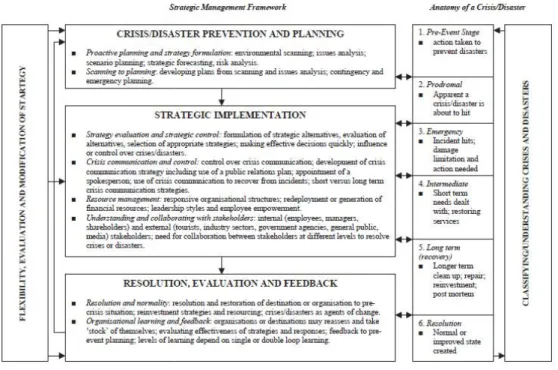
Based on research by Faulkner (2001), Fink (1986), and Roberts (1994), Ritchie (2004) further developed the theoretical framework for crisis and disaster management in the tourism industry (Figure 2.3). He set three main stages in managing such disaster situation: (1) prevention and planning (2) implementation (3) evaluation and feedback. Also he observed that between the management model and
Figure 2.2 Faulkner's Tourism Disaster Management Framework Figure 2.2 Faulkner's Tourism Disaster Management Framework Figure 2.2 Faulkner's Tourism Disaster Management Framework
a crisis lifecycle, there are some clear similarities, including:
A pre-event stage allowing the development of strategy and plans;
A stage immediately before or after a crisis or disaster occurs which requires the implementation of strategies to deal with its impacts;
Continued implementation of strategies to control or reduce the severity of the crisis/disaster;
A long term recovery or resolution phase allowing for evaluation and feedback into future prevention and planning strategies for destinations and businesses.
Additionally, he stressed that success in management depends on the nature of the crisis or disaster as well as a stakeholder's responsive behavior. It is necessary to be flexible and add evaluation and potential modification to the development of strategy and implementation during the whole process of the strategic management of a crisis or disaster.
Figure 2.3 Ritchie's Crisis and Disaster Management Framework
Source: after Ritchie (2004)
a crisis lifecycle, there are some clear similarities, including:
A pre-event stage allowing the development of strategy and plans;
A stage immediately before or after a crisis or disaster occurs which requires the implementation of strategies to deal with its impacts;
Continued implementation of strategies to control or reduce the severity of the crisis/disaster;
A long term recovery or resolution phase allowing for evaluation and feedback into future prevention and planning strategies for destinations and businesses.
Additionally, he stressed that success in management depends on the nature of the crisis or disaster as well as a stakeholder's responsive behavior. It is necessary to be flexible and add evaluation and potential modification to the development of strategy and implementation during the whole process of the strategic management of a crisis or disaster.
Figure 2.3 Ritchie's Crisis and Disaster Management Framework
Source: after Ritchie (2004)
a crisis lifecycle, there are some clear similarities, including:
A pre-event stage allowing the development of strategy and plans;
A stage immediately before or after a crisis or disaster occurs which requires the implementation of strategies to deal with its impacts;
Continued implementation of strategies to control or reduce the severity of the crisis/disaster;
A long term recovery or resolution phase allowing for evaluation and feedback into future prevention and planning strategies for destinations and businesses.
Additionally, he stressed that success in management depends on the nature of the crisis or disaster as well as a stakeholder's responsive behavior. It is necessary to be flexible and add evaluation and potential modification to the development of strategy and implementation during the whole process of the strategic management of a crisis or disaster.
Figure 2.3 Ritchie's Crisis and Disaster Management Framework
2.2.2 Tourism Post Disaster Management
In the previous discussion, we reviewed disaster and crisis definitions in general and recognized the vulnerable relations between tourism and disaster/crisis before suggesting that there is a need to develop tourism disaster management. In this sub section, post disaster management in the tourism industry is described and in this part, the long-term recovery phase will be given priority, since the focus of this thesis is to explore the post disaster management strategies and develop a generic post disaster model in tourism specifically in relation to the successful experience of tourism revitalization in Sichuan after the Wenchuan Earthquake.
As Murphy& Bayley (1989) suggested, from a tourist destinations perspective the recovery stage holds a distinctive relationship with tourism. At this point, the destination's image of security and pleasure is shattered, to some extent, and whether the recovery is successful or not has a decisive effect on future bookings and economic prospects. They also restated the important role of tourism in terms of attracting visitors back to the affected area quickly and passing the real recovery information from the disaster area to the international community through witnessed visitors. In addition, with the tourists coming, new revenue will be brought to the reconstruction work, which then is greatly able to accelerate the recovery phase.
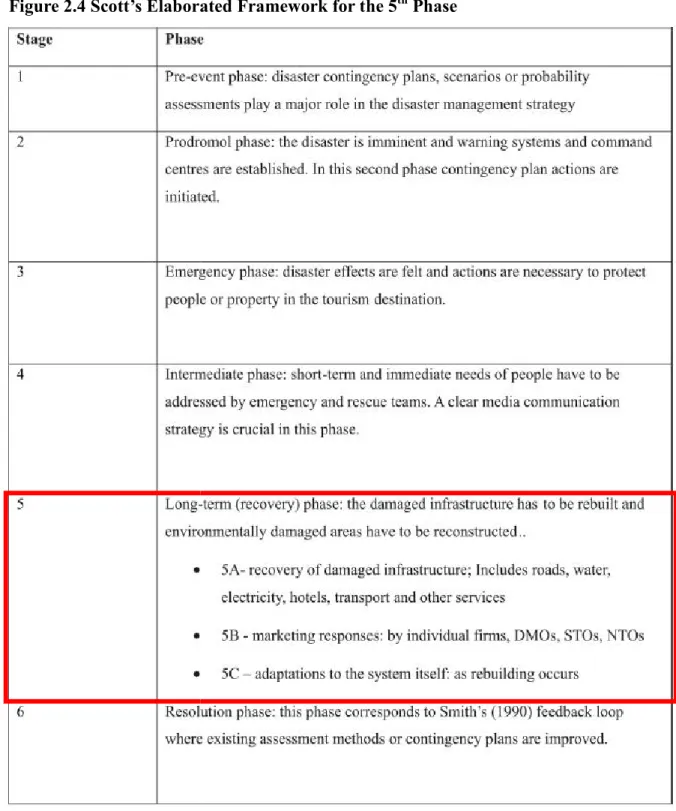
Faulkner’s model did not elaborate the recovery phase to any extent although he regarded that part as important (Scott et al., 2008). Therefore, based on Faulkner’s framework, Scott et al. (2008) elaborated the long-term recovery phase into three sub-phases, including 5A- recovery of damaged infrastructure; 5B- marketing responses and 5C- adaptations to the system itself (Figure 2.4).
As Scott et al. (2008) claimed, it is necessary to identify the model in more detail. Tourism crisis management practitioners and researchers have an obligation to document the process of previous events and develop strategies for coping with similar events in the future. In that sense, the tourist destination can minimize the damage to the lowest extent and be back on track as soon as possible.
Figure 2.4 Scott’s Elaborated Framework for the 5thPhase Figure 2.4 Scott’s Elaborated Framework for the 5thPhase Figure 2.4 Scott’s Elaborated Framework for the 5thPhase
CHAPTER THREE
There is no great historical evil without a compensating historical progress.
--- Engels, 1893
A DESCRIPTIVE ANALYSIS OF TOURISM CRISIS RESPONSE BY GOVERNMENT, LOCAL COMMUNITY AND TOURISTS TO THE WENCHUAN EARTHQUAKE
Spring 2008 was a season without beautiful bright sunshine for Sichuan’s tourism industry. The Wenchuan Earthquake had brought about huge devastation to this industry, which not only gave rise to a big loss with regard to tourism resources, but to more severe extent, hit the production capacity of the tourism industry (Yang& Ye, 2008). Tourism, unfortunately, became the only sector which was suspended completely in the disaster area shortly after the earthquake. Nevertheless, from the devastating earthquake until now the industry has seen a leap forward in development. The total tourism revenue of the province in 2008 fell to 109.15 billion RMB but rapidly increased to 188.61 billion RMB in 2010, and it is likely that it will continue to follow this pattern in the coming years (Figure 3.1). Sichuan tourism industry‘s response to the Wenchuan Earthquake has appeared successful and has been appraised as a miracle of recovery and reconstruction2, but one which
nevertheless needs to be reexamined and analyzed. In this chapter, the response
2The speech “The miracle of recovery and reconstruction” at World Best Practices of post-disaster
process to the Wenchuan earthquake are divided and illustrated in three phases. Further, the differentiated responsive behaviors by the government, local community and tourists in those three phases will each be indentified.
Figure 3.1 Total Tourism Revenue of Sichuan Province (2005-2010)
Data source was an internal document of the SCTA in 2011
2.2). In the case of Sichuan, with reference to an interview with Dr. Wen Xueju (Vice-president of the SRITP), the responsive process to the Wenchuan Earthquake could be hypothetically divided into three phases, which consisted of Relief and
Livelihood Resettlement; Reconstruction of Infrastructure and Industry Long-term Development. For the purpose of analyzing Sichuan’s response to the disaster, we
firstly use these three phases, which mainly refer to Dr.Wen’s point of view, through objective and evidence-based documents to elaborate the process of response to the Wenchuan Earthquake and then try to figure out whether the actual framework of responsive process corresponded to authority assertions in the real world.
3.2 Tourism Crisis Responses by Different Sectors in the First Phase after the Wenchuan Earthquake
3.2.1 Government Response in the First Phase
Disaster, specifically an enormous natural disaster, can suddenly transform the social order into a disorderly state. No matter the collective reactions from the inside or outside the disaster area, the convergence of various forces is a big challenge to governance (Tang et al., 2002 in Li, n.d.). Given the chaos and complex situation after a disaster, taking strong leadership to control the temporary chaos and avoiding further deterioration is always given the first consideration by the government. Additionally, in this critical stage, the speed of government response is usually
judged by the public as a measure of governance capacity; also, a quick response to some extent can comfort frightened people psychologically and give confidence to them to overcome the difficulties.
Based on the government countermeasures and foreign media coverage, we can see the Chinese government’s response to the Wenchuan Earthquake in the first stage as a quick reaction. Shortly after the earthquake, an instruction from President Hu Jintao was issued to rescue the victims as quickly as possible and ensure the safety of people in the affected area. Within three hours, Premier Wen Jiabao headed for Sichuan Province to advice on the relief work. On the same day, the Earthquake Relief Headquarters was set up in Beijing and took overall responsibility for earthquake rescue and relief. In addition, other aspects of resources were allocated to the disaster area quickly. The Associated Press reported that "The rapid mobilization of troops to stricken Sichuan province reflected the priority that China's leadership places on delivering efficient disaster relief... ”(AP, 2008). Compared to the Burmese government’s late response to “Cyclone Nargis", another disaster that also happened in May 2008, which was criticized by the international community, the Washington Times commented on Wenchuan's response “China wins world praise for quick quake response” (TWT, 2008).
on the consideration of a "not yet right" situation in the disaster area, the Chinese government rebuffed offers of help from international earthquake rescue teams although they decided to accept this one day later. As one of the task reports written by the members of the Japan Agency for International Cooperation suggests, despite their advanced rescue techniques and professionals, "the critical hours and days immediately following the disaster slipped away" (UPI, 2008).
With regard to media management, unlike in the past, the Chinese government not only loosened control of quake coverage, but also updated the information from the disaster area to the public immediately (Sun& Chou, 2009). However, the Financial Times (2008) argued that the live broadcasts of earthquake news on the Internet by a local television station was halted due to the fact that it offered more direct reporting from the disaster zone than the state-owned network.
In the post-disaster first phase, the tourism administration not only cooperated actively with the state-level relief operation to rescue tourists, but also took responsibility to inform all travelers entering the disaster area. On the same day the Wenchuan Earthquake happened, the National Tourism Administration of PRC (CNTA) issued an emergency announcement to all the travel agencies in China that suspended all group travel activities to Sichuan (CNTA, 2008). From then until June 15th2008, all the tourism activities were called off in Sichuan Province. The banning
greatly dampened the tourism industry in Sichuan, but on the other hand, the local tourism industry got valuable time to make assessment of disaster impacts and get ready to start an extensive tourism planning for the upcoming recovery stage.
Overall, the reaction from the government side in the first stage was timely and effective, but the official attitude on the acceptance of foreign professional rescue teams to arrive at the disaster area to rescue people in time was still conservative. In the case of media coverage, the concept that the state-level is always better than the provincial-level should be changed.
3.2.2 Local Community Response in the First Phase
Community is a word that has no clear boundaries. Throughout this thesis, the term community refers to “a particular area or place considered together with its inhabitants," as defined by the on-line Oxford dictionary3. Depending on the
relations with tourism and the Wenchuan Earthquake among those different units, we take the tourist attractions residents, tourism companies, local media and local tourism administration that were living at Sichuan Province and took the common goal for revitalizing tourism industry as the members of the local community.
In the first stage, the main activities carried out by the local community were self-helping and rescuing others. According to the statistics from the SCTA, there were more than 10,000 group tourists within Sichuan Province when the Wenchuan Earthquake happened, the SCTA quickly formed a specialized task force and informed all tourism-related sectors to rescue those group tourists. The successful cooperation from the various groups finally made the result satisfactory, 10668 group tourists who came from 12 countries, including 516 foreign tourists without any casualty were rescued after the Wenchuan Earthquake. This rescue operation was honored by the CNTA as a “miracle in the rescue history of tourism disaster” (SCTA, 2008a). During the rescue operation, the tour guides and tour bus drivers had a vital impact on comforting anxious tourists and taking them to look for the government rescuers. The local residents in this process provided their guiding assistance for those tourists groups who were not familiar with local conditions to find exits, and the media was responsible for timely transmission of rescue information to the outside world. The whole procedure was an integrated process of coordination and cooperation contributed by different sectors4. Being more familiar with tourist
personal information, the tourism companies’ reaction was actually more direct and immediate compared to that of the tourism administration. However, there was no emergency plan for tourism companies when the earthquake happened even though those companies played a significant role in rescuing tourists in a difficult time
(SCTA, 2008b). The overall passive response of tourism organizations however, indicates that the local industry lacked sufficient preparation for the disaster.
With respect to self-help, compared to Japan and some other earthquake-prone countries which have long been training and popularizing the public in earthquake education, the Director of CEA (China Earthquake Administration) pointed out that, generally speaking, Chinese public awareness of the need for evacuation in an emergency is still weak (CEA, 2011). While there is no specific data showing how many people evacuated by their own efforts in the Wenchuan Earthquake, the survey conducted by Tang& Guo (2011) on 900 residents in the heaviest-hit three cities, Dujiangyan, Shifang and Mianzhu showed that 76.8% respondents said there has been no training about earthquake relief in the cities and they never got such knowledge or information from the government. Compared to other cases observed by Shaw& Goda (2004) after the Kobe Earthquake, where 60% local residents were rescued by themselves in the Nishi Suma area, the local community in Sichuan was obviously lacking in relief knowledge to address the earthquake. Furthermore, the "Happy Farmhouses" (in Chinese: 农家乐), one of the characteristic form of rural tourism in Sichuan were greatly destroyed in the Wenchuan earthquake. Take Longmenshan Town for example, this small town had 882 farmhouses before the Wenchuan Earthquake, however, 70% of them collapsed during the disaster. The
the resistance to disaster is weak for the local community as a tourist destination.
As noted above, the local community was evidently ill prepared and ill-equipped to deal effectively with any large-scale disaster in the first phase. Any actions, even the successful ones conducted by the local administration were quite passive. Nevertheless, Shaw & Goda (2004) claimed that community is a quite important unit right after an earthquake and that this will also impacted on the speed of recovery. Nagakawa and Shaw (2004) also mentioned the grassroots organization in the community can help the people recover rapidly in the situation where there is lack of government resources and support. Historical experience has shown that mobilization by the state can never ever reach the speed of civil society assembly. The affected people in the disaster area will always be the frontline rescuers, and as an autonomous actor in the entire disaster cycle, the important role of local community has always been stressed by academics (Li, n.d.).
3.2.3 Tourist Response in the First Phase
Being different from the government and local community, tourists are usually unfamiliar with the area and the local emergency plan, which puts them at greater risk than the local residents. In the first stage, tourist response in the affected area is usually quite passive to accept assistance from outside, for instance, the government
and civil society. To a large extent, after the disaster they are on the road or in the tourist destinations waiting to be rescued. The enormous negative impacts of the earthquake on travelers are obvious given the suddenly changed situation faced by the local travel agencies and hotels. After the Wenchuan Earthquake, travel agencies in Sichuan encountered large-scale booking cancellations so that most of them closed their businesses. What was worse, occupancy in the hotels was less than 20%; almost all the tourism workers were unemployed. The safety image of tourism destination in Sichuan was severely damaged (WEPT, 2008).
The SASS (Sichuan Academy of Social Science) conducted a survey in the main tourist markets regarding tourists' desire to visit Sichuan after the Wenchuan earthquake. For the 224 valid respondents, 80 had intended to visit Sichuan before or after the Olympics (in the year of 2008), however, this figure decreased to 24 in the year after the Wenchuan earthquake. What is more, of those 224 respondents, only 24 people planned to visit Sichuan soon, 18 were without travel consideration over the long-term, and more than 80% interviewees hoped to visit Sichuan after 1 to 2 years. The data clearly show that tourist confidence was seriously lost as a result of the earthquake and that tourism market confidence needs a relatively persistent period to recover5. Also, in this survey, the respondents showed their expectations