
トップページ - 横浜国立大学学術情報リポジトリ
20
0
0
全文
(2) plant communities for suppressing sand movement on the forward part of the dune experimental plantation. As a result, the Miyawaki research group at Yokohama National University has conducted phytosociological research here since 1984 in order to create sound environmental protection forests on Shonan seashore. In this paper the emphasis is on study of Shonan vegetation dynamics. In preparing this paper the authors are much indebted to the research members of the Institute of Environmental Science & Technology, Y.N.U., for their invaluable discussion and their constant encouragement. We especially wish to acknowledge with many thanks the help of Dr. K. Fujiwara in the field research. Prof. E.O. Box of the University of Georgia (U.S.A.) contributed constructive comments on the manuscript. We wish to thank him also.. Shonan s e a s h o r e. Sagami-wan. 1:1000000 0. 10. 20. 30Km. Fig. 1. The location of Shonan seashore in Kanagawa Prefecture.. Fig. 2. Pinus thunbergii afforestation established for protecting the hinterland against. the severe coastal environment. Sandy beach is located on the left of the photo (Shonan seashore, Prefecture Kanagawa) ..
(3) 2. Description of the investigated area The study area faces Sagami Bay and extends from the eastern part of the Miura Peninsula to the western part of the Izu Peninsula, 35"30fN, 139"41fE (Fig. 1). Shonan seashore is 14.29 km in length, with sandy beach and dunes. The 85.9 ha coastal dune, located 100 200 m from the shoreline, was planted mainly with P. thunbergii (black pine) for protecting the hinterland against the sea (Fig. 2). The climate is warm-temperate. The mean annual temperature and the average annual precipitation are 15.5"C and 1759 mm, respectively. Winds are prevailingly northern in winter, southern in summer and southwestern in spring, with an average velocity of 4.1 m/sec. The sand size of the dune is generally less than 2.0mm. Nobuhara (1965) stated that the distribution of plant communities in the dune vegetation of the Tsujido area in Shonan seashore was determined by sand movement, especially from wind in winter. The increasing human impact, over the whole year but especially in summer, must also be an important influence on the distribution of plant communities on Shonan seashore.. 3. Methods. I. 4. 3. 1. Table synthesis and mapping After a first reconnaissance of the study area, all vegetation units were identified, recorded, and analyzed according to the Braun-Blanquet (1964) method. A total of 121 relevks (including 53 relevks on the dunes) was arranged in phytosociological tables based on the classical block structure-seeking handsorting method (Becking 1957, Ellenberg 1956). On this basis 21 communities (including 8 communities of sandy dunes) were identified. The vegetation units identified were mapped at a scale of 1:10,000 (actual vegetation map) based on field surveys and air photos (Fig. 3, Miyawaki and Suzuki 1980).. I. I I. I I. classification. 1. 1-. I. I. I. community table I I. I. I. 3 determination of phyto~ociological units - - - - - - - -* - - - - - - - - - - - - - - - - - - - - - - - deciding the legend of the actual vegetation map. t----------. I. I I. I. I 1. L. f. preparation of the actual vegetation map from air photos and topographic maps. m.. I I. I I J. I1 I I. !. Fig. 3. Procedure for mapping actual vegetation. 1 : Field works. 11 : Indoor works. 111 : Field and indoorwork.. 3. 2. Dynamics of dune vegetation The dune plant communities identified were compared using an index of dissimilarity (ID)..
(4) This index of dissimilarity between two comm~xnitiesis calculated as I D = CJCCnr/R'- CCn"/Rr'1/. N, where C C n is the sum of the cover values of the species in the relevks belonging to each community (one unit), R is the sum of the relev6 numbers arranged as a unit, and N is the sum of species occurring in two of the communities. The C C n / R values (Tab. 3) vary between 0 1, 2, 3, 4 and and 100, because Cn values are entered as 10, 20, 40, 60, 80 and 100, which 5 are converted into respectively. C C n / R values are quite similar to the 'characteristic degree' of cover, C/f, proposed by Malmer (1962). Malmer's ' f ' is the number of relev6s including the species. In this paper ' R' is the total number of relevhs belonging to the community. C C n / R is considered in the quantitative and qualitative analysis, which originates from C Cn/f x f/R, where CCn/f means the coverage of species and f/R means the frequency of species (cf. Malmer, N., 1962) (van der Maarel et al. 1985). To understand the distribution patterns of species and the community web on the dune, community ordination was done by calculation using the Pythagorean theorem. (For further imformation on ordinating vegetation data, see Mueller-Dombois and Ellenberg, 1974).. +,. 4. R e s u l t s and d i s c u s s i s n. 4. 1. Plant community and actual vegetation map Tables 1, 2, 6-13 show that most vegetation units are easily summarized in the form of synthesis tables, which constitute an objective method of checking the accumulated data for homogeneity and validity of component species. Phytosociological survey of plant communities and mapping of actual vegetation were conducted from July to November 1984. A. N a t u r a l v e g e t a t i o n 1. P o l y s t i c h o - P e r s e e t u m t h u n b e r g i i Suz.-Tok. 1952 The P o 1y s t i c h o-P e r s e e t u m t h u n b e r g i i occurred on the alluvial plain originating from the Sagami river. This association is found as small groves around houses. 2-1) W e d e l i o - C a r i c e t u m k o b o m u g i Ohba, Miyawaki et Tx. 1973 (Tab. 1) The W e d e 1i o-C a r i c e t u m k o b o m u g i, characterized by the dominant species Carex kobomugi, occurs on the forepart of the dune. The W e d e 1i o-C a r i c e t u m k o b o m u g i was destroyed by human sports activities such as surfing, fishing, cycling, sea bathing and strolling. Accordingly, Wedelia prostrata, the characteristic species of this association, is not found on Shonan seashore. W . prostrata is easily disturbed by human treading because its aerial stems creep along the ground. This association is divided into 3 subassociations : a typical subassociation without differential species, a subassociation differentiated by Ixeris repens, and a subassociation differentiated by Cuscuta australis, a plant parasitic on Calystegia solanella. 2-2) W e d e l i o - I s c h a e m e t u m a n t h e p h o r o i d i s Ohba, Miyawaki et Tx. 1973 (Tab. 1) The W e d e l i o - I s c h a e m e t u m a n t h e p h o r o i d i s occurs along the cycling road located in front of the Pinus thunbergii afforestation belt. This association is also strongly disturbed by human activities in the part of Shonan seashore studied. This association is characterized by Ischaemo anthephoroidis developing in patches. 2-3) I m p e r a t o c y l i n d r i c a e - V i t i c e t u m r o t u n d i f o l i a e Ohba, Miyawaki et Tx. 1973 (Tab. 1) The I m p e r a t o c y l i n d r i c a e - V i t i c e t u m r o t u n d i f o l i a e issometimes found innarrow openings in the Pinus thunbergii afforestation. The natural habitat of this association is planted with P. thunbergii widely. The I m p e r a t o c y l i n d r i c a e - V i t i c e t u m r o t u n d i f o l i a e is characterized by Imperata cylindrica var. koenigii and the dominant dwarf-tree Vitex rotundifolia. 3-1) Digitaria adscendens community (Tab. 2) The Digitaria adscendens community (differentiated by Digitaria adscendens) dominates mainly on disturbed areas in the region of potential natural W e d e 1i 0-1s c h a e m e t u m a n t h e p h o r o i d i s and W e d e 1i o-C a r i c e t u m k o b o m u g i. This community is divided into subunits, a typical subunit with only D. adscendens and a Cyperus rotundus subunit differentiated by C. rotundus..
(5) Tab. 1. Coastal dune vegetation on Shonan seashore.. Glehnietea littoralis Viticetea rotundifoliae ~lehnietalialittoralis Viticetallia rotundifoliae Caricion kobomugi Ischaemo-Viticion rotundifoliae C = Im~eratocylindricaeA = ~edelio-Caricetumkobomugi Viticetum rotundifoliae 1 = Typical subassociation 2 = subass. of Ixeris repens 3 = subass. of Cuscuta australis B = Wedelio-Ischaemetum anthephoroides Unit:. ". tNumber of relev&s(R): Mean number of species: Character & differential species of ass.: Carex kobomugi Differential species of subass.: ~ x e r i srepens. +. -. 1----t--2---t-3---.4 12 3 2 3 4 4. .. P------. 1 3 ('-3); L---,-,,. C 6 6. . I------. Cuscuta australis Character & differential species of ass.: Ischaemum anthephoroides Differential species of higher unit: Calystegia solanella IV (+-4)2 (+) Lathyrus japonicus Character & differential species of ass.: Vitex rotundifolia Imperata cylindrica var. koenigii Companions: Digitaria adscendens m+>2(+) m(+-1) Cynodon dactylon II(+) Oenothera laciniata Salsola komarovii I(+) Artemisia princeps I(+) Paederia scandens var. mairei Diodia teres Chenopodium album Portulaca oleracea Sonchus oleraceus Oxalis corniculata Lespedeza cuneata Cocculus orbiculatus Bidens pilosa Euonymus japonicus. . . .. 2 10. 12(+-4FI(+) L------~. .. .. I=12(+). 2 (+-I) III (+-2). .. 1(l). 1 (+). I(+). I(+). a. 1 (+I 1 (+I 1 (+I 1 (+). 3-2) Elymus mollis community (Tab. 2) The Elymus mollis community occurs just at the base of the protection net of the P.thunbergii afforestation,used as protection against wind.E.mollis,which differentiates the E.mollis community, is planted on the forepart of the dunes. The E.mollis community found at present, is mostly a remaining as well as spreading stand from the original planted areas on the Shonan seashore. The natural distribution of E.mollis is northern Japan, mainly Hokkaido and North Honshu (Ohba 1979, Tiixen 1966). 3-3) Cjlnodon dactylon community (Tab. 2) The Cynodon dactylon community, dominated by Cynodon dactylon, is found extensively on.
(6) Tab. 2.. Disturbed coastal dune vegetation on Shonan seashore.. 1. = Elymus mollis community 2 = Cynodon dactylon community 3 = ~igitariaadscendens community a = Typical s u b u n i t. b. 4. % h . u - ~ i to f Cyperus r o t u n d u s Diodia teres community. = =. Unit: Number of relevgs (R) : Mean number.of species: Differential species of comunities: ~ l y m u smollis Cynodon dactylon Digitaria adscendens Differential species of lower unit: Cyperus rotundus Differential species of community: Diodia teres Companions: Oenothera laciniata Carex kobomugi Calystegia soldanella Artemisia princeps Salsola komarovii Chenopodium album Eleusine indica Oxalis corniculata Lespedeza cuneata Cornmelina communis Digitaria timorensis Gramineae sp. Luzula capitata Euphorbia supina Galium spurium f. strigosum Rumex acetosa Chenopodium ambrosioides Setaria glauca ~ r a ~ r tis o s ferruginea Arthraxon hispidus Calystegia japonica Digitar ia violascens Paederia scandens var. mairei Rosa wichuraiana Sporobolus fertilis. 3---1--4---{. ---+--2+1-l. 7. 1 3 0 1. 4. 8. 7. I(+). I(+). 3 (+-I ) Iv(3-5)( I (+). .. 5. 2 (+-2). I------. 12(4). !](+). trodden areas near both sides of the cycling road. 3-4) Diodia teres community (Tab. 2) The Diodia teres community, differentiated by the exotic plant Diodia teres, occurs in the area of the I m p e r a t o c y l i n d r i c a e - V i t i c e t u m r o t u n d i f o l i a e , i. e. behind the P. thunbergii afforestation. This represents the stable part of the dunes. 4. Phragmites australis community (Tab. lo*) The Phragmites australis community, which is differentiated by the dominant species Phragmites australis, has a limited development on tributaries of the Sagami river near Yanagishima. This. *. Table 3 to 10 are shown in page 118 to 124..
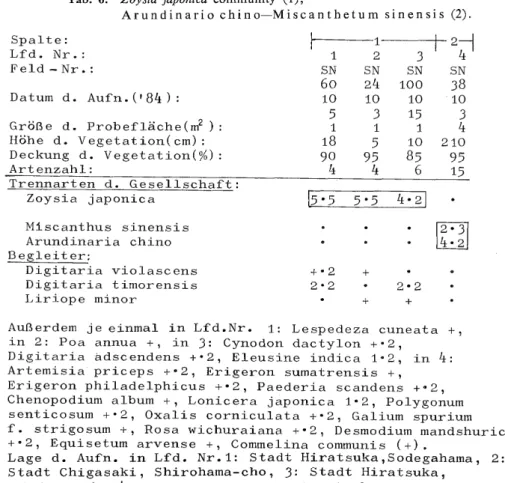
(7) community includes two subunits, an Equisetum arvense-Commelina communis subunit and a typical subunit. 5. M i s c a n t h e t u m s a c c h a r i f l o r i Miyawaki et Okuda 1972 (Tab. 3) The M i s c a n t h e t u m s a c c h a r i f 1o r i, which is characterized by the dominant species Miscanthus sacchariflori, is presented in three subassociations and two variants: a typical subassociation without characteristic species except Miscanthus sacchariflori, an Arundinaria hirtaLespedeza cuneata subassociation with differential species A. hirta and L. cuneata, and an Amphicarpaea trisperma-Humulus scandens subassociation with differential species Polygonum nodosum, P. thunbergzi, Stellaria neglects, A. trisperma and H. scandens; plus a Rosa multiflora-Metaplexis japonica variant with differential species R. multiflora, Achyranthes fauriei, Cardamine flexuosa, Rumex acetosa, Gramineae sp. and Metaplexis japonica. This association is developed along the Hanamizu river and branches of the Sagami river.. B. S u b s t i t u t e v e g e t a t i o n 6. Pinus thunbergii afforestation (Tab. 4) The Pinus thunbergii afforestation planted with only P. thunbergii, occurs 100-200 m from the shoreline. Interestingly, the P. thunbergii afforestation community clearly reflects the floristic contrast between the dune and areas further inland. This community includes many inland species, such as Celtis sinensis var. japonica, Parthenocissus tricuspidata, Ampelopsis brevipedunculata, Lonicera japonica and Ligustrum obtusifolium, and evergreen Ophiopogon ohwii and Fatsia japonica. 7. Euonymus japonicus-Pittosporum tobira plantation mixed with P. thunbergii (Tab. 4) The Euonymus japonicus-Pittosporum tobira plantation mixed with P. thunbergii occurs on the seaward side of the P. thunbergii afforestation. This plantation community characteristically consists of Cyperus rotundus, Elymus mollis, Calystegia soldanella and Oenothera laciniata, which ordinarily occur on the sandy dune. 8. Robinia pseudo-acacia afforestation The leguminous tree Robinia pseudo-acacia occurs sporadically in the P. thunbergii afforestation. Robinia pseudo-acacia afforestations, are not found on Shonan seashore. The ground under Robinia pseudo-acacia often is covered by nitrophilous herbs. 9-1) P u e r a r i o l o b a t a e - H u m u l e t u m j a p o n i c i Miyawaki 1967 (Tab. 5) The P u e r a r i o l o b a t a e - H u m u l e t u m j a p o n i c i is one of the representative associations among the R o s e t e a m u 1t i fl o r a e. This association, which is characterized by Artemisia princeps, Wisteria floribunda and Miscanthus sinensis, is divided into the Celastrus orbiculatus-Paederia scadens subassociation and Polygonum perfoliatum-Cayratia japonica subass., from the viewpoint of phytosociological species composition. 9-2) Lycium rhombi.folium community (Tab. 5) The Lycium rhombifolium community is one of forest-edge shrubs. It is differentiated by the dominant species Lycium rhombifolium. 9-3) Rubus trifidus community (Tab. 5) The Rubus trifidus community is also included in the R o s e t e a m u 1t i f 1 o r ae. This community, differentiated by the nitrophilous R. trifidus, is found on the banks of the second stream in Tsujido of Shonan seashore. 10. A r u n d i n a r i o c h i n o - M i s c a n t h e t u m s i n e n s i s Miyawaki 1971 (Tab. 7) The A r u n d i n a r i o c h i n o - M i s c a n t h e t u m s i n e n s i s is characterized by Arundinaria chino and Miscanthus sinensis. This association of Shonan seashore characteristically has many climbing plants such as Paederia scandens var. mairei, Lonicera japonica, Polygonum sentigosum, Rosa wichuraiana and Desmodium mandshuricum. 11. Zoysia japonica community (Tab. 6) The weed vegetation, mainly on roadsides but also golf courses, is represented by the Zoysia japonica community, which is differentiated by dominant Zoysia japonica. 12-1) Digitaria adscendens-Setaria glauca community (Tab. 8) The Digitaria adscendens-Setaria glauca community, which is differentiated by D. adscendens, S. glauca, D. timorensis, Eleusine indica, Paspalum thunbergii and Lespedeza cuneata, occurs on roadsides and newly built-up grounds..
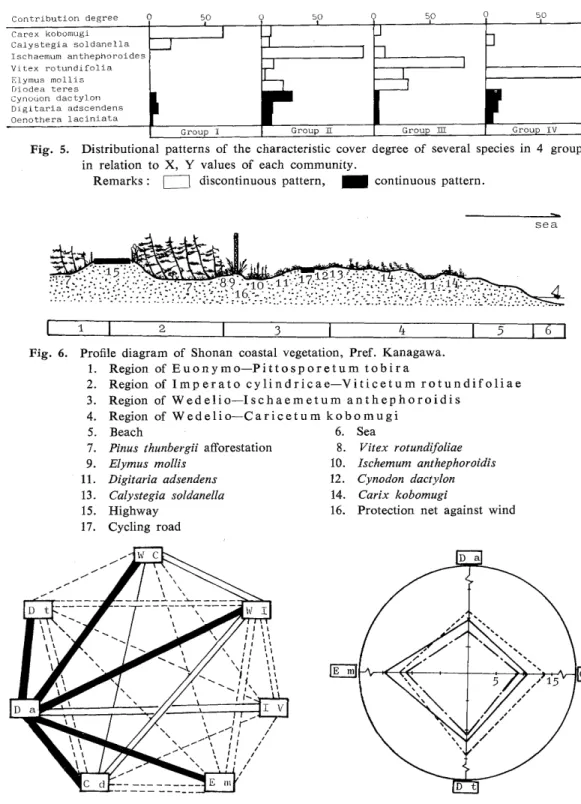
(8) 12-2) Erigeron canadensis-Artemisia princeps community (Tab. 8) The roadside weed vegetation is often represented by the Erigeron canadensis-Artemisia princeps community, which is differentiated by Erigeron canadensis and Artemisia princeps. 13-1) E r a g r o s t i o f e r r u g i n e a e - P l a n t a g i n e t u m a s i a t i c a e Tx. 1977 (Tab. 7) a s i a t i c a e , which is characterized The E r a g r o s t i o f e r r u g i n e a e - P l a n t a g i n e t u m by Eragrostis ferruginea, Plantago asiatica and Digitaria violascens, is frequently found at the roads near the banks of the Hanamizu river. 13-2) B r y o - S a g i n e t u m j a p o n i c a e Ohba 1971 (Tab. 7) The B r y o-S a g i n e t u m j a p o n i c a e, which is characterized by Bryum argenteum and Sagina japonica, often occurs in sidewalk gaps. 14. P i n e l l i o t e r n a t a e - E u p h o r b i e t u m p s e u d o c h a m a e s y c i s Miyawaki 1969 (Tab. 9) Weed communities of cultivated fields are represented by the P i n e 11 i o t e r n a t a e-E u p h o rbietum pseudochamaesyis. 15. Erigeron canadensis community (Tab. 9) The weeds of fallow fields are often represented on Shonan seashore by the Erigeron canadensis community. Others Residential areas with evergreen broad-leaved trees. Residential areas planted mainly with Pinus thunbergii. Residential areas with little green vegetation. Industrial areas. Newly built up areas. Natural bare lands. Open water areas.. 4. 2. The dynamics of dune vegetation 1) Ordination and grouping of communities Seven communities (Tab. 1, 2) occurring on the Shonan dune were compared pairwise by means of ID, an index of dissimilarity which takes into consideration the characteristic cover degree of species components of each community: I D = C 12Cnr/R' - C Cnrr/Rrr//N. The characteristic cover degree (CCn/R) is shown in Table 11 and the index of dissimilarity within and between two communities under comparison in Table 12. The range af I D values (7.65-14.96) was not so wide because of the small area studied. Ordination values of seven communities, obtained by using the Pythagorean theorem, are presented in Table 13. The position of the seven communities in a two-dimensional ordination model is shown in Figure 4. X-axis and Y-axis are correlated with the index of dissimilarity among the communities under comparison. By means of the agglomerative ordination, each community was clearly divided into 4 groups. Group I is, formed of only W e d e 1i o-C a r i c e t u m k o b o m u g i (under WC), with characteristic species Carex kobomugi occuring mainly on the forward part of the dune. Group I1 is formed of one association and three communities : W e d e 1i 0-1 s c h a e m e t u m a n t h e p h o r o i d i s (under WI) with characteristic species Ischaemo anthephoroidis distributed mainly along the middle part of the dune plus the Cynodon dactylon comm. (under Cd), Digitaria adscendens comm. (under Da) and Diodia teres comm. (under Dt), with differential species Cynodon dactylon, Digitaria adscendens and Diodia teres, respectively. Group 111 is formed of I m p e r a t o c y 1i n d r i c a eV i t i c e t u m r o t u n d i f o i a e (under IV) with characteristic species Vitex rotundifolia and Imperato cylindrica var. koenigii. Group IV is formed of the Elymus mollis comm. (under Em) with planted Elymus mollis as differential species. 2) Distribution patterns of component species Distribution patterns of several dune species, C. kobomugi, C. soldanella, I. antheporoides, V. rotundifolia, E. mollis, D. teres, C. dactylon, D. adscendens, 0. laciniata, reflecting characteristic. i..
(9) Tab. 11.. Characteristic cover degree of species components in seven communities on Shonan seashore arranged by the phytosocialogical method.. Symbol o f community Number o f r e l e v e s 11 T o t a l number o f s p e c i e s C a r e x kobornugi 64.6 Ischaemurn a n t h e p h o r o i d e s Vitex r o t u n d i f o l i a Elyrnus m o l l i s Cynodon d a c t y l o n D i g i t a r i a adscendens Diodea t e r e s Calystegia soldanella Cyperus r o t u n d u s Oenothera l a c i n i a t a Artemisia princeps S a l s o l a kornarovii Paederia scandens v a r . mairei Chenopodiurn album Cuscuta a u s t r a l i s Oxalis c o r n i c u l a t a Lespedesa c u n e a t a Cornrnelina cornrnunis Sporobolus f e r t i l i s I x e r i s repens Portulaca oleracea Sonchus o l e r a c e u s Glehnia l i t t o r a l i s Lathyrus japonicus Irnperata c y l i n d r i c a v a r . k o e n i g i i Cocculus o r b i c u l a t u s Bidens p i l o s a Euonyrnus j a p o n i c u s Rosa w i c h u r a i a n a Digi t a r i a tirnorensis Grarnineae s p . Luzula c a p i t a t a Euphorbia s u p i n a Eleusine i n d i c a Rumex a c e t o s a Chenopodiurn a m b r o s i o i d e s Setaria glauca Eragrostis ferruginea Arthraxon h i s p i d u s Calystegia japonica Digitaria violascens Galiurn spuriurn f . s t r i g o s u m Lamiurn purpureurn Hydrocotyle rnaritima Geranium t h u n b e r g i i Remarks: W C = W e d e l i o - C a r i c e t u m l i o b o m u g i , W I = W e d e l i o - I s c h a e m e t u m a n t h e p h o r o i d i s , IV= I m p e r a t o cylindricae-Viticetuln r o t u n d i f o l i a e , E m = E l y m u s mollis cornmunity, Cd= Cy~zodondactylon community, Da=Digitaria adscendens community, Dt=Diodia teres community.. cover degree, are shown in Figure 5. The species above for each group describes the tendency to be continuous or discontinuous. The species which can be named as the native species of the dune vegetation in this region, such as Carex kobomugii, Calystegia soldanella, Ischaemum anthephoroidis and Vitex rotundifoliae, occured discontinuously. Secondary species such as Cynodon dactylon, Diodia teres, Digitaria adscendens and Oenothera laciniata occured continuously. Even if each community is summarized in the form of synthesis tables, which constitute an objective method of checking the accumulated data for homogeneity and validity of component species. It will be suggested that these tendencies to continuity or discontinuity may have been caused by certain environmental factors, human and natural, on the sandy beach. Dune plant communities.
(10) Tab. 12. Matrix of indices of dissimilarity for the seven communities on Shonan seashore. Symbol of community Number of relevhs Total number of species Wedelio-Caricetum. l i o b o m u g i (WI). Wedelio-Ischaemetum r o i d i s (WI). i. anthepho-. (9) 12.30. (8) 12.85. (5) 9.98. (10) 7.65. (6) 12.6. Imperato cylindricae-Viticetum r o t u n d i f o l i a e (1V). Elymus mollis community (Em). I. Cynodon dactylon community (Cd) Digitaria adscendens community (Da) Diodia teres community (Dt) (-):. Number of species commonly found in two communities under comparison.. Tab. 13. Ordination values (X, Y) of seven. communities on Shonan seashore. Community. .: .&".. . .....*...:. .i. G r o u p 11'. Remark : X.Y values can be obtained by calculation using the Pythagorean theorem.. II. under much human impact will often be composed mainly of species occurring continuously. 0 ;1 '160 x On the other hand, Elymus mollis, a substitute species, presents a discontinuous pattern. This Fig. 4. Ordination of Y/X+values of the seven may be the reason why Elymus mollis is not only communities divided into 4 major groups local species in this region but also is intentionarranged on Shonan seashore. ally planted in restricted areas for suppressing sand movements. The associations WC, WI and IV, mainly dominated by species occurring discontinuously, are found inland from the beach, representing a zonal distribution. However, the original patterns of zonation are changed here and there by heavy human impact (Fig. 6).. ,. -..'iv'~..mG,oup ...... ....i. A. 3) Community web and distributional characteristics of the communities Figure 7 illustrates the community web of seven communities, as summarized from Table 12. The dissimilarity index computed for any two communities under comparison is divided into 5 levels : from most (14.96-13.49) to leaet (9.11-7.65) similar. A community web describes interlocking patterns among communities on closed habitats such as coastal dune vegetation. Potential natural communities, such as WC, WI and IV, are closely related to the Da community, as seen by lower dissimilarity value. The Da is very characteristic of roadsides, parking places and open spaces of residential areas. Therefore, it may be supposed that the studied areas are disturbed by human activities like treading, motor-cycling, fishing and so on. Figure 8 presents the interre-.
(11) C o n t r i b u t i o n degree C a r e x kobomugi Calystegia soldanella Ischaemurn a n t h e p h o r o i d e s Vitex rotundifolia Elyrnus r n o l l i s Diodea t e r e s Cynouon d a c t y l o n D i g i t a r i a adscendens Oenothera l a c i n i a t a. 0. 0. 50. 1. 0. 50. 1. I. Group I. I. Group II. I. 50. 100 I. 7. 17 I. 1. 0. 50. Group D I. I. I I. Group I V. J. Fig. 5. Distributional patterns of the characteristic cover degree of several species in 4 groups in relation to X, Y values of each community. Remarks : (discontinuous pattern, continuous pattern.. sea. Fig. 6. Profile diagram of Shonan coastal vegetation, Pref. Kanagawa. 1. Region of E u o n y m o - P i t t o s p o r e t u m t o b i r a 2. Region of I m p e r a t o c y l i n d r i c a e - V i t i c e t u m r o t u n d i f o l i a e 3. Region of W e d e l i o - I s c h a e m e t u m a n t h e p h o r o i d i s 4. Region of W e d e l i o - C a r i c e t u m k o b o m u g i 5. Beach 6. Sea 7. Pinus thunbergii afforestation 8. Vitex rotundifoliae 9. Elymus mollis 10. Ischemum anthephoroidis 11. Digitaria adsendens 12. Cynodon dactylon 13. Calystegia soldanella 14. Carix kobomugi 15. Highway 16. Protection net against wind 17. Cycling road. Fig. 7.. Community web representing dissimilarity between communities of Shonan dune vegetation. The single and double broken line, the single and double fine line, and the bold line indicate dissimilarity levels of 14.96-13.49, 13.49-12.03, 12.03-10.57, 10.57-9.1 1 and 9.11-7.65, respectively.. The interrelation of seven communites of Shonan dune vegetation represented by the index of dissimilarity (ID). Remarks:-Wedelio-Caricetum kobomugi -0-Wedelio-Ischemetum anthephoroidis - - -1mperato cylindricaeVitice tum rotundifoliae. Fig. 8..
(12) lations of seven communities on th duene vegetation, as modified by the index of dissimilarity (ID; Tab. 12) which was derived from the characteristic cover degree of component species. As seen from Figure 8, the following context will be suggested: (1) WI, with the smallest dissimilarity index (compared with WC and IV), had the closest relationship to the substitute communities Da, Cd, Dt and Em. This close relationship between WI and 4 substitute communities may be the reason why the cycling road was established in the W I region on the middle of the dune. (2) IV, with the biggest dissimilarity index (contrasting with W C and WI), is the least related to the 4 substitute communities. This is the reason why the region of IV 's distribution was used for the afforestation belt with Pinus thunbergii for protection against the severe coastal environment. IV is distributed mainly in the open space of this afforestation area.. 5. Summary This paper has reviewed mapping and classification of Shonan vegetation under heavy human impact. The dune vegetation of Shonan seashore has been subjected to ordination and grouping of communities, and the distribution patterns of some species have been explained through the characteristic cover degree in addition to the interrelation between distributional patterns of communities and their environment. (1) The actual vegetation in Shonan area was classified into 24 vegetation units. It was very difficult to find natural vegetation in Shonan area. (2) The map of actual vegetation, at a scale of 1:10,000, was accomplished with 22 units to show the distribution of plant communities in Shonan area. (3) Three associations and 4 communities were identified in the dune vegetation of Shonan seashore: W e d e l i o - C a r i c e t u m k o b o m u g i (WC), W e d e l i o - I s c h a e m e t u m anthep h o r o i d i s (WI), I m p e r a t o c y l i n d r i c a e - V i t i c e t u m r o t u n d i f o i a e (IV), plus the Digitaria adscendens community (Da), Cynodon dactylon community (Cd), Diodia teres community (Dt) and Elymus mollis community (Em). Three associations were recognized phytosociologically as native vegetation, and 4 communities as substitute or secondary vegetation on this dune. (4) Dune vegetation could be divided into 4 vegetation regions (4 groups) through the index of dissimilarity (ID, I D = C ICCrn/Rr- CCrr/R"I/N), based on characteristic cover degree ( C C n / " R) of component species, between communities under comparison. Group-I consisted of only WC, group-I1 of WI, Da, Cd and Dt, group-I11 of only IV, and group-IV of only Em. (5) Distribution patterns of some species were determined on the dune vegetation. Main component species of the native vegetation, such as Carex kobomugi, Calystegia soldanella, Ischaemum anthephoroidis and Vitex rotundifoliae, were discontinuous. The secondary species Cynodon dactylon, Digitaria adscendens and Oenothera laciniata were shown to have continuous cover patterns. Elymus mollis occured discontinuously, however, though being a substitute species at Shonan. E. mollis was planted additionally in some areas of the dune. (6) The community web was described for understanding the interlocking patterns among communities. This showed that the Digitaria adscendens community (one of the trodden communities) has the closest relationship to all other communities on the dune, due to heavy human impact like treading. (7) The most disturbed vegetation on the dune is the W e d e l i 0-1 s c h a e m e t u m anthephoidis.. Ref erenees Becking, R. W. 1957. The Ziirich-Montpellier school of phytosociology. The Botanical Review 23 (7): 411-469. Braun-Blanquet, J. 1965. Plant Sociology. Hafner publishing company, New York and London. 439 pp. Elenberg, H. 1956. Grundlagen der vegetationsgliederung, I. Aufgaben und Methoden der vegetations Kunde. Einfiihrung in die Phytogie, IV. 136pp. Eugen Ulmer, Stuttgart. Ishizuka, K. 1961. Ecological studies on the vegetatioil of coastal sand bars I. An analysis of vegetation on a recently formed sand bar. Annu. Rep. Gakugei Fac. Iwate Univ. 19, pt..
(13) 3:37-64. Ishizuka, K., ed. 1983. Environment and Distribution of Community. Asakura. Tokyo. 357pp. Maarel, E. van der. 1966. Dutch studies on coastal sand dune vegetation, especially in the delta region. Wentia 15: 45-82. -, Boot, R. and Dorp, P. 1985. Vegetation succession on the dunes near Oostvoorne, The Netherlands, since 1934, interpreted from air photographs and vegetation maps. Vegetatio 58: 123-136. - -, - and Rijnties, J. 1985. Vegetation succession on the dunes near Oostvoorne, The Netherlands ; a comparison of the vegetation in 1959 and 1980. Vegetatio 58: 137-187. - and Leertouwer, J. 1967. Variation in vegetation and species diversity along a local environmental gradient. Acta. Bot. Neerl. 16(6) : 21 1-221. Malmer, N. 1962 a, b. Studies on mire vegetation in the archaean area of southwestern Gijta-land (South Sweden). Bpora botanica 7 : 1, 2. Lund. Miyawaki, A. et al. 1972. Vegetation der Stadt Fujisawa, Prafectar Kanagawa. pp. 117. Fujisawa Japan. ---- et al. 1972. Reale Vegetation der Prafectur Kanagawa. 788pp. The Board of Education of the Kanagawa Prefecture. Yokohama. - et al. 1976. Vegetation der Stadt Chigasaki, Prafectur Kanagawa pp. 175. Chigasaki. Japan. - et al. 1976. Vegetation der Stadt Hiratsuka, Prafectur Kanagawa pp. 160. Hiratsuka. Japan. -, ed. 1977. Vegetation of Japan. pp. 535. Gakugen. Tokyo. ----, et al. 1977. Handbook of Japanese Vegetation. 850pp. Shibundo. -, ed. 1985. Vegetation of Japan, vol. 5. Chibu. 604pp. Shibundo. Tokyo. ---- and Suzuki, K. 1980. Process of phytosobiological studies and vegetation mapping. Bull. Inst. Envir. Sci. Tech. Yokohama Natn. Univ. 6(1) : 65-76. .' Mueller-Dombois, D. and Ellenberg, H. 1974. Aims and Methods of Vegetation Ecology. John Wiley and Sons, New York. 547 pp. Nobuhara, H. 1967. Analysis of coastal vegetation on sandy shore by biological types in Japan. Jap. Journ. Bot., 19(3): 325-351. - and Inoue, K. 1965. Change of the structure of the coastal vegetation at the dune of Tsujido, Kanagawa Prefecture, Observation of the coastal vegetation of the permanent quadrat (V) . Shakyu-genkyu (dune research). 12(1) : 33-40. - Okada, Y. and Fujihira, K. 1962. Observations on the damages of the coastal vegetation I. Jap. J. Ecol. 12(3): 101-107. - and Toyohara, M. 1364. Observations on the damage of the coastal vegetation 11. Jap. J. E c o ~ .14(5): 195-200. Odum, Eugene, P. 1971. Fundamental1 of Ecology (2nd edition). 574 pp. Saunders, Toppan. Singapore. Ohba, T. 1979. Syntaxonomy of the coastal vegetation of Japan-1. plant comm. of sandy seashore. Gaiyou and seibutsu (Ocean and creature). 4(1/4): 55-64. Ohba, T. Miyawaki, A. and Tiixen, R. 1973. Pflanzensoziologische Beobachtungen in Japan. Vegetatio 26(1-3) : 3-143. The Hague. Schwickerath, M. 1954. Die Landschaft und ihre Wandlung, auf geobotanischer und geograhischer Grundlage entwickelt und erlautert im Bereich des MeBtischblattes Stolberg. Aachen. Tagawa, H., Suzuki, E., Partomihardjo, T. and Suriadarma, A. 1985. Vegetation and Succession on the Krakatau Islands, Indonesia. Vetatio 60 : 131- 145. r Elymus-Gesellschaften an nordeurop,ischen, nordjapanischen und Tiixen, R. 1966. ~ b e nitrophile nordamerikanischen Kusten. Annales Botanici Fennici 3 : 358-367. ----- 1967. Pflanzensoziologische Beobachtungen an sudwestnorwegischen Kiisten-Diinengebieten. Aquilo, Ser. Botanica 6 : 241-272. Oulu. 9.
(14) Tab. 3.. M i s c a n t h e t u m s a c c h a r i f l o r i (1) Typical subassociation, ( 2 ) Arundinaria hirta subass., (3) Amphicarpaea trispermaHumulus scandens Subass.. Lfd-Nr.: Feld-Mr. : Datum d. aufnahme:. 1 SN. SN. 184. 77 184. 78 184. 2 90. 10 5 9 2 90. 10 5 1 0 2 90. 10 5 4 2 90. 9. 10. 11. 8. 110 GrijRe d. ~ r o b elahe f (m2) : II6he d. Vegetation(m) : Deckung d. vegetation(%): Zahl d. Aufnahmc: Artenzahl(Mitt1ere ~rtenzahl): Kenn-u. Trennarten d. Ass.: Miscanthus sacchariflorus. 4. 3 SN. 74 184 5 6. 15-4. 2 SN 59. 5-5. 5.5. 5.5. 5. -. 5 175 10 5 2 5 2.5 90. 6 SN 56. 184 174 10 9 5 5 6 1.5 85. -. -. 10. 11. 5.3. 7. -. 8. 174 9 5. -. -. 3 (17). 7 (9)-. 4.4 3(3-5) v(3-5). I. Arundinaria hirta Lespedeza cuneata IJolygonum nodosum Polygonum thunbergii Stellaria neglecta Amphicarpaea Trisperma Humulus scandens Rosa multiflora Achyranthes fauriei Cardamine flexuosa Gramineae sp. Rumex acetosa Metaplexis .japonica - ~egleiter: Artemisia princeps + +:2 +*2 +-2 (+) 2(+) II(+) 2.2 +.2 + + +.2 II(+) Commelina communis 3.3 1.2 1.2 + 2.3 I(+) Equisetum arvense Paederia scandens ver. mairei 1.2 + i 2(+-1) v ( + ) Cayratia japonica + + +a2 I(+) IV(+-1) Miscathus sinensis +-2 +-2 + + Calystegia japonica + + +-2 I(+) Phragmites australis 1.2 I(+) AuBerdem jc einmal in Lfd.Nr.1: Clinopodium gracile + , Rumex japonicus + - 2 , in 2:Erigeroq sumatrensis + , Setaria viridis +:2, in 3: Polygonum cuspidatum + , Pueraria lobata + , Phryma leptoatashya var. asiatica +, Arthraxon hispidus +.2, in 5: Panicum bisclcatum +.2, Salix intecra +, in 6: Solidago altissima + , in 7: Lycium rhombifolium 3(+), Stellaria aquitica 3(+), Bidens frondosa 2(+), Raphanus sativus var. hortensis 2(+), Digitaria adscendens l(+),Erigeron canadensis I(+), Cucumis sativus var. tuberculatus I(+), in 8: Polygonum perfoliatum II(+-3) , Dioscorea japonica I(+) , Melothria japonica I(+), Lactuca indica var. laciniata I(+), Sicyos angulatus I(+), Rubia akane I(+), Oenanthe javanica I(+), Euonymus japonicus I(+), Xanthium strurnarium I(+), Lage d. Aufn. in Lfd. Nr. 1: Stadt Hiratsuka, Hanamizu, 2-4,6: Stadt Chigasaki, Yanagishima, 5: Stadt Hiratsuka, 7,8: Stadt Chigasaki. Nachweis der Vegetationsaufnahme in Lfd. Nr.5: Miyawaki et a1 1979(~ab.12), 8 : Miyawaki et a1 1976(Tab.10)..
(15) Coastal afforestation on Shonan seashore 1=Euonymus japonicus-Pittosporum tobira-plantation 2 =Pinus thunbergii-plantation. Tab. 4.. Unit: Number of relevgs(~): Mean number of species: Planting species: Pinus thunbergii Euonymus ja~onicus Pittosporum tobira Differential species of lower comm.: Cyperus rotundus Digitaria adscendens Calystegia soldanella Oenothera laciniata Lonicera japonica Celtis sinensis var. japonica Parthenocissus tricuspidata Ophiopogon ohwii Fatsia japonica Ligustrum obtusifolium Arnpelopsis brevipedunculata Cocculus orbiculatus Companions: Paederia scandens var. mairei Miscanthus sinensis Ligustrum japonicum Commelina communis Artemisia princeps Rosa multiflora Oxalis corniculata Rosa wichuraiana Erigeron sumatrensis Oplismenus undulatifolius Ilex crenata Sonchus oleraceus Oenothera biennis Bidens biternata Bidens pilosa Morus bombycis Vitis ficifolia var. lobata Polygonum senticosum Rumex acetosa Achyranthes japonica Dioscorea japonica Cayratia japonica Arundinella hirta Robinia pseudoacacia Ixeris dentata ~ i r i o p eminor etc. -. -. 11-. ---+---24 5 23 26. 4. 3 (1 -3). V (4-5).
(16) Tab. 5.. 3. Spalte: +. 2. P u e r a r i o l o b a t a e - H u m u l e t u m j a p o n i c i (1): aCelastrus orbiculatusPaederia scandens, b- Polygonum perfoliatum-Cayratia japonica subass., Rubus triJidis community (2), Lycium rhombifolium community (3). '. 1. -a .. Lfd. Nr.: Feld-Nr. :. 1 SN. 68 Datum d. Aufn.(185): GroRe d. ~ r o b e lzche(m2 f ) : Exposition: Neigung( " ) : Hohe d. Vegetation(m) : Deckung d. Vegetation(%): Artenzahl: Trennarten d. Gesellschaft: Artemisia princeps Pueraria lobata Miscanthus sinensis. 10 5 4 2 100 11. 67 10 5 5 9 -. 80. 0.5 100. 9. 7. -. +*2. 4 SN 49 10. 1 1 100 5. b --------I 5 6 SN SN 48 109 10 10 5 1 5 9 4 S E 15 1.5 0.4 100 100 1 7 6. +. 4.4 5 - 5. 5 - 5 2.2 -+-. 3 SN. -. 3. 1-2. +. 2 SN 69 10 5 6 -. - - -+-. 1-2 - - -+7. Paederia scandens Ampelopsis brevipedunculata var. 1+*2 3 -3 1 Celastrus orbiculatus 1+*2 2.2 1 Arundinella hirta Y 1 2 _ - - + _ - - - - .I I. *. 7 8 SN SN 36 209 10 11 3 1 4 4 8 S - - 30 0.5 0.5 70 90 9 - 1 0. +-2 +-2 5.5 +02. 1.2. +. .. 1.2. -. Polygonum perf oliatum Cayratia japonica Humulus scandens Trennarten d. Gesellschaft: Rubus trif idus Trennarten d. Gesellschaft: Lycium rhombifolium Begleiter: Commelina communis 1.2 Phryma leptostachya var.asiatica Bidens pilosa Polygonum nodosum Erigeron sumatrensis Equisetum arvense +-2 Rosa multiflora +.2. .. O. c-L -. -- - - - --J. 14.4)-. a +.2 +a2 +-2. +. (+I. + + +. -. 1.2 1.2. + +a2 2-2 +02. AuRerdem je eimal in Lfd. Nr. 1: Erigeron annuus + * 2 , Artemisia japonica + - 2 , Calystegia japonica + , in 2: Dioscorea japonica + - 2 , i n 5: Albizia julibrissin + - 2 , Erigeron canadensis +, Amphicarpaea triseerma + * 2 , Pteridium aquilinum var. latiusculum +, Oenothera stricta +, Bedens frondosa 1.2, Xanthium strumarium +, i n 7: Diodia teres +, Setaria glauca + , Houttuynia cordata +, Phragmites australis +, in 8: Setaria viridis +, Lonicera japonica + * 2 , Achyranthes japonica +, Cocculus orbiculatus + * 2 , Digitaria adscendens +. Lage d. Aufn. in Lfd. Nr. 1-3: Stadt Hiratsuka, Higashi-cho, 4.5: Stadt Chigasaki, Yanagishima, 6: Stadt Chigasaki, Hanamizudai, 7: Stadt Hiratsuka, 7: Stadt Chigasaki, Shiomidai, 8: Stadt Hiratsuka, Hanamizudai..
(17) Tab. 6 . Zoysia japonica community (I),. Arundinario chino-Miscanthetum. sinensis (2).. Spalte: Lfd. Nr.: Feld Nr. :. -. Datum d. Aufn.(f84): GroBe d. Probeflache(m2 ) : Hohe d. Vegetation(cm): Deckung d. Vegetation(%) : Artenzahl: Trennarten d. Gesellschaft: Zoysia japonica Miscanthus sinensis Arundinaria chino Begleit er; Digitaria violascens Digitaria timorensis Liriope minor AuBerdem je einmal i n Lfd.Nr. 1: Lespedeza cuneata + , i n 2: P o a annua + , i n 3: Cynodon dactylon + - 2 , Digitaria adscendens + * 2 , Eleusine indica 1 - 2 , i n 4: Artemisia priceps +.2, Erigeron sumatrensis + , Erigeron philadelphicus + - 2 , Paederia scandens + 0 2 , Chenopodium album + , Lonicera japonica 1.2, Polygonurn senticosum + - 2 , Oxalis corniculata + * 2 , Galium spurium f. strigosum + , Rosa wichuraiana + - 2 , Desmodium mandshuricum + = 2 , Equisetum arvense + , Commelina comrnunis ( + ) . Lage d. Aufn. i n Lfd. Nr.1: Stadt Hiratsuka,Sodegahama, 2: Stadt Chigasaki, Shirohama-cho, 3: Stadt Hiratsuka, Takahama-cho,4: Stadt Chigasal~i,Midorigahama.. Tab. 7. Bryo-Saginetum jaonicae(l), Eragostio f e r r u n g i n e a g i n e a - P l a n t a g i n e t u m Spaltc:. +'. I. asiaticae (2). 1. Nr. : Veld-Nr. : 1,fd.. Datum d. Aufn.('84): GriiRe d. l'robef lache (m2) : I-liihe d. Vegetation(m) : Deckung d. Vegetation(%): Artenzahl: Kenn-v. Trennarten d. Ass.: Bryum argenteum Sagina japonica Kenn-u. Trennarten d. Ass.: Plantago asiatica Digitaria violascens Eragrostis ferrunginea. .. I'olygonun~ aviculae. 2.2. 5.5. 5.4. +. .. Trifoliun~repens + Lespedeza cuneata Traxacum officinale Bcgleiter: + ' Eleusine indica +.2 + • 3.3 + 2-2 Cynodon dactylon + +.2 +a2 -. Digitaria timorensis 2-2 + 2-3 Juncus tenuis 1-2 + - 2 , Oxalis corniculata AuRerdem je einmal in Lfd. Nr.2: Poa annua 2.3, Stellaria media + , in 3: Athraxon hispidus 10: Setaria glauca + , + , in 4: Carex incisa + - 2 , in 8: Rumcx acetosa ( + ) , in 9: Pcnnisetum alopecuroides + - 2 , in in 11: Paspalum thunbergii 1 - 2 , in 12: llydrocotyle maritima 1 - 2 , Kyllinga gracillima +.2. 5,13: Stadt Chigasaki, Lace d. Aufn. in Lfd. Nr. 1-3: Stadt Iliratsuka, Oiso, 4,6-9: Stadt Chigasaki, yanagishima, Hamasuka, 12: Stadt Hiratsuka, H a n a m ~ z u ,11,12: Stadt Iliratsuka, Ttsujido.. -. -. --. . -. .. -. -. -. -.
(18) Nr.: Feld-Nr. :. LT-d.. Datum d. Aufn.('84): Gr6Re d. ~ r o b e lf:che(m2 ): Ilohe d. Vegetation(m1: Deckung d. Vegetation(%): ~eigung(' ) : Exposition: Artenzahl: Trennarten d. Gesellschaft: Digit aria adscendens Digitaria timorensis Lespedesa cuneata Eleusine indica Paspalum thunbergii Setaria glauca. 18. -. W. 18. 13. W 9. 14. 12. Erigeron canadensis Artemisia princeps Erigeron su~atrensis Oenothera biennis Miscanthus sinensis Bidens pilosa Oenothera laciniata Begleiter: Setaria viridis Echinochloa crus-galli Commelina communis Taraxacum officinale Cayratia japonica Plantago asiatica Polygonum longisetum Arthraxon hispidus Setaria faberi AuRerdem je einmal in Lfd. Nr. 1: Paederia scandens var. mairei +, Sonchus oleraceus +, Euisetum arvense + , Justicia procumbens var. leucanta +, Dioscorea tokoro +, Rorippa indica +, in 2 : Polygonum yokusaianum 1.2, Arundinella hirta +, Digitaria violascens 2.3, Trifolium repens +, Euphorbia supina +.2, Eragrostis ferruginea +, in 4: Polygonum nodosum +, Calystegia japonica + , Humulus scandens +, in 5: Glycine soja 5.5, Galium verum var. asiaticum +, in 6: Pueraria lobata +.2, Bidens frondosa +, Chenopodium ambrosioides 1.2, in 7: Erigeron philadephicus +, Diodia teres 3 - 3 , Lathyrus japonicus +. Lage d. Auf. in Lfd. Nr.1,4: Stadt Chigasaki, Yanagishima, 2: Stadt Hiratsuka, Higashi-cho, 3,5,6: Stadt Chigasati, Hamamae, 7: Stadt Chigasaki, Hamaska..
(19) Tab. 9.. Erigeron canadensis community ( 1 ) and Pinellio ternatae-Euphrbietum. p s e u d o c h a m a e s y c i s (2).. Tab. 13. Erineron canadensis community( 1) and Pinellia ternata-Euphorbia pseudochamaesyceassociation(2). Spalte: Lfd. Nr.: Feld-Nr :. .. SN 108 12 1. 8. -. -. Grijfie d, ~ r o b e f l a c h e (m2) : Hohe d. vegetation(m1: Deckung d. vegetation(%): 90 Zahl d. Aufn. : 6 2 Mittlere ~rtenzahl(~rtenzah1): (2) 19 25 1Cenn.-u. Trennarten d. Ass.: Erigeron canadensis (1(1> Kenn.-u. Trennarten d. Ass.: u. hoheren Einheiten: Digitaria adscendens Cyperus microiria Portulaca oleracea Polygonum longise tun1 Oxalis corniculata III(+) 2(+-2) Echinochloa crus-galli Acalypha australis III(+) I(+) Chenopodium album III(+-1) I ( + ) Euphorbia pseudochamaesyce Lamium amplexicauls 1 - 1 1 Mallugo pentaphylla 1 - 1 ) 2 i Amaranthus lividus V(+-2) Stellaria neglecta IIII(+-2) Veronica persica Setaria viridis Commelina communis II(+) II(+) i Senecio vu'lgaris II(+) , Eleusine indica Cyperus iria Chenopodium ficifolium -Begleiter: V(+-1) 2(+-1) Equisetum arvense I(+) I(+) Erigeron sumatrensis I(+) 2(+? P o a annua I(+) I(+) Mazus japonicus Kulturpflanzen: Raphanus sativus = II(+) I(+) Allium fistulosum I(+> l(i Solanum tuberosum I(+? Brassica oleracea I(4) Lycopersicon esculentum Citrus unshiu Brassica campestris Daucus carota t( t ) Lase d. Aufn. i n Lfd.Nr.1: Stadt Chigasaki, ~amamae('84.oct.15) 2: Stadt Hiratsuka, 3: Stadt Chigasaki.. 15.51. *. -. a O. Arten, welche nur a n einem Ort aufgefunden worden sind, werden nicht aufgefihrt. Nachweis der vegetationsaufnahme i n Lfd. Nr.2: Miyawaki e t a1 1976 ( ~ a b 3.2 ) ,3: Miyawaki e t al 1976 ( ~ a b 34) .. ..
(20) Tab. 10. Phragmites australis community.. Lfd,Nr.: Feld-Nr. : Datum d. Aufn.: GroBe d , ~ r o b elahe f (m2) : Hohe d. Vegetation(m): Deckung d o Vegetation(%): Zahl d Aufn.: Artenzahl(~itt1ere ~rtenzahl): Trennarten d. Gesellschaft: Phragmites australis. 1. (3). 9. 5.5. 3(4-5). 4.4. ... (1;). 3(3-4). Equisetum arvense 1-22 3(3-5) Cornmelina communis + I(+) BegPeiter: Oenanthe javanica 1(2) 3(2-4) AuBerdem je einrnal in Lfd. Nre2: Rosa multiflora I(+), Gramineae sp. 2 ( + ) , Circaea erubescens I(+), Stellaria alsine var, undulata I(+), Ranunculus quelpaertensis var, g l a b e r I(+), in 3: Polygonum thunbergii 3(1), Phalaris arundinacea 1(2), Leersia sayanuka I(+), Cardamine flexuosa 3(+), Lythrurn anceps 1(1), Arenaria serph serpyllifolia I(+), Galium spurium f. strigosum I(+), Ampelopsis brevipedunculata I(+), Agropyron racerniferum 1(1), Scirpus triqueter 1(2), Polygonum sieboldii I(+), Veronica arvensis I(+), in 4: Rumex japonicus 1.2, EchinochPoa crus-galli 1.2, HumuPus scandens 2-27 Paederia scandens var. mairei + , ~ 0 n - japonica i ~ ~ ~ ~ +.2, Rumex acetosa +. Lage d. Aufn. in Lfd. 1 : Stadt Hiratsuka, 2:Stadt Chigasaki, 3: Stadt Chigasaki, Shiomidai, 4 : Staft Fujisawa. ,. Nachweis der Vegetationsaufnahme in Lfd. 1 Miyawaki e t al 1976(~~b.12),2: Miyawaki et al 1976 ( ~ a b . 1 2 ) 4: ~ Miyawaki et a1 1984 (Tab.30). O. O.
(21)
図


+7




関連したドキュメント
H ernández , Positive and free boundary solutions to singular nonlinear elliptic problems with absorption; An overview and open problems, in: Proceedings of the Variational
Keywords: Convex order ; Fréchet distribution ; Median ; Mittag-Leffler distribution ; Mittag- Leffler function ; Stable distribution ; Stochastic order.. AMS MSC 2010: Primary 60E05
This approach is not limited to classical solutions of the characteristic system of ordinary differential equations, but can be extended to more general solution concepts in ODE
All (4 × 4) rank one solutions of the Yang equation with rational vacuum curve with ordinary double point are gauge equivalent to the Cherednik solution.. The Cherednik and the
[56] , Block generalized locally Toeplitz sequences: topological construction, spectral distribution results, and star-algebra structure, in Structured Matrices in Numerical
In Section 3, we show that the clique- width is unbounded in any superfactorial class of graphs, and in Section 4, we prove that the clique-width is bounded in any hereditary
By interpreting the Hilbert series with respect to a multipartition degree of certain (diagonal) invariant and coinvariant algebras in terms of (descents of) tableaux and
Keywords: continuous time random walk, Brownian motion, collision time, skew Young tableaux, tandem queue.. AMS 2000 Subject Classification: Primary:
