
トップページ - 横浜国立大学学術情報リポジトリ
10
0
0
全文
(2) 68. (722). 横浜国際社会科学研究 第 17 巻第 6 号(2013 年 2 月). co-existence on the earth. As the world is facing several developmental challenges, poverty is the leading factor among them. Not only in developing countries, but also in the developed countries, citizens are suffering from poverty and socio-economic gaps. There are several discussions of various tools that could be used for reducing poverty. Since the 1980s, microfinance has been labeled as one of the most effective policy tool by the government, and has become an important component of development, poverty reduction and economic regeneration strategies around the world. By the early twenty-first century, tens of millions of people in more than 100 countries have been accessing services from formal and semi-formal microfinance institutions (MFIs). It has become global industry involving large numbers of governments, banks, aid agencies, NGOs, cooperatives and consultancy firms and directly employs hundreds of thousands of branch-level staffs (Hulme and Arun, 2009). Microfinance, which is understood as the means and institutions created in order to provide financial services to people excluded from traditional banking system, has a long history. Modern microfinance in particular, which emerged since the 1970s, owes much to the cooperative movement and to traditional “informal” financial practices─for instance, Rotating Savings and Credit Associations (ROSCAs)─that have been popular for centuries across the world (Labie and Mersland, 2011). From an international development perspective, microfinance has attracted increasing interest due to a wide variety of new institutions. There are several MFIs with various backgrounds. Some of these have directly emerged from the credit unions movement (such as the major credit and saving cooperatives networks in Africa); some have their roots in NGOs (such as the seminal cases of the Grameen Bank in Bangladesh, Prodem-Bancosol in Bolivia and the K-Rep Bank in Kenya); while others have emerged from public bank restructurings (such as the emblematic case of Bank Rakyat in Indonesia) (Labie and Mersland, 2011). These initiatives, along more than hundreds of others, have received a great deal of attention from national authorities, as well as from international donor and development communities. Moreover, during the last decade, there is increased interest from the international banking and investment communities. On the other hand, most of the MFIs have not succeeded to deliver the financial services efficiently, and some failed. Most MFIs face the challenge of institutionalization and achieving sustainability. The sustainability of an MFI demands not only financial viability and the ability to adapt to existing legal frameworks, it also requires a clear strategic vision and an organization that is transparent, efficient and accepted by all the stakeholders involved. These issues are often grouped together under the concept of “governance.” So it is inevitable to have effective governance to tackle those challenges of microfinance. The essential elements of effective governance will be discussed in governance section. Governance The term ʻgovernanceʼ, while relatively new to the development sector, became in the early 1990s an unavoidable concept when discussing on economic and social development issues. The governance issue has been placed in the development field since the outbreak of the Asian crisis in 1997, as one of the underlying causes of the crisis. Different aspects were supposed to be the reasons of the financial crisis. Among them, one element in which too little attention was paid until that period, emerged as one of the reasons as to the extent to which financial crises resulted. This was failure in “governance”─ broadly defined to include the efficient and effective management of public institutions and private firms. When countries and firms borrow excessively and mismanage their financial affairs, then almost by definition, they are not being governed well (Litan, Pomerliano, and Sudararajan, 2002). As the collective management of public and private institutions is inevitable for the prevention of the crisis, the governance of the public and private institutions should be on good function in that sense. In this regard, this research will firstly discuss the general idea of governance..
(3) Institutional Governance in Microfinance Institutions(Ragab Kayastha). (723). 69. Several international organizations have defined governance in different way. Among them, the World Bank (1992) first discussed the issues relating governance in the early 1990s. The World Bank defines governance as “The manner in which power is exercised in the management of a country’s social and economic resources for development”. Governance fosters strong, but sharply delimited, state capable of sustained socio-economic development and institutional growth. The World Bank (1994) has identified three distinct aspects of governance: (i) the form of political regime; (ii) the process by which authority is exercised in the management of a countryʼs economic and social resources for development; and (iii) the capacity of governments to design, formulate, and implement policies and discharge functions. The Asian Development Bank (ADB) defines governance exactly in the same way as the World Bank does (ADB, 1999). United Nations Development Program (UNDP) defines governance as “the exercise of political, economic and administrative authority in the management of a country’s affairs at all levels. It is the complex mechanisms, processes, relationships and institutions throughout which citizens and groups articulate their interests, exercise their rights, obligations and mediate their differences” (UNDP, 1997). Governance, in this context, often discusses to improve the effect of development assistance. Governance is mainly about addressing the issues of interests determining the process of managing public organizations to achieve their objectives and the value system within which the authorities of public officials are exercised and the choice of representation and unhindered participation in decision-making provided to citizen (Nepal, 2007). Nepal (2007) next pointed out that governance is a process of facilitating the utilization of collective power for the management of the societal affairs at various levels and in all their manifestations ─economic, political, and social. It is about what an organization should do (deciding plans and policies) and translating them into actions to achieve results. Governance is the culmination of managerial processes that direct institutional resources to achieve socioeconomic and political objectives, and to meet social responsibilities. It also provides answers to ʻwhatʼ, ʻhowʼ, ʻwhyʼ and ʻwhereʼ questions (Nepal, 2007). ʻWhatʼ pertains to the planning, and also refers to what is to be achieved. ʻHowʼ question is related to the methods, procedures and structures for the effective implementation of public policies and plans. ʻWhyʼ question is related to efficiency. ʻWhereʼ answers questions related to the allocation of resources based on priorities and requirements. Considering the several interpretations from the scholars and international organizations, it is noted that governance indicates the mechanism by which powers and responsibilities are exercised by the involved parties in managing the organization for the achievement of its goals and objectives. It has become an essential aspect to keep the discipline of general institutions as well as financial institutions. Similarly, among the several challenges, microfinance sector faces the lack of effective governance. When governance is discussed in the field of microfinance and banking sector, it is distinguished as corporate governance in existing literatures by several scholars and researchers. Corporate governance relates to the manner in which the business of the bank is governed. It is defined by a set of relationships between the bankʼs management, its board, its shareholders, and the other stakeholders (Greuning and Bratanovic, 2009). Effective corporate governance encourages a bank to operate in a safe and sound manner and to use its resources more efficiently. In relation to MFIs, corporate governance is defined as “a process that involves a system of check and balances between owners and other stake holders who set the standard and objectives of accountability of a given institution; leadership and commitment to ensure fulfillment of the institutionʼs mission and protection of its assets over time; and guidance by the board of directors, the governance is under the direction of the board” (Rock, Otero and Saltzman, 1998: p. 1). Corporate governance is therefore, a process through which a board of directors, guides an institution in fulfilling its corporate mission and protects the institutionʼs assets over time. Individual directors have to work in partnership to.
(4) 70. (724). 横浜国際社会科学研究 第 17 巻第 6 号(2013 年 2 月). balance strategic and operational responsibilities (Rock, Otero and Saltzman, 1998). Regarding this paper, it will focus on the public dimension and private dimension of microfinance institutions in Nepal. Corporate governance provides a disciplined structure through which a bank sets its objectives and the means of attaining them, as well as monitoring the performance of those objectives, it has mostly targeted to the corporations or the companies with corporate objectives. However, it is not certain that every microfinance institution has corporate objective, with different backgrounds and objectives, it is difficult to encourage the effective financial sustainability and outreach of MFIs through corporate governance. The discussion of Mersland (2009) also supports the above point to some extent. Mersland said that microfinance is practiced by a wide variety of organizations, not all of whom have the same priorities (Mersland, 2009). Mersland next pointed that MFIs are not only different in terms of their organizational forms, but also different in terms of products, methodologies, social priorities and profit seeking behavior, and historical roots (Mersland, 2009). So this research will focus on the concept of institutional governance (wider concept than corporate governance) for analyzing the public and private dimension of governance for examining the financial sustainability and outreach related to microfinance institutions in Nepal. Regarding that, it is essential to highlight the definition of institutions before doing additional discussion about institutional governance. Institutions This paper has particularly focused on the term as “institutional governance”, and also tried to describe governance in the finance sector. As highlighted in the short description of governance above, it is important to explain the definition of institutions before further discussing on the institutional governance, and specifically, institutional governance of the financial sector. The definition of institutions is broad and, therefore, defining them precisely for a widely accepted definition is quite difficult. The word “institution” seems to include every organization, private companies, schools and unions. It is also used in the meaning of rules and provisions in the society or organization. Aoki (2001) indicates that the formulation of institution is different depending on the purpose of analysis. For instance, North (1990) defined them as “the rules of game in society, or more formally, the humanly devised constraints that shape human interaction. In consequence, they structure incentives in human exchange, whether it is political, social or economic” (North, 1990: p. 3). North next pointed out that the institutions can play a role in providing incentive structures and shaping the direction of the economic change towards growth, stagnation and decline (North, 1990). Young (1989) has also quite a similar definition on institution as Northʼs. Young has stated that institutions are “relatively stable collections of social practices consisting of easily recognized roles coupled with underlying norms and sets of rules or conventions defining appropriate behavior for, and governing relations among occupants of these rules” (Young, 1989: p. 32). As a different concept, on the other hand, Dequech (2005) distinguished institutions into two categories, namely formal and informal. According to Dequech, formal institutions are the “institutions with a legal character. They include legal norms, contracts and organizational by-laws. When treating organizations as institutions, one would include also formal organizations, which may be defined as organizations with a legal existence such as public organizations and most firms in industrialized countries” (Dequech, 2005: p. 6). In contrary, informal institutions are “institutions without legal character and they include conventions and informal social norms, which, as discussed in detail below, are not enforced legally, without being necessarily illegal. When treating organizations as institutions, one would include also informal organizations such as informal firms, criminal gangs or networks of gangs, some charities, etc.” (Dequech, 2005: p. 6). Proposing similar concept to Dequech, Bastiasen et al. (2005) explained more pragmatic interpretation of.
(5) Institutional Governance in Microfinance Institutions(Ragab Kayastha). (725). 71. institutions as “the constellation of social networks and organizations as well as the associated rules of the game that govern interactions between and within the structures, as they are actually enforced”. Regarding the explanations on institutions, this research will refer the definition of North, Dequech and Bastiasen et al., and the indication of Aoki to discuss the institutional governance. The institution has wide concept throughout the public and private organizations and companies. It also includes informal social norms, community behavior and cultures and, also shapes the economic direction either growth or failure. So it is essential to establish governance, which is obeying rules and regulations, responsibility, discipline, for every kind of formal and informal institution to get the effective, sustainable and productive result. This research defines institutions just not as the government organizations and private financial organizations, but also include formal and informal rule by which the society and the state function. For the sustainability and self-sufficiency of the financial institutions, informal rules and behaviors such as caste system, daily life style has huge influence to decide the formal rules and regulations. So this research keeps the broader meaning of institutions including public, private, formal and informal rules. Institutional Governance As the definition of governance and institutions are stated, this section will discuss about the institutional governance in relation to Microfinance Institutions (MFIs). Institutional governance is the exercise of managing the political, social and economic human interaction. There are few scholars who defined the institutional governance. The definition of Dahal (1996) on governance also supports the definition above to some extent. He stated that “Governance applies to the exercise of power in a variety of institutional contexts, the objects of which is to direct, control, and regulate activities in the interests of people as citizens, voters and workers”(Dahal, 1996: p. 5). As described before, the general concept of governance is state-focused, and corporate governance is firm (corporation)-focused. However, each concept ignores what has been developed by the other. In order to discuss the institutional governance of MFIs, the linkage of the state and each financial institution is important. So the concept of institutional governance should include two dimensions; the public dimension as a government policy on microfinance, and the private dimension as MFIsʼ internal rules and management. The linkage of the indicators of institutional governance will be discussed later. Institutional governance is applicable for various institutions including social norms and human relations. Rules and regulations are created to be obeyed. However, some informal elements such as culture, life-style, geographical variations, and informal rules of society are difficult to measure the extent of being followed since they exist exogenously. Institutional governance is inevitable for putting value in sharing and co-operating those informal rules. So it needs the mechanism of informal rules, discipline and interest for functioning the formal policies, rules and regulation. In this regard, institutional governance is important for the different sizes of MFIs, which corporate governance lacks. As a supportive factor for the above explanation, Canadian International Development Agency (CIDA) explains that governance encompasses the values, rules, institutions, and process through which people and organizations attempt to work towards common objectives, make decisions, generate authority and legitimacy and exercise power. Indifferent from this definition, the concept of corporate governance in microfinance seems to provide a benchmark for strategic planning and control (i.e., the objectives), and it provides a specific benchmark for each institution rather than “a standard for the industry” (Labie and Mersland, 2011). As there are several types of financial institutions, as well as MFIs with various objectives, it is difficult to deal with the development of MFIs by the general governance theory. Furthermore, the theory of corporate governance is also insufficient to handle the challenges of MFIs, as it is quite obvious that microfinance is practiced by a wide variety of organizations, not all of whom have the same priorities. So.
(6) 72. (726). 横浜国際社会科学研究 第 17 巻第 6 号(2013 年 2 月). the concept of institutional governance is appropriate to gain the main objective of microfinance institutions─achieving financial sustainability and financial self-sufficiency. For this reason, different from the existing literatures, this research focuses on the theory of institutional governance in the financial sector to cope with the challenges of MFIs in Nepal. Institutional governance includes the wide area of governance, public sector as well private sector, compared to the narrow approach of corporate governance. This paper tries to depict the picture of the importance of institutional governance, which has not been discussed yet in Nepal and to think of the probable remedies for the challenges of MFIs in Nepal. Why Institutional Governance Matters in Microfinance Institutions Traditionally, the term “governance” was used in reference to governments and large companies; the term governance is now applied to microfinance among other areas. In microfinance literature, the term governance first appeared in 1997 (CGAP, 1997) and referred to the relationships between the board of directors and the management of an MFI. Governance is defined broadly as the system of people and processes that keep an organization on track and guides major decisions. Governing bodies define and uphold the organizationʼs goals and mission, guide major strategic directions, manage risks, maintain an organizationʼs health over time, and ensure accountability throughout the organization (CGAP, 2010). The concept of governance which has been discussed in the field of microfinance can be expressed as corporate governance. According to OECD (1999), corporate governance is typically defined as a system, or a set of mechanisms, by which an organization is directed and controlled. Corporate governance in microfinance is about assuring the long-term survival of service providers without them losing track of their missions. Some financial institutions have experienced major crises, showing the great importance of controlling institutional development. So the corporate governance debate comes to find the critical question of impact, efficiency and the ethics of microfinance. As microfinance gets the popularity and other issues emerge regarding financial backgrounds of microfinance institutions, the wide variety of roots and many different stakeholders, with their often competing interests and competences, together form one of the reasons why corporate governance in microfinance is an interesting area, but it remains demanding in terms of formulating public policy. There are several reasons for governance to be at the forefront of the microfinance policy debate. Labie and Mersland (2011) discussed the reasons, which have been elaborated here in six points. Among them, the major one is the dramatic growth in microfinance service providers of various types translates to a greater number of clients and assets, as well as more elaborate structures to manage. The second reason is the numerous institutional and legal changes, with credit unions building more and more elaborate networks, and many NGOs turning into shareholder-owned and regulated financial institutions. Thirdly, microfinance institutions are evolving, from credit-oriented single product to multi-purpose banking institutions that provide not only credit, but also savings, and sometimes other types of financial services such as remittances, money transfers, payment systems and insurance, therefore reinforcing the risks assumed by these institutions (Labie and Mersland, 2011: p. 285). Fourthly, liabilities management, which had not received much attention at first, is now increasingly becoming important. Fifthly, the behavior of public authorities towards microfinance is changing. Their originally hold negligence is being replaced by more proactive policies that create regulatory and supervisory frameworks supposed to favor a sound development of the microfinance industry. Sixthly, the international attention given to microfinance has been growing incredibly, culminating with the United Nations naming the year 2005 as the “Year of Microcredit” and the Nobel Peace Prize being awarded to the Grameen Bank and the founder Mohammad Yunus in 2006 (Labie and Mersland, 2011: p. 285)..
(7) Institutional Governance in Microfinance Institutions(Ragab Kayastha). (727). 73. Conclusion and Recommendations Considering the theory of governance, institutions and institutional governance, the importance of institutional governance in microfinance institutions has become clear. Observing the policy debate of diversified microfinance sector as described above, it is difficult to gain the objective of microfinance through corporate governance. As it is already explained that corporate governance is a system or mechanism to direct and control organizations. However, this definition seems poor for getting the ultimate control towards the objective of the firm or organizations. Indeed, in a field like microfinance, where organizations are usually characterized by multiple objectives (mostly financial and social), it is not always clear where the priorities should lie. In addition, semi-formal and informal microfinance institutions such as NGOs, credit unions and cooperatives models cover the majority in microfinance industry. As mentioned before, Mersland (2009) has also discussed quite similar point that microfinance is practiced by a wide variety of organizations with different priorities. So the western concept of corporate governance cannot be applied directly to every microfinance institutions as they are from different backgrounds. In case of developing countries such as in Nepal, it is more difficult to apply because of the lack of several fundamental aspects and policies. This paper, therefore, has tried to propose the new concept called “institutional governance” in Nepal to cover the huge territory of formal and informal MFIs. MFIs are generally focused on providing financial service for those who are excluded from the general banking and financial sectors. The purposes of MFIs are poverty alleviation, promoting agricultural production, investing small entrepreneurship, and empowerment of women. Indicators of Institutional Governance This paper has taken the theoretical support of Robert E. Litan, Michael Pomerleano, and V. Sundarajan (2002) in elaborating on governance in the financial sector. There are two dimensions of governance in the financial sector. One is public dimension in which governments typically regulate financial institutions and markets. Furthermore, in many countries, governments also own and operate financial institutions directly. So the governance of the financial policy and governmental organizations themselves should be at correct discipline within this public dimension. Governments decide on the policy options to adopt in order to perform these functions. Once the policy choices are made, good governance is required to make sure that implementation is effective and consistent (Litan, Pomerliano, and Sudararajan, 2002). On the other hand in the private dimension, financial sector governance refers not only to the control financial institutions can and do exercise over borrowers, but also to the institutions and practices, including the governance of regulators, designed to ensure the soundness of financial institutions themselves. In addition to the governmentʼs regulations and controls, the financial institutions themselves have self-governing rules and regulations. In another words, the self-governance or self-sufficiency maintains their management. As mentioned before, through the concept of institutional governance, it is more effective for the sustainability of the financial institutions if there is linkage between the governmentʼs rule and financial institutionʼs self-governing rules and regulation (Litan, Pomerliano, and Sudararajan, 2002). Governance in the financial sector is important for several clear and obvious reasons. One critical reason is to avoid financial crises─the failures of large numbers of financial institutions or the sudden and sharp collapse of prices of financial instruments traded on capital markets (Litan, Pomerliano, and Sudararajan, 2002). As mentioned before, in this paper, there is the discussion of institutional governance which is the linkage of public and private dimension of the governance in financial sector. Especially, this dissertation will discuss on the relationship of institutional governance with MFIs in Nepal. For that purpose, it is appropriate to analyze some indicators of.
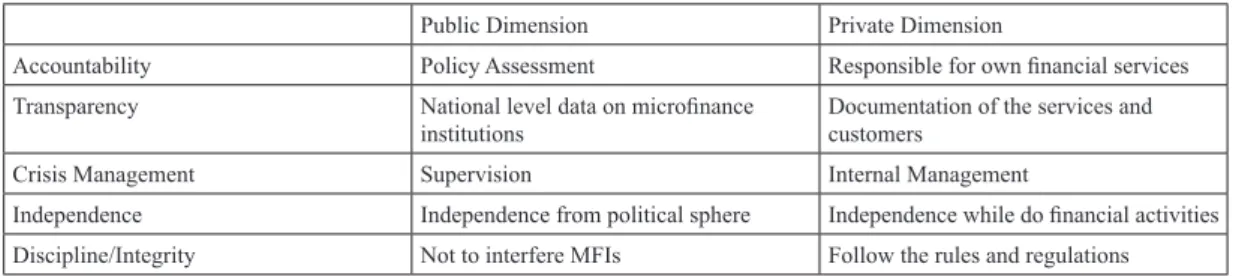
(8) 74. (728). 横浜国際社会科学研究 第 17 巻第 6 号(2013 年 2 月). Table 1 The Indicators of Institutional Governance Public Dimension. Private Dimension. Accountability. Policy Assessment. Responsible for own financial services. Transparency. National level data on microfinance institutions. Documentation of the services and customers. Crisis Management. Supervision. Internal Management. Independence. Independence from political sphere. Independence while do financial activities. Discipline/Integrity. Not to interfere MFIs. Follow the rules and regulations. Arranged by the author. institutional governance, by which linkage contribute to the institutional sustainability and financial self-sufficiency of MFIs in Nepal. In Table 1, there are some main indicators for the institutional sustainability and financial self-sufficiency from management and organizational point of view. Here, every indicator is distinguished in public dimension and private dimension. Accountability. This indicator is widely discussed in connections to the strengthening socio-economic practices in the financial sector. The importance of accountability is well known. But in practice, accountability requirements and relationships are not clearly defined in most of cases of the financial activities. Sometimes accountability also creates mistrust between the government and the financial institution; and between the institution and the client. Transparency. Similar to accountability, transparency is also important indicator to maintain the trust between the clients, institutions and the government, the rule maker. The institutional governance can be obtained when there is transparency in financial activities. Crisis Management. This indicator is important for keeping the good relation between the institution and the client by providing reliable capacity development training. On the other hand, the policy maker also needs to keep the trust between the institutions by providing appropriate rules and regulations. Independence. Independence is important essence which encourages the financial activities without any pressure and conditions. It is important for clients to be independent to gain the effective financial services, and also need for the financial institutions for the efficient output of the financial activities. Furthermore, the government should be independent to formulate the right policies. Discipline/Integrity. This research has distinguished the meaning of discipline and integrity. This indicator means to obey the rules and regulations to gain the appropriate outcomes from the financial activities. Fair and clear legal framework, impartial enforcement of such framework, protection of clientsʼ rights those of minorities and underprivileged communities, an independent and active management, an impartial and incorruptible financial services and policies for making institutional governance effective. Besides the above definitions, Das and Quintyn have also explained about the four indicators so this research also take reference of their definitions of the independence, accountability, transparency and integrity. Das and Quintyn (2002) identified four essential indicators of good regulatory governance: independence, accountability, transparency and integrity. The regulatory governance which Das and Quintyn argue is applied to those institutions that possess legal powers to regulate, supervise, or intervene in financial sector, which is Nepal Rastra Bank (NRB), the central bank of Nepal, and Ministry of Finance in Nepal. The indicators seem to be made for the governance in public dimension but they are also considered to be applied to the governance in private dimension..
(9) Institutional Governance in Microfinance Institutions(Ragab Kayastha). (729). 75. Independence. Das and Quintyn state that the good regulatory governance can be achieved by a fair degree of independence from both the political sphere and supervised entities (Das and Quintyn, 2002). Quintyn, Ramirez and Taylor also uses the same indicator and point out that politicians have a role to set laws and supervisory goals but the regulator have to implement them autonomously and should be accountable in the event that they fail to achieve them (Quintyn, Ramirez and Taylor, 2007). In public dimension, supervision and regulation which is independent from intervention by politicians and supervised institutions are important to achieve soundness of finance sector. In private dimension, independence is for the MFIs from the government and related stakeholders. Quintyn, Ramirez and Taylor show three critical elements of institutional independence: the terms of appointment, the agencyʼs governance structure and the openness and transparency of decision making (Quintyn, Ramirez and Taylor, 2007). Accountability. Effective independence, however, cannot be achieved without accountability. Accountability is essential for the agency to justify its actions against the background of the mandate given to it. Independent agents should be accountable to those who delegated the responsibility─the government or the legislature─but also to those who fall under their functional realm, and to the public at large (“stakeholders”). Transparency. Transparency refers to an environment in which the agencyʼs objectives, frameworks, decisions and their rationale, data and other information, as well as terms of accountability, are provided to the public in a comprehensive, accessible, and timely manner (IMF 2000). Transparency has increasingly been recognized as a “good” in itself, but it also serves other purposes related to the other components of governance. Policy-makers have been recognizing that globalization in general and the integration of financial markets and products in particular require a greater degree of transparency in monetary and financial policies, and in regulatory regimes and processes, as a means of containing market uncertainty. In addition, transparency has become a powerful vehicle for countering poor operating practices and policies. Integrity. Integrity refers to those mechanisms that ensure that staff of the agencies can pursue institutional goals without compromising them through their own behavior or self-interest. Integrity affects staff of regulatory agencies at various levels. Procedures for appointment of heads, their terms of office, and criteria for removal should be such that the integrity of the board-level appointees (policy-making body) is safeguarded. Secondly, the integrity of the agencyʼs day-to-day operations is ensured through internal Audit arrangements that ensure that the agencyʼs objectives are clearly set and observed, that decisions are made, and accountability is maintained. Thus, ensuring the quality of the agencyʼs operations will ensure the integrity of the institution and strengthen its credibility to the outside world. Third, integrity also implies that there are standards for the conduct of personal affairs of officials and staff to prevent exploitation of conflicts of interest. Fourth, ensuring integrity also implies that the staff of the regulatory agency enjoys legal protection while discharging their official duties. Without legal protection, objectivity of staff would be prone to contest─and staff to bribery or threat─and the overall effectiveness and credibility of the institution would suffer. In this way, the discussions of the indicators of institutional governance that this research has done become clearer with including Das and Quintynʼs proposal especially focused in public dimension as they explained in independence and transparency. Das and Quintynʼs stated institutional governance more in public dimension whether this research has discussed public and private dimension of institutional governance in balanced manner. This paper has applied the indicators of institutional governance to find out the effective remedies with the linkage of public dimension and private dimension of the governance in MFIs. Public dimension of the governance is the government or the policy maker of the MFIs, and the private dimension of the governance is the MFIs, the follower of the microfinance policy. The linkage of public and private dimension is the concept of institutional governance in MFIs. As explained before in the introduction, the objective of this research is to find the importance of the concept of the institutional governance in MFIs in Nepal. For achieving the effective institutional governance, the inter-relation of the two dimensions is important. For example, the informal rules, social life styles influence to make the formal rules.
(10) 76. (730). 横浜国際社会科学研究 第 17 巻第 6 号(2013 年 2 月). and the formal rules also affect the informal rules. Both are inter-linked which the general governance theory hasnʼt discussed well. So this research has targeted on this concept of the institutional governance to obtain efficient financial activities of MFIs. References Aoki, Masahiko (2001) Towards a Comparative Institutional Analysis, NTT Publications Bastiaensen, Johan, Herdt, Tom De and DʼExelle, Ben (2005) “Poverty Reduction as a Local Institutional Process”, World Development, 33(6), 979─993 CGAP (2010) News: Getting Back to Governance of dated October 14, 2010, <http://microfinance.cgap.org/2010/10/14/gettingback-to-governance/> Dahal, Dev Raj (1996) The Challenge of Good Governance: Decentralization and Development in Nepal, Centre for Governance and Development Studies Das, U. S. and Quintyn, M. G. (2002) “Crisis Prevention and Crisis Management: The Role of Regulatory Governance”, Financial Sector Governance: The Roles of the Public and Private Sectors, edited by R. E. Litan, M. Pomerleano, and V. Sundararajan. Washington, DC: Brookings Institution Press Dequech, David (2005) “Institutions: A Concept for a Theory of Conformity and Innovation,” Anais do XXXIII Encontro Nacional de Economia [Proceedings of the 33th Brazilian Economics Meeting] 174, ANPEC - Associação Nacional dos Centros de Pósgraduação em Economia [Brazilian Association of Graduate Programs in Economics] Greuning, Hennie van and Bratanovic, Sonja Brajovic (2009) Analyzing Banking Risk: A Framework for Assessing Corporate Governance and Risk Management, World Bank Publiactions Hulme, David and Arun, Thankom (2009) Microfinance: A reader, Routledge Studies in Development Economics Labie, Marc and Mersland, Roy (2011) “Corporate Governance Challenges in Microfinance”, The Handbook of Microfinance, World Scientific Publishing Co. Pte. Ltd. Ledgerwood, Joanna (2000) Microfinance Handbook: An Institutional and Financial Perspective, Sustainable Banking with the Poor, the World Bank Litan, Robert E., Pomerleano, Michael and Sundararajan, V. (2002) “Strengthening Financial Sector Governance in Emerging Markets”, Financial Sector Governance: The Roles of the Public and Private Sectors, Brookings Institution Press Mersland, Roy (2009) “The Cost of Ownership in Microfinance Organizations”, World Development, 37, 469─478 Nepal, Ram Babu (2007) Development, Governance and Management, Airawati Publication, Kathmandu North, Douglass C. (1990) Institutions, Institutional Change and Economic Performance, Cambridge University Press Rock, Rachel, Otero, Maria and Saltzman, Sonia (1998) “Principles and Practices of Microfinance Governance”, ACCION International Young, Oran R. (1989) International Cooperation: Building Regimes for Natural Resources and the Environment, Cornell University Press Quintyn, Marc, Ramirez, Silvia and Taylor, Michael W. (2007) “The Fear of Freedom: Politicians and the Independence and Accountability of Financial Sector Supervisors”, IMF Working Paper, International Monetary Fund, WP/07/25. [カヤスト ラガブ 横浜国立大学大学院国際社会科学研究科博士課程修了].
(11)
図
関連したドキュメント
Because of this property, it is only necessary to calculate a small range of cohomology groups, namely the even dimension and the odd dimension of cohomology groups, in order
Robust families of exponential attractors (that is, both upper- and lower-semicontinuous with explicit control over semidistances in terms of the perturbation parameter) of the
When a 4-manifold has a non-zero Seiberg-Witten invariant, a Weitzenb¨ ock argument shows that it cannot admit metrics of positive scalar curvature; and as a consequence, there are
But in fact we can very quickly bound the axial elbows by the simple center-line method and so, in the vanilla algorithm, we will work only with upper bounds on the axial elbows..
The existence of a global attractor and its properties In this section we finally prove Theorem 1.6 on the existence of a global attractor, which will be denoted by A , for
Using this obstruction and the generalization of the Atiyah-Segal completion theorem to C ∗ -algebras from [Phi89a], we can show, for instance (Theorem 4.6) that there are no actions
We use this criterion to obtain a formula for the number of primitive ideals in the algebra of 2 × n quantum matrices that are invariant under the action of the torusJ.
In two previous papers we introduced the notion of an Affine Klingenberg space A and presented a geometric description of its free subspaces.. Presently, we consider the operations
