Exploring the Black Box of Modularity: Process
to formulate design rules in the
Renault-Nissan CMF
著者
Shibata Tomoatsu
journal or
publication title
TMARG Discussion Papers
number
119
year
2015-07
TOHOKU MANAGEMENT
&ACCOUNTING RESEARCH
GROUP
GRADUATE SCHOOL OF ECONOMICS AND MANAGEMENT TOHOKU UNIVERSITY KAWAUCHI, AOBA-KU, SENDAI, 980-8576 JAPAN
Discussion Paper No. 119
Exploring the Black Box of Modularity:
Process to formulate design rules in the
Renault-Nissan CMF
Tomoatsu Shibata
Exploring the Black Box of Modularity:
Process to formulate design rules in the Renault-Nissan CMF
Summary:
This paper clarifies the process to formulate design rules, an issue remaining in the modularity research area, through a case analysis of the common module family (CMF) development process in the Renault-Nissan Alliance. This paper contributes three new findings. First, design rules must be clearly formulated before work starts on product design, and this sequence must be strictly observed. Secondly, the quality of the design rules is influenced by both technical issues and strategic issues, such as different market requirements. In this sense, DSM(design structure matrix) proposed through existing literature is not enough for formulating design rule. Finally, formulating design rules is therefore requires the active involvement of not only engineers but also senior managers with strategic view. In these ways, product development process of modular architecture differs from the conventional product development process.
1. Introduction
During the last decade, modularity has attracted the attention of numerous management scholars, and both theoretical and empirical studies have progressed. However, the existing literature on product modularity has so far not fully investigated two fundamental issues on product modularity: development process of modular product and process of making design rule.
These questions are black boxes in the current modularity research, that is, unresolved questions so far in existing literature, although this is an important question in modularity research. Within this background, this research tries to derive hypothetical framework of development process of design rule and modular product through in-depth case analysis.
On the other hand, recently, many automobile manufacturers, including Volkswagen (VW) of Germany and the Renault-Nissan Alliance, have adopted the principle of modularity to meet local market needs through various combinations of modules. The strategy behind this major trend is an attempt to achieve both customer orientation and cost competitiveness in the fast-growing emerging markets. This paper selected case of Renault-Nissan Alliance and analyzed how the Renault-Nissan Alliance has developed modular architecture called CMF(common module family) and design rules, because it achieved modularity between two companies with different technical policy and different company culture.
Purpose of this research constructs a hypothetical framework of the development process for modularity through the detailed analysis of a pioneering example, Renault-Nissan CMF. In this sense, this is exploratory research that aims to generate a hypothesis.
2 Previous Research and position of this paper
Ulrich(1995) defines product architecture as the scheme by which the function of a product is allocated to physical components . He proposes the definition of modular and integral architectures as ideal types.
The vast existing research on product architecture developed since 1990s can be categorized roughly into two groups. One group analyzes the benefits of modular architecture compared to integral architecture, and the other investigates the dynamism of product architecture from an evolutionary perspective (Baldwin and Clark, 1997, 2000; Langlois and Robertson, 1992; Robertson and Ulrich, 1998; Ulrich, 1995; Sanchez and Mahoney, 1996; Shibata, Yano and Kodama, 2005; Shibata, 2009; Sanchez, 2008; Sanchez, 2013).
benefits based on a comparison of integral architecture with modular architecture with varying themes, such as the changes in the relationships between product architecture and organization. This represents a static analytical framework, in which previous research has clarified the various benefits of modularity, such as reductions in cost and the speed of development (Robertson and Ulrich, 1998; Ulrich, 1995; Sanchez and Mahoney, 1996; Shibata, 2008).
Much of the research in this category stresses the potential benefit of modular architecture (Sanchez and Mahoney, 1996; Baldwin and Clark, 1997). In particular, Sanchez and Mahoney claim that modularity is not only a characteristic of product design, but is also a characteristic of the organizations designing and producing them (Sanchez and Mahoney, 1996). They argued that a modular product would make possible the adoption of a modular organization. Interesting and noteworthy research on relationship between product and organization include research on multi-technology products and architecture innovation.
Brusoni, Prencipe and Pavitt(2001) analyzed the development of multi-technology products such as aircraft engine control systems. Their results are at odds with foregoing research focused on modularity. They show that that multi-technology firms need to have more knowledge than is required for manufacturing, to cope with the imbalance resulting from uneven rates of development of the respective technologies of different components and unpredictable product level interdependencies. Uneven rates of technological change in multi-technology products create a performance imbalance amongst components that may require an intermediate stage of integration; namely, loosely coupled organizations coordinated by systems integrators (Brusoni and Prencipe, 2001). These arguments suggest that there is no one-to-one mapping between product architecture and organizational architecture, and that product modularity may call for highly interactive organizational arrangements.
Also, Henderson and Clark(1990) introduced the notion of modular and architectural innovation. An architectural innovation is defined as a change in the relationships between a product’s components, and organizations are built around stable product architectures. Henderson and Clark(1990) argue that the product architecture defines information processing capabilities, communication channels, and information filters within the organizations. These contributions have highlighted the managerial implications of modularity in products and organizations.
On the other hand, previous studies in the second category were interested in understanding the logic and evolution of the design of product architecture. Baldwin and Clark (2000) analyzed the computer industry in detail and explained the evolutionary process in the computer industry
according to the complex adaptive system framework paradigm. Researchers in this category state that various evolutionary tracks are created in an object with modular design without the object giving control to the evolutionary track as a result of 6 operators’ (Spliting and others) individual effects on each module. They insist that this force explains the rapid and various evolutionary tracks within the computer industry after the modularized IBM System/360 emerged.
Other interesting and noteworthy research based on evolutionary perspective is the discussion of a “dynamic shift in architecture” by Chesbrough and Kusunoki (2001), and also “module dynamics” by Shibata (2009).These studies reveal that product architecture moves gradually form integral to modular architecture, and then going back from modular to integral after breakthrough of technical system.
As I have explained above, the previous research on architecture is roughly divided into two categories: static comparisons between modular and integral architecture and an analysis of the dynamics of a modularized product. These previous research shares a common analytical framework, where research begins on the assumption that the design rule has been successfully formulated. However, modularity does not mean merely dividing a product into highly independent parts. The quality of design rule that defines how a product is divided and the interface to use for the divided parts is critically important to actually derive benefits from modularity (Baldwin and Clark, 2000; Shibata, 2009). If the quality is low in the quality of design rule, then it is not possible to reduce costs or derive other benefits from modularity.
The quality of design rule is significantly influenced by the development process and organization that formulates the design rule. Therefore, it is significant and valuable to investigate development process used to formulate the design rules for modularity, a hitherto unquestioned prerequisite, that is, black box of modularity.
3 Method
3.1 Case study and data
Due to the exploratory nature of this study, we adopted a qualitative, in-depth case study methodology. This study enabled us to collect comprehensive data and generate theoretical findings that we could not derive satisfactorily from existing theory. By developing theoretical insight and findings using case studies, the researcher is able to initiate the study as close as possible to the ideal of no theory under consideration and no hypothesis to test.
discussed the validity of case studies. Case studies make it possible to explain the relevance and cause-and-effect relationships of a variety of observations through detailed insights with consideration given to qualitative information. Case studies not only compensate for the weakness of generalities but are also indispensable in new, creative theorization.
The core of the qualitative evidence is comprised of personal interviews with company executives and engineers at Nissan Motor Corporation. A total of five in-depth, semi-structured interviews, each lasting about two hours, were conducted during 2012 and 2013. Interview data was complemented by follow-up communications via telephone and email. Case of Nissan CMF was constructed using interview data, published product literature, and Nissan’s technical documents. To validate our analysis, a draft of this case was circulated to individuals interviewed, who made corrections where appropriate.
3.2 Framework of analysis
Consequently, based on a case analysis of CMF, a new design method at Renault-Nissan, We will hypothetically deprive the development process used to create modular architecture. modularity here refers to a closed module wherein the design rule is private within a company, as opposed to an open module like personal computers. However, it is same in the sense that both cases require clear design rules.
The framework to analyze the development process of the design rule for the Renault-Nissan CMF has two viewpoints. One is the development process viewpoint, that is, to know which stage is the most rational to formulate the design rule during the product development process. The other is the organizational viewpoint: rationally, who in the organization should be engaged in the creation of design rule, and how should it be determined.
This paper focuses on the Renault-Nissan CMF because it achieved modularity between two companies with different histories and traditions, Renault and Nissan. It is difficult to promote modularity even within the same company, so modularity between different companies will be far more difficult and complex. Therefore, the complexities of this case of CMF should shed light on the issues related to the creation of the design rule.
4 Case
1: Design Rule Formulation Process for the Renault-Nissan CMF
On February 27, 2012, President and Chairman of Nissan Carlos Ghosn introduced the 4+1 CMF to the media as a fundamental change to the vehicle design concept.
“4+1” means four modules (Engine compartment, Front underbody, Cockpit, and Rear underbody) and one module (Electrical / Electronics architecture), which are called big modules. The interface rule between these big modules is formulated from two standpoints: a physical standpoint (including position, dimension and form, collision safety, and the input / output of sound, vibration, and heat, among others), and an electrical standpoint. Each of these big modules has a number of design variations for a mid-class vehicle, specifically two types of engine compartments, three types of front underbodies, three types of cockpits, and three types of rear underbodies.
The electrical / electronic architecture have one type of hardware and software used for all variable parts. Theoretically, there are 54 different vehicles possible through the combinations of these big modules (2 × 3 × 3 × 3 = 54).
The CMF’s purpose is to enable vehicles with different designs and functionality while promoting standardization, and to create optimum balance between product variation and volume efficiency. If component-sharing creates significant cost savings, the funds can be invested in environmental and safety measures, which will become important in the future and increase their product’s competitiveness. Moreover, development efficiency can improve tremendously by applying new technology, which has so far been used only in luxury cars to many types of vehicles.
Previously, automobile manufacturers standardized the components used on the same platform (chassis); however, this approach has limitations. In developing the CMF, the companies aimed to
standardize components on different platforms (cross-platform), effectively eliminating the platform concept. When implementing the CMF, components were classified not by platform but by the element where the component should have variation. For example, engineers could first consider whether to make weight variable, or whether other elements should vary. In the former case, they would then consider the basic design where component variation by weight is possible. As a result of the CMF, the compatibility between Nissan and Renault drastically increased from 6% to 53% based on the components’ prices, reducing component costs by 30%, all the more remarkable considering that this did not impair product variation compared to conventional methods.
The project of developing CMF officially began in September of 2009, with the first year devoted to formulating the design rule, and shifting to concrete product design at the end of 2010 once design rule was established. The first CMF-based mass production started in the autumn of 2013 with the launch of the new X-TRAIL. A total of 1.6 million vehicles composed of two types of Nissan vehicles, including the X-TRAIL and 10 Renault models, were introduced to the market sequentially. All of these new models were designed based on different combinations of the five big modules of the CMF. In the future, Nissan will apply the CMF to all vehicles except those that require a specific manufacturing process. Below Section describes the CMF developing process and organizational arrangement.
4.1 Establishing an interface between big modules
As the CMF aims to make it possible to develop cars using a combination of 4+1 big modules, one of important design rules concerns the compatibility of the physical and electrical interfaces between these big modules, which were developed sequentially between September of 2009 and the end of 2010. The physical interface includes the width of the dash lower, the width of floor, installation point for the air conditioning unit, penetration position of the dash lower, the installation point for the front seat rail, among others. Similarly, the electrical / electronic interface includes assigning functions to the controllers, assigning controllers to a network, which signals trigger functionality, and how electricity is supplied to the body control module (BCM) or other components. These two types of interfaces were determined between the big modules sequentially.
Each big module has its own manager responsible for layout, performance adjustments, and the compatibility of components in each module.
In addition to the manager for an individual big module, CMF also requires a person to take on the role of coordinating the possible combination of these modules. Combinations of multiple big
modules should follow interface rule and ensure the integrity as a car for the customer.
For this purpose, one of the most important thing is the accumulated knowledge and experience on “simulation technology”, with the most difficult being the collision experiment. However, since experimental data has accumulated over many years within Nissan, there is little difference between collision experiments by actual vehicle and the results of computer simulation, so it is possible to fine tune the design once the big modules are combined. This high correlation between reality and the virtually simulated data enabled collision simulation, which was previously difficult to perform. Without this simulation technology, it would not be possible to create the CMF. The quality of design rules is largely influenced by design capacity, and the simulation technology contributed significantly to improvements in the design capacity.
The procedure to formulate the interface rules between the big modules is as follows. First, set a target performance value for a vehicle. Then, change the boundary and synthesis conditions of the interfaces between the big modules, and use simulations to determine the conditions required to reduce the interference range between modules as much as possible to achieve the vehicle’s target performance. Next, make adjustments based on the feedback and repeat the simulation. This feedback cycle will be repeated toward target performance. According to Nissan, if each big module’s manager properly achieve his task with design rule, integrating these module will lead to completing about 80% of the vehicle. In this way, interface rule between big modules has thus been formulated in CMF.
The vehicle is not complete until the upper parts, such as a roof, are added to the combined 4 big modules. Though the Chief Vehicle Engineer (CVE) is responsible for the completed vehicles’ technical aspects, this person is responsible for engineering parts, and not for planning and marketing2. This responsibility falls to the Chief Product Specialist (CPS), who researches customer needs in the Indian market, for example, and plans the vehicle that meets them. In that sense, the CVE is technology-oriented and the CPS is market-oriented.
Both of these positions are in turn administered by the Program Director (PD), who sets clear and concrete goals for the market, type of vehicle, and number of vehicles, in addition to financial performance metrics such as the amount to invest and the profit target. These three General Manager-level employees oversee new vehicle development using the CMF within this organizational framework.
4.2 Solving the strategic issues of Design rule
Simultaneously, solutions to the strategic issues of design rule within big module were promoted while the interfaces between big modules were developed. The most difficult issue of design rule is determining where and how common parts and variable parts are separated in a big module, a problem that must be resolved by formulating the design rules for each big module. This is more than a technical problem, as it requires strategic aspects that consider various conditions. There are two types of strategic issues.
The first problem arises from the difference in market requirements, for example, requirements may differ in Asia and North America, and so there is a risk that sharing components sacrifices some market requirements. However, without component-sharing, it is not possible to develop efficient manufacturing volumes, so the most appropriate level of component-sharing must be found and promoted. Similarly, to avoid damaging the brand image of each vehicle model, the issue of how extensively to share components also arises. Even for component-sharing within one company, all of these requirements must be considered.
The second issue arises from the differences about technical policies within the two companies. Nissan calls its basic policy on the technology drawn from its accumulated historic experiences the Technical Policy. As both companies have different history, it become more difficult to judge which parts should be common and which should be variable. In the case of CMF between Nissan and Renault, the difference in technical policies becomes critical for promoting component-sharing.
absorption of collision energy depends largely on company’s technical policy. As another example, each company has different policies for the placement of the AC compressor control. At Nissan, it was controlled by an electronic control unit; at Renault, control rested with another unit. This difference depends largely on policy rather than technology. Companies with different histories will develop different policies, which are reflected in differences in design activity and products itself.
Each company also has a substantially different way of thinking about the layout, such as the arrangement of the engine room, seats, persons, and others. This is determined at the first stage of the vehicle production plan by considering various requirements, such as center of gravity, dynamic performance, under-floor arrangement, styling, and performance. This layout is often determined not only from a purely technical viewpoint but also based on a company’s accumulated knowledge.
Therefore, to promote component-sharing between Nissan and Renault, the differences in technical policies and layout should be overcome in addition to resolving problems related to market requirements. Nissan termed an issue obstructing component-sharing a Road Block (RB). These are not technical but rather strategic issues related to the prerequisite of design activity.
Take, for example, the shared components of a seat. If you ask the seat design department why components cannot be shared, they will insist that it is not related to seat design but the difference in safety requirement standards. In this case, the differing safety requirements are an RB. However, as the design unit does not have the authority to unify the safety requirements, a seat cannot be standardized. Therefore, to solve the RB, the reasons behind the different safety requirements must be discussed from a higher standpoint to clarify whether this difference stems from market requirements or a company’s technical policy, and to solve the problem. All RBs obstructing component-sharing should be solved before beginning concrete design activity.
Therefore, to formulate the design rule for component-sharing, the design department alone is insufficient, and requires an organizational system to solve the problems related to market requirements and technical policy. As organizational system to resolve these RBs, the close cooperation and adjustment between the Joint Steering Committee (JSC) and the design department is described below in Section 4.3. The JSC is tasked with resolving RBs at the General Management level at both Nissan and Renault, and will appoint the appropriate team members to deal with the issue. Various types of technology, knowledge, and know-how were required to solve the more than 800 RBs. Therefore, the companies established a flexible organization where appropriate members can come together according to the contents of an RB.
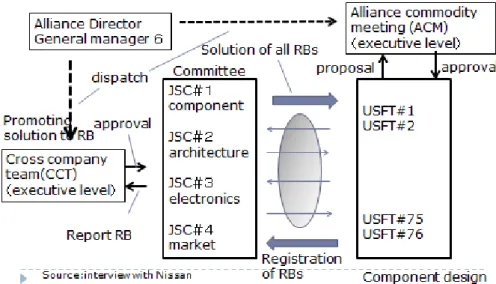
Figure 3 shows essence of organizational structure supporting the resolution of RBs, which became a strong driving force promoting RB resolution and forming design rules by introducing different viewpoint from design department. Next, we will explain the process and organization to promote the RB resolution in detail below.
4.3 Process and Organization to Solve Road Blocks
CMF project decided basic policy that actual design activity do not begin until all RBs are completely solved. RB resolution was set as a top priority. Fig. 4 shows that the 859 RBs at the end of 2009 decreased rapidly within one year. This section describes the process and organization established to resolve RBs.
Generally, in the design of a vehicle, the matrix organization of vehicle axis and component axis is a basic form. As engineers working on the vehicle axis think that creating the vehicle’s integrity and originality are important, they are not enthusiastic about component-sharing, since sharing components could compromise these characteristics. By contrast, engineers working on the component axis have strong incentives for component-sharing. Therefore, component-sharing in the CMF started with collecting as many issues obstructing component-sharing as possible from the component design department, the upstream strategic functional team (USFT), which has strong incentives to promote component-sharing.
each component system, such as seats and steering. There were 76 USFTs assigned to each component system, and the total number of car components is approximately 30,000, which are divided into 76 component systems. One USFT has approximately 20 members, so about 1,500 persons, all members of the USFTs, are involved in component design.
To promote component-sharing, the obstructive factor should be clarified at first. In the CMF, they first asked all members of the USFTs about impediments to standardizing the components and why sharing is difficult, among other questions. This process resulted in 859 issues regarding component-sharing as of November of 2009, which were registered in a database of RBs to resolve. Similar problems were classified. The 859 RBs were broadly divided into 4 groups of problems, for example, related to mechanical architecture or market requirements, and assigned to 4 JSCs.
Each of the JSCs were assigned one of four groups: issues related to components, issues related to mechanical architecture, issues related to electrical / electronics architecture, and issues related to market and product requirements. The JSC members included 6 General Managers (Atsugi – 3, Renault – 3) administered by the Alliance Directors, and they were tasked with solving the RBs reported by the USFT, a design unit, including problems resulting from technical policies and the layout. Since it is not possible to resolve RBs with only USFT employees who are responsible for actual design activity, the JSC tried to apply different tactics from higher perspective to resolve RBs. In order to do that, JSC requested related department to collect new data by experiments and conduct
new market research.
Solving RBs is a process of frequent and close adjustments between the JSC and USFT. The component layout provides an example. The BCM(body control module), which controls such things as power windows, was conventionally installed in different places according to the vehicle model. Therefore, the layouts and types of wire harness were diverse, increasing the number of components. This problem could be solved by aligning the way of thinking about layout, which would standardize both the layout and the wire harness. However, the USFT that actually designs the wire harness cannot solve BCM and layout problems. Thus, if the JSC leads the work to standardize the BCM layout, it becomes possible to standardize the wire harness.
Moreover, to further promote standardization of BCM, not only layout but also function of the BCM should be shared between Nissan and Renault. Actually, functions of BCM were different. At Nissan, one controller managed both the BCM and the keyless entry system, and at Renault, each of these systems used separate controllers. Therefore, at Nissan, one department developed the controller, and at Renault, each department developed individual controllers. The BCM sharing between Nissan and Renault was not just a technical issue but a strategic issue, which leads to an effect on the company’s organization. Therefore, the solution to RBs required both the engineers and senior managers.
Fig. 3 shows the official reporting channel. The JSC provided RB resolution progress reports to the CCT (Cross company team) monthly in coordination with the USFT, while simultaneously consulting about the issues it is facing and difficult matters and seeking direction in some cases. The CCT was a management team composed of executives including Vice Presidents, which promoted RB solutions. Fig. 4 shows that the initial 859 RBs were rapidly solved within a year. In this way, all of RBs were first solved to enable component-sharing, and then component design activity was started.3
4.4 Close Relationship with suppliers
The relationship with suppliers also changed significantly. Because sourcing occurs in a large block according to the vehicle type group for the CMF instead of by individual vehicle type in the conventional way, standardizing components means that each component’s production scale increases dramatically. The order scale was approximately 100,000 on average and approximately 1,700,000 for CMF. For example, there were originally 7 types of steering components with an average order quantity of 150,000 for each. For the mid-class CMF, there is only one type, but the order quantity increased ten-fold, to 1,550,000.
The CMF brings more scale merit as a result of the increased volume of same component; however, failure produces an enormous amount of damage. If the production scale for each component increases tenfold, the damage due to failure also increases tenfold. Thus, it is rational to foster close cooperation with suppliers on a deeper level and over a wider range.
Therefore, both at strategic and operational levels, closer relationships were built at earlier stages of development. The cooperative relationship at the strategic level means to disclose and share strategic information, such as investment plans, at an early stage. Conventionally, this type of information, including where the vehicles will be produced and the estimated production number, was not disclosed, or only a limited amount of such information was disclosed since new vehicle plans are top secret information. However, to promote CMF development, this strategic information was disclosed at an early stage, which enabled suppliers to make their own strategic decisions about the factory investment.
Similarly, at the operational level, a closer cooperative relationship was built. For example, the supplier receives the design specification of new vehicle to discuss which design enables component-sharing, and the extent of component-sharing it provides. Moreover, the supplier is expected to propose which design will increase the sharing rate of a component. Such input into the designs for the big modules can increase the rate of component-sharing. In short, increased component-sharing rates require information sharing and cooperation on a deeper level at early design stages. It was therefore rational to create closer cooperative relationships with suppliers at both the strategic and operational levels during the CMF development.
5 Discussion and findings: Product Development Process to realize modular
architecture
There are obvious limits to what can be inferred this single case analysis. But the wealth of detail available in this case should provide findings relevant to the product development process to realize modular architecture. Based on in-depth case analysis, we wish to discuss two research questions mentioned earlier.
The first issue is to discover how the effective product development process should be managed toward modular architecture. Next issue is to understand particularly the process of formulating design rule to achieve modularity in terms of organizational arrangement.
Based on in-depth case of CMF describe in section 4, section 5 will argue a rational development process for modularity and derive new findings about these issues.
5.1 Establishing Design Rule before starting component development
The CMF case reveals that they took following steps, by first formulating design rules by the end of 2010 before beginning concrete product development. In fact, CMF first established design rules, considering separation of common parts from variable parts, and response to different market requirements. In the process of formulating design rules, an organizational adjustment and coordination between related departments was required. RBs were solved in sequence and the boundaries between common and variable parts were set during the repeated close and informal coordination between the JSC and the USFT. At the end of 2010, when the design rules were formulated through repeated adjustments, they started component design activity. Considering the essence of modularity, one could consider the Nissan CMF development process as rationale.
The quality of design rule has an important effect on the success and failure of modularity, since subsequent concrete design activities proceed under constrained conditions to comply with the design rules. Thus, it is rational to first determine these and then finalize them. To make modularity success, concrete product development should begin only after design rules are set. If the formulated design rules are changed during the component development process, the development project will never end and management resources will be consumed. This will be a failure pattern which is commonly observed in unsuccessful modularity projects (Sanchez, 2013).
This means that modular product development requires a change from the conventional development process. In the conventional process, a problem with an interface rule during actual product design was resolved by tracing back through the previous process. The conventional process adopts the concept that less restrictive rules are formulated and design activities begins at early development stages, and any problems related to interface rules are solved through collective adjustment thereafter. However, this development process does not work well for modular product development. Required change of product development process is shown in figure5.
For the success of product modularity, the engineers must observe a new rule that subsequent change to design rules are not permitted, once it was established. Some engineers may strongly resist it because they are accustomed to the conventional way of product development process.
This does not mean that collective adjustments and close coordination are unnecessary. As described in case of CMF, the design rules were formulated through close collective adjustments by the USFT and JSC. In that sense, collective adjustments shifted to earlier phases in the total development process, as opposed to the conventional development process. In other words, developing the design rules for modularity requires close coordination between different departments at very earlier phases within total development process.
5.2 Developing Strategic Design Rules
One of the most important things to realize modular architecture is the development process of design rule, because design rule will particularly influence the success of product modularity. The CMF case clarifies the characteristics behind design rule development and who leads this effort as organizational mechanism.
Conventionally, it was thought that an engineer should formulate the design rule from a technical viewpoint as this was considered a technical issue. So, existing research has proposed development tools such as DSM(Design Structure Matrix) based on a technological viewpoint (Baldwin and Clark,
2000). DSM is a design method to determine the boundary between subsystems, such as components and tasks by focusing on the strength of interdependent relationships. DSM tries to minimize complexity existing in technical interdependence between subsystems, while it does not consider complexity existing in different market needs.
However, CMF case shows that establishing design rules from a technical viewpoint is not enough to achieve qualified product modularity. The task required involvement beyond a design department such as the USFT, to resolve issues related to market requirements and technical policies. Excessive component-sharing sacrifices responses to different market requirements, while insufficient component-sharing does not produce volume efficiency. Therefore, good design rule will have to balance different market requirement and volume efficiency.
Actually, in order to formulate design rule, CMF project had to solve two kinds of problems, those related to strategic perspective for vehicle design, such as adaptation to different market requirements and technical policies, and those related to organizational technical capacities such as simulation technology. Even if problems related to the strategy to promote design rule can be solved, excellent component-sharing still requires the technical capacity to perform concrete product development. On the other hand, even with a high level of technical capacity, excellent component-sharing comes only through strategic consideration. Figure 6 shows that there are two influencing factors to design rule.
In terms of organizational viewpoint, conventionally, engineers tended to think of component-sharing only within their own components and department. For example, a chassis
engineers thought only of chassis component-sharing. Since component-sharing requires technical knowledge on the component, it would initially appear rational to promote component-sharing according to individual design units. However, accumulated experience and knowledge of Nissan clarifies that component-sharing rate are limited if considerations are closed within single design units. Engineers could not standardize a component due to factors beyond their control.
Therefore, Nissan established new organizational system to develop design rule effectively. Indeed, the CMF’s design rules substantially increased component sharing rates. Within the CMF project, the JSC (Joint Steering Committee) with power to resolve such issues was established and staffed with General Managers from both Nissan and Renault by the Alliance Directors, because USFT does not have authority of managing strategic issues alone. The Alliance Directors are the highest decision-making bodies across the both companies, and their appointees led RB resolution holding great power, which improved the preconditions for component-sharing. This development system was a completely new approach to Nissan, first adopted for the CMF project.
It became clear that formulating design rule requires not only technical perspective but also strategic perspective, and therefore organizational mechanism to enable these requirements. These findings are rational considering the nature of modularity, and can be expressed in general terms as follows. Formulating design rules may be considered a function between resolving strategic issues such as market requirements as well as technical policies, and technical issue. The quality of design rules is influenced by two factors: resolving strategic issues and technical capacity.
Therefore, when formulating design rules, the involvement of engineers alone is not enough. It is rational to include the active involvement of executive-level senior managers at early development stages. This differs from conventional argument, where design rules were considered a technical issue and an engineer's specific task.
As an important task, senior members must lead the design rule formulation to resolve strategic issues. Moreover, their active involvement for a longer period beginning at earlier stages is a requirement and a significant change from the conventional development process, where their involvement was limited to the early planning stages.
6 Conclusion and future research
This paper aimed to clarify an issue that was thought to be a black box in the modularity research, the process to formulate the design rules for modularity and development process of modular product. From in-depth case analysis of CMF, three new findings related to product development process for
modularity could be derived.
First, the development process must start by first formulating the design rules, freezing them, and only then beginning concrete product design activity. Secondly, the quality of design rules depends on both technical capacity of the company and a consideration of strategic issues such as how to respond to differences of market requirements. This implies that analytical tool such as DSM is not sufficient for good design rule. Finally, formulating design rules requires the active involvement of senior managers in addition to engineers. In the development of CMF, Nissan established JSC that is different organization with a strategic viewpoint from USFT, and solved RBs in advance.
This paper claims that these findings are not limited to the CMF, but are generally applicable in the development of modular architecture. Also, these findings indicate that the process to develop modular architecture differs significantly from the conventional product development process, which has contribution to the developing useful theory of product development process.
So far, much research to pursue excellent product development processes has been conducted. From the research of Japanese companies, it was revealed that characteristic of effective product development process is, in short, the concept of overlapping (Takeuchi and Nonaka, 1986; Clark and Fujimoto, 1991). The concept means that product development process essentially includes overlapping in that the same tasks are completed by multiple entities while sharing information among the related departments.
In this overlapping process, the design rules are not strictly determined at the early stage of development, and the final specifications are determined through close coordination with various departments once development begins. This process has been called the rugby style of development in contrast to the relay style development, or concurrent engineering. Following this development process, the rules are not determined strictly at the beginning, and matters are decided later through accumulated organizational coordination. Japanese excellent companies have used this method to maximize both high reliability and quick delivery. Based on this finding, other overseas companies have tried to learn this practice and installed it into the companies over the decade.
On the other hand, other research pointed out that overlapping does not always work, and its effectiveness differs depending on the industry. For example, the previous research on the product development process in the computer industry insists that overlapping has no relationship with development performance. Iansiti and others who studied the mainframe computer industry argue that not overlapping but Technology Integration affects performance (Iansiti and West, 1997; Iansiti, 1998). Moreover, Eisenhardt and others who compare the computer and automobile industries
explained that this difference results from the different rates of change in the stable automobile industry and the fast-changing computer industry (Eisenhardt and Tabrizi, 1995), and insist overlapping is not effective in the fast-changing computer industry. They pointed out that speed of market changes are one factor influencing the effectiveness of overlapping development.
Based on this previous research into the product development process, the findings in this paper indicate that the effectiveness of overlapping may decrease in the development process of modular architecture. Formulating design rules has the most impact on the success or failure of modularity. These design rules should be strictly determined at a stage prior to the start of concrete product design, and are frozen until the development process is completed. This differs from the conventional development process where design specifications are determined while overlapping.
In other words, aside from the rate of market change, the product architecture is also a factor affecting the effectiveness of overlapping. Even within the automobile industry, changes of the product architecture influence the effectiveness of overlapping. Overlapping development process will be more effective to integral product architecture than to modular product architecture.
This paper has tried to clarify the black box of modularity, and simultaneously indicated the possibility of a new product development process towards modularity. This research agenda is an unexplored area bordering research on product modularity and that on product development processes. This paper is based on single case study, the Nissan CMF, and further research is expected in the future.
7 References
Baldwin , CarlisssY, and Kim B. Clark (1997). Managing in the Age of Modularity. Harvard Business Review, Vol.75 , No.5.
Baldwin , CarlisssY, and Kim B. Clark (2000). Design Rules: The Power of Modularity, Vol.1, Cambridge, MA: MIT Press.
Brusoni, Stefano, Andrea Prencipe and Keith Pavitt(2001).Knowledge Specialization, Organizational Coupling, and the Boundaries of the firm: Why Do Firms Know More Than They Make?. Administrative Science Quarterly, Vol. 46, December, 597-621.
Brusoni, Stefano, Andrea Prencipe(2006).Making design rules: a multidomain perspective. Organization Science, Vol. 17, 179-189.
Products and Organizations,” Industrial and Corporate Change, Vol. 10, No. 1, 179-205. Chesbrough, Henry W. and Ken Kusunoki(2001), “The Modularity Trap: Innovation, Technological
Phase Shifts and the Resulting Limits of Virtual Organization,” I. Nonaka and D. Teece, Eds., Managing Industrial Knowledge, London: Sage Press.
Christensen, Clayton and Raynor(2003). The Innovator's Solution, Harvard Business School Press, Boston, Massachusetts.
Clark, K. B., and Fujimoto, T. (1991). Product development performance: Strategy, organization, and management in the world auto industry. Boston, MA: Harvard Business School Press.
Eisenhardt, K. (1989) Building theories from case study research. Academy of Management Review, 14, 532-550.
Eisenhardt, K. M., and Tabrizi, B. N. (1995). Accelerating adaptive process: Product innovation in the global computer industry. Administrative Science Quarterly, 40, 84-110.
Fine, Charles, 1998, ClockSpeed: Winning Industry Control in the Age of Temporary advantage, Reading, Massachusetts: Perseus Books.
Glaser, B.G. and Strauss, A.L. (1967) The Discovery of Grounded Theory: Strategies for Qualitative
Research, Aldine Pub. Co., Chicago.
Henderson, R and K. Clark (1990). Architectural innovation: The reconfiguration of existing product technologies and the failure of established firms. Administrative Science Quarterly, March, pp9-30.
Iansiti, M. (1998). Technology integration. Boston, MA: Harvard Business School Press.
Iansiti, Marco and Jonathan West (1997). Technology Integration : Turning Great Research into Great Products. Harvard Business Review, May-June.
Park,Jin-Kyu, and Young K.Ro(2013).Product Architetctures and Sourcing Decisions. Journal of Management Vol.39 No.3,814-845.
Richard N.Langlois and Paul L.Robertson (1992). Networks and Innovation in a modular system: Lessons from the microcomputer and stereo component industry. Research Policy, 21, pp297-313
Robertson, David and Ulrich, Karl (1998). Planning for Product Platform. Sloan Management Review, Summer. Sanchez, R. and J. Mahoney (1996). Modularity, flexibility, and knowledge management in product and
organization design. Strategic management journal, Vol. 17 (Winter special Issue), pp. 63-76.
Sanchez(2008). Modularity in the mediation of market and technology change. Int.J.Techonology Management,Vol.42,No.4,pp.331-364.
Sanchez(2013). Buiding real modularity in automotive design ,development,production and after service. Int.J.Automotive Technology and Management,Vol.13,No.3,2013.
Salvador, Fabrizio and Veronica Villena(2013). Supplier integration and NPD outcomes. Journal of Supply Chain Management,Vol.49 No.1,87-113.
Shibata,Tomoatsu, Masaharu Yano, Fumio Kodama(2005). Empirical analysis of evolution of Product Architecture. Research Policy, Vol.34,pp.13-31.
Shibata,Tomoatsu(2009).Product innovation through module dynamics. Journal of Engineering and Technology Management, Vol.26,2009,pp.46-56.
Siggelkow, N. (2007) Persuasion with Case Studies. Academy of Management Journal, 50, 20-24.
Simon, HA (1981). The Science of the Artificial( 2nd Edition), Cambridge, Mass; MIT Press.
Takeuchi, H., & Nonaka, I. (1986). The new new product development game. Harvard Business Review, (1986,January-February), 137-146.
Ulrich, Karl (1995). The Role of Product Architecture in the Manufacturing Firm. Research Policy, 24, pp419-440.
Yin, R. (1994) Case Study Research: Design and Methods, second edition. Sage Publications Inc.
1 This case was created based on the interviews with Hideyuki Sakamoto of Nissan Motor Co., Ltd. (November 26, 2012 and March 7, 2013, Corporate Vice President at that time) and Hiroyoshi Yamamoto (March 7, 2013, April 3, and August 22, General Manager in charge of the Alliance CEO office at that time), and the contents of e-mail exchanges with Mr. Yamamoto, in addition to publicly available information from newspapers, magazines, and other sources. Mr. Yamamoto checked the contents of a draft version of the case. 2 General Project Managers at Toyota are responsible for both marketing and engineering, in contrast to the
CVE in this system. 3
According to Nissan’s estimates, if the component sharing rate increases beyond 75%, product diversity is sacrificed, as the vehicles are too close in design. However, to gain sufficient volume efficiency due to common use, a component sharing rate of 50% is necessary. Therefore, it is important to make judgments in design that balance the rate of shared components, differentiation, and investment within a component-sharing rate between 50% ~ 75%.