Errata
正誤表
p4. at Line 1: Resilience seems to be related to being able to tell their diagnosis to friends and making their purpose in this study.
2 #7 and #8=the adolescents who had been outpatients for less than 1 year.
Table 5 Strengths in Survivors Who were th e Newly Diagnosed and had Expereinced Relapse
Core Categories Stages Subcategories
Newly Diagnosed Relapsed
Cognitive discomfort
Diagnoses
Distraction Early inpatient Purposes
Positive attitude More knowledge of life Cognitive comfort Inpatient Purposes Personal competence Inpatient Purposes Positive attitude Connecting with friends
Confidence Near discharge Purposes
Positive attitude Confidence
Outpatient Purposes
Positive attitude Connecting with friends Confidence
More knowledge of life
目
次
は しが き
1Summary
3Psychosocial Strengths Enhancing Resilience in Adolescents With Cancer 5
How do we enhance
resilience
in childhood
cancer
patient
for their
は
し が き
平成19年
度∼21年 度 の科学研究費補助金 による基盤研 究 (
C) 「
小児 がんの
子 どもの将来 にむ けての弾力性 とその支援 :
小児 がん長期生存者 を中心に」の研究成果
報告書です。本研 究 は、思春期 にある小児 がん経験者 の方 とそ のご家族、そ して施設の
スタ ッフの ご協力 を得 て行われま した。皆様 のご理解 とご協力 に深 く感謝 を申し上 げま
す。
研 究 を 進 め て い く 中 で 、思 春 期 に あ る 小 児 が ん 経 験 者 が 身 体 的 ・心 理 社 会 的 に い ろ い ろ な 課 題 を 抱 え な が ら も 、入 院 生 活 、学 校 生 活 、 退 院 後 の 生 活 で 、勇 気 と 強 さ を も っ て 日々 を 送 っ て お られ る 側 面 を 学 ぶ こ と が で き ま した 。 こ の 研 究 が 教 育 ・研 究 ・実 践 の 分 野 で 、 小 児 が ん 経 験 者 のQOLを 高 め る 支 援 を 考 え る 資 料 の1つ と な れ ば 幸 い で す 。 こ の 研 究 は 、入 院 患 者 か ら長 期 生 存 者 の 方 へ と継 続 し た 調 査 を 行 っ て い る た め 、 これま で の 研 究 を ま と め た 研 究
「psychosocial strengths enhancing resilience inadolescents with cancer
(思春期 にあ る小児 がん患者の弾力性 を高め る心理社会 的な強
さ)」 を 載 せ て お り ま す 。
研究組織
研 究代表者 :石橋 朝紀 子
福 岡県立大学教授
連携研究者 :内田 雅代 長 野県看護 大学教授
:
岡村 純
日本 赤十字 九州 国際看護大学教授
:小川 純子 淑徳 大学看護 学部講師
交付決定額
(金 額 単 位 :円)直接経費
間接経費
平 成19年 度 700,000 210,000平成20年
度
780,000 180,000 平 成21年 度 650,000 150,000研究発表
1.学 会 誌
1)
A. Ishibashi, R. Ueda, Y. Kawano, H. Nakayama, A. Matsuzaki, T. Matsumora.How to improve resilience in adolescents with cancer in Japan. Journal of
Pediatric Oncology Nursing. 27(2), 73-93, 2010.
2)
A Ishibashi, J Okamura, R Ueda, S Sunami. Psychosocial strengths enhancingresilience in adolescents with cancer. Cancer Nursing. (投 稿 中)
2.学 会 発 表
1)
Psychosocial strengths enhancing resilience in adolescents with cancer. 42ndSummary
Adolescents survivors of childhood cancer experience multiple sources of
stress, nevertheless some continue to function normally and / or are resilient. The
purpose of this study was to explore the ways in which survivors increase their powers
of resilience, including the enhancement of psychosocial strengths enabling them to
create a conducive support network. To this end, the same research method as in the
previous study, `psychosocial strengths enhancing resilience in adolescents with cancer'
was applied.
This case study research method was used along with semi-structured
interviews. Pattern-matching logic using the 4-stage Self-Sustaining Process model
developed by Hinds and Martin was applied in order to arrive at a comparative analysis.
The participants were seven adolescents aged 12 to 24 years at the time of the
interviews, who had been outpatients for over one year. Their mothers also involved
in this study.
The adolescents
were interviewed
in person and the interviews recorded.
The simplified form of the Japanese Version of the Self-Perception Scale (SJS-PSA)
and the Social Network Map (SNM) were also applied to the adolescents and their
mothers. The study was conducted between 2006 and 2009. The previous study
suggested that resilience was related to purpose and stages such as being newly
diagnosed or suffering relapse. The newly diagnosed adolescents spent most of their
time coping with therapy during their time as an inpatient, therefore, they had a purpose
of going back to school and began to study at near discharge.
Other research subjects
reestablishing relationships with their friends. Resilience seems to be related to
being able to tell their diagnosis to friends and making their purpose. Reasons for
informing friends of their diagnosis revealed a difference between survivors who were
newly diagnosed and those who had relapsed.
The newly diagnosed subjects gave
information after their discharge in order to make friends , whereas those who had
relapsed informed their closest extant friends in order to connect with them openly.
There was also a difference in between survivors who informed their friends and those
who did not. The informing survivors found purpose in terms of doing something to
help others, while the non-informers did not.
Individual support should be given in order to improve resilience among
survivors. Nurses, physicians, families, and teachers need to be aware that survivors
telling friends of their diagnosis is important. We should therefore encourage
survivors to be open with their friends regarding their diagnosis. Similarly, we should
encourage their friends and family members to be as supportive of and receptive to this
process as possible. Finally, and due to the limited number of samples involved in this
study, further research to test the validity of these findings is called for.
Acknowledgments
We would like to acknowledge and express our sincere gratitude to the
research participants and their parents. We would also like to acknowledge the
support of Shosuke Sunami, Shouko Ishiwatari, and Naoko Satou at the Narita Red
Psychosocial
Strengths
Enhancing
Resilinece
in Adolescents
With Cancer
Akiko Ishibashi, Jun Okamura, Reiko Ueda, Shosuke Sunami
Introduction
Although adolescents with cancer are at the risk of developing cognitive, emotional, and
behavioral problems, 1,2 they show resilience. 3,4 Researchers have recognized the need
for studies on resilience among adolescents with cancer to improve their quality of
life. 3,5-8 Resilience comprises enhanced positive health concepts such as hope, positive
coping, and social support. 3,9 Hope relates to self-protective factor and resilience. 3 A
focus on not only individual protective but also on family and social protective factors
may have a positive impact on the long-term outcomes in adolescents with cancer. 10,11
However, little theoretical research has been conducted on the interventions to help such
patients with their psychosocial adjustments to the cancer experience. 3 In addition,
longitudinal research on adolescents with cancer could contribute in determining
whether certain strategies are more effective at certain stages during the treatment. 12
The objective of this study is to explore the methods of enhancing resilience in
Background
Conceptual Framework
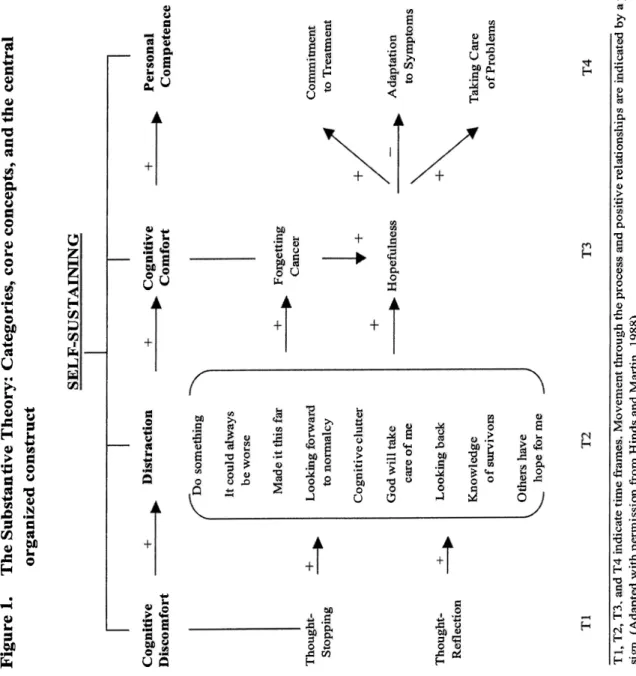
The Self-Sustaining Process (Fig. 1) was used as the framework.
The
Adolescent Resilience Model (ARM) was developed as a theoretical model to propose
the process and outcomes of resilience. 3 The model includes 6 factors: illness-related
risk, individual risk, family protective factors, social protective factors, individual
protective factors, and outcome factors. These factors are attached to an outcome
factor that comprises resilience and quality of life. Family protective factors include
family atmosphere, support and resources. Social integration and health care resources
are the same as social protective factors. This factor refers to maintaining peers and
school life, social relationships, and a normal life. Individual protective factors are
consists of derived meaning and positive coping. Derived meaning includes hope and
spiritual perspective. Hope is characterized by an expectation that a positive future
goal is possible.
Hope and positive coping are important concepts that enhance resilience.9
Being hopeful and positive about their future helps the adolescents to cope with
psychological stress. 3,19-21 Hope also encourages them to face the uncertainty of the
future as well as have a positive future goal. 3 Moreover, hope is defined as the degree
to which the adolescents believe that a positive future exists for themselves or
others. 12(P.
339)
The substantive theory (Fig. 1) helps them achieve hope and be aware
Self-sustaining is defined as a natural progression indicating that the adolescents with
cancer "move through to comfort themselves and achieve competence in resolving
health threats".12(p. 339)
The self-sustaining process includes 4 phases: cognitive discomfort,
distraction, cognitive comfort, and personal competence. Each phase comprises some
strategies. Cognitive discomfort occurs immediately after becoming aware of negative
or disrupting thoughts. Then, the experience of negative thoughts moves to a hopeful
state. This phase includes 2 strategies: thought stopping and thought reflection.
Distraction is a purposeful effort to discard threatening conditions through positive
thoughts or activities. Under this phase, 9 different strategies have been identified
including "doing something," "It could always be worse," and so on. Cognitive
comfort refers to the periods of comfort and lifting of spirits. This phase includes
strategies such as forgetting the disease and being hopeful. Patients have a view of the
future possibilities for themselves or others during the cancer experience. Hopefulness
alone is not enough to sustain this, but personal competence is also needed. Personal
competence of the adolescents changes and leads to a state where they view themselves
as resilient, resourceful, and adaptable in the face of serious health problems. Three
strategies have been identified for this phase: commitment treatment, adaptation to
symptoms, and taking care of problems. The self-sustaining characteristics usually
longer than others, or they may be skipped; (2) positive relationships exists among the 4
core concepts; (3) they include influences by other people such as nurses; and (4) they
have an ability to bypass distraction with humor.
Literature Review
Resilience has been conceptualized as a dynamic process involving an
interaction between both risk and protective factors. 13-15 When people successfully
cope with stress, they become mentally stronger and enhance their resilience. 13,15
Moreover, resilience refers to the ability to cope stress successfully with strength . 5,7,8,16
In addition, promoting factors leading to resilience has been discussed in relation to
18
childhood and with respect to the individual, their families, and the society . 5,13,17,
Resilience is often enhanced by other positive health concepts such as positive coping ,
meaning and purpose as well as social and emotional support. 3 ARM was developed
as a theoretical model to propose the process and outcomes of resilience and quality of
life. 3 It suggests the methods of enhancing protective factors and diminishing
risks. 10,11 It consists of 6 different factors. In the outcome factor, resilience comprises
a sense of confidence, self-transcendence of the cancer experience, and self-esteem. 3
Confidence is the control over events in the existing environment. Characteristics of
self-transcendence include a sense of being healed; purpose and meaning; and a
connectedness with others, nature, and God. Self-esteem involves feeling more
the Resilience Enhancing Adolescent Profile (REAP) was designed as a guide for
interventions in adolescents with cancer. 3 REAP is used to strengthen the individual
protective, family protective, and social protective factors, and to enhance resilience. 3
Methods
This study uses a case study research method with semi-structured interviews.
Yin 22 provided the case study description. One of the approaches to link data in case
studies is a pattern-matching method or relating several pieces of information from the
same case to the same theoretical proposition. 22 Each case study and unit of analysis
should either be similar to those previously studied by others or should differ in clearly
defined ways. Internal validity is supported if all patterns fit the proposition.
However, if patterns do not fit, or even if one of the variables does not fit, the
propositions are deemed unacceptable. Any theory must be tested through the
replication of findings by subsequent cases. Empirical results may be more effective if
2 or more cases support the same theory. Based on this idea, the self-sustaining
process of Hinds and Martins12 serves as a theoretical proposition and a guide to define
the case and unit of analysis.
Participants
After being approved by the institutional review board, we obtained the
oncologists of three different agencies: one from the eastern part, and the other two
from the western part of Japan. Physicians in the hematology/oncology clinic
identified potential participants from the appointment list. Participants were included
based on the criteria that they should be 12-18-year-old adolescents with cancer who
had been outpatients within 2 years. In total, 10 adolescents were approached by the
physicians who briefly explained the study. Nine adolescents and their mothers agreed
to meet the researchers, and after a detailed description of the study, signed the written
informed consent to participate. One adolescent refused to participate due to limited
availability of time for his participation. The final participants comprised 5 males and
4 females. Four had been diagnosed with acute lymphoblastic leukemia, 4 with acute
myelogenous leukemia, and 1 with non-Hodgkin's lymphoma (NHL). Five of them had
experienced peripheral stem cell transplantations (PSCTs).
Their diagnosis was
between the age of 1 to 5 years; 5 had been newly diagnosed and 4 had experienced
relapse.
The ages of the newly diagnosed patients ranged from 12 to 18 years (2 males
and 3 females), and the period of being outpatients was between 1 and 15 months.
The
relapse-experienced respondents were aged between 12 and 17 years (3 males and 1
female), and were outpatients for a period between 1 and 15 months.
Two of them had
an experience of a poor prognosis as outpatients.
Data Collection
Reliability means to minimize errors and biases in a study by using a case
after cancer therapy 23 was used to explore the methods of enhancing resilience. It was
modified into following simple questions 24
: (1) "Would you tell me how you felt when
you heard about your illness?" (2) "Would you tell me what kind of things you do and
think about that help you deal with treatments and finish them more easily?" (3)
"Would you tell me what kind of things you do and think about that help you deal with
the side effects of the treatment and other problems?" (4) "Were things the same or
different for you when you were close to discharge?" (5) "Would you tell me what kind
of things you do and think about that help you deal easily with being an outpatient?" (6)
"How have things changed in your life since the discharge?" Other people also
influence the lives of adolescents with cancer during the self-sustaining process. 12 In
this context, all participants were asked about their support providing resources such as
family, friends, teachers, and health care professionals. The same researcher
conducted the interviews. Nine adolescents, 7 of them in the pediatric oncology clinic
and 2 of them at their home, were interviewed individually. The interviews lasted
between 30 and 50 minutes while waiting for the result of a blood test. All interviews
were audiotape-recorded and transcribed verbatim. Demographic and health
information was obtained from the charts. Data were collected for a period from
October 2005 to August 2006.
Data Analysis
Transcribed interview data were used for analysis. Each interview was coded
helped to maintain the reliability and validity of the analysis. 25 Line by line coding of
the transcripts was performed to categorize data into themes through a careful and
restrictive review. Common themes were grouped together to know the lived
experience of the adolescents and to validate the analysis of the findings. 26 Data were
analyzed to compare with the self-sustaining process. First. Case 1 data was separated
into 3 periods: inpatient (included early inpatient), near discharge, and outpatient .
Second, data in each period were grouped based on the core phases such as cognitive
discomfort, distraction, cognitive comfort, and personal competence . Third, data in
core phases were classified into categories of thought stopping , thought reflection,
doing something, and so on. Finally, data in each category were grouped into
subcategories, coded using keywords such as shock and recovery . Additionally,
social support was identified into 5 areas: friends, family, healthcare professionals
,
teachers, and others. The grouping and coding of data were checked strictly using the
same process by three researchers. These analytic processes were replicated in all
Findings
This study explored the methods of enhancing resilience in adolescents with
cancer. Nine adolescents with cancer were interviewed. They were aged between
12 and 18 years and had been discharged within 2 years. The participants varied in
interviews, it was found that the adolescents moved through the self-sustaining process
and felt themselves hopeful and competent for resolving health related threats. By
comparing data from the self-sustaining process, some differences were found in the
categories. Some differences were also found in the use of subcategories between the
newly diagnosed and the relapse-experienced patients. A new category called
psychosocial strengths was identified. It consisted of positive attitude, purpose,
connection with friends, confidence, and more understanding of life. Differences were
also seen in the development of psychosocial strengths between the 2 groups.
Descriptions
The descriptions for the self-sustaining process are shown below. Case 1
(newly diagnosed) and Case 2 (relapse-experienced) are presented in full, while the
remaining cases are described briefly. A summary of the descriptions is shown in
Table 1 for Case 1 and 2, respectively. Cases 3, 5, 7, and 9 were similar to Case 1,
while Cases 4, 6, and 8 were similar to Case 2.
Newly diagnosed adolescents
Case 1
A female junior high school student had been an outpatient for 4 months.
She knew about her disease before her mother informed her. In the cognitive
shocked when she heard about the change in her blood type following peripheral stem
cell transplantations (PSCTs). However, she had a positive attitude and was able to
think about a good prognosis with the support of her parents and her physician during
the distraction phase. She seemed to have a purpose to live and looked forward to
normalcy and believed that would not succumb to her disease despite her friend's death.
When she learned that she would lose her hair, she started planning to grow her hair
again. She also tried to keep herself occupied by playing games with nurses and
nursing students. In the cognitive comfort phase, she became hopeful. During in the
inpatient period, she had a purpose of recovery and hoped of friendship and studies.
These hopes persisted until after discharge. She was sent a copy of lecture notes from
one of her friends, which also influenced her hope for studies.
As she neared
discharge, her hope was to go to an art university with her friend, to have family health,
and not to relapse after discharge.
In the personal competence phase, the adolescent was commitment to therapy
with the hope for recovery. She said, "I should not die due to my disease despite the
death of a student whom I knew." She coped with the hard time during therapy by
thinking about a movie she wanted to see. A nursing student visited and helped her
have a good time. She also learned how to adapt to symptoms. For example, she
sometimes changed her plan for studies when she felt very weak. Her purpose was not
to fall behind in classes as she neared discharge. She took care of her problems with
confidence. She studied English as diligently as possible and said, "I don't want to be
useful. Her efforts to study continued after the discharge, and she adapted to her
symptoms. Because of her condition, her parents wanted her to go to a regular high
school. Hence, she gave up her plan to go to a design school. After discharge, she
tried to study as much as possible by adapting to her symptoms, which allowed her to
gain confidence for studies and school. When she could not attend a physic class, she
asked the teacher if there was anything else she could do. She said, "My teacher had
told me to write a report." She ended up getting a grade. She made plans with
friends to go to a university. She took care of problems, had a positive attitude about
her hair, and was supported by her friends in this regard.
She explained, "When I had
gone to school wearing a bandanna, people had looked at me as if I were strange, but I
had gotten used to it." Her classmates told her that her hair was beautiful and she was
very glad about that. Furthermore,
she never talked with her friends about her disease
and experiences
in the hospital because it would trouble them. Moreover, she had a
better understanding
about life and said, " Just existence is the most important thing for
me...I
can do it in my own way."
Case 3
A high school female student had been an outpatient for 1 year. In the first
phase, after the diagnosis, she felt shocked and thought of death. However, she was
relieved when her mother told her that she would recover. During the distraction
phase, she developed a positive attitude and decided to undergo therapy. Her mother
letters and reading books but not studying. When she started losing hair, it was very
hard for her. However, she did not worry because she knew her hair would grow back
again. In the cognitive comfort phase, she hoped to recover as an inpatient, and go
back to school and study as she neared discharge.
In the last phase, she coped with the hard time by thinking of going home at
night during therapy. As discharge neared, she made a decision to shift to a school for
handicapped children because the previous school did not agree with her reentry school.
She had a positive thought toward studying and tried to catch up. After she neared
discharge, she gained a positive attitude. She said that she was bothered by the side
effects of medications and could not study enough, but she could live with the disease
now because of the support from a teacher. At that time, the teacher had advised her
not to study hard. Then, she connected with her friends and informed them about her
disease. Her friends visited her house often. However , she did not talk to them about
her cancer experience. She liked to talk to other survivors who might understand her .
Also, she felt more knowledgeable about life and said that she had known a student who
knew how many years he would live. She said, "I changed my mind... living is the
most important thing." Despite understanding that she might die, she took care of
herself and wanted to live longer.
Case 5
A male junior high school student was discharged about 13 months before.
He
phase, when a doctor explained to him about his disease, he did not understand well.
In the distraction phase, he had a positive attitude and thought about receiving therapy
with parental support. He said, "If I don't fight, I will not get better... I will try my
best." Letters from his friends and classmates also made him feel very happy. In the
next phase, i.e., the near-discharge period, he hoped to recover as an inpatient and to
play with friends and study in school. His hope continued after discharge, and school
grades became his concern. In the personal competence phase, during therapy, he
coped with the difficult situation by thinking of recovery. A physician helped him
study in his room, but he had to stop studying when he felt sick. As he neared
discharge, when his therapy was completed, he gained confidence. He felt that he had
"done" it
. His positive attitude allowed him to catch up on his studies after discharge.
He also tried to take care of a problem that resulted when an older student pulled off his
hat. He would go home crying, but his fellow students apologized later. Now, he did
not wear a hat at school, and his friends were understanding.
Case 7
A male junior high school student was an outpatient for 9 months, and he
received a poor result on a blood test. He did not talk much during the interview. In
the cognitive discomfort phase, his mother persuaded him to undergo therapy. He was
a bit shocked at the time of the diagnosis because of painful tests. In the distraction
phase, he had a positive attitude and decided to undergo the therapy with support from
his mother. When he felt well, he played games, which he had never done before.
Letters from classmates made him feel happy, and he wanted to go back to school. In
the next phase, his hope as an inpatient was to play video games (Othello) with friends
and not to relapse. As he neared discharge, the hope was to go back home, and then to
school for playing with friends. His good attitude continued beyond discharge.
In the last phase, he had a positive attitude and said, "I just tried to think that
it (the therapy) wasn't that bad." He studied in his room or in the hospital library as an
inpatient. As he neared discharge, he was very happy to leave the hospital and go back
to school. As an outpatient, he was careful when his friends asked him why he was
wearing a hat. He talked with confidence and said, "Isn't it okay?" When he was
enjoying himself at the table tennis club at school, the members made fun of him saying
that he was weak.
He told them to shut up. He gained a positive attitude and a
purpose for the cancer. He was told that the SCT result was not a good prognosis, but
he wanted to recover. His mother and he tried to contact cancer survivors who were in
similar situations. He attended classes for a short time and said that he was not able to
keep up with studies at all.
Case 9
A male high school student was an outpatient for 15 months. His parents
had jobs and could not stay with him every day.
In the first phase, when he was
informed, he could not clearly understand the disease. His understanding was that he
needed to spend a long time in the hospital. In the distraction phase, his mother stayed
with him and had everyday conversations with him without mentioning much about the
illness. He had a positive attitude and said that when he felt too sick, he would think
that the hard times would soon pass. He was able to bear it because of being with a
nurse who became his friend. During the cognitive comfort phase, as an inpatient, his
hope was to recover and study. As he neared discharge, he hoped to go back home and
to school to meet his friends and continue his studies. He wanted to talk with his
friends about his plans such as becoming a physician.
In the last phase, he was able to tolerate therapy because of a nurse who
became his friend. He also tried to keep up with his studies, but sometimes he felt too
sick. When he felt well, he would look after younger children. As he neared
discharge, the possibility of discontinuation of friendship made him worry and he was
scared of being alone at school. When he studied in the nurse's office, his friends
came to see him, and this gave him a chance to keep friendships at school. After
discharge, he aimed to study in the future. He put much effort into studies and wanted
to take his studies to a higher level. His friends and he also talked about their futures,
but not about his disease. He said, "The biggest part of the cancer experience was to
spend a lot of time with and talk to adults." He gained confidence because he had
been unable to talk that much before.
Relapse-experienced adolescents
Case 2
A female junior high school student had been discharged about 4 months ago.
In the cognitive discomfort phase, she experienced thought stopping and thought
reflection. Apart from expressing shock, she showed other responses such as returning
home without taking treatment after the diagnosis. She tried to promote positive
thoughts in the distraction phase. She decided to receive the therapy and go home as
soon as possible. Her mother supported her child by staying with her. Losing hair
made her more positive by making her hope for normalcy. She had a better
understanding of life and said, "Very short hair was the latest fashion." Her aim was
to explore her musical talent in the future. She interacted with friends and had a good
time playing games. She also talked about school and her purposes with friends,
which created the experience of cognitive clutter. As an inpatient, in the cognitive
comfort phase, she hoped of going back to school and taking dance lesson. She
already had hope for discharge. During the near-discharge period , she was relieved
that she would be going home soon and could forget about the cancer. Her hope was
to go back to school and play with friends, which she did every day after discharge .
However, she did not have hopes for recovery.
As an inpatient in the personal competence phase, she faced the cancer by
committing to therapy and adapting to her symptoms. Because she felt there was
nothing she could do about it, she was patient with painful procedures . She had
confidence during the exhaustive phase of therapy. She took baths by herself because
she wanted to. When she felt well, taking care of problems with a positive attitude
made her willing to study hard to reach her purpose. Moreover, by connecting with
close friends, she could talk about hospital and school life over the phone. Nearing
gained confidence when she was preparing to go back to school and insisted on going back to school.Her mother said that her doctor ordered her back to school 6 months later,but she negotiated with a physician to go backearly.She and her friends made plans over the phone very often for her after-discharge period.She had a positive attitude and studied with purpose after discharge.She attended school and studied hard as much as possible because she did not want to miss any classes.When she felt tired in school,she rested in the health office.She also took dance lessons after school for developing her musical talent.Moreover,by comectingwithfhendsandtalking
about her disease and its side effects,her fhends frequentlyvisitedhertoplay.After
the interview,she nodded when her mother said,“ You can cope with any hard situation in the future,can’t you?”She had gained confidence.
Case4
A male high school student had been an outpatient for 1 month.His
prognosis became poor.In the cognitive discomfort phase,he was shocked when he heard about the relapse.In the distraction phase,he had a positive attitude and believed that he would never suffer from illnesses.He did not feel that he was in danger and said,“ If I need a transplant,I will do it.”His purpose was to get out of the hospital.His mother stayed with him every day.His fhends who talked to him about school through a glass window in a cream room to influenced him to go back to school. His purpose along with his friends helped him cope with cancer therapy and to have hope.In the cognitive comfort phase,as an inpatient,he hoped to never suffer from
illness, to study, and to talk with friends in school. Nearing discharge, he had the hope
to graduate from high school along with his friends. After discharge, his hope was to
recover completely, improve his studies, get a job, and to blend into the society.
By the personal competence phase, as an inpatient, when he felt well, he
began to study with support from a counselor. He had a positive attitude and thought
about his school life. He said that he had talked about so many things he could do
with his junior high school friends after being an inpatient. However, he did not
inform his friends. As he neared discharge, he gained confidence and said that he had
slowly begun to think that he was recovering. He also said, "The therapy was
difficult, but now that I look back on it... it wasn't that difficult." After discharge, he
had a positive attitude and wanted to graduate from the high school with the support of
his friends. His stomach hurt and his leg muscles were weak, so he practiced walking.
It was difficult for him to go to school, so his friends visited him to help him with
studies. Moreover, because of the poor result on his blood test, he had the purpose of
receiving PSCTs again. When he signed the consent form, his mother said that she
tried to think that his will was the most important factor.
Case 6
A male primary school student had been an outpatient for 1 year. In the
cognitive discomfort phase, he thought hard about being in relapse. In the distraction
phase, he had a positive attitude and confidence and felt no serious threat because of his
illness, to study, and to talk with friends in school. Nearing discharge, he had the hope
to graduate from high school along with his friends. After discharge, his hope was to
recover completely, improve his studies, get a job, and to blend into the society.
By the personal competence phase, as an inpatient, when he felt well, he
began to study with support from a counselor. He had a positive attitude and thought
about his school life. He said that he had talked about so many things he could do
with his junior high school friends after being an inpatient. However, he did not
inform his friends. As he neared discharge, he gained confidence and said that he had
slowly begun to think that he was recovering. He also said, "The therapy was
difficult, but now that I look back on it... it wasn't that difficult." After discharge, he
had a positive attitude and wanted to graduate from the high school with the support of
his friends. His stomach hurt and his leg muscles were weak, so he practiced walking.
It was difficult for him to go to school, so his friends visited him to help him with
studies. Moreover, because of the poor result on his blood test, he had the purpose of
receiving PSCTs again. When he signed the consent form, his mother said that she
tried to think that his will was the most important factor.
Case 6
A male primary school student had been an outpatient for 1 year. In the
cognitive discomfort phase, he thought hard about being in relapse. In the distraction
phase, he had a positive attitude and confidence and felt no serious threat because of his
"We (his mother and he) had a purpose for receiving the therapy ... that we would fight
until the blood test results were good." He was faced with cancer therapy and spent
time playing with a boy who was in a similar situation. In the next phase, as an
inpatient, his hope was to study as much as possible and play with the boy. His hope
as he neared discharge was to go home and back to school to meet classmates soon.
After discharge, his hope was to study and play with friends.
In the personal competence phase, as an inpatient, his early purpose and hope
led him to cope with the therapy and connect with a friend. He suffered through the
radiation by thinking of playing and talking with his friends. He also studied when he
felt well, but sometimes he had to give up his studies. Nearing discharge, he had a
positive attitude and was happy about going back to school. He said that at first it had
been difficult to be inside all the time. Therefore, he made plans to study and to play
with friends all day long. Beyond discharge, his positive attitude helped him achieve
hope with the support from his friends. He started attending school only in the
mornings and rested in the afternoons. He also tried to connect with friends and asked
them to help him with homework.
Case 8
A male junior high school student was an outpatient for 1 year. He did not
talk much when he was in the hospital. In the first phase, he was shocked when
informed that he could not go to school. During the distraction phase, he had a
positive attitude and felt he could withstand cancer with his mother's support. As an
illness, to study, and to talk with friends in school. Nearing discharge, he had the hope
to graduate from high school along with his friends. After discharge, his hope was to
recover completely, improve his studies, get a job, and to blend into the society.
By the personal competence phase, as an inpatient, when he felt well, he
began to study with support from a counselor. He had a positive attitude and thought
about his school life. He said that he had talked about so many things he could do
with his junior high school friends after being an inpatient. However, he did not
inform his friends. As he neared discharge, he gained confidence and said that he had
slowly begun to think that he was recovering. He also said, "The therapy was
difficult, but now that I look back on it... it wasn't that difficult." After discharge, he
had a positive attitude and wanted to graduate from the high school with the support of
his friends. His stomach hurt and his leg muscles were weak, so he practiced walking.
It was difficult for him to go to school, so his friends visited him to help him with
studies. Moreover, because of the poor result on his blood test, he had the purpose of
receiving PSCTs again. When he signed the consent form, his mother said that she
tried to think that his will was the most important factor.
Case 6
A male primary school student had been an outpatient for 1 year. In the
cognitive discomfort phase, he thought hard about being in relapse. In the distraction
phase, he had a positive attitude and confidence and felt no serious threat because of his
early impatient, his purpose was to go home for a night. During therapy, he spent time
exchanging letters with friends. In the cognitive comfort phase, as an inpatient, he
hoped about successful therapy and studies. Nearing discharge, he hoped to play
baseball with teammates. After discharge, his hope was to play baseball with his
teammates and not to relapse.
By the last phase, as an inpatient, letters and photos from classmates
encouraged him to cope with therapy and study when he felt well. He also gained
confidence after passing through the hard time. He said, "If I could go through this, I
can go through anything." Nearing discharge, he prepared to go back to school.
After discharge, he had a positive attitude and achieved his goal of playing baseball.
To prepare for playing, he ran near a park every morning with all his family. He also
gradually improved in his studies, and his best friends supported him. He said that
when his friends would ask why he was wearing a hat, his best friend would ask them
not to inquire. When asked about his disease, he answered truthfully because he
wanted to be brave. He had a better understanding about life.
Differences in Categories
The findings of the above case studies suggested that the adolescents
experienced the entire process from being an inpatient to an outpatient. They had hope
and achieved competence in resolving health threats. By comparing data from the
illness, to study, and to talk with friends in school. Nearing discharge, he had the hope
to graduate from high school along with his friends. After discharge, his hope was to
recover completely, improve his studies, get a job, and to blend into the society.
By the personal competence phase, as an inpatient, when he felt well, he
began to study with support from a counselor. He had a positive attitude and thought
about his school life. He said that he had talked about so many things he could do
with his junior high school friends after being an inpatient. However, he did not
inform his friends. As he neared discharge, he gained confidence and said that he had
slowly begun to think that he was recovering. He also said, "The therapy was
difficult, but now that I look back on it... it wasn't that difficult." After discharge, he
had a positive attitude and wanted to graduate from the high school with the support of
his friends. His stomach hurt and his leg muscles were weak, so he practiced walking.
It was difficult for him to go to school, so his friends visited him to help him with
studies. Moreover, because of the poor result on his blood test, he had the purpose of
receiving PSCTs again. When he signed the consent form, his mother said that she
tried to think that his will was the most important factor.
Case 6
A male primary school student had been an outpatient for 1 year. In the
cognitive discomfort phase, he thought hard about being in relapse. In the distraction
phase, he had a positive attitude and confidence and felt no serious threat because of his
strategies fitted into the categories during the distraction phase. The rest of them,
such as "It could always be worse," "Made it this far," "God will take care of me,"
"Looking back
," "Knowledge of survivors," and "Others have hope for me" did not fit
in the categories. None of the patients forgot about their cancer during the cognitive
comfort phase.
Differences in Subcategories
The adolescents had hope and achieved competence in resolving health
threats from being an inpatient to an outpatient. There were differences in the
subcategories, which are shown between the newly diagnosed and the
relapse-experienced patients as they passed through the treatment process. For
example, the subcategories included keywords of coping strategies such as shock, other
responses, and recovery in the cognitive discomfort phase. The newly diagnosed
patients hoped to recover as an inpatient, but others did not. On the other hand, the
newly diagnosed patients did not use the coping strategies of school, but the
relapse-experienced patients did. Compared to the relapse-experienced patients, the
newly diagnosed patients did not interact with their friends in the hospital, even though
they wanted to have friendships. A summary of the findings during the self-sustaining
process for the newly diagnosed and the relapse-experienced patients is shown in Table
Newly diagnosed adolescents
In the cognitive discomfort phase,they experienced a shock at the time of diagnosis,as they heard about their illness.Some of them thought of death and painful tests.In the distraction phase,as ear1y inpatients,they were positive about the illness
and decided to have therapy with support from their mothers,who too were positive about the illness.Two of the patients were positive about losing their hair,because it was explained that their hair would grow back.As inpatients,during the cognitive comfort phase,recovery was hopeful in all cases except for one where the patient was diagnosed with NHL and did not understand the disease clearly,and consequently became seriously ill.Not all patients had hopes of returning to school.They had hopes of studying,but the one who did not talk much was not hopeful about studies. As inpatients,they spent their time coping with the therapy and did not interact with their friends.Friends such as nurses supported them and spent time doing some activities with them,After the near discharge period,school,studies,and friends were their hope.During the personal competence phase,as an inpatient,the adolescents coped with the therapy and the side effects with a hope of recovery.They did not have the hope about going back to school,but tried to study at the hospital class: however, their studies were sometimes stopped because of the side effects.During the near discharge period,except for those who did not talk much,the patients resumed their studies in an effort to go back to school.The rest,even though they wanted to,did not interact with their friends during their hospital stay.As outpatients,the adolescents had friendships and studies as the reasons to go back to school.Their friends
supported them when they were teased about having less hair.However,some of them never interacted with their friends about their cancer and experiences in the hospital. Two of the patients attended classes for only a short period of time because of poor prognosis and the side effects.
Relapse-experienced adolescents
During the cognitive discomfort phase,the relapse-experienced patients wanted either to go home or to their school.During the distraction phase,their
positive attitude allowed them to cope with the therapy and have a purpose to move out of the hospital.They had hopes of going back to school.They spent time in therapy and interacted with their bestfriends who encouraged them to cope with the therapy and study in order to go back to school.Their mothers also stayed with them or visited them every day.In the cognitive comfort phase,all patients except the one who did not express well,hoped to continue with their studies,school,and friends as inpatients and outpatients.The latter did not hope for school as an inpatient and for studies as an outpatient.During the near discharge period,while all hoped not to study, two expressed hope for recovery.One was given a poor prognosis and the other had hoped to play baseball with a team.Friendship was their hope as inpatients and
outpatients.During the personal competence phase,patients coped with the therapy as inpatients.They studied and exchanged information about their school and hospital experience with their special friends.All of them thought about school,except the one who talked 1ess.As they neared discharge,the adolescents were ready to go back to
school and comect with their friends.As outpatients,with support from their friends, they were hopeful of friendship,school,and studies.The patient with poor blood test results had a hard time studying as planned.Additionally,their mothers and families supported them in the hospital and after their discharge.
New Category
The new category of psychosocial strengths was identified for the period from
early inpatient to outpatient.In certain circumstances,an individual may be made
strong by unpleasant and potentially hazardous events.15,27 Resilient individuals have
both strong internal and external protective factors to move forward,27 “ Protection
may lie in the‘ steeling'qualities”13(p,326) that are more likely to arise when people have
to cope successfully with stress.13,l5
The psychosocial strengths consisted of positive attitude,purpose,connection with friends,confidence,and more understanding of life.Childhood survivors have high levels of self-esteem.28 Self-esteem refers to the extent to which an individual has
つ
a positive or negative attitude to wards himself or herself.3 Acceptance is characterized by listening to and gaining satisfaction from someone or something including others, the self,and the past and present situations.Acceptance and high self-esteem may lead to broader perspectives,activities,and purposes.29 Characteristics of
self-transcendence include a sense of connectedness with others,nature,and God; being healed; and having a purpose and meaning.29 Adult survivors of childhood cancer tend
to express more positively and engage in close relationships.28,30 Confidence is a perception that one has control over events in the environment and this may help in
lowering stress.3,31 The pediatric cancer survivors expressed themselves as more mature than their healthy peers.They felt themselves being more knowledgeable about life.20,30
Differences between newly diagnosed adolescents and relapse-experienced adolescents
A difference was found between the newly diagnosed and the
relapse-experienced patients during the development process of a new coping strategy. The newly diagnosed group had 3 types of patients and the relapse-experienced group revealed 2 types of patients.Compared to the newly diagnosed,the
relapsed-experienced patients had their purpose during the early inpatient period and their strength of comection with friends during the inpatient period.A summary of the psychosocial strengths is shown in Table 3.Based on this,the development waves for the newly diagnosed and the relapse-experienced patients were made.
Newly diagnosed adolescents
Three types of developing psychosocial strengths were found from the distraction phase to the personal competence phase.Here,strengths developed individually as early or late and categorized as after the early inpatient period; during the inpatient period,but not nearing discharge; and in the near discharge period.
Strengths of the 5 factors developed gradually after discharge. Type 1 patient, as
exemplified in Case 1, had a purpose for life in the early inpatient period. She explained,
"I should not die
." It led her to have the purpose of recovery as an inpatient. In the
near discharge period, the girl had a purpose of not falling behind in class and caught up
with her studies with the support from a teacher. As an outpatient, this purpose led her
to gain confidence and negotiate with her plans for studies, and she decided to go to a
university. Getting used to losing hair was an example of her positive attitude, and she
gained more understanding about life, saying, for instance, "Living was most
important."
Type 2 patients, as exemplified by Case 7, had a positive attitude towards no
relapse during the early inpatient period.
As an inpatient, the student had a positive
attitude towards his illness and explained, "I just tried to think that it wasn't bad."
He
did not talk much about the near discharge period.
When he was given a poor blood
test result as an outpatient, he had a purpose of recovery.
This positive attitude led
him to decide to repeat the therapy.
The student also gained confidence about being
teased for wearing a hat.
He said, "When my friends asked me why I was wearing a
hat, I said 'Isn't it okay?'"
Type 3 patients, exemplified by Cases 3, 5, and 9 had
positive attitudes and coped with the therapy with the hope of recovery as an early
inpatient.
One of them developed the hope of recovery in the near discharge period.
As they neared their discharge, they developed a positive attitude towards going back to
school.
They decided to go back to school and caught up with their studies.
One of
diagnosed adolescents.
The psychosocial
strengths developed individually
as early or
late.
After an initial life-threatening
period, a positive attitude gradually became
important.
The patients hoped for recovery through support from their mothers and
spent their time coping with the therapy as inpatients.
A positive attitude to cope with
the therapy, a purpose, and confidence increased as inpatients,
but it was difficult for
them to have the hope of going back to school and they began to study as they neared
discharge.
Friendship was also a hope in the near discharge period, but was usually
achieved as an outpatient.
Even though they had friendship,
some of them never spoke
to their friends about their experiences
in the hospital.
They attended school and tried
to have an adolescent's
life as an outpatient.
The development of psychosocial strengths seemed to be steady in the
relapse-experienced adolescents. As early inpatients, they did not feel positive about
recovery, but became positive and developed the purpose of getting discharged. Their
purpose helped them cope with the therapy, think about life after discharge, and study in
order to go back to school. During the inpatient period, they interacted with their best
friends who encouraged them to achieve their purpose. After discharge, they tried to
achieve hope and purpose with their psychosocial strengths.
Discussion and Implications
This study explored the methods of enhancing resilience in adolescents with
may gain strengths while experiencing the self-sustaining process. The strengths of
positive attitude, purpose, connection with friends, confidence, and more understanding
of life were the buffers for them to feel that they were leading quality of life.
The findings show that the development process seemed to be unsteady in the
newly diagnosed patients. A positive attitude may lead them to have their hope for
recovery and gain strengths in the future. On the other hand, the process appeared to
be steady in the relapse-experienced patients. Purpose may be an important guide for
them to connect with friends and cope with cancer, and may lead to improve their other
strengths. To enhance resilience, 5 factors may be important for them at certain stages
and to the individual with social support. As early inpatients, friends are important for
the newly diagnosed adolescents, while emotional support is significant for the
relapse-experienced adolescents. For them, their mothers and friends were considered
the key persons. Additionally, a cultural variation between the US and Japan may be a
cause of some of the differences in the categories.
Newly diagnosed adolescents
Positive attitude
Mothers, who had a positive attitude, may have been vital in helping their
children to gain a positive attitude and hope. The mother's belief that cancer is not
fatal may have been important for the development of strengths for the child. When
their illness, treatment,
and the side effects, but not regarding their future. 36
As early
inpatients,
information
on the future was important for the newly diagnosed patients.
Nurses need to focus on maintaining
a social network of friends, emphasizing
the
importance
of attending school, and talking about emotional concerns during the
treatment of adolescents
with cancer.
Friends
Peers and school are significant for normalcy of adolescents with cancer. A
normal life with friends is important for their development. 37 In this study, friendships
seemed to be an important factor helping them to have a normal life. The adolescents
began to develop hopes of going back to school and to interact with their friends as the
time of discharge came closer, but not enough to maintain healthy peer relationships.
Even as outpatients, they tended not to express their cancer experiences openly to their
friends. Friends encouraged them not only to go back to school and complete their
studies but also to live a normal life. Their feeling of normalcy in school depended on
their perception of how well they had kept up with their classmates and their studies and
how they were being accepted by their peers. 38 They were affected by feelings of
being different and isolated from their peers and by that of loss of interactions with the
peers and their classmates. 36,37,39,40 During cancer therapy, nurses should create such
an environment, where patients can discuss their awkward situations and also the ways
they felt about the changes in their body to help them deal with them. Encouragement
for friends to contact peers with cancer as well as emotional support for mothers may be
significant.
Adolescents having high levels of support from their parents tend to receive
high levels of support from their friends as wel1. 32 Parental support may enable the
child to have good friendships. In this study, in some cases, the adolescents did not
speak about their cancer experience to their friends in school, which may be considered
as a cultural aspect. In Japan, almost two-thirds of the family members of children
patients with cancer do not want the diagnosis to be discussed with the patient and the
others. 41 If mothers inform their children about the diagnosis, children may feel at
ease to speak openly to their friends about their cancer experience. Studies on family
resilience 3,42,43 may help in encouraging mothers to disclose their child's disease.
Relapse-Experienced Adolescents
Purpose
Having a purpose seemed to be important for them to gain strengths later.
Most of the adolescents had a purpose as early inpatients. The purpose may have been
gained from their previous experience of cancer, which included the feeling of
uncertainty and denial. A relapse of disease causes great anxiety because of negative