Japan Advanced Institute of Science and Technology
JAIST Repository
https://dspace.jaist.ac.jp/Title
Critical Position Identification in Games and Its
Application to Speculative Play
Author(s)
Khalid, Mohd Nor Akmal; Yusof, Umi Kalsom; Iida,
Hiroyuki; Ishitobi, Taichi
Citation
Proceedings of the 7th International Conference
on Agents and Artificial Intelligence (ICAART
2015): 38-45
Issue Date
2015
Type
Conference Paper
Text version
publisher
URL
http://hdl.handle.net/10119/14766
Rights
This material is posted here with permission of
SCITEPRESS. Copyright (C) 2015 SCITEPRESS. Mohd
Nor Akmal Khalid, Umi Kalsom Yusof, Hiroyuki Iida
and Taichi Ishitobi, Proceedings of the 7th
International Conference on Agents and Artificial
Intelligence (ICAART 2015), 2015, 38-45.
http://dx.doi.org/10.5220/0005179900380045
Description
Critical Position Identification in Games and Its Application to
Speculative Play
Mohd Nor Akmal Khalid
1, Umi Kalsom Yusof
1, Hiroyuki Iida
2and Taichi Ishitobi
2 1School of Computer Sciences, Universiti Sains Malaysia, 11800 Georgetown, Pulau Pinang, Malaysia2School of Information Science, Japan Advance Institute of Science and Technology, 1-1 Asahidai, Nomi, Ishikawa 923-1292, Japan
[email protected], [email protected], iida, itaichi @jaist.ac.jp
Keywords: Speculative Play, Critical Position, Games.
Abstract: Research in two-player perfect information games have been one of the focus of computer-game related studies in the domain of artificial intelligence. However, focus on an effective search program is insufficient to give the “taste” of actual entertainment in the gaming industry. Instead of focusing on effective search algorithm, we dedicate our study in realizing the possibility of applying speculative play. However, quantifying and determining this possibility is the main challenge imposed in this study. For this purpose, the Conspiracy Number Search algorithm is considered where the maximum and minimum conspiracy numbers are recorded in the test bed of a simple Tic-Tac-Toe game application. We analyze these numbers as the measures of critical position identifier which determines the right moment for possibility of applying speculative play through operators formally defined in this article as tactic and tactic. Interesting results are obtained with
convincing evidences but further works are still needed in order to prove our hypothesis.
1
INTRODUCTION
In the domain of speculative play, understanding the the game or mastering the game intricacy is the most important aspect for achieving successful outcome in the respective competitive combat (van den Herik et al., 2005). However, the main challenge in the domain of speculative play is to identify a (criti-cal) position for applying a speculative play. The opponent-model search (Iida et al., 1993; Carmel and Markovitch, 1993; Iida et al., 1994) is such a specu-lative play, but without the knowledge of when is the most optimum position to apply it during a game. In other words, determining when one should change his strategy from minimax to any speculative way is the puzzling issue.
The mechanics of computer-games in two-player perfect information games or two-player games in short, such as board games (e.g. tic-tac-toe, othello, checkers, chess, etc.), involve using a tree searching algorithm to evaluate and decide the possible moves to take. However, even in the best known search al-gorithms, the search space possesses exponential time complexity with the growing depth of the tree (Lorenz et al., 1995). Innovative search algorithms, search en-hancements, and learning ideas have been applied by
ample research efforts towards creating a computer program that dominates the games against their oppo-nents with better strength and performance (Schaeffer and van den Herikb, 2002), as well as overcoming the time complexity limitation of the tree search (Kishi-moto et al., 2012). In order to better understand the nature of any computer-game, studying the progress of the games is important for improving the game’s value as a form of entertainment.
When progressing on the board game, different positions made by a player throughout the game’s time horizon can effect the outcome of the endgame. Usually, playing well throughout the game when competing against top human players is not enough but playing optimally during the endgame (or certain parts of the games) is very important (Jansen, 1992; Donkers, 2003). Focusing on a certain stage of the game is essential in order to apply different specula-tive play to boost its excitement. However, the out-come of the computer-games (lose, win, or draw) is unclear until the game ends. Predicting this outcome during the progress of computer-games is mainly de-pendent on the likeliness of a position to result in ei-ther winning, losing, or draw. This situation is for-mally defined as critical position, where at a cer-tain point of the game progress, the game outcome
is measurable and eventually becomes certain and in-evitable.
Identifying critical position of a progressing com-puter game involve comprehending the comcom-puter players tendency of changing its strategy during a par-ticular moment of the game play. In other words, knowing the right moment of based on this critical position at a certain state of the game enables the pos-sibility of applying speculative play which essentially produces interesting outcome of the game (Ramon et al., 2002). Thus, identifying this critical position is highly dependent on the quantifying capabilities of the indicator. Therefore, a suitable search algorithm that acts as an indicator during the games progress is necessary in order to identify its critical position.
A well-known search indicators studied by sev-eral researchers in the late-80s is the Conspiracy-Number Search (CNS). Introduced by McAllester (McAllester, 1985; McAllester, 1988), CNS is a best-first search algorithm for minimax tree framework, which determines the cardinality of the smallest set of leaf nodes which have to “conspire” to change their values in order to change the minimax value of the root. This present a suitable opportunity for determin-ing the moments for applydetermin-ing speculative play (e.g. opponent model), thus acts as the motivating factor of selecting CNS for this study. One of the ideas under-lying CNS is that the distribution of the values over the leaf nodes of the tree, and the shape of the tree, should influence the selection of the next node to be investigated (Kishimoto et al., 2012). However, fo-cus on CNS as a search algorithm in computer-games research was faced with discouraging results (Lorenz et al., 1995; Schaeffer, 1989; Elkan, 1989; Schaef-fer, 1990; van der Meulen, 1990). Later, Allis et al. (Allis et al., 1994) derived and specialized CNS con-cepts to the AND/OR tree framework where the study matured into Proof-Number Search (PNS). Although CNS is different compared to PNS, CNS’s conceptual frameworks bear certain correlation to PNS.
This study concerns a matter of critical position identification, not a matter of program strength im-provement in games (See some approaches, e.g., done by Jonathan Schaeffer). Hence, we have chosen a game as simple as possible in order to clearly explain the proposed idea. Further investigation would be, as suggested, to implement the proposed idea in more complicated games such as chess. To our best knowl-edge, no other research has been done with CNs to identify critical positions instead of using as game-tree search heuristics (stability of the root node’s min-imax value). In this paper, any part of speculative play is not described. However, the relation between CN and strategic change at critical position (in case where
the position is going to be disadvantageous position) should be very important in the context of speculative play.
2
CONSPIRACY-NUMBER
SEARCH
In the minimax tree framework, the first player tries to maximize his or her advantage, while the second player tries to minimize it (Neumann and Morgen-stern, 1947; Shannon, 1950). CNS searches the tree in a manner that at least c 1 of the leaf values have to change in order to change the decision at the root (Lorenz et al., 1995). Intuitively, when expand-ing a minimax tree further, the accuracy and stabil-ity of the root value depend on how much it changes. Major changes on the root value make it unreliable (McAllester, 1988). Therefore, the concept of con-spiracy is used to measure the root value’s stability and its likelihood to change by narrowing the range of the plausible values of the root (Schaeffer, 1989). The likelihood of the root taking a particular value is reflected in that value’s associated conspiracy num-ber. This conspiracy number measures the size of the “conspirators” needed to bring about a certain change in root value; the more conspirators needed for a given change, the less likely the change (McAllester, 1988). This is done by keeping track so the number of leaf nodes whose value must be changed (when searched deeper) to change the root’s node value by a certain amount or taking on that new value. A change in the value of a certain set of leaf nodes is called conspiracy between those leaf nodes.
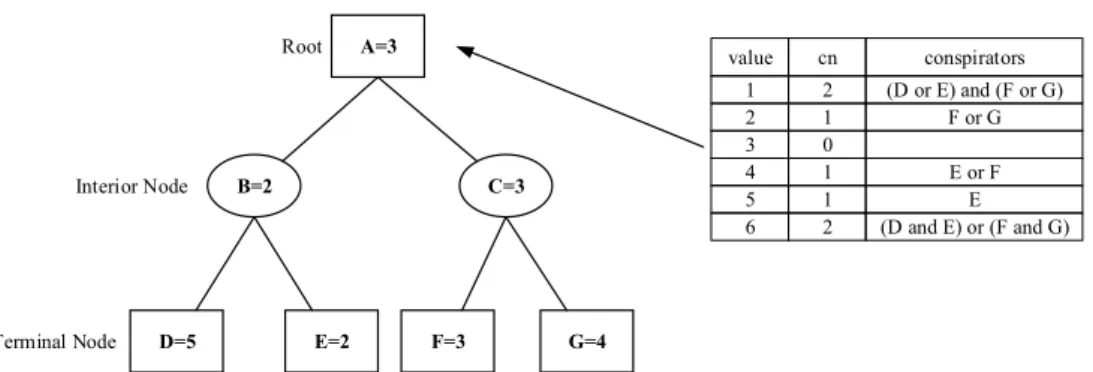
The algorithm is a probabilistic search in nature where there is no guarantee that the correct solution will be found when it terminates, but the most likely one instead. The conceptual framework behind the CNS is to grow search trees for which one has con-fidence by measuring the number of value through the conspiracy numbers. The search is guided in a best first manner, where the tree searched so far is kept in memory. An example is probably the best way to illustrate the function of a conspiracy number. The following is taken from (Schaeffer, 1989; Lorenz et al., 1995): Assume that the branching factor is 2, the range of values are from 1 to 6, the root node is the MAX node, inside the nodes are their names and their minimax values, and the simple tabular for stor-ing conspiracy numbers of the root. From Fig. 1, it can be observed that the leaves or terminal node have to at least change their value to cause the value of the root to become 1, 2, 4, 5, or 6. For example, only leaf E has to change its value to 5 in order for the root
A=3 D=5 E=2 F=3 G=4 B=2 C=3 Root Interior Node Terminal Node value cn conspirators 1 2 (D or E) and (F or G) 2 1 F or G 3 0 4 1 E or F 5 1 E 6 2 (D and E) or (F and G)
Figure 1: Illustration of a minimax tree adopting CNS algorithm.
value to become 5.
As described by Schaeffer (Schaeffer, 1989), there is a simple method of computing the conspiracy num-bers. At the terminal node t, the conspiracy number associated with node t value is 0 and for all other val-ues is 1. For the interior node, if the value x of a MAX node is to be increased to x x, only one of the successor nodes need to change its value to x’. It is clear that the conspiracy number for x’ is the mini-mum amongst all other successors. This is denoted as neededi. If the value x is to be decreased to x x, all successors with values greater than x’ must change their value to one lower than x’. That is the reason why the number of conspirators for these nodes are summed. This is denoted as neededi. The rules of calculating conspiracy numbers are given as the fol-lowing (v is the associated conspiracy number of the node and m is the minimax value of the node):
CN v 0 if v m, At MAX node:
CN v
all sons i
neededi v for all v m,
CN v min
all sons i neededi v for all v m.
At MIN node: CN v min
all sons i neededi v for all v m,
CN v
all sons i
neededi v for all v m.
Since its introduction, variants of CNS have been proposed by several researchers. Con-spiracy Search proposed by McAllester and Yuret (McAllester and Yuret, 1993) establishes lower and upper bound of the search. The MAX strategy estab-lishes a lower bound and the MIN strategy estabestab-lishes an upper bound. Thus, the conspiracy numbers can be used to measure the “safety” of these two strate-gies. Lorenz et al. (Lorenz et al., 1995) proposed a Controlled-Conspiracy Number Search where in-stead of variable depth, an quiescence search
is used and search bound is provided. The conspiracy number vectors are compressed into 3-tuples, allow-ing the CCNS to be independent of the granularity of the evaluation function (e.g. positional play in chess).
3
CONSPIRACY-NUMBER
SEARCH AS CRITICAL
POSITION IDENTIFIER
Determining critical position is vitals due to the fol-lowing reasons: First, the specific outcome of the game can be estimated in advance (e.g. resignation) and this estimation can be utilized for game outcome prediction. Second, the critical positions are expected to expose the possibilities of tactic changes, denoted as tactics or tactics, respectively. The tactics implies that the computer player tries to force a draw when it’s losing, while tactics implies that the com-puter player tries to force a draw when achieving a win is impossible. Third, critical positions can be used to estimate the moment for computer player to apply speculative play and change the outcome of the game.
However, why do we use CNS instead of the po-sitional scoring (evaluation function) alone during the game’s progression? The positional scoring act as a guiding function for an individual player to determine his/her state in the game’s progress (Buro, 1999). Al-though it might be suitable for identifying critical po-sitions, it still lack of the probabilistic element in ab-stracting the player’s decision to determine the next game state. Basically, positional scoring shows how the game progresses (i.e. which player is leading the game) but the CN-values potentially show its prob-able changes. Thus, the goal of critical position is to determine the possibility of improving or deteri-orating the positional score value of a move (evalu-ate for probable impact of next moves), while posi-tional scoring makes use of the evaluation features
of a move (evaluate for probable gain of next moves) (Buro, 1999).
3.1
Experimental Results and
Discussion
CNS requires two types of conspiracy numbers needed to maintain, needed and needed. We con-sider this as a scalar measures in the computer-game’s search progress to analyze and justify the rationale of the hypothesis mentioned earlier. A simple Tic-Tac-Toe game is used as the test bed of our study.
This experiment is tested with fixed-depth mini-max algorithm applying CNS as a scalar measures for recording the conspiracy numbers of the root values for each game moves. For every player X with search depth i there is an opposing player O with search depth j, where 2 i 6 and 2 j 6. Therefore, there are 25 total game sets (both player X and player O have five depths). Player X is assumed to be the first player to start the game in every case, since if player O starts the results will be just the reverse. The rules of the games are as follows:
For player O, the score is negative. For player X, the score is positive.
Player X tries to maximize the score, while player O tries to minimize the score.
For each row, if there are both X and O, then the score for the row is 0.
If the whole row is empty, then the score is 1. If there is only one X, then the score is 10. If there is only one O, then the score is -10.
If there are two X, then the score is 100. If there are two O, then the score is -100.
If there are 3 X, then the score is 1000. If there are three O, then the score is -1000.
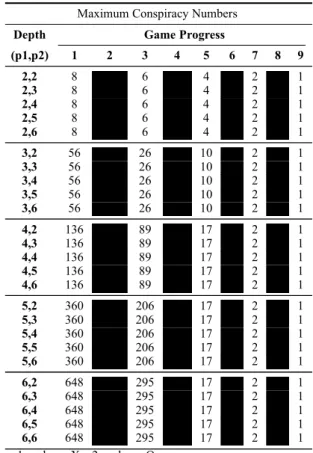
Table 1 and Table 2 shows the recorded maximum conspiracy numbers (MaxCN) and minimum conspir-acy numbers (MinCN) for every game sets, respec-tively. The odd and even numbers (highlighted in light gray) of the game’s progress are relevant to player X and player O, respectively. In all cases of game sets, the game outcomes is a draw. To counter this, we con-sider the final score of any player as win, lose, or draw as final score of 100, -100, and 0, respectively. Table 3 shows the final scores of every game of player X versus player O.
Observing Table 1 and Table 2, the MaxCN of player X decreases steadily (in most cases) while the MaxCN for player O decreases abruptly. To sim-plify the results interpretation, the following rules are adopted: The MaxCN of current player p is consid-ered abruptly decreased if MaxCNpi 1 MaxCNpi
MaxCNpi 1, where i equals to the game progress
Table 1: Maximum Conspiracy numbers of player X against player O with depth variations.
Maximum Conspiracy Numbers
Depth Game Progress
(p1,p2) 1 2 3 4 5 6 7 8 9 2,2 8 7 6 5 4 3 2 1 1 2,3 8 22 6 8 4 4 2 1 1 2,4 8 62 6 16 4 4 2 1 1 2,5 8 128 6 17 4 4 2 1 1 2,6 8 288 6 17 4 4 2 1 1 3,2 56 7 26 5 10 3 2 1 1 3,3 56 22 26 8 10 5 2 1 1 3,4 56 62 26 16 10 5 2 1 1 3,5 56 128 26 17 10 5 2 1 1 3,6 56 288 26 17 10 5 2 1 1 4,2 136 7 89 5 17 3 2 1 1 4,3 136 22 89 8 17 3 2 1 1 4,4 136 62 89 16 17 3 2 1 1 4,5 136 128 89 17 17 3 2 1 1 4,6 136 288 89 17 17 3 2 1 1 5,2 360 7 206 5 17 3 2 1 1 5,3 360 22 206 8 17 3 2 1 1 5,4 360 62 206 16 17 3 2 1 1 5,5 360 128 206 17 17 3 2 1 1 5,6 360 288 206 17 17 3 2 1 1 6,2 648 7 295 5 17 3 2 1 1 6,3 648 22 295 8 17 3 2 1 1 6,4 648 62 295 16 17 3 2 1 1 6,5 648 128 295 17 17 3 2 1 1 6,6 648 288 295 17 17 3 2 1 1 p1 = player X, p2 = player O
(e.g. moves). The value of MaxCN implies insta-bility and changes in the root value is more likely. In other words, possibility of losing or winning is high since the likeliness of the root value to change is high. However, the fact that the outcome is inevitable (ei-ther win or lose) but not known, this stage simulates the critical position which is highly recommended for applying speculative play.
For MinCN, however, a different interpretation is needed. The abruptly decreased MinCN utilizes the same rule as MaxCN: The MinCN of current player p is considered abruptly decreased if MinCNpi 1
MinCNpi MinCNpi 1 , where i equals to the
game’s progress (e.g. moves). This situation is the critical position for tactic changes ( tactic or tactic). In the case of abrupt inclining of MaxCN, the root value stabilizes and tactic change of the cur-rent player from better to worst (from winning to a draw or a draw to losing) is more likely. This particu-lar situation is when the tactic occurs. In the case of abrupt inclining of MinCN, the root value is limited to the available MinCN value only. Thus, this situation implies the likelihood of identifying the tactic change of the current player from worst to better (from losing to a draw or from a draw to winning). This particular
Table 2: Minimum Conspiracy numbers of player X against player O with depth variations.
Minimum Conspiracy Numbers
Depth Game Progress
(p1,p2) 1 2 3 4 5 6 7 8 9 2,2 1 6 1 4 1 3 0 0 0 2,3 1 4 1 4 1 1 0 0 0 2,4 1 13 1 8 1 0 0 0 0 2,5 1 13 1 5 1 0 0 0 0 2,6 1 23 1 1 1 0 0 0 0 3,2 6 6 4 4 0 0 0 0 0 3,3 6 4 4 4 0 0 0 0 0 3,4 6 13 4 8 0 0 0 0 0 3,5 6 13 4 5 0 0 0 0 0 3,6 6 23 4 1 0 0 0 0 0 4,2 4 6 3 4 1 3 0 0 0 4,3 4 4 3 4 1 1 0 0 0 4,4 4 13 3 8 1 0 0 0 0 4,5 4 13 3 5 1 0 0 0 0 4,6 4 23 3 1 1 0 0 0 0 5,2 13 6 5 4 0 3 0 0 0 5,3 13 4 5 4 0 1 0 0 0 5,4 13 13 5 8 0 0 0 0 0 5,5 13 13 5 5 0 0 0 0 0 5,6 13 23 5 1 0 0 0 0 0 6,2 13 6 5 4 0 3 0 0 0 6,3 13 4 5 4 0 1 0 0 0 6,4 13 13 5 8 0 0 0 0 0 6,5 13 13 5 5 0 0 0 0 0 6,6 13 23 5 1 0 0 0 0 0 p1 = player X, p2 = player O
Table 3: Final scores based on depths of player X against player O.
Final Score Player O
2 3 4 5 6 2 0 0 0 0 0 3 0 0 0 0 0 Player X 4 -100 -100 -100 -100 -100 5 -100 -100 -100 -100 -100 6 -100 -100 -100 -100 -100
situation is when the tactic occurred.
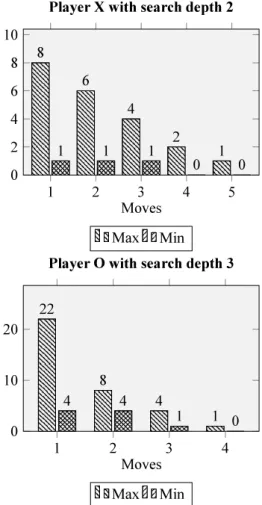
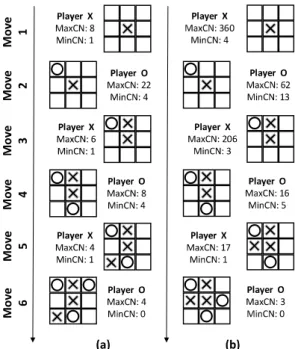
For instance, consider player X with search depth 2 against player O with search depth 3. Generally, player O can be regarded to outperform player X due to lookahead superiority. Figure 2 and Figure 4(a) simulates the mentioned game’s progress situ-ation. During the first move, player X chooses the middle position of the board leaving player O with limited options. The MaxCN and MinCN of player X is currently 8 and 1 respectively. After consid-ering the vertical, diagonal, and horizontal spaces, player O chooses the upper left corner of the board
Figure 2: MaxCN and MinCN for player X with search depth 2 against player O with search depth 3.
and currently possess MaxCN and MinCN of 22 and 4 respectively. Consequently, player X chose the up-per middle side of the board, which effects MaxCN to decrease steadily, while MinCN remain the same. Next, player O chooses the lower middle of the board which abruptly reduces player O’s MaxCN to 8 while MinCN remains the same. This situation imposes that player O is in a critical position, even if its intent is to prevent player X from winning. Therefore, player O is in the state of tactic and is advised to apply different tactic. In the next move, player X chooses the lower left corner of the board which has forced player O into another bad position. During the con-sequent move, player O’s MaxCN reduces steadily while MinCN is abruptly reduced to 1, which implies that player O has applied tactic where, instead of losing, it tries to force player X into a draw. Thus, the final outcome of the game is a draw.
Another example is the case of player X with search depth 5 against player O with search depth 4 which is given in Figure 3 and Figure 4(b). During
Figure 3: MaxCN and MinCN for player X with search depth 5 against player O with search depth 4.
the first move, player X chooses the middle position of the board leaving player O with limited options. The MaxCN and MinCN of player X is currently 360 and 4 respectively. The high value of MaxCN is be-cause of the deeper search depths. In the next move, player O chooses the upper left corner of the board and obtains a MaxCN and MinCN of 62 and 13 re-spectively. Consequently, player X chooses the upper middle side of the board, making MaxCN and MinCN decreases steadily. During the rest of the moves, the evolution of MaxCN of both player X and player O abruptly reduces, forcing both players into “dilem-mas” where both tactic and tactic occur. This situ-ation can be hypothetically defined as the state where both players are able to apply different tactics. On the other hand, observing the MinCN of both player X and player O during fifth and sixth moves implies that both player adopted the tactic. However, player O’s leading score plays its part and forces player X to lose the game (assumed final score is winning).
The challenge in the study of speculative play is to identify critical positions at which one should
con-Figure 4: Simulation of Tic-Tac-Toe games.
sider to apply a kind of speculative strategy such as opponent-model search in order to change the situa-tion: from behind to even or better. Another chal-lenge in GM-level man-machine matches is to iden-tify (no more promising) positions to resign. There-fore, the experiments suggested in this study provide the main foundation for identifying the critical posi-tions, although further investigation is expected.
4
CNS CORRELATIONS TO PNS
Application of PNS in the previous work such as (Ishitobi et al., 2013) raised questions whether any correlations exists in the application of CNS as a criti-cal position identifier. Theoreticriti-cally, experimental re-sults obtained from the previous section empowered the possibility of correlation between CNS and PNS as indicators in their respective tree search frame-work. This section attempts to identify that correla-tion and give a better picture on the importance of these two indicators. The following section will give a short description on the basis of PNS.
4.1
The Basis of PNS
PNS, like its ancestor CNS, is a best-first search al-gorithm in which the tree searched so far is stored in memory. The main difference is that PNS aims at proving the true value of root, where the interim minimax values are not considered (Allis et al., 1994).
The PNS heuristic determines the most promising leaf by selecting a most-proving node or most-promising node (MPN), which can contribute to either a proof or a disproof of the root if a leaf node is solved. The MPN can be formally defined as the node which, with the least possible effort, potentially contributes most to the establishment of the minimax value of the root. The MPN can be found by manipulating two criteria of the search tree: (1) its shape (determined by the branching factor of every internal node), and (2) the values of the leaves. The basic and un-enhanced PNS is an uninformed search method that does not require any game-specific knowledge beyond its rules (Kishi-moto et al., 2012).
The PNS produces two special values for each node n in order to find MPN. First, the proof num-ber (denoted as pn n where pn is the proof numnum-ber of node n) which is the smallest number of leaf nodes in the subtree starting with n that have to be proven in order to prove that n is a win. Second, the disproof number (denoted as dn n where dn is the disproof number of node n) which is the minimum number of leaf nodes that have to be disproved in order to prove that n is a loss.
Calculating the values of pn and dn for each node in the tree is performed in a bottom-up manner. Usu-ally, In a terminal node t, the game-theoretic value is known or the corresponding position has no legal moves. If t is a win, then pn t 0 and dn t 1. If t is a loss, then pn t 1 and dn t 0. If t is un-known, then pn t dn t 1. In this case, the termi-nal node t is called a temporary termitermi-nal node. For the internal MAX node, it is sufficient to have one child that proves the value of v. The pn of a MAX node is equal to the minimum of the pn of its children. For dn, the only way to disprove v is to disprove v for all its children. So, the dn for MAX node is equal to the sum of the dn of all its children. It is the reverse for the internal MIN node.
However, PNS is famously known for searching the AND/OR tree framework instead of the minimax tree framework. The AND/OR tree is a type of tree where the nodes have only three possible values: true, false, and unknown (Ishitobi et al., 2013). Using PNS, the pn for an AND/OR tree represents the minimum number of unsolved leaf nodes that need to be solved in order to win in the root. Similarly, the dn for an AND/OR tree represents the minimum number of un-solved leaf nodes that need to be un-solved in order to lose in the root. The PNS always considers the MPN in which the internal nodes can be decided recursively if the terminal node value was decided. Thus, PNS can be used to decide the value of the root node by deciding values of other nodes as soon as possible
(Ishitobi et al., 2013).
4.2
General Correlation of the Elements
of CNS and PNS
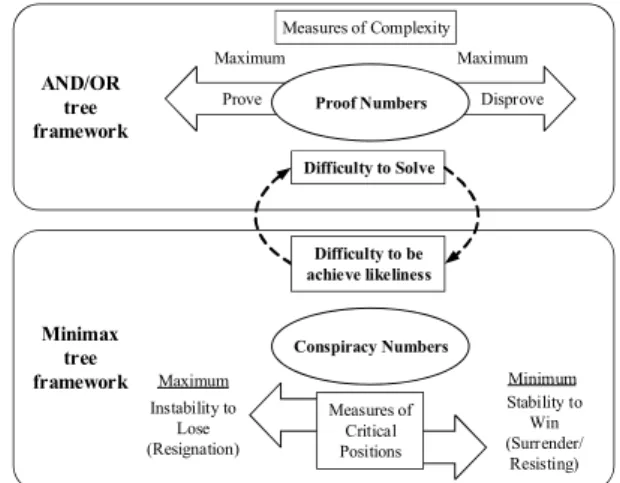
As described by Ishitobi et al. (Ishitobi et al., 2013), pn is related to the difficulty, which relates to the minimum number of unsolved nodes that need to be solved. So, maximum pn shows the complexity to solve these unsolved nodes. On the other hand, dn is related to the minimum number of unsolved nodes that need to be disproved. Therefore, maximum dn shows the complexity to disprove. In other word, both the maximum pn and maximum dn are an effective measures of difficulty to solve nodes as soon as pos-sible for the AND/OR tree framework.
The MaxCN and MinCN show a correlation to maximum pn and maximum dn in the minimax tree framework. In the CNS context, MaxCN and MinCN identify the critical position in the game’s progress for an expected outcome. MaxCN indicates the un-likeliness of root value in achieving a value. There-fore, high value of MaxCN implies the high likeliness of winning or losing. MinCN indicates that the like-liness of root value to achieve a value is limited to the value of MinCN. So, high value of MinCN im-plies the possibility of target change of the possible estimated outcome. Considering the relation to max-imum pn and maxmax-imum dn, we find that high values of MaxCN and MinCN are an effective measures of difficulty of a particular value to be likely. Figure 5 depicts the correlation of CNS and PNS.
AND/OR tree framework Minimax tree framework
Prove Proof Numbers Disprove Measures of Complexity Maximum Maximum Conspiracy Numbers Measures of Critical Positions Maximum Minimum Instability to Lose (Resignation) Stability to Win (Surrender/ Resisting) Difficulty to Solve Difficulty to be achieve likeliness
Figure 5: Correlation between CNS and PNS.
5
CONCLUDING REMARKS
The application of conspiracy numbers as the crit-ical position identifier in the context of tic-tac-toe game (two-players perfect information games). The theoretical correlation of maximum and min-imum conspiracy numbers to maxmin-imum proof numbers and maximum disproof numbers. In the results presented, we successfully identi-fied the critical position through maximum and mini-mum conspiracy numbers in most cases of game sets. However, not all game sets support the findings antic-ipated from the value of the maximum and minimum conspiracy numbers. Furthermore, further evidences are needed in order to conclude the conspiracy num-bers as the most suitable critical position identifier. In addition, by determining this critical position, pos-sible application of speculative play can be explored and exploited to improve the overall game excite-ment. Further explorations on larger and more com-plex game searches (othello, chess, and endgames of difficult positional chess) is the outlook which we will focuses in future studies in order to give a more accu-rate and extensive understanding on the role of CNS as critical position identifier. Similarly, future work on CNS as critical position identifier will potentially reinforce claims made on its correlation to PNS.
REFERENCES
Allis, L. V., van der Meulen, M., and Van Den Herik, H. J. (1994). Proof-number search. Artificial Intelligence, 66(1):91–124.
Buro, M. (1999). From simple features to sophisticated evaluation functions. In Computers and Games, pages 126–145. LNCS 1558, Springer.
Carmel, D. and Markovitch, S. (1993). Learning models
of opponent’s strategy in game playing.
Technion-Israel Institute of Technology, Center for Intelligent Systems.
Donkers, J. (2003). Nosce Hostem: Searching with
Oppo-nent Models. PhD thesis, Universiteit Maastricht.
Elkan, C. (1989). Conspiracy numbers and caching for
searching and/or trees and theorem-proving. In IJCAI, pages 341–348.
Iida, H., Uiterwijk, J., Herik, H. J. v. d., and Herschberg, I. (1993). Potential applications of opponent-model search: Part 1. the domain of applicability. ICCA
Jour-nal, 16(4):201–208.
Iida, H., Uiterwijk, J., Herik, H. J. v. d., and Herschberg, I. (1994). Potential applications of opponent-model search. part 2: risks and strategies. ICCA Journal, 17(1):10–14.
Ishitobi, T., Cincotti, A., and Iida, H. (2013). Shape-keeping technique and its application to checkmate problem composition. In Ninth Artificial Intelligence
and Interactive Digital Entertainment Conference.
Jansen, P. (1992). Using knowledge about the opponent in
game-tree search. PhD thesis, Carnegie Mellon
Uni-versity.
Kishimoto, A., Winands, M. H., M¨uller, M., and Saito, J.-T. (2012). Game-tree search using proof numbers: The first twenty years. ICGA Journal, (3).
Lorenz, U., Rottmann, V., Feldmann, R., and Mysliwietz, P. (1995). Controlled conspiracy number search. ICCA
Journal, 18(3):135–147.
McAllester, D. A. (1985). A new procedure for growing min-max trees. Technical report, Artificial Intelli-gence Laboratory, MIT, Cambridge, MA, USA. McAllester, D. A. (1988). Conspiracy numbers for min-max
search. Artificial Intelligence, 35(3):287–310.
McAllester, D. A. and Yuret, D. (1993).
Alpha-beta-conspiracy search.
Neumann, L. J. and Morgenstern, O. (1947). Theory of
games and economic behavior, volume 60. Princeton
university press Princeton, NJ.
Ramon, J., Jacobs, N., and Blockeel, H. (2002). Opponent modeling by analysing play. In Proceedings of
Work-shop on agents in computer games. Citeseer.
Schaeffer, J. (1989). Conspiracy numbers. Advances in
Computer Chess, 5:199–218.
Schaeffer, J. (1990). Conspiracy numbers. Artificial
Intelli-gence, 43(1):67–84.
Schaeffer, J. and van den Herikb, J. (2002). Games, com-puters, and artificial intelligence. Chips Challenging
Champions: Games, Computers and Artificial Intelli-gence, 3.
Shannon, C. E. (1950). Xxii. programming a computer for playing chess. Philosophical magazine, 41(314):256– 275.
van den Herik, H. J., Donkers, H., and Spronck, P. H. (2005). Opponent modelling and commercial games. In Proceedings of the IEEE 2005 Symposium on
Com-putational Intelligence and Games (CIG05), pages
15–25.
van der Meulen, M. (1990). Conspiracy-number search.