Panel Data Research Center at Keio University
DISCUSSION PAPER SERIES
DP2015-007 March, 2016
Does a Mother's Early Return to Work after Childbirth Improve Her Future Employment Status? Evidence Using the Birth Month of Japanese Babies
Wataru Kureishi* Colin McKenzie** Kei Sakata*** Midori Wakabayashi****
【Abstract】
We examine if a Japanese mother's early return to work after parental leave improves her employment status in the short- or long-term. We estimate recursive bivariate probit models for a mother’s employment status and an early return to work dummy using July births as an instrument. In Japan, the timing of a birth is crucial for the application deadline for admission into a licensed childcare facility which affects the timing of a mother’s return to work. We find that an early return to work has a positive effect on the mother’s likelihood of being in full-time employment in the long-term.
* National Institute of Population and Social Security Research ** Keio University
*** Ritsumeikan University **** Tohoku University
Panel Data Research Center at Keio University Keio University
Does a Mother’s Early Return to Work after Childbirth
Improve Her Future Employment Status? Evidence
Using the Birth Month of Japanese Babies
1
Wataru KUREISHI, National Institute of Population and Social Security Research Colin MCKENZIE, Keio University2
Kei SAKATA, Ritsumeikan University
Midori WAKABAYASHI, Tohoku University
1
The authors would like to thank participants in the Kansai Labor Workshop, Tokyo Labor Economic Workshop, and a seminar at Konan University for their helpful comments and suggestions, and gratefully acknowledge the financial assistance provided by the Japan Society for the Promotion of Science (JSPS) Grant in Aid for Scientific Research (B) No. 15H03363 for a project “The Impact of Child Birth and Child Care on the Employment of Women From the Perspective of Gender Preference, Nursing Care and Family Relationships” (Project Leader: Colin McKenzie). Data used in this paper comes from the Japanese Ministry of Health, Labour and Welfare’s Longitudinal Survey of Newborns in the 21st Century (21 seiki shussho ji judan chosa) and the Live Birth Form of Vital Statistics (Jinko dotai chosa shusseihyo). The fourth author wishes to acknowledge the financial assistance provided the Tohoku Kaihatsu Memorial Foundation and the Nomura Foundation.
2Corresponding author: Colin McKenzie, 2-15-45 Mita, Minato-ku, Tokyo, 108-8345, JAPAN. Tel: 81-3-5427-1831. Fax: 81-3-5427-1578. Email: [email protected]
1
Abstract
We examine if a Japanese mother’s early return to work after parental leave improves her employment status in the short- or long-term. We estimate recursive bivariate probit models for a mother’s employment status and an early return to work dummy using July births as an instrument. In Japan, the timing of a birth is crucial for the application deadline for admission into a licensed childcare facility which affects the timing of a mother’s return to work. We find that an early return to work has a positive effect on the mother’s likelihood of being in full-time employment in the long-term.
Keywords: bivariate probit model, childcare, employment, parental leave, quasi-experiment, treatment effect
JEL classification codes: J08, J13, J22
1. Introduction
Japanese society has been rapidly ageing due to a long-term decline in the birth rate. This in turn means a rapid decrease in the labor force. In order to deal with the decline in fertility rate and the rapid decrease in the labor force, Prime Minister Shinzo Abe has proposed various policy measures. One of his most contentious policy measures is an extension of parental leave from 1.5 years to 3 years3. Abe’s intention is to encourage mothers to stay in the labor force
after childbirth and childcare, and to reduce the number of children on the waiting lists for admission into child care facilities. Abe points out in his speech, that there is a strong demand for more than one year of maternity and parental leave among new parents, and proposes a policy called “3 nen kan dakko sihodai”, which literally means “cuddle your baby as much as you like for three years”. As the proposed policy intends, the longer parental leave may encourage women to return to work as their full-time position is secured. However, some people argue that the policy may in fact have the opposite effect to what is intended. They criticize the policy by arguing that longer parental leave deprives mothers of their job skills and career accumulation as the longer they are out of the labor force, the more likely it is that their job skills depreciate. Therefore, we focus on this argument, that is, the earlier mothers return to work after childbirth, the less likely that they experience a depreciation of their job skills, and the more likely it is that they are in a full-time position.
3Speech on Growth Strategy by Prime Minister Shinzo Abe at the Japan National Press Club, Friday, April 19, 2013. Accessed 26 January 2016. Available from URL:
http://www.kantei.go.jp/jp/96_abe/statement/2013/0419speech.html
3
The existing literature has so far been made in the context of identifying policy intervention of childcare and parental leave in the settings of difference-in-differences and regression discontinuity design. In Germany, where several maternity and parental leave reforms have been implemented since the 1970s, Schönberg and Ludsteck (2014) compare women who gave birth just before the reforms to those who gave birth just after reforms. They find that each expansion in maternity leave delays a mother’s return to work, but had little impact on a mother’s labor force participation in the long run. Geyer et al. (2015) focus on the 2007 German reform of parental leave benefits, and find modest positive effects on the labor supply of mothers in the second year after their child was born. In Austria, Lalive et al. (2014) and Lalive and Zweimüller (2009) show that extended parental leave significantly delays a mother’s return to work, but employment and earnings decrease only in the short run, but not in the long run. In the US, Baum (2003) shows that 12 week unpaid maternity leave legislation has small and statistically insignificant effects on employment and wages. In Canada, Baker and Milligan (2008) find that the introduction and expansion of statutory maternity leave increases the likelihood of mothers returning to their pre-birth employer and of their job continuity. In his survey of the literature for Japan, Yamaguchi (2015b) argues that very few papers seriously address the identification issues appropriately. Two exceptions are Asai (2015) and Nagase (2014). For example, Asai (2015) conducts a difference-in-differences analysis to examine the effects of an increase in the replacement rate of parental leave benefits from 25% to 40% in 2001, and finds little evidence that a mother’s job continuity increased in response to this reform. An alternative approach is the strategy of using the quarter of a birth as an instrumental variable in line with Angrist and Kruger (1991) and Gelbach (2002). Most
recently, Bauernschuster and Schlotter (2015), using day-of-birth cut-off dates as instruments for kindergarten attendance, find significantly positive causal effects on mothers’ employment probabilities and on their weekly working hours in Germany. Another closely related study is Berlinsli et al. (2011), who find no effect of preschool attendance on maternal labor outcomes using an enrollment-age rule.
Using data from the Japanese Ministry of Health, Labour and Welfare’s Longitudinal Survey of Newborns in the 21st Century, this paper examines whether or not a mother’s return to work within 1 year after childbirth has any impact on her being employed and being in full-time employment in the short run and in the long run. This data set contains information on children who were born in January and July 2001. We estimate recursive bivariate probit models for a mother’s employment status and an early return to work dummy using July births as an instrument. The method is a quasi-experiment using the birth month of newborn babies as an instrumental variable. Our approach is notable in that we direct attention to the relationship between the birth month of a new born baby, the deadline for making an application for admission into a licensed child care facility, and the mother’s early return to work. The data we use are a panel data of Japanese newborns and parents, which contains information on the newborn babies‘ birth months. As is explained in detail in section 2, in Japan the birth month of a baby is crucial in determining the timing of a mother’s return to work due to the application deadline for licensed childcare facilities. Our empirical evidence finds that an early return to work after child-birth has a significant positive causal effect on the likelihood of mother’s full-time employment in the long-term, but not the short-term. In
contrast, there is no causal effect of an early return to work on the likelihood of being employed in either the short-term or the long-term.
The rest of this paper is organized as follows. Section 2 provides details of the key institutional features of the parental leave system in Japan. The estimation method and the data used in this paper are discussed in sections 3 and 4, respectively. Section 5 presents the sample selection rules adopted and descriptive statistics for the sample used. Sections 6 and 7 discuss the use of the baby’s birth month as an instrument and the credibility of the exclusion restriction, and the estimation results, respectively. Section 8 concludes the paper.
2. Parental Leave and Childcare Facilities in Japan
4In Japan, an expectant or new mother is eligible for two types of legal leave: maternity leave and parental leave.
Any working woman is eligible to take 6 weeks of maternity leave before delivery (14 weeks in the case of a multiple pregnancy) and 8 weeks of maternity leave after delivery. The leave before delivery is available upon request, while the leave after delivery is mandatory. The maternity allowance paid per day to a working woman who is on maternity leave is funded by the National Health Insurance system, and, in general, amounts to two thirds of the standard daily income where the standard daily income is based on the woman’s pre-birth earnings.
4Since the births analyzed in this paper all occur in 2001, this paper focuses on child care leave system as it was in 2001. Asai (2015) contains a more detailed description of how the child care leave system has changed over time.
6
In 2001, working fathers and mothers, except daily and fixed-term employment workers, could request to take parental leave until their child reached the age of one.5 Unemployment Insurance paid 40% of the mother’s standard income as a parental leave benefit.6 It is worth noting that this 40% is broken down as follows: 30% of the pre-birth earnings were paid monthly during the leave, and the remaining 10 percent was paid six months after the mother returns to work. In addition, for the period of the maternity and parental leave, workers were exempted from paying both out-of-pocket and employer’s contributions for social security.
An increasing number of women take parental leave, while it is extremely rare for men to take parental leave in Japan. The Basic Survey of Women Workers' Employment Management reports that in 2002 64.0% of mothers took parental leave, while only 0.33% of fathers did (Ministry of Health, Labour and Welfare (Japan) (2002)). Maternity and parental leaves are expected to encourage many full-time working mothers to return to work after their children reach the age of one.
In Japan, traditionally, the use of child care service was not an option for parents, and child rearing was entirely on the shoulder of parents and their relatives. However, due to increases in the number of working mothers, the demand for child care facilities has increased over time. Child care facilities in Japan are established under the provisions of the Child Welfare Law. In the period of high economic growth in the 1960s, child care facilities became available in response to the diversification of childcare needs, which stem from increases in the number of working mothers.
5
From 2005, fixed-term employment workers who (a) have been continuously employed for one year or more by the same employer and (b) are expected to continue their employment after their child’s first birthday have been able to take parental leave.
6
In 2007, the payment was raised to 50% of the standard income.
7
Using data reported in the Report on Social Welfare Administration and Services produced by the Ministry of Health, Labour and Welfare, Figure 1 graphs the childcare utilization rates for children of various ages over time. Only 6% of parents with a 0-year-old children used child care facilities in 2002. As the age of the child rises, the proportion of children nursed in child care facilities increases. In 2002, 21% of 1-and-2-year-old are nursed in childcare facilities, whereas 36% of 3-year-old children are nursed in child care facilities. The ratio for 4-year-or-older children increases slightly, which may be because children of 4 years or more start going to kindergarten. For the most recent year, 2014, the utilization ratio for 0-year-old children has increased to 15%.
[Figure 1 around here]
The main child care facilities are licensed child care facilities (Ninka Hoikusho) subsidized by local governments. Due to government subsidies, licensed child care facilities are much cheaper than non-licensed facilities. Licensed child care facilities are regulated by the Child Welfare Act (Jido Fukushi Ho). In order for a child care facility to be licensed by a local government, the child care facility must fulfill certain minimum standards set by the Child Welfare Act relating to the size of building, the size of playground, the number of nursery teachers, the content of the nursery program, and nursery hours. The hours of child care services are 8 hours per day. The operating expenses of these licensed child care facilities are subsidized by the local government, and the childcare fees paid by parents are based on the family’s income. According to the 2003 Survey of Regional Child Welfare Services, 29.7% of households with one child paid 20,000 yen or more but less than 30,000 yen per month per household for childcare, while 22.8% paid less than 10,000 yen per month per household.
Non-licensed child care facilities, those facilities which are not authorized under the Child Welfare Law, have complementary functions to the licensed facilities in the present childcare system, and provide various kinds of childcare services which are not available from the licensed child care facilities, such as childcare immediately after maternity leave, extended hours of childcare service, nighttime childcare, and accepting children halfway through the academic year. However, as non-licensed child care facilities hardly receive any subsidies from the local government, many of them are financially constrained, and it is often said that some provide inferior childcare services to licensed facilities.
Due to their lower fees and relatively higher quality, parents with a newly born child prefer to use a licensed facility. However, not all children can be admitted to the licensed child care facilities due to the limited number of facilities and places available. It is important to note that under the Child Welfare Act, licensed child care facilities are provided to those guardians who are unable to look after their child(ren) at home during the daytime for reasons such as work and disabilities. In other words, unless both parents work, their child(ren) are not eligible for admission into a licensed child care facility. There are two important features of licensed childcare facilities that are relevant for our analysis. The first is that licensed childcare facilities only accept new children once a year on 1 April, the beginning of the academic and business year in Japan. The second is that the application deadline for an April admission in licensed child care facilities is in December of the previous year. This means that children born after the deadline need to wait for the next December for their application to be accepted in a licensed childcare facility. It is important to note that the rule is very strict, and no application is accepted after the deadline. Unless there is a vacancy in a licensed childcare facility during the year, which is extremely rare, parents who missed the application deadline have to wait a year before they can apply for their child can be admitted to a licensed childcare facility. It is well-known that in the
metropolitan areas of Japan there was substantial excess demand for licensed day care facilities at this time, so being able to make an application for admission did not guarantee that the child would be approved for admission into a licensed care facility (see National Institute of Population and Social Security Research (2004, p. 39)). The application deadline rule gives us a unique quasi experimental setting where the birth month of a newborn child can be used as an instrument as some mothers can return to work more smoothly than others using a cheap licensed childcare facility. This issue will be further discussed in section 5.
3. Estimation Method
Our objective is to estimate a causal model which describes whether or not a mother’s early return to work after childbirth has an impact on her future working status. Future working status is measured in two ways: whether the mother works full-time or not; or whether the mother is working or not.
We consider the following model for future working status which contains a binary treatment variable that is endogenous:
𝑌𝑌 = 1 [𝑋𝑋1𝜁𝜁1+ 𝜆𝜆1𝑇𝑇 + 𝑣𝑣1 > 0], (1)
where the outcome variable Y is a 0-1 dummy for the mother’s future employment status, the treatment variable T is 0-1 dummy variable taking the value unity if the mother returns to work “early” after childbirth and zero otherwise, X1 is a vector of control variables, 𝜁𝜁1and 𝜆𝜆1 are parameters to be
estimated, and 𝑣𝑣1 is a disturbance term.
In order to make causal inferences, we need to overcome a potential endogeneity problem, namely, the treatment variable T may be correlated with the error term in equation (1), which would bias the estimates of the regression coefficients. One reason for this is that a mother’s future employment
status and her early return to work may share some unobservable common causes which induce spurious associations, or confounding bias. For instance, unobserved work preferences can be correlated with both early return to work and future employment status (that is, career oriented women may return to work early and stay employed). Moreover, on the one hand, employers may place mothers with more ability into higher positions (full-time positions) and at the same time, the employers may be generous in allowing these mothers to take longer periods of parental leave. In this case, the estimated coefficient of an early-return-to-work variable in the future employment equation would show a spurious downward bias despite these two variables being independent. On the other hand, mothers with high abilities may want to return to work earlier due to their higher opportunity costs, which may cause an upward bias. Which bias dominates the other is ambiguous.
The endogeneity problem is dealt with by first postulating the following model for the binary treatment variable:
𝑇𝑇 = 1[𝑋𝑋2𝜁𝜁2+ 𝑣𝑣2 > 0] (2)
where X2 is a vectors of control variables, and 𝑣𝑣2 is a disturbance term. Second, it is assumed that (𝑣𝑣1,
𝑣𝑣2) are distributed as a bivariate normal random variable with zero means, unit variances, ρ =
Corr (𝑣𝑣1, 𝑣𝑣2), and that (𝑣𝑣1,𝑣𝑣2) are independent of X1 and 𝑋𝑋2, so that (1) and (2) form a recursive probit
model that can be estimated by maximum likelihood methods. Third, we use a baby’s birth month, January or July, as an instrument Z for the treatment variable T, which is included in 𝑋𝑋2 but not in 𝑋𝑋1. We will explain Z in section 6.
4. Data
The data we use is taken from the Longitudinal Survey of Newborns in the 21st Century (21 seiki shussho ji judan chosa, in Japanese), which is the first longitudinal survey conducted by the Japanese Ministry of Health, Labour, and Welfare.7 The survey is a mail-in longitudinal census survey which has tracked all newborn babies born in Japan in the periods of January 10-17 in 2001, and July 10-17 in 2001, and has been conducted every year since 2001.8 The first survey which we refer to as the ‘2001 survey’ was conducted when the babies were 6 month old, namely, on August 1 2001 for January babies and February 1 2002 for July babies. The number of questionnaires delivered and responses received for the 2001 survey are 26,620 and 23,423 for January babies (a response rate 88.0%), and 26,955 and 23,592 for July babies (a response rate of 87.5%), respectively. For the 2002 to 2006 surveys, the survey months continued to be August for January births and February for July babies. Since the 2008 survey, the survey months for January babies and July babies have been January and July, respectively.
Our instrumental variable Z is a dichotomous variable which equals one if the baby was born in July 2001 and zero otherwise (that is, babies born in January 2001).
For the variable Y in equation (1), we measure a mother’s employment status using two variables. The first one is a dichotomous variable which equals one if the mother is working as a full-time worker and zero otherwise. The second is also a dichotomous variable which equals one if the mother is working (as a full-time, part-time, self-employed or family worker, or a pieceworker at home), and zero otherwise. In this paper, we report results when these variables are measured at the time of the 2004 and 7 Sakata et al. (2015) provide a summary of the survey in Japanese.
8
The newborn babies were sampled from the Live Birth Form of Vital Statistics (Jinko dotai chosa shusseihyo).
12
2011 surveys, that is, three years and ten years after the child’s birth. The former is designed to pick up the “short-term” effects, and the latter is designed to pick up the “long-term” effects of the treatment variable.
To construct the treatment variable, T, we use information on answers to a question about parental leave in the 2001 survey, where the question was asked six months after the delivery of their child(ren) and only to respondents who were employed as full-time workers. The respondents were offered the choice of the following six answers: (1) have already taken parental leave; (2) currently on parental leave; and (3) plan to take parental leave; (4) workplace has a parental leave system but they did not take it up; (5) workplace does not have a parental leave system; and (6) do not know whether or not their workplace has a parental leave system. Those respondents who chose (1), (2) or (3) were then asked about the (expected) length of their parental leave (in months). The respondents were explicitly instructed to exclude the 8 weeks of post-delivery maternity leave and short-term working. Hence, we construct the treatment variable T representing a mother’s early return to work less than 12 months from childbirth as a dichotomous variable which equals one if the length of the mother’s parental leave is 9 months or less (that is, choices (1)-(3) and the reported parental leave is 9 months or less, and choices (4)-(6)) , and zero otherwise (that is, choices (1)-(3) and the reported parental leave is 10 months or more).9 Since these women are entitled to take 10 months parental leave, those who take 9 months or
9We did not use the duration of parental leave as the treatment variable since there are some respondents who report extremely long periods of parental leave up to three years. These observations may be outliers and may distort our results. As our focus is on whether a mother can return to work within the duration of the legally required parental leave, we do use the duration of parental leave as a treatment variable.
13
less are not using their entitlement to the full, and are thus called “early returners”. It should be noted that since the question about parental leave is asked 6 months after the delivery of the baby, mothers who report a period of parental leave of four months or less have actually returned to work by the time of the survey. For those mothers who report a period of parental leave of five months or more, this is not the case, so it represents their intended period of parental leave, so if they report their parental leave is 9 months or less, they intend to return to work early.
In 𝑋𝑋1 that appears in equation (1) we include the following control variables: mother’s age, the number of siblings, city size, co-residence with grandparents, and the father's annual income in the previous year. This information is obtained from the 2004 or 2011 surveys. In 𝑋𝑋2, in addition to the instrument Z, July, we include the following variables: mother’s age, city size, co-residence with grandparents, and father's annual income in the previous year. This information is obtained from the 2001 survey. In addition, in both 𝑋𝑋1 and 𝑋𝑋2 we include a dummy for whether the mother has a university degree or higher where this information is taken from the 2002 survey, and dummies for firm size where this information is take from the 2001 survey.
5. Sample Selection and Descriptive Statistics
Our sample is selected from the original 47,015 babies (23,423 January babies and 23,592 July babies) as follows. First, we use only respondents whose babies are first-born because mothers with more than one child may have more and better knowledge of child-bearing and child-rearing. They may also manipulate the timing of their child’s birth given knowledge that having a baby in the period from January to March is disadvantageous in terms of having the child admitted to licensed child care. Moreover, according to the admission criteria published by some municipal welfare offices, parents who
already have an elder child admitted in a licensed facility can get extra points for the newborn being admitted in the same child care facility. This reduces the sample to 23,503. Second, we restrict the sample to respondents who were employed as full-time workers both one year before delivery and a half year after delivery. This is because workers who have been continuously employed one year or more by the same employer have been able to take parental leave and because the questions about taking parental leave and the length of any parental leave were asked only to those mothers who were employed as full-time workers when the 2001 survey was conducted. This reduces the sample to 4,088. Moreover, we excluded parents where at least one has a foreign nationality, and single parents. Finally, restricting the sample to those who answer other questions providing necessary information reduces the final sample to 2,880 for 2004 and 2,356 for 2011.
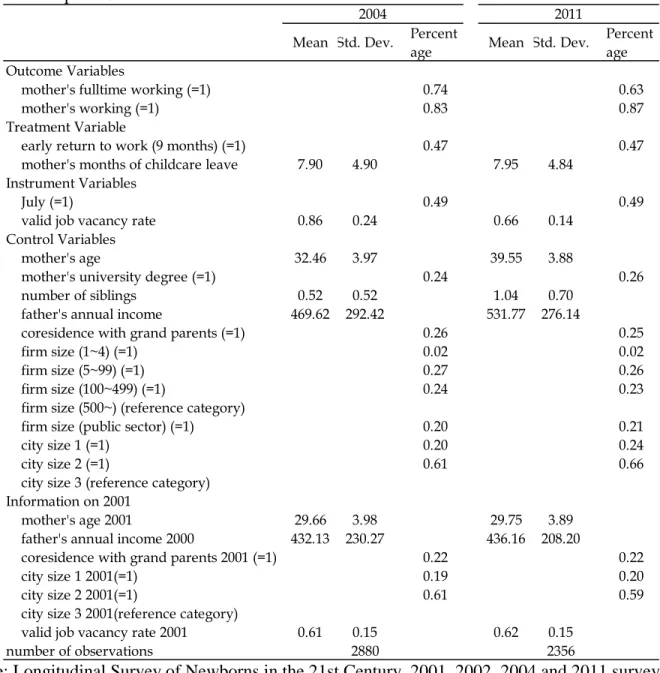
Table 1 provides descriptive statistics for this sample of full-time working mothers using information at the time of 2004 and 2011 surveys. At the time of the 2004 survey, when the newborn babies were three and a half years old, 83 percent of mothers, who were employed as full-time workers before delivery, were still in the labor force, and 74% of them continued to work as full-time employees. Mothers were on average 32.46 years old, which means that for our sample, the average age of bearing the first child is 29 years old. 24.4% of the mothers have at least a university degree. The average number of siblings is 0.52 which indicates that roughly, one in two has a younger sibling after 3 and half years. In the previous year (that is, 2003), husbands earned about 4.70 million yen (including tax) on average, which is 0.38 million yen higher than three year earlier (2000).
In Table 2 (a), we can observe mothers’ employment status at the time of the 2004 survey when the newborn babies have reached the age of three and a half. If a mother had returned to work earlier after childbirth, that is, the length of parental leave was 9 months or less, 77.6% of them worked full-time and 7.2% worked part-full-time at the full-time of the 2004 survey, while if a mother returned to work after
10 or more months of parental leave, 70.3% worked full-time and 7.4% worked part-time, respectively. In addition, only 13.7% of mothers returning to work early were not working three years after their childbirth, while nearly 20.5% of those not returning to work early were not working three years after their childbirth.
Table 2 (b) shows mothers’ employment status a decade after childbirth. Although the proportion of full-time workers for those who returned to work early is lower than three years after childbirth and that for those who did not return to work early also has decreased, a gap still persists in the ratio of mothers working full-time between those who returned to work early and those who did not. In addition, because children aged 10 might require less attention, compared to what is observed three years after childbirth the ratio of those who did not work decreases and that of those who work as part-time workers increases, regardless of whether they return to work early or not.
[Table 2 around here]
6. Baby’s Birth Month and a Mother’s Early Return to Work
In Japan, it is important to stress that the timing of a birth is crucial for when a child’s parents can make an application for the admission of their child into a licensed childcare facility.
In many municipalities, infants can enter a 0-year–old childcare class of a child care facility after they turn 3 to 6 months. In Japan, the school calendar year including that for licensed childcare facilities starts from April, and the application deadline for April admissions into licensed child care facilities is in December of the previous year. Thus, for babies born between January and March, the chance of them
being admitted into a licensed child care facility is very slim as they miss the deadline of December of the previous year. In other words, parents of those babies born between January and March (together with babies born in April or later of the same year) have to wait at least until December of that year before they can apply for admission of their child into a licensed child care facility and at least until April of the following year for their child to be admitted into that facility. This means that mothers who give birth in the period from January to March have to either find a non-licensed facility or a babysitter, which are more expensive, or a grandparent when their parental leave expires or quit their jobs. On the other hand, mothers who give birth after April in the same year may be able to return to their full-time position more smoothly after their maternity leave and parental leave as they can make submit their application for the admission of their child into a licensed child care facility before the December deadline of that year. Since a municipality’s implementation of the application deadline for child care facility admissions is keyed to a child’s birth month being before/after April, mothers who give birth after April are much more likely to be able to return to work earlier after childbirth than those who give birth from January to March.
For example,
• Taro, who was born January, 2001, cannot join a 0-year-old class in a licensed child care facility in April 2001 because the deadline for applying for admission, December 2000, has already passed, but in December 2001 his parents can apply for him to enter a 1-year-old class in a licensed child care facility in April 2002. The gap between the end of Taro’s mother’s parental leave and Taro joining the 1-year-old class could be covered by Taro’s mother taking unpaid parental leave, a non-licensed child care facility, or a baby sitter. In this case, Taro’s mother’s return to work is 1 year or more after childbirth.
• Hanako, who was born July 2001, may be able to enter a 0-year-old class in a licensed child care facility in April 2002 because the deadline for applications is December 2001. If her application is approved, Hanako’s mother can return to work in April 2002 less than 1 year after childbirth. If her application is not approved due to excess demand for licensed child care facilities, Hanako’s mother could return to work in July 2002 when her paid parental leave expires, provided she can find a non-licensed child care facility or baby sitter, and in December 2001 apply for Hanako to enter a 1-year-old class in a licensed child care facility in April 2001, or even quit her job.
We can obtain some idea of the types of child care used by mothers with a job10 according to a child’s age from data in the Comprehensive Survey of Living Conditions for 2001. For babies aged 0, 64.2% per cent were taken care of by their father and/or mother, 26.3% by their grandparents, 16.9% by licensed child care facilities, and 2.7% by unlicensed childcare facilities. For children aged 1, 39.6% were taken care of by their father and/or mother, 26.6% by their grandparents, 42.6% by licensed child care facilities, and 6.0% by unlicensed childcare facilities11.
Using data from the Longitudinal Survey of Newborns in the 21st Century, Figure 2 indicates how the distributions for the lengths of parental leave in months differ between mothers who gave birth in January and in July. The most important finding is that mothers who gave birth in July are more likely to take 6 to 9 months of parental leave compared with mothers who gave birth in January (for 7 months 10These data do not distinguish between women who are working full-time or part-time, or those who are currently on parental leave or who have returned from parental leave.
11
The sum of these percentages exceeds 100% because the survey which they are taken from allowed for multiple responses to the question about who cared for the children.
18
of parental leave, 9.1% for those who gave birth in July and 2.4% for January births), while mothers who gave birth in January are more likely to take 10 and 12 months of parental leave compared with mothers who gave birth in July (16.5% and 22.5% of mothers with July and January births took 10 months of parental leave, respectively, while 24.7% and 27.6% with July and January births took 12 months of parental leave, respectively). This implies that mothers who gave birth in July are more likely to return to work in April (6 or 7 months after maternity leave), which corresponds to the beginning of the school year. That is, they have a better chance of having their children admitted into licensed child care facilities than mothers with January births.
[Figure 2 around here]
Another interesting pattern is that about 50% of mothers who gave birth in January and about 40% of those in July answered that they would be taking 10 to 12 months of parental leave. There are few full-time working mothers who took (or expected to take) more than 13 months of parental leave because an eligible working mother can only collect parental leave benefits until her child reaches the age of 1.
If giving birth between January and March does not affect a mother’s employment status through any mechanism other than the mother’s early return to work, the timing of birth is a valid instrumental variable for the effect of early return to work. It should be noted that a child’s birth month Z randomizes not the mothers’ return to work, but the eligibility for applying for admission into a licensed child care facility, so it introduces an element of randomness in the process of a child being admitted into a licensed child care facility admission. That is, in our quasi-experimental setting, and we exploit the
random variation in mothers’ early return to work introduced by our quarter-of-birth type instrument a la Angrist and Kruger (1991). This enables us to re-write equation (2) as
𝑇𝑇 = 1[𝜇𝜇 + 𝛿𝛿𝛿𝛿 + 𝜙𝜙𝑋𝑋 + 𝑣𝑣2 > 0] (3)
where X are the other control variables. The relevance of the instrument is indicated by the coefficient 𝛿𝛿 on the child’s birth month, Z, which indicates the share of mothers who return to work early according to their children’s birth month.
One possibility that leads to a bias in our estimator is that the instrument is confounded with socio economics status (SES). For example, Buckles and Hungerman (2013) show that in the United States controlling for parental SES reduces the association between the quarter of birth and wages. Their paper argues against Angrist and Kruger’s (1991) proposal of using the quarter of birth as an instrument as they show that the mothers of children born early in the year are younger, have less education, and are less likely to be married or white. These factors directly affect wages.
Thus, we also checked for differences in parents’ socio economic factors before childbirth, such as mother’s and father’s age, mother’s and father’s education level, father’s income in the year before the birth, and the babies weight at birth between January and July births. As can be seen from Table 3, for families where the mother was working full-time before delivery, there are no statistically significant differences in these socio-economic factors.
[Table 3 around here]
7. Results
1. The Results of Estimations for Mothers’ Full-time Employment in 2004
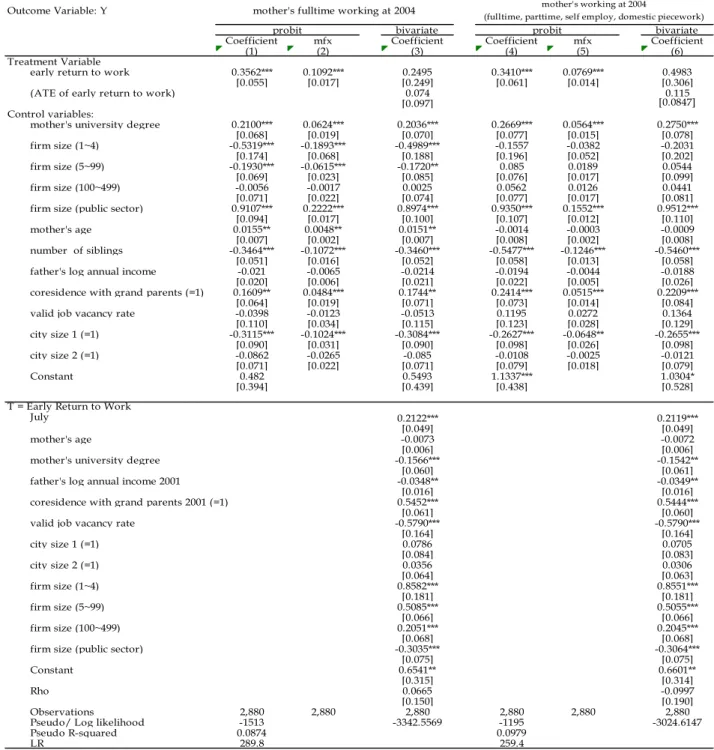
In Table 4 we present the results of probit estimates of equation (1) and bivariate probit estimates of equations (1) and (2) when the outcome variable Y is a dummy for mother’s full-time working and a dummy variable for working, and the treatment variable T is a dummy for an early return to work after childbirth, where the outcome variable is measured in year 2004, that is, three and a half years after the birth. In the table, we present the estimated coefficients and marginal effects for the probit models and estimated coefficients for the bivariate probit models. We also estimate the average treatment effect of early return to work for the bivariate probit models. Columns (1)-(3) in Table 4 report the estimated results when the outcome variable is whether or not a mother working as a full-time worker, and columns (4)-(6) report the results when the outcome variable is whether or not a mother works (as not only full-time worker but also part-time, self-employed or family worker, or pieceworker at home).
Looking at the results for the probit model in the columns (1) and (2), where endogeneity is not taken account for, we see that the treatment variable T, an early return to work after childbirth, has a positive and statistically significant effect. The marginal effect of an early return to work is 0.109, and this means that a mother who returns to work less than 12 months of her childbirth are 10.9% points more likely to work as full-time workers in 2004.
Looking at column (3) of Table 4, we see that treatment variable T, an early return to work after childbirth, does not have a statistically significant coefficient when the model is estimated as a bivariate probit model, while the coefficient of July in the estimation of equation (3) for the treatment variable T is positive and statistically significant, that is, all other things equal the mothers of children born in July are much more likely to return to work early compared to mothers of children born in January.
Columns (4)-(6) of Table 4 present the results when the outcome variable is a dummy variable for the mother’s working status in year 2004. In the simple probit estimates, an early return to work has a positive and significant effect as is the case for the previous full-time employment analysis. The marginal effect suggests that if the mothers return to work early, they are 7.69% points more likely to work in 2004 than mothers who return later. In the bivariate probit analysis, this variable is again insignificant.
Examining the control variables, we find that a mother with a university degree has a significantly higher probability of working full-time and working per se. Mothers who worked in in smaller firms in 2001 are significantly less likely to be employed full-time or employed at all in 2004, compared to mothers who worked in a large firm in 2001, while mothers who worked in the public sector are statistically more likely to be working full-time or working at all in 2004 compared to mothers who worked in a large firm in 2001. Co-residence with a grand-parent leads to a higher probability of a mother being in full-time employment and in employment in 2004, and also leads to a higher probability of the mother returning to work early. Compared to mothers who work in large firms in 2001, mothers in smaller firms in 2001 are more likely to return to work earlier, and mothers who work in the public service are less likely to return to work earlier. Ikeda (2010) analyzes the factors which determine women’s job continuity, and our findings on the relationship between firm size and parental leave are consistent with his results.
[Table 4 around here]
2. The Results for Mothers’ Full-time Employment and being employed in 2011
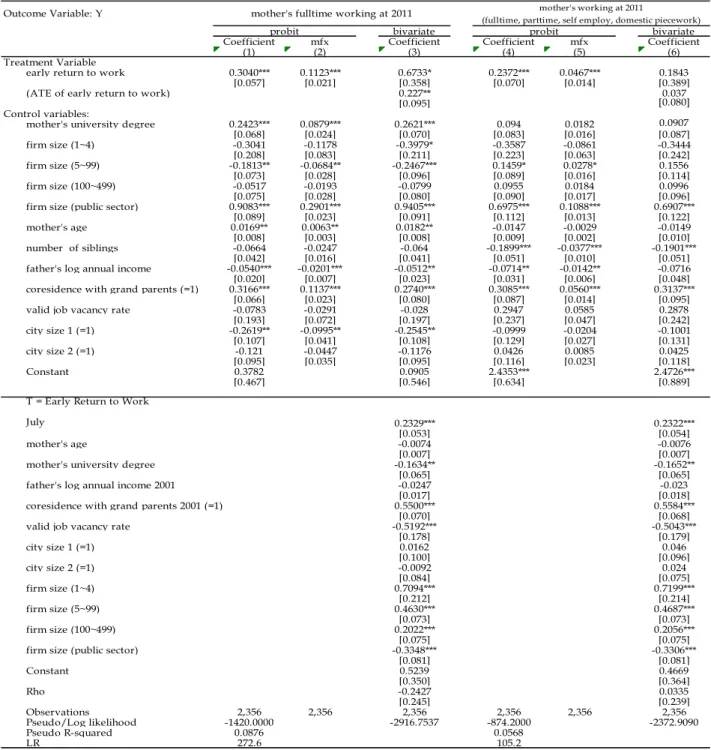
In Table 5, we present the results for our outcome variables in the year 2011, which is 10 years after the birth. Similar to the results presented in Table 4, the estimated results for the probit models in Table 5 show positive and statistically significant coefficients for the treatment variable in both full-time employment case and employment case. The marginal effects of an early return to work are 11.23% and 4.67%, respectively. However, unlike the case for 2004, a mothers’ return to work less than 12 months after her childbirth has a positive causal effect on full-time employment of the mothers in 2011. The average treatment effects (ATE) are computed following Wooldridge (2010, p. 594)) and suggest that an early return to work increases by 22.7% the probability that the mother will be employed as a full-time worker in 2011. On the other hand, the effects of an early return to work on being employed in 2011 is not statistically significant, so taken together these findings suggest that an early return to work has an impact on the type of work a mother is engaged in the long run rather than any impact on her employment status.[Table 5 around here]
8. Discussion and Conclusion
This paper examines the effects of a mother’s early return to work after childbirth on their future working status. By taking an advantage of the admission system for licensed child care facilities in Japan, we estimate recursive bivariate probit models using July births as an instrument. Our results show that a mother’s early return to work has a positive causal impact on her employment status.However,
the causal effects do not appear in the short term, but only appear for full-time employment in the long-term.
First, our bivariate probit estimates show that mothers who return to work early after childbirth are more likely to work as full-time workers in 2011 (column (3) in Table 5). This indicates that a mother’s employment status as a full-time worker is causally affected by her early return to work after her child birth. Second, when we change the outcome variable to a mother working or not in 2011 we do not have a significant coefficient on the treatment variable, early return to work (column (6) in Table 5). The empirical evidence highlights that a mother’s employment status in 2011 is not causally affected by her early return to work after her child birth in 2001. Thirdly, an early return to work has no causal effects on either being employed as a full-time worker or being employed in 2004 (columns (3) and (6) in Table 4). From these results, we find that a mother’s early return to work after her child birth has a causal positive effect on her full-time employment status in the long-term, but not on her employment status in either the short-term or long-term, or her full-time employment status in the short-term. One possible explanation for this is that those mothers, who did not return to work early, and in turn, who are less likely to successfully get their child into a licensed childcare facility, might have been able to stay employed or full-time employed using a non-licensed facility. Thus, in 2004, we did not observe any statistical differences between the mothers who return to work early and those who did not. However, many non-licensed child care facilities do not provide child care service for children over the age of 3 years old. Moreover, day care services at kindergartens become available for children over the age of 3 years old, and day care services at kindergartens are much cheaper than those at non-licensed facilities. The downside of using a kindergarten is that the standard operating hours are only four hours. Therefore, it seems that in the long run, those mothers who could return to work early using licensed child care facility stayed in fulltime employment, while those who could not return to work early had to move to
kindergarten and shift to part-time work after non-licensed options are no longer available or relatively more expensive. This explains why a mother’s early return to work has a positive and significant impact on full-time employment in 2011, but is not significant for employment in 2011.
Our results are also consistent with the known importance of skill accumulation by full-time workers in Japanese workers in the long-term. It is well-known that in Japan there is a clear distinction between full-time workers who operate in an environment where the accumulation of firm-specific skills is highly evaluated and other workers including part-time workers (for example, Kawaguchi (2011)).
Apart from our study, few study in Japan have investigated the impact of targeted policy intervention of childcare and parental leave on mothers’ return to work after childbirth in the context of a quasi-experimental setting.Yamaguchi (2015a) estimates a dynamic discrete choice structural model in the presence of parental leave legislation, and evaluates the effects of parental leave expansions, which have changed the duration of job protection and/or the replacement rate of the cash benefits. He finds that one-year job protection significantly increased maternal employment and earnings, but extending it from one to three years and offering additional cash benefits has little effect. His results are consistent with ours where mother’s employment status as full-time workers are causally affected by their early return to work after childbirth. In Japan, little is known about which policy interventions have a positive effects on mothers’ return to work after childbirth and job continuity. It is just possible that the provision of more nursery facilities is an effective one because many studies point to the problem of many children being on waiting lists for licensed child care facilities because existing childcare centers are insufficient to accommodate all the children of working mothers (Lee and Lee (2014) and Zhou and Oishi (2005)).
References
Angrist, J. D., & Krueger, A. B. (1991). Does Compulsory School Attendance Affect Schooling and Earnings? Quarterly Journal of Economics, 106(4), 979-1014.
Asai, Y. (2015). Parental Leave Reforms and the Employment of New Mothers: Quasi-experimental Evidence from Japan. Labour Economics, 36, 72–83.
Baker, M., & Milligan, K. (2008). How Does Job-Protected Maternity Leave Affect Mothers’ Employment? Journal of Labor Economics, 26(4), 655-691.
Bauernschuster, S., & Schlotter, M. (2015). Public Child Care and Mothers' Labor Supply—Evidence from Two Quasi-experiments. Journal of Public Economics, 123, 1-16.
Baum, C. L. (2003). The Effect of State Maternity Leave Legislation and the 1993 Family and Medical Leave Act on Employment and Wages. Labour Economics, 10(5), 573-596.
Berlinski, S., Galiani, S., & McEwan, P. (2011). Preschool and Maternal Labor Market Outcomes: Evidence from a Regression Discontinuity Design. Economic Development and Cultural Change,
59(2), 313-344.
Buckles, K. S., & Hungerman, D. M. (2013). Season of Birth and Later Outcomes: Old Questions, New Answers. Review of Economics and Statistics, 95(3), 711-724.
Gelbach, J. (2002). Public Schooling for Young Children and Maternal Labor Supply. American
Economic Review, 92(1), 307-322.
Geyer , J., Haan , P., & Wrohlich, K. (2015). The Effects of Family Policy on Maternal Labor Supply: Combining Evidence from a Structural Model and a Quasi-Experimental Approach. Labour
Economics, 36, 84-98.
Ikeda, S. (2010). Company Size and Childcare Leave: The Problems of Support for Women's Job Continuity. Japan Labor Review, 7(1), 119-139.
Kawaguchi, D. (2011). Applying the Mincer Wage Equation to Japanese Data. RIETI Discussion Paper
Series 11-J-026.
Lalive, R., & Zweimüller, J. (2009). How Does Parental Leave Affect Fertility and Return to Work? Evidence from Two Natural Experiments. Quarterly Journal of Economics, 124(3), 1363-1402. Lalive, R., Schlosser, A., Steinhauer, A., & Zweimüller, J. (2014). Parental Leave and Mothers' Careers:
The Relative Importance of Job Protection and Cash Benefits. Review of Economic Studies,
81(1), 219-265.
Lee, G. H., & Lee , S. (2014). Childcare Availability, Fertility and Female Labor Force Participation in Japan. Journal of the Japanese and International Economies, 32, 71–85.
Ministry of Health, Labour and Welfare (Japan). (2002). The Basic Survey of Women Workers'
Employment Management (in Japanese).
Nagase, N. (2014). The Effect of a Short-Hour Option Mandate on First Childbirth, Birth Intention and Work Continuation after Childbirth : Evidence from Japan. Journal of Population Studies, 37(1), 29-53 (in Japsnese).
National Institute of Population and Social Security Research. (2004). Child Related Policies in Japan. Retrieved February 25, 2016, from http://www.ipss.go.jp/s-info/e/chil
Sakata, A., Tano, J., & Fuse, K. (2015). For Ministry of Health, Labour and Welfare Longitudinal Survey (Development and Challenges of the Special Panel Survey). Advances in Social Research,
15, 21-29 (in Japanese).
Schönberg, U., & Ludsteck, J. (2014). Expansions in Materity Leave Coverage and Mothers' Labor Market Outcomes after Childbirth. Journal of Labor Economis, 32(3), 469-505.
Wooldridge, J. (2010). Econometric Analysis of Cross Section and Panel Data, 2nd edition. MIT Press: Cambridge.
Yamaguchi, S. (2015a). Effects of Parental Leave Policies on Female Career and Fertility Choices.
Available at SSRN. Retrieved January 26, 2016, from http://ssrn.com/abstract=2655884
Yamaguchi, S. (2015b). Family Policies and Female Employment in Japan. Available at SSRN. Retrieved January 26, 2016, from http://ssrn.com/abstract=2634281
Zhou, Y., & Oishi, A. (2005). Underlying Demand for Licensed Childcare Services in Urban Japan.
Asian Economic Journal, 19(1), 103–119.
Tables
Table 1: Descriptive Statistics
Mean Std. Dev. Percentage Mean Std. Dev. Percentage
Outcome Variables
mother's fulltime working (=1) 0.74 0.63
mother's working (=1) 0.83 0.87
Treatment Variable
early return to work (9 months) (=1) 0.47 0.47
mother's months of childcare leave 7.90 4.90 7.95 4.84
Instrument Variables
July (=1) 0.49 0.49
valid job vacancy rate 0.86 0.24 0.66 0.14
Control Variables
mother's age 32.46 3.97 39.55 3.88
mother's university degree (=1) 0.24 0.26
number of siblings 0.52 0.52 1.04 0.70
father's annual income 469.62 292.42 531.77 276.14
coresidence with grand parents (=1) 0.26 0.25
firm size (1~4) (=1) 0.02 0.02
firm size (5~99) (=1) 0.27 0.26
firm size (100~499) (=1) 0.24 0.23
firm size (500~) (reference category)
firm size (public sector) (=1) 0.20 0.21
city size 1 (=1) 0.20 0.24
city size 2 (=1) 0.61 0.66
city size 3 (reference category) Information on 2001
mother's age 2001 29.66 3.98 29.75 3.89
father's annual income 2000 432.13 230.27 436.16 208.20
coresidence with grand parents 2001 (=1) 0.22 0.22
city size 1 2001(=1) 0.19 0.20
city size 2 2001(=1) 0.61 0.59
city size 3 2001(reference category)
valid job vacancy rate 2001 0.61 0.15 0.62 0.15
number of observations 2880 2356
2004 2011
Source: Longitudinal Survey of Newborns in the 21st Century, 2001, 2002, 2004 and 2011 surveys. Sample selections: 1) first-born babies; 2) mothers who were employed as full-time workers both one year before delivery and a half year after delivery; 3) both parents have Japanese nationality; 4) both parents are alive and married and 5) answer other questions providing necessary information.
Note: * 10,000 yen
Table 2(a): Mothers' Employment Status in 2004 (percentage)
Full-time Part-time employed Self- piecework Domestic Housewives, No work,
Students Total Early return to work = 0 (n=1,519) 70.31 7.37 1.38 0.46 20.47 100.00 Early return to work = 1 (n=1,361) 77.59 7.20 1.40 0.15 13.67 100.00
Source: Longitudinal Survey of Newborns in the 21st Century, wave 2004. n= 2,880. Notes: Due to rounding, the sum of the individual components may not equal 100.0.
(b): Mothers' Employment Status in 2011 (percentage)
Full-time Part-time employed Self- piecework Domestic Housewives, No work,
Students Total Early return to work = 0 (n=1,253) 59.86 21.39 2.79 0.64 15.32 100.00 Early return to work = 1 (n=1,103) 66.00 20.04 2.54 0.27 11.15 100.00
Source: Longitudinal Survey of Newborns in the 21st Century, wave 2011. n= 2,356. Notes: Due to rounding, the sum of the individual components may not equal 100.0.
Table 3 Socio-Economic Status of Parents by Birth Month (Mean) Mother’s University Degree (=1) Father’s University Degree (=1) Mother’s
Age (year) Father’s Age (year)
Father’s Annual Income in 2000 (10,000 yen) Weight at Birth (g) January 0.23 0.40 29.16 30.79 426.14 3009.47 (0.01) (0.01) (0.09) (0.11) (5.80) (9.29) Sample size 1780 1779 1909 1909 1834 1909 July 0.24 0.41 29.14 30.98 416.66 3007.34 (0.01) (0.01) (0.09) (0.12) (4.63) (9.49) Sample size 1729 1728 1831 1831 1761 1831
p-value for test
of difference 0.64 0.66 0.88 0.23 0.20 0.87
Source: Longitudinal Survey of Newborns in the 21st Century, wave 2001. Notes:
The sample section criteria are: 1) first-born babies; 2) mothers who were employed as full-time workers both one year before delivery and a half year after delivery; 3) both parents have Japanese nationality; and 4) both parents are alive and married. Figures in brackets are standard deviations.
Table 4: Estimation Results of Mother’s Working Status in Year 2004
Outcome Variable: Y
bivariate bivariate
Coefficient mfx Coefficient Coefficient mfx Coefficient
(1) (2) (3) (4) (5) (6)
Treatment Variable
early return to work 0.3562*** 0.1092*** 0.2495 0.3410*** 0.0769*** 0.4983 [0.055] [0.017] [0.249] [0.061] [0.014] [0.306]
(ATE of early return to work) 0.074 0.115
[0.097] [0.0847]
Control variables:
mother's university degree 0.2100*** 0.0624*** 0.2036*** 0.2669*** 0.0564*** 0.2750*** [0.068] [0.019] [0.070] [0.077] [0.015] [0.078] firm size (1~4) -0.5319*** -0.1893*** -0.4989*** -0.1557 -0.0382 -0.2031 [0.174] [0.068] [0.188] [0.196] [0.052] [0.202] firm size (5~99) -0.1930*** -0.0615*** -0.1720** 0.085 0.0189 0.0544 [0.069] [0.023] [0.085] [0.076] [0.017] [0.099] firm size (100~499) -0.0056 -0.0017 0.0025 0.0562 0.0126 0.0441 [0.071] [0.022] [0.074] [0.077] [0.017] [0.081] firm size (public sector) 0.9107*** 0.2222*** 0.8974*** 0.9350*** 0.1552*** 0.9512***
[0.094] [0.017] [0.100] [0.107] [0.012] [0.110] mother's age 0.0155** 0.0048** 0.0151** -0.0014 -0.0003 -0.0009 [0.007] [0.002] [0.007] [0.008] [0.002] [0.008] number of siblings -0.3464*** -0.1072*** -0.3460*** -0.5477*** -0.1246*** -0.5460***
[0.051] [0.016] [0.052] [0.058] [0.013] [0.058] father's log annual income -0.021 -0.0065 -0.0214 -0.0194 -0.0044 -0.0188 [0.020] [0.006] [0.021] [0.022] [0.005] [0.026] coresidence with grand parents (=1) 0.1609** 0.0484*** 0.1744** 0.2414*** 0.0515*** 0.2209***
[0.064] [0.019] [0.071] [0.073] [0.014] [0.084] valid job vacancy rate -0.0398 -0.0123 -0.0513 0.1195 0.0272 0.1364 [0.110] [0.034] [0.115] [0.123] [0.028] [0.129] city size 1 (=1) -0.3115*** -0.1024*** -0.3084*** -0.2627*** -0.0648** -0.2655*** [0.090] [0.031] [0.090] [0.098] [0.026] [0.098] city size 2 (=1) -0.0862 -0.0265 -0.085 -0.0108 -0.0025 -0.0121 [0.071] [0.022] [0.071] [0.079] [0.018] [0.079] Constant 0.482 0.5493 1.1337*** 1.0304* [0.394] [0.439] [0.438] [0.528]
T = Early Return to Work
July 0.2122*** 0.2119***
[0.049] [0.049]
mother's age -0.0073 -0.0072
[0.006] [0.006]
mother's university degree -0.1566*** -0.1542**
[0.060] [0.061]
father's log annual income 2001 -0.0348** -0.0349**
[0.016] [0.016]
coresidence with grand parents 2001 (=1) 0.5452*** 0.5444***
[0.061] [0.060]
valid job vacancy rate -0.5790*** -0.5790***
[0.164] [0.164] city size 1 (=1) 0.0786 0.0705 [0.084] [0.083] city size 2 (=1) 0.0356 0.0306 [0.064] [0.063] firm size (1~4) 0.8582*** 0.8551*** [0.181] [0.181] firm size (5~99) 0.5085*** 0.5055*** [0.066] [0.066] firm size (100~499) 0.2051*** 0.2045*** [0.068] [0.068]
firm size (public sector) -0.3035*** -0.3064***
[0.075] [0.075] Constant 0.6541** 0.6601** [0.315] [0.314] Rho 0.0665 -0.0997 [0.150] [0.190] Observations 2,880 2,880 2,880 2,880 2,880 2,880
Pseudo/ Log likelihood -1513 -3342.5569 -1195 -3024.6147
Pseudo R-squared 0.0874 0.0979
LR 289.8 259.4
mother's fulltime working at 2004 (fulltime, parttime, self employ, domestic piecework)mother's working at 2004
probit probit
Notes: 1) Standard errors in brackets. *, ** and *** indicate statistical significance at the 10%, 5% and 1% levels, respectively. 2) The average treatment effects (ATE) are computed following Wooldridge (2010, p. 594).
Table 5: Estimation Results of Mother’s Working Status in Year 2011 Outcome Variable: Y
bivariate bivariate
Coefficient mfx Coefficient Coefficient mfx Coefficient
(1) (2) (3) (4) (5) (6)
Treatment Variable
early return to work 0.3040*** 0.1123*** 0.6733* 0.2372*** 0.0467*** 0.1843 [0.057] [0.021] [0.358] [0.070] [0.014] [0.389]
(ATE of early return to work) 0.227** 0.037
[0.095] [0.080]
Control variables:
mother's university degree 0.2423*** 0.0879*** 0.2621*** 0.094 0.0182 0.0907 [0.068] [0.024] [0.070] [0.083] [0.016] [0.087] firm size (1~4) -0.3041 -0.1178 -0.3979* -0.3587 -0.0861 -0.3444 [0.208] [0.083] [0.211] [0.223] [0.063] [0.242] firm size (5~99) -0.1813** -0.0684** -0.2467*** 0.1459* 0.0278* 0.1556 [0.073] [0.028] [0.096] [0.089] [0.016] [0.114] firm size (100~499) -0.0517 -0.0193 -0.0799 0.0955 0.0184 0.0996 [0.075] [0.028] [0.080] [0.090] [0.017] [0.096] firm size (public sector) 0.9083*** 0.2901*** 0.9405*** 0.6975*** 0.1088*** 0.6907***
[0.089] [0.023] [0.091] [0.112] [0.013] [0.122] mother's age 0.0169** 0.0063** 0.0182** -0.0147 -0.0029 -0.0149 [0.008] [0.003] [0.008] [0.009] [0.002] [0.010] number of siblings -0.0664 -0.0247 -0.064 -0.1899*** -0.0377*** -0.1901***
[0.042] [0.016] [0.041] [0.051] [0.010] [0.051] father's log annual income -0.0540*** -0.0201*** -0.0512** -0.0714** -0.0142** -0.0716 [0.020] [0.007] [0.023] [0.031] [0.006] [0.048] coresidence with grand parents (=1) 0.3166*** 0.1137*** 0.2740*** 0.3085*** 0.0560*** 0.3137***
[0.066] [0.023] [0.080] [0.087] [0.014] [0.095] valid job vacancy rate -0.0783 -0.0291 -0.028 0.2947 0.0585 0.2878 [0.193] [0.072] [0.197] [0.237] [0.047] [0.242] city size 1 (=1) -0.2619** -0.0995** -0.2545** -0.0999 -0.0204 -0.1001 [0.107] [0.041] [0.108] [0.129] [0.027] [0.131] city size 2 (=1) -0.121 -0.0447 -0.1176 0.0426 0.0085 0.0425 [0.095] [0.035] [0.095] [0.116] [0.023] [0.118] Constant 0.3782 0.0905 2.4353*** 2.4726*** [0.467] [0.546] [0.634] [0.889]
T = Early Return to Work
July 0.2329*** 0.2322***
[0.053] [0.054]
mother's age -0.0074 -0.0076
[0.007] [0.007]
mother's university degree -0.1634** -0.1652**
[0.065] [0.065]
father's log annual income 2001 -0.0247 -0.023
[0.017] [0.018]
coresidence with grand parents 2001 (=1) 0.5500*** 0.5584***
[0.070] [0.068]
valid job vacancy rate -0.5192*** -0.5043***
[0.178] [0.179] city size 1 (=1) 0.0162 0.046 [0.100] [0.096] city size 2 (=1) -0.0092 0.024 [0.084] [0.075] firm size (1~4) 0.7094*** 0.7199*** [0.212] [0.214] firm size (5~99) 0.4630*** 0.4687*** [0.073] [0.073] firm size (100~499) 0.2022*** 0.2056*** [0.075] [0.075]
firm size (public sector) -0.3348*** -0.3306***
[0.081] [0.081] Constant 0.5239 0.4669 [0.350] [0.364] Rho -0.2427 0.0335 [0.245] [0.239] Observations 2,356 2,356 2,356 2,356 2,356 2,356 Pseudo/Log likelihood -1420.0000 -2916.7537 -874.2000 -2372.9090 Pseudo R-squared 0.0876 0.0568 LR 272.6 105.2
mother's fulltime working at 2011 (fulltime, parttime, self employ, domestic piecework)mother's working at 2011
probit probit
Notes: 1) Standard errors in brackets. *, ** and *** indicate statistical significance at the 10%, 5% and 1% levels, respectively. 2) The average treatment effects (ATE) are computed following Wooldridge (2010, p. 594).
Figures
Figure 1: The Ratio of Day Care Center Utilization
Source: Authors' calculation using data from the Japanese Ministry of Health, Labour and Welfare’s Report on Social Welfare Administration and Services, and Population Estimates
Note: The utilization ratio of child care facilities is computed as the number of children being admitted into child care facilities in the age group/ the total number of children in the age group.
0.00 0.05 0.10 0.15 0.20 0.25 0.30 0.35 0.40 0.45 0.50 2002 2003 2004 2005 2006 2007 2008 2009 2010 2011 2012 2013 2014 Ra tio year
0 year old 1 & 2 year old 3 year old 4 or more year old
Figure 2: The Period of Parental leave
Source: Longitudinal Survey of Newborns in the 21st Century, wave 2001. n= 3,740
Notes: The question explicitly instructed respondents to exclude maternity leave and short-term working. The sample section criteria are: 1) first-born babies; 2) mothers who were employed as full-time workers both one year before delivery and a half year after delivery; 3) both parents have Japanese nationality; and 4) both parents are alive and married.
0 5 10 15 20 25 30 0 1 2 3 4 5 6 7 8 9 10 11 12 13 or more % months January July 35