前 文 筋強直性ジストロフィー(dystrophia myotonica; DM)は, 筋強直現象や特徴的な罹患筋分布に加え,全身に多彩な合併 症を有すこと1)2)から,早期診断,定期的な全身検索・機能評 価,専門科(神経内科・小児神経科)を核とした集学的医療 が重要3)だが,DM の生命予後は Duchenne 型筋ジストロ
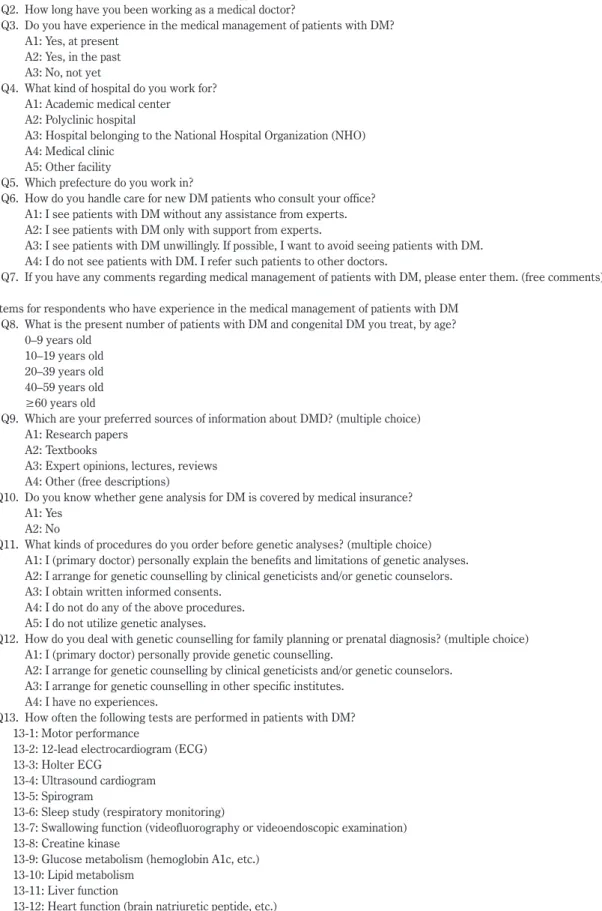
フィー(Duchenne muscular dystrophy; DMD) 4)などに比べて 改善が乏しい.この背景として,本症が抱える多彩な全身合 併症に精通するのは困難なこと,症状の無自覚や中枢神経障 害のために医療へのコンプライアンスが低いことなどが挙げ られる.DM でも新規治療薬の開発が進みつつあるが,標準 的医療の普及は治験遂行の上でも重要である.こうした背景 から,現在「筋強直性ジストロフィー診療ガイドライン」を 作成中である.実用的なガイドライン作成には診療実態の把 握が欠かせず,ガイドラインの有効性評価には,発刊前後の 診療実態の比較検討が重要である.このために,神経内科及 び小児神経専門医を対象としたアンケート調査を実施した. 対象・方法 対象は 2018 年 2 月末時点の神経内科専門医(Neurologist; N)と小児神経専門医(Child Neurologist; CN).アンケートは 23項目 62 設問で構成され,全員にプロフィール(医師経験 年数,DM 診療経験,所属学会,所属機関種別,所在地,診 療意欲)を,DM 患者を「現在診療している(診療中)」また は「過去に診療した(経験有)」医師には,年齢別診療患者 数,利用度の高い情報源,遺伝学的検査,挙児・出生前診断 への対応,機能障害・合併症への関心度,機能評価・合併症 検査の頻度,実施・推奨しているリハビリテーション,呼吸 ケア,心伝導障害・不整脈治療,胃瘻造設・栄養管理,耐糖 能障害治療を尋ねた(Table 1, Supplement). 2018年 3 月に調査用紙を送付し,2018 年 5 月末を期限と して Web または郵送で回収した.アンケートは無記名で,同 意取得は同意確認設問へのチェックで行った. 統計解析は SSPS ver.25 を用い,群間比較は χ2検定で行っ た.日本神経学会,日本小児神経学会双方に所属する医師は どちらの学会にもカウントし,所属施設は総合病院(「大学
原 著
本邦における筋強直性ジストロフィーの診療実態調査
―専門医対象全国調査―
松村 剛
1)*
高田 博仁
2)石垣 景子
3)小牧 宏文
4)高橋 正紀
5) 要旨: 筋強直性ジストロフィーの診療実態について,神経内科および小児神経専門医を対象にアンケート調査 した.遺伝学的検査の保険適応についての認知度,検査前説明実施率は高かったが,文書による同意取得は必ずし も行われていなかった.運動機能障害,心肺機能不全,伝導障害・不整脈,嚥下障害は 6 割以上が重要としたが, 本症に特有な低酸素血症・無呼吸,全身合併症を重要としたのは 35%未満だった.ホルター心電図や睡眠時呼吸 検査,嚥下機能評価の定期実施率は半数以下で,手間のかかる検査は実施困難な状況が示唆された.呼吸ケア・循 環器コンサルトでは小児神経科医で積極的で,神経内科では呼吸器装着や経管栄養に否定的な意見も見られた. (臨床神経 2020;60:120-129) Key words: 筋強直性ジストロフィー,診療実態,アンケート調査,神経内科専門医,小児神経専門医 *Corresponding author: 国立病院機構大阪刀根山医療センター脳神経内科〔〒 560-8552 大阪府豊中市刀根山 5-1-1〕 1)国立病院機構大阪刀根山医療センター脳神経内科 2)国立病院機構青森病院神経内科 3)東京女子医科大学小児科 4)国立精神・神経医療研究センタートランスレーショナル・メディカルセンター 5)大阪大学大学院医学系研究科保健学専攻機能診断学講座(Received July 16, 2019; Accepted November 1, 2019; Published online in J-STAGE on January 18, 2020) doi: 10.5692/clinicalneurol.cn-001347
Supplementary material for this article is available in our online journal. Official Website http://www.neurology-jp.org/Journal/cgi-bin/journal.cgi J-STAGE https://www.jstage.jst.go.jp/browse/clinicalneurol
Table 1 Questionnaire items and responses. Items for all respondents
Q1. Which academic society (or societies) do you belong to? A1: The Japanese Society of Neurology
A2: The Japanese Society of Child Neurology Q2. How long have you been working as a medical doctor?
Q3. Do you have experience in the medical management of patients with DM? A1: Yes, at present
A2: Yes, in the past A3: No, not yet
Q4. What kind of hospital do you work for? A1: Academic medical center A2: Polyclinic hospital
A3: Hospital belonging to the National Hospital Organization (NHO) A4: Medical clinic
A5: Other facility
Q5. Which prefecture do you work in?
Q6. How do you handle care for new DM patients who consult your office? A1: I see patients with DM without any assistance from experts. A2: I see patients with DM only with support from experts.
A3: I see patients with DM unwillingly. If possible, I want to avoid seeing patients with DM. A4: I do not see patients with DM. I refer such patients to other doctors.
Q7. If you have any comments regarding medical management of patients with DM, please enter them. (free comments) Items for respondents who have experience in the medical management of patients with DM
Q8. What is the present number of patients with DM and congenital DM you treat, by age? 0–9 years old
10–19 years old 20–39 years old 40–59 years old ≥60 years old
Q9. Which are your preferred sources of information about DMD? (multiple choice) A1: Research papers
A2: Textbooks
A3: Expert opinions, lectures, reviews A4: Other (free descriptions)
Q10. Do you know whether gene analysis for DM is covered by medical insurance? A1: Yes
A2: No
Q11. What kinds of procedures do you order before genetic analyses? (multiple choice) A1: I (primary doctor) personally explain the benefits and limitations of genetic analyses. A2: I arrange for genetic counselling by clinical geneticists and/or genetic counselors. A3: I obtain written informed consents.
A4: I do not do any of the above procedures. A5: I do not utilize genetic analyses.
Q12. How do you deal with genetic counselling for family planning or prenatal diagnosis? (multiple choice) A1: I (primary doctor) personally provide genetic counselling.
A2: I arrange for genetic counselling by clinical geneticists and/or genetic counselors. A3: I arrange for genetic counselling in other specific institutes.
A4: I have no experiences.
Q13. How often the following tests are performed in patients with DM? 13-1: Motor performance
13-2: 12-lead electrocardiogram (ECG) 13-3: Holter ECG
13-4: Ultrasound cardiogram 13-5: Spirogram
13-6: Sleep study (respiratory monitoring)
13-7: Swallowing function (videofluorography or videoendoscopic examination) 13-8: Creatine kinase
13-9: Glucose metabolism (hemoglobin A1c, etc.) 13-10: Lipid metabolism
13-11: Liver function
13-13: Renal function (cystatin C, etc.)
13-14: Endocrine function (thyroid hormone, etc.)
13-15: Brain imaging (Magnetic resonance imaging, Computed tomography, etc.) 13-16: Chest imaging (X-ray, Computed tomography, etc.)
13-17: Abdominal imaging (Computed tomography, Ultrasonography, etc.)
13-18: Gastrointestinal check (Upper gastrointestinal series, Endoscope, Fecal occult blood, etc.) 13-19: Ophthalmologic check
13-20: Otologic check 13-21: Dental check
A1: at least every half-year; A2: at least every year; A3: every 1-3 years; A4: less than once every 3 years; A5: occasionally Q14. How serious do you consider the following complications in patients with DM?
14-1: Weakness/motor dysfunction 14-2: Hypotonia 14-3: Myotonia 14-4: Conduction block/arrhythmia 14-5: Heart failure 14-6: Hypoventilation/respiratory failure 14-7: Apnea/hypoxia 14-8: Dysphagia
14-9: Glucose intolerance/insulin resistance 14-10: Lipidemia
14-11: Endocrine disorders 14-12: Tumors (benign, malignant) 14-13: Cognitive dysfunction
14-14: Mental retardation/verbal development delay
14-15: Development disorders (autism spectrum disorder, attention defect hyperactivity disorder, etc.) 14-16: Daytime sleepiness
14-17: Fatigability, depression 14-18: Eye disorders (cataract, etc.)
14-19: Otologic disorders (deafness, sinusitis, etc.) 14-20: Dental disorders (carious, periodontal disorders, etc.)
A1: very important; A2: important; A3: average; A4: not very important; A5: not important
Q15. What kind of rehabilitation therapies do you practice or recommend for patients with DM? (multiple choice) A1: Muscle-strengthening training (MST)
A2: Short leg braces (SLB)
A3: Braces and self-help devices for upper limb dysfunction A4: Speech training
A5: Swallowing training
A6: Cognitive dysfunction training
A7: Respiratory physiotherapy (RPT) such as assisted cough A8: I do not practice or recommend rehabilitation therapies. A9: Others (free comments)
Q16. Which of the following opinions is closest to your own about respiratory care for patients with DM?
A1: If a patient fulfills the indications, I aggressively introduce non-invasive positive-pressure ventilation (NPPV) and/or tracheal invasive ventilation (TIV).
A2: If a patient fulfills the indications, I preferentially introduce NPPV. If a patient cannot maintain a good condition with NPPV, I consider TIV.
A3: If a patient fulfills the indications, I introduce NPPV. I introduce TIV only if the patient specifically expresses the desire for it. A4: I consider introduction of mechanical ventilation only if the patient suffers from respiratory failure and is eager for ventilatory care. A5: I do not recommend mechanical ventilation. If a patient suffers from respiratory failure, I recommend oxygen therapy and/or palliative
care.
A6: I do not treat respiratory failure.
Q17. Do you have experience with the initiation or maintenance of NPPV in patients with DM? A1: I have experience with the initiation and maintenance of NPPV in patients with DM. A2: I only have experience with the maintenance of NPPV in patients with DM.
A3: I do not have experience with the initiation or maintenance of NPPV in patients with DM.
Q18. Is the initiation and maintenance of NPPV in DM difficult compared to other neuromuscular disorders (NMD)? A1: The initiation and maintenance of NPPV is difficult in DM compared to other NMD.
A2: There are no differences in the initiation and maintenance of NPPV between DM and other NMD. A3: The initiation and maintenance of NPPV is easy in DM compared to other NMD.
Q19. Do you have experience with the initiation or maintenance of mechanically assisted cough (MAC) in patients with DM? A1: I have experience with the initiation and maintenance of MAC in patients with DM.
A2: I only have experience with the maintenance of MAC in patients with DM.
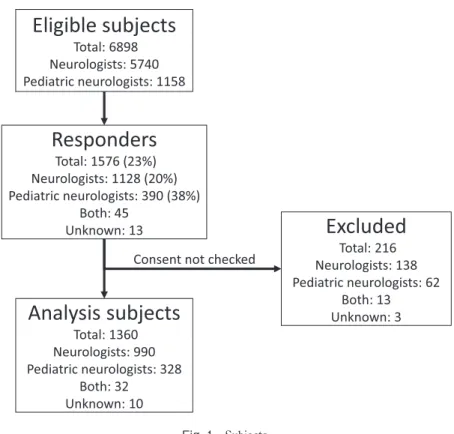
病院」および「総合病院」)(General Hospital; GH),国立病院 機構(National Hospital Organization; NHO),その他(「医院・ 診療所・クリニック」および「それ以外の機関」)の 3 群に, 診療患者数は 5 名以下(5 名以下)と 6 名以上(6 名以上)の 2群に,小児診療有無は 10 歳未満の診療患者有無に分けて検 討した. 本調査は独立行政法人国立病院機構刀根山病院(現独立行 政法人国立病院機構大阪刀根山医療センター)の臨床研究審 査委員会の承認(TNH-2018013; 2018 年 2 月 16 日)を得て実 施した. 結 果 アンケートの発送は 6,898 通(N 宛 5,740,CN 宛 1,158), 回収は 1,576 通(N: 1,128,CN: 390,両方 45,不明 13)だっ たが,216 通で同意設問にチェックが無く,解析対象は 1,360 通(N: 990, CN: 328,両方 32,不明 10)とした(Fig. 1). 回答者の医師経験年数は CN で長い傾向があり,診療経験 (診療中,経験有の和)は N 93%,CN 64%が有していた.診 療中医師の所属組織は,GH が約 2/3 を占め,CN でその他が, Nで NHO が高かったものの有意差は無かった.一方,診療 患者数は 2 名以下が多く,患者数 6 名以上の医師は N で 16%, CNでは 8%のみであった(Fig. 2).患者数 6 名以上の医師は NHOが 33%と GH(12%),その他(6%)より高かった. DM患者が受診したら自身で診療するかについて,診療中 医師は 89%が「診療する」と答えたが,「診療したことはな い」医師は 43%が「他の医師に紹介する」と回答した.経験 有医師で「他の医師に紹介する」と回答した割合は N で 14%, CNで 37%と差があり,特にその他の機関に勤務する CN で 46%と高かった. 利用頻度の高い情報源としては,「教科書」73%,「論文」 63%,「専門家の意見・講演・総説」51%,「インターネット」 42%の順であった. 本症の遺伝学的検索が保険適応であることは,診療中医師 の 83%が知っており,実施前の対応も「自身で遺伝学的検査 の有益性,問題点について検査前に説明している(自身で説 明)」74%と「臨床遺伝専門医または認定遺伝カウンセラーに よる遺伝カウンセリングを行っている」23%の合計は 97%と 高かった.一方,自身で説明している医師で文書による同意 取得を選択したのは 65%にとどまった.診療中医師におい て,挙児希望・出生前診断は「相談された経験が無い」が 49%を占めたが,小児診療有の医師(89 名)では 26%だっ Q20. Which of the following opinions is closest to your own regarding the treatment of cardiac conduction disorders/arrhythmia in patients with DM? A1: I consult with cardiovascular specialists if any conduction disorder/arrhythmia is found in ECG.
A2: I consult with cardiovascular specialists if high-risk conduction disorder/arrhythmia is found from ECG. A3: I consult with cardiovascular specialists if any conduction disorder/arrhythmia is found from Holter ECG. A4: I consult with cardiovascular specialists if high-risk conduction disorder/arrhythmia is found from Holter ECG. A5: I consult with cardiovascular specialists only if the patient has symptoms.
A6: I prescribe anti-arrhythmic drugs myself. A7: I do not treat conduction disorder/arrhythmia.
Q21. Which of the following opinions is closest to your own regarding tube feeding/gastrostomy? A1: I recommend gastrostomy to my patients at an early stage of disease.
A2: I recommend gastrostomy to my patients if swallowing dysfunction is found in any examination. A3: I recommend gastrostomy to my patients if symptoms are present.
A4: I recommend gastrostomy to my patients if the patient shows difficulty eating sufficient amounts of food and presents with malnutri-tion.
A5: I do not recommend gastrostomy. I recommend nasogastric tube placement.
A6: I recommend neither gastrostomy nor nasogastric tube placement. I generally continue oral feeding until the end stage of dysphagia. Q22. Do you have experience with treatment of glucose intolerance in patients with DM?
A1. I have no experience with treatment of glucose intolerance in patients with DM. A2: I have experience with treatment of glucose intolerance in patients with DM. Only for those respondents who chose A2 in Q22
Q23. What kinds of treatment do you use for glucose intolerance in patients with DM?
(Check “ ◎ ” for first-line treatment, “ 〇 ” for frequent treatment, “ △ ” for occasional treatment, and “ × ” for treatment not used.) A1: Sulfonylurea
A2: Glinide A3: Biguanide
A4: Dipeptidyl peptidase-4 inhibitor A5: Thiazoline derivative
A6: α-Glucosidase inhibitor
A7: Sodium-glucose cotransporter inhibitor A8: Insulin
A9: Diet A10: Exercise
Fig. 1 Subjects.
Among 1,576 responders, 216 subjects were excluded from analysis subset because they did not check consent.
Fig. 2 Profiles of subjects.
Abbreviations: yr: years, GH: general Hospital, NHO: National Hospital Organization. A. Job experience (Q4 of Table 1). B. Experience of medical management of patients with DM (Q6 of Table 1). C. Kind of Hospital (Q4 of Table 1). GH is sum of Academic medical center (A1) and Polyclinic hospital (A2). Others is sum of Medical clinic and other facility. D. Present number of patients with DM (Q7 of Table 1). Outer circles represent the data of Neurologists and inner circles depict the data of child neurologists. C, D reflect the data of specialists currently seeing DM patients.
た.相談経験の有る医師では「自身で遺伝相談に対応してい る」31%より,「臨床遺伝専門医または認定遺伝カウンセラー による遺伝カウンセリングを行っている」50%,「他施設に対 応を依頼している」35%が高かった. 症状・合併症について「非常に重要である」が 60%以上を 占めた項目は,「筋力低下・運動機能障害」,「心臓伝導障害・ 不整脈」,「心不全」,「嚥下障害」,「呼吸筋力低下・II 型呼吸 不全」で,35%未満の項目は,「筋緊張低下」,「筋強直現象」, 「睡眠時無呼吸・低酸素血症」,「耐糖能障害」,「脂質代謝異 常」,「内分泌異常」,「腫瘍」,「認知機能障害」,「知的・言語 発達遅延」,「発達障害」,「日中眠気」,「疲れやすさ・うつ」, 「眼科疾患」,「耳鼻科疾患」,「歯科疾患」だった(Fig. 3A). 患者数 6 名以上の医師は 5 名以下の医師に比べ,「発達障害」 (P = 0.001),「日中眠気」(P = 0.021)を重要とする割合が高 く,小児診療有の医師は,「筋緊張低下」(P = 0.015),「知 的・言語発達遅延(P = 0.003),「発達障害」(P = 0.003)を 重視し,「嚥下障害」(P = 0.036),「呼吸筋力低下・II 型呼吸 不全」(P = 0.041)への関心は低い傾向があった. 機能評価・検査の実施頻度は年 1 回以上(「少なくとも半 年おき」と「少なくとも年 1 回」の和)が 50%以上だった のは,「筋力・運動機能評価」,「12 誘導心電図」,血液検査 (CK,糖代謝,肝・胆道系機能,脂質代謝,心機能,腎機能, 内分泌)で,「定期的には実施しない」が 50%を超えたのは 「ホルター心電図」,「睡眠時呼吸検査」,「嚥下造影・内視鏡 検査」,「頭部画像検査」,「腹部画像検査」,「消化管検査」, 「眼科受診」,「聴力検査 / 耳鼻科受診」,「歯科受診」であった (Fig. 3B).患者数 6 名以上の医師は 5 名以下の医師に比べ,「ホ ルター心電図」(P = 0.027),「睡眠時呼吸検査」(P < 0.001), 「嚥下造影・内視鏡検査」(P = 0.006),「頭部画像検査」(P = 0.005),「胸部画像検査」(P = 0.003),「腹部画像検査」(P = 0.017)を年 1 回以上実施している割合が高かった. 実施・推奨しているリハビリテーション項目は「筋力増強 訓練」54%,「嚥下機能訓練」45%,「咳嗽訓練等の呼吸リハ ビリテーション」29%,「短下肢装具の使用」25%,「構音訓 練」24%の順であったが,「リハビリテーションは行っていな い,勧めていない」は N で 18%と CN の 8%より多かった. 勤務先では GH で全般的に実施・推奨率が低かった. 人工呼吸管理については,N では「検査上適応があれば NPPV導入を試みるが,患者からの要望が無ければ気管切開 は行わない(希望者のみ)」が 51%で,「人工呼吸管理は勧め ない,自覚症状が出れば酸素・緩和処置を勧める(緩和優 先)」,「呼吸不全に対する処置はしない(無処置)」も見られ たのに対し,CN は「検査上適応があれば非侵襲的陽圧換気 療法(non-invasive positive pressure ventilation; NPPV),気管 切開共に積極的に考慮する(積極的考慮)」,「検査上適応があ れば NPPV 導入を試み,NPPV が困難になれば気管切開も考 Fig. 3 Managements of multiorgan complications.
慮する(NIV 優先)」の和が過半数を占めた.(Fig. 4A).さら に,小児診療有の医師では,積極的考慮が 22%,NIV 優先が 43%,希望者のみが 32%で,緩和優先,無処置と答えた医師 は無かった.「NPPV の導入,管理を行った経験がある」は N の 方が CN より高いものの(Fig. 4B),NPPV 経験医師で「排痰 補助装置の導入,管理を行った経験がある」割合は CN の方が 高かった(Fig. 4C).また,患者数 6 名以上の医師では 5 名以 下の医師に比べて「DM 患者は他の神経筋疾患に比べて NPPV 導入・管理が困難である」とする割合が高かった(Fig. 4D). 施設別では,NHO は呼吸管理に積極的で,NPPV 導入・管理 経験や排痰補助装置の導入・管理経験も高いものの,困難感 も高かった(Fig. 5). 心伝導障害・不整脈治療では,CN で 12 誘導心電図および ホルター心電図で「伝導障害・不整脈等が確認されたら循環 器にコンサルトする」が 87%と高く(Fig. 6A),施設別では GHで早期にコンサルトする割合が高かった(P = 0.012). 胃瘻造設については,N・CN 共に「経口摂取困難・栄養障 害が顕在化したら胃瘻造設を勧める」が過半数だったが,N では「胃瘻造設は勧めない,原則として経口摂取のみを続け る」が 6%あった(Fig. 6B).施設別には,GH でより早期に 胃瘻造設を勧める割合が高かった(P = 0.001). 耐糖能障害治療は,N の約半数が実施しており(Fig. 7A), NHOでは58%と高かった.第一選択として最も頻度が高かっ たのは DPP4 阻害薬で,次いで食事療法であった.SU 製剤の 使用頻度は第一選択・日常的使用を合わせると,ビグアナイ ド系,α グルコシダーゼ阻害剤と同程度で,チアゾリン系, SGLT阻害剤,インスリンよりも高かった(Fig. 7B).施設別 では NHO でチアゾリン,α グルコシダーゼ阻害剤が高い傾 向があったが有意差は無く,NHO では運動療法が低かった (P = 0.017). 自由記載では,中枢神経障害による医療管理の困難さに関 するものが多く,多臓器障害や医療連携についての課題,小 児患者と成人患者の違い,ガイドラインや新規治療開発への 期待などがあった. 考 察 DMは筋ジストロフィーの中では最も有病率が多く,発症 年齢・重症度の幅が広く多臓器疾患の特徴を有す.以前,わ れわれは大阪府下の循環器,糖尿病,産婦人科,眼科専門医 に DM 診療実態調査を行い,DM 患者が合併症で多くの診療 科を受診していること,神経内科・小児神経科より先に他科 を受診する例が少なくないことを報告した5).今回の調査で は N,CN を対象としたが,診療経験率は N で 93.1%,CN で Fig. 4 Respiratory care in DM.
Abbreviations: NPPV: non-invasive positive pressure ventilation, MAC: mechanical assisted cough. A: Opinion of respiratory care (Q15 of Table 1). A1–6 reflect the answers of Q15 of Table 1. B: Experience of NPPV (Q16 of Table 1). C: Experience of MAC (Q18 of Table 1). A–C: Outer circles represent the data of Neurologists and inner circles depict the data of child neurologists. D: Difficulties of NPPV (Q17 of Table 1). Outer circle represents the data of specialists seeing 5 or less patients and inner circle depicts the data of specialists seeing 6 or more patients.
Fig. 5 Respiratory care in each kind of institutes.
A: Opinion of respiratory care (Q15 of Table 1). A1–6 reflect the answers of Q15 of Table 1. B: Experience of NPPV (Q16 of Table 1). C: Experience of MAC (Q18 of Table 1). D: Difficulties of NPPV (Q17 of Table 1). Outer circles represent the data of general hospitals, middle circles show the data of National Hospital Organization and inner circles depict the data of others.
Fig. 6 Cardiac and nutritional care in DM.
A: Opinion for treatment of conduction block/arrhythmia (Q19 of Table 1). A1–5 reflect the answers of Q19 of Table 1. B: Opinion for tube feeding (Q20 of Table 1). A1–6 reflect the answers of Q20 of Table 1. Outer circles represent the data of Neurologists and inner circles depict the data of child neurologists.
62.2%と高かった.診療中医師の所属機関は N・CN ともに GHが 2/3 程度を占め,DMD での同様の調査で N では NHO が 43%を占めたのと対照的であった6).これは,DM が多臓 器疾患であること,高度医療ケアを要す患者の割合が DMD ほど高くないことによると思われる.一般医療機関の受診が 多いため,診療患者数は 2 名以下が多く,十分な経験を得に くいことが推測された.DM 患者が来たら診療するかの設問 で,CN でその他に勤務する経験有医師に「他の医師に紹介 する」が高かったのは,周産期や乳幼児期の先天性患者への 対応に多くの場合集中治療設備が必要なことを反映したもの と推測する. 遺伝学的検索の保険適応認知度,検査前の説明実施率は高 かったが,文書同意取得は自身で説明を行っている医師の 65%にとどまった.本症は優性遺伝形式で他の家族員に及ぶ 影響も大きいことため適切な説明が不可欠で,文書による同 意取得も考慮すべきと思われる.一方,挙児希望・出生前診 断については,小児診療有の医師を除くと対応経験は少なく, 相談を受けた医師では遺伝専門家と他施設に対応を依頼して いる割合が 85%程度を占めており,より専門的な対応を選択 されていることが示された. 合併症への関心については,「筋力低下・運動機能障害」に 加え,「心伝導障害・不整脈」,「嚥下障害」,「呼吸筋力低下・ II型呼吸不全」への関心が高く,DM では合併率の低い「心 不全」も 60%以上が「非常に重要である」とした一方で,DM で早期から出現する「睡眠時無呼吸・低酸素血症」,患者から 愁訴の強い「日中眠気」や「疲れやすさ・うつ」7)について の関心は低く,DM の病態への理解が不十分と思われた.患 者の愁訴の強い症状への関心の低さは,医療コンプライアン ス低下の一因としても懸念される.検査の実施頻度では,予 約無しに実施可能な検査(「筋力・運動機能評価」,「12 誘導 心電図」,血液検査)の実施率が高く,予約や複数日を要する ことが多い「ホルター心電図」や「睡眠時呼吸検査」,「嚥下 造影・内視鏡検査」などは合併症への関心が高くても定期実 施率が低く,患者数 6 名以上の医師と 5 名以下の医師で差が 見られた.これには,診療経験が乏しい医師では多臓器障害 への関心が持ちにくい問題に加え,症状の自覚が乏しい患者 に定期的評価の必要性を理解させることの困難さが影響して いると推測された.全身合併症については関心・検査頻度と もに低かった.健診や他科で管理されている症例も少なくな いと思われるが,本症においては神経内科・小児神経科医が 全身合併症の適切な管理に誘導・調整することも重要な役割 と考える. DMでは,発症年齢によって重症度・合併症に幅があるが, 小児診療有の医師では,「筋緊張低下」や「知的・言語発達遅 延」,「発達障害」に対する関心が高く,臨床像の違いを反映 された結果となった.また,気管切開を含めた呼吸管理や排 痰補助装置導入,循環器へのコンサルトは CN が N より積極 的で,小児領域では積極的治療が望まれていることが示唆さ れた.一方,N では,呼吸管理や胃瘻造設,経管栄養に消極 的な意見も一定数見られた.NHO では呼吸ケアに積極的な反 面 NPPV 導入・管理の困難さを強く感じており,患者数 6 名 以上の医師で困難と感じている割合が高かった.成人患者で は自覚症状に乏しく治療の必要性を理解しない患者や治療を 中断する患者が少なくないことを反映したものと思われた. 心伝導障害・不整脈,低酸素血症,嚥下障害への適切な対応 は本症の生命予後改善にとって必須であるが,そのためには 医療者側だけでなく患者側の理解と協力が重要である. 耐糖能障害治療では,これまで α-グルコシダーゼ阻害剤や チアゾリン誘導体8),ビグアナイド9)などのエビデンスが示 されてきたが,今回の調査で最も使用頻度が高いのは DPP4 阻害薬で,市販後の期間は短いものの標準的治療として定着 していることが分かった.また,今回の選択肢には GLP-1 受 Fig. 7 Glucose intolerance.
A: Experience of treatment of glucose intolerance of DM (Q21 of Table 1). Outer circles represent the data of Neurologists and inner circles depict the data of child neurologists. B: Preference of each treatment (Q22 of Table 1).
容体作動薬が含まれていなかったが,これら新規治療薬の有 効性・安全性についてもエビデンスの構築が求められる. 循環器科へのコンサルト,胃瘻造設のタイミングは GH で 早い傾向があり,他施設への紹介に比べて自施設内でのコン サルトが容易なことを示唆した.一方,リハビリテーション については GH の実施・推奨率が低く急性期病院での慢性疾 患への対応困難さを示唆した.多様な問題を抱える本症の診 療においては,複数診療科・施設の連携を早期から構築する ことが重要である. 謝辞:本調査にご協力いただいた神経内科専門医,小児神経専門 医の皆様,専門医の名簿を提供いただいた日本神経学会,日本小児神 経学会に深謝します.本調査では,アンケート表紙に説明文と同意確 認項目を記載しましたが,チェックの無い回答が 216 通あり,解析対 象から除外せざるを得ませんでした.貴重な回答の全てを解析に用い られなかった点について陳謝します.なお,全回答による解析でも内 容には本質的な差違は無かったことを申し添えます.本研究は厚生労 働科学研究費補助金難治性疾患等政策研究事業「筋ジストロフィーの 標準的医療普及ための調査研究」(H28- 難治等(難)- 一般 -030) (H30-難治等(難)- 一般 -005)によって実施しました. ※著者全員に本論文に関連し,開示すべき COI 状態にある企業, 組織,団体はいずれも有りません. 文 献
1) Harper PS, van Engelen B, Eymard B, et al. editors. Myotonic dystrophy—present management future therapy—. New York: Oxford University Press; 2004.
2) Takahashi MP, Matsumura T, editors. Myotonic dystrophy —disease mechanism, current management and therapeutic development—. Singapore: Springer; 2018.
3) Ashizawa T, Gagnon C, Groh WJ, et al. Consensus-based care recommendations for adults with myotonic dystrophy type 1. Neurol Clin Pract 2018;8:507-520.
4) 松村 剛,齊藤利雄,藤村晴俊ら.Duchenne muscular dystrophy 患者の経時的死因分析.臨床神経 2011;51:743-750.
5) 松村 剛,木村 卓,穀内洋介ら.大阪府下筋強直性ジスト ロフィー患者の受療動向調査.臨床神経 2011;51:677-682. 6) 松村 剛,小牧宏文,川井 充.本邦におけるデュシェンヌ
型筋ジストロフィーの診療実態.臨床神経 2015;55:637-645. 7) Heatwole C, Bode R, Johnson N, et al. Patient-reported impact
of symptoms in myotonic dystrophy type 1 (PRISM-1). Neurology 2012;79:348-357. 8) 山本敏之,大矢 寧,礒部建夫ら.Pioglitazone 長期投与に よる筋強直性ジストロフィーの糖尿病治療.臨床神経 2005; 45:287-292. 9) 髙田博仁,小山慶信,今 清覚ら.筋強直性ジストロフィー type 1における耐糖能障害.臨床神経 2012;52:1259-1260. Abstract
Study of medical practices for patients with myotonic dystrophy in Japan
—Nationwide specialist survey
Tsuyoshi Matsumura, M.D., Ph.D.
1), Hiroto Takada, M.D., Ph.D.
2), Keiko Ishigaki, M.D., Ph.D.
3),
Hirofumi Komaki, M.D., Ph.D.
4)and Masanori P. Takahashi, M.D., Ph.D.
5)1)Department of Neurology, National Hospital Organization Osaka Toneyama Medical Center 2)Department of Neurology, National Hospital Organization Aomori National Hospital
3)Department of Pediatrics, Tokyo Woman’s Medical University Hospital 4)Translational Medical Center, National Center of Neurology and Psychiatry 5)Division of Health Science, Osaka University Graduate School of Medicine