Society of Japan
Vol. 20, No. I, March, 1977
ON THE COMPUTATIONAL EFFICIENCY
OF BRANCH-AND-BOUND ALGORITHMS
TOSHIHIDE IBARAKI, Kyoto University
(Received June 4, 1976; Revised September 16, 1976)
Abstract. The behavior of the number of partial problems T(A) which are decomposed in a branch-and-bound algorithm A (T(A) may be taken as a measure for the computational efficiency of A) is investigated in a fairly general setting. The first result is that the mean number f(n) of T(A) when A is applied to problems of size n grows at least as fast as exponentially with n, under relatively mild conditions, if A uses only the lower bound test as most of the conventional branch-and-bound algorithms do. Then it is pointed out that a possible way to avoid this exponential growth is to use the dominance test together with the lower bound test. The dominance test is also interesting from the view point of unifying a wide variety of algorithms as branch-and-bound.
These points are exemplified by the well known Dijkstra algorithm for the shortest path problem and the Johnson algorithm for the two-machine flow-shop scheduling problem, for which f(n)
:s:
n-1 holds by virtue of the dominance test.1.
Introduction
Branch-and-bound is a computational principle used to solve various com-binatorial optimization problems, in particular those which are not so nicely structured as to permit very efficient algorithms. For many "difficult" problems, such as the integer programming problem, the traveling salesman problem and various scheduling problems, branch-and-bound is reportedly the only practical approach.
As is well known, e.g. [1, 10, 11, 21, 23, 25, 27}, the underlying idea of branch-and-bound is to decompose a given minimization problem
Po
into more than one partial problem of smaller size. The decomposition is repeatedly applied to the generated partial problems until each undecomposed one is either solved or proved not to yield an optimal solution of PO' Fortheo-Branch-and-Bound Algorithms 17 retical simplicity, the computational efficiency of a branch-and-bound algo-rithm A is commonly measured by the numbe-r T(A) of partial problems which are decomposed in the entire computation (e.g., [14,21,27,28]). This measure is also adopted in this paper. The actual time required to carry out the entire computation of A is roughly given by T(A)·t, where t is the average time required to solve a partial problem. Thus, though smaller T(A) does not always imply shorter computation time (since
t
may increase when we make TeA) small), T(A) conveys essential information on the total computation time. For example, if T(A) grows exponentially with the size n of given problems, the total computation time also increases at J_east exponentially as a function of n (under a quite reasonable assumption thatt
is a nondecreasing function of n) .In order to make T(A) small, i t is crucial how to test given partial problems and, if possible, to conclude the impossibility of yielding an opti-mal solution of PO' Two types of tests, the lower bound test (e.g., [1, 23,
25, 27]) and the dominance test (e.g., [21,15]), are known. The first one is most common and is done by calculating a lower bound g(Pi) of the optimal value
f(P
i
)
of a partial problemPi;
if q (P.) > 2, where 2 is the value of the'0
1--best feasible solution of
Po
obtained so far, we conclude thatPi
does not provide an optimal solution ofPo
andPi
is terminated (excluded from con-sideration). The second one is based on a binary relationD,
called a domi-nance relation, such thatP.DP.
impliesf(P.) <f(P.);
thusP
J' is terminated
1-- J 1-- J
if some p. satisfying
P.DP.
has already been generated. Most of the current1-- 1-- J
branch-and-bound algorithms are using only the lower bound test, but there is a tendency of the increasing use of the dominance test (e.g.,[IS, 16, 22, 29]).
[15] contains additional references discussing practical uses of dominance relations.
In spite of the considerable success of branch-and-bound algorithms, it is empirically known that T(A) usually increases exponentially with the size of the given problem. In some cases, this is mathematically proved (e.g.,[l7l, Section 3.11 of [27]). The first purpose of this paper is to show the expo-nential growth of T(A), when only the lower bound test is used, in a rather general mathematical setting if certain assumptions are satisfied. It says that T(n), the expected value of T(A) when A is applied to a set of problems with size
n,
grows at least as fast as exponentially withn.
To obtain this result, only a mild assumption is made on branch-and-bound algorithmA
and problems to be solved. The assumption states, loosely speaking, that a branch-and-bound algorithm with the lower bound test only cannot avoid its,
exponential growth of
T(A)
unless either given problems are so simple as to generate the number of partial problems less than exponential even if all possible decompositions are performed, or an exceptionally accurate lower bounding function g is available such that g(Pi ) is very close to f(Pi ) for all partial problemsPi
but for a small number of exceptions. In some cases, the exponential growth ofT(n)
can actually be proved from the above result. Section 4 contains such examples.Note here that the branch-and-bound principle is general enough to accept the problems which are known to be NP-complete or more difficult. (According to Cook [4] and Karp [19], the NP-completeness is considered as strong evi-dence for the nonexistence of a polynomial time algorithm.) Therefore it is unreasonable to expect that
T(A)
of any branch-and-bound algorithm can be made to grow less than exponentially by means of a lower bounding function g which is easily calculated (say, in time bounded by a polynomial of size n). The above result, however, is stronger in thatT(A)
grows exponentially even for those problems much easier than NP-complete, and in that the expected value ofT(A)
grows exponentially with n as opposed to the worst case result consideredin the discussion of NP-eompleteness. This may suggest that branch-and-bound with only the lower bound test is not powerful enough to exploit all aspects of the problem structure useful to improve the computational efficiency.
It is then shown in the latter half of this paper that a possible way to overcome this difficulty is to use an appropriate dominance test. Under cer-tain assumptions, a dominance relation D can restrict the set of partial prob-lems, which are possibly decomposed, from J) (the set of all possible partial problems) to J)D always satisfying J) D c;D, where Jl D is determined independ-ently of lower bounding function
g.
Thus D has an effect of reducing the size of the set of partial problems which undergo the lower bound test. In particular, i f the size of ,p D grows less than exponentially, so does theT(A)
of the resulting algorithm.As such examples, the well known Dijkstra algorithm [5] for the shortest path problem and the Johnson algorithm l18] for the two-machine flow-shop scheduling problem are analyzed and shown that T(n)~n-l, while
T(A)
grows exponentially without the dominance test (under certain assumptions). It may also be interesting to see the fact itself that the Dijkstra algorithm and the Johnson algorithm can be viewed as braneh-and-bound algorithms. This may exhibit another aspect of the power of the dominance test; it helps US unify a wide variety of algorithms under the name of branch-and-bound. Thus it is the second purpose of this paper to show theoretically (and at the same timeBranch·and·Bound Algorithms 19
tutorially) that the dominance test is a quite natural and powerful tool which improves the computational efficiency for most of the existing branch-and-bound algorithms.
2. Branch-and-Bound Algorithm
This section gives a formal description of a branch-and-bound algorithm to solve a minimization problem PO' The TIlotivation for various concepts in-troduced in this section and the validity of the resulting algorithm may be found in papers such as [1, 10, 11, 14, 15, 21, 23, 25, 27].
The way in which the original problem Po and generated partial problems are decomposed into smaller partial problE,ms is represented by a finite root-ed tree J') =( Jl, e;), where Jl is a set of nodes and e; is a set of arcs. The root of J') is denoted by Po and corresponds to the given problem PO' (P., P.)
'Z- J
Ee;, Le., P. is a son of P., if P. is generated from P,; by decomposition.
J 'Z- J ~
The set of bottom (leaf) nodes J represents the partial problems which can be
trivially solved. The depth of a node Pi is the length of the path from Po to P .•
'/, The height of J') is the maximum depth of nodes in p , and is identified with the size of problem PO'
Let O(P
i ) and f(Pi) be the set of optimal solutions of Pi and the opti.mal value, respectively. 0 and
f
satisfyf(P.) =min{f(P. )
l.j=l,
2, ... , k} '/, '/,. J (2.1) O(P.)=u{O(P.) If(P.)=f(P.), j=l, '/, '/,. 'Z- '/,. 2, ... , k}, J Jif P. has sons p. , P. , ..• , P" (2.1) implies f(P.)$f(P.) for a son P. of
'/, -"I '/,2 '/,k '/, J J
Pi' (J'), 0, f) is called the branching st'l'ucture of PO' Our objective is to obtain O(P 0) and f(P 0)' without really generating all PiE Jl .
Note that f(P
i ) is usually not known but a lower bound g(Pi ) of f(Pi ) is actually calculated for each generated node Pi; g satisfies the following con-ditions. (a) g(Pi)$f(P i ) for PiE Jl , (b) g(Pi)=f(P i ) for PiE J , (c) g(Pi)$iJ(P j) if Pj is a son of Pi'
9
denotes the set of nodes Pi for which j'(Pi ) is obtained or O(Pi)nO(PO)=~ is concluded in the computing process of
g.
Then it satisfies(A)t g(P·)=f(P.) for P.E
C;,
1.- 1.-
1.-(B)
C;
:J J ,(C) PiE c; implies P.E
c;,
if P. is aJ J
At each stage of computation, a node in son of
p is
P ..
1.-called active if it has already been generated but neither decomposed nor terminated (i.e., solved or concluded not to yield an optimal solution of PO) by test. Given a set of active nodes A , a search function s selects a node s (A) from A. S is a
breadth-first search funetion i f s CA) has the minimum depth among the nodes in
A. I t is a depth-first search function if s (A) has the maximum depth. s is called a heuristic search function based on h: f l ~E (reals) and is denoted by
sh' if sh(A) is the node in A with the smallest h value (e.g., [11,14,27, 28]). To preclude the case of tie, it is assumed that
(2.2) h(P .)"ih(P.) for P ."iP.E P .
1.- J 1.- J
I f h is set equal to g, a is called a best-bound search function.
g
Now we present a formal description of a branch-and-bound algorithm A,
which uses only the lower bound test; algorithm using the dominance test will be discussed in Section 5. It obtains all optimal solutions, i.e., O(P
o) ,
upon termination. When only a single optimal solution is sought, it can be slightly modified to improve the computational efficiency (e.g., [14J). All the results in this paper, however, can be extended with minor modification.Branch-and-Bound Algorithm
A=«...a,
0, f), (C;, g), s).Remark. 0 denotes the set of the best feasible solutions of
Po
current-ly available, and is called the incumbent. z denotes its value. It is as-sumed that O(Pi ) is obtained as a by-product of computation of g(Pi ) if PiE~.
t
AI (Initialize)tt A -<-{PO}' Z+<x>, 0 -<-<I>(empty).
A2 (Search): I f A =<1>, go to A7; otherwise let P .-<-8 (A) and go to A3.
1.-A3 (Test): I f P.E .9 go to AS; otherwise go to A6 if g(P.»z, and go to
1.-
1.-When P. E .(; holds because 0 (P.) nO (PO) =<1> is concluded, g (P.) =f(P.) may not
" . 1.- • 1.-
1.-be satisfied or g(P
i ) may not be computed. Even in this case, we assume
for simplicity that condition (A) holds, since the value g(P
i ) is not
relevant to the computation process.
Branch-and-Bound Algorithms 21
A4 (Decompose): Generate sons
P. , E'. , ••• ,
p. of p". Return to A2 1-1 1-2 1-k vafter letting A -<-AU{P. ,P. , ••• , P- }-{P.}.
1-1 ~2 1-k
1-A5 (Improve): Go to A6 after letting
o
i f z<f(Pi
)
(=g(Pi
))
o
uO(Pi
)
if z=f(Pi
)
O(Pi
)
if z>f(Pi
)
z -<- min[z, f(Pi
)].
A6 (Terminate P.): Return to A2 after letting A-<-A-{P.}.
1-
1-A7 (Halt): Halt. O(P
O)= 0 and f(PO)=z; Po is infeasible (and O(PO)=~)
if z=oo.
Note that only a small portion of ~ is actually generated in most branch-and-bound algorithms. As was noted in Section 1, the computational efficiency of
A
is closely related to the number of nodes actually generated, which is measured byT(A): the total number of nodes which are decomposed in A4 until the computation halts in A7.
3.
A Lower Bound for T(A)
The next theorem gives a lower bound of T(A) which is valid for any branch-and-bound algorithm A.
Theorem 3.1.
Let A=( (A,0,
f), (C;, g), s) be a branch-and-bound algo-rithm. Then T(A)~I:7-C:I,
where :7={P.E ~I
g(P.)Oof(PO)} and1·1
denotes1-
1.-the cardina1ity of 1.-the set 1.-therein.
Proof:
Whenever a node P. E :7 - C; is tested in A3, it goes to A4 and P.1.-
1.-is decomposed since P ./.(" and g (P.) 'Sf(PO) OoZ always holds. Furthermore each
1.-
1.-ancestor P
k of Pi satisfies Pk/. C,." (by condition (C) of 9') and g(Pk)Oog(Pi )
(by condition (c) of g)'Sz, and P
k is also decomposed. Thus Pi is eventually
generated and tested; it is then decomposed in A4.
0
4.
Exponential Growth of T(A)
In this section, we ana1yze a probabi1istic behavior of a branch-and-bound algorithm and show evidence for the exponential growth of T(A) with the size of given problem PO'
Consider a class of problems which contains a number of (possibly infi-nite) problems with size
n
for each positive integern.
It is assumed that all problems with sizen
has the same tree ~en)
representing their decompo-sition processes. (If nE~cessary, preclude the problems with different ~ (n).) For example, the size of an integer programming problems with n 0-1 variables is n, and an infinite number of problems with size n can be generated by spec-ifying coefficients in the objective function and constraints. ~en)
in this case is a {2, n)-tree, i.e., each node in depths 0, 1, 2, ... ,n-l
has two sons and all nodes in depth n are bottom nodes. (This assumes a common decompo-sition schemet such that a partial problem is decomposed into two by fixing one variable to 0 and 1.)It is also assumed that each ~
en)
has an independent set tt of nodes{Pi
I
iEI{n)}c,~- .7 , wherer(n)=II(n)
I
satisfiesr{n»clk
l
n
for somecl,kl>O.
This condition is satisfied in most cases encountered in practical application. In the above (2, n)-tree of the integer programmi~ problem, r{n)=(~)2n holds for the set of all nodes in depth
n-l,
and r{n)=2laJ
holds for the set of all nodes in depth L~J, where a>O is a constant.For simplicity, we use the convention
f.=f{P.)
andg.=g{P.)
foriEI{n).
~ ~ ~ ~
By definition of
f
andg,
(4.l)
t
tt
Generally speaking, partial problems which are generated from different integer programming problems
Po
but correspond to the same node in the branching structureJ>{n)
may fix different variables to 0 and 1. Thus the partial problems corresponding to the same node are not the same in the sense that sets of fixed variables are different for different integer programming pr.oblemsPO'
Even in this case, however, we can say that all problemsPo
withn
variables have the same branching structure J}en)
which is the {2, n)-tree, and the following discussion can include this general decomposition scheme as will be easily confirmed. For some branching structures such as those discussed in Examples 4.1 and 4.2, this consider-ation is unnecessary since all partial problems corresponding to the same node have exactly the same set of fixed variables.Pi' Pj'c
fl areindependent
if neither is a proper descendant of the other.Branch-and-Bound A igori thms 23
hold_ No restriction is however a priori assumed on the relative values of
fi
and
fj
(orgi
andgj)
fori,jEI(n),
sincePi
andPj
are independent (cf. (Z.l)and condition (c) of g).
When we want to investigate the behavior of a branch-and-bound algorithm for a class of problems, as a whole, it would be natural to regard
fi
andgi
as random variables satisfying condition' (4.1)/ and having a probability densi-ty function
p(fa, fl'
f
Z' · · · 'fp(n)'
gl' :12\, ... ,gp(n»
which is specific to the given class of problems. To keep the ~odel as general as possible, we accept any probability density function provided that the marginal density functiont(4.Z)
exists for each
iEI(n) ,
and furthermore(4.3)
holds for some constant
£>a
(independent ofn)
and for alliEI'(n),
whereI'(n)cI(n)
and p'(n)=II'(n)
I satisfies(4.4)
T"(n»ck
-- Z Zn
for some cZ'
kZ>a.
Assumption (4.3) would need a justification. It says that
gi
has a posi-tive probability £ of being not greater thanfa(=f(P
a
»
when all problemswith size
n
are taken into account, for1:
in a nontrivial subsetI' (n)
ofI(n).
In other words, the magnitude of underestimation by lower bounding function
g,
i.e.,
fi-g
i
,
can be greater than the deviation offi
fromfa'
i.e.,fi-f
a
,
with a positive probability £. This may be quite natural since the class of problems under consideration would include those problems for which a partial problem
Po, iEI'(n),
is difficult and the underestimation byg
becomesrela-
1.-tively large. (See also the discussion in Examples 4.1 and 4.Z.)
Now let
T(n)
denote the mean ofT(A)
when a branch-and-bound algorithmA
is applied to all problems with size n in the given class. By the above as-sumptions,
T(n)
satisfiest
fi' gi
are assumed continuous. Iffi'
gi
are discrete, the following~
I-
'l-E. I'( n )E=r'(n)Eproving the next theorem.
(by Theorem 3.1)
(by (4.3))
(by (4.4))
Theorem 4.1.
The mean number T(n) of partial problems which are decom-posed in a branch-and-bound algorithm A applied to a class of problems B, whereA
andB
satisfy all the assumptions mentioned above, grows at least as fast as exponentially with the problem size n.This theorem says that the exponential growth of T(n) is inevitable un-less either the class of problems under consideration has a very narrow ~ (n) such that all independent sets of nodes have the cardinality less than ex-ponential, or an exceptionally good lower bounding function g is available for which (4.3) and (4.4) do not hold. Thus we should anticipate the exponential growth of T(n) for almost all branch-and-bound algorithms using the lower bound test only, as far as a class of problems having a nontrivial complexity is concerned.
At this point, it should be noted that the implication of Theorem 4.1 is primarily theoretical since P(gi) of (4.2) is usually not known for a given particular class of problems. In some cases, however, the assumptions in Theorem 4.1 can be actually checked, as in the following examples.
Finally, we should be careful enough not to conclude from the above dis-cussion that branch-and-bound algorithms are always useless. Even if T(n) grows exponentially, it may be possible to slow down its growth rate to a de-gree with which problems of meaningful sizes may be solved in practical com-putation time. Some examples of such practical branch-and-bound algorithms may be those currently used for the integer programming problem (e.g., [8, 9]) and the traveling salesman problem (e.g., [2, 13]), which are known to be NP-complete and hence believed to require exponential computation time by any algorithm whatever.
Example 4.1.
Let N be a complete graph with n nodes 1, 2, ... , n and dis-tance matrix [c .. ], where c . • >0 (possibly (0) is the length of arc (i, j), for'l-J 'l-J
lsi, jsn. The shortest path problem asks to find all paths from node 1 to node n having the minimum length.
Now let E={l, 2, ... , n} be the set of decisions, where i is the decision to make node i the next node to visit. Thus a sequence of dicisions (called
Branch-and-Bound A 19ori thms 25
a
policy) x=i
1
i
2- __i
k represents path1->-i
1
-+i
2-+ ... -+i
k• E* denotes the set of policies generated by L. In particular EEL* denotes the null policy. For each XEL'o" letP(x)
be the partial problem to find the set of shortest pathsO(P(x))
to node n with its initial portion restricted to bex;
notes their length.
P(E)(=P
O
)
stands for the original problem.be decomposed into n partial problems P(;rl),
P(x2), ... ,
P(xn).f(P(x))
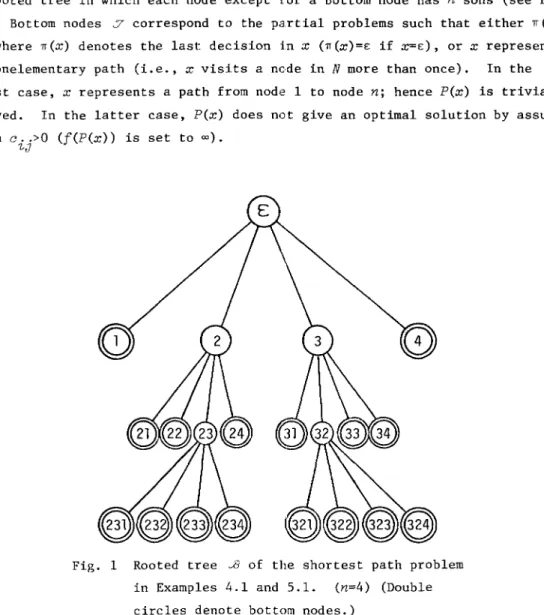
de-Each
P(x)
may Thus J3 (n) is a rooted tree in which each node except for a bottom node has n sons (see Fig. 1). Bottom nodes J correspond to the partial problems such that either 1T(x)=
n,
where 1T(X) denotes the last decision inx
(1T(X)=E if X=E), orx
represents a nonelementary path (Le., x visits a node in N more than once). In the first case,x
represents a path from node 1 to node n; henceP(x)
is trivially solved. In the latter case,P(x)
does not give an optimal solution by assump-tion c _ _ >0(f(P(x))
is set to 00).1-J
Fig. 1 Rooted tree J3 of the shortest path problem in Examples 4_1 and 5.1.
(n=4)
(Double circles denote bottom nodes.)For this branching structure (J3 (n), 0, 1), (5: , g) may be defined as follows.
(4.5)
g(P(x) )=
100
if P(X)E Jand x represents a nonelementary path,l cl' +C. .
+ ...
+c. . for x=ili? ... ik ,
otherwise.~l ~1~2 ~k-l~k
-It is not difficult to see that these::; ,
g
satisfy all the conditions given in Section 2. Thus these give rise to a branch-and-bound algorithm A=«~(n),0,
n,
(9,
g), s) for the shortest path problem.To analyze the behavior of A, consider a special graph structure: N is the n'-stage graph with the start node in stage 0, m nodes in each of the stages 1, 2, ... , n'-l, and the terminal node in stage n~ N has n=mn~m+2 nodes. An arc exists from each node in stage i to any node in stage i+l, for i=O, 1,
... , n'-l. The length of each arc is determined as a random number taken
in-dependently from the same probability density function
q(x)
defined over [1,00).q(x)
can be arbitrary as far as the useal assumptions to guarantee the centrallimit theorem are satisfied. In particular, its mean exists and is denoted a
(~l). Since each arc has length not smaller than 1, the length of the
short-est path in this graph is at least
n'.
It is now easy to see that each partial problem, which is not a bottom node, has exactly m sons with finite g-values (of course, only nodes with
fi-n
'J
nite g-values can lead to a shortest path). Thus exactly
mla
partial prob-. n'lems with finite g-values exist in depth L
a
~ of the branching structure. LetI(n)=I'(n) denote the set of their indices. Then g(Pi ) of Pi' iEI(n), is the length of a path consisting of
~'
arcs (i.e., the sum of lengths ofl~'J
arcs). By the central limit theorem, therefore,,
g(P.) is normallydistrib-~
uted around its mean al~
1
(sn') if n' is sufficiently large. Thus theproba-La
bility that g(Pi ) is not greater than the length of the shortest path (?n') is at least E=1/2 (>0).
Consequently the above model satisfies all the assumptions of Theorem 4.1 and hence T(n) grows at least as fast as exponentially with n' (i.e., n). Thus a branch-and-bound approach with lower bounding function (4.5) only is not competitive with other existing algorithms (e.g., [6]) which can obtain the shortest paths in polynomial time. By incorporating a dominance relation, however, the above branch-and-bound algorithm can be improved to a polynimial time algorithm, as shown in the subsequent sections.
Example 4.2.
Consider the flow-shop scheduling problem with n jobs and m machines [3]. Each job j (lsjsn) is processed on machines 1, 2, ... , m in this order. The processing time of job j on machine i is Pji (?O). \fuen onlyper-Branch-and-Bound Algorithms 27
mutation schedules are permitted (i.e., all machines process jobs in the same order), find an optimal schedule (Le., an order of n jobs on machines) which minimizes the maximum completion time (makespan) on machine
m.
An obvious branching scheme for this problem is to decompose a partial problem in depth
k
(~n), given a subschedule for initialk
jobs, into(n-k)
partial problems by fixing the (k+l)st jab from the remaining
(n-k)
jobs. In this scheme, a partial problem in depthk
is decomposed inton-k
sons. The resulting branching structure is similar to Fig. I (except that no job appears more than once in a subschedule defining a partial problem). All partial problems in depthn-l
belong to J" since the n-th job is then automatically determined. Fc;>r partial problemP,
letJ(P)
denote the set of fixed jobs,and
t .(P)
denote the completion time of job j(EJ(P»
on machinem
when jobsJ
in
J(P)
are processed in the order specified byP.
It is then obvious that(4.6)
satisfies all the conditions of a lower bounding function given in Section 2. The resulting branch-and-bound algorithnl
A,
however, satisfies all the assump-tions of Theorem 4.1 in certain cases as given below, and its T(~) must have an exponential growth.Now assume that processing times
Poi
are independently determined from au
probability density function
q(x)
which is defined over [0, 00) and has meana
(~O). The minimum of the maximum completion time on machine m,
t
m, obviously satisfiesBy the central limit theorem, again, t is normally distributed around its mean
a(n-IJ(P)
I)
ifn
is sufficiently large. Next, for partial problemsP
withn
depth
m+l
(its index set is denotedI(n)=I'(n»,
it is obvious that mU(P)~
L L
p--(=t')i=l jEJ(P)
J1.-n holds, and
t'
is also normally distributed around its meanmaIJ(P) I=ma
bym+l
the central limit theorem. Since (1)
mean(t)=a(n-IJ(P) I)=a(n-
n
)~amn ~ma ~ =mean(t')"1+1
m+l
m+l
holds for
IJ(p)
1= m~l'
and (2)t
andt'
are independent random variables, the probability of g(P)S~ is at least E=1/2. Consequently, in this case, all the assumptions of Theorem 4.1 are satisfied.func-tion (4.6) would not be efficient enough to solve large problems. When m is restricted to 2, however, a powerful method is known to improve its efficiency. It will be discussed as Example 6.2.
5.
Dominance Test
As mentioned in Section 1, the dominance test, which may be regarded as a generalization of the lower bound test, is sometimes incorporated in A3 (Test) of a branch-and-bound algorithm. It is based on a
dominance relation
tD
which is apartial ordering
on ~D satisfying(i)
PjDP
k
APjf P
k
implyf(Pj
> <f(P
k
) ,
(ii)
PjDP
k
APj fPk
imply that for each descendantP
k
,
ofP
k
,
thereex-ists a descendant
P.,
ofP.
such thatP.,DP
k,.J J J
By condition (i), we conclude that P
k does not provide an optimal solution of
Po
ifPj
satisfyingPjDP
k
has already been generated. As a result, A3 may be modified as follows.Modified A3
(Test)tt: Go to AS ifP
i
E9,
and go to A6 ifg(Pi»z
holdsor P
.DP.
holds for some P.(fp.)
E JV. Otherwise go to A4. (JV denotes the setJ '& ~ J
of nodes currently generated, i.e., those which are active, terminated or de-composed.)
A branch-and-bound algorithm with this modified A3 is denoted A=«~,
0,
f),(9,
g), D, s).A primal motivation of introducing a dominance relation is to improve the computational efficiency by terminating a larger number of partial problems. This point will be further discussed in the next section. It is also inter-esting, however, to see that almost all algorithms of combinatorial optimiza-tion problems based on dynamic programming can be viewed as branch-and-bound using a dominance relation. (This point was first noticed by Kohler [20] and
t This definition is for the case in which all optimal solutions of
Po
is sought. For the case of seeking a single optimal solution, it should be slightly modified [15] but the following argument also holds true without any essential change.tt
P.
is saidterminated
in A3 i f one of the conditionsP.E
9,
g(P.)
>z and'& '& '&
P.DP.
holds.Branch-and-Bound Algorithms 29
the dynamic programming approach to the traveling salesman problem [12] was formulated as a branch-and-bound algorithm using a dominance relation. Morin and Marsten [26], on the other hand, attempt to improve the dynamic programm-ing computation by usprogramm-ing a method based on the lower bound test of branch-and-bound algorithms.) A dominance relation thus adds another dimension of flex-ibility both in designing efficient braneh-and-bound algorithms and in unify-ing a wide variety of algorithms under the name of branch-and-bound.
As such. an example, we consider here the well known Dijkstra algorithm for the shortest path problem which apparently has never been considered as branch-and-bound. (For the description of the Dijkstra algorithm, see [5,6].)
Example 5!1.
Consider the branch-and-bound algorithmA
discussed in Example 4.1 to obtain the shortest paths in a given complete graph with posi-tive arc lengths. In addition to the 10IVer bounding function g of (4.5), introduce a dominance relationD
defined by(5.1)
P (x) DP (y)
~[
71(x)
=71(y)
andg (P (x) ) <g (P (y) ) ] .
*
This
D
satisfies condition (i) sinceg (P(x)) <g (P(x))
~ (\i' WE l: )(g (P(m)) <g (P
(yw))) '9f(x)<f(y).
Condition (ii) is also satisfied sinceP(x)DP(y)
~(\i'WE*
l:
)(p(m)DP(yw)),
as is easily proved.From these, we can now construct a branch-and-bound algorithm A=«~(n),
0, f),
Cc;:· ,
g), D, Sg)'
whereSg
is the best-bound search function mentionedin Section 2. A begins with decomposing
peEl
intoP(l), P(2), ... , Pen).
Dur-ing computation, only a partial problemP(x)
satisfying(5.2)
g(P(x))'Sg(P(y))
for a11P(Y)E
JJ satisfying7I(y)=7I(x)
can be decomposed, and the sequence of the decomposed partial problems P(;c l),
P(x
2
),···, P(x
r
)
satisfiesby virtue of D and best-bound search. As a characteristic of best-bound search, the first partial problem
P(x)
tested in A3 satisfyingP(x)e
~ and7I(x)=n
gives an optimal solution, andz
is immediately set tof(P(x))
(=thelength of the shortest path) from ro After then, no partial problem is
de-composed in A4 (since
z'Sg(P(x'))
for all the remaining partial problemsP(x')),
and A7 (Halt) is eventually reached_
It is now easy to see that A is essentially the same as the Dijkstra algorithm. (Although the Dijkstra algor:lthm is usually given in the form of obtaining a single optimal solution, the above algorithm obtai'ls all optimal
solutions. It can be easily modified to an algorithm for obtaining a single optimal solution.)
6. Upper Bound for T(A)
An upper bound for T(A) derivable from a dominance relation D is given in this section. This bound is sometimes useful to find a class of problems for which a branch-and-bound is particularly efficient, e.g., the shortest path problem of Example 5.1.
Let A=«....a, 0, f), (~;', g), D, sh) be a branch-and-bound algorithm with a heuristic search function (see Section 2). Heuristic search is adopted here since it includes most of the known search strategies, such as breadth-first search, depth-first search and best-bound search, as special cases [14). D is said consistent with h if P.DP. implies h(Pk)<h(P.) for any proper ancestor Pk
1- J J
of
P..
By definition of heuristic search, this implies that no proper ances-1-tor of Pi is active when F'j is selected (Le., Pi has already been generated or a proper ancestor of Pi has been terminated). Next, D is consistent with g
i f P.DP. implies g(P.)<g(P.). (This notion was first introduced in [21).)
1- J 1- J
The above two types of consistency assumptions are in fact satisfied by many dominance relations proposed in the literature. For example, the domi-nance relation used in [16, 22) for the two-machine flow-shop scheduling prob-lem to minimize mean flow time (instead of makespan), and the one used in [29] for the one-machine scheduling problem with deadlines are consistent with g
and
h,
where heuristic search function sh in these algorithms represents breadth-first search.Lemma 6.1.
D is consistent with a heuristic function h in each of the following cases.(a)t h(Pk)<h(Pn ) i f Pn is a son of Pk,and P.DP.I\P.I-P. implies h(P.)<h(P.).
iC iC 1 - J 1 - J 1- J
(b) h=g (i.e., best-bound search) and
D
is consistent with g.(c) sh is a breadth-first search function, and D satisfies that P.DP. 1- J
can hold only if P. and p. are in the same depth.
1- J
Now recall that D is a partial ordering on p P.E J> is minimal with J
respect to D if no P.I-P.E ~D satisfies P.DP.. The set of minimal nodes is
de-1-J 1-,7
noted byp D'
Branch-and-Boumi Algorithms 31
Lemma 6.2. For a branch-and-bound a.lgorithm A= «...E, 0, f),
(9.
g), D,sh)'
assume thatD
is consistent with bothg
andh.
Then anyPjE
JD decomposedin
A
is minimal with respect toD.
Proof: Assume that
P.DP.
andP.jP..
SinceD
is consistent withh, 1).
'l.-J 'l.-J
'I.-has already been generated (Le.,
PiE
JI') or ancestorP
k
ofPi
has beentermi-nated when
P
j is selected. In the first case,P
j is terminated in A3 by the dominance test. Thus consider the second case; three cases are possible.(a)
Pk
has been terminated in A3 byPkE
9.
Thenz(Pj )$z(Pk )$f(Pk )5f(Pi )
sinceP.
is selected afterP
k
'
wherez(P,.)
is the incumbent value whenP.
isJ d J
selected. Furthermore note that
f(Pi)=g(P
i
)
(sincePiE
9
by condition CC) of9)<g(Pj )
(sinseD
is consistent withg)
holds. ThusP
j
is terminated in A3by
g(Pj»z(Pj ).
(b)
P
k
has been terminated in A3 byg(Pk»z(P
k
).
Theng(P
k
)5g(P
i
)
(by condition (c) ofg)<g(P.)
(sinceD
is consistent withg),
and z(Pk)~z(P.)J J
since
P.
is selected afterP
k• Thusg(P .)'>z(P.)
andP.
is also terminated.J ~. J J
(c)
Pk
has been terminated in A3 byPaDP
k
for somePaE
JI'. Then some descendantPa'
ofP
a
satisfiesPa,DP
i
by condition (ii) of a dominance rela-tion, andP ,TJP.AP.DP.
impliesP ,DP.
sinceD
is a partial ordering (hencea ' l . - ' l . - J a J
transitive). Now assume that
P ,
is eventually generated inA.
It is then agenerated before
P
j by the consistency assumption with respect toh.
ThusP
jis also terminated in A3. Finally consider the case in which a proper ances-tor
P
b
ofP ,
a has been terminated (andF ,
a was not generated). We may thenapply the same argument as above to
P
b
instead ofPa'.
This process, however, cannot continue indefinitely since ~~ is finite. Consequently, it is proved that P. is also terminated.0
J
Theorem 6.3. Let A=«...E, 0, f), (:;:, g), D, Sh) be a branch-and-bound
algorithm with D consistent with both g and h. Then T(A) 51p - :;:
I.
D
Proof: Immediate from Lemma 6.2.
0
The lower bound of T(A) obtained in Theorem 3.1 for a branch-and-bound algorithm without using the dominance test can also be generalized to the case using it.
Theorem 6.4. Let A=«...E, 0, f), U;, g), D, s) be a branch-and-bound
algorithm (s may be any search function and D may be any dominance relation). Then T(A)~I(J - C; )npDI.
Proof: It was shown in the proof oE Theorem 3.1 that no
PiE
J - c,,' canbe terminated in A3 by
PiE
S. org(P
i
) >zU)i).
In addition, noPiEJ) D
can be terminated byP .DP.
for some P.E cif sincePo.
is minimal with respect toD.
0Example 6.1.
Consider the shortest path problem of Examples 4.1 and 5.1. By definition of D (see (5.1», i t is obvious that D is consistent with g. Dis also consistent with h by Lemma 6.1 (b), since the algorithm of Example 5.1 uses best-bound search. From (4.5) and (5.1), it is also obvious that P(x) is minimal with respec t to D i f and only i f g (P (x» <:g (P (y» for any y wi th TT (y)
=
TT(X). Therefore, under assumption (2.2) (i.e., no two partial paths have the
same length), there is exactly one minimal partial problem for each node i in the given network N. Thus 1'))D1=n, and the P(x) in P
D with TT (x)=n satisfies P(X)EC;. This shows that I fl
D- C, I=n-l and T(A)~n-l by Theorem 6.3. (If some
partial paths have the same length, this number increases correspondingly, since all shortest paths are to be sought.)
Example 6.2.
Consider the flow-shop scheduling problem introduced in Example 4.2. For this problem, no powerful dominance relation is known at present. Moreover, it is known that the flow-shop scheduling problem with m?3is NP-complete [7, 24], thereby suggesting that there exists no dominance re-lation D such that it can be tested in polynomial time whether P.DP. holds for
& J
a given pair p. and P., and T(A) of the resulting branch-and-bound algorithm A
1. ,7
is bounded by a polynomial (since otherwise A is an algorithm to solve an NP-complete problem in polynomial time, that is most unlikely).
For the flow-shop scheduling problem with m=2, however, there is a clas-sical polynomial time algorithm due to Johnson [18] (see also [3]). We do not give a detailed description of the Johnson algorithm, but point out that it can be viewed as a branch-and-bound algorithm with the following dominance re-lation
D.
(6.1) PkDP£ = ( a ) IJ(Pk) 1=IJ(P£)i (Le., Pk and P£ are in the same depth), (b) there exists exactly on et pair of jobs j l and j2 such that j l is forced to be processed before j2
in PI< but j2 is forced to be processed before j l in P£,
and (c) min[P
J" 1 I' PJ' 2 2]<min[P. J 2 I' p. J l 2]'
Note that j l is forced to be processed before j2 in P if either (1) j l ' j2E
J(P) and j l is fixed to be processed before j2' or (2) jlEJ(P) and j2'J(P).
The proof that D of (6.1) is in fact a dominance relation is omitted since i t is essentially the same as Johnson's proof [18].
Now i t is not difficult to show that exactly one partial problem in each
Hranch·and·Bound A 19ori thm.~ 33
depth of the branching structure belongs to J)D i f min [P. l' P. 2 J=min [P. l'
Jl J2 J2
To apply Theorem 6.3, consider a P. 21 does not hold for any pair
J
l and
J
2. J lbranch-and-bound algorithm with breadth-first search function (then Lemma 6.1 (c) holds). The resulting algorithm satisfies T(n)<;IJ!D- C;1=n-L Finally i t
is straightforward to show that this braneh-and-bound algorithm is equivalent to Johnson's original algorithm in the sense that the same sequence of partial problems are tested in both algorithms.
Acknowledgements
The author wishes to thank Professors H. Mine and T. Hasegawa of Kyoto University for their support and comments. He is also indebted to Miss T. Kanazawa for her excellent typing.
References
L Agin, N.: Optimum Seeking with Branch and Bound. Managenent Science, Vol. 13 (1966), pp. B176-B185.
2. Bellmore, B. and Nemhauser, G.L.: The Traveling Salesman Problem: A Survey. Operations ReseaY'ch, VoL 16 (1968), pp. 538-558.
3. Conway, R.W.: Maxwell, W.L., and Miller, L.W.: Theory of Scheduling, Addison-Wesley, Reading Mass., 1967.
4. Cook, S.A.: The Complexity of Theorem Proving Procedures. Proc. 3Y'd ACM Conference on Theory of Computing, (191'0), pp. l5l-lSH.
5. Dijkstra, E.W.: A Note on two Problems in Connexion with Graphs. Numerische Mathematik, vol. 1 (1959), pp. 269-271.
6. Dreyfus, S.E.: An Appraisal of Some Shortest Path Algorithms. Operations ReseaY'ch, vol. 17 (1969), pp. 394-411.
7. Garey, M.R., Johnson D.S., and Sethi, R.: The Complexity of Flowshop and Jobshop Scheduling. Technical Report No. 168, The Pennsylvania State Uni-versity, Computer Science Department, 1975.
8. Geoffrion. A.H .• and Harsten, R.E.: Integer Programming Algorithms:
A Framework and State-of-the-Art Survey. Managpment SC1:ence, voL 18 (1972). pp. 469-49L
9. Girfinkel, R.S., and Nemhauser, G.L.: Tntegep Programming, John Wiley and sons, New York, (1972).
10. Golomb, S.W., and Baumert, L.D.: Backtrack Programming. JouY'rIal of the A CM, vol. 12 (1965), pp. 516-524.
11. Hart, P.E., Nilsson, N.J., and Raphael, B.: A Formal Basis for the heuris-tic Determination of Minimal Cost Paths. IEEE TY'ansact1:ons on System sci-ence and CybeY'netics_, Vol. SSC-4 (1968), pp. 100-107.
12. Held, M., and Karp, R.M.: A Dynamic Programming Approach to Sequencing Problems. JouY'nal of SIAM, vol. 10 (1962), pp. 196-210.
13. Held, M., and Karp, R.M.: The Traveling Salesman Problem and Minimum Span-ning Trees: Part 2. Mathematieal PY'ogY'amming, vol. 1 (1971), pp. 6-25. 14. Ibaraki, T.: Theoretical Comparisons of Search Strategies in Branch-and-Bound Algorithms. Inter>national Jour>nal of ComputeY' and Infor>mation sci-ences, Vol. 5 (1976), pp. 315-344.
15. Ibaraki, T.: The Power of Dominance Relations in Branch-and-Bound Algo-rithms. Working Paper, Dept. of Applied Mathematics and Physics, Kyoto University, 1975; to appear in JOUY'nal of the ACM.
16. Ignall, E., and Schrage, L.E.: Application of the Branch and Bound Tech-nique to Some Flow-Shop Sequencing Problems. OpeY'ations ReseaY'ch, Vol. 13
(1965), pp. 400-412.
17. Jeroslow, R.G.: Trivial Integer Programs Unsolvable by Branch-and-Bound. Mathematical PY'ogY'amming, Vol. 6 (1974), pp. 105-109.
18. Johnson, S.M.: Optimal Two- and Three-stage Production Schedules with Setup Times Included. Naval ReseaY'ch Logistics QuaY'teY'ly, Vol. 1 (1954). 19. Karp, R.M.: Reducibility among Combinatorial Problems. In Complexity of
ComputeY' Computation."!, Miller, R.E., and Thatcher, J.W. (eds.), Plenum Press, New York, 1972, pp. 85-103.
20. Kohler, W.H.: Exact and Approximate Algorithms for Permutation Problems. Ph. D. Disseration, Princeton University, 1972.
21. Kohler, W.H., and Steiglitz, K.: Characterization and Theoretical Compari-son of Branch-and-Bound Algorithms for Permutation Problems. Jour>nal of the ACM, Vol. 21 (1974), 140-156.
22. Kohler, W.H., and Steiglitz, K.: Exact, Approximate, and Guaranteed Accu-racy Algorithms for the Flow-Shop Problem n/2/F/F. JouY'nal of the ACM, Vol. 22 (1975), pp. 106-114.
23. Lawler, E.L., and Wood, D.E.: Branch-and-Bound Method: A Survey. 0pcY'-ations ReseaY'ch, Vol. 14 (1966), pp. 699-719.
24. Lenstra, J.K., Rinooy Kan, A.H.G., and Brucker, P.: Complexity of Machine Scheduling Problems. Ann. DiscY'ete Mathematics, Vol. 1, to appear.
Branch·and·Bound A igorithms 35
25. Mitten, L.G.: Branch-and-Bound Method: General Formulation and Properties. Operations Research, Vol. 18 (1970), pp. 24-34.
26. Morin, T.L., and Marsten, R.E.: Branch-and-bound Strategies for Dynamie Programming. Operations Research~ Vo1 .. 24 (1976), pp. 611-627.
27. Ni1sson, N.J.: Problem-Solving Methods in Artificial Intelligence, McGraw-Hill, New York, 1971.
28. Poh1, I.: First Results on the Effect of Error in Heuristic Search. In Machine Intelligence 5, Me1tzer, B., and Michie, D. (eds.), Edinburgh University Press, 1969.
29. Sahni, S.K.: Algorithms for Scheduling Independent Tasks. Journal of the A CM, Vol. 23 (1976), pp. 116-127.
Toshihide IBARAKl: Department of Applied Mathematics and Physics, Faculty of Engineering, Kyoto University, Kyoto 606, Japan.