J. Op. Res, Japan, Vol. 1, No . .f, 1 [I.j$.
REGULATION OF THE CUT BY DYNAMIC PROGRAMMING
TSUTOMU ARIMIZU Government Forest Experiment Station
(Received June 7 l!}';S)
The development of regulation of cut which was the ongm of forest management can date back to at least 14 th century. Since then a great many number of method of determining the cut have been developed particularly in Europe and recently in the United States.
The remarkable thing about the methods employed in the actual regulation of the cut is that they are "locked H, since no real optimization needs not take place and any volume of annual cut can be produced in one and only one way. Even supposing there are orginally many ways of regulating cut, this comes about through behind-the". -scenes optimization. They consider nothing other than biol<?gical aspect in an incomplete form, excluding economic problems.
The cause of this non·optimization theory in regulation of the cut comes from assuming that growth rate would not be influenced by cutting to harvest. In this way to treat dynamic problems of regulation of the cut as nothing but special cases of static ones has simply robbed us of the insight that a more direct theory might yield. Actually several forest economists tried to make their theory dynamic by introducing time. However it is not merely the introduction of variables possessing time subscript that makes regulation of the cut dynamic. A problem is fundamentally unchanged if we write Yt-l in place of
z.
The methods of regulation of the cut can be divided into two classes except for the classification based on volume and area. One is the long-term regulation of the cut and the other short-term one. In actual forest practice the short-term regulation would play a more important role than the long-term one, so that more attention has been paid to it by an increasing number of foresters who have to manage their forests in the dynamic economi c environments, although the chief © 1957 The Operations Research Society of Japan
176 Tsutomu ArimiJJIL
concern of foresters has been directed to the long-term regulation of the cut. It has been the most fundamental problem of forest management to solve these two classes of problems simultaneously. In this paper regulation of the cut which is a key of forest management with the history of hundreds of years will be improved with the aid of dynamic programming.
We would like to express our sincere appreciation to Richard Bellman and Stuart Dreyfus for a number of helpful comments and Toshio Odanka for his kind suggestions.
TRADITIONAL APPROACH
Among the methods of regulation of the cut put into practice in forestry the most advaneed one would be Amortization formula and Horizontal Cut method devised by W. H. Meyer and H. H. Chapman, both of them being professors of Yale University School of Forestry in the United States, because they are only such as having the concept of optimization although their methods are short-term regulations. Amortization formula has the following form:
(1) where
Vo: the present volume,
Vn: the volume n years hence,
C the annual cut,
gt the compound interest growth rate of the entire stand, ingrowth included,
gm the compound interest growth rate of the marchantable stand.
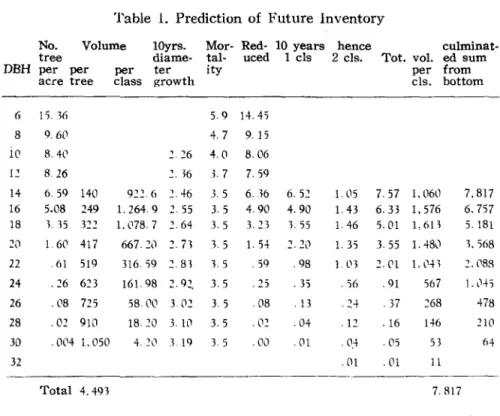
Dependable compound interest growth rate will be calculated from the stand projection method with the form in Table 1. Then various values of C is introduced to eompute the corresponding V" 's in order
to find the improvement in growing stoek in pereentage. Finally sueh cut as will satisfy the needs of forest owner and yet build up the growing stock in a satisfactory manner will be chosen. After the allowable annual cut has been determined, the cruise area should be
Regulation of the cut by dynamic programrnin,l( 177 divided into 10 annual cutting blocks, each of which will produce the required cut when its time of cutting is reached. The following formula is employed to determine the allocation of the annual cut.
where Vo
Vao:
(2)
the total volume on the cruise area,
the volume on the annual cutting block when cutting time is reached,
the compound interest growth rate of the stand, ingrowth included.
When Vao is found, then a series of 10 values are computed which
relates it to present volume.
Horizontal Cut method differs from the amortization approach in two distinct ways from the computational point of view, In this case the same projection calculation as for the amortization formula as shown in Table 1 is employed. In horizontal cut method simple interest, not compound is implicit in the calculation. But the difference is minimized by calculating from a stand table as of five years hence. It assumes that the cut is taken from the largest trees only and not distributed throughout the entire stands as is the case with the amortization formula.
In this paper an approach will be made on the basis of dynamic programming, using the reasoning of the above-mentioned two methods of regulation of the cut.
DYNAMIC PROGRAMMING APPROACH
Let us assume that we have to regulate the cut in the southern forests at Crossett, Arkansas, which consist of marchantable timber
per acre as indicated in Table 1. Timbers to be cut during the next ten years belong to those with DBH (diameter at breast-height, 1. 3 meter high) more than 22 inches. And we assume that the state of marchantable timber to be cut and to be left not cut at any particular time may be completely specified by two quantities, the volume of the total growing stock of the forests and the volume of marchantable
178 Tsutomll ArimizIl
Table l. Prediction of Future Inventory
No. Volume lOyrs. Mor- Red- 10 years hence culminat-tree diame- tal- uced 1 cls 2 cls. Tot. vol. ed sum DBH per per per ter ity per from
acre tree class growth eis. bottom
6 15.36 5.9 14.45 8 9.60 4. 7 9. 15 io 8.4(' 2 26 4.0 8.06 12 826 2.16 .1.7 7. 59 14 6. 59 140 9226 2.46 3. 5 6 .. 16 6.52 1.05 7.57 1,060 7,817 16 5.08 249 1. 264. 9 2.55 3.5 4.90 4.90 1. 43 6.33 1, 576 6, 757 18 ,. ,5 322 1. 078. 7 2.64 3.5 3.23 1.55 1. 46 5.01 1.6]) 5.181 ~0 1. 60 417 667.2,) 2. 71 3.5 1. 54 ::!.20 1.35 3.55 1. 48,) 1.'568 22 .61 519 316 59 281 1.5 . 59 .98 1 0, 2.01 1. ('4 ) 2.08R 24 .26 623 161. 98 2.92. 3.5 .25 .35 .'56 .91 567 1. ,14,; 26 .08 7'-~) 5800 302 3. 5 .08 .13 .24 .37 268 478 28 .02 910 1820 3. U) 3. 5 .02 .04 .12 . 16 146 210 30 .004 1. 050 4. 20 3 19 3.5 .00 .01 .0.4 .05 53 64 32 .01 .01 11 Total 4,49, 7.R17
Note: DBH means a diameter at breast height, 1 3 meter above the surface of the land.
timber left not cut. To simplify the problem for this initial com-putation, we shall assume that the volume of the cut is unbounded, although the total growing stock at the final stage is given. The purpose of this process wiII be taken to cut as many marchantable timber as possible over a time period of 10 years, given the final state of the total growing stock. The process is assumed to be discrete, with allocation made every year. At any particular year, t,
Xm. (t) = the total growing stock of marchantablo timber,
Kg (t) "-the volume of marchantable timber with DBH less than 22 inches which will not be cut.
Regulation of the cut by dynamic programming 119 At any particular time,
t,
the marchantable timber may be used for either of these three purposes, to be cut as harvest, to be left not cut to increase the volume of marchantable timber with DBH more than 22 inches, or to increase the volume of marchantable timber with DBH less than 22 inches which will increase the volume of harvest because of a fixed rate of the cut to the total growing stock.where
Let us write,
Xm (t) =Zc (t)
+z'"
(t) +Zg (t),a. Zc (t) :. the volume of the cut of marchantable timber with DBH more than 22 inches,
b. Zm(t)
c. Zg (t)
the volume of marchantable timber with DBH more than 22 inches but to be left, the volume of marchantable timber with DBH less than 22 inches.
Let us impose the following constraints,
a. dl;;;;'zc(t);;;;'aIX".({I, O<al<l, dl<O,
b. Zg (t) ;;;;'a2Xg (t) , (/2> 1.
(5 )
(6 )
The first constraint says that it is not possible to cut less than a fixed volume of marchantable timber and more than a fixed percentage of the total growing stock over any stage, k to k+ t, while the second asserts that there is not point to increase the volume of marchantal?le timber with DBH less than 22 inches more than the maximum capacity reSUlting from timber stand improvement in which timber cut will not be counted as harvest.
Let us now see how the state of the system is affected by the alloeation; assuming the linearity,
180
Xm (I
+
1) ==Xm (I) +asXm (t) -Zc (t), O<as <I,Xg (t
+
1) ==Xg (I) +a,Z'g (t) , 0 <a, <1.(7)
Finally, let us assume that the volume of merchantable timber cut with DBH more than 22 inches in a state is ZC (I) •
It is required to choose the volume of Zc (t),
z".
(I) and Zg (I), for1==0, I, 2,000, T -I, so as to maximize the total volume of annual cut
over the time period [0, T], given the initial volume,
and
Cl
=
X". (0) ,C2==Xg (0),
Let us define, for T== I, 2, 0 0 0,
17'
(Ch C2) =the total harvest cut over T stages, starting(8)
with initial volume, Cl and C~, and using an ( 9 ) optimal policy, 7'-1 IT (Cl, C2) == max L (z), L (z) :=: ~ ZC (I) • (t) t-O Then, clearly (lO)
Using the principle of optimality, we have
for T=2, 3, 000, T, where the maximization is over the region in
z
space defined byRegulatlon of tlae cut by dynamk programming
Table 2. Calculation of 10 stage Process Cl: 4,493 bd. ft.
C2: 3,394 bd. ft.
Information made available by calculation Normalized condition at al: .0250 az: .01875 aa: .06325 a4 : O. 1919 d) : 100 bd. ft. d2 : 6,800 bd. ft.
Acual condition using optimal policy Actual condition
at
181
stage beginning of stage vertex beginning of stage annual cut
Cl '"2 (1, .875) (4) (3.934, 4.493 ) 112.3 2 (1, .874) (4) (4.084.7. 4.664.9) 100.0 3 (1, .872) (4) (4,421. 1, 4,860.0) 100.0 -I (1, .868) (4) (4,403.5. 5.067.4) 100.0 5 (1. .864) (4) (4. 572. 2. 5.287.9) 100.0 6 (1. .859) (4) (4,747.2. 5,522.4) 100.0 7 (1, .854) (4) (4.929. 1, 5.771.7) 100.0 8 (1. .847) (4) (5.117.9. 6.036.8) 118.2 9 (1, .843) (4) (5.313. 9. 6.300.4) 153.9 10 (1, .842) (4) (5,517.4, 6,545.0) 159.0 11 (1. .842) (4) (5,728.7, 6,800.0) Total allocation to the annual cut: 1, 143.4 bd. ft.
CALCUI,ATION
The numerical calculation above by the method of successive approximations was made employing the technique depicted in the paper written to me by Richard Bellman and Stuart Dreyfus with the title .. On the Computational Solution of Dynamic Programming Process ···A Bottleneck process AriSing in the Study of Interdependent Industries ", which is to be published soon.
182
From the forestry point of view, dynamic programming applied to regulation of the eut consider the problems simultaneously which almost all existing methods of volume regulation have dealt with. In this paper only two processes were assumed but the number of processes can be increased at least to four with the conventional technique of computation of dynamic programming in case of 10 stage process. Computation of this kind of problem indicated in Table 2 is easy and it will take not so much time. There are other aspects of forest management which were overlooked here. These aspects can be considered simultaneously with the input-output model published in the Journal of Japanese Forestry Society, No. 5, Vo!. 40.