D05
Performance of Pile Foundations under Lateral Spreading events
using Centrifuge and Numerical Analysis
〇Anurag SAHARE, Kyohei UEDA, Ryosuke UZUOKA
Introduction
Lateral spreading due to liquefaction induced mechanism in piled foundations has been the cause of major failure of many structures in the past earthquakes, which represents a complex loading scenario involving a soil-pile-structure interaction. Piled foundations are subjected to lateral kinematic and inertial loading generated during an earthquake shaking event leading to the lateral spreading of soil in liquefiable soil strata. Though most of the past research on kinematic interaction of piled foundations focus on the mild slope conditions so as to induce limited amount of lateral spreading in order to study the soil-pile interaction, which may induce significantly lesser moments leading to a much safer design. In this paper, an effort has been made to deal with kinematic interaction in pile group foundation due to the mechanism of liquefaction induced large lateral spreading events and is compared with the mild ground sloping condition. The soil pile structure interaction also tends to differ based on the stiffness of soil layer and hence the failure mechanism may be completely different in case of pile foundation surrounded by the dense or non-liquefiable sand.
Different Cases studied
Following cases are considered in the present paper Part 1: With different sloping ground condition to induce different kinematic interactions between the pile and the surrounding soil
Table 1: Difference in sloping ground (Uniform sand) Cases Pile arrangement Sloping Ground
1-1 Single Pile 5 Degree Slope 1-2 2X2 Group Pile 5 Degree Slope
1-3 Single Pile 10 Degree Slope 1-4 2X2 Group Pile 10 Degree Slope Part 2: Non-liquefiable layer underlain by liquefiable layer
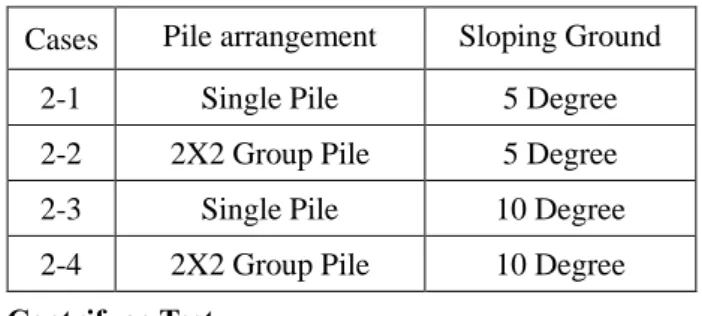
Cases Pile arrangement Sloping Ground
2-1 Single Pile 5 Degree
2-2 2X2 Group Pile 5 Degree
2-3 Single Pile 10 Degree
2-4 2X2 Group Pile 10 Degree
Centrifuge Test
The dynamic centrifuge tests were conducted at Centrifuge facility at Disaster Prevention Research Institute (Kyoto University) at 50G using the laminar container. Toyoura sand is used for all the cases which is saturated using Metolose at 50cst. The soil model is prepared by air pluviating the soil at a relative density of 50% for the liquefiable layer and a slightly cemented dense sand is used to achieve a non-liquefiable soil layer. Figure 1 shows the typical soil model used for the centrifuge test.
Numerical Analysis
The two dimensional effective stress model FLIP ROSE (Finite element analysis program of Liquefaction Process/Response of soil-structure systems during Earthquakes) based on finite element theory is used for the numerical analysis. The model is widely used to study the degree of damage suffered by the structure resting on liquefiable ground. The soil element is modeled using multi-spring model which represents the nonlinear stress-strain relationship. The pile element is modeled as nonlinear beam element. Nonlinear spring elements are used to consider the interaction between pile and the surrounding soil. The numerical analysis is carried out in two stages. Initially the static or self-weight analysis is carried out followed by the dynamic analysis to capture the soil-system response during the lateral spreading event under the seismic loading.
Results and Discussions (for uniform ground)
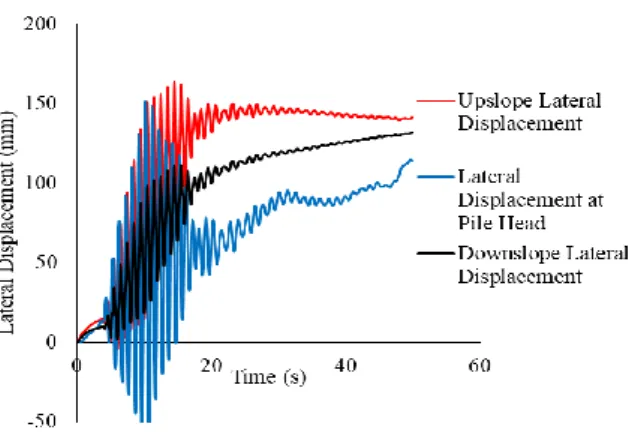
Fig. 2. Single Pile with 10 degree sloping ground
Fig. 2. Single Pile with 10 degree sloping ground
Fig. 4. Bending Moment at the end of shaking along the pile length for all 4 cases
Fig. 5. Maximum Lateral displacement along the pile length for all 4 cases
As seen from Fig. 2,3,4 and 5 (from the finite element analysis), the response of single pile and 2X2 group pile seems to differ significantly based on the different kinematic interactions. The single pile behavior is found to be more susceptible to large lateral spreading with the significant increase in moments along the pile length which may induce the formation of plastic hinges where the moments due to kinematic interaction alone is close to the resisting plastic moment values. Similarly, the soil pile system response differs significantly with the presence of denser sand layer (non-liquefiable layer) which imparts large pressure to the pile surface with plastic hinge formation near the non-liquefiable layer.
References