• 検索結果がありません。

<論説>Research on Factors That Japanese Companies Withdraw from Overseas Business

N/A
N/A
Protected

Academic year: 2021

シェア "<論説>Research on Factors That Japanese Companies Withdraw from Overseas Business"

Copied!
11
0
0

読み込み中.... (全文を見る)

全文

Abstract The present study examines the withdrawal behaviour of Japanese companies from overseas business. In particular, the tendency of companies that withdrew from overseas business is examined using a combined approach of dictionary-based approach and correlational approach in text mining. In addition, the study also analyses the purpose of entering the overseas business of the withdrawn companies. The study results show that most companies aimed at business expansion and strengthening by overseas expansion. On the other hand, in terms of withdrawal, a change in business strategy has a significant effect.. 1 Introduction Living standards continue to improve in the rapid growing emerging economies. In Japan, though, the population has been on the decline since 2011 and is expected to decrease over the long term. Japanese companies are facing a sharp drop in demand and changing industrial structures. If the TPP becomes effective, it will create a huge economic zone that accounts for about 40% of world GDP and over 10% of the population. Therefore, more and more Japanese companies are expanding overseas in pursuit of new markets.. The factors that lead companies to expand or withdraw from overseas businesses are studied in the context of foreign direct investment (FDI) and described in Section 2.. Besides, the sales area is extended through overseas expansion as part of a regional diversification strategy. This strategy aims to expand and develop existing management resources by extending the existing range of the company’s products and markets and expanding the company’s management resources to the new range. Barney (2011) claims out that diversification strategies have economic and financial benefits.. Typical economic benefits include economies of scale and of scope. The economies of scope imply. 論 説. Research on Factors That Japanese Companies Withdraw from Overseas Business. Yuki Itoh* and Yukiko Konno†. * Faculty of International Social Sciences, Yokohama National University; 79-4 Tokiwadai, Hodogaya-ku, Yokohama 240-8501, Japan; [email protected]. † Faculty of Economics, Kokugakuin University; 4-10-28 Higashi, Shibuya-ku, Tokyo 150-8440, Japan; konno. [email protected]. 114( ) 横浜経営研究 第40巻 第 3・4 号(2020)328. that companies run multiple businesses to make effective use of overlapping resources, thereby reducing costs and increasing sales. The economies of scale are to reduce the average costs by increasing production. Through regional diversification and running the business in multiple regions and increasing the scale, a range economy and economies of scale will arise, and it is believed that cost advantages can be achieved in both foreign and domestic markets. Berger and Ofek (1995) examined whether diversification helps companies achieve economic benefits such as economies of scope and economies of scale.. In terms of financial merit, diversification strategy is believed to have the following effects, and similarly regional diversification is believed to have the same merit. By establishing multiple businesses with low correlation of cash flow, there is a risk diversification effect that can reduce the risk as a whole company, and the profit stability of the company increases. Moreover, in the internal capital market of diversified companies, the amount of investment in each business and the cost of capital can be determined based on in-depth and accurate information than in the external capital market. Therefore, diversification influences asset allocation within a company. Therefore, diversification affects the asset allocation inside a company. Kim and Reinschmidt (2011) stated that while diversification has financial benefits such as risk diversification, there is a trade-off between risk reduction and corporate growth.. As mentioned earlier, diversification strategy results in economic and financial advantages. However, in terms of regional diversification strategy based on overseas expansion, emerging countries are at high risk of sudden changes in the system of local governance and theft of technology and design. Consequently, Small and Medium Enterprise Agency (2012) emphasized that several companies are unable to expand overseas.. In addition, different countries have different tax systems, accounting standards, securities rules, and political and economic systems, which have different effects on industries. Some companies benefited from regional diversification in terms of future prospects and sales growth. On the other hand, some companies have not only had to withdraw from overseas operations owing to worsening cash flow, but also had an adverse effect on domestic operations.. Despite this situation, most of the prior research has analysed overseas expansion, and the number of previous research withdrawing from overseas business is far less. Porter (1976) stated that there is little focus on the decision to exit from a business, while some studies on divestment concur that the decision to exit from a business is challenging. In particular, Belderbos and Zou (2006) and McDermott (2010) also agree that little empirical research exists on the issue of withdrawal from business. In a theoretical study, Boddewyn (1983b) studies withdrawal from overseas business.. The paucity of studies is likely due to the relative difficulty in understanding the actual situation of withdrawal. Koyama (2013) highlights that a comprehensive research on withdrawal in multinational companies is challenging because the research target is overseas subsidiaries and no statistical data are available in each country. Koyama (2013) also notes that lack of data from companies was an obstacle to research because withdrawal from business left a negative impression.. Given the lack of research across the world, the present study engages in text data mining and analyses text information described in characters and sentences. In particular, using a combined approach based on the dictionary and the correlational, this study examines the companies’ tendency to withdraw. Research on Factors That Japanese Companies Withdraw from Overseas Business(Yuki Itoh and Yukiko Konno)( )115329. from overseas business. In addition, a comparison was made between the companies that withdrew and their overseas expansion and the purpose of overseas expansion and the factors that led to withdrawal from overseas business were clarified.. 2 Literature Review 2.1 Study on withdrawal from overseas business This study focuses on Japanese companies’ withdrawal behavior among activities related to FDI. Studies on the withdrawal from FDI began in the 1970s. In general, withdrawal is defined as follows.. Boddewyn and Torneden (1973) presented some preliminary findings of a study on U.S. foreign disinvestments in 1967–1971 and defined a foreign divestment (or disinvestment) as a reduction in working assets or active management. They also mention that the most important components of divestment definition are complete and partial sales or liquidations of active operations, as well as expropriations and nationalisations.. Sachdev (1976) defines disinvestment as a reduction of ownership percentage in an active direct foreign investment on a voluntary or involuntary basis. Voluntary disinvestment includes all those cases of disinvestment, partial or absolute, for which the company’s own decisions are responsible as nationalisation of resources. Involuntary disinvestment is a case in which the foreign investor is forced to being taken over by the host government through nationalisation, expropriation, or confiscation.. Thus, withdrawal includes not only complete sale, partial sale and liquidation of operating activities, but also expropriation and specialisation. In addition, there are also cases of voluntary withdrawal and involuntary withdrawal.. Boddewyn (1979) observed that divestment can also be due to economic factors such as poor performance of the subsidiary or division, inability of the parent company to sustain further losses, or lack of capital to finance the modernisation or need for expansion.. Several studies related to diversification of companies and M&A and withdrawal activity exist since the 1980s (Duhaime and Schwenk (1985), Markides (1992), Hoskisson et al. (1994), Bergh (1997), Benito (1997), Haynes et al. (2000), Haynes et al. (2002), Haynes et al. (2003), Schlingemann et al. (2002), Brauer (2006)) .. In their study on diversification of companies and withdrawal activity, Hoskisson et al. (1994) indicated that product diversification and debt have important direct impacts on withdrawal activity. On the one hand, Haynes et al. (2000) indicated that both the value and extent of withdrawal activity is related to the size and diversification of the firm concerned and showed the insignificant association between firm performance and withdrawal. Mulherin and Boone (2000) emphasized that economic change is a source of the observed restructuring activity and found that both acquisitions and divestitures in the 1990s increased shareholder wealth.. Boddewyn (1983a), Boddewyn (1983b) and Berry (2010) are typical studies that analysed both expansion and withdrawal. Berry (2010) examined 190 U.S. firms over a 20-year period and showed that lower-cost production and new market opportunities affected the firms’ divestment decisions. On the other hand, Fisch and Zschoche (2012) examined 596 production locations of 189 German manufacturing firms and revealed that the decision to divest a foreign location owing to rising and uncertain labor costs. 116( ) 横浜経営研究 第40巻 第 3・4 号(2020)330. is moderated by the ease of dismissing workers and the opportunity to shift production to locations with contrasting labor cost developments.. Other related researches are as follows: Benito (1997) examined certain divestment factors of Norwegian foreign manufacturing companies and found that foreign divestment is inversely related to the host country’s economic growth, and related (horizontal) subsidiaries are less likely to be divested than unrelated (nonhorizontal) subsidiaries. Soule et al. (2014) examined variations in the rate of divestment by Burmese multinational firms and showed that in addition to firm-level concerns, firms divest from businesses in response to the political characteristics of their home country, including protests, level of political freedom, and transparency of institutions.. 2.2 Study on the theory of withdrawal from overseas business As a study on the theory of withdrawal from overseas business, Boddewyn (1983b) focused on Dunning’s eclectic paradigm. Using this paradigm, Dunning (1980), Dunning (1988), Dunning (1995), Dunning (2000) and Dunning (2015) explained the extent and pattern of international production, that is, production financed by FDI and undertaken by multinational enterprises. The paradigm asserts that the extent and pattern will be determined by the configuration of three sets of forces:. (1) Ownership-specific advantage: The (net) competitive advantages that firms of one nationality possess over those of another in supplying to any particular market or a set of markets.. (2) Location-specific advantage: The extent to which firms choose to locate these value-adding activities outside their national boundaries.. (3) Internalisation-advantage: The extent to which firms perceive it to be in their best interests to internalise the markets for the generation and/or the use of these assets, and by so doing, add value to them.. Accordingly, Boddewyn (1983b) translates Dunning’s three conditions into a proto-theory of foreign direct divestment as follows.. (1) A firm ceases to possess net competitive advantages over firms of other nationalities. (2) Even if the firm retains its net competitive advantages, it no longer finds it beneficial rather than. sell or rent them to foreign firms. (3) The firm no longer finds it profitable to use its internalized net competitive advantage outside its. home country. Boddewyn (1983b) reported that FDI theory demands that the three conditions be satisfied. simultaneously while foreign direct divestment theory requires only one of them. The related studies are shown in the following: Chen and Wu (1996) examined the determinants of. divestment of foreign subsidiaries in Taiwan and found that firm size and foreign ownership influence survival, while capital intensity and export proportion affect early withdrawal. Chang and Singh (1999) examined withdrawal opinions in the United States and indicated that when the resource profiles of a parent firm are unlike that of the business unit and there has been less development of firm-specific idiosyncratic assets, firms are more likely to sell businesses than dissolve them. Pattnaik and Lee (2014) examined the impact of cross-national distance on the divestment of foreign affiliates in Korea and found that the positive relationship between cross-national distance and affiliate divestment is likely to be. Research on Factors That Japanese Companies Withdraw from Overseas Business(Yuki Itoh and Yukiko Konno)( )117331. strengthened when a multinational corporation enters the host country through a joint venture and likely to be weakened for affiliates with greater experience in the host country.. 3 Empirical analysis 3.1 Analysis method The present study focuses on the withdrawal behaviour in the activities related to FDI of Japanese companies. Koyama (2013) noted that research on withdrawal is limited because of inadequate data collection and challenges in interviewing companies. The present study adopts text data mining and analyses text information described in characters and sentences.. Hearst (1999) observed that text expresses a vast, rich range of information, but encodes this information in an undecipherable form. However, it is possible to analyse text information using text data mining. Ye (2003) noted that the ultimate goal of data mining is to find hidden patterns from data, and it is just a sophisticated tool to extract information or to aggregate the original data.. Higuchi (2014) claimed that proper use of computers is desirable when organising or analysing text- type data using quantitative analysis techniques. There are two different approaches to quantitative analysis of text data using a computer. One is a dictionary-based approach, which uses a computer to classify words and documents based on the criteria (coding rules) stipulated by analysts. This is a method of manipulating the theory and problem awareness by creating classification criteria, that is, coding rules (Osgood (1952)). The other approach is called the correlational approach, which uses a computer to automatically find and classify groups of words that appear frequently in the same document or groups of documents containing many common languages through multivariate analysis.. Berelson (1952) noted that the dictionary-based approach leads to the risk of creating only coding rules that are convenient for the analyst’s theory and hypothesis. For the correlational approach, Higuchi (2014) highlighted that data manipulation is difficult, but it pursues theory and problem awareness as it depends heavily on multivariate analysis.. Therefore, Higuchi (2014) proposed the following two-step joining approach that combines the two approaches: In step 1, following the correlational approach using multivariate analysis, the data are summarised such that it minimises the influence of the analyst’s theory and problem awareness. In step 2, following the dictionary-based approach, coding rules are created to explicitly verify theoretical hypotheses and pursue problem awareness.. This enables clear distinction between the stage of summarising and presenting data without any manual work that may have an arbitrary cause and the stage of explicitly manipulating the theory hypothesis or problem awareness by creating coding rules. In addition, Higuchi (2014) created KH Coder, software that can execute both of these steps 1 and 2 and incorporate prior language processing.. This study uses KH Coder based on company information to examine the tendency of companies withdrawing from overseas business. In addition, it compares and analyses the data of the withdrawn companies when they entered overseas. As a method of analysis, the present study uses a co-occurrence network (Osgood (1952) and Corman et al. (2002)), which is a means of drawing a network by connecting concepts commonly used in data with lines. This study uses the methods proposed by Fruchterman and Reingold (1991) to draw words and word networks and by Kamada and Kawai (1989). 118( ) 横浜経営研究 第40巻 第 3・4 号(2020)332. to draw words, variables and headings. Just placing words close to each other is no evidence of a strong co-occurrence between them. It is shown that there is a strong co-occurrence relationship when words are connected by lines. It is possible to indicate which of the words are similar to each other by their appearance patterns, that is, what words are most likely to appear in the same document, depending on whether they are connected by lines.. 3.2 The data and variables Japanese companies that acquired overseas companies but sold them using M&A from 1996 to 2016 were studied. The documents published by Japanese companies about the acquisition or sale of overseas companies using M&A as text data were further analysed. Cases where a Japanese company acquired a foreign subsidiary of a Japanese company and expanded overseas, or sold an overseas company to a Japanese company and withdrew from overseas business were, however, excluded. In other words, the present study examines cases in which a Japanese company acquired a foreign company other than a Japanese company and entered the overseas market, sold the overseas company to a company other than the Japanese company, and withdrew from the overseas business. In transactions between Japanese companies, it is difficult to distinguish between a new foreign expansion or withdrawal from overseas business and an FDI. In addition, finance and trading companies as well as joint ventures were excluded in the type of business.. Table 1 shows sample of companies used in the empirical analysis and the sample size is 24 companies.. Table 1: The sample of companies used in the empirical analysis Japanese company local company country expansion withdrawal. Sokkia Corporation AGL Corporation USA 1996 2006 Shiseido Company, Limited LABORATOIRES DECLEOR S.A.S FRA 2000 2013 OKABE CO., LTD. HONG KONG KYOWA LIMITED CHN 2000 2010 Doshisha Corporation Hong kong laguna business Co., Ltd. CHN 2002 2014 Goodman Co., Ltd. LightLab Imaging, Inc. USA 2002 2010 Faith, Inc. Digiplug S.A.S. FRA 2002 2007 ARRK CORPORATION Avaplas Ltd. SIN 2004 2010 Sekisui Chemical Company, Limited XINJIANG YONGCHANG-SEKISUI COMPOSITES CO.,LTD CHN 2005 2016 Oricon Inc. CINE WELCOME CO.,LTD. KOR 2005 2008 SJ Holdings co., Ltd Fujian Jippo Wenhua Chuanbo Limited company CHN 2005 2007 Fukuda Denshi Co., Ltd. Kontron Medical SAS FRA 2005 2007 Nihon Enterprise Co., Ltd. Beijing Yezhu xing NETWORK TECHNOLOGY LIMITED CHN 2005 2015 livedoor, Inc. Innovation Interactive LLC USA 2005 2007 SHIDAX CORPORATION Restaurant Hospitality, LLC USA 2006 2014 PROTO CORPORATION JPEX Partners Inc. KOR 2006 2008 ARRK CORPORATION New System Holding Company Limited THA 2006 2008 ARRK CORPORATION Shanghai Launch Technical Automotive Center Co., Ltd. CHN 2006 2011 Sekisui Chemical Company, Limited Heitkamp, Inc. USA 2007 2016 Roland Corporation Twelve Tone Systems, Inc. USA 2008 2013 Rakuten, Inc. TARAD Dot Com Co., Ltd. THA 2009 2016 Eisai Co., Ltd. AkaRx, Inc. USA 2009 2016 MIMAKI ENGINEERING CO., LTD. KANPHOR INDIA PRIVATE LIMITED IND 2009 2016 Nipro Corporation Home Diagnostics, Inc. USA 2010 2015 Sharp Corporation Recurrent Energy, LLC USA 2010 2015. Research on Factors That Japanese Companies Withdraw from Overseas Business(Yuki Itoh and Yukiko Konno)( )119333. 3.3 Results Figure 1 shows the results of a co-occurrence network drawn using KH Coder with the contents shown in text regarding the factors for overseas expansion.. Figure 1 reveals the following: (1) The circles for ‘strengthen’ and ‘expansion’ are large, indicating that this word appeared. frequently. (2) ‘Strengthen’, ‘promotion’ and ‘business’ are connected to ‘base’ with thick lines. Moreover,. ‘promotion’ and ‘business’ are connected by a thick line. This indicates an intention to promote and strengthen the business by securing an overseas base through acquisition.. (3) ‘Expansion’ and ‘acceleration’ are connected by a thick line to ‘entry’. It is suggested that entry by acquisition is for expanding the business and accelerating the speed.. Figure 1: Co-occurrence network drawn in text regarding overseas expansion. strengthen. expansion. business. promotion. base. group. demandentry. acceleration. Primarily, most companies appear to aim at business expansion and business strengthening through overseas expansion in the acquisition. In summary, companies intended to strengthen and promote the business by securing overseas bases through acquisitions. Furthermore, the speed of business appeared to be accelerated and the business is expanded.. Figure 2 shows the results of a co-occurrence network drawn using the KH Coder with the contents shown in the text about the factors for overseas withdrawal.. 120( ) 横浜経営研究 第40巻 第 3・4 号(2020)334. Figure 2 reveals the following: (1) The circle becomes larger in the order of ‘management resources’ and ‘part’, which indicates. that these words are frequently used. (2) ‘Management resources’ and ‘selection’ associated with ‘concentration’. This indicates that the. withdrawal is conducted as an attempt to select and concentrate corporate activities. (3) ‘Operation’ and ‘reorganisation’ are closely related, as well as ‘part’, indicating that withdrawal. is made as part of business restructuring. (4) ‘Focus’ and ‘center’ are closely related to ‘growth’, implying that there is reinvestment in. growth fields.. Figure 2: Co-occurrence network drawn in text about the factors for overseas withdrawal. management resources. part. selection operation. reorganisation. concentration. focus. center. growth. expansion. business. divestment. withdrawal. secure. The change in business strategy is mainly seen to have a significant effect on the withdrawal from overseas businesses. In summary, it is suggested that companies withdraw in an attempt to select and concentrate as part of business restructuring, and that management resources are concentrated in growth fields.. 4 Discussion and Conclusion The present study examined the withdrawal behaviour of Japanese companies from overseas business. In particular, the tendency of companies that withdrew from overseas business was examined using a. Research on Factors That Japanese Companies Withdraw from Overseas Business(Yuki Itoh and Yukiko Konno)( )121335. combined approach of dictionary-based approach and correlational approach in text mining. In addition, the study also analysed the purpose of entering the overseas business of the withdrawn companies.. The study results showed that most companies aimed at business expansion and strengthening by overseas expansion. On the other hand, in terms of withdrawal, a change in business strategy had a significant effect.. Next, previous research and the case of individual companies were considered. Sekisui Chemical Company, Limited cited the impact of the reduction of public works as the cause of the disinvestment of Xinjiang Yongchang-Sekisui Composites Co., Ltd. Nipro Corporation stated that the disinvestment of Home Diagnostics, Inc. was a result of a significant drop in the U.S. Medicare reimbursement price. These are consistent with the work of Soule et al. (2014), who stated that withdrawal is politically influenced by the country of entry.. Fukuda Denshi Co., Ltd. stated that the disinvestment of Kontron Medical SAS was a result of the termination of the supply contract for purchased goods. This indicates that ownership-specific advantage was lost in Dunning’s three conditions, which is consistent with the work of Boddewyn (1983b).. Goodman Co., Ltd. also mentioned a loss in operating income as the cause of the disinvestment of LightLab Imaging, Inc. Proto Corporation cited that the disinvestment of JPEX Partners Inc. led to inability to secure the expected sales and profits. Oricon Inc. cited operating loss and widening deficit in the disinvestment of Cine Welcome Co., Ltd. These are consistent with the study Boddewyn (1979), who points out that the factors affecting the withdrawal from overseas business are largely due to poor business performance in overseas business.. To summarise the results, although companies expand overseas with the aim of expanding and strengthening their scale, they tend to withdraw from overseas due to their selection and concentration of businesses. In addition, from individual cases, it is found that withdrawal from overseas owing to various factors such as a change in the system of the country of entry, termination of the contract and poor business performance.. Few studies exist on withdrawal, but the present study analysed using text information described in characters and sentences through text data mining. Furthermore, by analysing the purpose of the withdrawn company when it entered the overseas market, it is possible to clarify what factors led to the withdrawal of a company from overseas business.. The present study also provides suggestions for more efficient decision making on regional diversification by M&A and the design of industrial support measures. Therefore, it can contribute to the promotion of active regional diversification of companies.. References Barney, Jay B. (2011) Gaining and Sustaining Competitive Advantage: Prentice Hall, 4th edition. Belderbos, René and Jianglei Zou (2006) “Foreign investment, divestment and relocation by Japanese electronics firms. in East Asia,” Asian Economic Journal, Vol. 20, No. 1, pp. 1-27. Benito, Gabriel R. G. (1997) “Divestment of foreign production operations,” Applied Economics, Vol. 29, No. 10, pp.. 1365-1378. Berelson, Bernard (1952) Content analysis in communication research, New York: Free Press. Berger, Philip G. and Eli Ofek (1995) “Diversification’s effect on firm value,” Journal of Financial Economics, Vol.. 37, No. 1, pp. 39-65, Symposium on Corporate Focus.. 122( ) 横浜経営研究 第40巻 第 3・4 号(2020)336. Bergh, Donald D. (1997) “Predicting divestiture of unrelated acquisitions: An integrative model of ex ante conditions,” Strategic Management Journal, Vol. 18, No. 9, pp. 715–731.. Berry, Heather (2010) “Why do firms divest?” Organization Science, Vol. 21, No. 2, pp. 380-396. Boddewyn, Jean J. (1979) “Foreign divestment: Magnitude and factors,” Journal of International Business Studies,. Vol. 10, No. 1, pp. 21-26. ― (1983a) “Foreign and domestic divestment and investment decisions: Like or unlike?” Journal of International. Business Studies, Vol. 14, No. 3, pp. 23–35. ― (1983b) “Foreign direct divestment theory : Is it the reverse of FDI theory?” Weltwirtschaftliches Archiv, Vol.. 119, No. 2, pp. 345-355. Boddewyn, Jean J and Roger Torneden (1973) “US foreign divestment: A preliminary survey,” Columbia Journal of. World Business, Vol. 8, No. 2, pp. 25-29. Brauer, Matthias (2006) “What have we acquired and what should we acquire in divestiture research? a review and. research agenda,” Journal of Management, Vol. 32, No. 6, pp. 751-785. Chang, Sea Jin and Harbir Singh (1999) “The impact of modes of entry and resource fit on modes of exit by multibusi-. ness firms,” Strategic Management Journal, Vol. 20, No. 11, pp. 1019-1035. Chen, Tain-Jy and Grace Wu (1996) “Determinants of divestment of FDI in Taiwan,” Weltwirtschaftliches Archiv, Vol.. 132, No. 1, pp. 172–184. Corman, Steven R., Timothy Kuhn, Robert D. Mcphee, and Kevin J. Dooley (2002) “Studying complex discursive. systems,” Human Communication Research, Vol. 28, No. 2, pp. 157-206. Duhaime, Irene M. and Charles R. Schwenk (1985) “Conjectures on cognitive simplification in acquisition and divest-. ment decision making,” Academy of Management Review, Vol. 10, No. 2, pp. 287-295. Dunning, John H. (1980) “Toward an eclectic theory of international production: Some empirical tests,” Journal of. International Business Studies, Vol. 11, No. 1, pp. 9-31. ― (1988) “The theory of international production,” The International Trade Journal, Vol. 3, No. 1, pp. 21-66. ― (1995) “What’s wrong—and right—with trade theory?” The International Trade Journal, Vol. 9, No. 2, pp. 163-. 202. ― (2000) “The eclectic paradigm as an envelope for economic and business theories of MNE activity,” Interna-. tional Business Review, Vol. 9, No. 2, pp. 163-190. ― (2015) “Reappraising the eclectic paradigm in an age of alliance capitalism,” in The Eclectic Paradigm: A. Framework for Synthesizing and Comparing Theories of International Business from Different Disciplines or Perspectives, London: Palgrave Macmillan UK, pp. 111-142.. Fisch, Jan Hendrik and Miriam Zschoche (2012) “The effect of operational flexibility on decisions to withdraw from foreign production locations,” International Business Review, Vol. 21, No. 5, pp. 806-816.. Fruchterman, Thomas M. J. and Edward M. Reingold (1991) “Graph drawing by force-directed placement,” Software: Practice and Experience, Vol. 21, No. 11, pp. 1129-1164.. Haynes, Michelle, Steve Thompson, and Mike Wright (2000) “The determinants of corporate divestment in the UK,” International Journal of Industrial Organization, Vol. 18, No. 8, pp. 1201-1222.. ― (2002) “The impact of divestment on firm performance: Empirical evidence from a panel of UK companies,” The Journal of Industrial Economics, Vol. 50, No. 2, pp. 173-196.. ― (2003) “The determinants of corporate divestment: Evidence from a panel of UK firms,” Journal of Economic Behavior & Organization, Vol. 52, No. 1, pp. 147-166.. Hearst, Marti A. (1999) “Untangling text data mining,” in Proceedings of the 37th Annual Meeting of the Association for Computational Linguistics on Computational Linguistics, ACL 99, pp. 3-10, USA: Association for Computa- tional Linguistics.. Higuchi, Koichi (2014) Measure text analysis for social survey: Aiming at succession of content analysis and devel- opment: Nakanishiya publication, [in Japanese].. Hoskisson, Robert E., Richard A. Johnson, and Douglas D. Moesel (1994) “Corporate divestiture intensity in restruc- turing firms: Effects of governance, strategy, and performance,” Academy of Management Journal, Vol. 37, No. 5, pp. 1207-1251.. Kamada, Tomihisa and Satoru Kawai (1989) “An algorithm for drawing general undirected graphs,” Information Processing Letters, Vol. 31, No. 1, pp. 7-15.. Kim, Hyung-Jin and Kenneth F. Reinschmidt (2011) “Diversification by the largest US contractors,” Canadian Journal of Civil Engineering, Vol. 38, No. 7, pp. 800-810.. Koyama, Daisuke (2013) “Foreign business activities and the strategic divestment of multinational enterprises : The. Research on Factors That Japanese Companies Withdraw from Overseas Business(Yuki Itoh and Yukiko Konno)( )123337. foreign direct investment and divestment of Japanese companies,” MNE Academy Journal, Vol. 6, pp. 43-62, [in Japanese].. Markides, Constantinos C. (1992) “Consequences of corporate refocusing: Ex ante evidence,” Academy of Manage- ment Journal, Vol. 35, No. 2, pp. 398-412.. McDermott, Michael C. (2010) “Foreign divestment,” International Studies of Management & Organization, Vol. 40, No. 4, pp. 37-53.. Mulherin, J.Harold and Audra L Boone (2000) “Comparing acquisitions and divestitures,” Journal of Corporate Finance, Vol. 6, No. 2, pp. 117-139.. Osgood, Charles E. (1952) “The nature and measurement of meaning,” Psychological Bulletin, Vol. 49, No. 3, pp. 197- 237.. Pattnaik, Chinmay and Jeoung Yul Lee (2014) “Distance and divestment of Korean MNC affiliates: The moderating role of entry mode and experience,” Asia Pacific Business Review, Vol. 20, No. 1, pp. 174-196.. Porter, Michael E. (1976) “Please note location of nearest exit: Exit barriers and planning,” California Management Review, Vol. 19, No. 2, pp. 21-33.. Sachdev, Jagdish C. (1976) “Disinvestment: A corporate failure or a strategic success,” International Studies of Management & Organization, Vol. 6, No. 1/2, pp. 112-130.. Schlingemann, Frederik P., René M. Stulz, and Ralph A. Walkling (2002) “Divestitures and the liquidity of the market for corporate assets,” Journal of Financial Economics, Vol. 64, No. 1, pp. 117-144.. Small and Medium Enterprise Agency (2012) 2012 White Paper on Small and Medium Enterprises in Japan: Nikkei Printing.. Soule, Sarah A., Anand Swaminathan, and Laszlo Tihanyi (2014) “The diffusion of foreign divestment from Burma,” Strategic Management Journal, Vol. 35, No. 7, pp. 1032-1052.. Ye, Nong ed. (2003) The Handbook of Data Mining, Boca Raton: CRC Press.. 〔Yuki Itoh, Associate Professor, Faculty of International Social Sciences, Yokohama National University〕 〔Yukiko Konno, Associate Professor, Faculty of Economics, Kokugakuin University〕 � 〔2020年 1 月27日受理〕

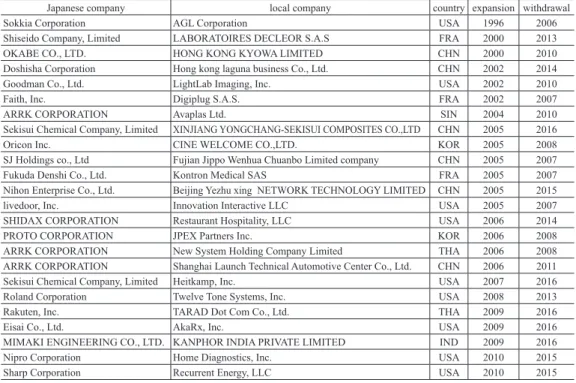
Table 1 shows sample of companies used in the empirical analysis and the sample size is 24  companies.
Figure 1 shows the results of a co-occurrence network drawn using KH Coder with the contents shown in  text regarding the factors for overseas expansion.
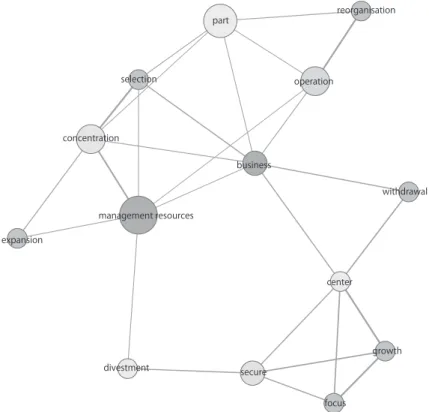
Figure 2 reveals the following:

参照

関連したドキュメント

Background The aim of the present study was to clarify the risk factors of several types of arteriosclerosis lesions in Japanese individuals with heterozygous

(Japan)”, no customer support is available for enqui- ries about purchases or usage in/from any countries other than Japan. Also, no foreign language other than Japanese

Therefore, after the foreign trading vessel departs from a port of loading, the shipping company, who files at the port of loading in the Pre-departure filing (the new rules), will

Therefore, after the foreign trading vessel departs from a port of loading, the shipping company, who files at the port of loading in the Pre-departure filing (the new rules), carries

The fact that Japanese links inclusion and partial inclusion is hardly evidence that the IN/ON continuum is deeply relevant, since functional considerations naturally link the

One may think that, if matrix subjects can be reactivated due to similarity-based reactivation, the distant NOM and DAKE-NOM conditions should show

Operators attempted to use the diesel-driven fire pump, which was developed for use as a so-called AM measure in order to further enhance plant safety, to inject water into

[Principle 4.1 Roles and Responsibilities of the Board of Directors 1] Supplementary Principle 4.1.1 As a “Company with Nominating Committee, etc.,” the Company’s Board of