■ Article ■
The Economy of Water: Changes in the Agrarian
Relations of a Rajasthan Village
●
Sumie Nakatani
1. Introduction
Land has been the main concern of studies on agrarian structure and economy in South Asia. However, agriculture in Devapur, a village of Rajasthan where I conducted my fieldwork,1) shows that in a certain ecological and social context water becomes a more important means of production than land and a main determinant of production relations in an agricultural economy.2) This paper describes agrarian relations in Devapur focusing on water ownership, its use and its control. Through analyses of the present situation of agrarian relations and their history, I argue for an understanding of the relations of production in Devapur agriculture not in terms of land but in terms of water. They will be examined as relationships defined by water issues such as water avail-ability, water ownership, and water productivity.3)
First, I will point out three important characteristics of Devapur agri-culture. Those are the unequal distribution of water, the mobility found in agrarian relations, and the prevalence of sharecropping. I will explain
中谷純江 Sumie Nakatani, Research Fellow of Japan Society for the Promotion of Sci-ence.
Subject: Social Anthropology.
Publications: "Religious Practices of Rajput Women in a Village in Rajasthan, India: A Meaning of Self-sacrifice to Hindu Women" (in Japanese), Minzokugaku Kenkyu (The Japanese Journal of Ethnology), No. 60-1, pp. 53-77, 1995. "Agrarian Relations in a Rajasthan Village," Zinbun (Annals of the Institute for Research in Humanities, Kyoto
136 Journal of the Japanese Association for South Asian Studies, 12, 2000
them in terms of a context in which the amount of water available for agricultural production is unpredictable. Second, I will discuss changes in agrarian relations caused by the mechanization of agriculture. In what way production relations had changed and traditional relations have been maintained will be discussed. Third , I will describe how the relations of Devapur agriculturists primarily to water and secondarily to the other factors of production determine the ways in which they are engaged in cultivation. This brings our discussion to the question of the choices and strategies of the agriculturists and the matter of class polarization among them. The reason why certain people choose to work as sharecroppers will be explained. Lastly, I will consider the role of sharecropping in Devapur agriculture. Sharecropping as a form of land tenure has been the subject of a great deal of debate among economists concerned with efficiency and, to some extent, with equity. The economic efficiency of sharecropping in Devapur and the nature of the relationship between owners of means of production and owners of labour will be discussed .4)
2. Devapur and its Setting 2.1 Geographical Features
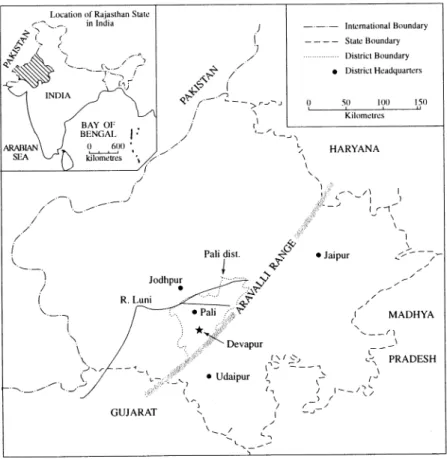
Devapur is a village located in the Pali district of Rajasthan , the south-western region of the Aravalli Range which is called the Luni Basin or Godwar tract (see Figure 1). The village lies on the bank of the Mithri river, which has seasonal water flows . It rises in the Aravalli Range and meets the Luni river, the only perennial river of the desert tract in Rajasthan.
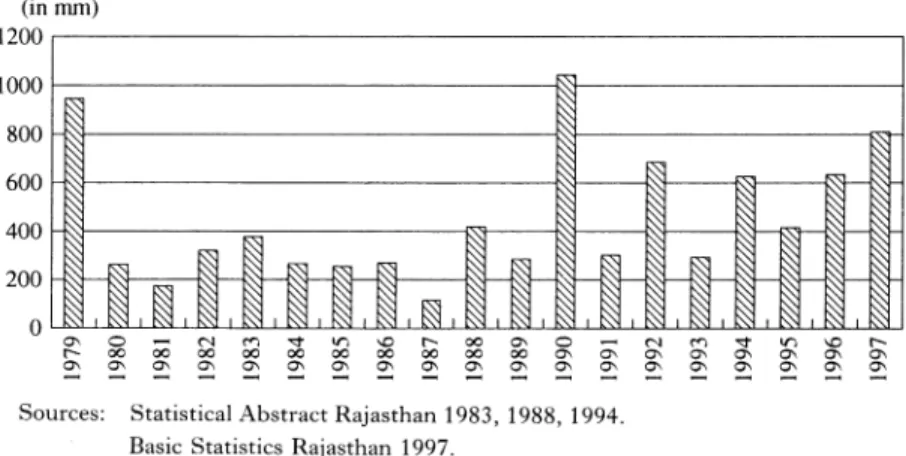
The climate of the Pali district is on the whole dry with a hot season . From May through early June is the hottest period of the year and the maximum temperatures sometimes reach 46°C . The period from mid-June to mid-September is normally the monsoon season. The average annual rainfall in the district, according to the District Gazetteer , is 472.2 mm and the area has a semi-arid environment5) that places certain rigorous conditions on the subsistence patterns of its inhabitant . Varia-tions in annual rainfall from year to year are considerable (see Table 1).
Less than 400 mm in annual rainfall indicates that the monsoon that year failed and a drought hit the area. On the other hand , in years with nearly
production. In nineteen years from 1979 to 1997, there were only five years with a good monsoon: 1988, 1992, 1994, 1996, and 1997. The shortage of rainfall and its erratic nature are major problems in the area. In other words, the irregularity and unpredictability of rainfall is an ecological characteristic of the area and a factor that has decisive effects on the agricultural activities of the local agriculturalists.
2.2 The Agro-Pastoral Economy
Under these ecological conditions, agriculturists can attain a degree of economic security only through an integrative pattern of cultivation and
138 Journal of the Japanese Association for South Asian Studies, 12, 2000
animal husbandry. Besides pastoralists who migrate during the dry sea-son with a herd of sheep and goats, agriculturalists who are settled in the village and cultivate land also raise a varying number of cows and buffa-los for milk production. The number of livestock in a household of agriculturalists tends to increase in proportion to the amount of agricul-tural production. It is locally said that 1000 rupees of cash income is available per month from a milking cow or buffalo after excluding the cost of fodder. Animal husbandry can provide not only milk which is a basic subsistence need, but also a useful cash income.
The activities of agriculture and animal husbandry are not in direct conflict. On the contrary, they complement each other, particularly in that animal husbandry provides essential fertilizer and agricultural crop residues provide fodder. In terms of labour demand, agricultural tasks are mainly performed by adult males, while those of animal husbandry are carried out by women and children. Participation in a mixed agro-pastoral economy is an important form of risk management for the house-holds of agriculturists. Production based on pastoralism is less suscep-tible to drought [Fisher 1997: 159].6)
2.3 The Castes of Agriculturists
Devapur was formerly one of the jagir estates granted to a Deora Rajput man by the Jodhpur State. It was around three hundred years ago when members of the Rajput clan came to inhabit and rule the
Table 1 Annual Rainfall in Pali District
Sources: Statistical Abstract Rajasthan 1983, 1988, 1994. Basic Statistics Rajasthan 1997.
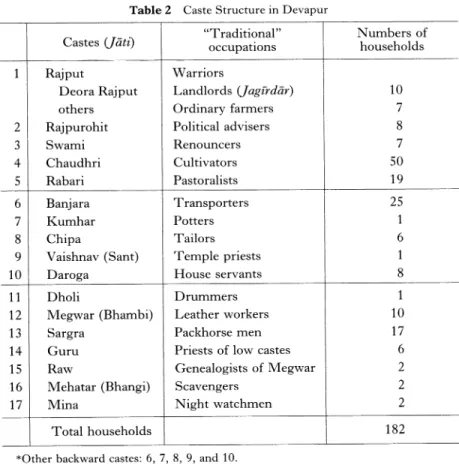
village. Devapur has a population of 1087 in 182 households. There are 17 different caste groups characterized by endogamy, hereditary mem-bership, and a style of life which sometimes includes the pursuit of a particular occupation defined by caste and which is usually associated with a hierarchical status (see Table 2).
Many households in the village are related to agriculture in one way or another, but only half of them identify themselves as agriculturists. The other half identify themselves as pastoralists, temple priests, tailors, or factory workers, even though their incomes partly derive from agricul-ture and some of them are actually involved in agricultural processes as
140 Journal of the Japanese Association for South Asian Studies, 12, 2000
seasonal labourers. The agriculturists mainly consist of Rajputs and Chaudhris. The former were traditionally landholders and the latter ten-ants. Among the Rajputs, the Deora Rajputs were landlords (jagirdar) who had controlled a huge amount of land and exercised political power , while other Rajputs were small-scale landowners, some of whom culti-vated the land themselves. Many households of Chaudhris received khatedari rights and became the real owners of the land by means of the Rajasthan Land Reform and Resumption of Jagir Act of 1952 and the Rajasthan Tenancy Act of 1955. The ex-jagirdar families of Rajput now supervise the agricultural production that is carried out by sharecrop-pers. We may call them supervising farmers. Chaudhris cultivate their own land, undertake sharecropping, or engage in wage labour. Some households of the other castes such as Rajpurohit , Swami, Daroga, Megwar, Sargra, and Mina are also engaged in cultivation.
3. Agrarian Relations in Devapur
In the following sections I point out three important features of agrar-ian relations that have to do with water, the most constraining resource in Devapur.7)
3.1 The Importance of Water Ownership and its Unequal Distri-bution
Since the Green Revolution brought the mechanization of agriculture to the village in the 1970s, cultivation in Devapur has become highly dependent upon the use of ground water. As a result, rabi(spring) culti-vation is considered to be the most important kind of agriculture because it is more profitable and less uncertain than that of kharif (autumn) which is primarily rain-fed.8) Rabi crops include wheat, barley, and raj-(rape) among others. Kharif crops include jowar (great millet), guar, maize, sesame, and so on.
The irrigated land has a higher crop yield and promises surplus pro-duction. Having water resources means a reliable income for agricultur-ists from cultivation, and it also makes possible an increase in their income from animal husbandry. In the dry season, cows and buffalos will give less or no milk unless they are fed green fodder. The owner of a source of water which does not contain salt can grow rajga (a kind of green fodder) in his field and give his cattle plenty of green fodder through-out the year.9) Thus, his income from milk increases. In addition, rajgei itself is in high demand and is sold at a high price to those who keep
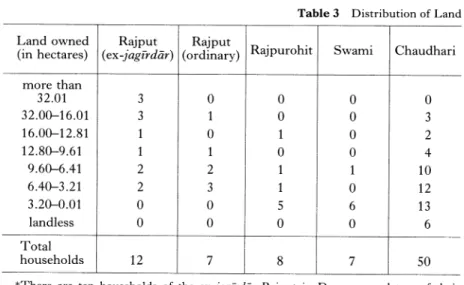
among Households by Castes
142 Journal of the Japanese Association for South Asian Studies, 12, 2000
cattle but have no water resources.
In contrast to the irrigated land which is highly valuable to agricultur-ists, land without a water supply is less useful. Even though there is a vast amount of unirrigated land in Devapur, much of it is not utilized even for kharif cultivation. Most of the inoperative land is located far from the settlement area and owned by small landholders. Since they do not have vehicles like tractors or bullocks-carts, it is difficult for them to reach their field every day. In the growing stage, the crops need to be watched day and night to prevent animals from eating them. Unirrigated land cannot pay for such agricultural labour, being small in area and not very productive. [Nakatani 1998: 119-121]. In addition, the uncertainty of production with kharif crops makes it more difficult for small land-holders to invest in such a small piece of land. Only the unirrigated land located near the settlement area is sown in kharif cultivation.
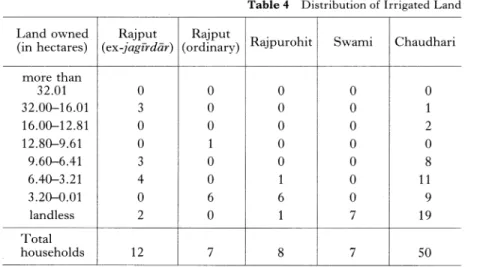
Due to the low value in use, unirrigated land in Devapur does not have much exchange value either.10) Therefore, the pattern of land distri-bution tells us little about agrarian structure in Devapur. The land re-forms of the 1950s modified the unequal distribution of landholdings among the agriculturists in Devapur, but did not fundamentally change agrarian relations since most of the land given to tenants by landlords was unirrigated or barren. Table 3 shows the distribution of land among
the households in Devapur according to caste. It demonstrates that most of the households in all castes own land and that landless households make up only 35 of the total 184 villaghouseholds. Table 4, on the other hand, shows the distribution of irrigated land. In this table we find information about the ownership of water resources among the village households. "Landless" in Table 4 means that the household does not have a source of water to provide for land. Among the 118 waterless households, 83 own unirrigated land.
Although water is of prime importance in Devapur agriculture, its distribution among the households is quite uneven. About thirty years ago when no motor pumps were installed, bullocks were used to lift water from the wells. Today artesian and tube wells with electrical or diesel pumps operate in the village. The mechanization of irrigation systems increased the amount of water lifted from a well and expanded the scale of cultivation, but the over-exploitation of ground water by pumping machines has gradually decreased the level of the ground water and many wells in the village have run dry.") I heard that at least 10 wells in the village had dried up and 32 households had lost their water
resources in the last twenty years.
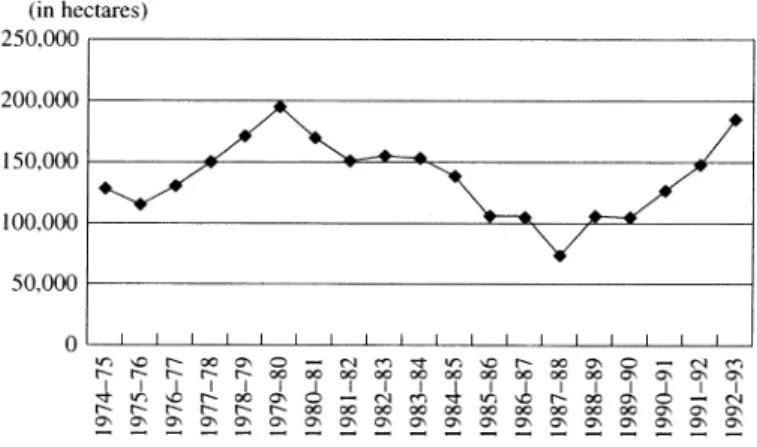
At the district level, the number of energized wells decreased from 37,355 to 18,200 in the twenty years between 1973 and 1993 [Gazetteer
144 Journal of the Japanese Association for South Asian Studies, 12, 2000
of India 1995a: 61]. Table 5 shows changes in the area irrigated from wells in the Pali district from 1974 to 1993. We find that the annual fluctuation in the area irrigated from wells is considerable, and that the irrigated area did not increase so much in twenty years. The annual fluctuation in the irrigated area resulted from variations in rainfall. The reason we cannot find expansion of the irrigated area , despite the mecha nization of agriculture, seems to be related to the fact that the number of wells in the district decreased by a little under half in the same twenty years. The mechanization of lifting water and the lowering of the water table has led to a concentration of water resources in the hands of a few people. Only those who could afford to spend huge amounts of money to deepen wells and install pumps were able to draw plenty of water , ex-pand the area of cultivation, and increase production, while most agri-culturists were not able to invest in irrigation and their shallow wells ran dry. Today, the number of waterless households in Devapur approaches 65% of the total households which are engaged in agriculture and all of which own some amount of land.
3.2 The Mobility of Agrarian Relations
It is true that the ownership of water in Devapur tends to be con-trolled by certain rich agriculturists, but the possession of water is not as stable as land ownership. This unstability gives agrarian relations some
Table 5 Area Irrigated from Wells in Pali
mobility. The ground water level is gradually decreasing and wells need to be constantly deepened in order to maintain a supply of water. It is, however, uncertain whether or not additional water can be extracted from the same place simply by deepening a particular well since the flow
Table 6.1 Cultivated Area for Kharif Crops in Devapur
Table 6.2 Cultivated Area for Rabi Crops in Devapur
Table 6.3 Converted Area from Unirrigated Land into Irrigated Land for Rabi Crops
146 Journal of the Japanese Association for South Asian Studies, 12, 2000
148 Journal of the Japanese Association for South Asian Studies, 12, 2000
150 Journal of the Japanese Association for South Asian Studies, 12, 2000
152 Journal of the Japanese Association for South Asian Studies, 12, 2000
and the amount of groundwater are unpredictable. Not a few households have failed to find water in spite of a huge expenditure for digging a well. Every person who owns a supply of water has the fear of losing it, although the probability of losing it varies according to how much the owner can invest in the well and where the well is located .12)
Furthermore, the amount of water available for cultivation also changes according to the rainfall. Therefore, the cultivated area varies every year . In the case of kharif cultivation which depends on natural rainfall , the area cultivated in Devapur in 1995-96, for example, was about one-quarter of that of 1997-98 (see Table 6.1). Even in the rabi cultivation which takes advantage of irrigation and which is, therefore, relatively stable, the difference in the scale of cultivation each year is quite large , because the amount of water in a well will increase in a good monsoon and decrease in a drought (see Table 6.2).
The change in the scale of production due to fluctuations both in water ownership and in water availability naturally gives mobility to the economic conditions of agriculturists and also leads to changes in pro-duction relations. The contractual period for sharecropping is one-year, whereas that of agricultural labour is on a daily basis since the number of sharecroppers and labourers needed varies in accordance with the scale of production. This makes the positions of the sharecropper and wage labourer insecure, but it gives them, at the same time, the opportunity to change the owner with whom they contract their services.
Table 7 continued
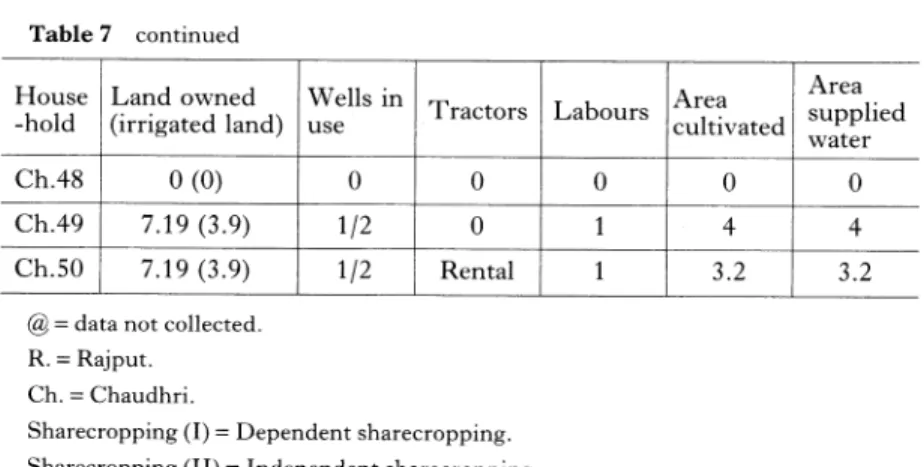
@ = data not collected.
R. = Rajput. Ch. = Chaudhri.
Sharecropping (I) = Dependent sharecropping. Sharecropping (II) = Independent sharecropping.
3.3 The Sharecropping System
The system of sharecropping is prevalent in Devapur agriculture. The sharecropping contract is made at the beginning of the monsoon season and is valid for the one year in which kharif and rabi- crops are cultivated. The distribution of the harvest is prescribed in Devapur as follows. Kharif crops are divided into three shares: one for land, one for a tractor and seed, and a third share for labour. In rabi cultivation, the crops are divided into five shares: one for land, two for water, one for a tractor and seed, and one for labour. The details of the contract, such as who pays for fertilizer and how chaff is divided, are agreed upon in each contract every year between the lessor and the lessee.
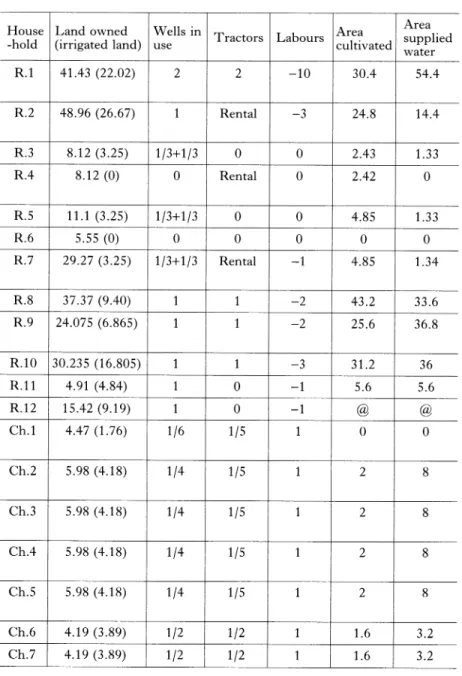
Table 7 shows by household the ownership of the means of produc-tion and the performance of sharecropping in the rabi cultivation of
1997-98. For lack of space, only the households of ex-jagFrdiir Rajput and Chaudhri are shown in the table. 'Land owned' is the total amount of land owned by households. It includes irrigated, unirrigated and bar-ren land. The figure in parentheses shows the area registered as irrigated in the government record. 'Well in use' and •ftractor' are the number of working wells and tractors owned by households. There are many cases of co-ownership of a well and a tractor. 'Labour' is the number of family members who are engaged in cultivation. Those who work casually are not included in the number. 'Minuses in labour' means that the house-hold took in the labour of others. 'Area cultivated' shows the area of one's own land cultivated for rabi crops in 1997-98. It excludes rented
154 Journal of the Japanese Association for South Asian Studies, 12, 2000
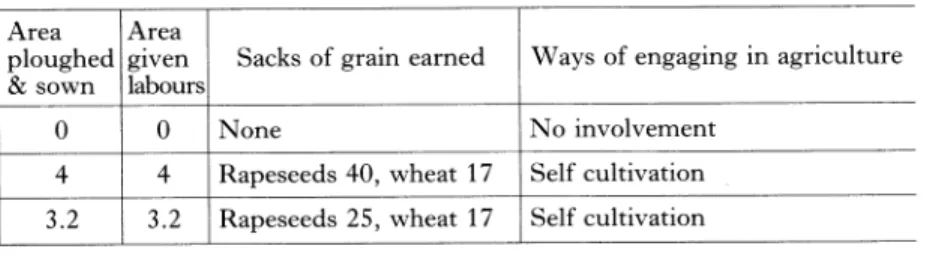
land and includes leased out land. This figure indicates how much land a household utilized for cultivation. 'Area supplied water' shows the area to which a household supplied water for irrigation. It includes one's own land and rented land, both of which one's water was supplied to. The figure indicates the amount of water that a household utilized for cultiva-tion. 'Area ploughed & sown' means the area in which one bore expenses of a tractor and seed for ploughing and sowing. 'Area given labours' is the area in which one gave his labour for cultivation. The figure shows how much land one cultivated by one's own labour.
For example, R.9 managed 27.2 hectares of cultivation in 1997-98. Out of it the area owned by him was 25.6 hectares and the rented land was 1.6 hectares. He supplied water for irrigation to the 27.2 hectares that he managed and to the 9.6 hectares that another person managed. Thus the total area to which he supplied water was 36.8 hectares. The area he ploughed and sowed was 27.2 hectares. This means he bore the expenses of a tractor and seed for ploughing and sowing in the area he managed. He himself did not work in the field and all the agricultural work in his management area was done by the two sharecroppers he employed. Thus, the area he gave labour to is 0 hectares. To conduct this cultivation, he made three kinds of sharecropping contract with four persons: two sharecroppers, a landowner, and a water leaser. He received four-fifths of the harvested crops in 25.6 hectares of his own land, three-fifths in 1.6 hectares of the rented land, and two-fifths in 9.6 hectares of the other person's management area to which he supplied water. In total he earned 186 sacks of rapeseeds, 23 sacks of wheat, and 30 sacks of barley. Regarding to the fertilizer, he paid half of the cost in the area he managed and the other half was paid by his two sharecroppers. He paid for the seed and received all the chaff after the harvest. In the area to which he only supplied water, he did not pay for the fertilizer and seed and did not get any chaff.
Few agriculturists in Devapur are provided with all the factors of production. In rabr cultivation in 1997-98, out of the total 113 house-holds, 10 households neither leased in nor out any means of production and conducted cultivation on their own. The other 103 households made sharecropping contracts among themselves. Usually those who own enough water expand their scale of cultivation by leasing land and labour, while others who have less or no water lease water or lease out their labour.
They decide the amount of land that they will cultivate in any particular
year based on the availability of water, and then negotiate with each
other in order to lease water, land, a tractor, and/or labour on a
share-cropping basis. The shareshare-cropping contract in Devapur is not like a
standard contract with two parties such as a landowner and a tenant who
provide productive resources and divide crops. It sometimes involves
more than two parties. The respective owners of the different factors of
production come together and carry out the cultivation.
The system of sharecropping has a kind of flexibility which allows it to
deal with situations in which the number of parties involved in
cultiva-tion varies. Furthermore, the sharecropping contract is also flexible enough
to cope with changes in productivity caused by the unpredictable
rain-fall. When the contract is made at the onset of the monsoon season, no
one knows how much water there will be that year. With respect to those
two points, the sharecropping system is better suited to the agricultural
conditions of Devapur compared with a fixed rent or wage system.
4.
Changes
in Agrarian
Relations
4.1 The Mechanization
of Agriculture
and the Change in Crop
Shares
About thirty years ago the first tractor was introduced to Devapur and
the first motor pump was installed in a well. The number of such
agri-cultural machines in Devapur has gradually increased and machinery
has taken over the important role that bullocks used to play in the
pro-duction process. According to the village people, bullocks were used in
many fields for ploughing, threshing, and the lifting of water before
thirty years ago. After that, the level of the groundwater gradually went
down and it became impossible to lift water with bullocks. Today, all
working wells in the village are equipped with motor pumps.
The mechanization of agriculture changed the value placed on the
main factors of production and led to a change in the rules for dividing
crops. Before mechanization, the value was not put on water itself, but
on the labour required to lift it. The seed and manure applied to the
fields were prepared by the agriculturists themselves and did not need to
be purchased from the market. In other words, water, seed and manure
were not regarded as capital for production, although they were
impor-156 Journal of the Japanese Association for South Asian Studies, 12, 2000
tant factors of production. Thus, crops were divided into four shares: one for land, one for lifting water, one for ploughing and sowing, and one for other kinds of farm work like watering, watching, threshing, and winnowing. Since the bullocks were owned by the tenant, not the land-lord, three shares used to belong to the tenant and only one-quarter of the total crop was given to the landlord as rent.
In the past, the harvest work on the farms held by landlords was conducted by all of the village people. For harvesting, large amounts of labour are necessary to complete the harvest quickly at the right time. In order to obtain this labour for the harvest, landlords used to hold an adold in which all the village people participated and were provided with tea, biri (local cigarettes), a good meal, and gur (cane sugar) in return for a day's labour. For the village people, participating in the harvest on the landlord's farm was an obligation and a sign of loyalty to him. For the landlord, holding an adolii was not just a way of concentrating large amounts of labour, but also a way of displaying his power and generos-ity. The more villagers participating in his harvest, the greater his pres-tige. In the case of ordinary people, the additional labour needed for the harvest was obtained by means of labour exchange among themselves.
Today, water is lifted by motor pumps. The person who owns a pump and bears expenses for fuel and the costs of its repair, that is, the owner of water, receives two-fifths of the total crop. Bullocks are not used for ploughing in any field. The person who owns a tractor and provides seed receives one-fifth of the total crop. The share for the landowner de-creased from one-quarter to one-fifth in rabi cultivation. This is because land without water has become less valuable after the Green Revolution. Lastly, the share for the labour rendered by tenants has changed from three-fourths to one-fifth. For the harvest as well, there is a remarkable change in the way of collecting labourers. Today agricultural labourers are employed and their wages are born by neither the landowner nor the water owner, but by the sharecropper. The harvesting work is included in the labour rendered by the sharecropper. He decides whether he needs labourers and how many labourers he needs to complete the work in the field he has contracted for cultivation.
4.2 Changes in the Nature of Production Relations
amount of water that could be lifted by the bullocks was limited. How-ever, the area cultivated using bullocks was also small. People never thought that water was scarce and unequally distributed. The motor pump made it possible to lift as much water as was available in a well. The greater amount of water that can be lifted, the wider the area that can be cultivated using a tractor. Today, water is sometimes sent to a field five kilometres away from the well through a long earthen channel running across several fields. In this way land registered as unirrigated can be converted into irrigated when enough water is available (see Table 6.2 & 6.3).
The amount of water now determines the scale of cultivation and the number of sharecroppers needed. Thus the relationship between the landlord and the tenant has lost its secure nature and become a relation-ship based on a yearly contract between the owner of the land, water, and tractor and the owner of labour. This change in the nature of the relationship implies that the control exercised over the tenant by the landlord has changed from a social to an economic one. In the past, tenants not only supplied their labour to landlords, but also worked on their own initiative. For example, they decided for themselves when and what crops would be grown in the field. They cultivated the same field every year and the right of cultivation in the field passed on to their sons. The field was, therefore, considered to be 'theirs', although they recog-nized that the real owner of the field was the landlord. Previously the relationship between the landlord and the tenant was a patron-client one, but now it is better described as an economic relationship between a supervising farmer and a sharecropper. Sharecroppers can no longer make decisions in the production process. They lost most of the share in the harvested crops and their pride in agricultural work as well.
The emergence of wage labourers has also resulted from the same process of mechanization in agriculture followed by the change in pro-duction relations. The use of machines decreased the number of tenants who constantly worked, whereas the expansion of the area of cultivation increased the numbers of labourers for harvesting.13) Some of the ex-tenants became agricultural labourers. They engage in construction work during the agricultural lean period. The ex-landlord no longer has the social power to call on the village people to do his work and he also no longer needs to secure their subsistence, since the relationship has changed.
158 Journal of the Japanese Association for South Asian Studies, 12, 2000
4.3 The Idiom of 'Tradition' Expressed in the Sharecropping Re-lationship
The present sharecropping relationship is based on economic needs. Sharecropping is prevalent in Devapur because it is useful, rational, and economical. Nevertheless, it is expressed by the village people using the idiom of 'tradition'. This is evident in the negotiations in which the details of the sharecropping contract are discussed. The negotiations are carried out without any direct claims on the economic interests of either side. The sharecropper, for example, asks to increase his share, saying "I have been serving your family for a very long time from my father's generation", "I have many daughters to marry", or "I am expecting you to be generous to poor cultivators like us". He asks the supervising farmer for an increase in his share and benefits by appealing to the traditional relationship between a patron and a client.") When the share-cropper stops working, he will probably say that he has become too old to undertake cultivation or that he is sick. The supervising farmer knows that the real reason may be different. It soon becomes apparent in a small village.
A supervising farmer once told me that everyone talked in sweet words, but no one maintained any loyalty to him. He also said that his family has become richer because he has given up the various obligations that his father as a real patron had fulfilled to his dependents. What he said implies that the appropriation of labour of sharecroppers has become more direct. However, the sharecropping contract made between the supervising farmer and the dependent sharecropper takes the form of the traditional relationship based on morality. What is interesting is that this
'traditional'
relationship is continuously renewed and used to gain
eco-nomic benefits by both sides. When a supervising farmer, for example, asked his sharecroppers to grow cotton on his farm providing good con-ditions in dividing the profit, he took up the attitude of a generous owner and explained that all the risks in cotton cultivation would be borne by him and that large profits were expected. His sharecroppers refused the proposal and said that they had not engaged in cotton cultivation tradi-tionally. In reality, the supervising farmer wanted to grow cotton be-cause it was very profitable for him, while the sharecroppers did not want to because cotton cultivation is labour intensive and because they know that the more they work, the more they are exploited. In Devapur
today, only self-cultivating agriculturists are engaged in cotton cultiva-tion.
5. Production Relations Determined by Water
5.1 The Owner and the Non-Owner of Water
Present agrarian relations have been restructured by agricultural mecha-nization and changes in the value of the main factors of production, particularly of water. Since the ownership of water is the most important factor in determining production relations in Devapur, we classify the village agriculturists into two categories: those who own water resources (owners of water) and those who do not own water resources (non-owners of water) and explain the ways in which they are engaged in
agriculture (see Figure 2 & Table 8).
First of all, all the owners of water in Devapur, regardless of their self-identification, take part in agriculture. There are three different ways in which an owner of water may be engaged in agriculture. The first way is to supervise agriculture (khett sa‚•bharna) without conducting any manual work. Out of the twelve households of ex-jagirdiir Rajputs, seven house-holds own a good amount of water and supervise agriculture. They con-tract with several numbers of sharecroppers according to the size of cultivation they manage. In the cultivation of 1997-98, for example, the
supervising farmer who owned the largest amount of water contracted with ten sharecroppers (see Table 7, Household of R.1). He owns 22.02
160 Journal of the Japanese Association for South Asian Studies, 12, 2000
hectares of irrigated land, but he expanded his area of cultivation up to 54.4 hectares by sending water to 34.38 hectares of the unirrigated land, among which 8.38 hectares was his own and 24 hectares was leased from several landowners. He provided all of the other factors of production except labour and received four-fifths of the total production on his own land and three-fifths on the rented land.
The second way is to cultivate using one's own labour and water (khudukasht). There were 31 households of this category in 1997-98. They may be called as households of self-cultivating agriculturists. They were tenants in the past, but became owners of land by means of land reforms and at present they have sources of irrigation for the land . Nor-mally several households of brothers and kin jointly own a well , since the investment required is so great. Among the 31 households of self-culti-vating agriculturists, 7 own their private wells and the other 24 are of joint owners (see Table 7). In some cases these co-owners of a well
cultivate together and divide crops, in other cases they cultivate sepa-rately and draw water one by one, one household each day in a set order. The joint ownership of a well enables several households to have a source of water, but it often leads to a scramble for the scarce water in a well on which several fields depend and results in the failure of the crops in all the fields.
The last way is to lease out land and water to those who engage in cultivation and gain two fifths of the harvested crops without being in-volved in the production process. We may call them proprietors-(I). Three households in Devapur are counted in this category. One owner's family does not live in Devapur and the other two households do not have the labour force for cultivation since the family heads work in Bombay. Their land with water resources is in high demand and is leased out to Devapur agriculturists.
While all of the owners of water take part in cultivation in some way or (Rabi Cultivation in 1997-98)
162 Journal of the Japanese Association for South Asian Studies, 12, 2000
another, about 50% of the non-owners of water are involved in cultiva-tion. There are three different ways in which the non-owners of water take part in cultivation. The first way is sharecropping (bhagedari). The agriculturists of this category supply their labour for cultivation. They are again divided into two categories: dependent sharecroppers and in-dependent sharecroppers. A dependent sharecropper supplies only his labour to a supervising farmer who provides all of the other factors of production, that is, land, water, a tractor and seed. Regarding to the other inputs, the general rule is that the cost of fertilizer is divided equally between the owner of water and the owner of labour, and that the chaff belongs to those who provided seed. However, the rules are beginning to change as the sharecroppers gradually gain bargaining power. Fertilizer is in many cases provided by the supervising farmer. Chaff is divided equally between the two parties in some cases, but the supervis-ing farmer keeps all of it in other cases.
An independent sharecropper manages cultivation by leasing water on a sharecropping basis and hiring a tractor from its owner at the rate of 150-200 rupees per hour. The cultivated land belongs to him if there is a well near his field and he can take water on lease from the well. But in many cases, the land also belongs to someone else. Usually an indepen-dent sharecropper first finds a well in which water is available for lease, and then contracts with a landowner whose land is close to the well. Most of the agriculturists including those who own water resources usu-ally take agricultural loans from the middlemen at crop markets for the cash needed for high yield varieties of seed, chemical fertilizer, the costs of hiring a tractor, and/or the wages for the agricultural labourers during the harvest. The loan is taken at the beginning of cultivation and repaid by selling harvested crops to the middleman who gave the loan. In this way independent sharecroppers can arrange all the necessities of cultiva-tion.
The second way of taking part in cultivation for non-owners of water is to lease out land to agriculturists who manage cultivation, and to be not involved in the production process at all. People of this category also can be called proprietors, but the difference is that proprietors of this second type do not own a source of water. The proprietor-(II) provides unirrigated land and receives a one-fifth share of the harvested crop as
but a few of them are engaged in agriculture for themselves. They work as sharecroppers and their land is let out to others who arrange water for the cultivation of their land (see Table 7, Household of Ch.38 and Ch.47). Many people in Devapur own land, but those who can lease it out are few. Only the land which is equipped with a well or which is located near a well is in demand. Thus, many landholders cannot utilize their land for cultivation.
The third way in which non-owners of water participate in cultivation is to work as agricultural labourers. Most labourers for harvesting are women since their wages are lower than those of men. Male labourers are hired for tasks considered more difficult or heavier like driving trac-tors, running threshing machines, and climbing trees to cut off branches. Male labourers from the households of agriculturists are temporary labourers while the women are seasonal labourers. Thus we do not in-clude them in the table that shows ways of engaging in agriculture. To work as a wage labourer is often regarded as one of the ways to make money for investment in agricultural production.
Owners of water take in land and/or labour according to the amount of water available in the year, while non-owners of water take in water or lease out labour. In making sharecropping contracts, the owners of water are normally in a stronger position than the non-owners of water since the availability of water is very low in Devapur. Most of the agricultur-ists who have surplus water prefer to lease land for the expansion of their cultivation areas rather than to lease out water, because that is more profitable. Only in years in which plenty of water is available in the wells do some self-cultivating agriculturists lease out their surplus water due to a shortage of family labour.
In this way, agriculturists in Devapur are first divided into two cat-egories: owner and non-owner of water, and then each of these is subdi-vided into three types according to the difference in the ways of conduct-ing cultivation. Except that the supervisconduct-ing farmers, who were tradition-ally the landlords and who are still economically powerful by having water resources, continue to occupy the highest position in the agrarian hierarchy in Devapur, the other types of agriculturists do not form classes or distinct groups. For most of the agriculturists in Devapur, who may be called peasants, the way they engage in agriculture depends on their choices and is determined after careful consideration of the availability of
164 Journal of the Japanese Association for South Asian Studies , 12, 2000
land and/or water, the allotment of family labour, and the social
relation-ships with the other village people. They are not in the process of
polar-ization. In fact, in a good monsoon year, there is a large difference in
agricultural income between an owner of water and a non-owner of
water (see Table 9.1 & 9.2). In a bad year, however, the dependent
sharecroppers are sometimes better off than the other agriculturists. Thus,
there may be economic differences among the peasant households in any
particular year. However, their economic situations may reverse in the
following year.
5.2 Choices of the Non-Owner of Water
In this section we will discuss what choices are open to those
agricul-turists who do not possess water, the most important means of
produc-tion. Then, we will ask what are the points that they consider when they
choose a particular course of action among several possibilities in order
to make a living and hopefully improve their living conditions.
The first choice for a non-owner of water is whether he engages in cultivation or not. If he decides not to engage in agriculture, a popular alternative among the youth is to go Bombay to work. The number of people who engage in non-agricultural occupations is increasing year by year. Even an older man sometimes goes to work in the city when he finds it difficult to support his family by agriculture or when he needs extra money, but this is rare and temporary. In order to conduct cultiva-tion, the choice for the non-owner of water is to undertake sharecrop-ping either as an independent sharecropper or as a dependent one. In the
case of the independent sharecropper, he has to arrange all the factors of production on his own. So, he will decide from whom he should take land and/or water on lease. In the case of the dependent sharecropper, he must decide on a supervising farmer under whom he is willing to work. Although the percentage of crop shares is the same, there are significant differences between the supervising farmers in Devapur and those in other villages in terms of the extra jobs required and the benefits given by them. There are minor differences even among the supervising
farm-Table 9.2 Sacks of Wheat & Barley Earned in Raba Cultivation in 1997-98
166 Journal of the Japanese Association for South Asian Studies, 12, 2000
ers in the same village. Some households of supervising farmers are reputed to provide good conditions for sharecroppers and others are reputed to make sharecroppers do a lot of work.
In order to choose from these several options, the following matters are considered. The first one is the question of economic efficiency. The income that is presumed to be available is compared with the labour and other inputs required. Another consideration is economic security. Not only how much profit can be produced, but also how regularly it can be produced is one of the important concerns. Since cultivation is highly affected by ecological changes, especially by the availability of water, many households of agriculturists have strategies or measures to
con-front such changes. One of the measures is to allot family labour into different types of work: sharecropping, wage labour, and non-agricul-tural occupations. If two members of a household engage in sharecrop-ping, they work on different farms to disperse the risk.
The last and the most important consideration is that of social rela-tionships. All people think of economic gain and security, but not every-one makes the best decision on the basis of his economic calculations. Since most of the agriculturists depend on others in conducting cultiva-tion, the choice of the person with whom he makes a contract for culti-vation is, to some extent, influenced by the social relationship between the participants in the contract. The matter of concern is not only the present relationship, but also what it was in the father's generation. To keep good relations with partners is, at least on the surface, necessary for making sharecropping contracts. Factors such as the social ties of caste and kinship and political position influence and restrict choices. The partners may be kin, close friends, or a patron and his client. With respect to the dependent sharecroppers, the supervising farmer wants people who are ex-tenants and belong to the middle-ranked castes, be-cause he also makes the sharecroppers do house work such as the collec-tion of firewood, the milling of grain, the preparacollec-tion of food for feasts, and he may even send them on errands to his relatives' houses. The supervising farmers, since they are Rajputs of the upper caste, cannot let the people of lower castes prepare a feast for them, because they have to maintain their social status and ritual purity.
In the past when all of the village agriculturists cultivated the fields of landlords, to undertake cultivation was a kind of privilege for the
ten-ants. The landlords used to keep as many tenants on as they wanted to. These days, the number of sharecroppers who work for them is decreas-ing. This is partly because agricultural mechanization has decreased the number of sharecroppers required on any particular farm, but also partly because it has gradually become difficult for the supervising farmer to keep suitable sharecroppers in his employ. People come to dislike
work-ing under superviswork-ing farmers and opportunities for non-agricultural work are also available for them. Recently some dependent
sharecrop-pers have been drawn from lower castes and from neighbouring villages and these new types of dependent sharecroppers tend to maintain a purely economic relationship with the supervising farmer.15)
5.3 Reasons for Work as Dependent Sharecroppers
Despite the general tendency that fewer and fewer agriculturists in Devapur rely on supervising farmers for their subsistence and that more and more young people work outside the village, some still keep tradi-tional relationships with them. We will consider why they still choose to cultivate land as dependent sharecroppers of a particular supervising farmer.
If we compare two types of sharecropping in terms of the total income earned, there is not a clear difference between the two (see Table 9.1 &
9.2). The difference is in the share of crops that each receives according to the factors of production provided. The dependent sharecropper re-ceives only one-fifth of the crop, but the expenses are born by the super-vising farmer except for the wages of agricultural labourers. The inde-pendent sharecropper receives either two-fifths or two-thirds of the crop as shares for the tractor and seed, for labour, and for land (if the land belongs to him), but he must bear all the expense of agricultural inputs. The difference of income is not derived from the type of sharecropping but rather from how much land they undertake for cultivation, how many people engage in the cultivation, and most importantly whether sufficient water is supplied to the field being cultivated. Cultivation by a minimum number of sharecroppers in a large field with sufficient water is most profitable. Since most of the supervising farmers own sufficient water, it sometimes happens that the dependent sharecroppers working under them have a higher income than independent ones. However, these conditions of cultivation change every year and in each contract.
168 Journal of the Japanese Association for South Asian Studies , 12, 2000
Thus, it is difficult not only for us, but also for the agriculturists them-selves to know which type of sharecropping is more profitable .
In terms of economic security, there are some advantages for a depen-dent sharecropper working under a powerful supervising farmer . One of them is access to green fodder which is essential for milking cows and buffalos in the dry season.16) There are also other advantages such as receiving half of the chaff after cultivation and the possibility of borrow-ing a tractor from the supervisborrow-ing farmer with only the payment of a fuel charge. These advantages seem to be very small compared with the labor provided by the sharecropper in a year in which there is a good monsoon followed by a good harvest. The dependent sharecropper works throughout the year for the family of a supervising farmer and receives only one-third of the kharif crops and one-fifth of the rabi crops . In addition to the agricultural work in the field, private work for the supervising farmer is often required without any extra payment .
However, if rain does not come, being a dependent sharecropper of a powerful farmer is an effective way to survive. If the monsoon were to fail, most of wells in the village except for two or three owned by super vising farmers would run dry. The kharif crops would fail and the com -ing rabf crops would not be sown in most of the fields . No green grass, no chaff, and no fodder would be available . The cattle would stop giving milk and starve. People would wait for rain as long as possible , but they would finally have to give up their cattle and send them away . In such a situation, the land of the powerful supervising farmers is still provided with water, although on a smaller scale. Their sharecroppers would still receive some amount of crops, green fodder, and chaff during a drought . In a severe drought, the supervising farmer reduces the cultivated area and the numbers of sharecroppers. Those who are fired are sharecrop-pers from outside of the village [Nakatani 1998: 121-23].
We can say that one of the incentives for working as a dependent sharecropper is the economic security provided during a drought . How-ever, agriculturists in Devapur are not concerned only with economic interests. Dependent sharecroppers think that the more they work , the more their labour is appropriated and that they are degraded by it . They are especially unhappy to be called on to do private work for the super-vising farmer. Thus, some of them prefer to work under supersuper-vising farmers outside the village, where no advantage is received but no non
-economic relationship is involved.
It is true that the economic advantages received from the supervising farmer are attractive for agriculturists, especially for those who are non-owners of water. But it is difficult to know whether or not working as a dependant sharecropper will be an economically better choice, since avail-ability of water is unpredictable when the sharecropping contract is made. The reasons for work as a dependent sharecropper, in the end, cannot be fully understood as long as we consider it to be a purely economic choice. Rather the relationship should be seen as one between the ex-landlord and the ex-tenant. In other words, the relationship has been maintained since their fathers' generation. For sharecroppers, they are obliged to work for the supervising farmer since the fathers worked for the super-vising farmer's father. For the supervising farmer, he asks certain share-croppers to work for him for the same reason. Even though they are not always willing to work as dependent sharecroppers, they do not abandon the traditional ties unless they have a more profitable means of livelihood or have 'proper' reasons to stop working according to the logic of the village people.
6. Conclusion
By way of conclusion, I will reconsider the role of the sharecropping system in the development of agriculture. Since the new technologies of agricultural machinery and hybrid seed were introduced, the economy of Devapur agriculturists has been closely related to the change in prices of crop markets and the labour market. The market economy has strikingly penetrated into their life as consumers as well. With the introduction of new technology, the percentage of a crop that is given to the owner of labour is seriously reduced. But the absolute amount of crop given to him does not necessarily decrease, given the fact that as the scale of cultivation expands, the number of sharecroppers among whom the crop is redistributed decreases, and the crop yield increases.17) The agricultur-ists in Devapur make a profit from cultivation in good monsoon years and invest it in agricultural capital, especially in the improvement of the water supply.
These aspects of present-day Devapur agriculture are different from the situation that is called stagnation or involution of agriculture.18) This
170 Journal of the Japanese Association for South Asian Studies, 12, 2000
forces us to reconsider the view that sharecropping contracts are soon
likely to be replaced by relationships more suited to the demands of
` mode
rn ' agriculture.19) The prevalence of sharecropping in Devapur is
related to the fact that water is the most important factor of production and its ownership determines the production relations, and more impor-tantly to the fact that water availability fluctuates so dramatically that it is impossible to fix the price of water. Owners of water try to produce as much as possible by making the most efficient and economical use of available water. Non-owners of water, on the other hand , deal with this ecological uncertainty by means of a sharecropping system that makes it possible to carry on cultivation, to come through drought years, and ultimately to make a profit in good monsoon years. Thus , we can under-stand sharecropping as a mechanism to utilize a variable amount of water up to the maximum and as a system that make it possible for each agriculturist to pursue his own economic interests according to his posi-tion both in the agrarian relations and the social relations of the village . In neighbouring areas where water is constantly supplied from a canal , the tenancy contract has already changed to a fixed rent system . This fact also supports our understanding of the sharecropping in Devapur .
We have seen that the agriculturists in Devapur engage in cultivation in a number of ways and that water ownership and its availability deter-mine their position in the agrarian relations and the particular way that they engage in agriculture. However, it is also important to emphasize that even an agriculturist who does not possess water , the critically im-portant factor of production, has options and chooses one out of several possibilities based on the considerations of economic and social relations. The system of sharecropping in Devapur was restructured when water became capital. The nature of the sharecropping relationship has changed from the social to the economic, but it seemingly takes a form of 'tradi-tional' relationship based on morality in order to cover their pursuit of economic interests and to keep a good relationship with one another . A supervising farmer needs 'traditional' sharecroppers in order to exploit their labour while keeping his social status and pride. Sharecroppers cannot break off 'traditional' ties with the supervising farmer since the availability of water is unpredictable. The idiom of 'tradition' is eco-nomically used in the sharecropping relationship.
Acknowledgments
I would like to thank all the people in Devapur who shared their knowledge and experience with me. Earlier drafts of this paper have been presented at the annual meeting of the Japanese Association for South Asian Studies in 1999 and the PhD. thesis writing seminar orga-nized by Professor M. Tanaka in the Institute for Research in Humani-ties, Kyoto University. I benefited very much from the discussion and comments raised at these meetings. Special thanks to Professor K. Kano of Kanazawa University for his comment and advice.
Notes
1) The fieldwork on which this paper based was conducted from September 1992 to March 1993 and from March 1998 to September 1998 in a Rajasthan village. Sev-eral visits to the same village in short periods were carried out between these two field trips.
2) Oono [1971] describes the agricultural situation in a Persian village where water is scarce and unevenly distributed. He mentions that the ownership and control of water is a critical factor of agricultural production in the village. The situation he observed in a Persian village seems to be very similar to that which I found in a Rajasthan village. But he only points out the importance of water in village agricul-ture and does not consider how the uneven distribution of water is related the system of sharecropping prevailing in the village and the agrarian structure as a whole.
3) I use the term of 'water' in place of land. Water availability, water ownership, water productivity respectively mean how much water is available for production, how many water resources a person owns, and how many crops can be produced by a certain amount of water and quality of water supplied to land in a period of time. 4) The economic efficiency of sharecropping has elicited a great deal of academic inter-est, discussion and investigation among economists. It has been argued that share-cropping is a technically efficient mechanism for the control of labour, an intensification of input, and the reduction of the risks associated with particular factors of produc-tion or uncertainties of ecology and climate [cf. Cheug 1969; Newbery and Stiglitz 1979; Bardhan and Srinivisan 1971]. The nature of sharecropping relationships has been discussed by two opposing approaches. Marxists see sharecropping contracts as instruments of surplus labour appropriation, presupposing that the relationships between the owner of the means of production and the owner of labour are inher-ently adversarial [cf. Pearce 1983]. Moral economists, on the other hand, explain sharecropping as a kind of reciprocal system in the local community by means of which the subsistence of all members is guaranteed [cf. Geertz 1963; Scott 1976]. 5) Degree of aridity can be defined in a number of different ways. The simplest ap-proach is to take the mean annual rainfall as the criterion. Areas with less than
100 mm of rain per year are classified as desert, areas with between 100 and 400 mm per year as arid, and areas with more than 400 mm per year as semi-arid. Arid land
172 Journal of the Japanese Association for South Asian Studies, 12, 2000
is unsuitable for any agriculture, whereas some agriculture is possible on semi-arid land [Fisher 1997: 21].
6) While crop production on rainfed land in a drought year can be less than 10% of the production in a good year, milk and wool remain above 50% of the level in a good year [CAZRI 1983; quoted in Fisher 1997].
7) See Nakatani [1998] for a detailed description of agrarian relations in Devapur. In the article, I discuss the natural resources, the technology, and the labour organiza-tion in Devapur agriculture, the ownership of the means of production, and the relationship between landlords and sharecroppers.
8) Generally agriculturists in Devapur are less interested in kharif crops. Thus, the net area sown in kharif is far less than that in rabi. This is mainly because heavy rain may spoil the seeds sown or a drought may wither the seedlings. The successful cultivation in kharif needs rainfall both at the right time and in the right quantity . On the other hand, rabi cultivation needs higher capital investment, but its produc-tion is secure as long as water is available in the well and the necessary inputs are done [cf. Nakatani 1998].
9) Good quality ground water contains no or less salt. It can produce a variety of crops and vegetables, while saline water is used only for wheat and millet cultivation . Saline water also damages the soil itself [Nakatani 1998: 113].
10) The price of land per bigha (1.65 ha) in Devapur, according to the village people , is 500 to 2,000 rupees, while land in a neighbouring village where water for irrigation is constantly supplied from a canal costs 15,000 to 20,000 rupees per bigha . 11) The water level in Devapur is said to have decreased from 25 to 90 feet over the last
twenty or thirty years [Nakatani 1998: 112].
12) Even among the ex-jagirdar,there are five households which own little water, al-though they own a good amount of land. They are brothers and cousins and share two wells. They made their old well deeper since it had dried completely, but the water level in the well did not increase. Then they dug at new place at the expense of 200,000 rupees, but little water came out. Today they are in an economically difficult condition.
13) All the harvesting work is still done by human labour. Combines are not used in Devapur, because they waste chaff which serves as cattle fodder.
14) Brow mentions the flexible ideology of sharecropping which provides both the hier-archical and the reciprocal idioms [Brow 1980]. The use of traditional status be-tween a patron and a client is found in his argument with respect to the hierarchical aspect of the ideology.
15) Out of the 23 dependent sharecroppers employed by the supervising farmers in Devapur, 14 people were from middle castes and 3 people from lower castes of the same village. The remaining 5 people came from lower castes in neighbouring vil-lages. On the other hand, among the 22 people who engaged in agriculture as depen-dent sharecroppers, 17 were employed by the supervising farmer in Devapur and 5 were employed outside the village.
16) In Devapur the limited numbers of wells, most of them owned by the supervising farmers, supply sweet water which makes it possible to grow rajga. By engaging in sharecropping under the owner of sweet water, the sharecropper can receive half of
rajga in the field. Since rajga is costly, this advantage is a strong incentive. The other villagers who do not undertake sharecropping have to buy ridges of rajga either from supervising farmers or from their sharecroppers.
17) The average yields of wheat per hectare in the state of Rajasthan were 875 kg in 1963 and 1,253 kg in 1973, but they increased considerably over the twenty years from 1973 to 1993 and reached 2,287 kg by 1993. The high yielding variety of wheat sown in Devapur in 1997-98 was Raj 1482 . This variety has a yield of 4,000 to 5,000 kg per hectare, while the local varieties yield only 1,000 to 1,400 kg per hectare [Gazet-teer of India 1995b: 13].
18) Geertz argues that sharecropping is useful as an involutional mechanism [1963: 98]. 19) A widely held view is that sharecropping will disappear with the capitalist
develop-ment of agriculture. Robertson and Lehmann are among the minority who opposed this. Robertson argues that sharecropping relationships should be examined in the context of a household developmental cycle [Robertson 1982]. Lehmann points out that the practice of sharecropping has a particularly important part to play in the emergence of an agrarian structure dominated by what he calls capitalized family farms [Lehmann 1986].
References
Bardhan, P. and T. Srinivisan, 1971, "Cropsharing Tenancy in Agriculture: A Theoreti-cal and Empirical Analysis", American Economic Review 61, pp. 48-64.
Brow, James, 1980, "The Ideology and Practice of Share-Cropping Tenancy in Kukulewa and Pul Eliya", Ethnology 19-1, pp. 47-67.
CAZRI, 1983, "Outlines of the Technologies for Reconstruction of the Arid Zone", Technical Bulletin 7, Jodhpur, Central Arid Zone Institute.
Cheung, S., 1969, The Theory of Share Tenancy. Chicago: Chicago University Press. Fisher, R.J., 1997, If Rain Doesn't Come: An Anthropological Study of Drought and
Human Ecology in Western Rajasthan. Delhi: Sydney Studies & Manohar.
Gazetteer of India, 1976, Rajasthan District Gazetteers: Pali. Jaipur: Government of Rajasthan. •\
, 1995a, Rajasthan State Gazetteer, Vol. 1: Land and People. Jaipur: Government of Rajasthan. •\
, 1995b, Rajasthan State Gazetteer, Vol. 3: Economic Structure and Activities. Jaipur: Government of Rajasthan.
Geertz, Clifford, 1963, Agricultural Involution: The Processes of Ecological Change in Indo-nesia. Berkeley: University of California Press.
Lehmann, David, 1986, "Sharecropping and the Capitalist Transition in Agriculture: Some Evidence from the Highlands of Ecuador", Journal of Development Economics 23, pp. 333-54.
Nakatani, Sumie, 1998, "Agrarian Relations in a Rajasthan Village", Annals of the Insti-tute for Research in Humanities, Kyoto University, Zinbun 33, pp. 107-27.
Newbery, D. and J. Stiglitz, 1979, "Sharecropping, Risk Sharing and the Importance of Imperfect Information" in J.A. Roumasset, et al., eds., Risk Uncertainty and Agricul-tural Development. Southeast Asian Regional Center for Graduate Study and Research in Agriculture, pp. 311-39. New York: Agricultural Development Council.