ミュージカルノイズフリー音声抽出における 音声カートシス比に基づく反復回数の制御
∗☆平野佑佳,宮崎亮一,猿渡洋,中村哲
(奈良先端大)
1 Introduction
To achieve high-quality speech enhancement, noise reduction using a microphone array has been widely studied. In recent years, we previously proposed a BSSA [1] that consists of accurate noise estimation by independent component anal- ysis (ICA) [2] and the following speech extraction procedure based on nonlinear noise reduction such as spectral subtraction (SS). However, BSSA always suffers from artificial distortion, so-called musical noise, owing to nonlinear signal processing.
To solve this problem, we have proposed iterative BSSA [3] consisting of dynamic noise estimation by ICA and musical-noise-free iterative SS [4]. This method can perform noise reduction with perfectly no musical noise even with increasing the number of iterations in SS, but instead always suffers from speech distortion. Since speech distortion cannot be measured without a clean reference speech signal, we should have to decide the number of iterations manually based on our auditory perception.
Recently, we have proposed a speech kurtosis ra- tio (4th-order statistics) as a new unsupervised mea- surement of speech distortion [5]. Therefore, in this paper, first, we propose a new speech kurtosis esti- mation method using the noise signal estimated by ICA. Next, we propose an automatic control of the number of iterations based on the speech kurtosis ratio estimated using ICA in iterative BSSA.
2 Related Works
2.1 Musical-Noise-Free Iterative BSSA In this section, we describe iterative BSSA that can perform noise reduction with perfectly no mu- sical noise in nonstationary noise (see Fig. 1). This method consists of iterative blind dynamic noise es- timation by ICA and musical-noise-free speech ex- traction by modified iterative SS, where multiple it- erative SS are applied to each channel while main- taining the multi-channel property reused for ICA.
We conduct iterative BSSA in the following man- ner, where the superscript [i] represents the value in the ith iteration of SS (initially i = 0).
Step(I) The observed signal vector of the K-channel array in the time-frequency domain,
x[0](f, τ ), is given by
x[0]
(f, τ ) =
h(f)s(f, τ) +
n(f, τ), (1) where f denotes the frequency subband, τ is the frame index,
h(f) = [h
1(f ), h
2(f ) . . . , h
K(f )]
Tis a column vector of the transfer functions from the tar- get signal position to each microphone, s(f, τ ) is the target speech signal, and
n(f, τ) is a column vector of the additive noise.
∗ Unsupervised control of speech quality based on higher-order statistics in musical-noise-free blind speech extraction, by Yuka Hirano, Ryoichi Miyazaki, Hiroshi Saruwatari, and Satoshi Nakamura (Nara Institute of Science and Technology)
1st iteration
DS Output SS
SS ICA
SS SS ICA
SS SS ICA 2nd iteration Final iteration
Fig. 1 Block diagram of iterative BSSA.
Step(II) We perform signal separation using ICA
o[i](f, τ) =W
ICA[i](f )x
[i](f, τ ), (2)
WICA[i][p+1](f) =µ[I
− ⟨φ(o[i](f, τ ))(o
[i](f, τ ))
H⟩τ]
·WICA[i][p]
(f ) +
WICA[i][p](f ), (3) where
WICA[i][p](f ) is a demixing matrix, µ is the step- size parameter, [p] is used to express the value of the pth step in the ICA iterations,
Iis the iden- tity matrix,
⟨·⟩τdenotes a time-averaging operator, and
φ(·) is an appropriate nonlinear vector function.
Then, we construct a noise-only vector,
o[i]noise(f, τ ) =[o
[i]1(f, τ ), . . . , o
[i]U−1, 0,
o
[i]U+1(f, τ ), . . . , o
[i]K(f, τ )]
T, (4) where U is the signal number for speech, and we apply the projection back operation to remove the ambiguity of the amplitude and construct the esti- mated noise signal,
z[i](f, τ ), as
z[i]
(f, τ) =
WICA[i](f )
−1o[i]noise(f, τ ). (5) Step(III) We perform SS independently in each input channel and derive the multiple target-speech- enhanced signals. This procedure can be given by x
[i+1]k(f, τ ) =
√
|
x
[i]k(f, τ )
|2−β
|z
k[i](f, τ )
|2exp(j arg(x
[i]k(f, τ))) (if
|x
[i]k(f, τ )
|2> β
|z
k[i](f, τ)
|2)
ηx
[i]k(f, τ ) (otherwise)
,
(6) where x
[i+1]k(f, τ ) is the target-speech-enhanced sig- nal obtained by SS at a specific channel k, β is the oversubtraction parameter, and η is the floor- ing parameter. Then we return to step (II) with
x[i+1](f, τ ). When we obtain sufficient noise reduc- tion performance, we proceed to step (IV).
Step(IV) Finally, we obtain the resultant target- speech-enhanced signal by applying DS to
x[∗](f, τ ), where
∗is the number of iterations after which suffi- cient noise reduction performance is obtained. This procedure is expressed by
y(f, τ ) =
wDST(f )x
[∗](f, τ ), (7)
wDS(f ) = [w
(DS)1(f ), . . . , w
(DS)K(f )], (8) w
k(DS)(f ) = 1
K exp(
−2j(f /N)f
sd
ksin θ
U/c), (9)
- 669 -
2-1-3
日本音響学会講演論文集 2014年3月
where y(f, τ ) is the final output signal of iterative BSSA,
wDSis the filter coefficient vector of DS, N is the DFT size, f
sis the sampling frequency, d
kis the microphone position, c is the sound velocity, and θ
Uis the estimated direction of arrival of the target speech [1]. Moreover, [A]
ljrepresents the entry of
Ain the lth row and jth column.
This method can generate almost no musical noise even with increasing noise reduction, but instead al- ways suffers from large speech distortion because of no justification of applying ICA to such signals non- linearly distorted by SS. Since speech distortion can- not be measured without a clean reference speech signal, we should have to decide the number of iter- ations manually based on our auditory perception.
2.2 Unsupervised Measurement of Speech Distortion
2.2.1 Speech Kurtosis Ratio
As an evaluation of speech distortion, cepstral dis- tortion is widely used. However, cepstral distortion cannot be measured without a clean reference speech signal. To solve this problem, speech kurtosis ratio was proposed as an unsupervised measurement of speech distortion. The speech kurtosis ratio is ob- tained as [5]
kurtsis ratio
[s]= kurt
[s]proc/kurt
[s]org, (10) where kurt
[s]procis the speech kurtosis after signal pro- cessing and kurt
[s]orgis the speech kurtosis before sig- nal processing. It is proved that the speech kurtosis ratio is strongly correlated to cepstral distortion [5].
2.2.2 Speech Kurtosis Estimation Method The observed signal in the time-frequency do- main, x(f, τ ), is given by x(f, τ ) = s(f, τ ) + n(f, τ ).
Since the speech component is always contaminated with noise at every time-frequency grid, it is difficult to estimate the speech kurtosis via theoretical analy- sis. Therefore, we inversely calculate the kurtosis of the speech power spectrum in a data-driven manner, utilizing two observable statistics of the noisy speech signal x(f, τ ) and noise signal n(f, τ ) [5]. Note that the proposed speech kurtosis estimation is an un- supervised method because it requires no reference (clean) speech signals, unlike cepstral distortion.
To cope with the mathematical problem that the mixing of speech and noise is additive but generally their higher-order moments are not additive, we in- troduce the cumulant, which retains the additivity for additive variables. Meanwhile, in the transfor- mation from a waveform to its power spectrum, the exponentiation operation is conducted. However, the cumulant does not have a straightforward re- lationship. In this case, we use the moment instead of the cumulant. Thus, we previously proposed the use of a moment-cumulant transformation [5]. In moment-cumulant transformation, The mth-order moment µ
m(x) can be written as
µ
m(x) =
∑π(m)
∏
B∈π(m)
κ
|B|(x), (11)
where π(m) runs through the list of all partitions of a set of size m, B
∈π(m) means that B is one of the blocks into which the set is partitioned, and
|
B
|is the size of set B. In the same manner, the mth-order cumulant κ
m(x) is given by
κ
m(x)=
∑π(m)
(
−1)
|π(m)|−1(
|π(m)
|−1)!
∏B∈π(m)
µ
|B|(x).
(12) Hereafter, when we define complex-valued variables of the observed (noisy speech) signal, the original speech signal, and the noise signal as (x
R+ ix
I), (s
R+ is
I), and (n
R+ in
I), in [5], the kurtosis of the speech power spectrum is estimated from moment- cumulant transformation, and the additivity of cu- mulants, as
kurt
speech= µ
4(s
2R+ s
2I)
µ
22(s
2R+ s
2I) =
N(µ
m(x
R), µ
m(n
R))
D(µ
m(x
R), µ
m(n
R)) ,
(13) where
D
(µ
m(x
r), µ
m(x
i), µ
m(n
r), µ
m(n
i))
=
[µ
4(x
r)+ µ
4(x
i)
−µ
4(n
r)
−µ
4(n
i) +
{2µ
2(x
i)
−6µ
2(n
r)
−2µ
2(n
i)
}µ
2(x
r) +
{−2µ
2(n
r)
−6µ
2(n
i)
}µ
2(x
i) +6µ
2(n
r)
2+2µ
2(n
i)µ
2(n
r)+6µ
2(n
i)
2]2
, (14)
N(µ
m(x
r), µ
m(x
i), µ
m(n
r), µ
m(n
i))
=µ
8(x
r)+ µ
8(x
i)
−µ
8(n
r)
−µ
8(n
i) +
{4µ
2(x
i)
−28µ
2(n
r)
−4µ
2(n
i)
}µ
6(x
r) +
{4µ
2(x
r)
−4µ
2(n
r)
−28µ
2(n
i)
}µ
6(x
i) +
{−28µ
2(x
r)
−4µ
2(x
i)
+56µ
2(n
r)+4µ
2(n
i)
}µ
6(n
r) +
{−4µ
2(x
r)
−28µ
2(x
i)
+4µ
2(n
r)+56µ
2(n
i)
}µ
6(n
i) +
[
6µ
4(x
i)
−70µ
4(n
r)
−6µ
4(n
i)+420µ
2(n
r)
2+
{−60µ
2(n
r)
−36µ
2(n
i)
}µ
2(x
i) +60µ
2(n
i)µ
2(n
r)+36µ
2(n
i)
2]
µ
4(x
r) +
[−
6µ
4(n
r)
−70µ
4(n
i)+36µ
2(n
r)
2−{
36µ
2(n
r)+60µ
2(n
i)
}µ
2(x
r) +60µ
2(n
i)µ
2(n
r)+420µ
2(n
i)
2]
µ
4(x
i) +70µ
4(n
r)
2+ µ
4(n
r)+70µ
4(n
i)
2+ µ
4(n
i)+µ
2(x
r)
−{
360µ
2(n
r)
3+216µ
2(n
i)µ
2(n
r)
2+360µ
2(n
i)
2µ
2(n
r)+2520µ
2(n
i)
3}
µ
2(x
i) +2520µ
2(n
r)
4+360µ
2(n
i)µ
2(n
r)
3+216µ
2(n
i)
2µ
2(n
r)
2+360µ
2(n
i)
3µ
2(n
r)+2520µ
2(n
i)
4. (15) This method can estimate speech kurtosis with high precision. However, if the noise signal estimated by the speech absence part is short, this method cannot work stably.
- 670 -
日本音響学会講演論文集 2014年3月
Fig. 2 Block diagram of ICA-based kurtosis esti- mation.
3 Proposed Method
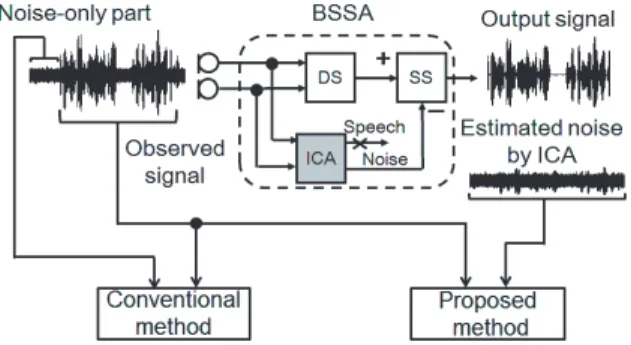
3.1 Speech Kurtosis Estimation by ICA The main problem in the conventional method is the low robustness in the estimation of higher-order statistics. In this method, it is necessary to calcu- late up to eighth-order statistics. Since such higher- order statistics are very sensitive to outliers, we can- not estimate them stably from limited few samples in speech absence part, causing considerable degra- dation of estimated speech kurtosis. To solve this problem, we propose a new speech kurtosis estima- tion method using the noise signal estimated by ICA instead of that in speech absence period (see Fig. 2).
ICA can dynamically estimate nonstationary noise signal with great accuracy. By using the noise signal estimated by ICA, we can obtain enough the noise signal of length, and we can estimate higher-order statistics stably from a sufficient number of samples.
3.2 Speech-Kurtosis-Based Quality Control Since iterative BSSA can generate no musical noise by keeping its higher-order statistics, it can be assumed that the statistical quantity of the resid- ual noise signal in iterative BSSA does not change before/after processing. Therefore, we propose the control method of the number of iterations in the SS part using the speech kurtosis estimation method described in Sect. 3.1.
In this method, first, we calculate speech kurtosis before processing using the ICA-based noise estima- tion. Next, as for the estimate of speech kurtosis after processing, we can efficiently obtain it thanks to the assumption of fixed noise statistics in musical- noise-free properties.
The mth-order moment of noise signal n before signal processing given by
µ
m(n) =
∫ ∞
0
n
mP(n)dn, (16) where P (n) is the probability density function of a power-spectral-domain signal n. Since we consider that the noise statistics after signal processing are the same as that before signal processing, we calcu- lated µ
m(n
′) after signal processing as
µ
m(n
′) =
∫ ∞
0
α
mn
mP (n)dn
= α
mµ
m(n), (17)
where
∗′is a signal after signal processing, and α is a noise reduction rate, α = n
′/n, which can be
estimated by speech absence part. We can estimate speech kurtosis after signal processing using µ
m(n
′) and (13) as,
D
(µ
m(x
′r), µ
m(x
′i), µ
m(n
′r), µ
m(n
′i))
=
[µ
4(x
′r)+ µ
4(x
′i)
−α
4{µ
4(n
r)+ µ
4(n
i)
}+2
{µ
2(x
′i)
−3α
2µ
2(n
r)
−α
2µ
2(n
i)
}µ
2(x
′r)
−
2α
2{µ
2(n
r)+3µ
2(n
i)
}µ
2(x
′i) +2α
4{
6µ
2(n
r)
2+ µ
2(n
i)µ
2(n
r)+3µ
2(n
i)
2 }]2, (18)
N
(µ
m(x
′r), µ
m(x
′i), µ
m(n
′r), µ
m(n
′i))
=µ
8(x
′r)+µ
8(x
′i)
−α
8µ
8(n
r)
−α
8µ
8(n
i) +4
{µ
2(x
′i)
−7α
2µ
2(n
r)
−α
2µ
2(n
i)
}µ
6(x
′r) +4
{µ
2(x
′r)
−α
2µ
2(n
r)
−7α
2µ
2(n
i)
}µ
6(x
′i) +4α
6{−
7µ
2(x
′r)
−µ
2(x
′i)+14α
2µ
2(n
r)+α
2µ
2(n
i)
}µ
6(n
r) +4α
6{−
µ
2(x
′r)
−7µ
2(x
′i)+ α
2µ
2(n
r)+14α
2µ
2(n
i)
}µ
6(n
i) +
[
6µ
4(x
′i)
−70α
4µ
4(n
r)
−6α
4µ
4(n
i)
−
12α
2{5µ
2(n
r)+3µ
2(n
i)
}µ
2(x
′i) +12α
4{
35µ
2(n
r)
2+5µ
2(n
i)µ
2(n
r)+3µ
2(n
i)
2 }]µ
4(x
′r) +
[−
α
4{6µ
4(n
r)+70µ
4(n
i)
}−
12α
2{3µ
2(n
r)+5µ
2(n
i)
}µ
2(x
′r) +12α
4{
3µ
2(n
r)
2+35µ
2(n
i)
2+5µ
2(n
i)µ
2(n
r)
}]µ
4(x
′i) +70α
8{
µ
4(n
r)
2+ µ
4(n
i)
2 }+ α
4{µ
4(n
r)+µ
4(n
i)
}+ µ
2(x
′r) +72α
6[−
5µ
2(n
r)
3−3µ
2(n
i)µ
2(n
r)
2−
5µ
2(n
i)
2µ
2(n
r)
−35µ
2(n
i)
3 ]µ
2(x
′i) +72α
8[
35µ
2(n
r)
4+5µ
2(n
i)µ
2(n
r)
3+3µ
2(n
i)
2µ
2(n
r)
2+5µ
2(n
i)
3µ
2(n
r)+35µ
2(n
i)
4]
. (19)
This processing is advantageous because we can omit the re-estimation process of noise kurtosis that is difficult to estimate after nonlinear signal process- ing like SS. Finally, based on the above-mentioned estimates of speech kurtosis before/after processing, we predict speech distortion and control the maxi- mum number of iterations in iterative BSSA.
4 Evaluation Experiments
4.1 Speech Kurtosis Estimation
To confirm the effectiveness of the proposed the speech kurtosis estimation method, we conducted objective evaluation experiments. In this experi- ment, the speech kurtosis estimated by the con- ventional method and the proposed method were compared. We used a two-element microphone ar- ray with an interelement spacing of 2.15 cm, and the direction of the target speech was set to be
- 671 -
日本音響学会講演論文集 2014年3月
0 0.5 1.0 1.5
0.5 1.0 3.0 5.0
Normalized error
Data length of noise-only part [s]
Proposed method Conventional method
Good Bad
Fig. 3 Experimental result of speech kurtosis esti- mation.
1.10 1.15 1.20 1.25 1.30
1 2 3 4 5
Number of iterations
Speech kurtosis ratio
3.00 3.25 3.50 3.75 4.00 4.25
1 2 3 4 5
Number of iterations
Cepstral distortion [dB]
(a) (b)
Estimated Oracle
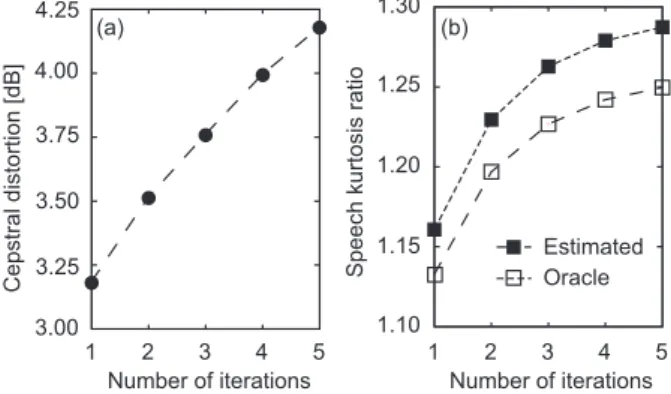
Fig. 4 (a) Relation between number of iterations and cepstral distortion, (b) Relation between num- ber of iterations and speech kurtosis ratio in oracle or estimated.
normal to the array. The size of the experimen- tal room was 4.2
×3.5
×3.0 m
3and the reverbera- tion time was approximately 200 ms. All the sig- nals used in this experiment were sampled at 16 kHz with 16-bit accuracy. The observed signal con- sisted of the target signal of one speaker (female) and one real-recorded diffuse noise (railway station noise) emitted from eight surrounding loudspeak- ers. The input SNR was set to 0 dB. The FFT size was 1024, and the frame shift length was 256.
The length of speech absent part was set to 0.5, 1.0, 3.0 or 5.0 s. We calculated the normalized error of the estimates in the conventional and proposed methods and compared the accuracy of speech kur- tosis estimation. The normalized error is defined as e
norm=
|kurt
oracle−kurt
speech|/kurt
oracle, where kurt
oracleis the power spectral kurtosis of the clean speech signal and kurt
speechis the estimate of the speech power spectral kurtosis.
The result is shown in Fig. 3. In the conventional method, the normalized error increases as the data length of the noise-only part decreases. In contrast, since the proposed method can use sufficient data length, the normalized error is lower in each case, meaning that the proposed method can stably esti- mate speech kurtosis with high accuracy compared with the conventional method. Therefore, we can confirm the validity of the proposed method.
4.2 Control in Iterative BSSA
We conducted objective evaluation experiments to confirm the validity of the proposed method of con- trol of the number of iterations in iterative BSSA.
In this experiment, we calculated cepstral distortion and estimated speech kurtosis of the output signal of iterative BSSA. The number of iterations in it- erative BSSA was set to 1, 2, 3, 4 and 5, and the
results of each case were compared. Thus, we eval- uated whether or not estimated speech kurtosis was used as measure of speech distortion instead of cep- stral distortion. We used a four-element microphone array with an interelement spacing of 2.15 cm. The input SNR was set to 5 dB. The noise reduction rate was set to 10 dB. We used the noise signal estimated by ICA as the noise signal before/after processing.
Other experimental conditions are the same as those in the previous subsection.
The result is shown in Fig. 4. Figure 4 (a) shows a relation between the number of iterations and cep- stral distortion for the extracted speech in iterative BSSA, and (b) shows a relation between the num- ber of iterations and speech kurtosis ratio in oracle or estimated by the proposed method. In Fig. 4, both cepstral distortion and the estimated speech kurtosis ratio increase as the number of iterations increases. Thus, the speech kurtosis ratio is valid for an unsupervised measurement of speech distor- tion.
From this results, the number of iterations of it- erative BSSA is controllable by limiting the value of the speech kurtosis ratio within an allowable value in human perception. Therefore, we can control the number of iterations with a constraint on sound quality degradation.
5 Conclusions
In this paper, we propose a new speech kurtosis estimation method using the noise signal estimated by ICA, and an automatic control of the number of iterations in iterative BSSA. Experimental evalua- tions confirmed the efficacy of the proposed meth- ods.
Acknowledgements
This work was partly supported by JST Core Research for Evolutional Science and Technology (CREST).
References
[1] Y. Takahashi, T. Takatani, K. Osako, H. Saruwatari, K. Shikano, “Blind spatial subtraction array for speech enhancement in noisy environment,” IEEE Trans. Audio, Speech, and Lang. Process., vol.17, no.4, pp.650–664, 2009.
[2] P. Comon, “Independent component analysis, a new concept?,” Signal Process., vol.36, pp.287–
314, 1994.
[3] R. Miyazaki, H. Saruwatari, S. Nakamura, K. Shikano, Toward musical-noise-free blind speech extraction: concept and its applications, Proc. APSIPA, 2013.
[4] R. Miyazaki, H. Saruwatari, T. Inoue, Y. Taka- hashi, K. Shikano, K. Kondo, “Musical-noise- free speech enhancement based on optimized it- erative spectral subtraction,” IEEE Trans. Au- dio, Speech and Lang. Process., vol.20, no.7, pp.2080–2094, 2012.
[5] R. Miyazaki, H. Saruwatari, R. Wakisaka, K. Shikano, T. Takatani, Theoritical analy- sis of parametric blind spatial subtraction ar- ray and its application to speech recognition per- formance prediction, Proc. HSCMA, pp.19–24, 2011.
- 672 -
日本音響学会講演論文集 2014年3月