九州大学学術情報リポジトリ
Kyushu University Institutional Repository
超重核合成に向けた準弾性散乱による融合障壁分布 の研究
田中, 泰貴
http://hdl.handle.net/2324/2236025
出版情報:Kyushu University, 2018, 博士(理学), 課程博士 バージョン:
権利関係:
Study of Fusion Barrier Distributions from Quasielastic Scattering Cross Sections
towards Superheavy Nuclei Synthesis
Taiki Tanaka
Department of Physics, Kyushu University
February 11, 2019
Abstract
The study of fusion barrier distributions is of fundamental importance in under- standing heavy-ion induced fusion reaction toward synthesis of superheavy nu- clei. Cross sections of the reactions for producing new elements are predicted to be much smaller than those for the existing elements. They are also known to be particularly sensitive to the incident energy. One of the most direct informa- tion for determining the optimum incident energy is the fusion barrier distribution.
This work aims at precisely obtaining the fusion barrier distribution of heavy-ion induced reactions by measuring the quasielastic scattering and at probing the re- lation between the barrier distribution and the optimum incident energy at which the evaporation residue cross section is maximized. Reactions studied in this work involve not only the cold fusion reactions traditionally used for the synthesis of new elements withZ =107−113, but also the hot fusion reactions recently being used for the synthesis of new elements heavier than Z = 114. Effects of chan- nel coupling and deformation of the target nucleus on the barrier distributions are discussed.
Many quasielastic scattering measurements were performed at RIKEN Nishina Center for Accelerator-Based Science using the gas-filled recoil ion separator GARIS to improve our understanding of fusion reactions. What is new in this method is measuring the recoiled nuclei at completely forward side using GARIS.
This method enable to derive the barrier distribution for angular momentuml=0 concern with superheavy nuclei synthesis. The excitation functions of quasielas- tic scattering cross-section of 48Ca+208Pb, 50Ti+208Pb, 48Ca+238U, 22Ne+248Cm,
26Mg+248Cm,30Si+248Cm,34S+248Cm,40Ar+248Cm,48Ca+248Cm and50Ti+248Cm were determined.
The quasielastic barrier distributions were extracted for the 10 reaction sys- tems previously noted, and were compared to coupled-channels calculations, and were compared to evaporation residue cross-sections. The calculation results indi- cate that the deformation of actinoide target nucleus, the vibrational and rotational excitations of the colliding nuclei, as well as neutron transfers before contact, affect the structure of the barrier distribution. The peak of the 2n evaporation cross-section of the cold fusion reactions 48Ca+208Pb and 50Ti+208Pb – relevant
to the synthesis of No (atomic number Z = 102), Rf (Z = 104) – emerged at the same energy as a local maximum of the barrier distributions. The evaporation cross-section of the hot fusion reactions 22Ne+248Cm, 26Mg+248Cm, 48Ca+238U and 48Ca+248Cm – relevant to the synthesis of Sg (Z = 106), Hs (Z = 108), Cn (Z = 112) and Lv (Z = 116), which are the frontier of the known superheavy nuclei – peak at an energy between experimental average Coulomb barrier height and the Coulomb barrier for a side collision. It is clear that the hot fusion reactions take advantage of a compact collision geometry with the projectile impacting the side of the deformed target nucleus.
The Coulomb barrier height of side collisions for synthesizing unknown su- perheavy nuclei were calculated using the experimental results from the barrier distribution study. New method for determining the incident energy for unknown superheavy nuclei using experimental results was proposed. This determination is independent of theoretical predictions that may include a large model dependence.
Contents
1 Introduction 6
1.1 History of the new elements . . . 6
1.2 Superheavy elements . . . 8
1.2.1 Liquid drop model . . . 8
1.2.2 Shell model and macroscopic-microscopic model . . . 8
1.2.3 Quantum many body system . . . 10
1.2.4 Frontier of the nuclei . . . 10
1.2.5 Importance for optimum incident energy . . . 10
1.2.6 How to solve the problem of optimum incident energy . . 13
1.3 Fusion barrier distribution . . . 14
1.3.1 Previous works for barrier distribution studies and super- heavy nuclei synsthesis . . . 14
1.3.2 Weak points in previous works . . . 14
1.4 Thesis objectives . . . 15
1.4.1 Purpose of this thesis . . . 15
1.4.2 New method of barrier distribution measurement . . . 15
1.4.3 Fusion dynamics for synthesizing superheavy nuclei . . . 15
1.4.4 Systematics of hot fusion reactions . . . 16
1.5 Contributions . . . 16
2 Experiment 17 2.1 Overview of the Experiment . . . 17
2.2 Beam . . . 17
2.2.1 Ions . . . 17
2.2.2 Beam intensity and attenuators . . . 18
2.3 Accelerator . . . 18
2.4 Targets . . . 19
2.4.1 208Pb Target . . . 19
2.4.2 238U Target . . . 21
2.4.3 248Cm Target . . . 21
2.5 The gas-filled recoil ion separator GARIS . . . 23
2.5.1 Overview of GARIS . . . 23
2.5.2 Beam intensity monitor (45◦elastic monitor) . . . 24
2.6 Focal plane detectors . . . 25
2.6.1 Time-of-flight detectors . . . 25
2.6.2 Position sensitive silicon detector (PSD) . . . 27
2.7 Data aquisition system . . . 27
2.7.1 1st-2nd mode . . . 28
2.7.2 Dead time . . . 28
3 Data Analysis and Results 31 3.1 Particle Identification . . . 31
3.1.1 ToF-E matrix . . . 31
3.1.2 Estimation of the mass . . . 33
3.1.3 Pulse height defect . . . 33
3.1.4 Energy loss in mylar window . . . 34
3.1.5 Estimated mass . . . 35
3.2 Separation of deep-inelastic scattering events . . . 36
3.2.1 Previous methods for the treatment of the deep-inelastic scattering events . . . 36
3.2.2 Upper Limit for Contaminated Deep-inelastic Events . . . 36
3.3 Transmission efficiency . . . 43
3.3.1 Transmission efficiency of GARIS . . . 43
3.3.2 Cutting the events due to the difference of the magnetic rigidity of the nuclei and settingBρof GARIS. . . 43
3.4 Analysis for 45◦elastic monitor . . . 45
3.5 Determination of the incident energy at target center . . . 46
3.6 Errors . . . 48
3.6.1 Systematic errors . . . 48
3.7 Experimental results . . . 53
4 Discussion 56 4.1 Comparison with coupled-channels calculations . . . 56
4.1.1 Single-channel calculation . . . 56
4.1.2 Coupled-channels calculation . . . 58
4.2 Comparison with the excitation function of the experimental evap- oration residue cross-sections . . . 58
4.2.1 Cold fusion reactions . . . 58
4.2.2 Hot fusion reactions . . . 60
4.3 Optimum incident energy for synthesizing unknown superheavy nuclei . . . 66
4.3.2 Determination of the optimum incident energy . . . 68
5 Conclusion 71 A Theoretical backgrounds 83 A.1 Capture cross-section . . . 83
A.2 Probability of compound nucleus formation . . . 85
A.3 Survival probability . . . 89
A.4 Deriving the barrier distribution . . . 90
A.4.1 Penetration probability for the Coulomb barrier . . . 90
A.4.2 Capture cross-section and penetration pribability . . . 91
A.4.3 Penetration probability and the barrier distribution . . . . 93
A.5 Rutherford scattering cross-section . . . 94
A.6 Quasielastic scattering cross-section and barrier distribution . . . . 95
A.7 Experimental barrier distribution . . . 96
A.7.1 Deriving the experimental cross sections ratio ofdσQE/dσR and the barrier distributions. . . 96
A.8 Quantum tunneling in one-dimensional system . . . 97
A.9 Numerov method . . . 99
A.10 Coupled-channels calculation . . . 101
A.11 Coupled-channels calculation code CCFULL . . . 102
A.11.1 Rotational coupling . . . 102
A.11.2 Vibrational coupling . . . 103
A.11.3 Transfer coupling . . . 104
A.11.4 Input parameters . . . 104
A.12 Woods-Saxon internuclear potential . . . 106
B Principle of GARIS 107
C Table of Estimations 109
D Statistical error 111
Chapter 1 Introduction
1.1 History of the new elements
From the ancient times, people have tried to understand the properties of the mate- rials in nature. Ancient philosophers tried to think about the origin of the materials through rhetoric and logic alone. The elements began to be understood by experi- mental results in the 16th - 17th centuries[1]. The periodicity of the elements was noticed in the 18th century[2]. The elements were arranged as a periodic table by Dmitri Ivanovich Mendeleev (1834 - 1907) in 1869, published in 1870.
The first particle accelerators, such as electrostatic accelerator (Van de Graaff, 1931) linear accelerator (Lawrence and Sloan, 1931) cyclotron (Lawrence, 1932), were invented and developed in 1930’s[3]. Technetium (Tc, atomic numberZ = 43) was the first artificial element produced using a particle accelerator in 1937[3].
Scientists have been able to produce many artificial elements beyond those ex- isting in nature. All of the elements which are heavier than uranium were dis- covered by artificial methods. Table 1.1 shows the reactions, investigators, and years of discovery for elements heavier than uranium. At this time, elements up to Z = 118 are recognized by international union of pure and applied chemistry (IUPAC). Scientists try to synthesize new elementsZ = 119 or 120 presently.
There are two methods for new element synthesis heavier thanZ = 102, so called “cold fusion reaction” and “hot fusion reaction”. The cold fusion reaction was used for new element synthesis between Z = 107 and 113, using spherical magic nuclei 208Pb or 209Bi as a target. The excitation energy of the compound nucleus is reduced by the reduced mass of the magic nuclei. The excitation energy is around 10 − 20 MeV, and the compound nucleus emits just 1 or 2 neutrons to make an evaporation residue without fission. The survival probability Psurv is much large compared to that of hot fusion reaction as a result of expeling a few
Table 1.1: Table of the informations of syntheses new elements. The informations based on Ref. [3]
Z Symbol Reaction Investigators Year
93 Np 238U(n,γ)239U→239Np MacMillanet al. 1939 - 1940 94 Pu 238U(d,2n)238Np→238Pu Seaborget al. 1940
95 Am 239Pu(2n,γ)241Pu→241Am Seaborget al. 1944
96 Cm 239Pu(α,n)242Cm Seaborget al. 1944
97 Bk 241Am(α,2n)243Bk Seaborget al. 1949
98 Cf 242Cm(α,n)245Cf Seaborget al. 1950
99 Es 238U+15n→253Es Seaborget al. 1953
100 Fm 238U+17n→255Fm Seaborget al. 1953 101 Md 253Es(α,n)256Md Seaborget al. 1955 102 No 246Cm(12C,4n)254No Seaborget al. 1958 103 Lr 252Cf(11B,6n)257Lr Ghiorsoet al. 1961 104 Rf 249Cf(12C,4n)257Rf Ghiorsoet al. 1969 105 Db 249Cf(15N,4n)260Db Ghiorsoet al. 1970
243Am(22Ne,4n)261Db Morlandet al. 1971 106 Sg 249Cf(18O,4n)263Sg Ghiorsoet al. 1974 107 Bh 209Bi(54Cr,n)262Bh Armbrusteret al. 1981 108 Hs 208Pb(58Fe,n)265Hs Armbrusteret al. 1984 109 Mt 209Bi(58Fe,n)266Mt Armbrusteret al. 1982 110 Ds 208Pb(62Ni,n)269Ds Armbrusteret al. 1995 111 Rg 209Bi(64Ni,n)272Rg Hofmannet al. 1995 112 Cn 208Pb(70Zn,n)277Cn Hofmannet al. 1996 113 Nh 243Am(48Ca,3n)288Mc→284Nh Oganessianet al. 2004
243Am(48Ca,4n)287Mc→283Nh Oganessianet al. 2004
209Bi(70Zn,n)278Nh Moritaet al. 2004 114 Fl 242Pu(48Ca,3n)287Fl Oganessianet al. 2004 115 Mc 243Am(48Ca,3n)288Mc Oganessianet al. 2004
243Am(48Ca,4n)287Mc Oganessianet al. 2004 116 Lv 245Cm(48Ca,2n)291Lv Oganessianet al. 2004 117 Ts 249Bk(48Ca,3n)294Ts Oganessianet al. 2010
249Bk(48Ca,4n)293Ts Oganessianet al. 2010 118 Og 249Cf(48Ca,3n)294Og Oganessianet al. 2006
The hot fusion reactions were used for synthesizing new element 102 ≤ Z ≤ 106 and 114 ≤ Z ≤ 118. The reaction employed deformed actinide nuclei as a target. Since the excitation energy of a compound nucleus of hot fusion reaction is higher than that of cold fusion reaction, the reaction is called “hot fusion reaction”.
The compound nucleus releases 3 - 6 neutrons, then, the survival probabilityPsurv
is considerably smaller than that of cold fusion reaction. Both the cold and hot fusion reactions have some advantages and disadvantages.
1.2 Superheavy elements
1.2.1 Liquid drop model
Weizsacker[4] and Bethe[5] proposed the formula of Weizsaecker-Bethe. It is based on “liquid drop model”, and the model explained the characteristics of the nuclear binding energy well. In 1938, Otto Hahn irradiated uranium with neu- trons. Then, he observed radium in the experimental result. He was not able to understand the reason. He sent a letter to Lise Meitner to find the reason. Lise Meitner explained the reason to him. Otto Hahn understood the mechanism of the fission from her explanation and got the Nobel prize in 1944. The fission barrier disappears toward superheavy element region in the liquid drop model. It means, superheavy elements do not have the stability against fission and should immediately undergo nuclear fission. In such a case, superheavy elements can not exist.
1.2.2 Shell model and macroscopic-microscopic model
Mayer[6] and Jensen[7] established the shell model in 1949. Strutinsky intro- duced the macroscopic-microscopic model in 1966. In that model, he adopted the liquid drop model as macroscopic part, and the shell model as microscopic part[8]. Figure 1.1 shows the calculated results of the macroscopic-microscopic model (solid lines) and liquid drop model (dashed line). In case of the liquid drop model, the fission barrier disappear at Z > 104. The fission barrier persists in the superheavy element region due to the shell effect. In addition to above in- formations, the model explained the existence of the nuclear isomerism well. The possible existence of superheavy element was considered after introduction of this model. We were able to search for the superheavy elements more thanZ = 104.
Figure 1.1: Nuclear deformation energy (solid lines) and the liquid drop model deformation energy (dashed lines) for heavy nuclei. In case of the liquid drop model, the fission barrier disappear at Z > 104. Thanks to the shell effect, the fission barrier appear not only Z ≤ 104 region but also superheavy elements region. This figure is taken from Ref. [8].
1.2.3 Quantum many body system
In the lectures of quantum mechanics, we learned about quantum tunneling. It is one of the most famous and original phenomena in quantum mechanics. However, I think, it is rare for this phenomenon to be seen in our real life. Since the super- heavy nuclei have a lot of nucleons and make Coulomb barrier potentials which is made some of the nuclear potential and Coulomb potential, we are able to demon- strate the phenomenon using the superheavy nuclei. One focus of this thesis is the penetration of the Coulomb barrier, and the effect of quantum tunneling is clearly seen.
In case of alpha decay study, the decay is caused by the penetration of the Coulomb barrier. Since the penetrability depends on the shape of the Coulomb barrier[9], such decay studies enable us to understand the nuclear structure in fine detail. The region of alpha decay is very limited, covering only the heavy and superheavy nuclei region. We are able to research nuclear structure in fine detail in superheavy nuclei region by synthesizing superheavy nuclei.
1.2.4 Frontier of the nuclei
Where is the next double magic nuclei beyond208Pb? Theoretical physicists have made multiple predictions for the next magic numbers[10, 11]. However, the predicted proton magic numbers differ due to dependence on various models. Ac- cording to Fig. 1.2, the fission barrier heights in of the region of nuclei heavier than known nuclei is not high enough to allow existence of such nuclei. There- fore, we may have a little hope to make heavier nuclei than known superheavy nuclei. The Russian group, however, has clarified the evidence for an island of stability from the results of systematic studies in superheavy nuclei region[12].
From these systematic measurements of the superheavy nuclei, we might be able to reach the island of stability.
1.2.5 Importance for optimum incident energy
Figure 1.3 shows the evaporation residue cross sections for the reaction of48Ca+208Pb as functions of center of mass energies. In this case, if the incident energy were changed by 1.6% (5%) from the optimum position, the cross-section would de- creased to about one third (one order of magnitude lower). We would like to know the dependence of energy on cross-section, and it is valuable to perform synthesis studies at the optimal energy. However, in cases such as the synthesis of nihonium by cold-fusion, where 1 atom was seen for 200 days of beam on target, we cannot experimentally determine the optimal energy.
Figure 1.2: Fission-barrier height in the heavy and superheavy region. This figure is taken from Ref. [11].
蒸発残留核の生成断面積σ ER(μb) 0.0 0.5 1.0 1.5 2.0 2.5 3.0 3.5
255
102No (1n)
254
102No (2n)
253
102No (3n)
252
102No (4n)
165 170 175 180 185 190
重心系での衝突エネルギーE
c.m. (MeV)
195
E
c.m.(MeV) σ
ER( μ b )
Figure 1.3: Evaporation residue cross sections for the reaction of 48Ca+208Pb as functions of center of mass energies. The experimental results were taken from the Refs. [13, 14, 15]
How to decide the incident energy for syntheses new elements?
Scientists had two ways to predict the optimum incident energy. One is the theo- retical calculation, the other is the systematics of the experimental result.
Figure 1.4 show the predicted optimum incident energies for reactions50Ti+248Cm and 51V+248Cm from the theoretical calculations[16, 17, 18, 19, 20]. The error bars are indicative of the energy coverage regions which correspond to energy loss in 500-µg/cm2 248Cm target. The predicted values are different with each other be- yond the energy coverage region. In such a case, we will not be able to decide the optimum position. This is a consequence of a strong model dependence.
220 225 230 235 Ec.m. [MeV]
Liu Wang
50Ti+248Cm
Adamian Ghahramanya Zhu
240
235 245
Ec.m. [MeV]
51V+248Cm
Figure 1.4: Theoretical calculation results for optimum incident energies. The er- ror bars are indicative of the energy coverage regions which correspond to energy loss in 500-µg/cm2 248Cm. The values were cited from the Refs. [16, 17, 18, 19, 20]
Figure 1.5 shows the excitation functions for the production of265Hs, 271Ds,
272Rg,277Cn, and278Nh by208Pb(58Fe, n),208Pb(64Ni, n),209Bi(64Ni, n),208Pb(70Zn, n), and209Bi(70Zn, n) reactions, respectively. The optimum incident energy which gives us the maximum of the evaporation residues cross section are aroundEx∼ 15 MeV for the cold fusion reaction. In case of the reaction of48Ca+254Es, we will be able to use the systematics of hot fusion reactions such as48Ca beam induced reactions.
However, the case of the reactions which use the projectiles which are heavier than
48Ca, we will not be able to use such systematics.
Figure 1.5: Excitation functions for the production of265Hs,271Ds, 272Rg, 277Cn, and 278Nh by 208Pb(58Fe, n), 208Pb(64Ni, n), 209Bi(64Ni, n), 208Pb(70Zn, n), and
209Bi(70Zn, n) reactions, respectively. The vertical error bars represent statistical uncertainties, and the horizontal error bars represent the energy loss in the targets.
Upper limits are indicated by arrows. These figures are taken from the Ref. [21]
1.2.6 How to solve the problem of optimum incident energy
When one aims to synthesize unknown superheavy nuclei, the incident beam en- ergy is often set near the Coulomb barrier. Since the barrier heights predicted by theoretical models differ considerably from one another[22, 23, 24, 25, 26, 27], it is essential to determine them experimentally. Such information can be accessed by studying the barrier distribution. The study of reaction mechanism is required for synthesizing new elements to understand the optimum incident energy. We are required to study all of the processes to understand the mechanism, that is, capture process, compound nucleus formation process, evaporation process. This thesis represents the first step in this effort, the study of the capture process. The informations were derived from the fusion barrier distributions.
1.3 Fusion barrier distribution
Studying the barrier distributions of heavy-ion reaction systems provides impor- tant information on the nucleus-nucleus potential near the Coulomb barrier[28].
In heavy-ion reaction systems, the barrier is strongly modified by couplings of the relative motion between colliding nuclei to several nuclear excitations [28], as well as to nucleon transfer channels[29]. These couplings replace a single Coulomb barrier with a multitude of barriers. Such dynamic properties of heavy- ion reactions can be studied by experimentally extracting so-called barrier dis- tributions from excitation functions. Even though a global potential, such as the Bass barrier,[30, 22] may provide a reliable average barrier height, it does not account for the distribution of barrier heights in detail. Many experimen- tal studies have established the validity of the concept of the existence of a bar- rier distribution[28, 31], and coupled-channel calculations have been successfully compared to the experimentally determined barrier distributions[29, 32].
The barrier distribution is obtained from either fusion reactions [33] or quasielas- tic (QE) scattering [34], which is defined as the sum of all reaction processes other than fusion (i.e, elastic scattering, inelastic scattering, and direct transfer chan- nels). These two types of barrier distribution representations have been shown to be similar to each other, although the barrier distribution representation derived from QE scattering tends to be broadened and less sensitive to the structure at lower energies[28, 29, 34, 35] compared with the one derived from fusion excita- tion functions. In this work, the method of deriving the barrier distribution from QE scattering events was adopted.
1.3.1 Previous works for barrier distribution studies and su- perheavy nuclei synsthesis
The barrier distributions and the peak of evaporation residue cross sections have been shown to be correlated [36, 37] in the case of a 208Pb target based cold fu- sion reaction. Therefore, barrier distribution measurements enable not only the determination of an optimal incident beam energy, but they can also facilitate an understanding of the sub-barrier enhancement of fusion cross sections induced by channel couplings. It is unclear whether a similar correlation exists for hot fusion reactions.
1.3.2 Weak points in previous works
In the previous experiments[36, 38], they measured the QE scattering events from backscattering (∼ 170◦). The QE cross section for angular momentuml = 0 was
In the fusion reaction, especially in synthesis of superheavy nuclei, the projec- tiles corresponding tol = 0 mainly contribute to synthesizing superheavy nuclei.
It is important to obtain the QE scattering data forl=0 in the point of view of the discussion about the dynamics of the superheavy nuclei syntheses.
The barrier distribution forl= 0 is easy to describe in the theoretical equations (See Eqs.(A.45) and (A.65)). In the Ref. [35], they discussed about the large-angle QE barrier distributions, and describe the barrier distributions for θ = 140◦. In case of theθ =180◦, we do not have to take into account such problem.
1.4 Thesis objectives
1.4.1 Purpose of this thesis
The final goal of this thesis is to clarify the fusion mechanism for the reactions relevant to synthesizing new elements and estimating the optimum incident en- ergy for new element and isotope searches in superheavy nuclei region. These experimental searches will enable us to extend the frontier of nuclei and elements.
1.4.2 New method of barrier distribution measurement
Achieving this purpose has required the development of the new method of barrier distribution measurement by using the gas-filled recoil ion separator GARIS[39, 40], which has successfully been used for the synthesis of the new element Nh[41, 42, 43]. A major advantage of our setup is that the QE scattering cross section is measured by detecting target recoils, rather than scattered projectiles, so that the QE events could be well separated from deep-inelastic (DI) events and thereby allow us to the fusion barrier distribution for angular momentum l = 0. This enabled us to extract more reliable and more detailed barrier distributions for sys- tems relevant to superheavy nuclei, compared with the previous attempts[36, 38].
The experimental setup is described in Chapter 2. The DI events will be discussed in Chapter 3.
1.4.3 Fusion dynamics for synthesizing superheavy nuclei
In case of the208Pb target-based cold fusion reactions, the barrier distributions and the peak of evaporation residue cross sections have been shown to be correlated [36, 37]. It is unclear whether a similar correlation exists for hot fusion reactions.
This is discussed in Chapter 4.
1.4.4 Systematics of hot fusion reactions
To understand the mechanism of hot fusion reactions, the systematics of barrier distributions in superheavy element region was measured. From those results, estimations for the optimum incident energies to synthesize unknown superheavy nuclei were made. This is shown in Chapter 4.
1.5 Contributions
The author conducted the experiment as a co-spokesperson, and took a major role for the experiment; request and proposal for the beam time, contact with accel- erator staffabout the beam request and radioisotope (RI) chemistry group about the RI target, planning the procedures of experiment, GARIS tuning, optimize the data aquisition system, data taking, analyzing the experimental results, theoretical calculation by using the published code, writing the publications.
Chapter 2 Experiment
A series of barrier distribution measurements were performed in RIKEN heavy ion Linac (RILAC) facility[44]. The experimental setup and procedures are described in this chapter.
2.1 Overview of the Experiment
The experiments consisted of the following steps:
1. Ion production by ion source,
2. Ion acceleration to the requested energy using the RIKEN linear accelerator RILAC
3. Colliding the ion with target nuclei,
4. Separating the target-like particles from the background ions using the gas- filled type recoil ion separator GARIS,
5. Identification of the target-like particles by using the focal plane detectors.
2.2 Beam
2.2.1 Ions
Seven primary beam ions – 22Ne6+, 26Mg7+, 30Si8+, 34S10+, 40Ar11+, 48Ca11+ and
50Ti11+ – were used in this work. The beams of 22Ne6+, 26Mg7+, 30Si8+, 34S10+,
40Ar11+ions prepared from an 18 GHz ECR ion source[45] and injected into the RIKEN heavy-ion linear accelerator (RILAC)[44]. A beam of 48Ca11+ ions was
prepared using the micro-oven technique[46]. A beam of50Ti11+ion was prepared by means of the metal ions from volatile compounds (MIVOC) technique[47].
MIVOC were synthesized from 92% enriched 50Ti material prepared at IPHC Strasbourg; the final synthesis step was performed at RIKEN.
2.2.2 Beam intensity and attenuators
The beam intensities used as listed in Table 2.1. The beam intensities were ad- justed to optimum intensities based on the statistics of the events and the dead time (see Sec. 2.7.2) of the focal plane detectors. The ions were distributed maximum intensities listed in Table 2.1. After the ion source, an attenuator system allowed for decreasing beam intensity by use of combinations of grids with transmission of 1/2, 1/5, 1/10, and 1/100.
Since the quasielastic scattering cross sections at the lower incident energy points were much high, the 1/100-attenuator was used due to the requirement of dead time and statistics of the events. The full beam intensity or 1/2-attenuator was used for higher incident energy points.
Beams of22Ne,26Mg,30Si, and34S were produced using non-enriched source materials. As such, the beam intensities were decreased based on the natural abundance of the desired isotopes. The beam intensity of 30Si was significantly lower than the other beams, because of the lower natural abundance and difficulty of the ionization in ion source.
Table 2.1: Beam intensities of this work. 1 pnA corresponds to an impinging beam of 6.2×10⁹particles per second. Natural abundance values were taken from[48].
Beam Beam intensity (pnA) Natural abundance
22Ne 15 – 300 0.0925
26Mg 1.3 – 130 0.1101
30Si 6.3 – 12 0.0309
34S 1.7 – 170 0.0425
40Ar 8.3 – 830 0.9960
48Ca 9.2 – 920 0.0019
50Ti 6.3 – 630 0.0518
2.3 Accelerator
The heavy ion beams of this experiment were distributed by RILAC facility[44].
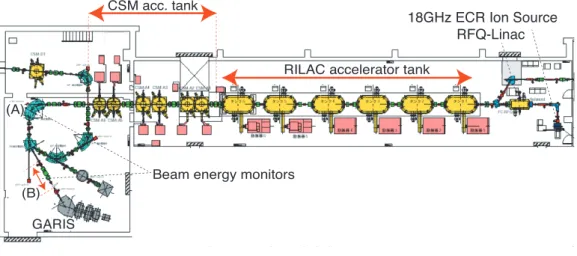
5.8 MeV/u by RILAC and charge state multiplier (CSM).
The beam energy was measured by two methods:
1. from the magnetic rigidity of the ions traversing a 90◦ bending magnet in- dicated as (A) in Fig. 2.1,
2. by time-of-flight measurement system indicated as (B) in Fig. 2.1.
The accuracy of these systems was±0.2%[49].
18GHz ECR Ion Source RFQ-Linac RILAC accelerator tank
CSM acc. tank
GARIS
Beam energy monitors (B)
(A)
Figure 2.1: Schematic view of the RIKEN heavy ion Linac (RILAC) facility.
2.4 Targets
The series of barrier distribution measurements used three types of targets: 208Pb,
238U and248Cm. The208Pb targets were of a fixed type, while targets of238U and
248Cm were of a rotating type.
2.4.1
208Pb Target
The208Pb targets were produced by the vacuum evaporation of metallic208Pb onto 60-µg/cm2 carbon backing foils. The thickness of the 208Pb layer deposited was 170 − 230µg/cm2(see Tab. 2.2). To change the beam energy without modifying the RILAC accelerator parameters, aluminum foils were placed in front of the
208Pb target as an energy degrader (see Tab. 2.2).
Figure 2.2 show the target wheel of 208Pb. The targets were mounted at No.
1 - 4, and the energy degrader foils with thicknesses of 0.8, 2.0 and 3.0µm were
mounted with target No. 2 - 4, respectively. There is a viewer for beam spot tuning at No. 5. The spare targets were mounted at No. 9 - 13 to obtain the balance of the rotating wheel. The target wheel was fixed by adhesive tape. The target positions, it corresponds to change the irradiation target, manually adjusted by the author for every energy points.
Table 2.2: Thickness of energy degraders, backings and target list.
Reaction Energy degraders Carbon backing 208Pb Target (µm) (µg/cm2) (µg/cm2)
None 60 170
48Ca+208Pb 0.8 60 190
2.0 60 220
3.0 60 230
None 60 180
50Ti+208Pb 0.8 60 210
2.0 60 190
3.0 60 170
Figure 2.2: The photograph of the208Pb target wheel. The targets were mounted at No. 1, 2, 3 and 4, and the aluminum foils with thicknesses of 0.8, 2.0 and 3.0µm were mounted with target No. 2, 3 and 4. There is a viewer for beam spot tuning at No. 5. The spare targets were mounted at No. 9 - 13 to obtain the balance of the rotating wheel.
2.4.2
238U Target
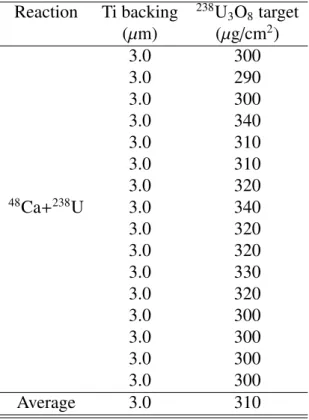
The 238U3O8 targets were produced by electrodeposition[50] of the material on 3.0-µm-thick Ti backing foils. The 30 cm radius target wheel contained sixteen arc-shaped targets, and it was rotated at 2000 rpm during the beam irradiation. No aluminum degraders were used for the238U target.
Table 2.3: Thickness of backings and target list for the reaction of48Ca+238U.
Reaction Ti backing 238U3O8target (µm) (µg/cm2)
3.0 300
3.0 290
3.0 300
3.0 340
3.0 310
3.0 310
3.0 320
48Ca+238U 3.0 340
3.0 320
3.0 320
3.0 330
3.0 320
3.0 300
3.0 300
3.0 300
3.0 300
Average 3.0 310
2.4.3
248Cm Target
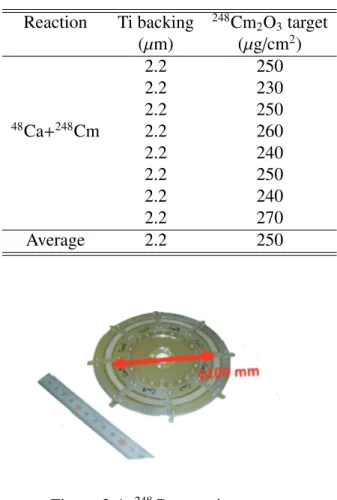
The248Cm2O3 targets were produced by electrodeposition[51] of the material on 2.2-µm-thick Ti backing foil for 48Ca+248Cm reaction, 2.1-µm-thick Ti back- ing foil for the reactions 22Ne+248Cm, 26Mg+248Cm, 30Si+248Cm, 34S+248Cm,
40Ar+248Cm, and50Ti+248Cm. The average thickness of the248Cm2O3 layer was deposited 250µg/cm2 for the reaction of 48Ca+248Cm, 450µg/cm2 for the other
248Cm reactions. The 10-cm-radius target wheel contained eight arc-shaped tar- gets, and it was rotated at 1000 rpm during the beam irradiation. No aluminum degraders were used with the248Cm target. There was a beam slit (Ta) in front of the248Cm targets (see Fig. 2.5).
Figure 2.3: 238U rotating target. This photo was taken from the down stream side of the beam line.238U targets were deposited by electrodeposition in this side.
Table 2.4: Thickness of backings and target list for the reaction of48Ca+248Cm.
Reaction Ti backing 248Cm2O3target (µm) (µg/cm2)
2.2 250
2.2 230
2.2 250
48Ca+248Cm 2.2 260
2.2 240
2.2 250
2.2 240
2.2 270
Average 2.2 250
Table 2.5: Thickness of backings and target list for the reactions of 22Ne, 26Mg,
30Si,34S,40Ar,50Ti+248Cm.
Reaction Ti backing 248Cm2O3target (µm) (µg/cm2)
2.1 460
2.1 440
2.1 440
22Ne,26Mg,30Si,34S,40Ar,50Ti+248Cm 2.1 450
2.1 450
2.1 460
2.1 460
2.1 460
Average 2.1 450
2.5 The gas-filled recoil ion separator GARIS
2.5.1 Overview of GARIS
As shown in Fig. 2.6, GARIS[39, 40] consists of an initial dipole magnet (D1), followed by two quadrupole magnets (Q1) and (Q2), and a final dipole (D2) mag- net. The separator was filled with pure helium gas at a pressure of ∼ 120 Pa.
The gas was inserted between D2 and focal-plane detection system, and the gas was discharged by differential pumping system which is upstream from the rotat- ing target and protects the accelerator. The entrance of the detector chamber at the focal-plane was sealed by 0.5-µm mylar foil to maintain a high-vacuum with pressure below 3.0× 10⁻⁵Torr, as required to prevent the discharge of the MCP detector. The ion optics property of GARIS is shown in the Table 2.6.
Table 2.6: The ion optics property of GARIS Magnification (x) -0.76
Magnification (y) -1.99 Dispersion 0.97 cm/% Acceptance∆θ ± 68 mrad Acceptance∆ϕ ± 57 mrad Acceptance∆Ω 12.2 msr Total length 5.76 m
Beam slit (Ta)
Beam path
Figure 2.5: The target box for248Cm rotating target.
2.5.2 Beam intensity monitor (45
◦elastic monitor)
For the normalization of measured excitation functions using the Rutherford scat- tering cross section, Rutherford scattering events were measured by a silicon detector (see Fig. 2.7) with an active area of 3.6 × 3.6 mm2, mounted either 25 or 142 cm downstream of the target at 45◦with respect to the beam axis (see Fig. 2.6). The calculated results of Rutherford cross sections in Sec. A.5 indicate the detected events at angles more forward thanθlab= 91◦follow Rutherford scat- tering. We can regard the observed elastic scattering atθlab = 45◦as Rutherford scattering events at every incident energy in this study.
0 1 2 [m]
He gas region
D2 Q2
Q1 D1
GARIS
Primary beam
Beam intensity monitor Target
Beam stopper (Ta)
Recoiled target-like nuclei Primary beam
Differential pumping Beam slit (Ta)
Figure 2.6: Schematics of GARIS. GARIS consists of an initial dipole magnet (D1), followed by two quadrupole magnets (Q1) and (Q2), and a final dipole (D2) magnet. This figure was taken from Ref. [37].
2.6 Focal plane detectors
The focal plane detectors comprised time-of-flight (ToF) detectors and a 16-strip position sensitive silicon detector (PSD) (see Fig. 2.8).
2.6.1 Time-of-flight detectors
The time-of-flight detectors were used for measurement of time-of-flight of the nuclei at the focal plane. Time-of-flight detectors were constructed of mylar foil, wire grids for making some electric fields, and micro channel plates. The mylar windows were made from 0.5-µm-thickness mylar, and it have an 85-mm diam- eter window coated by 100Å Au and 20-µg/cm2 CsI to increase the secondary
Figure 2.7: The photograph of PIN photodiode. This figure was taken from Ref. [52].
L = 29.5 cm ToF
Targ et-li ke
PSD Strip 0 Strip 15
Figure 2.8: Schematics of the focal plane detector system composed of two time- of-flight detectors and a 16-strip position-sensitive silicon detector (PSD). This figure was taken from Ref. [37].
electron emission probability. The windows emit the secondary electrons when the heavy-ion pass the mylar windows. The secondary electrons were accelerated by the electric field between mylar foil and wire grid 1, deflected by the electric field between wire grids 2 and 3, amplified by micro channel plates (MCP) and detected by cathode plates. The distance between mylar foils was 295 mm. Since the efficiency of the time-of-flight detector was 99% for alpha particles from the
241Am source[53], the target-like events of 208Pb, 238U and 248Cm should have been detected with closed to the 100%. The full width at half maximum (FWHM) of the timing resolution was 700 ps.
Mylar foil
Micro Channel Plate (MCP) Electron
Heavy ion Wire grid 1
Wire grid 2 Wire grid 3
Cathode plate
Figure 2.9: Schematic view of the time-of-flight detector.
2.6.2 Position sensitive silicon detector (PSD)
The PSD detector was used for measurement of the implantation energy of the nuclei at the focal plane. The PSD detector has an active area of 58×58 mm2and is divided into 16 strips. The thickness of the detector was 300µm. The PSD has position sensitivity only along the vertical axis. Since the PSD was divided to 16 strips, we were able to know the positions for horizontal axis. A precise energy calibration of the PSD strips was performed on the basis of the well-known254No decay lines via the48Ca+208Pb reaction.
2.7 Data aquisition system
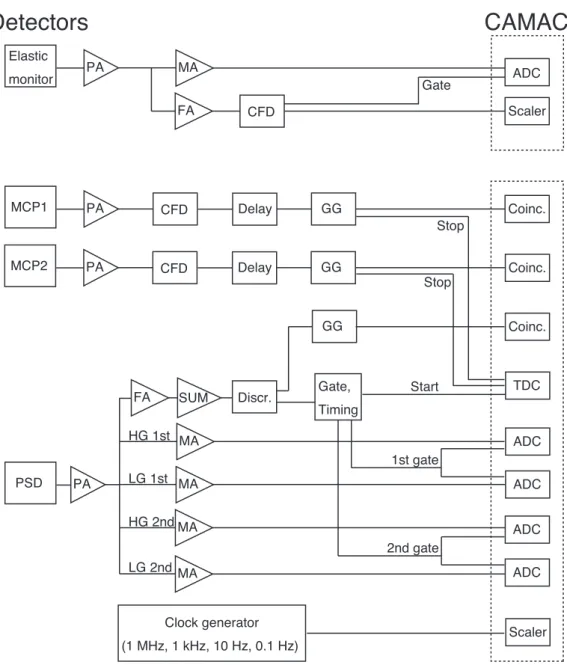
The events data were gathered by CAMAC/NIM system controlled by Linux OS personal computer. Figure 2.10 shows the block chart of the single processing and the data acquisition system. The signals were managed by electronic devices
indicated in 2.10, and the data were controlled by NaoDAQ program via crate con- troller CC7700. The data acquisition system was started by the signal measured by the PSD. The electronic discriminator level was set to approximately 1 MeV.
The events of our experiment were sorted for each incident energy. Our sort code was written on the basis of the ROOT code[54].
2.7.1 1st-2nd mode
The 1st-2nd DAQ mode was used for the reactions of48Ca+208Pb,50Ti+208Pb and
48Ca+248Cm. In case of searching the very short-lived nuclei correlation events (∼1 s), the 1st-2nd DAQ mode is used not to miss the DAQ for the very short-lived event which just after the preceding event. Figure 2.11 shows the time window for the 2nd gate. In case the time difference which between 1st event and 2nd event is 5−255µs, the 2nd event is observed by the 2nd gate.
The 2nd gate event was not used as an event of the QE scattering event in this barrier distribution study. The 1st-2nd DAQ mode was used for the reactions
48Ca+208Pb, 50Ti+208Pb and 48Ca+248Cm due to the machine time management with evaporation residue measurement. The dead time was revised to take into account for the difference of the dead time. The dead time was 310 µs in case of the only 1st gate event. The dead time was 480 µsin case of the 1st-2nd gate event.
The 1st-2nd mode was not used for the reactions22Ne+248Cm, 26Mg+248Cm,
30Si+248Cm,34S+248Cm,40Ar+248Cm,50Ti+248Cm,48Ca+238U.
2.7.2 Dead time
It takes 310µs to gather the data if only the 1st gate is used in the data acquisition (DAQ) system. The dead time is 3.1% in case of 100 counting per second at the focal plane detectors. The data were corrected for dead time. The dead time should be decreased as much as possible. The counting ratio at the focal plane detectors was checked and the beam intensity adjusted so as to maintain 100 - 200 counts per second at each energy setting.
Elastic
monitor PA MA
FA CFD
Gate ADC
Scaler
MCP1 PA CFD Delay GG Coinc.
MCP2 PA CFD Delay GG Coinc.
Coinc.
TDC Stop
Stop GG
PSD PA MA
MA SUM MA
MA HG 1st
FA
LG 1st HG 2nd
LG 2nd
Discr. Gate, Timing
Clock generator (1 MHz, 1 kHz, 10 Hz, 0.1 Hz)
ADC ADC ADC ADC 1st gate
2nd gate Start
Scaler
Detectors CAMAC
Figure 2.10: Block chart of the data acquisition system. PA : Pre-Amplifier, MA : Main-Amplifier, FA : Fast Amplifier, CFD : Constant Fraction Discriminator, Delay : Digital delay box, GG : Gate and delay Generator, Discr. : Discriminator, ADC : Analog to Digital Converter, Coinc. : Coincidence Register, TDC : Time to Digital Converter
Time OFF
ON
1st gate 2nd gate
Event
5 μs 35 μs
2nd gate open 250 μs
[μs]
0 5 255 290
Figure 2.11: Time window for the 2nd gate.
Chapter 3
Data Analysis and Results
Data analysis and results are described in this chapter. The particle identification, separation of deep-inelastic scattering events, transmission efficiency, analysis of 45◦elastic monitor and experimental barrier distributions will be explained in this chapter.
3.1 Particle Identification
3.1.1 ToF-E matrix
The analysis procedure of the48Ca+248Cm reaction, as shown in Fig. 3.1, should serve as an example for the analysis of all reactions described in tis section. Fig- ure 3.1 shows two-dimensional (2D) plots of the content of the ToF-E matrix for the reaction 48Ca+248Cm as described in Ref. [37]. From the expected energy calculations, such as the two body reaction, energy loss calculation in target, my- lar windows, helium gas in GARIS, the events in the 2D plots were classified as follows:
• 248Cm target-like events,
• 181Ta-like events sputtered from the stopper by an impinging beam,
• 181Ta-like events sputtered from the slits by an impinging beam,
• 48Ca beam-like events.
The 181Ta (beam slit) events were not observed in case of 208Pb and 238U target reactions, because there was no beam slit.
0 5 10 15 20 25 30
0 20 40 60 80 100 120 140
×
10 0 ×
10 20 30 40 50 60 70 80 90 100
Time-of-Flight [ns]
0 10 20 30 40 50 60 70 80 90 Ec.m. = 174.8 MeV
10 0 ×
10 20 30 40 50 60 70 80 90
0 10 20 30 40 50 60 70 80 Ec.m. = 186.3 MeV 90
10 0 ×
10 20 30 40 50 60 70 80 90
0 50 100 150 200 250 300 350 Ec.m. = 208.2 MeV 400
0 20 40 60 80 100 120
10
× Energy [MeV]
0 10 20 30 40 50 60 70 80 90
0 5 10 15 20 25 30 35 40 45 Ec.m. = 221.5 MeV
Target-like
181Ta (Beam slit) Beam-like
181Ta (Beam stopper)
30 32 34 36 38 40 42 44 46 48 50
50 60 70 80 90 30 50 60 70 80 90 32
34 36 38 40 42 44 46 48 50
Energy [MeV]
Time-of-Flight [ns]
Ec.m. = 221.5 MeV Ec.m. = 208.2 MeV
(a)
(b)
181Ta (Beam slit) Target-like 48Ca +248Cm
Figure 3.1: (a) Two-dimensional plots of ToF vs E. The vertical axis shows the
3.1.2 Estimation of the mass
As shown in Fig. 3.1, 181Ta-like events resulting from beam impinging the slits were observed to be commingled with248Cm target-like events. To more clearly separate these events required an effort to estimate masses from the time-of-flight and energy measurements.
3.1.3 Pulse height defect
Electron and hole pairs are made in proportion to the kinetic energy of the im- planted nucleus when lighter nuclei are implanted in a silicon detector. The ki- netic energy of the implanted nuclei can be measured due to the electrons and holes moving to electric plates. In the case of heavy nuclei, the kinetic energy is released only within a very narrow range, then, some electrons and holes are combined again by ion recombination. The pulse height is artificially diminished.
This phenomenon is called the “pulse height defect”.
The effect can be corrected by the method from the Ref. [55]. The following parameters, such as, the atomic number and mass of implanted nucleus Z1 and M1, the atomic number and mass of detector materialZ2 and M2, Bohr radiusa0
were used to define the Kaufman constantk,
k= 0.8853a0(Z12/3+Z22/3)−1/2M2
Z1Z2e2(M1+M2) . (3.1) For example, the Kaufman constant isk = 0.5208 in case of238U implanted in the silicon detector. The parameterϵis defined as
ϵ =kE. (3.2)
By using thisϵ, the pulse height defect∆ϵis calculated as
∆ϵ(ϵ)= 6ϵ
ϵ+8 + A
1+525ϵ−1.407. (3.3) A is a free parameter ranging from 13 to 15. In this time, A = 14 is employed as it yields the maximally parsimonious experimental results. For example, the
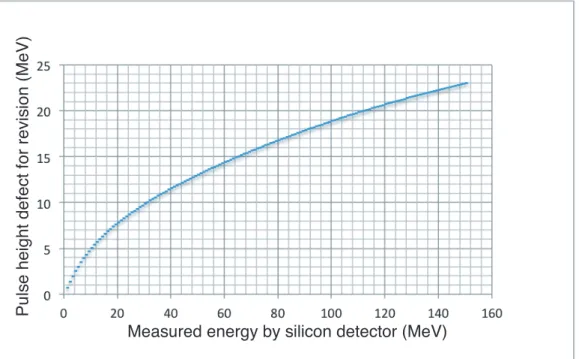
∆ϵ = 16 MeV for E= 70 MeV of the combination of248Cm and silicon detector (see Fig. 3.2).
The variation of∆ϵ resulting from variation of the free parameterAis shown in Table 3.1. As the free parameterAdoes not significantly affect the value of∆ϵ, the choice ofAsimilarly does not impact the particle identification.
Measured energy by silicon detector (MeV)
Pulse height defect for revision (MeV)
Figure 3.2: Calculated pulse height defect for combination of 248Cm and silicon detector based on Ref. [55].
Table 3.1: Calculated pulse height defect for combination of 238U and silicon detector based on Ref. [55] with changing the free parameter AbetweenA = 13 andA=15 at E =70 MeV.
A ∆ϵ(MeV)
13 15.0
14 15.5
15 16.0
3.1.4 Energy loss in mylar window
The time-of-flight between mylar 1 and mylar 2, indicated in Fig. 3.3, was gath- ered. The energyE2indicated in Fig. 3.3 should be derived to estimate the correct mass for passing nuclei. The energy corresponding toE3in Fig. 3.3 was extracted by using the measured energy from the PSD and the correction of pulse height defect. To obtainE2, the energy was modified using the following three-step pro- cedure:
1. TheE2-value was estimated by assuming all events were248Cm by the time- of-flight information,
3. TheE2-value was derived by the sum of the calculated energy loss at mylar foil 2 andE3.
The value ofE2 was extracted from the measured energy at PSD and time-of- flight informations by this procedures.
E1 E2 E3
Mylar 1 Mylar 2
Time-of-flight detectors PSD
Figure 3.3: Explanation for energy loss in mylar foils.
3.1.5 Estimated mass
The mass of passing nuclei was estimated from the measured time-of-flight and calculated energy based on measured energy. The mass-like Mlike of nuclei was calculated by using the E2 in Fig. 3.3 and time-of-flight TToF measured by ToF detectors and the flight pass of ToF detectorLToF(= 29.5 cm),
Mlike =2EToF
TToF2
L2ToF. (3.4)
Figure (a) in Fig. 3.4 show the 2D plots of the time-of-flight vs. Mlike (ToF- Mlike). The events were clearly assigned using the above calculation to be:
• 248Cm target-like events,
• 181Ta-like sputtered from the stopper by an impinging beam,
• 181Ta-like sputtered from the slits by an impinging beam,
• 48Ca beam-like events.
For lighter nuclei, such as48Ca and181Ta, theMlikevalues were overestimated, because the revision parameters were optimized for248Cm target-like events. Nev- ertheless, this analysis allowed for the clear identification of the events.
Figure 3.4 (b) and (c) show a zoom-in of the red square region in Fig. 3.4 (a). A valley between the181Ta-like (beam slit) components and248Cm target-like com- ponents was clearly observed in the plot, allowing for unambiguous determination of the248Cm target-like events. The target-like events gate for every experimental energy setting was defined from such figures.
3.2 Separation of deep-inelastic scattering events
The treatment of deep-inelastic (DI) scattering events is introduced in this section.
The previous experiments of DI events are also introduced. The observed DI events were displayed and the upper limit for DI events were derived.
3.2.1 Previous methods for the treatment of the deep-inelastic scattering events
In a previous work from Mitsuokaet al.[36], DI scattering events were not able to be separated from QE scattering events, because they did not use a separator such as GARIS. However, they were able to observe the QE and DI events without any separation. They applied two techniques to their analysis:
• set the borderline at − Q = 20 MeV following the study from Rehm et al.[56],
• comparison with the simulation results from the Monte Carlo reaction sim- ulation code LINDA[57].
3.2.2 Upper Limit for Contaminated Deep-inelastic Events
It is difficult to distinguish the QE event from the DI event. The main part of DI event was measured by changing the magnetic rigidity parameter of GARIS. The upper limits of the DI events were estimated from the main part of the DI events.
The parameter is not suitable for DI event when the magnetic rigidity param- eter is set for QE event. The DI events should be decreased compared to the case of the optimum one. The upper limit for DI event was estimated by this logic.
Two dimensional plots of ToF-E and ToF-M
The target-like events were divided into QE and DI event using the observed data to estimate the DI components. Left side panels of Fig. 3.6 shows a two-
0 50 100 150 200 250 300 350 400
Mass-like [u]
0 10 20 30 40 50 60 70 80 90 100
Time-of-Flight [ns]
0 20 40 60 80 100
Beam-like
Target-like
181Ta (Beam slit)
181Ta (Beam stopper)
48Ca+248Cm Ec.m. = 219.8 MeV
200 210 220 230 240 250 260 270 280
26 28 30 32 34 36 38 40 42 44 46
0 20 40 60 80 100
Time-of-Flight [ns]
Target-like
181Ta (Beam slit)
Mass-like [u]
200210 220230
240250 260270
Mass[u] 280 26 28 30 32
34 36 38 40 42
Time-of-Flight [ns]
0 20 40 60 80 100 120
Counts
(a)
(b)
(c)
181Ta (Beam slit)
Target-like
Figure 3.4: Graphical explanation of how to separate target-like event and the
181Ta event from beam slit.
70
Zn+
208Pb
Figure 3.5: Measured energy spectrum at θ = 172◦ in 70Zn+208Pb at Ec.m. = 254.9 MeV. This figure is taken from Ref.[36]. They tried to repro- duce the shape of the DI component by using the Monte Carlo reaction simulation code LINDA[57]. σMassandσTKEis the input parameter of the simulation code.
reaction40Ar+248Cm similarly to Fig. 3.1. The two different magnetic rigidity set- tings of the GARIS for every incident energy is displayed in Fig. 3.6. The energy Ec.m.and the magnetic rigidity settings was written in the figures.
Some 2D plots of the content of the ToF vs. Mass-like (ToF-M) following the procedures in Sec. 3.1.5, and displayed in center panels of Fig. 3.6. The magnetic rigidity setting is same as just left side panels. To discuss the behavior of DI and QE events, the red rectangular regions were used as the gate for target-like component (target-like gate).
Right side panels of the Fig. 3.6 show some energy spectra of the events which were gathered by target-like gate, and the energy Ec.m. and the magnetic rigidity setting is same as just left side panels. The valleys were observed following fig- ures:
• energy=18 MeV forEc.m.= 154.5 MeV with 1.668 Tm,
• energy=26 MeV forEc.m.= 181.2 MeV with 1.632 Tm,
• energy=33 MeV forEc.m.= 193.7 MeV with 1.596 Tm.
From the comparison with Figs. 3.6 and 3.5 from the previous work in Mit- suoka et al.[36], the low energy side hump shown in the right side panels of the Ec.m. = 154.5 MeV 1.668 Tm, Ec.m. = 181.2 MeV 1.632 Tm and Ec.m. = 193.7 MeV 1.596 Tm in the Fig. 3.6 is assigned as DI components.