Deployment of a divisional structure in Germany after World War II
journal or
publication title
Doshisha Shogaku (The Doshisha Business Review)
volume 64
number 6
page range 983‑1024
year 2013‑03‑15
権利(英) Doshisha Daigaku Shogakkai
The Association of Commerce Doshisha University
URL http://doi.org/10.14988/pa.2017.0000013227
Deployment of a Divisional Structure in Germany after World War Ⅱ
Toshio Yamazaki*
Abstract
In this paper, we consider the deployment of divisional structures using case studies of typical corpora- tions from major industries, and examine the impact and role of US corporations and consulting firms in or- der to understand German characteristics of management organization structure. We will explore these de- ployments based on their relationship to the traditional attributes of German business management. Regard- ing various factors in which Germany differed from the US, circumstances behind decentralization, delegat- ing authority to divisions, correlating general manager compensation to division results, and Germany’s tra- ditions of collegiate management and the board-majority system were important. This paper examine the de- ployment of a divisional structure after World WarⅡ through the early 1970s in relation to changes in business strategies, management systems and practices, and managers’ traditional attitudes.
Key words: Divisional structure, Functional structure, Diversification strategy, Decentralization, Control systems, Controlling
Contents
ⅠResearch Problems
ⅡTransformation of Business Strategy in Germany : Expansion of Diversification 1 Social and Economic Background of Postwar Diversification
2 Advancement of Diversification and its Characteristics
ⅢDeployment of Divisional Structure in Major German Industries 1 Overall Circumstances of the Deployment of Divisional Structure 2 Case Studies of the Deployment of Divisional Structures
3 Deployment of Divisional Structures and Establishment of Internal Control Organizations
──Deployment of Controlling Systems and Its Significance──
ⅣThe Role of US Corporations and Consulting Firms in Management Organization Reforms 1 Management Organization Reforms and the Role of US Corporations
2 Management Organization Reforms and the Role of US Consulting Firms
ⅤGerman Characteristics of Deployment of Divisional Structure 1 Divisional Structure Mechanisms and Their German Characteristics
2 Management Traditions in German Corporations and Their Influence on the Deployment of Divisional Structures
────────────
*Professor/Ritsumeikan University, Faculty of Business Administration, 1−1−1 Noji-higashi, Kusatsu, Shiga, 525−
8577, Japan
Office : Tel+81−77−561−4865, Fax+81−77−561−3955 e−mail : [email protected]
(983)113
Ⅰ Research Problems
After World War Ⅱ, the expansion of domestic markets and market opportunities resulting from advances in mass production served as a basis for business diversification that in turn stimulated changes in management organization. Once again, the American-style management system was established as an effective model. A prime example was the decentralized divi- sional structure implemented first in several pioneering corporations in the
1
1920s and spread- ing after the war. German corporations as well sought to restructure organizations along the lines of the US model. However, in Germany there were many factors that influenced on the introduction of American-style divisional structure.
This paper discusses the deployment of a divisional structure in Germany after World War
Ⅱ in relation to changes in business strategies, management systems and practices, and man- agers’ traditional attitudes. We examine the progress of diversification in German corporations and its connection to organizational structure reforms, the overall situations post the deploy- ment of the divisional structure.
We also consider case studies of representative corporations in major industries such as the chemical, electric, and iron and steel industries. We review the deployment of a control sys- tem as an internal control organization and the role of US corporations and management con- sulting firms in management organization reforms. These discussions explain various charac- teristics of the deployment of German-style divisional structure such as (1) the impact level of delegation of authorities and responsibilities, (2) the traditions and roles of the board of direc- tors and collegiate management, (3) the characteristics of the board majority system, (4) the significance of divisional executive management, and (5) the use of a compensation system linked to divisional profits.
Many studies approach this theme from the perspective of economic and business
2
histories.
However, these studies do not always identify which elements of American and German man- agement methods were combined, how they were hybridized, and which factors determined the hybridization. This paper attempts to explain the details of hybridization and the process of modifying US management methods. It is very important to elucidate how German-style busi-
────────────
1 A. D. Chandler Jr.,Strategy and Structure : Chapters in the History of the Industrial Enterpreise,Cambridge, Massachusetts, 1962, A. D. Chandler Jr.,The Visible Hand : Managerial Revolution in American Business, Cambridge, Massachusetts, 1977, A. D. Chandler Jr.,Scale and Scope : The Dynamics of Industrial Capital- ism,Berkeley, Massachusetts, 1990.
2 See books and articles cited in this paper.
同志社商学 第64巻 第6号(2013年3月)
114(984)
ness management and its particular characteristics, conforming to German and European con- ditions while still bearing on the German management style, surfaced during the deployment of the American management method from the perspective of structural analysis. We will con- sider the problems stemming from the German method of conforming to the American method, impacted by traditional and cultural factors in business management as well as institu- tional factors, and its relationship to the structural characteristics of German capitalism.
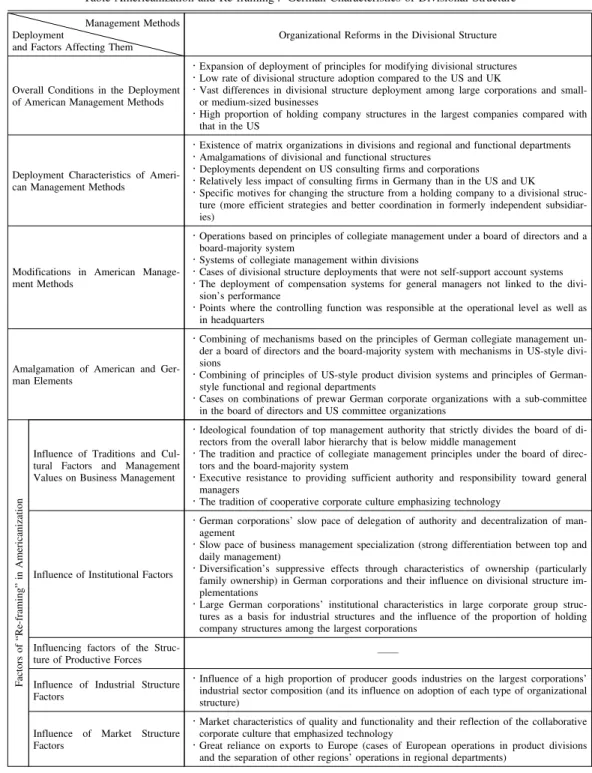
The author establishes the idea of “re-framing” as an analytical framework, using which we analyze the various problems in deploying American management methods that created condi- tions that facilitated business management changes in the postwar era. Re-framing, that is, the framework for analyzing various problems with the deployment of US management methods is explained below. Re-framing in this text refers to business management methods and sys- tems that are defined by structural characteristics of a country’s capitalism and how these are adapted, modified, and made compatible with the structural characteristics of capitalism in a country to which it is transferred. Among these, structural characteristics of this capitalism are related to the state of existence of the following items : a structure of productive forces, in- dustrial structures, and market structures──these three characteristics of German Capitalism are deeply connected to re-framing. In addition, management values, business management tra- ditions, and cultural factors and definability from an institutional perspective are also closely related to re-framing. Business management traditions and culture interrelated with business management standards and values. Decisions on where to place value, that is, production, technology, quality, or marketing policies, which are more directly tied to profit, specifically short-term profit, greatly affect corporate behavior. However, management values and business management culture are not simply matters of general culture, but have deep connections with the structural characteristics of target markets identified by corporations. For example, if the commodity market in a certain country or region prioritizes product quality or functionality, corporations will focus on values and differentiation in technology or production because man- agement values conform to market characteristics. Thus, market characteristics are closely re- lated to management standards and values regarded important by corporations. In addition, in- stitutional factors include legal systems comprising all types of regulations ; labor relations ; educational systems ; and system for specialized skills. A country’s educational system is closely related with the cultivation of executives and managers and that of skilled workers.
Thus, the receiving nation’s capitalistic characteristics are amended or modified to an adapt- able form when the originating country’s management methods, created for its own capitalistic structural characteristics, are introduced and spread throughout a foreign country using that
Deployment of a Divisional Structure in Germany after World WarⅡ(Yamazaki) (985)115
country’s methods. Accordingly, re-framing is the process of structural adaptation in response to different environmental conditions and a method of structural analysis, whereby the overall structure of business management is foundational.
Below, we will consider the deployment of divisional structures in Germany. First, we re- view the expansion of diversification in German corporations in SectionⅡ. In Section Ⅲ, we consider organizational structure reforms along with case studies of divisional structure de- ployment in representative corporations in major industries. In SectionⅣ, we examine the role of US corporations and management consulting firms in management organization reforms. In SectionⅤ, we explain various characteristics of German-style divisional structure deployment based on these discussions.
Ⅱ Transformation of Business Strategy in Germany : Expansion of Diversification
1 Social and Economic Background of Postwar Diversification
We will first look at the expansion of diversification, one of the most important factors in postwar management organization reforms. At the time, diversification in German corporations was regulated by changes in the environment of industry competition. Specifically, changes in demand patterns and the pace of technological advancement caused changes in competition, with innovations in products and marketing method supplanting traditional factors such as pricing and quality. In addition, increased consumer affluence related to technological poten- tial gave birth to many new product and market opportunities that enabled corporations in many industries to experience fast growth and high profits. Major corporations operating in more traditional boundaries with no potential of absolute or relative growth encountered a dif- ficult choice. For example, at the chemical company Hüls, it became apparent that the reduc- tions in revenue and profit at the beginning of the 1960s far exceeded those of IG Farben’s three major successor companies, and heightened the necessity for
3
diversification. In addition, many corporations that had quickly accumulated resources rather than reinvesting in mature products or markets, particularly the most successful companies, needed to find growth oppor- tunities outside their own industry. Diversification was an important element in the strategic response to these
4
circumstances. Particularly at the end of the 1960s, competition due to the
────────────
3 Vgl.Hüls Archiv,Ⅰ−5−8, Aktennotiz (8. 8. 1962), S.1.
4 G. P. Dyas, H. T. Thanheiser,The Emerging European Enterprise. Strategy and Structure in French and Ger- man Industry,London, 1976, p.132.
同志社商学 第64巻 第6号(2013年3月)
116(986)
opening up of new markets and the lowering of tariffs in EEC countries was an important fac- tor in this re-orientation toward
5
diversification.
However, the characteristics of German corporate ownership, particularly financial and man- agement constraints in family-owned corporations, restricted
6
diversification. Other factors lim- iting diversification included the necessity for rebuilding in the post-war years ; extremely rapid growth in the automotive, electrical, and capital goods industries ; tax laws ; and tradi- tion of cartels and trusts linked to relatively weak anti-trust
7
laws. Technological relevance was a dominant factor of the diversification movement in Germany. However, analysis of the top 100 industrial enterprises reveals that diversification was not the only direction taken after the war, but in fact diversification also occurred simultaneously, or nearly so, with horizontal and vertical
8
integration.
2 Advancement of Diversification and its Characteristics
Next, as we look at strategic changes in the advancement of diversification, 34 out of the top 100 industrial enterprises’ business structures in 1950s Germany were single types and 26 were dominant types. In contrast, 32 companies were related types and seven were unrelated types. Although single-type firms decreased to 22 by 1960, the most important change in the 1950s was the diversification that occurred in 12 such corporations. In this diversification, nine of these corporations became dominant types, two related types, and one an unrelated type. As a result, dominant-type firms increased slightly to 28 by 1960. From 1950 to 1960, nine corporations diversified away from being dominant types, with eight of these becoming related types and one an unrelated type. While 40 corporations had become related types by 1960, unrelated types slightly increased to nine, a minor change.
In contrast, in 1960 and 1970, the greatest changes were in diversification to related types (5) and unrelated types (10). In 1970, 56% of corporations had significantly diversified in this manner. Although related types had decreased slightly to 38, unrelated types had greatly in- creased to 18.
Further, as we examine changes in the 20-year period between 1950 and 1970, the channel diversification often adopted was from single type to dominant type to related type to unre- lated type. It was rare for a company to stray from this channel and move from a single type
────────────
5 U. Wengenroth, Germany : Competition abroad──Cooperation at home, 1870−1990, A. D. Chandler, Jr., F.
Amatori, T. Hikino (eds.),Big Business and the Wealth of Nations,Cambridge University Press, 1997, p.162.
6 G. P. Dyas, H. T. Thanheiser,op. cit.,p.133.
7 Ibid.,p.100.
8 Ibid.,p.90, p.101.
Deployment of a Divisional Structure in Germany after World WarⅡ(Yamazaki) (987)117
to a highly diversified related type or unrelated type. That is, 35% (nine out of 26) of the cor- porations that were dominant types in 1950 had changed over 10 years, and 25% (seven out of 28) of the corporations that were dominant types changed by
9
1970.
Thus, we see that in Germany, the striking expansion of diversification to unrelated types, such as that among US conglomerates, had not occurred in the 1960s, as Germany emphasized diversification in related types.
Ⅲ Deployment of Divisional Structure in Major German Industries
1 Overall Circumstances of the Deployment of Divisional Structure (1) Expansion of Diversification and Changes in Organization Structure
We will next look at the changes in organizational structure and their relationship to the ex- pansion of strategy. In comparing the number of top 100 industrial enterprises using a func- tional structure in the years 1950, 1960, and 1970, 36 companies used a functional structure, which then decreased to 21 and finally to 20. In 1950, 15 companies had a holding company structure, which fell to 14 and then to 12. Companies with a mixture of functional and holding company structures increased from 43 to 48, and then fell dramatically to 18. In contrast, companies with a divisional structure numbered a mere five in 1950, tripled to 15 in 1960, and greatly increased to 50 by 1970. Observing the 78 German capital firms, companies with a divisional structure were unheard of in 1950 and by 1960 there were still only three ; how- ever, by 1970, they accounted for 40% of the total. Nevertheless, when compared to the 78%
and 72% adoption rates of the US and UK, respectively, Germany’s rate was still low.
In 1950 and 1960, 25 of the top 100 companies implemented organizational structure re- forms, out of which the most common change was a shift from a functional structure to a combination of functional and holding company structures (12 companies), while a change to a divisional structure was largely unseen. Deployment of divisional structures progressed strongly in the 1960s, and between 1960 and 1970, 36 out of 47 companies chose to adopt this type of organization. In the 20 years between 1950 and 1970, the most common pattern was a change from a functional structure to a combination of functional structure and holding company, and then to a divisional structure. Of the 45 companies that adopted a divisional structure, only four moved from a functional structure and six from a holding company struc- ture. In contrast, 35 companies changed from a functional structure/holding company combina-
────────────
9 Ibid.,p.26, pp.63−72. For an index on types and classifications of diversifycation, refer to R. P. Rumelt,Strat- egy, Structure and Economic Performance,Boston, 1974, Chapter 1
同志社商学 第64巻 第6号(2013年3月)
118(988)
tion to a divisional
10
structure.
Regarding such changes, E. Gabele has noted that among the overall changes to manage- ment structure, change processes resulting in divisional structures were overwhelmingly com- mon. However, there was a great difference in adoption between large firms and small- and medium-sized firms. For example, at the end of 1974, although 46.7% of large corporations had implemented a divisional structure, among medium-sized firms, the implementation rate was only 38
11
%. In 1982, A. Harrmann pointed out that during the prior decade, many corpora- tions had restructured, with one of the characteristics of this change being apparent in opera- tional field-, division-, and product-oriented organizations. However, when viewed overall with small- and medium-sized firms, many corporations did not replace their functional struc- tures with divisional structures. Among the large companies that primarily moved to a divi- sional department or divisional structure during the late 1960s and early 1970s, some had product divisions and regional divisions, among which overseas and European division regions were
12
problematic.
Next, as we look at the relationship between strategy and organizational structure, in 1950, only 7% of the top 100 industrial enterprises that had implemented diversification (both re- lated and unrelated) were also using a divisional structure. This proportion had reached 20%
by 1960 and 67% by 1970. Of the 78 West German capital firms, a mere 8% had this struc- ture in 1960 which increased up to 63% by
13
1970. However, when compared with the 500 largest US companies, not only was there a difference in the adoption rate of divisional struc- tures, but there also was a time lag in implementing diversification and divisional structures.
Among the 45 corporations that had shifted to this organization form between 1950 and 1970, 14 had made the change within 10 years, seven between 10 and 20 years, and nine took more than 20 years to change. In addition, 60% of corporations that had expanded to include greater varieties in products and markets during the 1950s had adopted a divisional structure during that 10-year period. Although this figure rose to 75% by the 1960s, the most remarkable wave of divisional structure deployment was witnessed in the late
14
1960s. In 1967, the domain of corporate organization was regarded as a new
15
frontier, and deployment of divisional structures
────────────
10 G. P. Dyas, H. T. Thanheiser,op. cit.,pp.65−73.
11 E. Gabele,Die Einführung von Geschäftsbereichsorganisation,Tübingen, 1981, S.1−2.
12 A. Harrmann, Steigert ein Wechsel der Strukturorganisation die Unternehmenseffektivität?,REFA-Nachrichten, 35. Jg, Heft 4, August 1982, S.202−3.
13 G. P. Dyas, H. T. Thanheiser,op. cit.,p.66.
14 Ibid.,p.73−4.
15 Wo liegen noch Rationalisierungsmöglichkeiten im Betrieb?, REFA-Nachrichten, 20. Jg, Heft 6, Dezember 1967, S.263.
Deployment of a Divisional Structure in Germany after World WarⅡ(Yamazaki) (989)119
in more than half of the 100 largest corporations occurred after that
16
year. On this point, H.
Siegrist noted that divisional structures first began to truly penetrate German corporations in the late 1960s, approximately 10 years after overall penetration in the
17
US.
(2) Generational Change in Management and Deployment of Divisional Structures Divisional structure deployment in German corporations was significantly affected by man- agement systems and practices as well as managers’ traditional attitudes. Compared with a country such as the US, where management had evolved, business management specialization in German corporations was stagnant, and there was a strong differentiation between daily op- erational and top executives, who were highly
18
autonomous. The ideological foundation of top management authority that had become entrenched as a traditionally strict gap kept between executives at the board of directors level and the lower, laborer level was diametrically op- posed to broader delegation of responsibility and strategic information sharing between verti- cal strata required by a divisional structure. In such cases, adoption of a new form of organi- zation typically depended on one person or alternatively a group of a few people. The depar- ture of certain individuals from the ranks of top management and handoffs to successors be- came decisive points in the timing of organizational
19
change.
The fact that organizational restructuring occurred after the beginning of the 1960s gener- ally resulted from opposition by one or two key individuals in the power structure of a given corporation rather than a lack of either top management knowledge regarding divisional struc- tures or confidence in its appropriateness for solving problems in their organization. Therefore, a change in corporate control resulting from a generational change in management was an im- portant method of eliminating obstacles to organizational
20
restructuring. As V. Berghahn noted, the generational change in management began slowly at the beginning of the
21
1960s, and shifts from a functional structure to a divisional structure occurred relatively slowly as a result of dependence upon these generational changes in
22
corporations.
────────────
16 G. P. Dyas, H. T. Thanheiser,op. cit.,p.129.
17 H. Siegrist, Deutscher Großunternehmen vom späten 19. Jahrhundert bis zur Weimarer Republik, Geschichte und Gesellschaft,6. Jg, Heft 1, 1980, S.88.
18 Vgl. H. Hartmann,Der deutsche Unternehmer : Autorität und Organisation, Frankfurt am Main, 1968, S.47, S.75, S.78, S.91, S.281, S.291.
19 G. P. Dyas, H. T. Thanheiser,op. cit.,p.136.
20 Ibid.,p.114.
21 V. Berghahn,Unternehmer und Politik in der Bundesrepublik,Frankfurt am Main, 1985, S.293.
22 S. Hilger,
”Amerikanisierng“ deutscher Unternehmen. Wettbewerbsstrategien und Unternehmenspolitik bei Henkel, Siemens und Daimler-Benz (1945/49−1975),Stuttgart, 2004, S.278.
同志社商学 第64巻 第6号(2013年3月)
120(990)
2 Case Studies of the Deployment of Divisional Structures
Based on the previous overview of the deployment of divisional structures, we will next consider case studies of typical corporations in major industries.
(1) Deployment of Divisional Structures in the Chemical Industry and its Characteristics
①Henkel Case Study
Let us first look at the chemical industry, an archetype of the expansion of diversification and deployment of divisional structures.
Henkel was a typical corporation that implemented organizational reforms based on a pro- posal from the Stanford Research Institute (SRI), a US consulting firm. SRI made three pro- posals regarding long-term business planning, strategic business planning, and organizational
23
structure. The proposal for organizational restructuring made in December 1968 was approved in
24
1969, and on this basis, a new organizational structure was deployed. At Persil/Henkel, where diversification was in progress to a certain extent, top management had extraordinary difficulty in operating the company at peak efficiency with middle and lower levels of man- agement organized according to
25
function. In SRI’s proposal, Persil/Henkel had arrived at the point where they needed to make fundamental changes to their organizational structure due to corporate scale and
26
diversity. In Henkel’s existing functional structure, specific obstacles had become apparent, including the delegation of profit responsibility, manufacturing methods to reduce overall corporate costs, optimization of costs for marketing and other functions, and in- adequate information exchange among various functional silos during operational planning. A lack of clarity on responsibilities and authority in addition to a lack of delegation of authority at all levels of the company caused major problems. Therefore, top management was forced to deal with issues in excessive detail, which resulted in problems because insufficient time re- mained for basic corporate policy decision-making and
27
planning.
It was decided that increasing profits and decreasing costs required cost centers and profit
────────────
23 Vgl. Henkel Archiv, 251/1, Stanford Research Institute (SRI), Einführung einer verbindlichen langfristigen Planung in die Persil/Henkel Gruppe──Phase Ⅰ, April 1967, Henkel Archiv, 251/2, SRI, Langfristigen Planung für Persil/Henkel, PhaseⅡ: Strategische Planung, 1. Bd, 2.Bd, Juli 1968, Henkel Archiv, 314/133, SRI, Langfristigen Planung für Persil/Henkel, PhaseⅢ: Organisationsstruktur der Unternehmensspitze und des leitenden Management, Dezember 1968.
24 Henkel GmbH,Geschäftsbericht 1969,S.33.
25 Henkel Archiv,251/2, Stanford Research Institute, Langfristigen Planung für Persil/Henkel, PhaseⅡ, S.315.
26 Henkel Archiv, 314/133, Stanford Research Institute, Langfristigen Planung für Persil/Henkel, PhaseⅢ, S.3, S.24.
27 Ebenda,S.24−6, S.28−30,Henkel Archiv, 314/96, SRI-Besprechung am 16. Oktober 1968 (17. 10. 1968), S.3, Henkel Archiv,251/10, SRI. Mündliche Präsentation. Struktur der Unternehmensorganisation von Persil/Henkel.
Deployment of a Divisional Structure in Germany after World WarⅡ(Yamazaki) (991)121
centers in lower groups with authority and responsibility delegated to
28
them. Thus, responsibili- ties for specific markets were delegated to each division, and organizational restructuring was conducted with the concept that various activities such as product development, production, and marketing in any given market orientation should be consolidated into
29
divisions. The re- structuring resulted in 1) six product divisions, 2) regional departments, 3) eight functional de- partments, and 4) an executive committee that acted as the representative executive organ of the board of directors.
The organization comprised six divisions : 1) detergent and cleaners, 2) packaging materi- als, 3) organic chemical products, 4) home care pharmacology, 5) toiletries, and 6) inorganic chemical products and adhesive substances. Operational management in each division was re- sponsible for the authority the executive committee delegated to them, and for operations as defined by a framework of policies. Each division was in charge of the various operational functions necessary for the efficient execution of divisional business activities and operational function such as production, marketing, development of new products through product release, and exportation. Responsibility for all necessary operations in the division rested with a gen- eral manager, and each division was organized as an independent profit center.
As we look at regional departments, the SRI proposals included the establishment of two departments : one for Europe and the other for non-European regions. However, in actuality, only the department responsible for non-European regions was set up. In addition, functional departments were created with the primary responsibilities of 1) advising and supporting divi- sions, other operational departments, and regional departments ; 2) providing aid and informa- tion to executive committees for various functional areas and issues ; and 3) establishing poli- cies, standards, and processing methods for the company overall, providing major service functions, and estimation of each functional activity. Functional departments were set up for 1) business planning, 2) finance and accounting, 3) legal affairs, 4) logistics, 5) organizations and scientific management, 6) production and engineering, 7) R&D, and 8) human resources and social affairs. These were all cost centers.
Among top management organization reforms, Henkel GmbH became the executive body acting as general office managing all domestic and foreign operations. This office supervised Henkel & Cie GmbH and Henkel International GmbH, which were responsible for European operations and non-European regions, respectively. By creating a headquarters’ organization as
────────────
28 Henkel Archiv, 251/2, Stanford Research Institute, Langfristigen Planung für Persil/Henkel, PhaseⅡ, 2. Bd, S.440.
29 Interview der Z für O zur Reorganisation der Henkel-Gruppe,Zeitschrift für Organsation, 39. Jg, Nr.5, Mai 1970, S.199.
同志社商学 第64巻 第6号(2013年3月)
122(992)
well as divisions, the executive team, comprising the headquarters’ board of directors, was freed from individual operational problems of each division, and dedicated its time and energy to activities such as general issues in operational management of each division as well as plan- ning, management, and control. Furthermore, these executives established five corporate-wide staff departments to support their activities : 1) management support, 2) European industry, 3) international public relations, 4) audits, and 5)
30
secretarial.
By 1967, SRI had conveyed the principle of return on investment (ROI), an important con- cept for management in a divisional structure requiring a self-support account
31
system. This acted as an efficient system foundation for profit planning and budgetary control.
②Bayer Case Study
Our next subject, Bayer, had no need to move away from a functional structure until the be- ginning of the 1960s. However, as with Henkel, corporate growth and competition set corpo- rate management on a new
32
path. It was proposed that everyday operational management be relegated to lower level managers to lighten the operational burden of directors, and it was de- cided that these operations would be conducted by divisions. The separation of production and sales organizations ended, and the consolidation of production and sales created “partial com- panies” that were defined in the same terms as US-style
33
divisions.
The deployment of a divisional structure in Bayer began with the restructuring in February
34
1970, and the new organization was implemented on January 1,
35
1971. The new organization
────────────
30 Vgl.Henkel Archiv, 314/133, Stanford Research Institute, Langfristigen Planung für Persil/Henkel, PhaseⅢ, S.1−114,Henkel Archiv,314/96, Niederschrift über eine außerordentliche gemeinsame Postbesprechung am 20.
Februar 1969 (20. 2. 1969),Henkel Archiv, 251/10, Einrichtung von Sparten und Funktionen (31. 10. 1968), Henkel Archiv,25/10, Faktoren, die für eine produktionorientierte Organisationsstruktur sprechen (11. 7. 1968), Henkel Archiv, 153/42, Niederschrift über die gemeinsame Post PERSIL/HNKEL/BÖHME/HI vom 12. 11.
1968 (14. 11. 1968),Henkel Archiv,251/10, Neuorganisation. Unterlage für Gemeinsame Post am 12. 11. 1968 (9. 11. 1968),Henkel Archiv,251/10, Oranisationder Unternehmensspitze (30. 5. 1968),Henkel Archiv,153/42, Präsentation einer Organisationsstruktur für das Management Persil/Henkel duruch das Stanford Research Insti- tut (SRI),Henkel Archiv, 314/96, Zentral-Geschäftsführung Henkel GmbH, Henkel Archiv, 314/96, Die Un- ternehmensorganisation nach Sparten (18. 7. 1968),Henkel Archiv, 314/96, Neuordnung (10. 3. 1969),Henkel Archiv, 314/96, Neuordnung. Organisationsvorschlag für Funktionen──Produktion/Ingenieurwesen──. Be- sprechung am 12. Februar 1969 (13. 2. 1969), Henkel Archiv, 251/9, Kurz-Referat. Gewinn- und Kosten- verantwortung der Sparten/Funktionen (6. 5. 1969), Henkel Archiv, 251/9, Kostenverantwortung der Funk- tionen, insbesondere der Funktion Finanzen/Rechnungswesen. Notiz Mr. Cavender vom 17. 4. 1969 (23. 4.
1969), Henkel GmbH,Geschäftsbericht 1968,W. Feldenkirchen, S. Hilger,Menschen und Marken. 125 Jahre Henkel 1876−2001,Düsseldorf, 2001, S.200−2, Die organisatorische Neuordnung der Henkel-Gruppe “Sparten, Funktionen und Regionen”,Zeitschrift für Organisation,39. Jg, Nr.5, Mai 1970, S.196−8.
31 S. Hilger,a.a.O.,S.233.
32 C. Kleinschmidt,Der produktive Blick. Wahrnehmung amerikanischer und japanischer Management- und Pro- duktionsmethoden durch deutsche Unternehmer 1950−1985,Berlin, 2002, S.266−8.
33 Bayer Archiv,001−004−003, Vorschlag für einen Organisationsplan der FFB (ohne Agfa), S.1−2, S.4.
34 Bayer Archiv,001−004−002, Die Schrift von Kurt Hansen an die Leitenden Angestelltender Werke ! Deployment of a Divisional Structure in Germany after World WarⅡ(Yamazaki) (993)123
featured three primary
36
elements : divisions, a central staff department, and staff for the board of directors. Bayer created a thorough division of labor and delegation of authority, thereby al- lowing managers to concentrate better on managerial
37
activities. The general objective of the new organization conceived by Bayer’s W. Knauff was to take measures in tackling the changes caused by rapid growth, technological development, and market expansion, which would place Bayer in a position where the growing number of operations in the future could be effectively managed. In this aim, maximizing flexibility and efficiency became an objec- tive. In addition to the formation of sales-oriented divisions, Bayer clearly delineated adminis- trative boundaries ; delegated authority and responsibilities ; architected an efficient informa- tion system appropriately for the new organizational structure ; developed a corporate group- wide integrated planning system ; and clearly divided functions within lines, staff, and com- mittees.
Bayer was divided into nine product divisions : 1) inorganic chemical products, 2) organic chemical products, 3) rubber, 4) plastics and lacquer, 5) polyurethane, 6) dyes, 7) textiles, 8) pharmaceuticals, and 9) plant protection chemicals. These divisions were managed on the basis of policies established by the board of directors from which general managers would seek ap- proval for their division plans at the appointed time each year. They then bore the responsibil- ity delegated by the board of directors to achieve divisional goals on the basis of those plans.
The division into nine product divisions was deemed important to give appropriate operational scale to the divisions. Each division had an integrated set of functions : production, sales, ap- plications engineering, and research. Division management was in general delegated by the board of directors to two people : an individual responsible for commercial affairs and the other responsible for technological affairs. Each was a director with equal authority.
Manufacturing plants and their related auxiliary plants (such as drying plants) were inte- grated on a division production basis appropriately for their locations. As long as the various departments within each division were not consolidated into service departments that worked across divisions (such as central staff departments), a particular division’s sales oversight in- cluded all other departments or groups necessary for the success of the respective division’s
────────────
! Leverkusen, Dormagen, Elberfeld und Uerdingen sowie der deutschen Aueßnstellen (25. 2. 1970), S.1,Bayer Archiv,001−004−002, Neuorganisation der Farbenfabriken Bayer AG──(3. 2. 1970),Bayer Archiv, 010−004
−005, Neuorganisation der Bayer AG, S.1,Bayer Archiv, 010−004−005, Die Schrift von Kurt Hansen an die Leitenden Angestellten der Werke Leverkusen, Dormagen, Elberfeld und Uerdingen (2. 9. 1965),Bayer Archiv, 001−004−003, Neuorganisation.
35 Bayer Archiv,001−004−002, Vorstandsrundschreiben Nr.63 (14. 10. 1970), S.1.
36 Bayer Archiv,010−004−005, Neuorganisation der Bayer AG, S.2.
37 Vgl.Bayer Archiv,210−001, Führungsgrundsätze der Bayer AG, S.4.
同志社商学 第64巻 第6号(2013年3月)
124(994)
marketing such as market development, customer support, market research, and order process- ing. In addition, research operations were integrated into divisional research departments, with research groups working in divisional research departments and researchers outside the central scientific research laboratories consolidated into the division’s research department. Placing technology departments into divisions, Bayer intended to stimulate close contact between sales, development, research, and production. Regarding divisional staff departments, division offices were composed of staff units, and had technical and commercial staff managed by one person. These staff organizations acted as planning, direction, and control organizations and would provide services within the division’s purview.
Among the top management organizational changes, the board of directors had corporate- wide operational management responsibility and was in charge of divisional and central staff department operation management ; corporate policy ; making corporate-wide or semi- corporate-wide objectives ; decision-making for investments or other basic organizational is- sues ; decision-making and approval for opening up negotiations on stock acquisition and sale ; and important personnel issues such as manager selection and support for appointment, advancement, and transfer. Even among directors, a division of labor was implemented for production, sales, corporate group adjustment, research, engineering, finance and accounting, legal and tax affairs, and human resources and social issues. In addition, a staff for the board of directors was created to aid directors in their work. This staff organization served several purposes : prioritizing activities and avoiding information loss ; jointly conducting staff func- tions between those responsible for commercial and technical areas as a means of planning, direction, and control for the board of directors to provide corporate-wide management ; and establishing and allocating staff functions appropriate for new organizations. Furthermore, cen- tral staff departments were established. Their functions were services provided to divisions as well as the company as a whole, and oversight for each of them was given to one individual reporting to the board of directors. These staff departments were 1) human resources and so- cial issues, 2) engineering, 3) finance and accounting, 4) purchasing, 5) advertising, 6) legal and tax affairs, 7) central research, 8) patents and licensing, and 9) applications engineering.
These central staff departments, along with the board of directors’ staff, served as connecting points for all nine divisions, both domestic and international, of the corporation. Specialized management for each central staff department was undertaken by directors representing spe- cialized fields. Moreover, extra-divisional committees and council organizations were estab- lished for effective information exchange. In 1972, 10 committees and council organizations were formed : 1) general manager council, 2) investment council, 3) plant manager council, 4)
Deployment of a Divisional Structure in Germany after World WarⅡ(Yamazaki) (995)125
central personnel committee, 5) central production committee, 6) central sales committee, 7) central research committee, 8) central engineering committee, 9) central technical committee, and 10) central corporate group coordination
38
committee.
Overall, the new organization helped increase the company’s competitiveness in global mar- kets. Moreover, the organization had the objectives of improving the workforce’s awareness of revenues and costs, delegating authority and personnel management, and strengthening market consciousness across the
39
corporation.
③BASF Case Study
Furthermore, BASF was busy restructuring their organization from the late 1960s to the early 1970s and instituted a new organization in June of
40
1970. After the war, BASF adopted a functional structure covering production, sales, research, engineering, finance, human resource and social issues, and legal
41
affairs. In addition, by the early 1960s, manufacturing department was divided into four sections by product
42
line. However, the scope and growth rate of the chemical industry rendered review of a functional structure’s functional domain impossible. At BASF, just as at Bayer, Hoechst, and Siemens, splitting up the company into relatively inde- pendent divisions for greater overall visibility and delegating responsibilities to divisions for the production and sales of specific product lines was the only method to restore
43
visibility.
Not only did BASF’s revenues more than double between 1960 and 1970, but with additional
────────────
38 Bayer Archiv,001−004−002, Neuorganisation der Farbenfabriken Bayer AG (3. 2. 1970),Bayer Archiv, 001−
004−002, Organizational Rearrangement of Farbenfabriken Bayer AG──Objectives, Functions and Tasks──, Bayer Archiv, 001−004−002, Organisationplan der Farbenfabriken Bayer AG, Leverkusen, Stand : 1. 4. 1971, Bayer Archiv, 001−004− 001, Farbenfabriken Bayer A. G., Leverkusen-Bayerwerk. Organisationspläne der Verkaufsabteilungen,Bayer Archiv,001−004−002, Vorstandsrundschreben Nr.64 (22. 10. 1970),Bayer Archiv, 001−004−003, Die Schrift von Kurt Hansen an W. Knauff über den Vorschlag des Organizsationsplanes von Knauff(24. 2. 1964), S.3−4, S.8, Bayer Archiv, 010−004−005, Organisatiorische Gliederung der Bayer AG, Stand : 1. 7. 1972,Bayer Archiv,010−004−005, Neuorganisation der Bayer AG,Bayer Archiv, 001−004−002, Die Schrift von Kurt Hansen an die Leitenden Angestellten der Werke Leverkusen, Dormagen, Elberfeld und Uerdingen sowie der deutschen Aueßnstellen (25. 2. 1970), S.2−3.
39 C. Kleinschmidt,a.a.O.,S.269.
40 BASF Archiv, C 0, Organisatiorische und personelleänderungen bei AOA (5. 6. 1970), S.1, E. Koch, Offene Tore für das schöpferische Potential. Neuorganisaton der BASF──Die WELT sprach mit Vorstandsvorsitzen dem Bernhard Timm,Die Welt,Nr.193, 21. 8. 1970.
41 BASF Archiv, C 0, Die Neuorganisation der BASF unter Marketingssichtspunkten, S.2,BASF Archiv,C 19/14, C 0, Organisatorische Maßnahmen (19. 12. 1961),BASF Archiv, C 19/14, Organisatorische Maßnahmen (21.
12. 1961),BASF Archiv,C 19/13, Organisation im Verkauf (24. 6. 1960).
42 BASF Archiv,C 0, Organisation der BASF (1. 1. 1964),BASF Archiv, C 19/14, Werksinterner Verteiler (25. 1.
1962),BASF Archiv, C 19/15, Rundschreiben an alle Abteilungen des Werkes (20. 12. 1963),BASF Archiv, C 19/15, Die Schrift an alle Vertrauensleute (22. 7. 1963). For information on organization changes at this level, refer to W. Abelshauser, Die BASF seit der Neugründung von 1952, W. Abelshauser (Hrsg.),Die BASF : Eine Unternehemensgeschichte,München, 2002, S.571−3
43 BASF Archiv,C 0, Die Neuorganisation der BASF unter Marketingssichtspunkten, S.2.
同志社商学 第64巻 第6号(2013年3月)
126(996)
progress achieved through business expansion and external acquisitions, other group compani- es’ revenues also increased by more than 20 times during the same period. In addition, with forward and backward integration into the oil and gas areas, the dramatic growth of the com- pany and expansion of industry scope and business lines, it became impossible to maintain the company’s existing organization management. The first crisis in terms of profit and finance emerged in mid-1967, forcing the company to acknowledge the necessity of organizational re
44
structuring.
The organizational restructuring aimed to resolve these issues by transferring management functions from the board of directors to operational divisions. The role of a division’s general manager was to implement and realize optimal production and sales strategies that could achieve planned revenue goals. The general manager was entrusted with domains worth be- tween 100 million and 600 million Deutsche Marks, and great value was placed on having them act as actual managers. Therefore, broad commerce and technical responsibilities were transferred into each
45
division. There were four product divisions at the operational activity level : 1) basic chemicals, oil, gas, and agricultural chemical products ; 2) plastics and tex- tiles ; 3) dyes, chemicals, and pharmaceuticals ; and 4) consumer products and sales coordi- nation. The duties of these product divisions, in addition to the domains of production and sales, included planning, development, and applications engineering functions, and acted as profit centers with responsibility for revenues and
46
profits. BASF’s own internal documents re- garding this organizational restructuring focused on particularly one large issue the organiza- tion experienced until that time with operational departments in that, although the operational departments were responsible for costs, they were not responsible for
47
profits. Thus, a divi- sional general manager was given a division that was formed as a profit center under the di- rection of the board of directors with that issue in mind, and each division was consolidated according to their group under the purview of an executive
48
director. The board of directors comprised nine members, seven of whom acted as divisional general
49
managers. In addition, the divisions took responsibility for executing long-term strategies for not only operational
────────────
44 K. Selinger, Die Organisation der BASF-Gruppe,Zeitschrift für Organisation, 46. Jg, Heft 1, 1977, S.17, W.
Abelshauser,a.a.O.,S.570, S.574.
45 E. Koch, Offene Tore für das schöpferische Potential,Die Welt,Nr.193, 1970.
46 BASF Archiv,C 0, Neuorganisation der BASF-Gruppe (in : BASF Information, Sonderausgabe, Oktober 1969).
47 BASF Archiv,C 0, Die Neuorganisation der BASF unter Marketingssichtspunkten, S.3−4.
48 BASF Archiv,C 0, Bemerkungen von Professor Dr. Timm über die Neuorganisation der BASF (29. 8. 1973), S.6.
49 BASF Archiv, C 0, The Badische Anilin- und Soda-Fabrik AG (BASF), Some Information Worth Knowing, p.5. For more information on personnel changes in primary BASF departments and positions, refer toBASF Ar- chiv,C 0, Organisation der BASF (Stand : Juli 1975).
Deployment of a Divisional Structure in Germany after World WarⅡ(Yamazaki) (997)127
planning but also other areas of activity. Inter-divisional connections in production and sales were secured with planning systems, transfer pricing, and a common sales
50
network.
The internal structures of divisions such as basic chemicals, oil and gas, and agricultural products were organized into narrower categories according to products such as basic chemical products, oil and gas, chemical fertilizers, and plant protection chemicals. Each unit had a staff organization and a support system for operational activities. The consumer products and sales coordination division had three departments : 1) dyes and paints, 2) magnetic technology and printing plates, and 3) sales coordination. In contrast to the former two, which were product departments, the sales coordination department was responsible for marketing methods, organi- zation, sales staff coordination, publicity, and European branches (including customer coordi
51
nation).
In addition, regional departments responsible for non-European regions were established in response to the increasing importance of overseas operations. Regional departments comprised four regional sections : 1) North America, 2) Central and South America, 3) Africa and West Asia, and 4) South Asia, Southeast Asia, and Australia. Each had its own staff
52
organization.
Product divisions were responsible for products primarily limited to Europe, whereas the four regional departments were responsible for all products in their region. BASF’s international activities were always overseen by legally independent companies ; hence, the main function of regional departments was the coordination of these companies’ revenue goals. Regional de- partments, such as product divisions, were evaluated on their
53
results. In that respect, regional departments acted as regional divisions in areas outside of Europe, and product divisions fo- cused on Europe as well as regional departments responsible for non-European areas had inte- gral management organizations.
At the top management level, directors had responsibility for management of corporate group strategy along with direct responsibility for parts of new organizational subsets. A new staff group called the “headquarters planning department” supported the board of directors’ ac- tivities. Modern technologies such as management information systems (MIS) were used for selecting and processing of information. In Addition, their use made possible management ac- tivities informed by data-based planning and the clear delegation of authority within large work domains at appropriate management
54
levels. This headquarters planning department had
────────────
50 K. Selinger,a.a.O.,S.17.
51 BASF Archiv,C 0, Neuorganisation der BASF-Gruppe (Juni 1970).
52 Ebenda, S.12−3,BASF Archiv, C 0, Neuorganisation der BASF-Gruppe (in : BASF Information, Sonderaus- gabe, Oktober 1969).
53 K. Selinger,a.a.O.,S.19.
54 BASF Archiv,C 0, Direktionssitzung am 17. 10. 1969 zum Thema “Neugestaltung der Organisation der ! 同志社商学 第64巻 第6号(2013年3月)
128(998)
five sections : 1) investment appraisal, 2) national economy, 3) planning systems, 4) strategic planning and investment, and 5) annual planning and budgeting. Planning function work was divided, with a unit responsible for market analysis being placed in the national
55
economy. In these planning departments, the production, sales, and investment plans created by the various departments of each division were scrutinized and elaborated upon, with alternative plans also created. Through this process, many more corporate strategy and investment plans were sub- mitted to directors, who would then be better able to select a plan more likely to be
56
optimal.
The development of such headquarters mechanisms enabled by these planning departments was a response to the need for delegation of operational authority as well as to the growing need to connecting functions in the centralized elements that followed
57
decentralization. At the headquarters level, functional staff departments were created to provide corporate group serv- ices. These four departments were 1) research, 2) legal and tax affairs, 3) finance, and 4) hu- man resources and social
58
issues.
These new forms of organization were developed with the cooperation of the influential US management consulting firm,
59
McKinsey. As we will describe later, this US consulting firm had a large impact on subsequent organizational restructuring in BASF.
④Glanzstoff Case Study
Furthermore, the developments noted in the aforementioned three companies were observed at Glanzstoff from the late 1960s through the early 1970s, when Glanzstoff also deployed a product divisional structure. When we examine the feinchemical division, for example, two in- tegral principles were applied. One was a concept of divisions organized vertically by product domain, integrating all activities in Glanzstoff as well as AKU and other affiliated companies.
The other principle sought international business structures for chemical products that include sulfur and feinchemicals. This division managed organic and inorganic sulfide products except intermediate products resulting from Viscose production, agricultural chemical products, feinchemical and products related to these three areas. R&D and production of these products
────────────
! BASF-Gruppe”, S.1−3.
55 BASF Archiv, C 0, Dem Vorstandsvorsitzenden direkt unterstellte Einheiten, S. A, S.2 A, BASF Archiv, C 0, Organisation der BASF-Grupe (Dezember 1972), S.3,BASF Archiv, C 0, Neuorganisation der BASF-Gruppe (Juni 1970), S.3.
56 E. Koch, Offene Tore für das schöpferische Potential,Die Welt,Nr.193, 1970.
57 BASF Archiv,C 0, Neuorganisation der BASF-Gruppe (in : BASF Information, Sonderausgabe, Oktober 1969).
58 BASF Archiv, C 0, Die Schrift an die Mitarbeiter (2. 2. 1970), Neuorganisation der BASF-Gruppe, (in : BASF Information,Sonderausgabe, Oktober 1969).
59 BASF Archiv,C 0, Direktionssitzung am 17. 10. 1969 zum Thema “Neugestaltung der Organisation der BASF- Gruppe”, S.2−3.
Deployment of a Divisional Structure in Germany after World WarⅡ(Yamazaki) (999)129
in various EEC countries as well as all sales and marketing activities globally were consoli- dated in this division. Engineering and other various activities in the other operational domains of AKU and Glanzstoff’s central department were coordinated by divisions.
Each division was placed under a general manager, who was responsible for its operational results in addition to coordination of all divisional functions such as production, sales, and revenue as well as further expansion of the division. General managers held authority over all departments and specialized bureaus in AKU and Glanzstoff in order to perform their role and obtained various reports, statistics, and other materials critical to their divisions. Moreover, each division had a deputy general manager who acted as a proxy in the general manager’s absence or when problems arose. Divisional activities were monitored by a governing body comprising three members from AKU and Granzstoff’s executive team.
For division investments, the general manager annually submitted the following year’s in- vestment plan to the governing body. Authority for a discretionary amount of money was granted in an investment plan framework approved by the governing body that reviewed each investment application. The amount varied by position. A divisional general manager’s discre- tionary range was between 20,000 and 100,000 Deutsche Marks, and anything above that amount required the governing body’s approval. Investment limits within the discretionary amount were set at a maximum of 20,000 Deutsche Marks for production or sales divisional operations managers, and a maximum of 10,000 Deutsche Marks for anyone lower in the
60
division.
Similarly, all AKU and Glanzstoff wool domain activities were integrated in a vertically or- ganized wool division that was a business unit organized as an independent division. The function of the division, responsibility and authority of its general manager, and discretionary investment amount were nearly identical to those of the feinchemical
61
division.
⑤Hoechst Case Study
Hoechst’s organizational restructuring of 1952 divided all the company’s domestic and for- eign plants and subsidiary companies into five divisions : 1) inorganic chemical products, ni- trogen fertilizer, and plant protection chemicals, 2) dyes and other materials and textile aux- iliaries, 3) plastics and solvents, 4) pharmaceuticals, and 5) textiles and film. That structure would later be further reorganized into seven divisions. Each division was placed under a di-
────────────
60 Rheinisch-Westfälisches Archiv zu Köln,Abt 195, F 7−4, Vorschlag über die Bildung einer gemeinsamen AKU- Glanzstoff Schwefelchemie-Division unter der Bezeichnung Feinchemikalien-Division (FCD) (1. 10. 1968).
61 Rheinisch-Westfälisches Archiv zu Köln,Abt 195, F 7−5, Vorschlag über den Aufbau einer gemeinsamen AKU/
Glanzstoff Vliesstoff Division unter der Bezeichnung Colbond Division (1. 12. 1968).
同志社商学 第64巻 第6号(2013年3月)
130(1000)
rector responsible for technology. Coordinating departments were established for finance and accounting ; legal affairs, patents, and tax affairs ; sales ; research ; engineering ; plant man- agement ; and technology (which was later eliminated). In addition, a technical management department and commercial management department were established. In this manner, Hoechst undertook broad management decentralization, though one domain was always simultaneously connected to a division and a coordinating department. Because of this structure, all important decisions needed the approval of at least two directors, which was a joint
62
responsibility. Under the directors, work group committees were formed with rather broad decision-making author- ity, which for example could comprise administrative directors and important engineers in plant. In this structure, Hoechst followed IG Farben AG’s
63
model.
However, with the increase in global revenues, greater number of manufacturing facilities, continually expanding operations, and additional domains that came with Hoecsht’s rapid growth during the 1960s, management could no longer be contained by the existing organiza- tional framework. As a result, Hoechst decided that an organizational restructuring was in or- der and decided to more broadly and clearly delegate authority so that the board of directors could take more time to consider basic issues and make decisions. To that end, all operations were split into 14 separate divisions. Each division had consolidated functions for production, sales, research, applications engineering, planning, and profit and loss accounting. The divi- sions operated within a pre-determined operational scope for which they were responsible globally. The management groups of each division comprised scientists and technicians as well as sales and production management staff members, and domains were restructured with clearly delineated operations.
Half of the directors were in charge of divisions while the other half oversaw the 10 coordi- nation departments : 1) plant and technical management (domestic), 2) international produc- tion, 3) sales, 4) research, 5) applications engineering, 6) engineering, 7) finance and account- ing, 8) legal affairs, patents, and taxes, 9) procurement, and 10) human resources and social issues. Performance evaluations for each division were, as a principle, conducted by two direc- tors who were entrusted by the board of directors to audit each division as a part of their overall set of responsibilities. Additional staff departments were deployed and they had two critical roles : producing preparatory communications for all work committees and securing broad cooperation within the
64
company.
────────────
62 Farbwerke Hoechst AG,Geschäftsbericht 1969,S.14, K. Winnacker, Nie den Mut verlieren. Erinnerungen an Schicksalsjahr der deutschen Chemie,Düsseldorf, 1972, S.178−9, S.504.
63 Ebenda,S.184.
64 Farbwerke Hoechst AG,a.a.O.,S.14−7, K. Winnacker,a.a.O.,S.451, S.463−4, S.505.
Deployment of a Divisional Structure in Germany after World WarⅡ(Yamazaki) (1001)131