Globalization and arts education in Chinese higher education
著者(英) Yi Yang
journal or
publication title
Hyoron Shakaikagaku (Social Science Review)
number 113
page range 133‑144
year 2015‑06‑30
権利(英) The Association of Social Studies, Doshisha University
URL http://doi.org/10.14988/pa.2017.0000014253
Abstract: Today, globalization is regarded as a keyword to describe the society in which we live.
In a global society, knowledge and human resources are considered as the most important domains. What kind of capable person is required in a knowledge-based society? What kind of higher education is most suitable for the global era? To develop the individual’s abilities and to cultivate new educational thinking are no doubt becoming urgent tasks for higher education.
In order to respond to the increasing development of economic needs, higher education reforms have been carried out in China. In contrast with previous reforms, nowadays, the aim was put forward to produce capable, high-quality graduates with a well-based, wide-range knowledge, fertile imagination, and full creativity. Being a part of higher education, the role and significance of Arts Education has been highlighted.
The propose of this paper is to clarify how Arts Education could contribute to and facilitate an individual’s all-round development, by taking Tusinghua University as a case study to examine the possibility of Arts Education in the global society.
Key words: Arts education, Globalization, Massification, General education, All-round development
Contents
1. Globalization and higher education globalization 2. Outline of the development of Chinese higher education 3. Higher education reform since the late 1990s
4. Process of Arts Education in China
5. Arts Education reform in universities : the example of Tsinghua’s trail
6. Conclusion : How can Arts Education contribute to the globalization of higher education?
1. Globalization and Higher Education Globalization
Although there are various definitions of globalization, the term generally refers to the process in the development of human society which involves the multiplications of
────────────
†同志社大学社会学部准教授
*2015年3月2日受付,2015年4月21日掲載決定
論文
Globalization and Arts Education in Chinese Higher Education
Yi YANG
†133
connections within the world and the increasing interdependence of political, economic, trade and cultural activities among different countries. Globalization has also been interpreted as a holistic understanding of the world, or a view to regard the world and its citizens as a whole.
The term has been increasingly used since the mid-1980s and has become widely well-known since the mid-1990s. In this era, globalization has become a reality. Because of its impact on human society, the topic of globalization has become a big issue, being discussed in political, economic, socio-cultural, educational and other fields.
In a global society, knowledge and human resources are considered as the most important domains. What kind of capable person is required in a knowledge-based society? What kind of educational ideology and methods are most suitable for the global era? To develop the individual’s abilities and to cultivate new educational thinking that can adapt to current global societies are no doubt becoming the most important and urgent tasks of higher education.
Responding to today’s global needs, topics such as “assessment”, “learning outcomes”
and “quality” have become the focus of much discussion in many countries, and more and more higher education reforms have been carried out. We have witnessed the globalization of higher education. A Chinese education scholar, Zhang, divided the characteristics of higher education globalization into three main sections. The first is the trend, or the increasing interdependence and convergence of global higher education. The second is the phenomenon, or the swift interaction/interchange in higher education areas such as researchers, information, resources, thought, theory and teaching methodology. This has brought about numerous changes in educational systems and structure. Finally, he mentions the developing process which has inevitably led to fierce competition between universities around the world (Zhang, 2013).
Higher education globalization has brought us a new learning and teaching style which is quite different from any previous models we had experienced. At the same time, it asks us to rethink the relationship between individuals, nations and the world. As we know, the main purpose of education is to cultivate an individual’s socialization and enculturation, helping him or her to be a useful person to the society to which he or she belongs. However, in today’s global society, the world has become very closely connected, providing us with greater opportunities to associate with others of different cultural backgrounds. Understanding, communicating, and co-existing with others is necessary for the development of the well- rounded person. In this sense, higher education is not only concerned with developing individuals and nations, but is also about creating global citizens and the development of the world as a whole. In other words, it should be helpful to the world community.
Globalization and Arts Education in Chinese Higher Education 134
Naturally, when considering the globalization of higher education, many people are concerned that global homogenization may cause national features to disappear. However, maintaining national identity and independence while at the same time pursuing common thoughts and values is regarded as the basic tenet of the Chinese higher education reform.
Therefore, what kinds of reforms are required for us to adopt, bearing in mind the needs of the society? In this paper, I would like to highlight the role and significance of Arts Education in higher education in China. Compared with other reform movements, Arts Education is less mentioned because of its ambiguity. However, as we will see later, today, the Chinese government and educators have recognized Arts Education as an important and efficient way to foster the individual’s development and a means for facilitating the globalization of higher education in China.
How can Arts Education contribute to the globalization of higher education? To answer this question I need to examine at least three issues. The first is background analysis. How and when does Arts Education become emphasized in Chinese higher education reform? The second issue regards its position in education. We can see how people evaluate Arts Education from its historical development process by looking at the value and function of Arts Education, and how it differs from other fields. Finally, we need to examine teaching practice.
To do this, an example will be shown to demonstrate how Arts Education is carried out in universities.
2. Outline of the Development of Chinese Higher Education
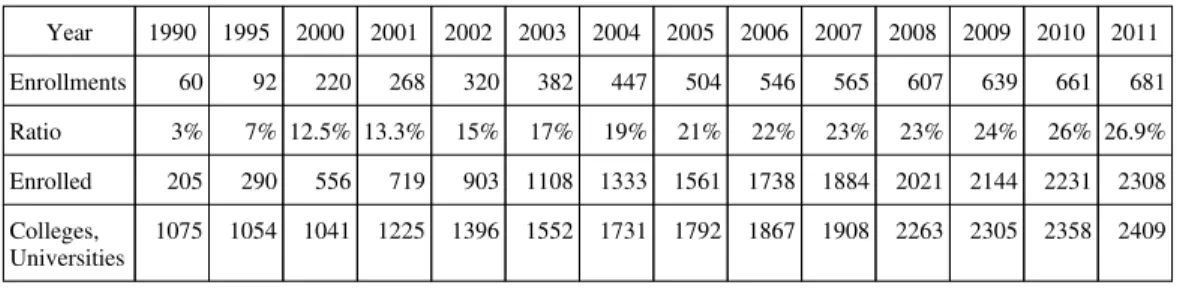
As early as the 1990s, in order to respond to the rapid economic growth and changing needs of the society, higher education reform began to be carried out in China. In 1998, the Chinese Ministry of Education issued “An Act Plan for the Education Development in the 21st Century” which announced that the higher education gross enrolment would be raised from 9% to 15% in the population of college-aged students. In addition, in 1999, “A Resolution on Deepening Education Reform and Moving Forward to Quality-Oriented Education in an All- Rounded Way” was published, stating that higher education gross enrolment would increase up to 15% by the year 2010. In fact, we achieved this goal in 2002. In 2003, the GER (gross enrolment rate) rose to 17%. According to Martin Trow’s theory, China entered the phase of massification in higher education. By 2011, the number of colleges and universities had increased to 2,409, processing twice the number of students than the previous twenty years.
The total enrolment was more than 23 million, with a GRE of 26%. Table 1 shows the
Globalization and Arts Education in Chinese Higher Education 135
increase in enrolment and number of universities during those twenty years. With this process of expansion in higher education, more and more students now have the opportunity to enter university to study. However, the increasing development has also brought numerous problems.
3. Higher Education reforms since the late 1990s
At the beginning of the 1990s, Chinese higher education reform started with the undergraduate curriculum. The most important government policy that affected the reform was the “Reform Plan of Higher Education Teaching Content and Curriculum Towards the 21st Century” (1994). This plan consisted of all educational activities in higher education, and the aim of the reform was put forward to produce capable, high-quality graduates with the well- based, wild-ranged knowledge required for the 21stcentury.
Although many changes can be seen in Chinese higher education reforms, “quality” has been the keyword during the reform phase and the ideal of emphasizing quality-oriented education has been foremost. Especially since 1999, quality-oriented education, as the basic premise of undergraduate curriculum reform, has been the focus of change in most universities (Huang, 2005).
Nowadays, the definition of quality-oriented education in China is not clear. Generally, it refers to not just giving knowledge to students, but developing them on four levels : morally, culturally, professionally and psychologically. A high-quality student is not only a specialist in his or her field, but also a well-cultivated person with a wide knowledge background. Quality- oriented education should not merely be regarded as the aim of curriculum reforms, but should be the primary purpose of all higher education reforms, which can only be achieved through general education.
Thus, since the late 1990s, general education has been implemented in most universities.
Table 1 The Increasing Number of Students and Universities
Year 1990 1995 2000 2001 2002 2003 2004 2005 2006 2007 2008 2009 2010 2011
Enrollments 60 92 220 268 320 382 447 504 546 565 607 639 661 681
Ratio 3% 7% 12.5% 13.3% 15% 17% 19% 21% 22% 23% 23% 24% 26% 26.9%
Enrolled 205 290 556 719 903 1108 1333 1561 1738 1884 2021 2144 2231 2308 Colleges,
Universities
1075 1054 1041 1225 1396 1552 1731 1792 1867 1908 2263 2305 2358 2409 Source : Science Portal China, http : //www.spc.jst.go.jp/staistics/statictisc_index.html, China Education Year Book 2012, 20 Feb. 2013, with author’s modifications
Globalization and Arts Education in Chinese Higher Education 136
The courses offered vary according to the features of the individual universities, but are generally two-fold : compulsory and elective. Under this concept of general education, science students are provided with courses in literature, history, philosophy, and arts, while courses in natural, sciences are taught to the arts students. Since 1999, general education has provided social sciences, natural sciences and humanities courses to all students across the board.
This promotion of general education, which emphasizes the integration of arts and sciences, has become a common tendency in many countries. For example, in Japan, a report entitled “A way of General Education in a New Era” was published by the Central Council for Education in 2002. The report indicated the significance of general education in a global society, and pointed out that “general education should not be regarded as a kind of education which separates knowledge into various fields like sciences, arts, humanities, social sciences, natural sciences, nor as an entry-level education into a specialized course. Rather, it is the acquisition of intellectual techniques which are beyond any specialized framework and which provide a way of thinking that allows deep insight into human existence” (A Way of General Education in a New Era). From this document we can see that developing the “competence”
which is required for globalization is regarded as the purpose of general education in Japan (Masubuchi, 2010).
Further, the emphasis on quality-oriented education is derived from two other special phenomena in China. Firstly we have the exam-oriented education system. The sole standard for admission into universities has led students to study hard from the primary school, with teachers and parents paying more attention to intellectual development than to the development of the whole person. Such an educational system creates students with higher intellectual capacities but lower overall abilities. The second phenomenon is the decline in general morality. China’s economic development has changed people’s lives rapidly, certainly improving their standard of living, but at the same time causing a decline in morality. Many people now believe only in what is visible, tangible, and controllable, such as material goods, money, power, social status, etc., and they neglect the value of a fuller spirit, and of high ethical standards. Being “rich in material goods but poor in spirit” has become a serious social problem in China.
The promotion of general education reform emerged under this situation. The question was how general education could solve this problem that we were facing? Arts education being an integral part of general education, its role and significance were highlighted and it became a topic of discussion in higher education.
I will now focus on Arts Education, and clarify how Arts Education can contribute to and
Globalization and Arts Education in Chinese Higher Education 137
facilitate quality-oriented education.
4. Development of Arts Education in China
The concept of Arts Education has a long tradition in the history of China. The emphasis on the influence of the arts on an individual’s development is derived from Confucian philosophy. In ancient times, students who wanted to become scholar-officials were required to learn six classical subjects ; this was called六芸(riku gei). Riku Gei consisted of 礼 (rei), 楽(gaku),射 (sha),御(gyo),書(sho),数(su), and its function was similar to the liberal arts in ancient Greece. 楽 (gaku) and 書 (sho) were directly connected with the study of the Arts. Moreover, Confucius was interested above all in the moral perfectibility of mankind. He laid great emphasis on his idea of礼楽 (reigaku), where 楽(gaku) did not mean music only, but was regarded as a comprehensive arts form in ancient China. Confucius also rejected the categorization of man as either good or bad, and stressed the potential for developing moral conduct through Arts education. His views have had far-reaching consequences for the Chinese people’s attitude towards Arts education.
As early as the 20th century, the development of modernization was a major concern for most Chinese intellectuals. They clearly recognized that in order to stand up to the West, the promotion of educational modernization was an urgent issue. While studying aboard or learning from the western modernization, many educators and philosophers were aware of the importance of aesthetic education. This would lead to a change national characteristics. As German aesthetics were increasingly introduced into China, a reform of aesthetics education was carried out. When he served as Minister of Education and President of Beijing University, Mr. Cai Yuan-pei actively promoted aesthetic and arts education. He considered aesthetic education as an aim of holistic education, and his idea of “adopting aesthetic education instead of religion” deeply impacted the modernization of Chinese education. Wang Guo-wei, another famous philosopher, was an advocate of aesthetic education. Based on the thoughts of the German philosopher Immanuel Kant, he put forward the individual’s full development, including intellect, emotion and will, as the goal of education and emphasized that the development of emotion should be accomplished through Arts Education.
After the foundation of the new China, the process towards Arts Education comprised three phases : The first phase, from the 1950s to the 1960s, was the establishment of Chinese Arts Education. All-round development became the acknowledged aim of school education, and Arts Education was undertaken to foster the development of emotion and sensitivity.
Globalization and Arts Education in Chinese Higher Education 138
Because there were no art departments in universities, Arts Education for college students was usually undertaken through social activities.
During the 1960s and through the late 1970s, China experienced its Cultural Revolution.
The Cultural Revolution destroyed traditional culture almost entirely. All art activities were forbidden, along with the publication of any academic works about the arts.
With the economic reform in the mid-1980s, the recognition of arts became a concern among some scholars and researchers. Many papers and books about Western aesthetics and art theories and concepts were translated and the role of aesthetics and the arts became a hot topic of discussion in academic circles.
Simultaneously, the government established an Art Education Committee to be in charge of all arts educational activities from primary school to university. This committee produced numerous documents to promote the development of Arts Education.
The first one was the “General Plan for Arts Education (1989−2000)”. It states that the purpose of Arts Education is to cultivate noble moral sentiments, aesthetic ideas, and Marxian doctrine aesthetics, to acquire the basic knowledge and skills of the Arts, to enhance patriotism and national pride, self-confidence, and morality, and to facilitate the individual’s full and harmonious development.
A second document, “The State Education Commission on the Strengthening of Arts Education” (1997), emphasized the importance of Arts Education. It indicated that Arts Education has the irreplaceable role of improving quality-oriented education by contributing to the development of thinking ability, imagination and creativity, emotional intelligence, noble sentiments and morality. It also pointed out that education through arts can help students to establish aesthetic concepts, stimulate aesthetic passion, and can shape personality and a more rounded development.
The “Development Plan of Arts Education (2001−2010)” was issued in 2002, detailing its function, methods and aims. Art curriculum reform was mentioned in this report. Generally speaking, by 2005, all colleges and universities were to offer arts elective and restricted elective courses, with credits required. Higher institutions were to improve the quality of teaching, to provide high-level distinctive arts courses, and assess students’ learning outcomes, in particular their emotional, innovational, and aesthetic abilities.
Another world document which influenced Chinese Arts Education reform was the “Road Map for Arts Education” proposed by The World Conference on Arts Education in 2006. In this report, Arts Education is regarded as a universal human right for all learners. The aims were to develop individual capabilities, exemplified in details as creativity, initiative, a fertile
Globalization and Arts Education in Chinese Higher Education 139
imagination, emotional intelligence and moral “compass”, critical reflection, autonomy, freedom of thought and action, and cognitive development. It stated that Arts Education contributes to an education which integrates physical, intellectual, and creative faculties and makes possible more dynamic and fruitful relations among education, culture, and the arts (UNESCO, 2006).
It can be concluded that, Arts Education is not only essential for an individual’s holistic growth, but it also enriches the individual and provides him or her with the “general skills”
required in a global society.
5. Arts Education in university
In China, we have two types of colleges and universities to carry out Arts Education.
One is called an Arts College, which mainly trains professional artists, and the other is the Arts Centre or Arts College within various universities. Arts Education through general education is usually undertaken in the latter.
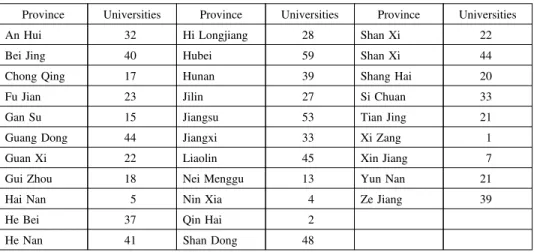
In the late 1990s, arts colleges were seldom found in comprehensive universities. But since the beginning of the 21st century, arts colleges have been established in most universities. Today, over 800 universities have arts colleges (see Table 2). Arts colleges are required to provide professional training and also have an obligation of general education for all students. Usually, arts courses in general education are provided by universities which have arts colleges. However, is Arts Education fully implemented in those universities? This is a matter of debate.
Table 2 The Number of Arts Colleges in Each Province
Province Universities Province Universities Province Universities
An Hui 32 Hi Longjiang 28 Shan Xi 22
Bei Jing 40 Hubei 59 Shan Xi 44
Chong Qing 17 Hunan 39 Shang Hai 20
Fu Jian 23 Jilin 27 Si Chuan 33
Gan Su 15 Jiangsu 53 Tian Jing 21
Guang Dong 44 Jiangxi 33 Xi Zang 1
Guan Xi 22 Liaolin 45 Xin Jiang 7
Gui Zhou 18 Nei Menggu 13 Yun Nan 21
Hai Nan 5 Nin Xia 4 Ze Jiang 39
He Bei 37 Qin Hai 2
He Nan 41 Shan Dong 48
Source : http : //www.mei−shu.cn/edu/ 18 Feb. 2013
Globalization and Arts Education in Chinese Higher Education 140
Compared with other fields, Arts Education, especially Arts Education in universities, is not quite attained because of the uncertainty of how to approach it. Some researchers have analyzed that two tendencies exist in Arts Education in universities : one tendency is a focus on theory, while the other focuses on technique (Yao, 2011). Neither of these, taught in isolation, is effective. Having a wholly subjective or abstract emphasis on the contents causes students to lose interest in the study of the arts and they become uncertain as to why it is valuable to learn (Zeng, 2009). Arts Education is always neglected in universities because of its apparent lack of purposefulness. Another important concern is how to assess the learning outcomes in these systems.
Although research on Arts Education is still at the beginning stage, there have already been some unique trials that can serve as examples. Among them, Arts Education at Tsinghua University is the most representative of the aims and ideals of Arts Education in China.
Tsinghua University was founded in 1911, and in the early period of its existence, it established an educational ideal that emphasized the necessity of combining humanities and science through Arts Education. The university had as its mission to “educate the all-round person through aesthetic education” and stated that “education would not be excellent without aesthetic education.”
In 1929, courses concerning arts such as Music, Fine Art, Piano and History of Western Music were offered firstly as elective courses to all students. In 1948, Folk Music, Music Composition, Piano, Vocal, Strings were newly added, and most of the students chose these courses. In 1993, an Arts Centre was established which was mainly in charge of Arts Education in the University. The aims of the Arts Centre is to cultivate students’
comprehensively, to develop their artistic abilities, art skills and creative thinking, and to combine science, humanities and the arts as one. It holds that Arts Education should be offered to all students. The motto of Tsinghua University, “Arts Education for all”, has a profound significance nowadays.
In terms of the curriculum, various survey, multi-level courses were treated as a given.
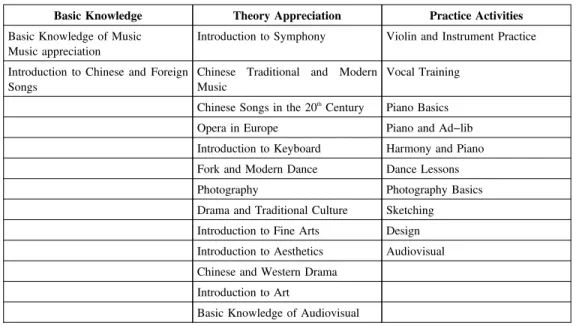
Divided into three groups according to the students’ different levels, the curriculum provides basic knowledge to those who have no prior artistic knowledge, offers a variety of courses for those who wish to study and acquire cultural knowledge, and provides creative opportunities to those who want to try out their ideas. Table 3 and Table 4 show the subjects which were taught in Arts Education. Although the curriculum changed little over th period, more practice was required in the year 2007.
The concept of connecting theory and practice, with contents covering local and Western
Globalization and Arts Education in Chinese Higher Education 141
arts, was a new style of Arts study whereby students learned the arts from their history and culture, while getting practical training as well. Furthermore, most of the teachers were artists themselves. Their artistic experience helped the students to know more about the world of an artist and the process of producing works. All of these factors contributed to bringing the Arts
Table 3 Elective Courses (2000) concerning Arts Education
Basic Knowledge Theory Appreciation Practice Activities Basic Knowledge of Music
Music appreciation
Introduction to Symphony Violin and Instrument Practice Introduction to Chinese and Foreign
Songs
Chinese Traditional and Modern Music
Vocal Training Chinese Songs in the 20thCentury Piano Basics
Opera in Europe Piano and Ad−lib
Introduction to Keyboard Harmony and Piano Fork and Modern Dance Dance Lessons
Photography Photography Basics
Drama and Traditional Culture Sketching Introduction to Fine Arts Design Introduction to Aesthetics Audiovisual Chinese and Western Drama
Introduction to Art
Basic Knowledge of Audiovisual
Zeng, Fanren (2009),A Comparative Study of Arts Education Between China and Western Countries,pp.342−343 Table 4 Elective Courses (2007) concerning Arts Education
Theory Practice Club Activeties
Music and Music Appreciation Piano and Music Basics Dance Chinese Songs in the 20thCentury As Above Solo and Duet
Symphony Appreciation As Above Dance and Group Dance
Traditional and Modern Music As Above Bruce Piano Performance
Drama Appreciation As Above Strings
Keyboard Basics As Above Comprehensive Arts
Photography As Above Symphony
Local and Modern Dance As Above Chorus
Introduction to Opera Dance Concert
Music Acoustics Dance Romanticism
Western Music Appreciation Dance Strings and Brass
Strings Appreciation Photography Dance
Sketching Chinese Folk Dance
Photography Basics Brass
Dance Appreciation Symphony Brass
Chinese Opera Chinese Drama
Zeng, Fanren (2009),A Comparative Study of Arts Education Between China and Western Countries,pp.344−345 Globalization and Arts Education in Chinese Higher Education
142
closer to the students.
However, some problems remained. Firstly, the curriculum needed to be more structured and systematic. Secondly, how was one to evaluate the abilities that the student acquired through arts studies? Without evaluation standards that were comprehensive and understandable, how would people interpret the meaning of arts study?
6. Conclusion
With the development of Chinese higher education, numerous reforms have been carried out in quick succession. One characteristic of these reforms is quality-oriented education, which has been a constant focus. General education is regarded as an effective means to improve the quality of education for students, and, in particular, as an aspect of general education, the role and significance of Arts Education has been recognized because of its traditional function. The Government issued many documents in order to promote the development of Arts Education in China.
Through Arts Education, students not only increase their knowledge, but also better themselves by developing capabilities, such as : creativity, initiative, imagination, emotional intelligence and morals, critical thinking, and autonomy, all of which are necessary and important in the face of the challenges posed by a global society. Nevertheless, Arts Education has not yet been implemented fully in educational institutions, especially at the tertiary level.
Compared with other intellect-oriented subjects, arts are generally undervalued and regarded as unimportant. As a consequence, Arts Education is neglected and denigrated by teachers and parents.
How can Arts Education contribute to the globalization of higher education? Before answering this question, we should ask why Arts Education is necessary for a human being and what the real aim of Arts Education is. What is the significance of Arts Education for us?
If we do not find some answers, the contribution of Arts Education to overall education will never be realized.
The UNESCO report, “A Road Map for Arts Education”, defined that experiencing and developing appreciation and knowledge of the arts enables the development of unique perspectives on a wide range of subject areas, perspectives which cannot be discovered through other educational means (UNESCO, 2006). Here, “perspective” can be interpreted as a way of thinking about the world which differs from rational cognition, but tends to be aesthetic. Creating an aesthetic way of thinking about the world, about human existence, and
Globalization and Arts Education in Chinese Higher Education 143
finally what it is to be a human being may be considered the real aim of the Arts Education.
References
1. Green, Andy (1997),Education, Globalization and Nation.St. Martin’s Press.
2. Read, Herbert (1958),Education Through Art.Pantheon Books.
3. Stromqurist, Nelly P., Monkman, Karen (2000),Globalization and Education : integration and contestation across cultures.Rowman & Littlefield.
4. Tickle, L (1987),The Arts in Education : Some Research Studies.Croom Helm.
5. Wang, Jie (2008), The Expansion of Chinese Higher Education and the Choice of Education Chance.
TOSHIDO.
6. Bao, Wei (2007), Private Higher Education Institutions in China : Responding to the Society’s Needs.
TOSHIDO.
7. Masubuchi, Yukio (2010),The Education Choice in a Global Society.Sophy University Press.
8. Sato, Manabu, Imai, Yasuo (2003),Create the Children’s Imagination,Tokyo University Press.
9. Huang, Futao (2000), “The Structure of Chinese Undergraduate Curriculum in the late 1990s”, DaigakuRonshu,Hiroshima University, Higher Education Research Centre.
10. Huang, Futao (2005), “Curriculum Reform in Universities”, Hiroshima University,RIHE81.
11. Huang, Futao (2009), “Liberal Education and Gerneral Education in America”, DaigakuRonshu, Hiroshima University, Higher Education Research Centre.
12. Zeng, Fanren (2009), A Comparative Study of Arts Education Between China and Western Countries, Economy and Science Press.
13. Liu, Guizhen, Li, Jinyu (2012) “The Basic Thought of Arts Education in Universities”,Northwest Normal University,Vol.46, 6.
14. Yao, Hong (2011), “From Technique to Aesthetic Education”,Creativity and Design,Vol.17.
15. Ding, Donglan (2010), “Arts Education in the Educational Plan Outline”,Aesthetic Education,Vol.1.
16. Fu, Zhipin ; Yang, Yuhui (2009), “The Value Orientation and the Reform Tendency of Arts Education in Universities”,Higher Education and Higher Vocational Education Research,Vol.14.
URL
http : //code.fabao365.com/law_265304_1.html http : //code.fabao365.com/law_224123_1.html
http : //www.unesco.org/new/fileadmin/MULTIMEDIA/HQ/CLT/CLT/pdf/Arts_Edu_RoadMap_en.pdf Globalization and Arts Education in Chinese Higher Education
144