九州大学学術情報リポジトリ
Kyushu University Institutional Repository
中間エネルギー重陽子およびα誘起反応への核内カ スケード模型の拡張
モニラ, ジャナツル, コブラ
https://doi.org/10.15017/1931898
出版情報:Kyushu University, 2017, 博士(工学), 課程博士 バージョン:
権利関係:
Doctoral Dissertation
Intranuclear Cascade Model for Deuteron- and Alpha- induced Reactions at Intermediate Energies
By
Monira Jannatul Kobra
Department of Applied Quantum Physics and Nuclear Engineering
Graduate School of Engineering, Kyushu University, Japan
i
Table of Contents
1 Introduction ... 1
1.1 Accelerator Driven System (ADS) ... 1
1.2 Heavy Ion Cancer Therapy ... 4
1.3 Space Radiation ... 6
1.4 Nuclear Fission Reactor ... 7
1.5 Nuclear Fusion Reactor ... 9
1.6 Particle Transport Codes ... 10
1.6.1 PHITS ... 10
1.6.2 LAHET ... 13
1.6.3 Geant4 ... 14
1.6.4 FLUKA ... 14
1.6.5 NMTC ... 15
1.7 Nuclear Reaction Models ... 15
1.7.1 Intranuclear Cascade (INC) Models ... 17
1.7.2 Quantum Molecular Dynamics (QMD) Model ... 20
1.7.3 Liege Intranuclear Cascade (INCL) Model ... 22
1.7.4 An INC Model for Deuteron- and Alpha-Induced Reactions... 24
1.7.5 INC Model Utilized at Present Research ... 25
1.8 Problems of Nuclear Models ... 25
1.9 Purpose of this Research ... 27
1.10 Structure of the Present Thesis ... 27
2 Theoretical Model ... 29
ii
2.1 INC ... 29
2.1.1 Ground State of the Target Nucleus ... 29
2.1.2 Kinematics ... 30
2.1.3 Collision ... 31
2.1.4 Coupling with Evaporation Model ... 36
2.2 GEM ... 37
2.2.1 Generalized Evaporation Model ... 37
2.3 Double Differential Cross Section (DDX) Calculation ... 40
2.4 Probability of Deflection Angle ... 42
3 Deuteron-Induced Nuclear Reactions ... 44
3.1 Introduction ... 44
3.2 The Bound Deuteron ... 45
3.3 Extended Model for Deuteron-Induced Reactions ... 46
3.3.1 Ground State ... 46
3.3.2 Projectile Breakup ... 48
3.3.3 Probability of Trajectory Deflection Angle ... 49
3.4 Search for Optimal Parameters ... 50
3.4.1 Deuteron Nuclear Potential ... 50
3.5 Calculation Results and Discussions ... 53
3.5.1 (d, d’x) Reactions ... 53
3.5.2 Protons Energy Spectra ... 57
3.5.3 Neutron Energy Spectra... 64
3.6 Comparison with Other Models ... 65
4 Alpha-Induced Nuclear Reactions ... 69
iii
4.1 Introduction ... 69
4.2 Extension of INC model ... 70
4.2.1 Incident Nuclear Ground State ... 70
4.2.2 Projectile Breakup ... 70
4.2.3 Investigation of Potential Depth ... 73
4.2.4 Investigation of Maximum Impact Parameter ... 75
4.2.5 Probability of Deflection Angle ... 77
4.3 Calculation Results and Discussions ... 77
4.3.1 INC for Forward Angular Positions ... 91
4.4 Comparison with Other Models ... 95
5 Conclusion ... 106
References ... 108
Acknowledgement ... 116
1
1 Introduction
With the advent of science and technology, particle transport codes attract growing interest in basic science, technology and applications in recent years. The physical processes considered for hadrons transport include electromagnetic and hadronic processes, the latter of which is simulated by using nuclear reaction models. Nowadays, nuclear reactions are modelled in two stages: the first stage is cascade process and the second one is the static process followed by the cascade process. To describe the fast process, we have developed a code1 that has been incorporated into the widely used Monte Carlo Particle and Heavy Ion Transport code System (PHITS)2. Background and the purpose of this work are described.
1.1 Accelerator Driven System (ADS)
The energy needs of our society have been increasing continuously over the last century.
We search for new sources as well as would like to utilize the sources efficiently we already have. About 80% of our energy source oil, gas, coal etc. The energy production by these sources increases the CO2 emission, one of the main causes of global warming.
The alternative energy source can be the nuclear power plant, a CO2 free energy source.
This led to increase the number of nuclear power plants and to make the nuclear plants as sustainable as possible. However, the nuclear power generation in future will depend on solving three issues3 i) no quick exhaustion of nuclear fuel ii) safety and security of power plant iii) nuclear waste management.
2
Fig. 1.1 Schematic representation of an ADS.3
First, I will talk about the third issue, nuclear waste management problem. The waste of nuclear power contains highly radiotoxic, long-lived isotopes. The usual solution is to keep the nuclear wastes underground for about ten thousand years. The process includes long-term monitoring, high cost, and it is also difficult to handle. To manage the highly radiotoxic waste, the alternative idea is to separate (or partitioning) the long-lived waste isotopes from the utilized fuel using the transmutation technique by the acceleration driven system (ADS). The technique involves a proton beam of few hundred MeV from an accelerator hit a spallation target surrounded by a blanket assembly of nuclear fuel located in the centre of the reactor. Usually, 10-15 spallation neutrons emit per incident high-energy proton. The spallation neutrons eventually transmute the waste isotopes lowering the half-life from hundreds of thousands of years to several hundred years. Fig.
1.1 shows a schematic diagram of an ADS project.
The incorporation of ADS technology in nuclear power generation may enhance the safety of the power plant by altering the geometry of the reactor chamber. The plan is:
3
available neutrons for fission chain reactions in the chamber will not allow to multiply in successive reactions and having them take off the reactor. Meanwhile, the fast spallation neutrons colliding with moderator turn them thermal neutrons and sustain the nuclear fission process. Therefore, the shutdown of the accelerator will stop the reactor. The reactor will have enhanced safety. In addition, to solve the nuclear fuel exhaustion problem, ADS technology can be useful. Study says if the current rate of uranium consumption continues the available fuel will last only for about 100 years. Uranium is the most common nuclear fuel until now. The use of naturally abundant thorium as a new primary fuel has been tantalizing for many years. The fertile thorium upon absorbing fast neutron will transmute to fissile U233, which is an excellent fuel.
Considering the huge applicability, extensive research on ADS technology has been going on. To run the project, the problems with its size, high technologic requirements, etc. need to solve. Many such projects have been running all around the world to carry out the experiments, test the accuracy of models describing spallation, transmutation reactions etc. The aim of such investigations is to design the optimal parameters required for ADS system. Optimization of the device requires simulation tool, particle transport codes. The macroscopic simulation tool provides information on the reactor in operation e.g. what waste to expect or what kind of shielding should prepare etc. It is very important for the tool that uses nuclear reaction models to provide precise information.
Therefore, the nuclear reaction model used in transport codes should also be precise enough. It uses Intranuclear cascade (INC) model to simulate nuclear reactions. Besides emission of spallation neutrons from the high-energy proton-induced nuclear reactions, deuterons, alpha particles etc are also ejected in ADS. The nuclear model should capable of simulating secondary particles initiated nuclear reactions besides handling proton- induced nuclear reactions.
4
1.2 Heavy Ion Cancer Therapy
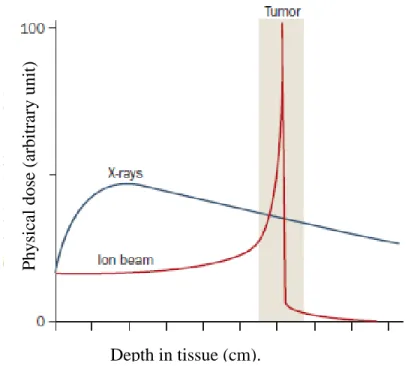
Particle physics technology has improved dramatically the cancer treatment and many other applications in medical science. Besides surgery, radiotherapy manifests a great advantage to treat the localized malignant tumour. High energy X-rays have been used for cancer treatment. In last two decades, charged particles e.g. proton, helium, carbon therapy have gained high interest.4 The success of the radiation therapy in cancer treatment depends on providing the right amount of dose to the cancerous cell without affecting surrounding normal tissues. The primary reason to choose the particle radiotherapy over the most advanced X-ray therapy is the sharp increase of dose at the well-defined depth (Bragg-peak, Fig. 1.2) and rapid fall-off beyond that maximum. By contrast, dose with X-ray decreases exponentially with tissue depth.
Fig. 1.2 Comparison of the depth-dose relationships for x-rays and charged particles.5 Depth in tissue (cm).
Physical dose (arbitrary unit)
5
For the heavy-ions, the ratio of Bragg peak dose to the entrance dose is larger. Particles heavier than proton are referred as heavy-ions in oncology. High linear energy transfer (LET) for heavy-ion radiotherapy provides biological effects of high relative biological effect (RBE) and low oxygen enhancement ratio (OER) in the Bragg peak region.
Although the larger charge exhibits greater effectiveness, proton and helium reveal almost the same biological effects. Neon and Carbon deliver higher biological effects of high RBE and low OER in the Bragg peak region. The RBE ratio (Bragg peak vs entrance region) is highest for Carbon. The RBE is even higher for Argon but nuclear fragmentation extends the dose even beyond the Bragg peak. The pioneering work of heavy-ion radiotherapy started with helium and neon ions at the Lawrence Berkeley Laboratory, University of California in Berkeley in 1977. World’s first heavy-ion radiotherapy has been started at Heavy Ion Medical Accelerator in Chiba (HIMAC) in National Institute of Radiological Sciences (NIRS), Japan. NIRS has been treating cancer with high-energy carbon ions since 1994.
To have specific information about biological and physical dose delivered on the human body during heavy-ion radiotherapy, particle transport codes are indispensable. Late effect of low dose exposure is a serious issue for childhood cancer treatment with carbon radiotherapy. Fragments produced in the carbon incident reactions emitted at large angle with high energy beyond the irradiation field that causes an amount of dose in normal tissues. INC utilized in transport codes requires to capable of simulating fragments induced nuclear reaction for accurate dose calculation. The fragments consist of the cluster deuteron, alpha etc. particles. In addition, the theoretical success of alpha-induced reactions will open the pathway for INC model to expand for carbon-incidence radiotherapy dose calculations.
6
1.3 Space Radiation
Cosmic rays involve two types, galactic cosmic rays (GCR), whichoriginates outside the solar system but within the galaxy, and high-energy particles emitted by the sun, which is called solar particle events (SPE). The compositions of these two types of rays are different and have a distinct contribution of equivalent dose to the exposure. When primary cosmic rays interact with the earth atmosphere, they are converted to secondary particles. The dominant energy range of the cosmic rays is 10 MeV/nucleon to several GeV/nucleon. Fig. 1.3 shows relative abundance of the galactic cosmic rays up to z =26.
The primary GCRs contains 10-12% alpha and the alpha-induced reactions are the primary source of 2He and 3He production. Cosmic rays are the main source of radiation in a manned space mission.
To understand the biological effect of exposure to ionizing radiation in the space exploration missions or for the workers at International Space Station (ISS), research is going on. Currently, NASA radiation guideline is only to missions in lower Earth orbit (LEO) and there is no guideline for the missions beyond LEO. The biological effect of radiation exposure is an indispensable concern for the manned mission. The experience of the manned mission is only about four decade and limited to near Earth’s orbit. The possibility of the late and long-term effect of cosmic rays demands to understand well.
To build a theory of cosmic rays, it is very much important to understand the composition of the primary cosmic rays, its source, acceleration, and the transport mechanism.
Accurate simulation of the nuclear reactions by cosmic rays and interstellar matter is highly expected. The cross section and energy spectra of the secondary particles resulting from the nuclear reactions are important parameter to solve the issues. To build a cosmic ray database and to demonstrate the transport of cosmic rays, theoretical models are indispensable.6
7
Fig. 1.3 Relative abundance of GCR nuclei from hydrogen (Z = 1) to iron (Z = 26).7
The INC model in transport tool like PHITS is important to estimate dose received by astronauts in a spaceship. High-energy cosmic rays or secondary particles not only harmful for an astronaut but also they destroy the devices like computers, which are the very fundamental requirement in spacecraft for getting commands from earth or sending scientific data from the space. Single event upset is one of the issues caused by heavy particles. The single event upset occurs when the high energetic heavy particle strikes sensitive portions of an electronic device interrupting its correct operation.
1.4 Nuclear Fission Reactor
Nuclear fission is the fragmentation of atomic nuclei into two lighter nuclei of comparable masses. Two German chemists, Otto Hahn and F. Strassmann in 1939, discovered nuclear fission reactions, one of the most important discoveries in nuclear
8
physics that allows the utilization of internal nuclear energy for the practical purpose.
Nuclear reactors are devices where the controlled chain reactions are maintained to have the steady flow of neutrons generated by fission of heavy nuclei accompanied by the release of energy that is used for the practical purposes. Enrico Fermi led to build the first nuclear reactor and launched in December 1942. Nuclear models and simulation tools are the very important tools for nuclear energy research. To estimate the heat generation, material damage by neutrons and nuclear waste management, nuclear models and data libraries are essential tools. Scientists and engineers have been working to make the reactors more efficient through nuclear models and simulations. It is almost impossible to observe what is happening inside the reactor. Nuclear models and simulation tools not only allowing the scientists to understand what is occurring inside as well as observing the impact on the environment. A diagram of nuclear fission chain reaction is presented in Fig 1.4.
Energy released by fission, Qf of the nucleus (A, Z) that fragments into masses M1 (A1, Z1), M2 (A2, Z2) with binding energy W1 (A1, Z1), W2 (A2, Z2), respectively, is
Qf = M (A,Z) c2- [M1 (A1,Z1) c2 M2 (A2,Z2) c2] = W1 (A1,Z1) W2 (A2,Z2) - W (A,Z)
(1.1)
When a fissile element like 235U absorbs a neutron, it may undergo fission reaction. The heavy nucleus will split into two or more fission products releasing energy, gamma radiation and neutrons. Under certain condition, produced neutrons may contribute the chain reaction.
9
Fig. 1.4 The Fission nuclear reaction.8
1.5 Nuclear Fusion Reactor
A fusion reactor is a device that permits the controlled release of fusion energy. Nuclear fusion is the process by which two or more light nuclei fuse together. The process is accompanied by the release of huge energy due to the difference in mass between reactants and products. Any practical fusion reactor has not developed yet. Deuterium and tritium are considered as best fuel in a fusion reactor. Before commercial use, huge theoretical research and simulations should run and that is what is going on in many parts of the world. Macroscopic simulation tool like PHITS is an important ingredient for this kind of research.
10
1.6 Particle Transport Codes
Particles and heavy ions have been used in various fields of science and technologies e.g.
nuclear physics, material sciences, space and geosciences, accelerator technologies, medical sciences, etc. In addition, various applications related to high-energy radioactive ions are being planned. Spallation products from high-energy ions are also planned to be used in nuclear physics. In the design of this kind of numerous facilities, it is extremely important to deal with transport and collision of various particles and heavy ions over a wide energy range. To handle the issues like estimation of shielding or estimation by tracing high-energy particles, the particle transport code is an essential. The transport codes provide macroscopic simulations by using microscopic various models. There are many particle transport codes like FLUKA, Geant4, PHITS etc. and we have then been using the codes in various research and application fields. In this section, a widely used transport code, PHITS, as well as other transport codes are discussed.
1.6.1 PHITS
PHITS stands for particle and heavy ion transport code system. It is a three-dimensional Monte Carlo particle transport simulation code. Several institutes in Japan and Europe through the collaboration have developed PHITS; Japan Atomic Energy Agency has been managing the whole project. Fig. 1.5 shows a list of institutes currently involved in the development of PHITS. This widely used transport code is written in FORTRAN, and developed based on the transport code NMTC/JAM9.
PHITS uses various nuclear reaction models and data libraries to deal with the transport of almost all particles, e.g., neutron, protons, photons, electrons, heavy ions over a wide energy 10-5 eV to 1 TeV/u. The application of PHITS can be divided into two categories;
namely transport process and a collision process. In the transport process, the motion of
11
particles is simulated even in external magnetic and gravitational field. During the motion of charged particles and heavy ions in matter, ionization processes take place that is named as transport process. Another physical process is the collision of the particles and heavy ions with nucleus in the matter. The decay of the particles is also included in collision processes. PHITS determines the mean free path using the total reaction cross section of particle, which is important to determine next collision points.
Fig. 1.5Institutes involved to the development of PHITS10.
The physics models used in PHITS for simulating atomic and nuclear collisions are summarized in Fig 1.6. For the transport of neutrons energy 20 MeV down to 1 meV, PHITS uses data library. For the high energy hadrons-induced nuclear reaction, the model JAM11 is used, while for intermediate energy nuclear reactions INCL4.6 are employed to simulate dynamic stage of nuclear reactions. As alternative options, modified BERTINI and INC-ELF1 are used in this region. The quantum molecular dynamic model, JQMD, is utilized to simulate nucleus-nucleus reactions. INCL4.612 is a default nuclear model for the simulation of deuteron-, triton-, 3He, and α-induced nuclear
12
reactions. If the excitation energy of the residual nucleus is very high, statistical multi fragmentation model, SMM, is implemented before the evaporation model. Data library is used for the atomic collisions. Besides, some other models are also used; details are given2,13.
Fig. 1.6 The recommended Physics models for PHITS2.88 to simulate nuclear and atomic collisions.14
The important functions of PHITS are i) the event generator mode for low energy neutron interaction ii) the beam transport function, iii) the function for calculating the displacement per atom (DPA) iv) the microdosimetric tally function.10 All the functions make it useful for specific fields.
The event generator mode and microscopic tally functions are used mainly for medical purposes such as patient estimation for radiotherapy and computed tomography examination. The mode is also indispensable for estimation of soft error in the semiconductor. For both the neutron and charged particle beam line design, the beam transport functions are useful. The DPA function is used to evaluate radiation damage in
13
material structure. To evaluate the deposited energy in microscopic sites, the microdosimetric function is used. PHITS has been extensively in J-PARC project to build the shielding, target, neutron beam lines due to its features. Several projects that use PHITS are also currently in progress. The PHITS-based treatment planning system has been initiated as well. It is to be noted that the INC-ELF utilized in PHITS is the previous version of the model used in the present research.
1.6.2 LAHET
LAHET15,16 is a Monte Carlo code to simulate particle transport and nucleons, pions, light ions interactions with matter. LAHET code system has been developed at Los Alamos National Laboratory, USA based on the LANL version of HETC Monte Carlo code that was developed at Oak Ridge laboratory.
To describe nucleon-nucleon interaction, it uses Bertini model17. Bertini INC model is a default option in LAHET. As an alternative to Bertini INC, it employs ISABEL INC18 model, which is an extension of Yariv and Freankel’s VEGAS code having a capability to treat hydrogen and helium ions as projectiles. As an option, LAHET utilizes pre- equilibrium EXCITON model for the subsequent de-excitation of the residual nucleus.
LAHET has two options for the fission induced by the high-energy interactions. The ORNL model and the Rutherford Appelton Laboratory (RAL) model by Atchison. RAL is the default model in LAHET and it allows fission for Z ≥ 71. LAHET utilizes Fermi Breakup model instead of evaporation model. Fermi breakup model de-excites the excited nucleus by breakup into two or more products. The unstable product will go through the subsequent breakup.
14 1.6.3 Geant4
Geant419 is a software toolkit. It simulates the “passage of particles through matter”. The earlier version of Geant4 is developed by CERN, Switzerland. The present one, Geant4, is developed through collaboration.
Quark-Gluon String (QGS) model20 is utilized to describe the interaction of protons, neutrons, pions and kaons with the nuclei at the incident energy range 20 GeV to 50 TeV.
Coupled with the gamma-nuclear model, QGS can simulate photon-induced reactions in higher energy domain. For the intranuclear cascade energy region, Geant4 uses Bertini- style cascade code and Binary cascade model21. In Bertini-style cascade model, main features are mainly taken from Bertini model22,23. As an alternative to Bertini style cascade code, Binary cascade model is utilized in Geant4. Nuclear de-excitations are simulated with Precompound model. Exciton model, Fermi breakup model and Fission model also used in Geant4 code. Chiral Invariant Phase Space model is used as an event generator in Geant4.
1.6.4 FLUKA
FLUKA is a fully integrated Monte Carlo simulation package.24,25 The code is written in Fortran 77, and is mainly developed by CERN, Geneva, Switzerland and INFN, Milan, Italy. The applications of FLUKA extend to accelerator design and shielding, accelerator driven system studies, neutrino physics etc.
A Glauber-Gribov model is employed to describe the cascade stage of hadrons-nucleus interactions. At sufficient high energy hadron-nucleus interaction is described by (G)INC model. FLUKA utilizes the exciton model for the description of the pre-equilibrium stage.
For the last stage of interactions, evaporation model of Weisskopf-Ewing approach and fission model of Atchison algorithm or Fermi breakup model is used.26 For nucleus-
15
nucleus interactions, FLUKA uses DPMJET-III model27 for energies greater than 5 GeV/n.
1.6.5 NMTC
The high-energy particle transport code NMTC/JAM is an updated version of the nucleon-meson transport code NMTC/JAERI that was developed by the joint proposal of JAERI and KEK9,28. NMTC code employs JAM model for the interactions at above 3.5 MeV and Bertini model below 3.5 GeV. JAM is a hadronic cascade model that simulates ultra-relativistic nuclear collisions. Later on, PHITS is derived from NMTC/JAM in addition to HETC- CYRIC.2
1.7 Nuclear Reaction Models
Theoretical nuclear reaction models play an important role to understand the mechanism involved in the target-projectile system and estimate the required cross sections where data are not reliable or not fully available. The characteristics of nuclear reactions varied on the projectile incident energy, nature of projectile etc. There are various models of different natures, restricted to specific energy regime or specific phenomena. Therefore, it is a long-term desire to develop the nuclear model that can have a wide range of applicability, describe the reactions involving many species of incoming and outgoing particles and have high predictive accuracy as much as possible.
The reaction mechanism proposed by Serber29 splits the nuclear reactions in two-stages.
In the first stage, the incident particle initiates a cascade inside the nucleus. At this stage, nuclear reactions between the high-energy projectile and complex target nuclei are considered as nucleon-nucleon interactions. The cross section of nucleons are taken as in free space nucleon cross section, however, Pauli Exclusion Principle governs the
16
consideration. The second stage is the slow stage where the residual nucleus got de- excited by the evaporation or fission process. These two stages of nuclear reactions are well separated by their timescale. In the fast cascade stage, the collision takes place in the time scale of 10-22 S, where the second statistical process takes place in a slower timescale of the order or 10-16 S. The nuclear reactions usually refer as spallation reactions (Fig. 1.7).
Fig. 1.7 Basic spallation reaction process.30
There have been developed various ideas to describe the fast cascade process including Goldberger31, Bertini32, Metropolis et al.33, Chen et al.34, Boudard et al.35, Iwamoto et al.36 etc. All these models use the Monte Carlo technique to calculate cascade stage of the nuclear reaction. The model name used for these kinds of calculations is known as intranuclear cascade model though there are different name proposed by the various working groups. In addition, cascade stage can also be simulated by JQMD code37, which is based on quantum molecular dynamic (QMD). To simulate the evaporation/fission process, GEM38, ABLA etc. is used. In some studies, between cascade and evaporation
17
model, a pre-equilibrium model, exciton39, is used. However, transport codes, PHITS, utilize INC models like JAM, INCL, INC-ELF or JQMD coupled with evaporation model for the incident energy 0.1 – 3 GeV. A large number of particles, as well as clusters, emits in these reactions. The primary, as well as the secondary particles, initiated nuclear reactions require simulation having accurate predictions.
1.7.1 Intranuclear Cascade (INC) Models
Intranuclear cascade model is usually applicable for the nucleon-induced nuclear reactions where incident energy lies between intermediate to the high-energy region.
There are several different INC codes as it is mentioned earlier. Some aspects are common to all of them. An overview and classification of INC model are given below.
1.7.1.1 Overview of INC Model
The INC model has been developed to explain nucleon-induced spallation reactions at high-energies. The interaction between incident particles and the target nucleons in the INC model is based on the multiple scattering theory of Serber40 and Watson41. In the INC framework, nucleons in the nucleus are considered as collections of free particles and the interaction between the incident and target nucleons is considered as nucleon- nucleon (N-N) collision. Here, two-body collision is approximated as Quasi-Free scattering (QFS) with two-body collision cross section. In INC, when the kinetic energy of the projectile is high enough, it is assumed to travel in a straight-line trajectory in the nucleus, interference is not considered. A schematic diagram of INC model is shown in Fig. 1.8. In the figure, a nucleon with given kinetic energy and impact parameter enters a nucleus, initiates a two-body collision while moving in a straight-line trajectory. The nucleon scattered by the two-body collision follows a straight-line trajectory and repeat
18
the collision one after another. This is called multiple scattering or multi-step collision.
The nucleons that acquire enough momentum will be emitted from the nucleus.
Fig. 1.8 Schematic diagram of INC model.
1.7.1.2 Classification of INC Model
All INC models can be categorized into two classes. One is space-dependent INC and the other one time-dependent INC. Time-dependent INC model studies the interaction between two collisions. Space-dependent INC model emphasizes the interaction between collections of nucleons with continuous medium characterizes by a mean free path. A bit more details of these two approaches are given below.
In the space-dependent INC model, the target nucleus is treated like a continuum with density distribution. Each participating nucleon is given mean free path according to collision cross section (nucleon-nucleon scattering cross section) of the incident particle and the nucleon in the medium. Projectiles are given mean free path at the beginning only.
19
The collision point x is given by the following Eq. (1.2) with the uniform random number ξ between [0, 1) and the mean free path λ,
(1.2)
where is
(1.3)
(1.4)
here is the nucleon-nucleon collision cross section, Z is the number of protons, A is the mass number, ρ is the nucleon density, and are collision cross section between the incoming particle, and target proton and neutron, respectively. Space- dependent approach is used by e.g. ISABEL model, Bertini model, VEGAS model.
In time-dependent INC, each projectile and target nucleon is given a position and momentum. The nucleons will propagate until they come close to a certain distance, rij,
(1.5)
here is the nucleon-nucleon collision cross section. INCL is a time-dependent model.
The INC model in the present research is also a time-like model. Time-dependent models are easy to handle and require less computation time.
As described above, the space-dependent and time-dependent INC largely differs depending on the method of determining the collision point, but there is no difference between the two-body scattering methods after the collision. In the next few sections, descriptions of some models that are utilized to simulate the cascade stage are represented.
20
1.7.2 Quantum Molecular Dynamics (QMD) Model
Quantum Molecular Dynamics can describe the cascade stage of nuclear reaction model.
QMD is used in transport code to handle hadrons as well as heavy-ion induced reactions.
In the following, a summary of JQMD37 developed by Japan Atomic Energy Agency is given.
The QMD model is a semi-classical simulation method. The Gaussian wave packet is used to express each nucleon state. The Gaussian wave function is
(1.6)
where L is the width of the wave packet. Ri and Pi are the centres of a wave packet in the coordinate and momentum spaces, respectively. The total wave function is the direct product of these wave functions.
The one body distribution function is obtained by Wigner transform of wave function,
(1.7)
The Ri and Pi time evaluation is described by Newtonian equations of motion and two body collision term. The Newtonian equations of motion are
(1.8)
where the Hamiltonian, H, is
21
(1.9)
here the first term, Ei, is the single particle energy of ith nucleon. The second and third terms are the Skyrme type potential energies, the fourth term is the Coulomb energy, and the fifth term symmetry energy. In 4th term, “erf” is the error function and is an overlap density of nucleon.
(1.10)
with the density distribution,
(1.11)
In Eq. (1.9), = -219.4 MeV, = 165.3 MeV, and τ = 4/3 are taken as parameters. The parameter Ci represents the number of charge in ith nucleon, one for proton and zero for neutron. The elementary charge is given by e.
In the collision term, the channels included are as follows (B is for baryon and N for nucleon):
22
1.
2. , 3.
4.
5.
6.
7.
8.
Apart from the collision term, the decay of the baryonic resonances during propagation is as follows:
9.
10.
11.
Once the equilibrium is attained, evaporation model performs the calculation of the de- excitation of the residual nucleus.
1.7.3 Liege Intranuclear Cascade (INCL) Model
Liege intranuclear cascade model35 (INCL) has been developed by University of Liege, Belgium and CEA, France. The model has been used to simulate the dynamic stage of nuclear reactions for the cases of nucleon, pion or cluster incidence. Transport codes, PHITS, Geant4 employ INCL model to simulate cascade stage of nuclear reactions. The incident energy limit of INCL ~150 MeV to GeV range energy. INCL follows time-like approach. A stopping time is used to end the cascade process. The particle follows the straight-line trajectory.
INCL4.642 is a default model in PHITS for deuteron- and alpha-induced nuclear reactions.In the present study, we are focusing on cluster-induced reactions. The features related to cascade-induced and cluster production reactions of INCL4.6 are shortly represented here.
23 Cluster emission at INCL
A coalescence model is employed to allow the cluster emission process in this model.
Different steps of cluster-emission are as follows,
i) An outgoing nucleon arriving at the surface of the target nucleus is selected to be emitted as a cluster with surrounding nucleons, if it has energy more than the threshold energy, otherwise, it will be reflected.
ii) The size of the cluster is formed by searching nucleons close in the phase space.
iii) The virtual cluster is selected phenomenologically.
iv) The selected cluster
a. should have the sufficient energy to escape, , Ti kinetic energy of nucleons, Vi depth of the potential.
b. must successful to penetrate the Coulomb barrier.
c. will emit if the angle of direction of the cluster satisfy, , where θ is the angle between the direction of the cluster and the radial outward direction passing through centre of the cluster.
If the above conditions are fulfilled, the cluster will be emitted with kinetic energy in the direction of the sum of the constituent momentum of the cluster nucleons. If any of the conditions disagrees, nucleon may be emitted alone.
Handling incident cluster at INCL:
Initial nucleon distribution inside the cluster is done according to Gaussian distribution12. Momentum distribution follows the same Gaussian manner. The incident cluster is
24
considered as collections of the independent nucleons. At the beginning, the cluster centre of mass is positioned in such a way so that at least one nucleon touches the Coulomb radius i.e. the incident cluster radius is taken as same as Coulomb radius.
1.7.4 An INC Model for Deuteron- and Alpha-Induced Reactions
To understand the effects of complex projectile like deuteron and alpha on the cascade stage, a study was carried out by Mathews et al.43 based on VEGAS model34. The density distribution in the target nucleus is considered as a step function distribution to approximate Fermi distribution by eight concentric regions having a constant density.
The particle trajectory is classical and the collision pairs are only p-d, n-d, p-α, d-d, d- α, and α-α. Neutrons and protons are taken as similar while considering the cross section.
The cascade nucleons are allowed to refracted or reflected at the potential surface.
Probability of cluster breakup is,
(1.12)
where is the reaction cross section, and is the total cross section. A step function is employed to calculate the cluster breakup probability. A random number is used to select the collision partner for the incoming cluster considering the existence of cluster inside the target. While the cluster energy goes below the cut-off energy, the cascade stops. The cut-off energy for neutron is considered as Fermi energy (Ef) + 2 × average binding energy (EB) and for proton the larger one among Ef +2 × EB or Ef + EB + Coulomb barrier.
The cluster density distribution is same as nucleon density distribution in the target. The number of clusters present in the target is considered to fit the experimental data. The Fermi momentum of the n-nucleon cluster is taken as n-times the Fermi momentum of the individual nucleon. And the potential energy of the cluster is taken as -(Ef + EB), with Ef is the Fermi energy, and EB is the nucleon binding energy of the cluster. The model
25
was examined at the incident energy up to 380 MeV only. The predictive power of this model is low.
1.7.5 INC Model Utilized at Present Research
The research group at Kyushu University has developed an INC model originally. The model follows a time-dependent approach. The details of the model will be given in chapter 2.
The model already successfully applied for proton-induced and proton production reactions for the incident energy ~200 MeV or higher. Later on, to have a wider application of INC, the model was successfully extended at low incident energy for (p, p’x) reaction at about 50 MeV. The model is already successful in reproducing cluster production nuclear reactions. The model also incorporated in widely used particle transport codes, PHITS named as INC-ELF1. In this research, we will use the model name as ‘INC model’.
1.8 Problems of Nuclear Models
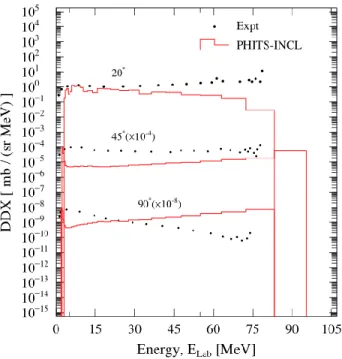
BERTINI, JAM, JQMD, INCL are widely used models to simulate the cascade stage of nuclear reactions as described in earlier sections. It is a common expectation that a model will have wider applications considering incident energy range as well as incoming and outgoing species. Though BERTINI, JAM, JQMD are known as successful, the models cannot reproduce the double differential cross section of light fragment emission during cascade stage. Bertini and JAM cannot work with cluster-induced reactions. INCL4.6 can handle the formation of the cluster using coalescence model. On the other hand, the model shows poor predictions in case of cluster emission, especially in case of inelastic scattering. In addition, JQMD is highly recommended for nucleus-induced reactions but
26
the success in reproducing cluster-induced cluster production reactions is still poor. Fig.
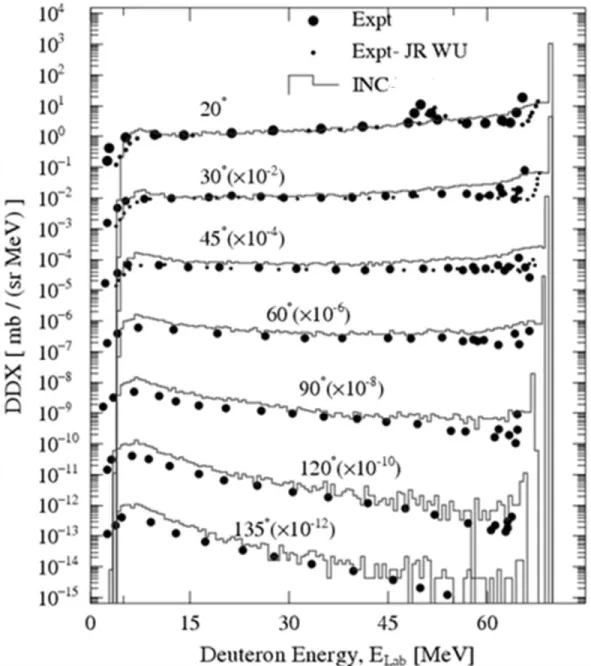
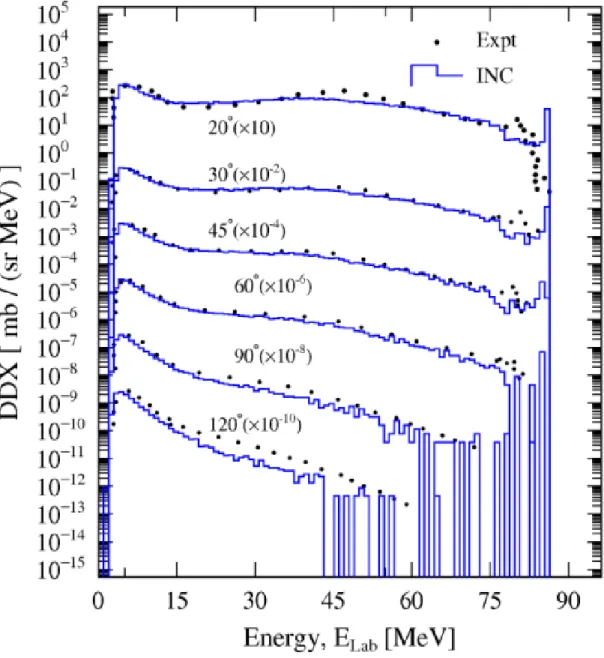
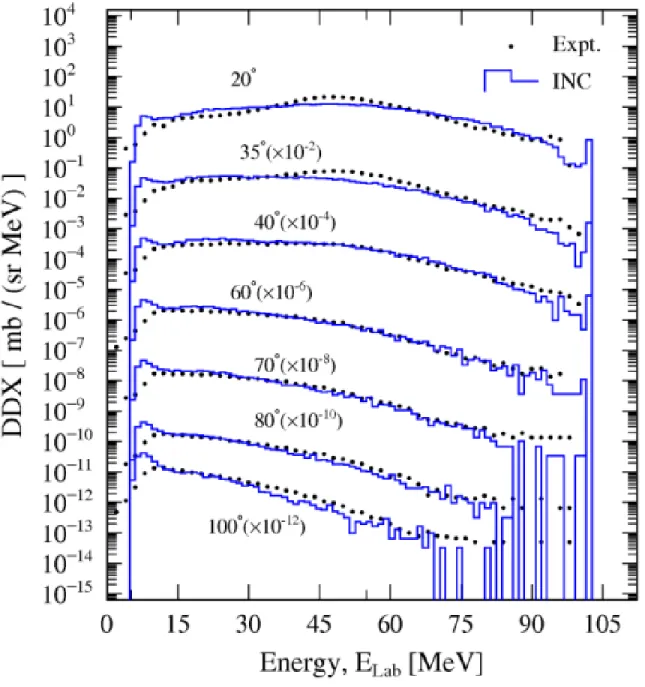
1.9 represents the comparison of INCL and JQMD (red and green line histogram, respectively) calculation results with the experiment data (solid circles) for the 58Ni (α, α’x) nuclear reactions at 140 MeV incident energy. The experimental data are taken from EXFOR44.The calculations were executed using PHITS.
The prediction abilities of INCL and JQMD models are not always satisfactory enough.
As mentioned earlier, light-cluster induced nuclear reactions need to be handled well for heavy-ion radiotherapy, space technology, ADS technology. The comparison of calculation results by the two models incorporated in PHITS coupled with evaporation model shown in Fig. 1.9 demonstrates the need to improve INC model for cluster- induced reactions.
Fig. 1.9 Comparison of model result for the alpha induced reaction on 58Ni at bombarding energy 140 MeV with the experimental DDX spectra.
27
1.9 Purpose of this Research
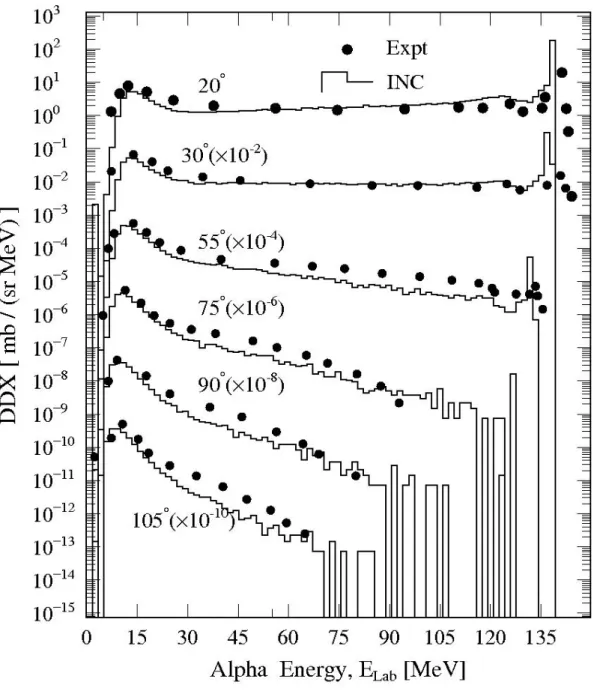
INC is demanded to reliable estimation for cluster-induced reactions because the late effect of low-dose exposure is a serious issue for childhood cancer treatment in heavy-ion therapy. Fragments produced in heavy-ion nuclear reactions are emitted at large angles with high-energies, and therefore healthy tissues far from the irradiation field suffer amounts of doses. It is known that the INC model and other non-perturbative reaction models including the QMD model give passably good accounts for nucleon productions, but large discrepancies for cluster production reactions in spite of great efforts. It has been therefore suggested that unpreceded physics idea is needed to improve the INC model for cluster-induced cluster production reactions. The purpose of this work is to introduce into the INC framework an idea of virtual excited state, whose wavefunction is expressed as a superposition of different cluster units. Model calculations are executed to verify the proposed model by comparison with experimental observations on deuteron- and α-induced reactions at incident energies of 22.3 - 99.6 MeV and 140 -160 MeV respectively.
1.10 Structure of the Present Thesis
This paper consists of five chapters.
Chapter 2 details of the INC code. A short description of the evaporation code is provided as well. DDX calculation procedure is very briefly described.
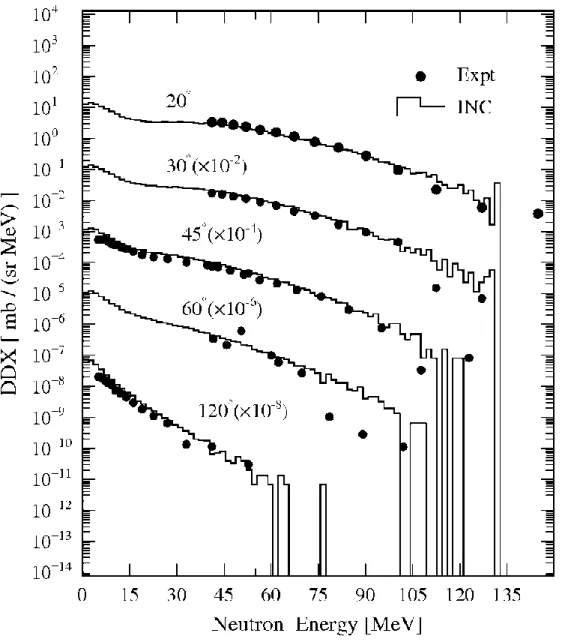
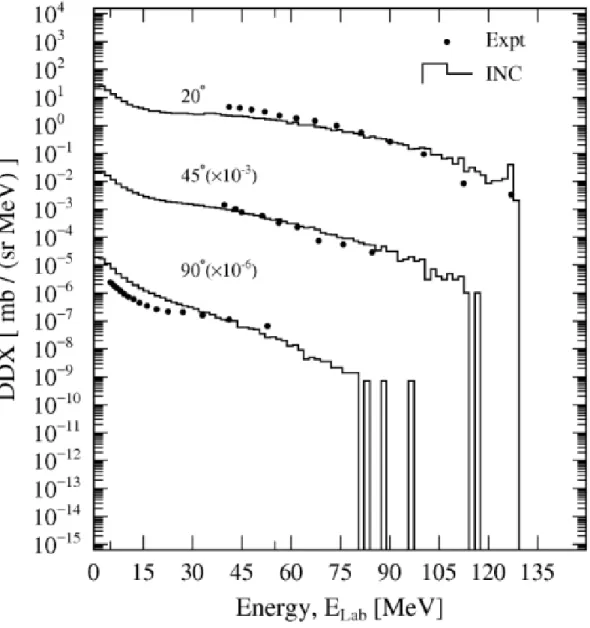
Chapter 3 focuses deuteron-induced nuclear reactions. The descriptions of the extension of the model for deuteron-induced reactions are discussed. The validity of the proposed model is verified comparing with experimental energy spectra for (d,d’x), (d,px) and (d,nx) reactions on several targets from 27Al to 181Ta.
28
In chapter 4, the alpha-induced nuclear reactions for all channels are represented. The expended model description is represented first. Later on, the proposed model is verified comparing with experimental observations for 27Al and 58Ni targets.
Chapter 5 draws the conclusion and discusses the future research plan.
29
2 Theoretical Model
2.1 INC
In this section, description of the INC model utilized in the present research is presented.
The time-dependent approach is chosen since the approach allows to use the realistic nuclear density distribution.
2.1.1 Ground State of the Target Nucleus
In the INC model, it is necessary to locate the position and momentum of the nucleons in the target nucleus before entering the cascade calculation. In this study, we assume that the shape of the target nucleus is spherical. The positions of nucleons in the target nucleus are sampled according to Woods-Saxon type density distribution45. The Wood- Saxon density distribution is written as
(2.1)
where R0 is the nucleus radius, and is a parameter represents the diffuseness of the nuclear surface. is the cut-off radius and is given by Using the Negele’s45 expression,
(2.2)
where A is the mass of the target nucleus. The momentum of each nucleon is generated according to the Fermi-Dirac distribution. The Fermi momentum, with the corresponding Fermi energy, TF, is
30
(2.3)
(2.4)
where, m is the rest mass of the nucleon and is the depth of nuclear potential. The potential depth is assumed to be, Ebind is the binding energy, using Bethe- Weizsacker's mass formula,
(2.5) Fig. 2.1 shows the schematic diagram of the target nuclear potential assumed in this study.
Fig. 2.1 Schematic diagram of nuclear potential.
2.1.2 Kinematics
It is assumed that incident particles move in the nucleus by obtaining potential energy when entering the nucleus. The depth of the potential is taken as, V0 = 45 MeV. A nucleon that enters the nucleus or is allowed to move, by a two-body collision according
31
to free relativistic kinematics, follows Newtonian equation of motion. That is, the time evolution of nucleons obey the equation of motion as
(2.6)
where mi is the mass of the i-th nucleon.
It is assumed that only nucleons having kinetic energy more than potential barrier are in motion inside the nucleus, and the rest of the nucleons are stationary. The nucleons are presumed to move in straight line. The particles can exit nucleus only if it has energy greater than given threshold energy. For the case of neutron the threshold energy is considered as same as V0 and for the proton or charged particle, the Coulomb barrier needs to be considered as well. The Coulomb barrier, , is defined by
(2.7)
where is the proton number of the target nucleus, is the proton number of the projectile. The particle loses energy for nuclear potential of MeV per nucleon when it releases the nucleus.
2.1.3 Collision
When the incident particle passes through the nucleus, elastic scattering or inelastic scattering may happen with the target nucleons. The scattered nucleon may go out of the nucleus, or it can collide again with other nucleons.
During the time evolution, it is assumed that two particle can undergo collision with each other if their relative distance fulfill the condition,
32
(2.8)
here, rij is the distance between ith and jth nucleon, is the nucleon-nucleon collision (scattering) cross section, and is expressed generally by the sum of the elastic scattering cross section and the inelastic scattering cross section as . It is to be mentioned that in this thesis we are considering only elastic scattering. The inter-nuclear distance is assumed to be Lorentz invariant,
(2.9)
(2.10)
(2.11)
with and .
2.1.3.1 Collision Cross Section
Nucleon-nucleon collision cross section is an important input in a nuclear model.
However, the perfect description of collision cross section has not reached due to theoretical uncertainties. In the present study, we have used the nucleon-nucleon cross section by Cugnon parameterizations46.
For proton-proton (pp) system, the elastic cross section is almost equal to the total cross section for . Above this value, the data is scarce and poorer in quality than total cross section. For pp system, the parameterization is used for elastic cross sections as
33
,
(2.12)
The data for np system is more scarce. For np system, the parameterization is used as
.
(2.13)
In above two equations, is the momentum of the nucleon in the laboratory system.
When is more than , inelastic scattering occurs, and Δ resonance and π mesons generate. Cross sections are expressed in mb. However, the inelastic scattering is not considered, as the main reaction mechanism of a nucleon-nucleon collision in the energy domain used for this research is elastic scattering.
2.1.3.2 Angular Distribution
The two colliding nucleons are scattered by the azimuth angle ϕ and the (cosine of) polar angle μ in the center of mass system. The distribution is isotropic for ϕ, but for μ, it has a characteristic distribution with forward peaked. The distribution of μ is obtained according to experimental differential scattering cross section . In the INC model, Cugnon et al.46 proposed parameterizations are chosen. According to Cugnon, differential cross section, for pn system, and for pp system, are expressed as
34
(2.14)
, (2.15)
Here, represents the elastic scattering cross section, and N is a normalization factor. t and u are Lorentz-invariant. Mandelstam variables, t and u, are given by the following equation with respect to the (cosine of) scattering angle μ, as
(2.16)
(2.17)
The parameters 、 、 are given by the following equations:
,
(2.18)
,
(2.19)
(2.20)
The sampling of (cosine of) scattering angle, μ is performed using direct method.
2.1.3.3 Momentum after Collision
The momentum of the particle after collision in the cm system, is given by the following equations:
35
(2.21)
here s = cos θ sin υ cos φ + sin θ cos υ. However, ϕ and θ represent the azimuth and polar angle, respectively, before the collision in the cm system, and can be represented as
(2.22)
φ and υ represent the azimuth angle and polar angle, respectively, after collision in the cm system.
The following expression is the relation between the momentum of the i-th particle in the cm system, , and that of the i-th nucleon in the laboratory system, .
(2.23)
(2.24) here V and are defined by
(2.25)
(2.26)
with .
The momenta and of the nucleon after collision in the laboratory system are given by the following equations:
36
(2.27)
(2.28) where .
2.1.3.4 Pauli Blocking
In the final state of collision, Pauli blocking effect is taken into account. The simple form of Pauli blocking probability is adopted as
(2.29)
here and represent the momenta of two nucleons i and j, respectively, after collision, and is a Heaviside function. Pauli blocking in INC model refers, when the momentum in either two nucleons after the collision becomes smaller than Fermi momentum, collision does not happen between those nucleons. In other words, Pauli blocking parameter becomes in Eq. (2.29),
2.1.4 Coupling with Evaporation Model
The INC model is given a time that stops the cascade processes and provides a way to start the evaporation process. That time is referred as stopping time and is determined by the equation,
(2.30)
Before and after the cascade calculation, the conservation laws for mass number, charge, energy, and momentum are given as
(2.31)
37
(2.32)
(2.33)
(2.34)
where subscripts p represents incident particle, t represents target nucleus, ej represents emitted particle, and rem represents excited nucleus after completion of cascade. Tlab is the incident energy in the laboratory system, Kej is the kinetic energy of the emitted particles, Erec is the recoil energy, and S is the separation energy.
During the cascade calculation, information of emitted particles is directly outputted. At the end of the cascade, information of excited nuclei is used as an input value to the next de-excitation process. In this research, we have used GEM code to calculate the further particle emission during the de-excitation of the residual nucleus at the end of cascade phase.
2.2 GEM
GEM code is a simulation program that describes the de-excitation of an excited nucleus.
It is based on the Generalized Evaporation Model38 and Atchison Fission model47. At the end of INC calculation, information about residual nucleus is sent to GEM code.
2.2.1 Generalized Evaporation Model
Generalized evaporation model is based on Weisskopf-Ewing’s48 formulation and is proposed by Furihata49. For the emission of a particle j from a parent nucleus i with total kinetic energy in the cm system between ε and ε+dε, the decay probability Pj is
(2.35)
38
where E is the excitation energy of a parent nucleus in MeV; i represents a parent nucleus with mass Ai, charge Zi, and d is for daughter nucleus with mass Ad and charge Zd generated after emission of ejectile j with mass Aj and charge Zj. The reverse reaction cross section is ; and are the level densities of the parent and daughter nucleus respectively in [MeV-1], and with as spin. The Q-value of the reaction is calculated according to the following equation with excess mass as
(2.36) here the excess mass is calculated by Cameron’s formula. The cross section for inverse reaction is express as
(2.37) where the geometric cross section, and the coulomb barrier is
[MeV]. The parameter set for , b, , are used as described by Dostrovsky et al.50 and Matuse et al.51
The total decay width for the emitted particle can be obtained by integrating Eq. (2.35) with respect to the total kinetic energy ε from Coulomb barrier V up to the max value (E- Q) as
(2.38) The total level density is expressed as,
,
(2.39)