• 検索結果がありません。

Studies on Optimization of a pH-Shift Control Strategy for Producing Monoclonal Antibodies in Chinese Hamster

N/A
N/A
Protected

Academic year: 2021

シェア "Studies on Optimization of a pH-Shift Control Strategy for Producing Monoclonal Antibodies in Chinese Hamster "

Copied!
81
0
0

読み込み中.... (全文を見る)

全文

(1)

九州大学学術情報リポジトリ

Kyushu University Institutional Repository

動的数理モデルを用いた抗体生産CHO細胞培養におけ るpH制御の最適化に関する研究

鳳桐, 智治

https://doi.org/10.15017/1931972

出版情報:Kyushu University, 2017, 博士(農学), 課程博士 バージョン:

権利関係:

(2)

Studies on Optimization of a pH-Shift Control Strategy for Producing Monoclonal Antibodies in Chinese Hamster

Ovary Cell Cultures using a pH-Dependent Dynamic Model

Tomoharu Hogiri

Graduate School of Bio resource and Bioenvironmental Sciences Kyushu University

2 0 1 8

(3)

2

Table of Contents

1 Abstract ・・・・・・・・・・・・・・・・・・・・・・・・・・・・・・・・・・・・・・・・・・・・・・・・・・・・3 2 Introduction ・・・・・・・・・・・・・・・・・・・・・・・・・・・・・・・・・・・・・・・・・・・・・・・・・4 3 Preparing a pH-Dependent Dynamic Model for Producing Monoclonal Antibodies in Chinese Hamster Ovary Cell Cultures ・・・・・・・・・・・・・・・・・6 3.1 Materials and Methods ・・・・・・・・・・・・・・・・・・・・・・・・・・・・・・・・・・・・ 6 3.2 Results and Discussion ・・・・・・・・・・・・・・・・・・・・・・・・・・・・・・・・・・・ 16 3.3 Tables and Figures ・・・・・・・・・・・・・・・・・・・・・・・・・・・・・・・・・・・・・・・ 20 4 Optimization of a pH-shift Control Strategy using the Model ・・・・・・・・・ 51

4.1 Materials and Methods ・・・・・・・・・・・・・・・・・・・・・・・・・・・・・・・・・・・ 51

4.2 Results and Discussion ・・・・・・・・・・・・・・・・・・・・・・・・・・・・・・・・・・・53

4.3 Figures ・・・・・・・・・・・・・・・・・・・・・・・・・・・・・・・・・・・・・・・・・・・・・・・・55

5 Discussion and Conclusions ・・・・・・・・・・・・・・・・・・・・・・・・・・・・・・・・・・・72

6 Acknowledgements ・・・・・・・・・・・・・・・・・・・・・・・・・・・・・・・・・・・・・・・・・・74

7 References ・・・・・・・・・・・・・・・・・・・・・・・・・・・・・・・・・・・・・・・・・・・・・・・・・ 75

(4)

3

1. Abstract

To optimize monoclonal antibody (mAb) production in Chinese hamster ovary cell cultures,

culture pH should be temporally controlled with high resolution. In this study, I propose a

new pH-dependent dynamic model represented by simultaneous differential equations

including a minimum of six system components, depending on a pH value. All kinetic

parameters in the dynamic model were estimated using an evolutionary numerical

optimization (real-coded genetic algorithm) method from the experimental time-course data

obtained at different pH values ranging from 6.6 to 7.2. An optimal pH-shift schedule was

determined theoretically. The optimal pH-shift schedule was validated experimentally and

mAb production increased by approximately 40% with this schedule. Throughout this study,

it was suggested that the culture pH-shift optimization strategy using a pH-dependent

dynamic model is suitable to optimize any pH-shift schedule for CHO cell lines used in mAb

production projects.

(5)

4

2. Introduction

Monoclonal antibodies (mAbs) represent one of the largest segments of the therapeutic protein market [1]. Since they are large proteins and possess many disulfide bonds, in many cases a mammalian expression system is used for their production [2,3]. One of the major production systems uses Chinese hamster ovary (CHO) cells in conjunction with dihydrofolate reductase (DHFR)-mediated gene amplification. Many studies have intensively investigated methods to increase productivity by improving culture medium [4,5,6,7,8,9,10], feed medium [11,12,13,14,15] and culture processing [16,17,18]. However, it is very difficult to optimize production cultures because they have many parameters that influence each other;

environmental factors such as culture pH, dissolved oxygen (DO), temperature and growth rate, production rate and nutrient consumption rate of culture cells.

Recently, design-of-experiment (DOE), a statistical approach for modeling and productivity optimization, has been applied to design biopharmaceutical manufacturing processes such as antibody production [19,20,21,22]. Consequently, pH has been reported as one of the most important parameters related to cell culture. In most studies investigating the use of DOE in antibody production [19,21], pH is assumed to be constant throughout the culture period.

However, in a few studies [20,22], the culture period was divided into two phases of culture time as determined by the phase period and pH value of each phase.

As an alternative to this approach, a pH-dependent dynamic model for mAb production is

effective for tuning the time of pH-shift and time-dependent pH values more precisely. The

knowledge-based large models have been based on metabolome analysis. However, it is

difficult to determine all the kinetic parameters experimentally. In this study, a simple

pH-dependent dynamic model for mAb production is proposed, using simultaneous

differential equations including only the following six system components, the values of

(6)

5

which change against pH-shift; number of viable cells, number of apoptotic cells, number of dead cells, amount of the product (mAb), culture volume and pH value. Since there are no reports on whether apoptotic cells produce mAb, the model considered the possibility of mAb production by apoptotic cells.

The objective of this study is to estimate the pH-shift schedule throughout culture time using

a numerical optimization method. Furthermore, the proposed pH-shift schedule is evaluated

using an experimental mAb production culture.

(7)

6

3. Preparing a pH-Dependent Dynamic Model for Producing Monoclonal Antibodies in Chinese Hamster Ovary Cell Cultures

3.1 Materials and Methods

3.1.1 Cell Culture

A CHO cell line (provided by Mitsubishi Tanabe Pharma Corporation) that stably produces a recombinant mAb was used in this study. Using a DHFR-mediated gene amplification system, the cell line was established from a CHO DG44 cell line. Two genes cording the light chain and the heavy chain of the mAb were inserted under promoters of the vector including dhfr and introduced in the host cell. To increase the gene copy number, culture medium that

contains suitable concentration methotrexate and doesn’t contain thymidine and hypoxanthine was used. Because methotrexate inhibits activity of the DHFR that is essential to synthesize both of thymidine and hypoxanthine, the mAb genes were amplified with amplification of dhfr by the suitable concentration methotrexate. The light chains and the heavy chains were

folded and constantly secretory expressed through the native system of the host cell. The established cell line was sealed in vials and stored in liquid nitrogen.

The freezing cells were melted immediately in a water bath that is controlled at 37

o

C and washed CD CHO medium (Thermo, Cat# 10743). The cells were seeded in Spinner flasks, and sub-cultured on a magnetic stirrer in a humidified incubator at 37°C and 8% CO

2

. The passage culture medium (Table 3.1) was used for this sub-culture.

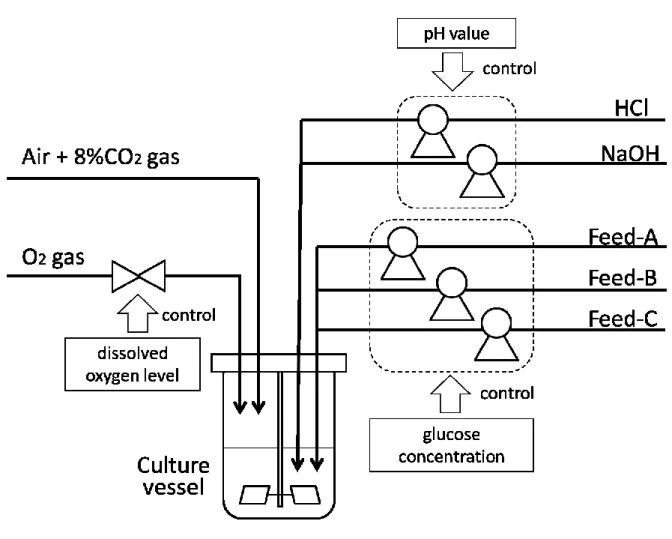
The increased cells were used for some production cultures that were performed in fed-batch

mode with continuous feeding in 3-L bioreactors (ABLE, BCP-02NP3). Overview of the

culture system is shown in Figure 3.1. The initial culture volumes were 1 L. The production

(8)

7

culture medium (Table 3.2) was used for inoculation and Feed-A, B and C (provided by Mitsubishi Tanabe Pharma Corporation) were fed during the cultures. Feed-A, B and C were fed with the ratio of 5:2:1 and the limiting substrate was designed as glucose. Therefore, they were fed to keep glucose concentration to 2 ± 1 g/L. The dissolved oxygen level was kept 90 mmHg by changing the oxygen rate of upper gas area of the cultures. Culture pH was controlled by feeding with 10% HCl and 1 mol/L NaOH. Cell culture samples were taken every day for analysis. Cultures were performed and monitored until the viable cell density falls to vary low value (9–14 days).

3.1.2 Analysis of Culture Property

Viable cell density, apoptotic cell density and dead cell density were determined using flow cytometry system (Merck Millipore, Guava system). Culture samples were mixed with Guava Nexin Reagent (Guava Technologies) which includes Annexin V-PE and 7-AAD following the recommended method. By the regent, apoptotic and dead cells were stained. These cells were radiated by blue laser in the flow cytometry system, and detected by yellow and red fluorescence, respectively. Cell viability was calculated by dividing the viable cell density by the total cell density.

The dissolved oxygen level and pH values were measured by a blood analyzer (Siemens healthcare, RAPIDLab 248). Culture samples were sucked from the sample port of the system and measured.

The glucose concentration was measured using enzyme membrane system (Oji-keisokukiki,

BF-7). At first, cells were taken away from the culture samples by centrifugation and

filtration. Then these supernatants were diluted in distilled water and provided to the glucose

detection cassette (Oji-keisokukiki, ED07-0003). Glucose concentration was determined by a

standard curve that was made by standard samples (Oji-keisokukiki, SL-23).

(9)

8

Antibody titer was measured using high-performance liquid chromatography (HPLC) (System Gold, Beckman, CA, USA) and a protein A affinity column (TOYOPEARL AF-rProtein A-650F, TOSOH, Tokyo, Japan). Culture samples were applied to the column and washed by PBS buffer. After that the captured antibodies were eluted by flowing 100 mmol/L Glysine pH2.8 buffer, and detected absorbance at 280 nm. Antibody titer was determined by a standard curve that was made by standard samples (provided by Mitsubishi Tanabe Pharma Corporation).

3.1.3 pH-dependent dynamic model

In this study, it was proposed that a pH-dependent dynamic (time-variant) model for mAb production including minimum six components. The model outline is shown in Figure 3.2 where IgG is the amount of mAb production, and X

n

, X

a

and X

d

are the number of viable cells, apoptotic cells and dead cells, respectively. V is the culture volume and pH is the pH value in culture. The open arrows (v

0

–v

4

) represent the mass flux of the respective pathway where v

0

is the growth rate of viable cells, v

1

is the onset rate of apoptosis, v

2

is the death rate of apoptotic cells, v

3

is the death rate of viable cells and v

4

is the disappearance or lysis rate of dead cells. The two bold arrows represent the mAb production speed, where P

1

and P

2

are the specific production rates (SPRs) of viable cells and of apoptotic cells, respectively. Since this study was performed in fed-batch mode with continuous feeding to maintain constant concentration levels of nutrients in culture, the culture volume V temporally increases with feeding.

The proposed model is represented by the following simultaneous differential equations (3.1)–(3.5). The r

1

, r

2

and r

3

in equation (3.5) are kinetic parameters related to nutrient requirement by viable cells growth, by maintain of viable and apoptotic cells, respectively.

Equations (3.6)–(3.13) define the parameters in the simultaneous differential equations

(10)

9

(3.1)-(3.5). Since the SPRs of viable cells (P

1

) and of apoptotic cells (P

2

) are dependent on pH value, in this study P

1

and P

2

are represented by Power-Law formalisms of pH value, as shown in equations (3.6) and (3.7), where ρ

1

and ρ

2

are multiplicative parameters or rate constants for production, and g

1

and g

2

are exponential parameters or kinetic orders [23,24,25]. To facilitate the performing numerical integration calculation, the pHs in the equations (3.6) and (3.7) should be normalized, so they were subtracted by 6.4 and fallen within the range from 0.2 to 0.8. In equation (3.8), expressing specific growth rate (SGR) μ by a logistic model [26], μ

max

is the maximum SGR and X

max

is the maximum total cell density. In equation (3.10), the power α represents the effect of apoptotic cell density on the rate of apoptosis [27]. The k

1

, k

2

, k

3

and k

4

in equations (3.10)–(3.13) are kinetic parameters representing the onset rate of apoptosis or death.

Among the parameters, since μ

max

, X

max

, k

1

, k

2

, k

3

, k

4

, r

1

, r

2

and r

3

are pH-dependent, I assumed that they are represented by explicit function (f

i

; i=1,2,…,9) of pH value as shown in equations (3.14)–(3.22). The mode of function f

1

-f

9

was estimated by experimental study under constant pH throughout the culture period.

These pH-dependent parameters are used to calculate IgG, X

n

, X

a

, X

d

and V, and therefore IgG, X

n

, X

a

, X

d

and V change with pH value.

dIgG/dt = P

1

X

n

+ P

2

X

a

(3.1)

dX

n

/dt = v

0

– v

1

– v

3

(3.2)

dX

a

/dt = v

1

– v

2

(3.3)

dX

d

/dt = v

2

+ v

3

– v

4

(3.4)

dV/dt = r

1

v

0

+ r

2

X

n

+ r

3

X

a

(3.5)

where

(11)

10

P

1

= ρ

1

(pH – 6.4)

g1

(3.6)

P

2

= ρ

2

(pH – 6.4)

g2

(3.7)

μ = μ

max

( 1 – ( X

n

+ X

a

+ X

d

) / ( X

max

V ) ) (3.8)

v

0

= μX

n

(3.9)

v

1

= k

1

(X

a

/V)

α

X

n

(3.10)

v

2

= k

2

X

a

(3.11)

v

3

= k

3

X

n

(3.12)

v

4

= k

4

X

d

(3.13)

X

max

= f

1

(pH) (3.14)

μ

max

= f

2

(pH) (3.15)

k

1

= f

3

(pH) (3.16)

k

2

= f

4

(pH) (3.17)

k

3

= f

5

(pH) (3.18)

k

4

= f

6

(pH) (3.19)

r

1

= f

7

(pH) (3.20)

r

2

= f

8

(pH) (3.21)

r

3

= f

9

(pH) (3.22)

3.1.4 Numerical Integration

The proposed model shown in the previous section is unsolvable analytically. In order to

perform simulation under the model, numerical integration is effective approach. Many kinds

of numerical integration methods were suggested in previous studies, and I have to select a

suitable method for the model.

(12)

11

Power-low functions easily cause big error for calculating numerical integration, so they require close attention to select a numerical integration method. In the situation of this study, some values of the components that are the base of exponentiations in the model are small at the beginning of the culture. This is especially detrimental for numerical integration. It is generally recommended that some kinds of solution methods should not be used in case when the base of exponentiation is very small [29].

Accordingly, I tested a following numerical integration method whether they could calculate ideal results for an exponentiation when the base is small. This test was performed for selecting a suitable method for the power-low functions in the model such as equation (3.6), (3.7) and (3.10).

The X value in equation (3.23) when t is 0.0001 was estimated by following methods.

dX/dt = X(t)

g

(3.23)

where

X(t=0) = 0.01 (3.24)

The analytical result is calculated by equation (3.25) that is derived by integration of equation (3.23).

X(t) = (X(t=0)

1-g

+ (1-g)t)

1/(1-g)

(3.25)

(13)

12

3.1.4.1 Fourth order Runge-Kutta method

Fourth order Runge-Kutta method (RK4) is generally well known method and given by following equations.

𝑋

𝑖

(𝑡 + ∆) = 𝑋

𝑖

(𝑡) + 1

6 (𝑘

𝑖1

+ 2𝑘

𝑖2

+ 2𝑘

𝑖3

+ 𝑘

𝑖4

)

where

𝑘

𝑖1

= ∆ ∙

𝑑𝑋𝑑𝑡𝑖

(𝑋

𝑗

= 𝑋

𝑗

(𝑡))

𝑘

𝑖2

= ∆ ∙

𝑑𝑋𝑑𝑡𝑖

(𝑋

𝑗

= 𝑋

𝑗

(𝑡) +

12

𝑘

𝑗1

) 𝑘

𝑖3

= ∆ ∙

𝑑𝑋𝑑𝑡𝑖

(𝑋

𝑗

= 𝑋

𝑗

(𝑡) +

12

𝑘

𝑗2

) 𝑘

𝑖4

= ∆ ∙

𝑑𝑋𝑑𝑡𝑖

(𝑋

𝑗

= 𝑋

𝑗

(𝑡) + 𝑘

𝑗3

)

3.1.4.2 Fourth order Runge-Kutta-Fehlberg method

Fourth order Runge-Kutta-Ferhlberg method (RKF45) [30] is developed by improving RK4.

The result is given by following equations.

𝑋

𝑖

(𝑡 + ∆) = 𝑋

𝑖

(𝑡) + 25

216 𝑘

𝑖1

+ 1408

2565 𝑘

𝑖3

+ 2197

4104 𝑘

𝑖4

− 1 5 𝑘

𝑖5

where

𝑘

𝑖1

= ∆ ∙

𝑑𝑋𝑑𝑡𝑖

(𝑋

𝑗

= 𝑋

𝑗

(𝑡))

(14)

13

𝑘

𝑖2

= ∆ ∙

𝑑𝑋𝑑𝑡𝑖

(𝑋

𝑗

= 𝑋

𝑗

(𝑡) +

14

𝑘

𝑗1

)

𝑘

𝑖3

= ∆ ∙

𝑑𝑋𝑑𝑡𝑖

(𝑋

𝑗

= 𝑋

𝑗

(𝑡) +

323

𝑘

𝑗1

+

329

𝑘

𝑗2

)

𝑘

𝑖4

= ∆ ∙

𝑑𝑋𝑑𝑡𝑖

(𝑋

𝑗

= 𝑋

𝑗

(𝑡) +

19322197

𝑘

𝑗1

72002197

𝑘

𝑗2

+

72962197

𝑘

𝑗3

) 𝑘

𝑖5

= ∆ ∙

𝑑𝑋𝑑𝑡𝑖

(𝑋

𝑗

= 𝑋

𝑗

(𝑡) +

439216

𝑘

𝑗1

− 8𝑘

𝑗2

+

3680513

𝑘

𝑗3

4104845

𝑘

𝑗4

)

𝑘

𝑖6

= ∆ ∙ 𝑑𝑋

𝑖

𝑑𝑡 (𝑋

𝑗

= 𝑋

𝑗

(𝑡) − 8

27 𝑘

𝑗1

+ 2𝑘

𝑗2

− 3544

2565 𝑘

𝑗3

+ 1859

4104 𝑘

𝑗4

− 11 40 𝑘

𝑗5

)

The time pitch width is modified every time step by the following algorithm. When the following R value is not bigger than the TOL, the calculated 𝑋

𝑖

(𝑡 + ∆) is adopted and new time pitch width is used for next step. However, when the R is bigger than the TOL, the calculated 𝑋

𝑖

(𝑡 + ∆) is discarded and re-calculated by using new time pitch. In this study, TOL was set 0.0001.

𝑅 = max

𝑖

[

1

|

3601

𝑘

𝑖1

4275128

𝑘

𝑖2

752402197

𝑘

𝑖4

+

501

𝑘

𝑖5

+

552

𝑘

𝑖6

| ]

∆← {

∆ ∙ 0.1 (δ < 0.1)

∆ ∙ δ (0.1 ≤ δ < 4)

∆ ∙ 4 (4 ≤ δ)

where

δ = 0.84 (

𝑇𝑂𝐿𝑅

)

1 4

3.1.5 Parameter estimation

All parameters in the dynamic model were estimated with a numerical optimization method

(15)

14

using the time-course data of IgG, X

n

, X

a

, X

d

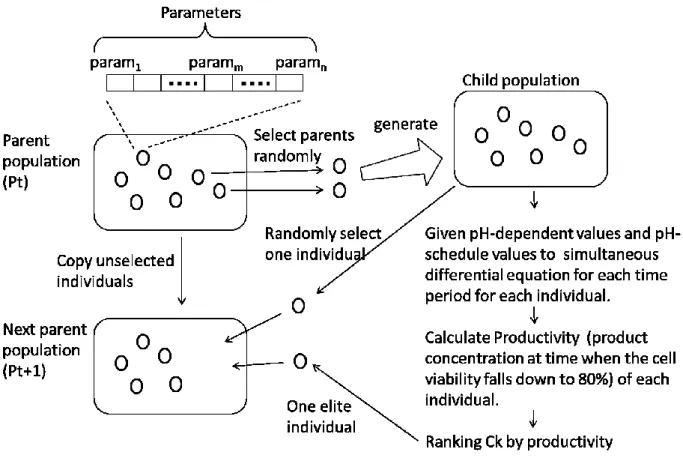
and V at different pH (6.6, 6.8, 7.0 or 7.2, respectively). In this study, as a numerical optimization method, I applied a real-coded genetic algorithm (RCGA) that is constructed using a crossover technique called unimodal normal distribution crossover (UNDX) and a model for alternation of generations called minimal generation gap (MGG) [31,32]. The overview of the method is shown in Figure 3.3.

The parameter estimation was performed as follows;

1. Begin t = 0 (t: generation).

2. Randomly create initial parent population (population size = 100): P.

3. t = t + 1.

4. Randomly select two parents from the P

t-1

and remove these from P

t-1

.

5. Generate a child population from the two parents using UNDX (population size = 100).

6. Establish a simultaneous differential equation of each time period of each individual in the child population.

7. Calculate the productivity of each individual in the child population and select one elite individual that has the highest productivity.

8. Add one elite individual and one randomly selected individual to P

t-1

and set P

t

. 9. Calculate the productivity of each individual in P(t) and check the maximum

productivity.

10. If the values of the maximum productivities are not changed throughout the last 100,000 generations, then, go to next process, else, return to step 3.

11. Save most elite individual.

Since ρ

1

, ρ

2

, g

1

, g

2

and α are independent of pH, the estimated values of these parameters are

(16)

15

fixed under any pH condition. As already described, for μ

max

, X

max

, k

1

, k

2

, k

3

, k

4

, r

1

, r

2

and r

3

, the mode of function (f

1

-f

9

) of pH has to be estimated, using experimental data under constant pH (6.6, 6.8, 7.0, 7.2) as follows;

1. Using a numerical optimization method, estimate these parameter values to realize experimentally obtained time courses of IgG, X

n

, X

a

, X

d

and V under each constant pH value.

2. Plot the obtained optimized value of each parameter with pH value, and fit the mode of

function of f

1

–f

9

using the interpolated techniques.

(17)

16

3.2 Results and Discussion

3.2.1 Cell culture

I performed four cell culture experiments at constant pH (6.6, 6.8, 7.0 or 7.2), as shown in Figure 3.4. These cultures were stopped at the point that the cell viabilities became less than 30 % (pH 6.6: 307 h, pH 6.8: 331 h, pH 7.0: 331 h, pH 7.2: 211 h). The results show that good cell growth and mAb titers were obtained when the pH was 6.8 or 7.0; the cell viability decreased to 80% at day 6 (=139 h) and the productivity was approximately 0.40 g/L (pH 6.8:

394 mg/L, pH 7.0: 402 mg/L). However, pH 6.6 and 7.2 produced a bigger decrease in viability and lower productivity (pH 6.6: 197 mg/L, pH 7.2: 283 mg/L) as shown in Table 3.3.

Comparing the results of pH 6.8 and 7.0, an amount of apoptotic cells at pH 7.0 was larger than that of pH 6.8. On the other hand, an amount of dead cells was inverted. The times when cell viability decreased to 80% are almost same; however a reason of the decreasing seems to be different.

The increasing of culture volume was consequent on the feeding, and most of the feeding volume was occupied by feeding of Feed-A, B and C. Although the cell growth was more active at about the middle pH; the higher pH set, the higher culture volume level became.

These results suggest that the nutrient consumption rate per cell is varying by the pH value.

3.2.2 Numerical Integration method

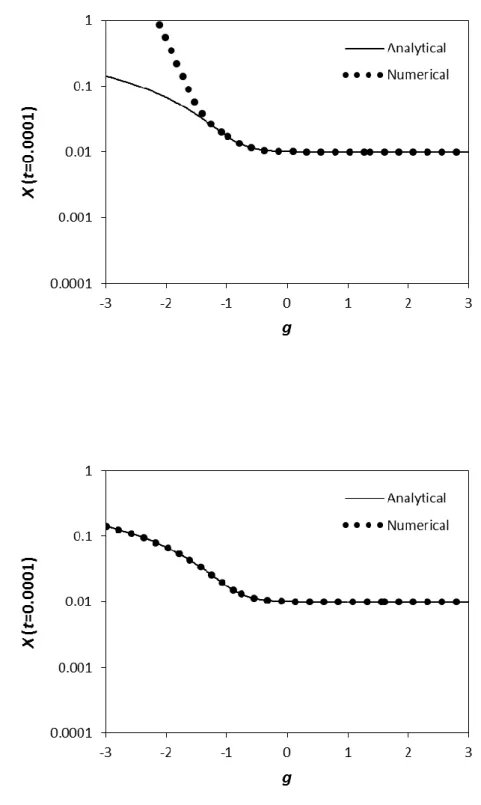
I performed the test of numerical integration methods by the equation (3.23) with -3<g<3,

and got a result shown in Figure 3.5. I got an almost same result with the analytical result

with the fourth order Runge-Kutta-Fehlberg method (RKF45), although the fourth order

Runge-Kutta method (RK4) gave different result when g was smaller than -1. This result

suggests that the time pitch width of RK4 should be smaller than 0.001 when the base is

(18)

17

much smaller than 1 and the exponent is smaller than -1. It is also suggested that the suitable time pitch width of RK4 for exponentiations depends on the values of the base and the exponent, so having an automatic pitch width correction function is desirable.

The RKF45 that has the automatic pitch width correction function gave a reliable result in scope of -3<g<3. Therefore, I decided to use Fourth order Runge-Kutta-Fehlberg method for the model in this study.

3.2.3 Parameter Estimation

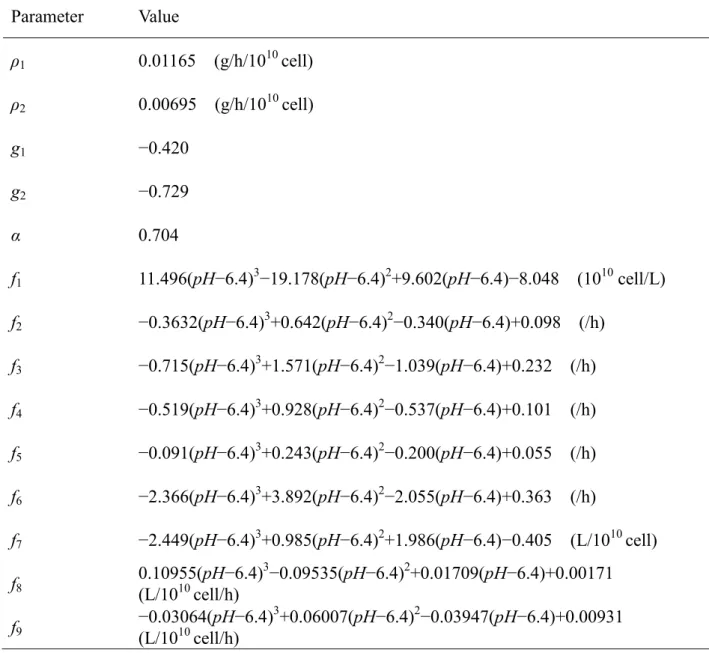
Tables 3.4 shows the results of the estimated parameters. The figures (Figure 3.6-3.9) show the resulting fits, and the average fitting error per sampling point was 6.59%. These results suggest that the model with only six system components was suitable for describing the culture results.

The pH-dependent parameters (μ

max

, X

max

, k

1

, k

2

, k

3

, k

4

, r

1

, r

2

and r

3

) were estimated to realize experimentally obtained time courses of IgG, X

n

, X

a

, X

d

and V under each constant pH value as shown by dots in Figure 3.10. All the modes of functions for the pH-dependent parameters (f

1

–f

9

) were determined as cubic functions that can describe the relationship between pH and each parameter smoothly, as shown by lines in the same figure.

In the model, the possibility that apoptotic cells in fed-batch culture can produce mAb is included, which has not been revealed clearly by now. Using the constructed model, the specific production rates of both viable cells and apoptotic cells were calculated as dependent values of pH as shown in Figure 3.11. The results show that although the specific production rate of apoptotic cells is smaller than that of viable cells, the relative magnitude is 64-98%

within the pH range from 6.6 to 7.2. This result suggests that the effect of apoptotic cells on

productivity is not negligible and should be considered when developing a model for

optimization of mAb production in culture.

(19)

18

To support the suggestion, additional parameter estimation with the model whose ρ

2

is fixed to zero was performed. The changed model neglects the productivity of apoptotic cells. The result of parameter fitting to the experimental results of the amount of the mAb production is shown in Figure 3.12. The simulation precision was not satisfactory and the average fitting error per point was 21.7%. Attending to the shape of the time course data, the angle of inclination of the fitted curves by the neglecting apoptotic cells production model became very small in the late stage of the cultures, because the numbers of viable cells were small in the stage. This trend does not suitable for the experimental results that were rising continuously. These results also suggest that the effect of apoptotic cells on productivity is not negligible.

3.2.4 Sensitivity Analysis

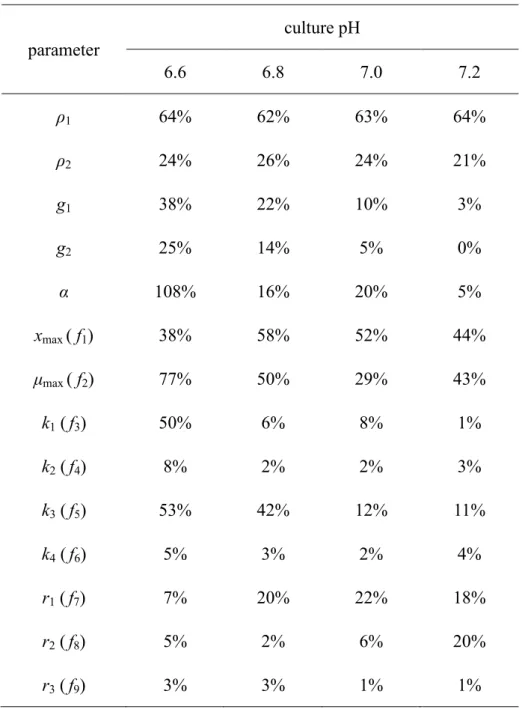
To evaluate coefficient sensitivity, I calculated sensitivity index (SI) for each parameter. SI is defined as the magnitude of change rate in IgG/V value at the endpoint of each pH condition per magnitude of change rate of an input parameter as shown in equation (3.26).

The A is the estimated parameter set, and the A

+10%i

or A

–10%i

is the parameter set that is increased or decreased parameter i value 10% from A.

SI

i

= |IgG(A

+10%i

)/V(A

+10%i

) – IgG(A

–10%i

)/V(A

–10%i

)| / (0.2 × IgG(A)/V(A)) (3.26)

The result is shown in Table 3.5. According to the result, the majority of parameters are

sensitive for the result. However, some parameters such as k

2

(death rate of apoptotic cells),

k

4

(lysis rate of dead cells) and r

3

(parameter that is related to nutrient requirement by

apoptotic cells) have small SI at any pH value. It was suggested that k

2

, k

4

and r

3

are not

critical for the model. Because the reactions related by k

2

, k

4

and r

3

are only activated when

(20)

19

the apoptotic and dead cells exist sufficiently, the period while these parameters have impacts

for productivity was limited to the late phase of the culture. Furthermore, these parameters do

not relate to the production flux directly, so the impacts were small. These are presumed as

the reasons that the SIs of these parameters were small.

(21)

20

3.3 Tables and Figures

Table 3.1. Formation of Passage Culture Medium

Component Amount (/L)

CD CHO Medium Up to 1 L

L-Glutamine 200mmol/L 40 mL

Recombinant human Insulin 4mg/mL 3.75 mL

Methotrexate solution 25 μmol/L 10 mL

Penicillin 10,000 unit/mL and Streptomycin 10 mg/mL mixture 5 mL

Table 3.2. Formation of Production Culture Medium

Component Amount (/L)

CD CHO Medium Up to 1 L

L-Glutamine 200mmol/L 40 mL

Recombinant human Insulin 4mg/mL 3.75 mL

Hypoxanthine 10 mmol/L and Thymidine 1.6 mmol/L mixture 10 mL

Penicillin 10,000 unit/mL and Streptomycin 10 mg/mL mixture 5 mL

(22)

21

Table 3.3. Production titer for each culture pH when the cell viability decreased to 80%

Culture pH IgG Titer (mg/L)

6.6 197

6.8 394

7.0 402

7.2 283

(23)

22

Table 3.4. Estimated constant or pH-dependent parameters involved in the model Parameter Value

ρ

1

0.01165 (g/h/10

10

cell) ρ

2

0.00695 (g/h/10

10

cell)

g

1

−0.420

g

2

−0.729

α 0.704

f

1

11.496(pH−6.4)

3

−19.178(pH−6.4)

2

+9.602(pH−6.4)−8.048 (10

10

cell/L) f

2

−0.3632(pH−6.4)

3

+0.642(pH−6.4)

2

−0.340(pH−6.4)+0.098 (/h)

f

3

−0.715(pH−6.4)

3

+1.571(pH−6.4)

2

−1.039(pH−6.4)+0.232 (/h) f

4

−0.519(pH−6.4)

3

+0.928(pH−6.4)

2

−0.537(pH−6.4)+0.101 (/h) f

5

−0.091(pH−6.4)

3

+0.243(pH−6.4)

2

−0.200(pH−6.4)+0.055 (/h) f

6

−2.366(pH−6.4)

3

+3.892(pH−6.4)

2

−2.055(pH−6.4)+0.363 (/h)

f

7

−2.449(pH−6.4)

3

+0.985(pH−6.4)

2

+1.986(pH−6.4)−0.405 (L/10

10

cell) f

8

0.10955(pH−6.4)

3

−0.09535(pH−6.4)

2

+0.01709(pH−6.4)+0.00171

(L/10

10

cell/h)

f

9

−0.03064(pH−6.4)

3

+0.06007(pH−6.4)

2

−0.03947(pH−6.4)+0.00931

(L/10

10

cell/h)

(24)

23

Table 3.5. Sensitivity index for each parameter at each culture pH

parameter

culture pH

6.6 6.8 7.0 7.2

ρ

1

64% 62% 63% 64%

ρ

2

24% 26% 24% 21%

g

1

38% 22% 10% 3%

g

2

25% 14% 5% 0%

α 108% 16% 20% 5%

x

max

( f

1

) 38% 58% 52% 44%

μ

max

( f

2

) 77% 50% 29% 43%

k

1

( f

3

) 50% 6% 8% 1%

k

2

( f

4

) 8% 2% 2% 3%

k

3

( f

5

) 53% 42% 12% 11%

k

4

( f

6

) 5% 3% 2% 4%

r

1

( f

7

) 7% 20% 22% 18%

r

2

( f

8

) 5% 2% 6% 20%

r

3

( f

9

) 3% 3% 1% 1%

(25)

24

Figure 3.1. Overview of the culture system. O

2

gas valve was controlled by dissolved oxygen

level. Liquid delivery pumps of acid solution (10% HCl) and alkaline solution (1 mol/L

NaOH) were controlled to keep culture pH as set value. Liquid delivery pumps of Feed-A, B

and C were controlled to keep glucose concentration of the culture 2±1 g/L.

(26)

25

Figure 3.2. The outline of the pH-dependent dynamic model for monoclonal antibody

production.

(27)

26

Figure 3.3. Overview of the parameter estimation algorithm.

(28)

27

(a)

(b)

Figure 3.4. Results of cell culture experiments at constant pH (pH 6.6, 6.8, 7.0 or 7.2). (a)

Amount of the product (IgG), (b) number of viable cells (X

n

). (continued)

(29)

28

(c)

(d)

Figure 3.4. (continued) Results of cell culture experiments at constant pH (pH 6.6, 6.8, 7.0 or

7.2). (c) Number of apoptotic cells (X

a

), (d) number of dead cells (X

d

). (continued)

(30)

29

(e)

Figure 3.4. (continued) Results of cell culture experiments at constant pH (pH 6.6, 6.8, 7.0 or

7.2). (e) Culture volume (V).

(31)

30

(a)

(b)

Figure 3.5. Results of the test of Numerical Integration methods with analytical result. (a)

Fourth order Runge-Kutta method, (b) Fourth order Runge-Kutta-Fehlberg method.

(32)

31

(a)

(b)

Figure 3.6. Resulting fits by the parameter estimation for cell culture experiments at pH 6.6.

Points: experimental results, solid lines: resulting fits of the parameter estimation. (a) Amount

of the product (IgG), (b) number of viable cells (X

n

). (continued)

(33)

32

(c)

(d)

Figure 3.6. (continued) Resulting fits by the parameter estimation for cell culture experiments at pH 6.6. Points: experimental results, solid lines: resulting fits of the parameter estimation.

(c) Number of apoptotic cells (X

a

), (d) number of dead cells (X

d

). (continued)

(34)

33

(e)

Figure 3.6. (continued) Resulting fits by the parameter estimation for cell culture experiments at pH 6.6. Points: experimental results, solid lines: resulting fits of the parameter estimation.

(e) Culture volume (V).

(35)

34

(a)

(b)

Figure 3.7. Resulting fits by the parameter estimation for cell culture experiments at pH 6.8.

Points: experimental results, solid lines: resulting fits of the parameter estimation. (a) Amount

of the product (IgG), (b) number of viable cells (X

n

). (continued)

(36)

35

(c)

(d)

Figure 3.7. (continued) Resulting fits by the parameter estimation for cell culture experiments at pH 6.8. Points: experimental results, solid lines: resulting fits of the parameter estimation.

(c) Number of apoptotic cells (X

a

), (d) number of dead cells (X

d

). (continued)

(37)

36

(e)

Figure 3.7. (continued) Resulting fits by the parameter estimation for cell culture experiments at pH 6.8. Points: experimental results, solid lines: resulting fits of the parameter estimation.

(e) Culture volume (V).

(38)

37

(a)

(b)

Figure 3.8. Resulting fits by the parameter estimation for cell culture experiments at pH 7.0.

Points: experimental results, solid lines: resulting fits of the parameter estimation. (a) Amount

of the product (IgG), (b) number of viable cells (X

n

). (continued)

(39)

38

(c)

(d)

Figure 3.8. (continued) Resulting fits by the parameter estimation for cell culture experiments at pH 7.0. Points: experimental results, solid lines: resulting fits of the parameter estimation.

(c) Number of apoptotic cells (X

a

), (d) number of dead cells (X

d

). (continued)

(40)

39

(e)

Figure 3.8. (continued) Resulting fits by the parameter estimation for cell culture experiments at pH 7.0. Points: experimental results, solid lines: resulting fits of the parameter estimation.

(e) Culture volume (V).

(41)

40

(a)

(b)

Figure 3.9. Resulting fits by the parameter estimation for cell culture experiments at pH 7.2.

Points: experimental results, solid lines: resulting fits of the parameter estimation. (a) Amount

of the product (IgG), (b) number of viable cells (X

n

). (continued)

(42)

41

(c)

(d)

Figure 3.9. (continued) Resulting fits by the parameter estimation for cell culture experiments at pH 7.2. Points: experimental results, solid lines: resulting fits of the parameter estimation.

(c) Number of apoptotic cells (X

a

), (d) number of dead cells (X

d

). (continued)

(43)

42

(e)

Figure 3.9. (continued) Resulting fits by the parameter estimation for cell culture experiments at pH 7.2. Points: experimental results, solid lines: resulting fits of the parameter estimation.

(e) Culture volume (V).

(44)

43

(a)

(b)

Figure 3.10. Estimated functions involved in the model. (a) f

1

, (b) f

2

. (continued)

(45)

44

(c)

(d)

Figure 3.10. (continued) Estimated functions involved in the model. (c) f

3

, (d) f

4

. (continued)

(46)

45

(e)

(f)

Figure 3.10. (continued) Estimated functions involved in the model. (e) f

5

, (f) f

6

. (continued)

(47)

46

(g)

(h)

Figure 3.10. (continued) Estimated functions involved in the model. (g) f

7

, (h) f

8

. (continued)

(48)

47

(i)

Figure 3.10. (continued) Estimated functions involved in the model. (i) f

9

.

(49)

48

Figure 3.11. Relationship between pH and specific production rate of viable cells (P

1

) or

apoptotic cells (P

2

).

(50)

49

(a)

(b)

Figure 3.12. Resulting fits by the parameter estimation for the amount of the product (IgG) of

the cell culture experiments. Points: experimental results, solid lines: resulting fits by the

considering apoptotic cells production model, dashed lines: resulting fits by the neglecting

apoptotic cells production model. (a) pH 6.6, (b) pH 6.8. (continued)

(51)

50

(c)

(d)

Figure 3.12. (continued) Resulting fits by the parameter estimation for the amount of the product (IgG) of the cell culture experiments. Points: experimental results, solid lines:

resulting fits by the considering apoptotic cells production model, dashed lines: resulting fits

by the neglecting apoptotic cells production model. (a) pH 7.0, (b) pH 7.2.

(52)

51

4. Optimization of a pH-shift Control Strategy using the Model

4.1 Materials and Methods

4.1.1 Cell Culture Model

The dynamic model with six system components constructed in a previous section was used for simulation.

4.1.2 pH-shift optimization

In this study, I defined “productivity” as the molar concentration of product mAb (=IgG/V) at the time when the cell viability (= X

n

/ ( X

n

+ X

a

+ X

d

) ) falls to 80%, which is the lowest limit to achieve a enough degree of the purification by the following purification process that can be performed in standard manufacturing facility such as the protein A affinity chromatography and ion exchange chromatography in small number of buffer steps.

To maximize the productivity, I performed an algorism whose outline is described in Figure

4.1, and searched for an optimal pH-shift schedule. The calculation was done under the

following restricted conditions; pH can be shifted with every T

c

-hours between the minimum

pH (6.6) and the maximum pH (7.2) as shown in Figure 4.2. For the experimental pH control,

I set the time interval (T

c

) to 24 h and pH could be shifted every 24 h. The manipulated values

are some pH values and I considered a 384 h culture period, which is enough for cell viability

to decrease to 80% under any pH-shift pattern. The allowed pH range is from 6.6 to 7.2. To

determine the optimal pH-shift schedule, RCGA that is constructed with UNDX and MGG

[31,32] was used as following way;

(53)

52

1. begin t = 0 (t: generation).

2. Randomly create initial parent population (population size = 100): P.

3. t = t + 1.

4. Randomly select two parents from the P

t-1

and remove these from P

t-1

.

5. Generate a child population from the two parents using UNDX (population size = 100).

6. Establish a simultaneous differential equation of each time period of each individual in the child population.

7. Calculate the productivity of each individual in the child population and select one elite individual that has the highest productivity.

8. Add one elite individual and one randomly selected individual to P

t-1

and set P

t

.

9. Calculate the productivity of each individual in P(t) and check the maximum productivity.

10. If the values of the maximum productivities are not changed throughout the last 2000 generations, then, go to next process, else, return to step 3.

11. Save most elite individual.

4.1.3 Validation

I validated the proposed pH-shift schedule by experimental study. The optimized pH-shift

schedule that was calculated previous section was performed under the same culture method

with the section 3.1.

(54)

53

4.2 Results and discussion

4.2.1 pH-shift optimization

A new optimized pH-shift schedule was found by the exhaustive search of pH space between 6.6 and 7.2. The estimated culture profile is shown by a solid line in Figure 4.3. The result shows that the productivity is maximized with a gradual increase in pH from 6.89 to 6.96 and it is approximately 0.56 g/L.

The optimized pH-shift schedule requires performing a gradual increase in pH from 6.89 to 6.96. The pH-shift range is very small but very important; if the pH value is not shifted from 6.89, the dead cells will quickly increase and the culture period will become shorter by approximately 20 h, and as a result, the productivity will decrease by approximately 16%, as shown in Figure 4.3 (dashed line). This result suggests that productivity is highly sensitive to culture pH and pH should be strictly controlled for reproducibility in productivity.

The gradual increase in pH keeps the specific growth rate low, resulting in a longer life for viable cells by reducing the apoptosis onset rate that strongly depends on cell density. Figure 4.5 shows the relationship between pH and specific growth rate that depends on the total cell density (=X

n

+ X

a

+ X

d

). The figure indicates that lower pH results in a lower specific growth rate in the early culture phase when the total cell density is low, and higher pH results in a lower specific growth rate in the late culture phase when the total cell density is high.

Therefore, the increase in pH leads the culture to prolong the harvest time and maintain production for longer.

The relationship between pH and onset rate of apoptosis (v

1

) or death (v

3

) of viable cells is

shown in Figure 4.6. Both relationships suggest that these onset rates become low level when

the pH is approximately 6.9 and pH should be maintained at approximately 6.9 to keep cells

healthy.

(55)

54

To evaluate the pH-shift interval, I set the T

c

(pH-shift interval size) to 1 h and optimized pH-shift schedule was calculated under the condition that pH could be shifted to any value between 6.6 and 7.2 every 1 h. The calculated result of pH-shift schedule also indicates gradual increase as shown in Figure 4.7. For the first 48 hours, the influence of pH value upon the cell growth or productivity is relatively small; therefore it is allowed that the pH takes a constant value (6.89) for 48 hours without impairing productivity, although the pH changes wildly when the T

c

is 1 h. The time-course data of each system components (IgG, X

n

, X

a

or X

d

) is almost same with that of the pH-shift schedule when the pH-shift size is 24 h as shown in Figure 4.8. The productivity is approximately 0.58 g/L that did not increase except for just 2.6% as shown in Figure 4.9. Accordingly, the 24 h-interval is frequent enough for the pH-shift to optimize the productivity in this study and it is easy to operate as daily pursuits.

4.2.2 Validation

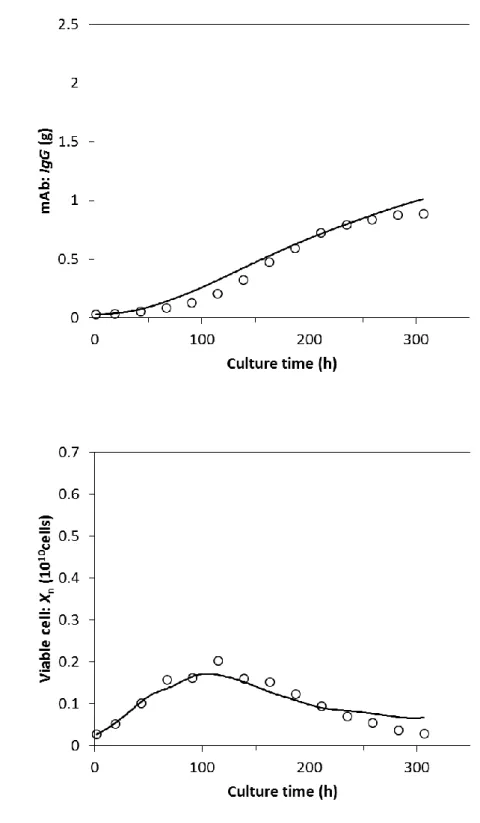
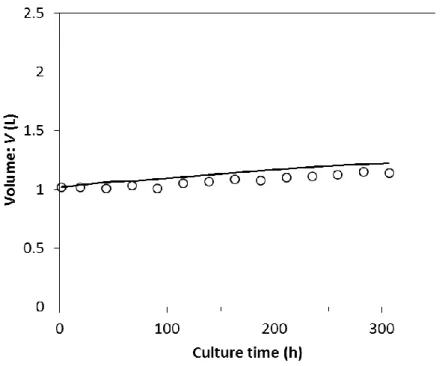
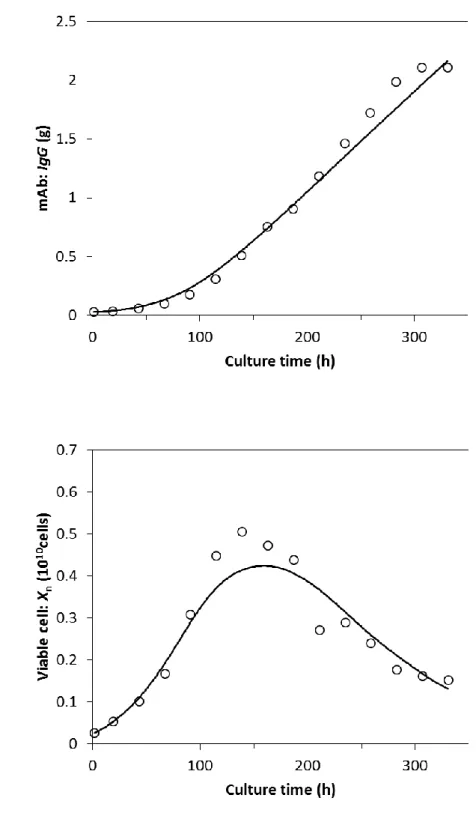
To evaluate the estimated culture profile, a cell culture experiment was performed three times and the result is depicted in Figure 4.10 as circle points with error bar which describe standard deviation.

The estimation error per sampling point was only 4.51% and the productivity was 0.58 g/L, which is an increase of approximately 40% compared with cell culture at constant pH, as shown in Figure 4.11.

The model proposed in this study and estimated parameters were supported by the real cells.

(56)

55

4.3 Figures

Figure 4.1. pH-shift optimization algorithm. The RCGA that is constructed with UNDX and

MGG.

(57)

56

Figure 4.2. Manipulated variables for productivity optimization. The pH can be shifted with

every T

c

-hours between the minimum value (6.6) and the maximum value (7.2).

(58)

57

Figure 4.3. pH-shift schedules. Solid line: optimal pH-shift schedule, dashed line: constant

pH schedule (pH 6.89).

(59)

58

(a)

(b)

Figure 4.4. The time-course data of simulations with optimal pH-shift schedule (solud line)

and constant pH schedule (dashed line). (a) Amount of the product (IgG), (b) number of

viable cells (X

n

). (continued)

(60)

59

(c)

(d)

Figure 4.4. (continued) The time-course data of simulations with optimal pH-shift schedule

(solud line) and constant pH schedule (dashed line). (c) Number of apoptotic cells (X

a

), (d)

number of dead cells (X

d

). (continued)

(61)

60

(e)

Figure 4.4. (continued) The time-course data of simulations with optimal pH-shift schedule

(solud line) and constant pH schedule (dashed line). (e) Culture volume (V).

(62)

61

Figure 4.5. Relationship between pH and specific growth rate that varies with total cell

density: (0) Total cell density = 0 cells/L, (1) total cell density = 0.1×10

10

cells/L, (2) total cell

density = 0.2×10

10

cells/L, (3) total cell density = 0.3×10

10

cells/L, (4) total cell density =

0.4×10

10

cells/L.

(63)

62

Figure 4.6. The relationship between pH and onset rate of apoptosis or death of viable cells.

(64)

63

Figure 4.7. The optimized pH-shift schedules. Solid line: T

c

= 24 h, dashed line: T

c

= 1 h.

(65)

64

(a)

(b)

Figure 4.8. The time-course data of simulation when T

c

is 24 h or 1 h. (a) Amount of the

product (IgG), (b) number of viable cells (X

n

) when T

c

is 24 h or 1 h. Solid line: T

c

= 24 h,

dashed line: T

c

= 1 h. (continued)

(66)

65

(c)

(d)

Figure 4.8. (continued) The time-course data of simulation when T

c

is 24 h or 1 h. (c) Number

of apoptotic cells (X

a

), (d) number of dead cells (X

d

) when T

c

is 24 h or 1 h. Solid line: T

c

=

24 h, dashed line: T

c

= 1 h. (continued)

(67)

66

(e)

Figure 4.8. (continued) The time-course data of simulation when T

c

is 24 h or 1 h. (e) Culture

volume when T

c

is 24 h or 1 h. Solid line: T

c

= 24 h, dashed line: T

c

= 1 h.

(68)

67

Figure 4.9. The productivity data of simulation when T

c

is 24 h or 1 h.

(69)

68

(a)

(b)

Figure 4.10. The time-course data of simulation and experimental cell culture. (a) Amount of

the product (IgG), (b) number of viable cells (X

n

) of experiments or a simulation with

optimized pH-shift schedule. Lines: simulation result, points: experimental result. (continued)

(70)

69

(c)

(d)

Figure 4.10. (continued) The time-course data of simulation and experimental cell culture. (c) Number of apoptotic cells (X

a

), (d) number of dead cells (X

d

) of experiments or a simulation with optimized pH-shift schedule. Lines: simulation result, points: experimental result.

(continued)

(71)

70

(e)

Figure 4.10. (continued) The time-course data of simulation and experimental cell culture. (e) Culture volume of experiments or a simulation with optimized pH-shift schedule. Lines:

simulation result, points: experimental result.

(72)

71

Figure 4.11. The productivity data of simulation and experimental cell culture.

(73)

72

5. Discussion and Conclusion

In this study, I developed a simple pH-dependent dynamic model, which includes a minimum of six system components and is applicable for pH-shift schedule within a range of 6.6≤pH≤7.2. Although the model was developed in the experimental studies under constant pH, I could use it to determine the optimal pH-shift schedule. It was proposed that the culture pH-shift optimization strategy using the pH-dependent dynamic model is effective.

In the model, there are some pH-dependent parameters (μ

max

, X

max

, and k

1

, k

2

, k

3

, k

4

, r

1

, r

2

and r

3

) and the relationship between pH and each parameter was determined as cubic function after performing parameter fitting for each result of the experiment under constant pH.

Because the relationships were complex (not monotonic increase, not monotonic decrease and not bilateral symmetry), cubic functions that have many coefficients were adaptable in this case, but there was a danger that they would be overfitting. It is an important future issue to discover the types of functions that are biochemically logical for these relationships.

According to the results of parameter fitting, it was suggested that the specific production rate of apoptotic cells is not small and not negligible. This suggestion was supported by the poor fitting result of the neglecting apoptotic cells production model. However, it was actually not observed directly that the apoptotic cells were producing the antibody. To prove the productivity of apoptotic cells more correctly, some technological innovations are needed.

If it was able to extract the apoptotic cells without any stress that affect their activity as an example, the productivity could be assayed.

Furthermore, the methodology to develop this model should be applied to other significant

culture parameters such as the temperature, which is generally regarded to affect specific

growth rate and specific production rate. The dissolved oxygen level is also regarded to affect

the productivity and the posttranslational modification [33]. Performing experimental studies

(74)

73

under constant temperature or dissolved oxygen level and understanding the effect of these components could facilitate the development of a temperature- or dissolved oxygen level- dependent dynamic model. Moreover, it would be possible to determine a simultaneous optimization of pH, temperature and dissolved oxygen level by developing a model taking the effects of pH, temperature and dissolved oxygen level into account.

In this study, I demonstrated not only pH-shift optimization, but also a universal

optimization strategy for mAb-producing cell cultures.

(75)

74

6. Acknowledgements

This study has been accomplished while I was at Kyushu University under my supervisor, Prof. Masahiro Okamoto. I would like to thank Prof. Masahiro Okamoto for advice and encouragement, and for providing many time for teaching computer simulation from the basics to the advanced level.

I would like to thank Mr. Akitoshi Nishizawa and Mr. Hiroshi Tamashima at Mitsubishi Tanabe Pharma Corporation for advising some cell culture experiments in this study.

I would like to thank Dr. Yukihiro Maki at Fukuoka International University for teaching real-coded genetic algorithm and furnishing the source code.

I would like to thank Dr. Ryuta Saito at Mitsubishi Tanabe Pharma Corporation for advice to make my work better thing from many aspects.

Finally, I must express my gratitude to Risa, my wife, for her continuous support and

encouragement.

(76)

75

7. References

1. Ecker DM, Jones SD, Levine HL.: The therapeutic monoclonal antibody market, mAbs, 7, 9-14 (2015).

2. Frenzel A, Hust M, Schirrmann T.: Expression of recombinant antibodies, Frontiers in Immunology, 4, 1-20 (2013).

3. Li F, Vijayasankaran N, Shen AY, Kiss R, Amanullah A.: Cell culture processes for monoclonal antibody production, mAbs, 2, 466-477 (2010).

4. Rouiller Y, Perilleux A, Collet N, Jordan M, Stettler M, Broly H.: A high-throughput media design approach for high performance mammalian fed-batch cultures, mAbs, 5, 501-511 (2013).

5. Lu F, Toh PC, Burnett I, Li F, Hudson T, Amanullah A, Li J.: Automated Dynamic Fed-Batch Process and Media Optimization for High Productivity Cell Culture Process Development, Biotechnology and Bioengineering, 110, 191-205 (2013).

6. Zhang H, Wang H, Liu M, Zhang T, Zhang J, Wang X, Xiang W.: Rational development of a serum-free medium and fed-batch process for a GS-CHO cell line expressing recombinant antibody, Cytotechnology, 65, 363-378 (2013).

7. Liu Y, Zhang W, Deng X, Poon HF, Liu X, Tan WS, Zhou Y, Fan L.: Chinese hamster

ovary cell performance enhanced by a rational divide-and-conquer strategy for chemically

(77)

76

defined medium development, Journal of Bioscience and Bioengineering, 120, 690-696 (2015).

8. Ling WLW, Bai Y, Cheng C, Padawer I, Wu C.: Development and Manufacturability Assessment of Chemically-Defined Medium for the Production of Protein Therapeutics in CHO Cells, Biotechnol Prog, 31, 1163-71 (2015).

9. Reinhart D, Damjanovic L, Kaisermayer C, Kunert R.: Benchmarking of commercially available CHO cell culture media for antibody production, Appl Microbiol Biotechnol, 99, 4645-4657 (2015).

10. Kishishita S, Katayama S, Kodaira K, Takagi Y, Matsuda H, Okamoto H, Takuma S, Hirashima C, Aoyagi H.: Optimization of chemically defined feed media for monoclonal antibody production in Chinese hamster ovary cells, Journal of Bioscience and Bioengineering, 120, 78-84 (2015).

11. Kang S, Mullen J, Miranda LP, Deshpande R.: Utilization of Tyrosine- and Histidine-Containing Dipeptides to Enhance Productivity and Culture Viability, Biotechnology and Bioengineering, 109, 2286-2294 (2012).

12. Sun Y, Zhao L, Ye Z, Fan L, Liu X, Tan WS.: Development of a fed-batch cultivation for antibody-producing cells based on combined feeding strategy of glucose and galactose, Biochemical Engineering Journal, 81, 126-135 (2013).

13. Kyriakopoulos S, Kontoravdi C.: A Framework for the Systematic Design of Fed-Batch

(78)

77

Strategies in Mammalian Cell Culture, Biotechnology and Bioengineering, 111, 2466-2476 (2014).

14. Yang WC, Lu J, Nguyen NB, Zhang A, Healy NV, Kshirsagar R, Ryll T, Huang YM.:

Addition of Valproic Acid to CHO Cell Fed-Batch Cultures Improves Monoclonal Antibody Titers, Mol Biotechnol, 56, 421-428 (2014).

15. Hecht V, Duvar S, Ziehr H, Burg J, Jockwer A.: Efficiency Improvement of an Antibody Production Process by Increasing the Inoculum Density, Biotechnol Prog, 30, 607-615 (2014).

16. Kuwae S, Ohda T, Tamashima H, Miki H, Kobayashi K.: Development of a fed-batch culture process for enhanced production of recombinant human antithrombin by Chinese hamster ovary cells, J Biosci Bioeng, 100, 502-510 (2005).

17. Gomez N, Ouyang J, Nguyen MD, Vinson AR, Lin AA, Yuk IH.: Effect of temperature, pH, dissolved oxygen, and hydrolysate on the formation of triple light chain antibodies in cell culture, Biotechnol Prog, 26, 1438-1445 (2010).

18. Selvarasu S, Ho YS, Chong WP, Wong NS, Yusufi FN, Lee YY, Yap MG, Lee DY.:

Combined in silico modeling and metabolomics analysis to characterize fed-batch CHO cell culture, Biotechnol Bioeng, 109, 1415-1429 (2012).

19. Legmann R, Schreyer HB, Combs RG, McCormick EL, Russo AP, Rodgers ST.: A

Predictive High-Throughput Scale-Down Model of Monoclonal Antibody Production in CHO

(79)

78

Cells, Biotechnology and Bioengineering, 104, 1107-1120 (2009).

20. Horvath B, Mun M, Laird MW.: Characterization of a Monoclonal Antibody Cell Culture Production Process Using a Quality by Design Approach, Mol Biotechnol, 45, 203-206 (2010).

21. Rouiller Y, Solacroup T, Deparis V, Barbafieri M, Gleixner R, Broly H, Eon-Duval A.: Application of Quality by Design to the characterization of the cell culture process of an Fc-Fusion protein, European Journal of Pharmaceutics and Biopharmaceutics, 81, 426-437 (2012).

22. Nagashima H, Watari A, Shinoda Y, Okamoto H, Takuma S.: Application of a Quality by Design Approach to the Cell Culture Process of Monoclonal Antibody Production, Resulting in the Establishment of a Design Space, Journal of Pharmaceutical Sciences, 102, 4274-4283 (2013).

23. Savageau MA.: Biochemical system analysis: a study of function and design in molecular biology, Massachusetts, Addison-Wesley (1976).

24. Voit EO.: Canonical nonlinear modeling: S-system approach to understanding complexity, New York, Van Norstand Reinhold (1991).

25. Tominaga D, Okamoto M.: Design of Canonical Model Describing Complex Nonlinear

Dynamics, Computer Applications in Biotechnology, Oxford, Pergamon Press (1998).

(80)

79

26. Jason, A.: A deterministic model for monophasic growth of batch cultures of bacteria, Antonie Van Leeuwenhoek, 49, 513-536 (1983).

27. Hardy K, Stark J.: Mathematical models of the balance between apoptosis and proliferation, Apoptosis, 7, 373-381 (2002).

28. Maki Y, Tominaga D, Okamoto M, Watanabe S, Eguchi Y.: Development of a system for the inference of large scale genetic networks, Pacific Symposium on Biocomputing, 6, 446-458(2001).

29. Shiraishi F.: Biological Systems Theory, Sangyo-tosho (2006).

30. Fehlberg E.: NASA Technical Report R-315: Low-order classical Runge-Kutta formulas with step size control and their application to some heat transfer problems, National Aeronautics and Space Administration, Washington D.C. (1969).

31. Ueda T, Koga N, Okamoto M.: Efficient Numerical Optimization Technique Based on Real-Coded Genetic Algorithm, Genome Informatics, 12, 451-453 (2001).

32. Maki Y, Takahashi Y, Arikawa Y, Watanabe S, Aoshima K, Eguchi Y, Ueda T, Aburatani S, Kuhara S, Okamoto M.: An integrated comprehensive workbench for inferring genetic networks: voyagene, J Bioinform Comput Biol, 2, 533-50 (2004).

33. Restelli V, Wang MD, Huzel N, Ethier M, Perreault H, Butler M.: The Effect of

Dissolved Oxygen on the Production and the Glycosylation Profile of Recombinant Human

(81)

80

Erythropoietin Produced From CHO Cells, Biotechnology and Bioengineering, 94, 481-94

(2006)

Table 3.3. Production titer for each culture pH when the cell viability decreased to 80%
Table 3.4. Estimated constant or pH-dependent parameters involved in the model  Parameter  Value  ρ 1 0.01165    (g/h/10 10  cell)  ρ 2 0.00695    (g/h/10 10  cell)  g 1 −0.420  g 2 −0.729  α  0.704  f 1 11.496(pH−6.4) 3 −19.178(pH−6.4) 2 +9.602(pH−6.4)−8.
Table 3.5. Sensitivity index for each parameter at each culture pH
Figure 3.1. Overview of the culture system. O 2  gas valve was controlled by dissolved oxygen  level
+7

参照

関連したドキュメント

For the thick case, this result was announced by Buekenhout, Delandtsheer, Doyen, Kleidman, Liebeck and Saxl, and in the thin case (where the lines have 2 points), it amounts to

In other words, the aggressive coarsening based on generalized aggregations is balanced by massive smoothing, and the resulting method is optimal in the following sense: for

It is suggested by our method that most of the quadratic algebras for all St¨ ackel equivalence classes of 3D second order quantum superintegrable systems on conformally flat

A generalization of Theorem 12.4.1 in [20] to the generalized eigenvalue problem for (A, M ) provides an upper bound for the approximation error of the smallest Ritz value in K k (x

In particular, we consider a reverse Lee decomposition for the deformation gra- dient and we choose an appropriate state space in which one of the variables, characterizing the

Atherosclerosis is a disease of the vasculature that is characterized by an accumulation of lipid-laden immune cells and apoptotic cells in the arterial wall.. Recently, the

In this paper, we focus on the existence and some properties of disease-free and endemic equilibrium points of a SVEIRS model subject to an eventual constant regular vaccination

(It is a standard convention to denote the unique line on two distinct collinear points x and y of a partial linear space by the symbol xy.) A linear space ðP ; LÞ with all lines