INVITED SURVEY PAPER
Smart Power Supply Systems for Mission Critical Facilities
Keiichi HIROSE†a)andTadatoshi BABASAKI††b),Members
SUMMARY To develop the advanced and rich life, and the also econ- omy and social activity continuously, various types of energy are neces- sary. At the same time, to protect the global environment and to prevent the depletion of natural resources, the effective and moreover efficient use of energy is becoming important. Electric power is one of the most im- portant forms of energy for our life and society. This paper describes topics and survey results of technical trends regarding the electric power supply systems which are playing a core role as the important infrastruc- ture to support the emergence of information-oriented society. Specifically, the power supply systems that enhance high power quality and reliability (PQR) are important for the steady growth of information and communi- cation services. The direct current (DC) power, which has been used for telecommunications power systems and information and communications technologies (ICT), enables existing utilities’ grid and distributed energy resources to keep a balance between supply and demand of small-scaled power systems or microgirds. These techniques are expected to be part of smartgrid technologies and facilitate the installation of distributed genera- tors in mission critical facilities.
key words: electirc power, power quality, reliability, micro grid, smart grid, DC power, mission critical facilities
1. Changes in Power Use
Electric power grids are an important part of the social in- frastructure and have undergone remarkable development since their industrial introduction in the latter half of the 19th century [1]. Our consumption of energy has been in- creasing along with human and social development, and the increased demand for electric power has been particularly striking. For that reason, the electrification ratio, which is the proportion of primary power occupied by electricity, has been increasing continuously [2].
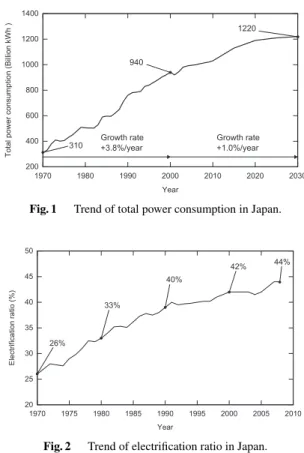
The trend in electric power demand in Japan (Fig. 1) shows that demand increased by a factor of about three in the 30 years from 1970 to 2000, from 310 billion kWh to 940 billion kWh. While the annual rate of increase in those 30 years was 3.8%, that rate is expected to drop to 1.0%
per year for the 30 years beginning in 2000. Electricity is safe and clean and offers many advantages, such as ease of conversion and high efficiency, and the forms of use are ex- pected to steadily expand from now into the future. The trend in electrification in Japan is shown in Fig. 2, where we
Manuscript received August 2, 2011.
Manuscript revised October 28, 2011.
†The author is with the Research and Development Headquar- ters, NTT Facilities, Inc., Tokyo, 170-0004 Japan.
††The author is with NTT Energy and Environment Systems Laboratories, NTT Corporation, Musashino-shi, 180-8585 Japan.
a) E-mail: [email protected]
b) E-mail: [email protected] DOI: 10.1587/transcom.E95.B.755
Fig. 1 Trend of total power consumption in Japan.
Fig. 2 Trend of electrification ratio in Japan.
see an increase from 26% for 1970 to 44% for 2008, and that increasing trend is expected to continue up to 2030.
Accordingly, although the rate of increase in demand for electrical power in Japan has been decreasing in recent years, the electrification ratio continues to increase and the social role and importance of electricity are likely to be even greater in the future. If we focus on the form of using electri- cal power from the perspective of the use and consumption of power, which is to say from the demand side rather than from the standpoint of power generation and distribution as seen by the power industry, then a great change in recent years can be seen. Up to roughly the 1970s, electric power was used mainly for lighting, heating, and motors.
The trend changed after the 1980s, and currently air conditioning, refrigeration, cooking appliances and other electromechanical devices that have incorporated semicon- ductors, power electronics technology, and digital electron- ics such as TV sets, audio-visual systems and personal com- puters have come into widespread use. (We refer to such equipment generically as ‘digital load devices’ in this pa- Copyright c2012 The Institute of Electronics, Information and Communication Engineers
per). With advances in information and communications technologies (ICT), the trend in overall power consumption in recent years has been a continuing steep increase in the use of digital load devices in a wider range of fields, includ- ing, industry, public corporations, economics, and medicine.
For example, microcomputers sold at 1.2 million units per three months in 1993, but only five years later that rate had tripled, and digital load devices had permeated daily life and industry [3]. In the United States for example, digi- tal load devices accounted for 10% of all load devices in 2000, but that proportion is expected to by 70% by 2020 [4].
These digital load devices are extremely sensitive to power quality factors such as voltage fluctuation and momentary power interruptions, and dealing with those vulnerabilities has become problematic.
Thus, the ways in which electrical power is used are changing such that most load devices are vulnerable to volt- age fluctuation and other such factors of power quality.
A power system that provides highly-reliable, high-quality power is required so that the mass-marketed digital load de- vices that are in use can continue stable operation without stopping unexpectedly, malfunctioning or incurring other problems. What measures can be taken to provide a sta- ble power system is an issue in the field of electrical power grids.
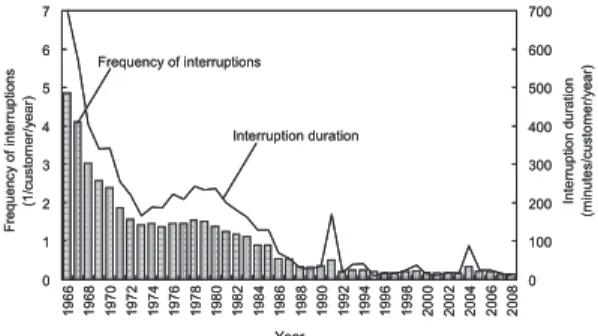
2. Improving the Power Quality and Reliability (PQR) Electrical power is generally supplied to a particular region by an electric power company, and that company is respon- sible for maintaining a reliable supply of power. In Japan, too, the efforts of electric companies and the manufacturers of plant and facilities to improve the power quality and reli- ability (PQR) have spanned many years. Data showing the trend for the frequency of occurrence and duration of power interruptions per consumer per year in Japan are presented in Fig. 3; power interruption duration data for various coun- tries are compared in Fig. 4. Japan has achieved a level of power system reliability that is very high relative to other countries by reducing the number and duration of power in- terruptions [5], [6].
Previously, the most important issue was stability of power supply for both the supply side and the demand side, and reliability was generally measured in terms of frequency and duration of power interruption [7]. Nevertheless, the use of digital load devices that are vulnerable to voltage fluctua- tion has increased year by year, and the demand is for power quality that involves normal voltage at the waveform level as well as reliability that involves simply whether or not volt- age is present [8].
Figure 5 shows relation between power qulaity and re- liability. Reliability can be recognized as one part of the power quality. Reliability of the power supply can be ex- pressed both interruption frequencies and availabiliy for the relation between up-time and down-time.
Various events that occur in the power grid or in the load equipment itself can disrupt the voltage magnitude
Fig. 3 Trend of power supply reliability in Japan.
Fig. 4 Comparison of average interruption duration.
Fig. 5 Concept of power quality and reliability.
or waveform, and sometimes the frequency as well. The generic name for these factors is ‘power quality’ [9]. A decrease in power quality can harm industrial facilities and equipment or facilities in consumer homes, or otherwise cre- ate unintentional inconvenience. Power quality itself is a very broad concept. Although it has been defined in many ways in different countries, areas, applied specifications and standards and for various kinds of facilities and equipment, a generally-accepted definition is the one from reference [10], “any power problem manifested in voltage, current, or frequency deviations that results in failure or malfunction of customer equipment”. The main phenomena that affect power quality are listed in Table 1 [10], where they are clas- sified temporally as transient events that last less than a few seconds, short-duration events that last from a few cycles to one minute or less, and long-duration events that last for a longer time. The table also classifies steady-state voltage imbalances, waveform distortions, voltage fluctuations, and frequency variations. The economic loss for both suppli- ers and consumers of power from damage to facilities or the stopping or malfunctioning of load devices or systems due to decreases in power quality and the costs of measures for
Table 1 Categories and characteristics of power system electromagnetic phenomena [10].
Categories Typical duration, voltage magunitude 1.0 Transients
1.1 Impulsive
1.1.1 Nanosecond <50 ns
1.1.2 Microsecond 50 ns-1 ms
1.1.3 Millisecond >1 ms
1.2 Oscillatory
1.2.1 Low frequency 0.3–50 ms, 0-4 pu 1.2.2 Medium frequency 20μs, 0-8 pu 1.2.3 High frequency 5μs, 0-4 pu 2.0 Short-duration variations
2.1 Instantaneous
2.1.1 Interruption 0.5–30 cycles,<0.1 pu 2.1.2 Sag (dip) 0.5–30 cycles, 0.1–0.9 pu 2.1.3 Swell 0.5–30 cycles, 1.1–1.8 pu 2.2 Momentary
2.2.1 Interruption 30 cycles-3 s,<0.1 pu 2.2.2 Sag (dip) 30 cycles-3 s, 0.1–0.9 pu 2.2.3 Swell 30 cycles-3 s, 1.1–1.4 pu 2.3 Temporary
2.3.1 Interruption 3 s-1 min,<0.1 pu 2.3.2 Sag (dip) 3 s-1 min, 0.1–0.9 pu
2.3.3 Swell 3 s-1 min, 1.1–1.2 pu
3.0 Long-duration variations
3.1 Interruption, sustained >1 min, 0.0 pu 3.2 Undervoltages >1 min, 0.8–0.9 pu 3.3 Overvoltages >1 min, 1.1–1.2 pu 4.0 Voltage unbalance Steady state, 0.5–2%
5.0 Waveform distortion
5.1 DC offset Steady state, 0–0.1%
5.2 Harmonics Steady state, 0–20%
5.3 Interharmonics Steady state, 0–2%
5.4 Notching Steady state, N/A
5.5 Noise Steady state, 0–1%
6.0 Voltage fluctuations Intermittent, 0.1–7%
7.0 Frequency variations <10 s, N/A
averting such problems are increasing [11].
We believe that it is not economically or techni- cally reasonable to require power suppliers to take preven- tive measures (waveform-level or millisecond-order mainte- nance of voltage in particular) for particular consumers that use many load devices that are characteristically vulnerable to decreases in power quality to. That is to say, according to the power quality and needs, measures such as installation of an uninterruptible power system (UPS) [12] and optimiza- tion of the protection system on the demand side are impor- tant from the viewpoint of social cost and overall system op- timization. No optimal problem-solving approach has been proposed to deal with the power quality problem, because the causes of the phenomena are complex and diverse. The tendency to occur and frequency of occurrence are not un- derstood, because the tolerance of the load equipment varies by type and class, and because there are no clear standards or criteria for countermeasures. Installation of a UPS is a common measure to maintain power quality, but the known problems include excesses in specifications, system capac- ity, and battery backup time, and excessive redundancy in power system configuration [13].
3. Obstacles to Power Quality and Reliability
The electrical power grids owned and operated by power companies in Japan can provide extremely high supply relia- bility through redundant and adaptive networks and standby power generation facilities as well as advanced distribution systems. On the other hand, power quality phenomena that cause power outages that halt the function and operation of facilities and equipment or malfunctioning or damage on the consumer side are often caused directly by factors that are external to the electrical power grid, including social activi- ties, weather conditions, and degree of technological devel- opment.
Focusing on Japan, we take an overall view of the trends in power interruption and power quality in electrical power grids over recent years in the following sections.
3.1 Outage Causes and Countermeasures
According to the Electrical Safety Statistics for Japan [14], power interruptions are broadly classified as accidental power interruptions and planned power interruptions in the following way.
• Accidental power interruption: accidents or damage in- volving work on electrical facilities of the utilities (ex- cept on service drop lines) or the effect of other ac- cidents that cause power interruption to ordinary con- sumers, but not including cases in which the circuit was automatically reclosed to end the power interruption
• lanned power interruption: planned interruption of power for the purpose of constructing, modifying or maintaining utilities’ grids
Accidental power interruptions are further classified as those related to system accidents and local power interrup- tions. The proportion with which accidents occur in electri- cal power grids by sector is shown in Fig. 6, where we see that electrical accidents affecting high-voltage distribution line sectors account for 87% of the total, and most power interruptions are local, with problems only rarely spreading to affect a wide region. In recent years, automation of distri- bution sectors has advanced [15] and those sectors are con- figured such that, even when power interruption accidents occur, the problem is isolated at the point of occurrence and power is restored within minutes by automatic switches with minimum harm [16]. That is one factor in the extremely high reliability of power system compared to other coun- tries.
The causes of accidental power interruption in distribu- tion sectors in Japan are shown in Fig. 7. The main causes are natural phenomena (56%) and accidental contact (12%), etc. Accidents that are not directly related to power com- pany facilities and operation account for roughly 70% [17].
Fig. 6 Ratio of secters of power outages.
Fig. 7 Root cause of interruptions on distribution lines.
3.2 Wide-Area Interruptions Caused by Natural Disasters, etc.
While local power interruptions are becoming rare, wide- area power outages continue to occur with some frequency in Japan and other countries. Japan has experienced ma- jor power outages due to natural disasters such as the Great Hanshin Earthquake (1995) [18] and Typhoon21 in Ibaraki Prefecture (2002) [19] as well as a power transmission line accident involving a crashed Self-defense Force aircraft (1999) [20] and a wide-area outage in the Tokyo area caused by a river-barge crane contacting transmission lines (August 2006) [21], [22].
In other countries, too, there have been power out- ages accompanying the relaxation of power regulations and equipment failures such as the major outage in Auckland, New Zealand (1998) [23], the California power outages (1998 and 2001)[24], wide-spread power outages in major European cities in England, Italy, and the major power out- age in North America (August 2003) [25], [26]. Such out- ages involving both very large areas and a long time until restoration of power have occurred often.
Electrical power grids are artificial systems for which
Fig. 8 Significant weather-related U.S. electric grid disturbances.
complete protection against typhoons, earthquakes, light- ning and other such phenomena is very difficult. Although these phenomena have extremely low probabilities of occur- ring, this shows that large-scale power outages caused by natural disasters or man-made problems can occur as well as local outages. Although there is much that is unclear in the cause and effect relationship between natural phenom- ena and power grid accidents, the relations can be repre- sented statistically.
As an example, the relationship between abnormal weather and grid disruptions in the United States is shown in Fig. 8 [27]. Weather-related disruptions increased by a fac- tor of 20 from 1992 to 2008, and strong winds, abnormally high temperatures, flooding, lightning and other weather phenomena are expected to account for a large proportion of outages in the future as well. Other than weather, there is concern for grid disruptions due to human error and in- tentional acts, and consumers must always face a risk of power cut-off. Although the frequency is very low, the oc- currence of major disasters produce a tremendous amount of damage. An example of the relation between disaster fre- quency and damage cost is shown in Fig. 8. Disruptions due to major earthquakes or terrorism occur once in a number of decades but can cause damage valued at a billion dollars or more Fig. 9. As the dependence of social life on electric power increases, measures to protect power facilities from such damage become more important, and the efficiency and appropriateness of investment for that purpose have become issues [29].
3.3 Increase in Distributed Power Systems
In recent years, the expectation for achieving a sustainable society through the use of renewable energy to protect the global environment and prevent global warming has been rising [30]. The growing awareness of environmental prob- lems and expectations for natural energy, and various other factors such as the implementation of national policies and economic support that reflect international agreements [31]
and lower facility costs from technological innovation and manufacturers have resulted in a sharp expansion in the in- troduction of distributed power systems such as wind gener-
Fig. 9 Society-wide impacts from major disasters.
ators [32] and solar power [33].
Distributed power systems are installed near the de- mand area, and while they are regarded as effective for con- trol of CO2emissions and lower transmission loss, they may also cause problems such as voltage surges through reverse flow into the grid [34], [35].
Also, the control of the output of natural energy sources is difficult, and voltage drops where areas connect can cut off the distributed power system from the grid, making the grid unstable and worst-case power outages have been reported [36]–[38].
Many distributed power systems involve mostly con- sumer assets, and when a power interruption or other such accident occurs on the grid, power continues to be supplied by the distributed power system alone. There is thus a risk of independent operation in which power is supplied locally to the lines of the power company and to the loads of other parties [39].
Furthermore, overcurrent or voltage fluctuation may occur when a distributed power system that is operating in- dependently recloses asynchronously with the grid, not only decreasing power quality, but possibly damaging facilities and equipment of the power company and other consumers.
In Japan, distributed power systems and other envi- ronmental facilities that concern the grid are being planned [40], but an appropriate balance for stable power supply and use on both the supplier side and the consumer side is re- quired, because introducing distributed power systems that use natural energy sources to the existing grid brings the risk of affecting power quality and supply reliability.
4. Trends and Problems in the Introduction of Infor- mation and Communication Systems
Our dependence on ICT systems in our daily lives has in- creased in recent years. Although it has escaped our deep awareness, the role of ICT has become as important as elec- tricity, gas, water, traffic, communication, and other impor- tant elements of social infrastructure. The provision of di-
Fig. 10 Typical layout of data center.
verse, uninterrupted services via ICT systems supports eco- nomic growth, promotion of the common wealth, prosperity, and a safe and secure life, and is essential to the continuing development of society.
Data centers are special ICT buildings and facilities that support such services, and the number of data centers, including new construction, has increased sharply in devel- oping countries and regions as well as in advanced countries and regions such as Japan, Europe and North America. The rapid expansion in use of ICT via data centers has brought with it an increase in energy consumption in that field, and the effects on the existing power grid, global environment and resources, and social life are steadily increasing.
The trend in the introduction of ICT systems and the effects of that trend are summarized below.
4.1 Social Effects of Introducing and Expanding Data Centers
Formerly these facilities were called ‘computer centers’, but communication networks became faster and increased in bandwidth and became more interconnected, and the term
‘data centers’ has been the most common term used since the late 1990s.
Currently, the term ‘data center’ generally refers to ICT-related facilities or to a form of business. As we can see from the example data center configuration shown in Fig. 10, data centers are facilities in which servers and com- puters, data storage devices and media as well as network equipment for communication and data exchange with the outside are centrally housed in sturdy buildings that are equipped for resistance to power interruption, fires, earth- quakes, flooding, and other such threats [41].
Data centers can also be said to be large industrial fa- cilities that are information factories for data processing and handling [42]. Within data centers, a large amount of ICT equipment is operated to provide various services for busi- nesses and individuals. The ICT equipment itself comprises microprocessors, memory devices and digital electronic cir- cuits, which do not tolerate even slight drops in voltage, to say nothing of actual power outages. Although it depends
on the configuration of the ICT equipment, a high qual- ity power supply is required for stable operation with no malfunctioning of the ICT systems. Accordingly, a power system that provides a stable supply of reliable and quality power is essential to realizing the potential of ICT to achieve advanced and prosperous lives in society [43].
4.2 Energy Consumption in Data Centers
Data centers consume a large amount of energy and in nearly all cases at this time, they receive and use the power gen- erated by power companies and transmitted via distribu- tion facilities. Because of integration and centralization, the amount of power received by data centers has increased from previous levels of a few megawatts to, in some cases, over 10 MW.
In the United States, the power transmission network is aging and the transmission capacity is limited, and reports of data centers being constructed near power plants to short- cut the distribution system are increasing [44], [45]. The lo- cation constraints imposed by securing an adequate supply of power that is inexpensive and stable is another problem facing future construction of data centers. Estimates of fu- ture power consumption by data centers on the macroscopic level are being made by Japan [46], [47] and various other countries and organizations [48], [49].
One such study calculates that ICT will account for from 15 to 20% of Japan’s domestic power demand in 2025 [46]. According to those calculations, the increase in power consumption by Japan’s data centers from 2006 (21 billion kWh) to 2025 (52 billion kWh) will be 31.3 billion kWh. If that amount of power were to be supplied by power plants with a rated output of one million kilowatts for example, it would require construction of four new power generation units (assuming an annual total of 8760 h, up-time ratio of 0.8, and annual production of 7 billion kWh). Data centers in Japan that consume an amount of energy converted to a fuel oil basis of 1,500 kor more are classified as ‘facto- ries specified for energy management’ under laws for the rationalization of energy use (Energy Conservation Law) [50] and are thus required to set a target for reduced energy use and establish a plan for achieving the target. That fact, too, makes greater efficiency and energy conservation urgent problems for data centers and is of high concern to everyone involved in data center construction and operation.
4.3 Heat Density in Data Centers
In the ICT field, the performance of CPUs (Central Process- ing Units) and other processors for processing high defini- tion images and video and large volumes of data at high speed is increasing daily. In the field of communications, the transition from the conventional network of switches, transmission equipment and wireless equipment to the NGN (Next Generation Network), which uses routers and servers, is proceeding [51]. That, too, is affected by the problem of energy consumption in the processing of communication
Fig. 11 Chip maxmum power.
Fig. 12 ICT equipment heat density.
traffic that is increasing yearly [52], [53].
As shown in Fig. 11, the amount of heat per unit area generated by processors exceeded that of irons and hotplates (from several watts to 10 W/cm2) in the 1990s, and after 2005 it has been said to have reached the heat density of atomic reactors (several hundreds of watts per square cen- timeter) [54]. The trend in the heat density of communica- tion equipment [55], and equipment for data centers [56] is shown in Fig. 12. Because ICT equipment is equipped with multiple processors at higher mounting density and more ICT equipment is being mounted on data center racks, the annual growth in heat density exceeds the efforts by manu- facturers to reduce energy consumption. The heat density of some types of ICT equipment that has been introduced and operated in recent years exceeds 10 kW/m2, and that value is expected to increase further in the future. The load den- sity for an ordinary office is from 50 to 150 W/m2, so the heat density in data centers is a special technical problem for which technical countermeasures are being developed.
4.4 Energy Flow in Data Centers and Measures for Im- provement
The general power flow to a data center [42] is illustrated in Fig. 13. Taking the primary unit of energy output for power plants to be 1, about 2/3 is lost in the process of power gen- eration and distribution and only about 1/3 reaches the data center. Although the main load in a data center comprises the servers and other ICT equipment, the total load has three components when we add the air conditioning system and UPS. Currently, the power consumed by ICT equipment in data centers is half or less of the power received. Further-
more, of the ICT equipment, if we exclude the power used by the power supplies and cooling fans for the servers, the power consumption of the processors and memory devices accounts for less than 10% of the primary power generated.
Beyond reducing power consumption by processors and memory devices, a good balance among the three com- ponents of total energy use in the operation of data centers and efficient operation are important for energy conservation data centers and for the prevention of global warming and efficient use of various resources. An example of measures to improve data center efficiency and energy conservation is presented in Fig. 14 [42].
The number of data centers that are introducing dis- tributed power systems for environmentally-friendly opera- tion is increasing. For example, the introduction of a so- lar power system to offices by Google in the United States involves 1.6 MW solar panels, the largest in the U.S., to achieve a 30% reduction in power consumption. Similarly, there are many examples data centers in Japan, are also in- stalling solar panels to reduce CO2emissions as a measure against environmental problems. In Europe, a number of data center construction projects that use wind-generated power in areas where wind conditions are suitable have been announced.
There is also a movement to locate large integrated and centralized data centers near power plants outside the city and plans to operate data centers on geothermal power. To deal with power transmission and improvement of energy efficiency, and to deal with environmental problems, exam- ples of data centers that are introducing distributed power systems are increasing in proportion to the expansion of ICT use.
Fig. 13 Power flow from power station to ICT equipment in data center.
Fig. 14 Improvement methods for data center’s energy efficiency [42].
5. Requirements for Highly-Reliable Power for Miss- ion-Critical Facilities
Data centers and other ICT-related facilities are required to operate continuously 24 hours per day and 365 days per year without interruption of services. In the telecommunica- tions industry, communications buildings are equipped with highly reliable power supply systems [57] that use appro- priate combinations of the commercial grid, long-life stor- age batteries, emergency generators and other such facili- ties. Companies have also been attempting their own mea- sures to maintain high reliability in the face of natural disas- ters that have occurred with increased frequency and scale in recent years and various other risks [58], [59].
Now that ICT systems have become a part of the social infrastructure, the effects of ICT system failures can be as- sumed to include threat to life and property as well as eco- nomic loss. Accordingly, in addition to high energy effi- ciency and energy conservation, the stable supply of high- quality power to ICT system is also essential to safe and secure living in society. The economic cost per hour of loss of business due to ICT system down-time, etc. can be cal- culated, and an example is presented in Table 2 [60]. Many phenomena related to power quality, and surge over-voltage and voltage dips in particular, are of short duration, mostly in the range from microseconds to a few cycles. For load equipment and facilities that have insufficient tolerance to fluctuations in input, however, those phenomena may cause malfunction or system failure. Even a single power qual- ity problem often requires hours to restore normal operation [61]. The cost per downtime event for various industries is presented in Table 3 [60].
Depending on the conditions, ICT system failure may cause a huge economic loss, and as dependence on ICT systems increases into the future, the effects of failures is
Table 2 Cost of downtime per hour [60].
Industry Average Cost per Hour (US$)
Brokerage 6,400,000
Energy 2,800,000
Credit card operations 2,600,000 Telecommunications 2,000,000
Manufacturing 1,600,000
Retail 1,100,000
Health care 640,000
Media 340,000
Human life “Priceless”
Table 3 Cost of downtime per event [60].
Industry Typical Loss (US$)
Financial 6,000,000/event
Semi-conductor manufacturing 3,800,000/event
Computer 750,000/event
Steel/heavy manufacturing 300,000/event Telecommunications 30,000/event
Data processing 10,000/event
Plastics manufacturing 10,000/event
expected to be even greater than has been experienced so far. In Europe, North America, and some other countries as well as in Japan, various methods that enable a shift from the present complete dependence on the existing large-scale grid for power to simultaneous supply of power and heat in areas that are near the demand are being studied. In the background of these studies are needs that are diverse and nonuniform, such as transforming the power industry, im- proving the performance of small and medium scale power generators and facilities, promoting the use of low-cost, re- newable energy, and improving the reliability of the power grid, but the research has a common direction, which is an ideal new energy grid that is oriented to the future. On the part of power consumers, systems for ICT and diverse other fields that include medicine, finance, transportation, manu- facturing, etc., there is increasing need for highly reliable power, such as higher quality of grid power and uninterrupt- able power supply, etc. [60].
The expansion in use of digital load devices in recent years has resulted in a diversification of needs with respect to power, including many individual consumers feeling the need for high-quality power supply in addition to businesses that use ICT systems, and a certain proportion of consumers who wish for lower charges with the previous degree of power quality [62], [63]. In conventional power systems, re- liability and quality are standard items and there is no room for consumer choice. In recent years, however, appropriate combination of power equipment that uses power electron- ics, distributed power systems, and storage batteries have made it possible to simultaneously offer multiple grades of power quality to satisfy diverse needs. A new concept of the power network or power grid for implementing that scenario was created and much research and testing is being done in that area [64]–[66].
In the following sections, we explain typical power schemes that are under research.
5.1 Microgrids
The concept of the microgrid has been proposed [67], [68].
A microgrid comprises many small distributed power sys- tems that can be operated together autonomously as a lo- cal system without dependence on existing grid power. The power source facilities that constitute a microgrid are mainly distributed systems that have a small capacity compared to the existing ultility’s grid (See Fig. 15). Distributed power systems often include types of systems that operate intermit- tently and have unstable output, such and wind power and solar panels, so it is difficult to maintain a balance of sup- ply by using such systems alone. Achieving stable micro- grid operation requires study of control systems and energy storage facilities [69]. There is no clear definition of a mi- crogrid, but an example is “a small-scale grid that has a dis- tributed power system and load that involves on-site power- generation and supply systems that have multiple power sources and heat sources that can be controlled and managed together using ICT-related technology, and can operate inde-
Fig. 15 Typical configuration of microgrid.
pendently of the commercial power grid” [70]. Microgrids are expected to serve as local integrated energy systems that are more efficient and functional [71].
5.2 Smartgrids
The smart grid is being actively studied in many countries as a new concept in power systems whereby ICT is used to raise reliability and power quality, improve the availability of power systems, increase energy efficiency, introduce and expand the use of renewable energy, and reduce peak load [72]. In contrast to a microgrid whose capacity and scale and target area are limited compared to existing power systems, the smart grid is a concept that includes all types of power generation, power transmission and distribution, and power customers while accommodating future developments like distributed power supplies and electric vehicles whose in- troduction and expansion are expected. The purpose and necessity of researching smart grids differ from one country to the next.
In Japan, the future introduction of renewable energy on a large scale would call for a Japanese type of smart grid that could cope with the unstable output of this type of energy. This smart grid would consist of technology for effectively using and controlling power-electronics equip- ment and storage facilities including electric vehicles. It would also cooperate with the existing power system to pre- vent jumps in distribution-line voltage and deterioration in power-supply reliability and power quality [73], [74].
In the United States, cooperative operation between the power system and telecom sites as load facilities is being studied in the form of demonstration projects for reducing peak load. A typical power-system configuration of a tele- com site is shown in Fig. 16. The DC load at a telecom site includes switching equipment, transmission equipment, and radio equipment that makes up most of the equipment in the facility, but there is also an AC load consisting of lighting equipment, air conditioning equipment, and some informa- tion devices. As shown in the figure, applications in this field are achieved through power converters, a battery sys- tem, standby generators (including distributed power sup-
Fig. 16 Telecom power system for smart grid demonstration.
Fig. 17 Concept of FRIENDS.
plies), control, monitoring, and protection equipment, and DC loads that are operated on a 24/365 basis. These are es- sential constituent elements of a smart energy system that has been much discussed in recent years. As one type of DC power supply, the battery system shown in the figure enables power to be supplied without interruption even if AC input should be shut down or switched. It can also be used to reduce peak load without bringing the load system to a halt.
In New York City, a project has begun on demonstrat- ing the interoperability of demand response centered about the power system and 29 telecom sites with the aim of re- ducing peak load. The plan here is to evaluate not only the use of standby generators and battery systems but also the integration of fuel cells and wind facilities during the course of the project [75].
5.3 FRIENDS
In preparation for deregulation in the electrical industry, FRIENDS (Flexible Reliable and Intelligent Electrical eN- ergy Delivery System), has been proposed [76], [77] as a new electric power delivery system that enables the instal- lation of small-scale distributed power systems and energy storage systems on the consumer side, power retail distribut- ing, and flexible setup of consignment power lines to meet various consumer requirements (See Fig. 17).
FRIENDS includes the concept of multiple-quality power supply in which there is no power interruption, volt- age dips, or high harmonics, etc., as well as the provision
Fig. 18 Configuration of the MPQSS installed in Sendai.
of low-cost power. The studies of FRIENDS address busi- ness operation issues as well as technical issues such as op- timum operation of small-scale generation facilities and en- ergy storage systems, advanced distribution systems, power quality and demand management, automated metering and customer information services, etc. [78]–[80].
5.4 Multiple Power Quality Supply Systems
As an example of the development a new electric power delivery system that is typical of FRIENDS, the Multiple Power Quality Supply System scheme is being investigated.
After various proposals and laboratory investigations, the Agency for Natural Resources and Energy of the Ministry of Economy, Trade and Industry commissioned construc- tion of a specific power network system under the concept of
“The Future Power Network System” in 2002, and the New Power Network System Association was established for that purpose.
As part of that work, verification through simulations related to the direction for specific systems that will be re- quired in the future and studies on the direction for specific future technical development with the objective of coordi- nating grid power and distributed power have begun.
Through those discussions, a future image of the new power network system was presented, the Multiple Power Quality Supply System (MPQSS) and integrated control system was evaluated on the basis of simulations, and the technical development issues were summarized [81].
Then, in response to a call by New Energy and Indus- trial Technology Development Organization (NEDO), field operation of the Multiple Power Quality Supply System [82]
was conducted in Sendai City in the four years beginning with 2003 [83].
Figure 18 shows the configuration of the MPQSS in- stalled in Sendai for demonstration. One MPQSS study raised the issue that although DC distribution is expected to reduce the cost of power interruptions, calculating and evaluating the cost from an overall view of the entire system
is problematic [84].
In MPQSS, the power-supply range (the arrangement of load-demand facilities) is about 1 km square, which ne- cessitates the deployment of optical fiber for the trunk line.
To control the supply of power and compensate for drops in power quality, various types of data are simultaneously measured at 22 points including the amount of power gen- erated, load demand, and voltage and current waveforms at distributed power supplies. These data are passed to the operations-control equipment of the same power-supply system for use in operations. Installing a GPS device at each of these points enables time synchronization so that data from many points can be simultaneously analyzed [85].
The Great East Japan Earthquake, which stuck at 2:46 in the afternoon of March 11, 2011, coupled with the subse- quent tsunami and nuclear accident at the Fukushima No. 1 nuclear power plant, inflected massive damage in the eastern part of Japan. As a result of this disaster, a long-term power outage of about two and a half days occurred even in Sendai city where multiple power quality supply systems had been operating. At the same time, the trunk line for medium- pressure gas was undamaged and gas-supply services were never interrupted in the city. As a result, gas-engine power generators, though experiencing a momentary shut down as soon as the city lost power, could be restarted shortly there- after by personnel in charge so that power could be sup- plied to university hospitals and welfare facilities and the supply of heat using thermal exhaust from power generation could be continued. Additionally, the supply of high-quality power such as DC and uninterruptible AC to loads contin- ued without interruption even immediately after power was lost. These examples demonstrate the effectiveness of this system in the face of major disasters.
Furthermore, a demonstration of the Premium Power Quality Park, which has a concept similar to MPQSS, for factories has been reported in the United States [86].
5.5 Cost-Benefit Analysis of Multiple Power Quality Sup- ply Systems
If the quality of supplied power comes in many types, the analysis models and calculations become complicated mak- ing studies difficult to perform. Reference [87], however, has reported case studies on the cost-benefit analysis of sys- tems each consisting of an uninterruptible AC power sup- ply and an uninterruptible DC power supply. Consider- ing the potential effectiveness (advantage) of using a high- reliability power supply to prevent losses due to power out- ages or accidents, these studies assessed the validity of con- structing three such systems on the basis of net present value (NPV) taking into account initial investment, running costs, and expected losses as calculated from the probability of ac- cident occurrence.
Figure 19 shows the model used here for evaluating the cost benefit of three cases: 1) multiple power quality supply system (10 kW each for AC and DC), 2) a multiple power quality supply system with a 20 kW photovoltaic generator
Fig. 19 Cost-analsys model of mutiple power qualty supply system.
Fig. 20 Estimation result of NPV for power backup equipment of three cases: Multiple power quality supply system without PV system, Multiple power quality supply system with PV system, and PV system with battery.
(10 kW each for AC and DC use), and 3) a 20 kW photo- voltaic generator (10 kW each for AC and DC use) com- bined with a 100 kWh battery for control of power-supply fluctuations. The load applications of AC and DC are man- ufacturing and Internet services, respectively, each with a load capacity of 10 kW. An AC power supply is applied to manufacturing applications to provide backup for semicon- ductor manufacturing equipment, motors, etc. A DC power supply is applied to Internet services considering the ease of driving ICT equipment like servers and telecommunica- tion devices by DC and the fact that high-efficiency opera- tions can be performed with DC. A load system that shuts down due to a problem in the power supply system would normally take about 2 h to recover for both DC and AC ap- plications.
Results of calculating NPV for the above three cases are shown in Fig. 20. For the case of a photovoltaic gener- ator combined with a battery for controlling power-supply fluctuations, NPV never becomes positive for the expected lifetime of the facilities with the result that facility invest- ment cannot be recovered. However, when combining that system with a multiple power quality supply system, results indicate the possibility of obtaining a backup power sup- ply that can be effective (advantageous) in preventing power outages or other interruptions to a load system and that can recover facility investment within the 15 years of facility lifetime.
Fig. 21 Typical configuration of CERTS’s microgrid.
5.6 CERTS
In the United States, studies of a power supply system in which multiple levels of power quality are provided in ac- cordance with the demand of the load system began in re- sponse to the major power outage in North America that oc- curred in 2003 [88].
The U.S. Department of Energy (DOE) is leading the field in support for microgrid development, and the Consor- tium for Electric Reliability Technology Solutions (CERTS) has been formed of members from government, academia and commerce, including the Lawrence Berkeley National Laboratories, the University of Wisconsin, the American Electric Power company among others. Various proposals have been made and testing has been conducted by the con- sortium [89]. The concept of applying supply reliability and quality differently according to the importance of the load when power outages or facility failures occur, or when con- straints on power source operation restrict supply capacity, is also being introduced by CERTS, and is similar in concept to FRIENDS and MPQSS.
The microgrid being studied by CERTS (See Fig. 21) is intended to shift with continuity to independent operation when there is an interruption of grid power or the supplied power is insufficient, and then reconnect to the grid when grid power is restored. Thus, methods for automatic and seamless switching between being connected to the grid and independent operation, methods for protection against short circuit failures during independent operation, and microgrid control methods for stability of voltage and frequency un- der the conditions of independent operation, etc. are being tested [90].
6. DC Power Supply Systems
The ordinary power provided by power companies and oth- ers in the electricity industry is alternating current at a fre- quency of 50 Hz or 60 Hz. On the power consumption side, on the other hand, AV equipment, information and commu- nication equipment and other such digital electronic equip- ment as well as appliances that ultimately operate on direct current or direct current converted from alternating current, such as inverter-equipped air conditioners and refrigerators,
Fig. 22 Today’s DC power applications.
have been increasing in recent years [91].
Also, the application range of DC power supplies, such as the growth in introduction of renewable energy sources like solar cells and storage batteries to eliminate the fluctua- tions in the output of such sources, has expanded rapidly in recent years [92]–[94].
The ICT industry has the same energy requirements as other industries, economy and high operability, but it has the following three additional requirements, all of which must be satisfied simultaneously.
• Low loss and high efficiency
• Supply to high-density loads
• High power quality and reliability
Telecommunications facilities have long used rectifiers in DC power supplies. For data centers, too, DC supply methods are attracting attention in studies of power supply in Europe, North America, Japan and other countries [95]–
[97]. Currently, many data centers are equipped with UPS as a measure against power supply problems, but because ordinary UPS use batteries for energy storage, they require ac-dc and dc-ac power converters that create power conver- sion loss during normal operation as well as in the back-up operation.
DC supply systems involve fewer stages of power con- version than do AC supply systems, and thus provide the ad- vantage of higher energy efficiency. They also feature higher reliability through simpler configuration [98].
Furthermore, the ease of installing distributed power systems that have DC output near the load facilities and the high connectability and compatibility with battery storage systems and ICT equipment make DC supply systems the subject of much research [99]–[103].
6.1 Today’s DC Power Application
There are many DC power applications in our daily life and industries. Figure 22 shows some examples of DC power’s current uses [104]. Voltage ranges of the applications take on a wide range of values, from hundreds of kilo-volts to less than one volt. For example, HVDC systems are used for
long energy transmission lines from distant generating sta- tions or for interconnection of separate alternating-current systems. Additionally, low voltages are applied to many digital appliances, like TV sets, personal computers, and so on. Railways are also powered by DC, and automobiles also have DC circuits within them.
6.1.1 Edison’s Invention
In the early stages of the business of electric power distri- bution, DC power was set up as the default system for the United States by Edison’s invention of an electric distribu- tion system [105]. DC power worked very well with in- candescent lamps, which were the daily lighting load. DC power systems could be directly used with lead-acid bat- teries, which provided valuable load leveling and backup power during DC generator failure. In those days, one of advantages for DC power systems was already achieved by batteries used to store electrical energy, which are still stud- ied by many engineers and researchers today.
DC power plants could be simply paralleled, enabling economical operation by using smaller gen-set and improv- ing reliability. At the introduction of Edison’s system, no practical AC motor was available. These were all signifi- cant technical advantages for DC power in 1880s. In the
“Current war” in the late 1880s, Edison ended up a loser due to AC advantages like the poly-phase system and trans- formers developed by Nikola Tesla and Lucien Gaulard. In New York City, by 2006 barely more than 50 customers still used the DC service from the city’s utility company, and the last direct-current distribution service was shut down in November 2007 [106].
Some cities continued their DC power networks well into the 20th century. For example, Stockholm had a DC network until the late 1970s [107]. Swedish utilities used
±220 volts DC for three-wire distribution nominal voltage to deliver electrical power from a DC power station.
6.1.2 Telecom Power System
It was recorded that in 1876 Alexander Graham Bell in- vented the “electrical speech machine” [108] that we today call a telephone. For more than 100 years, telecom power systems have been developed on the basis of direct current technologies, and the telecom business continues to grow all over the world. The basic requirements for a telecommuni- cations power system are to provide uninterruptible power to mission critical loads, to be safe for workers and the pub- lic, and to have a lifespan longer than 20 years with mainte- nance. To meet these requirements, DC power systems have been used in telecommunications power systems all over the world for a long time. The most common operating voltage is 48 Volts dc (Vdc). Telecommunications power systems are used in many types of buildings, areas, and countries.
Figure 23 shows a typical power configuration of the mod- ern telecommunications system.
Fig. 23 Typical telecommunication’s power system.
Fig. 24 Comparison between DC and AC power systems.
6.1.3 New Requirements for DC Powering
In recent years, ICT systems have been consuming energy increasingly rapidly all over the world. Furthermore, so- cietal trends and interest in ‘green’ and ‘sustainable’ tech- nologies have meant increased attention on data centers. In modern data centers, AC systems have generally been the power sources for ICT equipment such as servers, data stor- age equipment, and network switches; here AC power is converted into DC in the equipment. A past feasibility study in Sweden [109] and US DC demonstrations [110], [111]
showed that by supplying DC power directly to the servers, the conversion loss from AC to DC is eliminated, thus im- proving power efficiency and reducing power consumption (See Fig. 24).
In addition to that, DC at a higher voltage than 48 Vdc leads to reducing green-house gases, which helps to real- ize an environmental friendly power supply system for ICT equipment. Furthermore, compared with the AC uninter- ruptible power supply (UPS) system, this DC power supply system has the advantage of a lower failure rate due to elim- inating the power conversion unit, thus assuring higher re- liability. This system’s technology is now attracting world- wide attention. On the basis of the data obtained in this op- erational test, some candidates across many industries will standardize the higher voltage DC power supply system and extend this system onto the market.
Fig. 25 NTT Facilties’ operation center powered by 48 Vdc.
6.1.4 Expanded Applications of 380 VDC Distribution There are big opportunities to replace the present AC UPS systems by introducing a 350 Vdc powering system in not only telecom switch facilities but also commercial buildings and residential homes. In 2006, a Swedish company, UPN, started feeding 350 Vdc into factory buildings, local gov- ernment offices, broadcasting sites, and so on [112]. The ICT equipment is working very well without trouble. More- over, 350 Vdc powers PCs, monitors and some types of ap- pliances even though they have no special DC specifications nor have they been modified or redesigned.
6.2 Some Examples of DC Powering by NTT Group 6.2.1 DC-48 V Data Center in Saitama City
An integrated system that manages and remotely monitors telecommunications power plants has been developed that started operations at the end of 2006 [113] (see Fig. 25).
The system is used to operate and maintain more than 200,000 telecommunication power plants, including devices such as rectifiers, inverters, and UPSs, and air-conditioning plants installed in about 8,000 telecommunication buildings.
Adapting the entire center system to a 48 Vdc power sup- ply and introducing mutual substituting functions have made the system even more reliable. The configuration of the DC power system is the same as that shown in Fig. 23.
Fig. 26 Recent DC power demonstrations with NTT group.
6.2.2 Demonstration of Multiple Power Quality Supply System
NTT Facilities started the first field demonstration of mul- tiple power quality supply system in Sendai, Japan (see Fig. 26) [83]. This demonstration project is entrusted by NEDO. For the study, a multiple power quality supply sys- tem that feeds both AC power and high voltage DC was built and installed in the field. The project is an interesting ap- proach to provide different power quality levels to different types of customers. The power system could provide higher quality power and improve reliability to meet different cus- tomers’needs.
6.3 Development of New Power System for Telecom- muncations Sites/Data Centers
Many countries forecast that the amount of energy con- sumption in data centers will rocket due to ICT applications rapidly progressing and being utilized in societies and in- dustries. For example, the Japanese Ministry of Economy, Trade, and Industry (METI) estimates that the IT sector will be responsible for 15 to 20% of all electricity consump- tion in Japan by 2025. Therefore, a green IT initiative was launched in 2007 to develop effective products in order to cut energy usage in the future IT services.
NTT group companies also started some activities, in- cluding new DC power system development, demonstration tests, DC power promotion, and international standardiza- tion. In June 2008, NTT holdings officially announced that NTT group companies will introduce DC power systems to create and to operate “green facilities” for ICT systems by 2010.
6.3.1 The 380 VDC Power Supply System
At the beginning of 2009, three demonstration sites for 380 Vdc were opened in Tokyo, Japan. Developed 100-kW power systems were installed at each site (see Fig. 26).
The 380 VDC power supply system consists of redun- dant rectifier modules to convert AC into DC power, storage
Fig. 27 Configuration of the 380 VDC power supply system.
Fig. 28 Overview of the 380 VDC power supply system.
batteries for backup, and a power distribution frame (PDF) to divide primary output into some secondary feeders [114], [115].
The configuration and overview of the 380 VDC power supply system are shown in Fig. 27 and Fig. 28, respectively.
The rectifier converts 200 Vac to 400 Vdc and charges the batteries. The PDF distributes the power to ICT equipment.
If the power grid fails, the battery starts to discharge without interruption and disterbane to back-up the load power. In an AC power supply system, the DC power of the battery converts to AC power and AC power is supplied to ICT equipment. Dc-ac and ac-dc conversions are neces- sary to supply sufficient DC power to the components. In a DC power supply system, the battery power directly sup- plies the ICT equipment. Some conversion is not necessary to supply to ICT equipment. A DC power supply system is very simple. Therefore, it is 10 times more reliable than an AC system. The 380 power supply system is high reliable.
Due to rise of the DC voltage from the conventional−48 V to aournd 400 V, the supply current can be reduced, as a re- sults, system cost and construction flexibility are improved because smaller diameter power cables can be used.
6.3.2 Plug & Socket and Power Strip for 380 Vdc Distri- bution
NTT Facilities and Fujitsu Component Ltd. developed a power plug & socket (see Fig. 29) and a power strip for a
Fig. 29 Plug and socket outlet for 400 VDC power distribution.
Fig. 30 Multiple socket-outlets for 400 VDC.
380 Vdc distribution system (see Fig. 30) [116]. The plug
& socket can solve technical problems arising from arc dis- charge from open/closed-circuits and its influence on the hu- man body and facilities.
For safety reasons, the plug & socket incorporates a mechanical switch that prevents energization between power plug terminals unless loading apparatuses, such as an ICT device, are being used. When a loading apparatus is used, the power plug is inserted into the socket in the out- let, and then the mechanical switch is switched to “on” so as to close the internal contact. This mechanical switch allows workers and maintenance staffto plug and unplug it without any voltage being applied to it, thus realizing safer operation than current AC power distribution systems.
The socket is equipped with functions for preventing wrong insertion and unintended unplugging due to tripping.
Furthermore, the socket is equipped with an ark blocking module that uses high density magnetic force and forcibly extinguishes the arc when the mechanical switch is switched to “off” before pulling the plug out of the socket.
In addition to these features, the prototype of the power socket consumes almost no power inside the outlet because it is not equipped with semiconductors or complex mechan- ical components. It is possible to achieve high reliability at a low cost because of the small number of components.
6.4 Future Works
An ideal future DC power system is under development.
However, some issues will need a lot of effort to be over- come. This section describes two such examples.
6.4.1 Prevention of Oscillation
Today’s digital loads, like ICT equipment, have character- istics of negative impedance. Some papers report that volt- age oscillation will occur in DC power system with negative impedance [59], [117]. To make sure of stable conditions for DC distribution networks, some tests, simulations, and theorical analysis are required.
6.4.2 Standardizations of New DC Power System
For not only safety but also economic reasons, some sets of global standards are essential to introduce new a DC power system [118]. Today, there are no international standards.
Some activities to study and issue new standards concerning new DC powering, protections, installations, and works are being considered.
For example, the Swedish national committee briefly introduced a proposal to set up a strategic group on low voltage direct current (LVDC) distribution systems up to 1,500 Vdc in relation to energy efficiency at the Interna- tional Electrotechnical Committee (IEC) in February 2009.
The International Telecommunications Union Standardiza- tion Sector (ITU-T) and the European Telecommunications Standards Institute (ETSI) have also started to study the 400 VDC systems.
Some activities for not only ICT system applications, but also commercial and residential buildings have begun.
An example in the U.S. is the recently-formed EMerge Al- liance [119] to move forward to finalize DC power distri- bution standards for commercial products before the end of 2009.
7. Conclusion
Today, the mission critical facilities such as ICT systems have grown rapidly and the number of digital load devices is increasing, the importance of power supply system is in- creasing rapidly, too. Therefore, power quality and reliabil- ity (PQR) of power supply must be becoming essential in power supply system.
At the same time, distributed energy resources such as solar power, wind energy, and fuel cell are expected to in- crease for environmental protection and global warming is- sues. The power distribution system to the mission critical facilities like must solve the instability which is the defect of the renewable energy.
Research and development activities in the field of the PQR for power supply system are indispensable to cover this technical issues and meet customers requirements.
Microgrids and DC power technologies in new ideas tend to emphasize improving all aspects of both traditional power system and renewable energy resources with improv- ing delivered PQR. On the other hand, improvements could be achieved by controlling PQR more locally, and micro- grids and DC power technologies may be suitable for such approach.
References
[1] T.P. Hughes, translated by N. Ichiba, Networks of Power, Heibon- sha, 1996.
[2] Power System Subcommittee of the General Resource and Energy Study Group, Energy Demand in Japan Up to 2030, Ministry of Economy, Trade and Industry, Feb. 2004.
[3] M. Samotyj, D.V. Dollen, and B. Howe, “Powering the digital rev- olution: Electric power security, quality, reliability, and availability in the digital age,” Power Systems and Communications Infrastruc- tures for the Future, Beijing, PRC, Sept. 2002.
[4] M. Amin, “Complex interactive networks/systems initiative: Final summary report,” The Electric Power Research Institute (EPRI), March 2003.
[5] Federation of Electric Power Companies of Japan Website, Trends in Number and Duration of Power Outages.
http://www.fepc.or.jp/present/supply/antei/sw index 01/index.html (Accessed 2010-12-08)
[6] Federation of Electric Power Companies of Japan Website, Inter- national Comparison of Power Outage Duration.
http://www.fepc.or.jp/present/supply/antei/sw index 02/index.html (Accessed 2010-12-08)
[7] M. Okamura and N. Kobayashi, “Latest trends in power quality technology,” IEEJ Trans. PE, vol.125, no.7, pp.643–646, 2005.
[8] Special Committee for the Study of the EMC Problem for Electri- cal Power, “The EMC problem for electrical power,” IEEJ Techni- cal Reports, no.949, p.46, 2004.
[9] N. Murakami, “Definition of power quality and measurement methods,” NTT Facilities Research Institute, 2005 Annual Re- search Report, 2005.
[10] R.C. Dugan, M.F. McGranaghan, S. Santoso, and H.W. Beauty, Electrical Power Systems Quality, 2nd ed., McGraw-Hill, 2003.
[11] Special Committee on Voltage Dip Countermeasures, “Voltage dip countermeasures,” Electric Technology Research Association, vol.46, no.3, 1990.
[12] K. Matsuzaki, “Technical trends in uninterruptable power supplies (Latest trends in UPS 2010),” OHM, vol.97, no.9, pp.64–67, Sept.
2010.
[13] “General survey on new power network technology,” NEDO, 2007 Report, New Power Network System Verification Research, March 2008.
[14] Agency for Natural Resources and Energy of the Ministry of Econ- omy, Trade and Industry, Nuclear and Industrial Safety Agency, 2002 Electrical Safety Statistics, Consumer Power Interruption Statistics, July 2004.
[15] H. Hajima, “Power company distribution facilities A la Carte 8 distribution automation system,” J. IEIEJ, vol.29, no.7, pp.431–
435, July 2009.
[16] IEEJ Special Committee on Distribution Grids, “Methods of eval- uating distribution grid reliability and technology for decreas- ing power interruption duration,” IEEJ Technical Reports Part 2, no.298, pp.3–51, May 1989.
[17] T. Maeda, T. Yoshino, and M. Tanaka, Transmission and Distri- bution, Materials for Power Generation, Tokyo Denki University, 1997.
[18] O. Usuda, “Restoration of the power lifeline after the great Hanshin earthquake,” J. IEEJ, vol.115, no.9, pp.578–581, 1995.
[19] Jukankyou Research Institute, Considering Forum Energy: Report on a Survey of the Effects of Wide-area Power Outages on Con- sumers, May 2003.
[20] TEPCO press release, “Power outage caused by self-defense force aircraft cutting power lines,” Tepco Website (1999-11-22).
http://www.tepco.co.jp/cc/press/99112202-j.html (Accessed 2010- 12-08)
[21] “Follow-up news flash! Major Tokyo-area power outage circum- stances and countermeasures,” OHM, vol.93, no.10, pp.28–31,
![Table 1 Categories and characteristics of power system electromagnetic phenomena [10].](https://thumb-ap.123doks.com/thumbv2/123deta/10098893.1499186/3.892.76.430.156.677/table-categories-characteristics-power-electromagnetic-phenomena.webp)