PAPER
An SBL-Based Coherent Source Localization Method Using Virtual Array Output
Zeyun ZHANG†, Xiaohuan WU†a),Nonmembers, Chunguo LI††,Member,andWei-Ping ZHU†††,††††,Nonmember
SUMMARY Direction of arrival (DOA) estimation as a fundamental issue in array signal processing has been extensively studied for many ap- plications in military and civilian fields. Many DOA estimation algorithms have been developed for different application scenarios such as low signal- to-noise ratio (SNR), limited snapshots, etc. However, there are still some practical problems that make DOA estimation very difficult. One of them is the correlation between sources. In this paper, we develop a sparsity-based method to estimate the DOA of coherent signals with sparse linear array (SLA). We adopt the off-grid signal model and solve the DOA estimation problem in the sparse Bayesian learning (SBL) framework. By considering the SLA as a ‘missing sensor’ ULA, our proposed method treats the output of the SLA as a partial output of the corresponding virtual uniform linear array (ULA) to make full use of the expanded aperture character of the SLA.
Then we employ the expectation-maximization (EM) method to update the hyper-parameters and the output of the virtual ULA in an iterative man- ner. Numerical results demonstrate that the proposed method has a better performance in correlated signal scenarios than the reference methods in comparison, confirming the advantage of exploiting the extended aperture feature of the SLA.
key words: direction of arrival (DOA) estimation, off-grid model, sparse Bayesian learning (SBL), sparse signal recovery (SSR), coherent source
1. Introduction
Direction of arrival (DOA) estimation is a crucial task in array signal processing. It has been extensively researched in the past few decades. Many algorithms have already been developed for different scenarios such as low signal-to-noise ratio (SNR), limited snapshots, correlated signal scenarios [1],[2], etc. The most well-known DOA estimation methods are the subspace-based methods represented by MUSIC[3]
and ESPRIT[4]which exploit the orthogonality between the signal and noise subspaces of the covariance matrix and have been applied in many fields for their super-resolution and/or low complexity. However, for highly or fully correlated signals, the spatial correlation matrix used in MUSIC (SS- MUSIC) becomes singular or nearly singular, leading to poor
Manuscript received October 25, 2018.
Manuscript revised February 1, 2019.
Manuscript publicized May 16, 2019.
†The authors are with the Key Lab of Broadband Wireless Com- munication and Sensor Network Technology, Nanjing University of Posts and Telecommunications, Nanjing, China.
††The author is with the School of Information Science and Engineering, Southeast University, Nanjing, China.
†††The author is with the Department of Electrical and Computer Engineering, Concordia University, Montreal, Canada.
††††The author is with Nanjing University of Posts and Telecom- munications, Nanjing, China.
a) E-mail: [email protected] DOI: 10.1587/transcom.2018EBP3309
estimation performance. For this situation, the authors of [5]proposed a modified version of the MUSIC method with spatial smoothing preprocessing which leads to a full-rank spatially smoothed correlation matrix.
Recently, sparse signal recovery (SSR) methods have been used for DOA estimation [6]. Malioutov etc, pro- posed an `p-norm-based method named `1 reconstruction with singular value decomposition (L1SVD) for DOA es- timation [7], where the `1-norm is used to constrain the sparsity and the SVD is applied to reduce the computation loads. The L1SVD method uses an on-grid signal model to divide the angle space into a set of grids, and assumes that the incident signals exactly lie on the fixed grids. In[8], a so- called sparse iterative covariance-based estimation (SPICE) method is proposed. The authors developed a spatial corre- lation matching approach by employing the on-grid signal model and extending the spatial correlation matrix. Al- though SPICE has been proposed for uncorrelated sources, it has been verified to be a robust method as L1SVD in correlated signal scenario.
As the predefined grid set is not continuous, there al- ways exists a bias between the true DOAs and the grids in the on-grid signal model. While reducing the inter-grid space will cause much higher computation, the estimation accuracy is still limited due to the restricted isometry prop- erty (RIP) rule [9]. Although the L1SVD method adopts the iterative grid refinement (IGR) strategy to improve the estimation accuracy and reduce the computational complex- ity, the improvement of estimation accuracy is still limited.
Different from the on-grid signal model, the incident sig- nals estimated in the off-grid signal model are no longer restricted to lie on the predefined grid points[10],[11]. In- stead, the bias caused by grid mismatch is parameterized approximately by the first order Taylor expansion of array manifold. Many methods have been proposed based on the off-grid signal model. The sparse total least squares (S- TLS) method proposed by Zhu et al.[12]studied the off-grid model for the first time. They exploited the bias of recon- struction matrix with compressed sensing algorithm and then proposed an alternating iteration methodology to solve this non-convex problem. However, this method is not focused on the problem of DOA estimation. Wu et al.[10]proposed a new method named off-grid `1 Cholesky covariance de- composition (OGL1CCD) which uses a two-step iterative procedure to solve the mismatch problem. The OGL1CCD method can greatly improve the estimation accuracy, but the performance improvement is limited in low SNR and corre- Copyright © 2019 The Institute of Electronics, Information and Communication Engineers
lated signals scenarios. In[13], an efficient method for both 1-D and 2-D DOA estimation was proposed by exploiting the Hermitian–Toeplitz structure of the covariance matrix.
It can locate more sources than directly using the sample covariance matrix in some cases. Recently, in[14], the au- thors propose to apply a family of nonconvex penalties on the singular values of the covariance matrix as the sparsity metrics to approximate the rank norm. It can be regarded as a sparsity-based method with the number of sampling grids approaching infinity.
It has been proven that the sparse Bayesian learning (SBL) class of methods have some advantages in DOA es- timation. First, these methods do not rely on the RIP rule to guarantee reliable estimation performance and thus facili- tate combining some parameters with respect to the priors of the signal. Second, the SBL class of methods have smaller convergence error than the`p-norm-based methods which means the SBL methods have fewer local minima[15]. Fur- thermore, the global minima of the SBL class of methods are always the sparsest solution, while the`p-norm-based and matching pursuit classes of methods do not have this character. More importantly, the SBL based methods are robust to the correlation of the incoming signals. Yang et al. [16] proposed a new method based on off-grid sig- nal model, named as sparse Bayesian inference (OGSBI). It adopts Bayesian inference to estimate the parameters with a Gamma hyperprior assumption as the sparse prior for the signals of interest. Although it also uses SVD procedure to reduce the computation, its estimation accuracy is not satis- factory. Jagannath et al.[17]studied the mismatch problem of DOA estimation in single snapshot case and derived the theoretical Bayesian Cramer-Rao bound (BCRB) for the off- grid signal model. In[11], a perturbed sparsity-based DOA estimation model named perturbed SBL (PSBL) is proposed to solve the mismatch problem. Although it is still an off- grid SBL (OSBL) algorithm, yet different from the off-grid signal model mentioned above, it uses the linear interpola- tion method to construct an off-grid signal model and obtains an identical estimation precision throughout the whole angle space.
The number of sources that can be estimated is also an important indicator of the performance of the algorithm.
However, most of the above mentioned methods focus on in- creasing the number of identifiable sources by vectorizing the covariance matrix and assuming the sources are uncorrelated [18]. For uncorrelated signal scenarios, some methods have been proposed for DOA estimation where the sources are more than active antennas. Pillai et al.[19]have verified that by using anM-element minimum redundancy array (MRA) and a larger dimension augmented array output covariance matrix, it is possible to estimate as many asM(M −1)/2 uncorrelated sources. In[20], the authors use the maximum likelihood method to address the statistical properties of the augmented covariance matrix when the array output covari- ances are estimated from finite data. Shakeri et al. [21]
rewrite the spatial correlation matrix as Khatri-Rao prod- uct of the array manifold matrix with grid-based model, and
exploit least squares (LS) method to address the DOA estima- tion problem. A primary technique for expanding the array aperture is based on constructing special array geometries such as the nested array[22], the coprime array[23]–[25], etc. These special array geometries can generally be sub- sumed into a so-called sparse linear array (SLA), and most of the conventional and SSR-based methods can be adopted for the SLA directly. The biggest advantage of SLA is that it can achieve larger array apertures with the same number of elements as ULA.
The SLA can be regarded as a ‘missing sensor’ ULA where the inter-sensor spacing can be larger than half wave- length. Due to the enlarged array aperture, the SLA is ex- pected to locate more sources and exhibit higher accuracy than the ULA with the same number of sensors. On the other hand, it can reduce the costs of sensors and other hardware equipments compared to the ULA. Furthermore, the SLA can reduce the mutual coupling between sensors, making the sensor arrangement more flexible.
Based on the characteristic of expanded aperture, in this paper, we present an off-grid method for the estimation of the DOA of correlated sources with the SLA under the SBL framework. The main idea is to treat the output of the SLA as a partial output of the corresponding virtual ULA and then employ the EM method[26],[27]to update the hyper- parameters and the output of the virtual ULA with an iterative procedure. Numerical results demonstrate that the proposed method has a better performance than the reference methods in coherent signal scenarios. Specifically, our method can locate 4 coherent signals accurately by an SLA with only 4-elements, where the existing methods would fail.
Notations used in this paper are provided below. Bold symbols denote vectors and matrices. A∗, AT, AH and A†denote the conjugate, transpose, conjugate transpose and pseudo-inverse of matrix A, respectively. vec(A) denotes the vectorization operator that stacking A column by column.
A(M×N) denotes the matrix with size M ×N. sn denotes
then-th row of matrixS. diag(A)denotes the vectorization operator of the entries along the principal diagonal of matrix bm A. tr(•)is the trace operator. INdenotes the identity ma- trix with sizeN×N.<(•)denotes the real part of a complex variable. [K] denotes the set of elements{1,· · ·,K}. kak2 andkAkFdenote the`2-norm and Frobenius norm of vector aand matrixA, respectively.
The rest of the paper is organized as follows. Section 2 revisits the signal model as preliminaries. Section 3 intro- duces our proposed method. Simulations are carried out in Sect. 4 to demonstrate the performance of our method with comparison to several existing approaches. Finally, Sect. 5 concludes the whole paper.
2. Signal Model
Consider that K narrowband far-field signals impinge onto an SLA ofDomnidirectional sensors and assume thatKis already known. The DOAs of theseKsignals can be denoted asθ=[θ1,· · ·, θK]T, and then the array output at timetcan
be expressed as
x(t)=A(θ)s(t)+v(t), (1) where x(t) = [x1(t),· · ·,xD(t)]T, A(θ) = [a(θ1),· · ·, a(θK)] and s(t) = [s1(t),· · ·,sK(t)]T are the array out- put data, the array manifold matrix and incident signals, respectively, and v(t) is a complex white Gaussian noise vector with zero mean which is uncorrelated with source signal vector s(t). Here, a(θk),k ∈ [K] is the steering vector of the k-th signal and can be denoted as a(θk) = [e−j2πd1sinθk/λ,· · ·,e−j2πdDsinθk/λ]T, where λ represents the signal wavelength anddi,i∈[D] denotes the location of thei-th sensor. When L snapshots are collected, the array output can be easily extended to a multiple measurement vector (MMV) model as
X =A(θ)S+V, (2)
where X = [x(1),· · ·,x(L)], S = [s(1),· · ·,s(L)], V = [v(1),· · ·,v(L)], l ∈ [L], respectively. According to the theory of SSR, we uniformly divide the angular space into a fixed set ofNpossible angles of arrivalΦ=[φ1,· · ·, φN] with N K, leading to the expanded manifold matrix B(Φ)H =[b(φ1),· · ·,b(φN)]. The grid interval is defined asr = 180◦/(N−1). In the off-grid signal model, when the incident signal does not lie on the grid set, there exists a bias between the actual source directionθk and the near- est grid φnk, nk ∈ [N], denoted asδnk = θk −φnk, with
−r/2 ≤δnk ≤r/2. In this case, the corresponding steering vector of thek-th signala(θk)for the off-grid model can be approximated by the first order Taylor expansion
a(θk)≈b(φnk)+c(φnk)δnk, (3) where the vectorb(φnk)is the steering vector corresponding toφnkandc(φnk)is the derivative ofb(φnk)with respect to φnk. The bias corresponding to each grid can be denoted as
δn =
0 otherwise
θk−φnk ifn=nkfor anyn∈[N],k∈[K]. (4) By denoting∆ =diag(δ)withδ =[δ1,· · ·, δN]T, the array output in (2) can be reformulated as
X =AHS¯+V =(BH+C∆)H S¯+V, (5) where AH= (BH+C∆)H , ¯S =[ ¯s(1),· · ·,s(L)¯ ],BHis the ab- breviation ofB(Φ)H , andCH=[c(φ1),· · ·,c(φN)]. It can be seen that ¯S is the extension ofS corresponding toΦwith non-zero entries denoting the true sources locations. For NK, ¯s(l)is a sparse vector.
3. Proposed Algorithm
In this section, we will elaborate our proposed method based on the SBL framework. Since the SLA can be regarded as
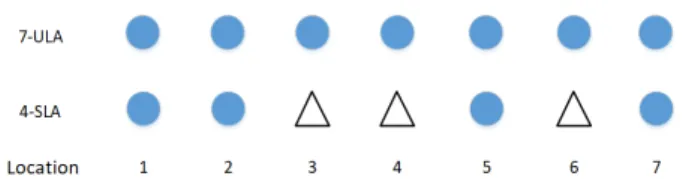
Fig. 1 A 4-element SLA diagram and its relationship with the 7-element ULA.
a ‘missing sensor’ ULA, the array outputXcan be regarded as the selected output of an M-element virtual ULA with D < M andK < M, i.e.,X =PY, whereY is denoted as the output of the virtual ULA, andP∈CD×M is a selection matrix, which can be generated by eliminating the zero rows of diagonal matrix diag(p). Here, the binary vector p ∈ CM×1defines the mapping between the virtual ULA and the SLA: if thei-th(i ∈ [M]) element’s output of the virtual ULA is selected as the output of the SLA, the corresponding entry of pis set to 1, otherwise 0. Taking 4-element SLA as an example, the relationship between the SLA and virtual ULA is shown in Fig. 1, where symbol•denotes that there is a sensor corresponding to the location, andMdenotes there is no sensor located in this position. To retain the same aperture as the virtual ULA, it is assumed that the SLA always selects the first and last antennas of the corresponding virtual ULA.
Thus, the corresponding binary vector can be expressed as p =[1 1 0 0 1 0 1]T. Then, the array output of the virtual ULA can be given as
Y =A¯S¯+V =(B¯+C∆)¯ S¯+V,¯ (6) where ¯Adenotes the array manifold of the virtual ULA with PA¯ =A,H PB¯ =B,H PC¯=CHandPV¯ =VH, respectively.
One can achieve the DOA estimate directly by using the outputXof the SLA. However, it is expected that more sources could be estimated if we can recover the output of the corresponding virtual ULA according toX. It is worth noting that unlike some other methods using second-order statistics to enlarge the degree of freedom (DoF) which led to uncorrelated constraint, we adopt the SBL framework to recover the output of the virtual ULA to enlarge the DoF instead.
We will elaborate our method based on the SBL methodology in the following. The SBL is initially used for regression and classification in machine learning, which is to find the posterior probabilityp(x|y;Θ)by the Bayesian rule, whereΘdenotes the set of all hyperparameters. The hy- perparameters can be estimated by marginalizing overxand then performing evidence maximization. Given the hyper- parameters, the solution ˆxcan be obtained by the Maximum- A-Posterior (MAP).
In the off-grid signal model (6), assume that the columns of ¯Sare mutually independent, and each column is a zero- mean Gaussian vector, i.e.,
¯
s(t)∼N(0,Γ),t∈[L] (7) where Γ = diag(γ) is the covariance matrix with γ = [γ1,· · ·, γN]T,γn ≥0,n ∈ [N]. Note thatΓhas the same
sparse structure withS¯andγnis a nonnegative hyperparam- eter controlling the row sparsity, which means whenγn =0, the associated row ofS¯becomes zero. Then we can obtain the probability density function (PDF) ofS¯as follows,
p(S¯;Γ)=|πΓ|−Lexp−tr(S¯HΓ−1S)¯ . (8) Assume that the entries of the noise matrixV are mutually independent and each row of V has a complex Gaussian distribution, i.e.,
v(t)∼N(0, σI),t ∈[L], (9)
whereσ is the noise power. For the MMV model (6) the Gaussian likelihood is given by
p(Y|S;¯ σ,δ)∼N(A¯S, σI).¯ (10) In our signal model, the outputY of equivalent virtual ULA is unknown. Considering the relation betweenY and X, the mean ofp(Y|X)can be given as
µY|X =A¯S¯+PH(X−PA¯S¯). (11) Using the Bayes rule we obtain the posterior PDF ofS¯ as
p(S¯|Y;Γ, σ,δ)∼N(µS¯,ΣS¯), (12) with mean and covariance matrix being given by
µS¯ =ΓA¯HΣ−Y1Y
ΣS¯ =(Γ−1+σ−1A¯HA)¯ −1 =Γ−ΓA¯HΣY−1AΓ,¯ (13) whereΣY =σI−AΓ¯ A¯H.
Due to the strict convergence characteristic of the EM method, it is used to maximize the posteriorp(Y,S¯;Θ) in order to find the hyperparametersΘ={γ,δ, σ}while treat- ingS¯as a hidden variable. This is equivalent to maximizing the log-posterior logp(Y,S;¯ Θ). The EM method consists of two steps: the expectation (E) step and the maximiza- tion (M) step. The E-step computes the expected value of logp(Y,S;¯ Θ)which is defined as theQ-function. Given the virtual array output Y and the estimated hyperparameters Θoldfrom the previous iteration, theQ-function is computed by
Q(Θ)=ES|Y¯ ;Θold
logp(Y,S¯;Θ)
=ES|Y¯ ;Θold
logp(Y,S¯;σ,δ)p(S¯;Γ), (14) Note that in computing the Eq. (14),p(Y,S¯;σ,δ)does not depend onΓ, andp(S;¯ Γ)is independent of{σ,δ}. Hence, Eq. (14) can be decomposed as
Q(Θ)=ES¯|Y;Θoldlogp(Y,S;¯ σ,δ)+ES¯|Y;Θoldlogp(S;¯ Γ). (15) Next, the M-step is used to maximize the above Q- function to find a new estimate ofΘ. To estimateΓ, Eq. (15) can be simplified toQ(Γ)=ES|Y;Θ¯ old[−logp(S;¯ Γ)]. Since
S¯is Gaussian,Q(Γ)can be denoted as
Q(Γ)=ES¯|Y;ΘoldLlog|πΓ|+tr(S¯HΓ−1S)¯ 'Llog(|Γ|)+LtrΓH(ΣS¯+µS¯µH¯
S). (16) The derivative of formula (16) with respect toγn,n ∈ [N] can be expressed as
∂Q(Γ)
∂γn =−L γn + L
γn2
f(ΣS¯)n,n+ (µS¯)n,:
22
L
g. (17) Letting (16) be zero, the iterative expression of γn can be deduced as follows,
γn =(ΣS¯)n,n+ (µS¯)n,:
22
L . (18)
Similarly, (15) can be simplified as follows to estimate σandδ
Q(σ,δ)=ES¯|Y;Θoldf
logp(Y,S;¯ σ,δ)g
=ES¯|Y;Θold
fM Llog|πσ|+σ−1
Y−A¯S¯
2 F
g
'M Llogσ+σ−1(
kY−Aµ¯ S¯k2F +ES¯|X;ΘoldkA(¯ S¯−µS¯)k2F)
=M Llogσ+σ−1f
kY−Aµ¯ S¯kF2 +Ltr(AΣ¯ S¯A¯H)g
.
(19) Letting (19) be zero with respect to the derivative ofσ, the iterative expression ofσcan be given as
σ=
Y−Aµ¯ S¯
2
F+Ltr(AΣ¯ S¯A¯H)
M L . (20)
Then, by bringing (6) into (19) and following the deriva- tion of[16], the iteration rule ofδcan be expressed as
δ=U−1G, (21)
where U=<(
µS¯µH¯
S +LΣS¯◦ C¯HC¯)
(22) G=<(
diagC¯H(Y−Bµ¯ S¯)µH¯
S −LC¯HBΣ¯ S¯) . (23) When EM method converges, the final estimates of sig- nals power spectrum and the corresponding angle bias can be obtained as ˆγfinal and ˆδfinal, respectively. Then the final DOA estimates can be given as
θˆ=φˆfinal+δˆfinal, (24)
where ˆφfinal denotes the angles corresponding to the maxi- mumKpeaks of ˆγfinal. Finally, our proposed method can be summarized in Algorithm 1 bellow.
4. Numerical Results
In this section, we evaluate the performance of the proposed
Algorithm 1Proposed method
Input: X,K,N,p.
Initialization:σ(0),γ(0),δ(0), ¯S. repeat
(1)UpdateYby equation (11);
(2)UpdateµS¯andΣS¯by equation (13);
(3)Updateγnby equation (18);
(4)Update noise powerσby equation (20);
(5)Update angle biasδby equation (21);
untilConvergence Output: θˆby using (24).
method with comparison to L1-SVD, SS-MUSIC [5] and off-grid SBL (OSBL) as well as the stochastic Cramer-Rao Lower Bound (CRLB) by extensive simulations. The L1- SVD method is a classical method of DOA estimation in SSR field which is based on on-grid signal model. It has the advantage of low computation and good robustness to coher- ent signal scenarios. The SS-MUSIC is a subspace-based and widely used traditional method especially for coherent signal. To make a fair comparison of the proposed method with the reference methods, we first set simulation condi- tions and definitions. We consider an SLA with 4 sensors represented by vector p = [1 1 0 0 1 0 1]T, and assume the leftmost sensor as the start position. In the initializa- tion of our proposed method, letγ(0) = M L1 Σl=1L |B¯HX(l)|, σ(0) =0.1× kXk2
F/(M L),δ(0) =0. The stop criterion is given by
|δ(n+1)−δ(n)|
δ(n) <10−4. (25) The root mean square error (RMSE) is defined as
RMSE= vu t 1
N K¯
N¯
X
n=1
θˆn−θn
22, (26)
where ¯N denotes the total number of trials, ˆθn andθn the estimated and true directions of signals in the n-th trial.
The maximum number of iterations is set to 3000. All simulations are carried out in MATLAB 2017a on a PC with a Windows 7 system and a quad core 3.2G CPU.
Our proposed method mainly focuses on DOA estima- tion in the coherent signal scenario. First, we compare the performance of our proposed method with that of other meth- ods for different grid intervals under two coherent signals.
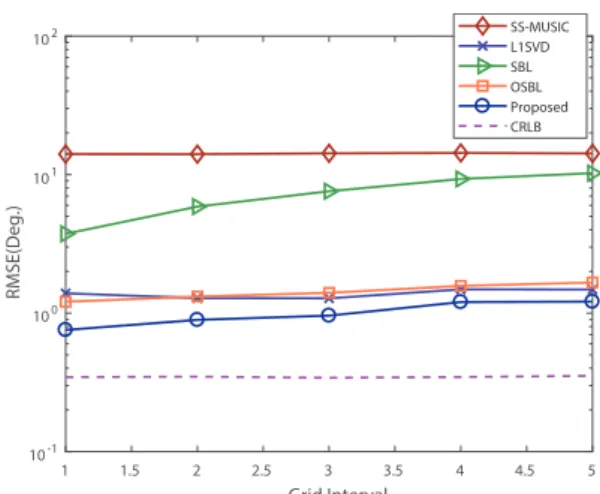
Assume that the two coherent signals impinge onto the SLA from [−10◦+z,5◦+z] and letL=100, SNR=5 dB. The variable z is a random variable with uniform distribution chosen from [−r/2,r/2] and is used to avoid the true DOA landing on the grid points exactly. We chose five different grid intervals, i.e.,r = 1◦,2◦,3◦,4◦,5◦, and carry out 300 independent Monte Carlo trials. The RMSE and CPU time are shown in Fig. 2 and Fig. 3, respectively.
From Fig. 2, it can be seen that, in addition to the SS- MUSIC algorithm, the RMSE of other methods are getting worse as grid interval increases, and our proposed method is closer to the CRLB curve. From Fig. 3, it is seen that
Fig. 2 RMSE comparisons for different methods in terms of grid interval with two coherent signals impinging onto a 4-SLA from(−10◦+z,5◦+z). L=100. SNR = 5 dB.
Fig. 3 Time comparisons for different methods in terms of grid interval with two coherent signals impinging onto a 4-SLA from(−10◦+z,5◦+z).
L=100. SNR = 5 dB.
other than L1SVD, the computational complexity falls as grid interval rises. The computational complexity of our method and OSBL declines slowly when the grid interval exceeds 2◦. Considering the balance between computation and estimation accuracy, we choose the grid interval r = 2◦. It is noted that, when r = 2◦, L1SVD, OSBL and our proposed method have almost the same computational complexity.
Then, we compare the RMSE of those methods on dif- ferent SNRs. The basic settings are the same as that in Fig. 4 and we set the SNR from −15 dB to 15 dB. As shown in Fig. 4, when SNR < −10 dB, the performance of our pro- posed method and OSBL are almost the same, but when SNR ≥ −10 dB, our proposed method is much better than others. Especially, it shows the effectiveness of our idea by making a comparison with OSBL method. The numeri- cal results show that when SNR ≥ −3 dB, the performance of our method have an improvement from 2.3 dB to 4.3 dB than the OSBL method. Specifically, when SNR =−6 dB,
−3 dB and 9 dB, the POSBL gives an improvement of 0.6 dB,
Fig. 4 RMSE comparisons of different methods with two coherent signals impinging onto a 4-SLA from(−10◦+z,5◦+z).L=100 in terms of SNR.
Fig. 5 RMSE comparisons for different methods with two coherent sig- nals impinging onto a 4-SLA from(−10◦+z,5◦+z)in terms of the number of snapshots, SNR = 5 dB.
2.3 dB and 4.3 dB than the OSBL method respectively.
Next, we compare the performance with fixed SNRs but different number of snapshots. Assume that SNR =5 dB, and two coherent signals impinge onto the SLA from [−10◦+z,5◦+z]. The simulation results are shown in Fig. 5.
It can be seen that our proposed method has a better perfor- mance than all other methods, and it is worth noting that the performance of all methods almost have no improvement while L ≥ 40. This observation shows that increasing the number of snapshots can not provide obvious performance improvement in coherent signals scenarios.
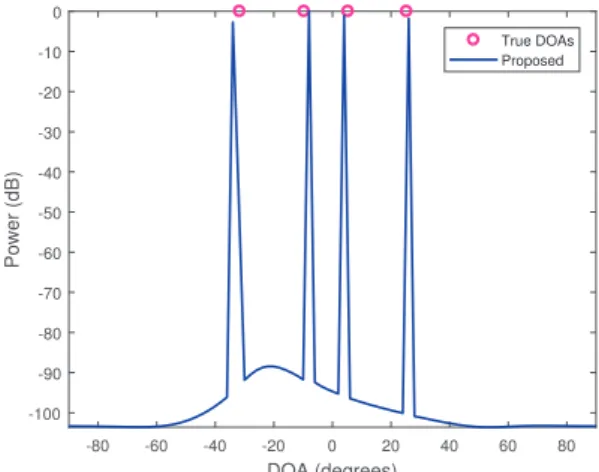
Finally, we test the capacity of estimating multiple co- herent sources with our proposed method. Let SNR=5 dB, L = 100 and assume 4 coherent signals impinge onto the SLA from [−32◦,−10◦,5◦,25◦]. The spectrum of our pro- posed method is shown in Fig. 6. It can be observed that our method can locate all the 4 coherent sources accurately with 4-element SLA.
Fig. 6 Spectrum of our method with 4 coherent signals impinging onto a 4-SLA from(−32◦,−10◦,5◦,25◦).L=100. SNR = 5 dB.
5. Conclusion
In this paper, we have presented an off-grid DOA estimation method in SBL framework. By using a selection matrix, the output of the SLA is converted into an output of the corre- sponding virtual ULA. The EM method is employed to up- date the hyper-parameters and the output of the virtual ULA iteratively. Numerical results demonstrate that the proposed method has a better performance in correlated signal sce- narios than several other methods in literature. Especially, when SNR ≥ −3 dB, our method brings an improvement from 2.3 dB to 4.3 dB than the OSBL method. Thus, the effectiveness of our proposed method has been verified.
Acknowledgments
This work was supported by the Natural Science Foundation of China (61671144, 61871235, 61801245, 61471205, 61771256), the NSF of Jiangsu Province (BK20180748), the NSF of Jiangsu Higher Education In- stitutions (18KJB510032), and NUPTSF (NY218101).
References
[1] H. Krim and M. Viberg, “Two decades of array signal processing research: The parametric approach,” IEEE Signal Process. Mag., vol.13, no.4, pp.67–94, July 1996.
[2] Z. Yang, J. Li, P. Stoica, and L. Xie, “Sparse methods for direction- of-arrival estimation,” Academic Press Library in Signal Processing, vol.7, pp.509–581, Elsevier, 2018.
[3] R. Schmidt, “Multiple emitter location and signal parameter esti- mation,” IEEE Trans. Antennas Propag., vol.34, no.3, pp.276–280, March 1986.
[4] R. Roy and T. Kailath, “ESPRIT-estimation of signal parameters via rotational invariance techniques,” IEEE Trans. Acoust., Speech, Signal Process., vol.37, no.7, pp.984–995, July 1989.
[5] T.J. Shan, M. Wax, and T. Kailath, “On spatial smoothing for direction-of-arrival estimation of coherent signals,” IEEE Trans.
Acoust., Speech, Signal Process., vol.33, no.4, pp.806–811, Aug.
1985.
[6] X. Wu, W.P. Zhu, and J. Yan, “A Toeplitz covariance matrix recon- struction approach for direction-of-arrival estimation,” IEEE Trans.
Veh. Technol., vol.66, no.9, pp.8223–8237, Sept. 2017.
[7] D. Malioutov, M. Cetin, and A.S. Willsky, “A sparse signal re- construction perspective for source localization with sensor arrays,”
IEEE Trans. Signal Process., vol.53, no.8, pp.3010–3022, Aug. 2005.
[8] P. Stoica, P. Babu, and J. Li, “SPICE: A sparse covariance-based es- timation method for array processing,” IEEE Trans. Signal Process., vol.59, no.2, pp.629–638, Feb. 2011.
[9] E.J. Candes, “The restricted isometry property and its implications for compressed sensing,” Compt. Rend. Math., vol.346, no.9-10, pp.589–592, May 2008.
[10] X. Wu, W.P. Zhu, J. Yan, and Z. Zhang, “Two sparse-based methods for off-grid direction-of-arrival estimation,” Signal Process., vol.142, pp.87–95, Jan. 2018.
[11] X. Wu, W.P. Zhu, and J. Yan, “Direction of arrival estimation for off-grid signals based on sparse Bayesian learning,” IEEE Sensors J., vol.16, no.7, pp.2004–2016, April 2016.
[12] H. Zhu, G. Leus, and G.B. Giannakis, “Sparsity-cognizant total least- squares for perturbed compressive sampling,” IEEE Trans. Signal Process., vol.59, no.5, pp.2002–2016, May 2011.
[13] X. Wu, W.P. Zhu, and J. Yan, “A fast gridless covariance matrix reconstruction method for one- and two-dimensional direction-of- arrival estimation,” IEEE Sensors J., vol.17, no.15, pp.4916–4927, Aug. 2017.
[14] X. Wu, W.P. Zhu, and J. Yan, “A high-resolution DOA estimation method with a family of nonconvex penalties,” IEEE Trans. Veh.
Technol., vol.67, no.6, pp.4925–4938, June 2018.
[15] D.P. Wipf and B.D. Rao, “Sparse Bayesian learning for basis se- lection,” IEEE Trans. Signal Process., vol.52, no.8, pp.2153–2164, Aug. 2004.
[16] Z. Yang, L. Xie, and C. Zhang, “Off-grid direction of arrival estima- tion using sparse Bayesian inference,” IEEE Trans. Signal Process., vol.61, no.1, pp.38–43, Jan. 2013.
[17] R. Jagannath and K.V.S. Hari, “Block sparse estimator for grid match- ing in single snapshot DoA estimation,” IEEE Signal Process. Lett., vol.20, no.11, pp.1038–1041, Nov. 2013.
[18] Z. Liu, Z. Huang, and Y. Zhou, “Sparsity-inducing direction finding for narrowband and wideband signals based on array covariance vectors,” IEEE Trans. Wireless Commun., vol.12, no.8, pp.1–12, Aug. 2013.
[19] S.U. Pillai, Y. Bar-Ness, and F. Haber, “A new approach to array geometry for improved spatial spectrum estimation,” Proc. IEEE, vol.73, no.10, pp.1522–1524, Oct. 1985.
[20] S. Pillai and F. Haber, “Statistical analysis of a high resolution spatial spectrum estimator utilizing an augmented covariance matrix,” IEEE Trans. Acoust., Speech, Signal Process., vol.35, no.11, pp.1517–
1523, Nov. 1987.
[21] S. Shakeri, D.D. Ariananda, and G. Leus, “Direction of arrival esti- mation using sparse ruler array design,” 2012 IEEE 13th International Workshop on Signal Processing Advances in Wireless Communica- tions (SPAWC), pp.525–529, June 2012.
[22] P. Pal and P.P. Vaidyanathan, “Nested arrays: A novel approach to array processing with enhanced degrees of freedom,” IEEE Trans.
Signal Process., vol.58, no.8, pp.4167–4181, Aug. 2010.
[23] P. Pal and P.P. Vaidyanathan, “Coprime sampling and the music algorithm,” 2011 Digital Signal Processing and Signal Processing Education Meeting (DSP/SPE), pp.289–294, Jan. 2011.
[24] C. Zhou, Y. Gu, Z. Shi, and Y.D. Zhang, “Off-grid direction-of- arrival estimation using coprime array interpolation,” IEEE Signal Process. Lett., vol.25, no.11, pp.1710–1714, Nov. 2018.
[25] C. Zhou, Y. Gu, X. Fan, Z. Shi, G. Mao, and Y.D. Zhang, “Direction- of-arrival estimation for coprime array via virtual array interpola- tion,” IEEE Trans. Signal Process., vol.66, no.22, pp.5956–5971, Nov. 2018.
[26] B. Wang, Y.D. Zhang, and W. Wang, “Maximum likelihood from incomplete data via the EM algorithm,” J. Roy. Statist. Soc. B (Methodol.), vol.39, no.1, pp.1–38, 1977.
[27] Z. Zhang and B.D. Rao, “Sparse signal recovery with temporally
correlated source vectors using sparse bayesian learning,” IEEE J.
Sel. Topics Signal Process., vol.5, no.5, pp.912–926, Sept. 2011.
Zeyun Zhang received the B.E. degree in electronic information science and technol- ogy from Shandong University, Jinan, China, in 2005. He is currently working towards the Ph.D.
degree in signal and information processing at Nanjing University of Posts and Telecommuni- cations, Nanjing, China. His research interests include compressed sensing and array signal pro- cessing in Radar and Communication.
Xiaohuan Wu received the B.S. and Ph.D.
degrees from the College of Telecommunication and Information Engineering, Nanjing Univer- sity of Posts and Telecommunications, Nanjing, China, in 2010 and 2017, respectively, where He is currently a Lecturer. Dr. Wu is a member of IEEE, the IEEE Signal Processing Society and IEEE Communications Society. His current research interests include array signal process- ing, compressive sensing, millimeter communi- cations and statistical signal processing.
Chunguo Li received the bachelor’s de- gree from Shandong University, Ji’nan, China, in 2005, and the Ph.D. degree from the South- east University, Nanjing, China, in 2010, all in wireless communications. From June 2010, he joined the Faculty of Southeast University, where he was promoted to associate professor in April 2012 and full professor in April 2017. He be- comes an advisor of Ph.D. candidates since Dec.
2016. From July 2012 to June 2013, he did the Postdoctoral Research with Concordia Univer- sity, Montreal, QC, Canada. From July 2013 to August 2014, he joined the DSL Laboratory as Visiting Professor in EE department of Stanford University, Palo Alto, CA, USA. His research interests include underwater acoustic wireless communications, 5G cellular transmission, green com- munications, next generation of WiFi. He has published over 100 refereed journal/conference papers. He holds eight filed patents. He is currently an Associate Editor for Elsevier AEU International Journal of Electronics and Communications, an Associate Editor for Circuits, Systems and Signal Processing, an Editor for KSII Transactions on Internet and Information Systems and has served for many IEEE conferences as the TPC member.
He is the Reviewer for many IEEE journals. He was the recipient of the Southeast University Excellent Young Professor Award in 2015; the Sci- ence and Technology Progress Award of the National Education Ministry of China in 2014; the Excellent Foreign Postdoc Award of Canada in 2012;
the Best Ph.D. Thesis Award of Southeast University in 2010, and several conference Best Paper Awards. He is the senior member of IEEE, senior member of Chinese Institute of Electronics (CIE) and overseas member of IEICE.
Wei-Ping Zhu received the B.E. and M.E.
degrees from Nanjing University of Posts and Telecommunications, and the Ph.D. degree from Southeast University, Nanjing, China, in 1982, 1985, and 1991, respectively, all in electrical en- gineering. He was a Postdoctoral Fellow from 1991 to 1992 and a Research Associate from 1996 to 1998 with the Department of Electrical and Computer Engineering, Concordia Univer- sity, Montreal, Canada. During 1993–1996, he was an Associate Professor with the Department of Information Engineering, Nanjing University of Posts and Telecommuni- cations. From 1998 to 2001, he worked with hi-tech companies in Ottawa, Canada, including Nortel Networks and SR Telecom Inc. Since July 2001, he has been with Concordia’s Electrical and Computer Engineering Depart- ment as a full-time faculty member, where he is presently a Full Professor.
Since 2008, he has been an Adjunct Professor of Nanjing University of Posts and Telecommunications, Nanjing, China. His research interests include digital signal processing fundamentals, speech and audio processing, and signal processing for wireless communication with a particular focus on MIMO systems and cooperative relay networks. Dr. Zhu was an Associate Editor of the IEEE Transactions on Circuits and Systems Part I: Fundamen- tal Theory and Applications from 2001 to 2003, and an Associate Editor of Circuits, Systems and Signal Processing from 2006 to 2009. He was also a Guest Editor for the IEEE Journal on Selected Areas in Communications for the special issues of : Broadband Wireless Communications for High Speed Vehicles, and Virtual MIMO during 2011–2013. Since 2011, he has served as an Associate Editor for the IEEE Transactions on Circuits and Systems Part II: Express Briefs. Currently, he also serves as an Associate Editor of Journal of The Franklin Institute. Dr. Zhu was the Chair-Elect of Digital Signal Processing Technical Committee (DSPTC) of the IEEE Circuits and System Society during 2012–2014, and is presently the Chair of the DSPTC.