LETTER
A Hypergraph Matching Labeled Multi-Bernoulli Filter for Group Targets Tracking
Haoyang YU†a), Wei AN†, Ran ZHU†,Nonmembers,andRuibin GUO†,Member
SUMMARY This paper addresses the association problem of track- ing closely spaced targets in group or formation. In the Labeled Multi- Bernoulli Filter (LMB), the weight of a hypothesis is directly affected by the distance between prediction and measurement. This may generate false associations when dealing with the closely spaced multiple targets. Thus we consider utilizing structure information among the group or formation.
Since, the relative position relation of the targets in group or formation varies slightly within a short time, the targets are considered as nodes of a topological structure. Then the position relation among the targets is mod- eled as a hypergraph. The hypergraph matching method is used to resolve the association matrix. At last, with the structure prior information intro- duced, the new joint cost matrix is re-derived to generate hypotheses, and the filtering recursion is implemented in a Gaussian mixture way. The sim- ulation results show that the proposed algorithm can effectively deal with group targets and is superior to the LMB filter in tracking precision and accuracy.
key words: group targets structure information, hypergraph matching, joint cost matrix, labeled multi-Bernoulli
1. Introduction
The group targets are a set of multiple targets with stable relative position relationship and move coordinately in the surveillance region. Since the targets in group are closely spaced, the main difficulty in achieving the trajectories of the group targets is the data association between the predic- tions and the measurements in the context of process noise and measurement noise.
The association logic of conventional multi-target tracking algorithms such as joint probability data associa- tion (JPDA)[1] and multi-hypothesis tracking (MHT)[2], [3] are not reliable when dealing with densely distributed targets. As Mahler and Vo constantly improved the random finite set (RFS) theory, new ways are presented for multi- target tracking, forming the following three new solutions:
• PHD combined with MHT. Kusha Panta proposed two methods of combining probability hypothesis den- sity (PHD) with MHT. One is to use the output of the PHD filter as the input of MHT (PHD-with-association filter), which is equivalent to the cascade of the two algorithms[4]. Another is regarding the PHD filter as a clutter filter, and the measurements around the out- put of the PHD filter is used as the input of the MHT Manuscript received March 20, 2019.
Manuscript revised June 5, 2019.
Manuscript publicized July 1, 2019.
†The authors are with College of Electronic Science, National University of Defense Technology, Changsha, 410073, China.
a) E-mail: [email protected] DOI: 10.1587/transinf.2019EDL8058
(PHD-with-MHT)[5]. These methods are superposi- tion of the two algorithms. It increases the complexity of the algorithm, and the performance is determined by only one of the two algorithms.
• PHD with label attached. By attaching a unique label to the Gaussian component[6]or particle[7], the esti- mation state of each target carries a unique identity. In this way, the target ID is embedded in the PHD recur- sion process with no algorithm complexity increases.
However, when dealing with closely spaced targets, the results of the clustering is unreliable, and it is hard to extract the state and target label.
• GLMB and LMB. The latest proposed General- ized Labeled Multi-Bernoulli (GLMB)[10],[11]com- bines MHT and RFS statistical theory and has been shown to outperform PHD, cardinalized PHD (CPHD), and cardinality balanced multi-target multi-Bernoulli (CBMeMBer) filters in tracking accuracy. It inher- its the good performance of MHT algorithm in the context of low detection probability and dense clut- ter. The LMB[12]filter, i.e., the simplified version of GLMB, solved the combination explosion problem and has been applied successfully in large scale multi-target tracking.
To further improve the tracking performance of closely spaced targets, the prior information among the group should not be ignored. Although the group targets are densely distributed, the relative position is stable within a short time, and it is an effective information that can be used. Hypergraph is a generalization of a graph and it is capable of representing relationship among vertexes. Hy- pergraph matching method was always used in feature point matching in computer vision, pattern recognition, and ma- chine learning fields. Recently, the hypergraph was intro- duced in point target tracking. In[8], the authors described the group structure under the framework of hypergraph the- ory and improved the performance of the data association.
In this paper, we introduce the group structure information into the LMB filter, expecting to improve the data associa- tion performance and the ability of the group target tracking.
2. Association Problem in Group Targets Tracking
2.1 Disadvantage of Association Based on Distance In LMB filter, the association probability is determined by Copyright c2019 The Institute of Electronics, Information and Communication Engineers
Fig. 1 Comparison of the two association logics. The solid squares de- note the tracks at time stepk−1, and the hollow ones are the predictions.
×are measurements at time stepk. Different colors represent different IDs.
the distance between prediction and measurement, but this strategy is no longer reliable when tracking closely spaced multi-targets. As shown in Fig. 1 (a), compared with track L1k|k−1, the measurementz1k is closer to the predicted track L2k|k−1, and therefore the probability of associationL2k|k−1 → z1k is higher than L2k|k−1 → z2k. But actually the measure- mentz1k is generated by track Lk1−1 at time step k. There- fore, it is hard to obtain reasonable association when dealing with densely distributed targets only with distance informa- tion. Although the target positions in the group are closely spaced, the relative position relationship between the adja- cent frames does not change significantly.
Let’s take the scenario in Fig. 1 (b) for instance, the pre- dicted tracks can be regarded as three nodes of a triangle and so as the measurements at time stepk. The orientation of the
‘measurement triangle’ barely changes comparing with the
‘predicted triangle’, since the targets move in formation. For the above reason, we consider introducing the relative posi- tion information to improve the association performance.
2.2 Hypergraph Representation of Group Targets Struc- ture
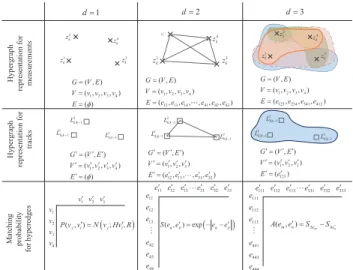
Hypergraph is a generalization of graph. A traditional graph is composed of vertexes and edges, an edge can only con- nect two vertexes. While the edge of a hypergraph can con- nect any certain number of vertexes. A hypergraphG can be denoted as G = (V,E), where V = (v1,· · ·vp) is the set of vertexes,E is the set of hyperedges those connect a certain number of vertexes. Ad-tuple hypergraph is a hy- pergraph that all hyper-edges of which connectsdvertexes.
Therefore, a 1-tuple hypergraph is a set of vertexes, a 2- tuple hypergraph is a graph, a 3-tuple hypergraph is a set of triples. The above definition shows that a hypergraph can not only describe the state of the vertexes, but also the in- terrelationships among the vertexes through the hyperedges.
The sketch map of the hypergraph is shown in Fig. 2.
2.3 Hypergraph Matching Probability
With the tracks and measurements represented in hyper- graph form, we can resolve the data association by comput-
Fig. 2 The hypergraph representations of tracks and measurements.
ing the similarity of vertex-vertex or hyperedge-hyperedge.
vertex-vertex. Obviously, it is the traditional way of determining the probability of association based on the dis- tance between two vertexes when tuple numberd=1. It is calculated as follows
P(vj, vi)= 1
(2π)nz/2|Σ|1/2exp
−1 2xΣ−1x
(1) where x =
vj−vi
is the vector difference between mea- surementvjand predictionvi,Σis the covariance matrix of x,nzdenotes the number of measurement.
hyperedge-hyperedge. If a feature vector is invari- ant on adjacent frames, a hyperedge can be instantiated by it. When tracking the targets in a group, the distance be- tween every two targets or the overall group structure can be considered as a constant between adjacent frames. Thus a hyperedge can be instantiated by a vector that connects two vertexes when tuple number d = 2. For example, e12 = z1−z2, e12 = L1k|k−1 −L2k|k−1. A hyperedge can be instantiated by the triangle area that connects three vertexes when tuple numberd=3. In this paper, the hypergraph with tuple numberd=2 is adopted and the matching probability is calculated as
S(eq,ep)=exp
−eq−ep (2) whereeqis theqthelement ofV,epis thepthelement ofV. Compared to the vertex-vertex matching matrixP, the hyperedge-hyperedge matching matrixS naturally contains the relative position information of the group since the hy- peredge is instantiated by a vector rather than a particle.
3. Joint Cost Matrix with Hypergraph Matching In this section, we design the following steps to solve the association problem of group targets tracking, which is blended with hypergraph matching result.
Step 1Given by the sub-equation of Eq. (28) in[11],
the association probability of LMB filter is presented as fol- lows
q(zj;li)=N(zj;Hmli,HPiH+R) (3) where 1 ≤ i ≤ I, 1 ≤ j ≤ J, I is the track number at time stepk−1,Jis measurement number at time stepk,mli
andPidenote the mean position and covariance of the target with labelli,H denotes the linear observation model,Ris the measurement noise covariance. Here let the association matrix be abbreviated asQ,
Step 2 Since the hyperedge matching matrix S indi- cates the correspondences between hyperedge and hyper- edge, it is not the practicable association for vertex to vertex, i.e., prediction to measurement. The vertex-vertex matching matrixX can be resolved according to the relative entropy error method. The specific method can be found in[9].
Step 3The new joint association matrix is the combi- nation of the traditional association matrixQand the hyper- graph matching matrixX, i.e.,Q=Q∗XT, where∗denotes dot products. Letq(zj;li) denotes the element of theithrow and thejthcolumn of the matrixQ. Replace q(ξ)k withq(ξ)k in [11](26), the joint cost matrix is rewritten as
Ci,j=−ln
⎛⎜⎜⎜⎜⎜
⎜⎜⎜⎜⎜
⎜⎜⎜⎜⎜
⎝ PD
J(ξ)(i)
k=1 w(kξ)(i)q(kξ)(zj;i) (1−PD)κ(zj)
⎞⎟⎟⎟⎟⎟
⎟⎟⎟⎟⎟
⎟⎟⎟⎟⎟
⎠
(4)
whereCi,j denotes the cost of the jth measurement associ- ated with theith track, PD is detection probability,w(ξ)k (i) is the weight of hypothesis (θ(i), ξ),θ(i) is association so- lution of target with labelli, ξ is association map history, κ(zj) denotes the clutter intensity. Then with the ranked as- signment and k-th shortest path algorithms[13], thekbest hypotheses can be obtained. The remaining steps are the same as the LMB and will not be reiterated here.
4. Numerical Results and Analysis
4.1 Simulation Setup
The following simulation scenario is setup. A group of five targets moves straightly from the upper right to the bottom left in the region [−20,20]×[−15,15], the kinematic state of each target is defined as [x,x, y,˙ y]˙ T, where [x, y]T denotes the position and [ ˙x,y˙]T denotes the velocity. The motion model and observation model are
Fk|k−1=
⎡⎢⎢⎢⎢⎢
⎢⎢⎢⎢⎢
⎢⎢⎣
1 Ts 0 0
0 1 0 0
0 0 1 Ts
0 0 0 1
⎤⎥⎥⎥⎥⎥
⎥⎥⎥⎥⎥
⎥⎥⎦ Hk=
1 0 0 0
0 0 1 0
(5) The covariance of process noiseQkand measurement noiseRkare respectively given as
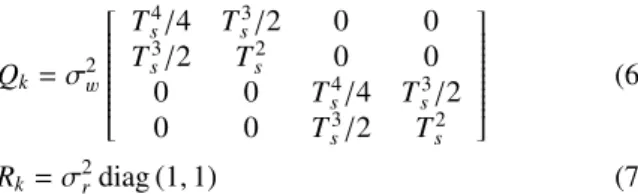
Qk=σ2w
⎡⎢⎢⎢⎢⎢
⎢⎢⎢⎢⎢
⎢⎢⎣
Ts4/4 Ts3/2 0 0 Ts3/2 Ts2 0 0 0 0 Ts4/4 Ts3/2 0 0 Ts3/2 Ts2
⎤⎥⎥⎥⎥⎥
⎥⎥⎥⎥⎥
⎥⎥⎦ (6)
Rk=σ2rdiag (1,1) (7)
where σw = 0.01,σr = 0.2. The sampling period Ts = 1s. The clutter number returns per frame subject to Poisson distribution with mean λ = 2 and uniformly distributed in the surveillance region. In this paper, we only investigate the effect of hypergraph matching on data association. Thus the target survival and detection probability is set toPs=1 andPd =1, respectively. The simulation time is 20s.
4.2 Result of a Single Simulation
The initial state of each target is set to [16,−1.1,8,−0.8], [15.5, −1.1, 9, −0.8], [15, −1.1, 8, −0.8], [14.5, −1.1, 9,
−0.8], [15,−1.1,10,−0.8]. The survival time of each target lasts for 20s. The single run of the scenario is shown in Fig. 3.
From Fig. 3 (c), it can be seen that the LMB generates a large number of target ID switches during the inception phase, while from Fig. 3 (d) the HGM-LMB filter outputs more clear tracks with less ID switches.
4.3 Results of Monte Carlo Simulations
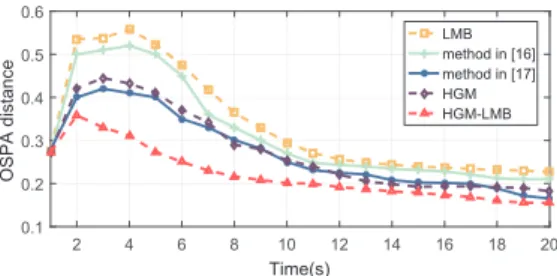
In this subsection, the tracking performance is measured us- ing the OSPA distance[14]and the ‘CLEAR MOT’ met- rics[15]. Another two filters proposed recently are used as contrast. 500 Monte Carlo simulations are performed and
Fig. 3 Association and tracking performance comparison of LMB and HGM-LMB. (a) shows the best path derived from the traditional cost ma- trix, (b) shows the matching result given by hypergraph matching method, (c) shows the tracks outputted by the LMB filter, (d) shows the tracks out- putted by the HGM-LMB. The black lines denote the ground truth of the targets, gray+in (c) and (d) are the measurements, and each colored curve represents a estimated track with unique ID.
Fig. 4 Mean OSPA distance comparison within 500 Monte Carlo.
Table 1 Evaluation based on CLEAR MOT metrics.
MethodIndicator
TPR MOTP FPR FNR ID Switch MOTA
LMB 83.90% 0.2008 7.77% 7.79% 10.3880 76.13%
method in[16] 84.24% 0.2107 7.59% 7.62% 9.4856 78.65%
method in[17] 90.33% 0.1915 4.78% 5.24% 5.2590 90.24%
HGM 89.18% 0.1964 4.98% 5.28% 4.9150 90.13%
HGM-LMB 92.65% 0.1877 3.59% 4.17% 3.9760 89.06%
the results are given in Fig. 4 and Table 1. The meanings of the ‘CLEAR MOT’ indicator are given as below, and the details of the indicators can be refer to[15].
• TPR (true positive rate): correct association probabil- ity;
• MOTP: multiple objects tracking precision;
• FPR (false positive rate): ratio of false positives;
• FNR (false negative rate): ratio of misses;
• IDS: ratio of mismatches, i.e., track ID switches;
• MOTA: multiple objects tracking accuracy.
From Fig. 4, the OSPA value provided by HGM-LMB is lower than three contrast filters. Since[16]focus more on parametric modeling of assumptions about targets interac- tive motion, while in the tracking scene where the structure is relatively stable and the target interaction is weak, the pro- posed HGM-LMB is more applicable. The method in[17]
also focus on utilizing structure information, which is sim- ilar to ours. By borrowing adjacent matrix conception in graph theory,[17]expressed the targets as nodes in a tree.
It’s not hard to imagine that a hypergraph is more stable than a tree when describing a graph with an abundance of nodes.
For hypergraph matching method, the predicted track can- not match with the corresponding measurement when miss detection occurs, leading to the rupture of the track. While the LMB inherits the idea of the MHT and maintains a hy- pothesis for the miss detection, which means the track is more possible to be hold to match with the corresponding measurement in the next time step. From Table 1, all the in- dicators of the HGM-LMB is superior to comparison meth- ods in performance. It further proves the effectiveness of our proposed HGM-LMB in scenes of multi-target cooperative motion.
We now review the relationship between hypergraph matching method and the LMB. Since the distance based association method in LMB cannot cope with closely spaced targets, group structure information has to be taken into con- sideration. Hypergraph matching is just right for the prob-
lem of point matching in two topological graphs and we use it as the association method in HGM-LMB. The hypergraph matching method greatly improves the association perfor- mance by using the group structure information, and then improves the trajectories quality.
5. Conclusion
In this paper, we focus on the data association problem in closely spaced multiple targets. We introduce the hyper- graph theory to describe the relative position relationship of multiple targets. The hypergraph matching method is used to resolve the association between adjacent frames. We in- tegrate the hypergraph matching result into the LMB filter and then propose the HGM-LMB filter. Through the sim- ulation and analysis, we verify that the relative position is significant information when tracking closely spaced multi- ple targets and the proposed HGM-LMB filter is superior to the comparison methods in tracking precision and accuracy.
References
[1] T. Fortmann, Y. Bar-Shalom, and M. Scheffe, “Joint probabilistic data association for multiple targets in clutter,” Proc. Conf. on Infor- mation Sciences and Systems, 1980.
[2] S.S. Blackman, “Multiple hypothesis tracking for multiple target tracking,” IEEE Aerosp. Electron. Syst. Mag., vol.19, no.1, pp.5–18, 2004. DOI: 10.1109/MAES.2004.1263228
[3] S.-W. Joo and R. Chellappa, “A multiple-hypothesis approach for multiobject visual tracking,” IEEE Trans. Image Process., vol.16, no.11, pp.2849–2854, 2007. DOI: 10.1109/TIP.2007.906254 [4] K. Panta, B.-N. Vo, S. Singh, and A. Doucet, “Probability hypoth-
esis density filter versus multiple hypothesis tracking,” Proc. SPIE, vol.5429, pp.284–295, 2004. DOI: 10.1117/12.543357
[5] K. Panta, B.-N. Vo, and S. Singh, “Novel data association schemes for the probability hypothesis density filter,” IEEE Trans. Aerosp.
Electron. Syst., vol.43, no.2, pp.556–570, 2007. DOI: 10.1109/ TAES.2007.4285353
[6] K. Panta, D.E. Clark, and B.N. Vo, “Data association and track management for the Gaussian mixture probability hypothesis den- sity filter,” IEEE Trans. Aerosp. Electron. Syst., vol.45, no.3, pp.1003–1016, 2009. DOI: 10.1109/TAES.2009.5259179 [7] D.E. Clark and J. Bell, “Multi-target state estimation and track
continuity for the particle PHD filter,” IEEE Trans. Aerosp. Elec- tron. Syst., vol.43, no.4, pp.1441–1453, 2007. DOI: 10.1109/TAES.
2007.4441750
[8] S. Wu and J. Xiao, “Tracking group targets using hypergraph matching in data association,” Proc. SPIE, vol.8137, 2011. DOI:
10.1117/12.897202
[9] R, Zass and A. Shashua, “Probabilistic graph and hypergraph match- ing,” IEEE Conference on Computer Vision and Pattern Recogni- tion, pp.1–8, 2008. DOI: 10.1109/CVPR.2008.4587500
[10] B.-T. Vo and B.-N. Vo, “Labeled random finite sets and multi- object conjugate priors,” IEEE Trans. Signal Process., vol.61, no.13, pp.3460–3475, 2013. DOI: 10.1109/TSP.2013.2259822
[11] B.-N. Vo, B.-T. Vo, and D. Phung, “Labeled random finite sets and the Bayes multi-target tracking filter,” IEEE Trans. Signal Process., vol.62, no.24, pp.6554–6567, 2014. DOI: 10.1109/TSP.
2014.2364014
[12] S. Reuter, B.-T. Vo, B.-N. Vo, and K. Dietmayer, “The labeled multi-Bernoulli filter,” IEEE Trans. Signal Process., vol.62, no.12, pp.3246–3260, 2014. DOI: 10.1109/TSP.2014.2323064
[13] K.G. Murty, “An algorithm for ranking all the assignments in order
of increasing cost,” Operations Research, vol.16, no.3, pp.682–687, 1968. DOI: 10.1287/opre.16.3.682
[14] B. Ristic, B.-N. Vo, D.E. Clark, and B.-T. Vo, “A metric for perfor- mance evaluation of multi-target tracking algorithms,” IEEE Trans.
Signal Process., vol.59, no.7, pp.3452–3457, 2011. DOI: 10.1109/ TSP.2011.2140111
[15] K. Bernardin and R. Stiefelhagen, “Evaluating multiple object tracking performance: The CLEAR MOT metrics,” Eurasip Jour- nal on Image and Video Processing, vol.2008, 246309. DOI:
10.1155/2008/246309
[16] C. Leon, L. Mihaylova, and H. Driessen, “Tracking of interact- ing targets,” 20th International Conference on Information Fusion, 2017. DOI: 10.23919/ICIF.2017.8009855
[17] S. Zhu, W. Liu, C. Weng, H. Cui, “Multiple group targets track- ing using the generalized labeled multi-Bernoulli filter,” Proc.
35th Chinese Control Conference, 2016. DOI: 10.1109/ChiCC.
2016.7554109