IEICE TRANS. FUNDAMENTALS, VOL.E103–A, NO.1 JANUARY 2020
265
LETTER
Special Section on Intelligent Transport SystemsA Cell Probe-Based Method for Vehicle Speed Estimation
Chi-Hua CHEN†a),Member
SUMMARY Information and communication technologies have im- proved the quality of intelligent transportation systems (ITS). By estimat- ing from cellular floating vehicle data (CFVD) is more cost-effective, and easier to acquire than traditional ways. This study proposes a cell probe (CP)-based method to analyse the cellular network signals (e.g., call ar- rival, handoff, and location update), and regression models are trained for vehicle speed estimation. In experiments, this study compares the practi- cal traffic information of vehicle detector (VD) with the estimated traffic information by the proposed methods. The experiment results show that the accuracy of vehicle speed estimation by CP-based method is 97.63%.
Therefore, the CP-based method can be used to estimate vehicle speed from CFVD for ITS.
key words: intelligent transportation systems, cellular floating vehicle data, cellular networks, vehicle speed estimation, regression
1. Introduction
Constructing intelligent transportation systems (ITS) to obtain real-time traffic information (e.g., average vehicle speed, travel time, traffic flow, and traffic condition) are im- portant issues for the developments of smart city. The real- time traffic information collection methods can be grouped into three classes: vehicle detector (VD), global position system (GPS)-based probe car, and cellular floating vehi- cle data (CFVD). Although the precise traffic information can be estimated and collected by VDs, the deployment and maintain fees are very expensive. GPS-based probe car can report the vehicle speed and travel time, but the penetration rate of GPS-based probe cars is usually not high enough to infer precise real-time traffic information. The number of people owning cell phones has been increased, so using mo- bile stations (MSs) as probes for tracking the locations of MSs and obtaining CFVD is feasible.
Some studies proposed analytical models based on CFVD to estimate traffic information (e.g., traffic flow, ve- hicle speed, vehicle density, and travel time). For instance, when a MS moves from a location area (LA) to another LA, the normal location update (NLU) procedure is performed.
Therefore, the NLU events can be used to estimate traffic flow. Furthermore, two consecutive NLU events can be col- lected and analysed for the estimations of vehicle speed and travel time [1]. However, the traffic information estima- tion methods based on two consecutive NLU events are only
Manuscript received December 11, 2018.
Manuscript revised July 9, 2019.
†The author is with the College of Mathematics and Computer Science, Fuzhou University, China.
a) E-mail: [email protected] DOI: 10.1587/transfun.2019TSL0001
Fig. 1 The considered factors in CP-based method.
suitable for long road segments. Therefore, traffic informa- tion estimation methods based on two consecutive handoff (HO) events have been proposed for shorter road segments [2]. Although these methods can obtain precise traffic infor- mation for shorter road segments, the availability ratios of these methods may be very lower.
Therefore, this study tracks and analyses the locations of mobile user signals through interfaces of cellular net- works. Firstly, this study monitors the network interfaces (e.g., A and IuCS) and designs an ITS server to retrieve the network signals (e.g., NLUs, HOs, and call arrivals (CAs)) and estimate the traffic condition information. When a call is initialized, the processes of CA will be performed by a calling party and a called party; the number of CA which is associated with vehicle density [3] can be used for ve- hicle speed estimation. This study designs a regression- based method and considers the NLU-based method and HO-based method to propose a vehicle speed estimation al- gorithm which is called CP-based method (shown in Fig. 1).
2. Vehicle Speed Estimation
2.1 NLU-Based Speed
For the estimation of NLU-based speed, Fig. 2 illustrates the space diagram for vehicle movement and NLU on a road.
This study supposes that there is a road covered by three LAs and a MS in a car on the road. The detail steps are as follows.
Step 1: When the car moves from LA1to LA2, the NLU pro- cedure is performed. A NLU signal is sent to core network, and the ITS server can retrieve the signal which contains the location of NLUL1and NLU timet1.
Step 2: When the car moves from LA2 to LA3, the NLU procedure is also performed. The ITS server also retrieves Copyright c2020 The Institute of Electronics, Information and Communication Engineers
266
IEICE TRANS. FUNDAMENTALS, VOL.E103–A, NO.1 JANUARY 2020
Fig. 2 The cell switching of a moving MS on a road.
the signal which contains the location of NLUL5and NLU timet5. Then the NLU-based speed of the MS can be com- puted asun = d(Lt5−t1,L15) in the period [t1,t5], whered(L1,L5) denotes the geographic distance betweenL1andL5. 2.2 HO-Based Speed
For the estimation of HO-based speed, Fig. 2 illustrates the space diagram for vehicle movement and HO on a road.
This study supposes that there is a road covered by six cells and a MS in a car on the road. The detail steps are as fol- lows.
Step 1: A CA is performed by the MS in the car at timet2, and the car keeps moving on the road.
Step 2: When the communicating MS in the car moves from Cell3to Cell4, the HO procedure is performed. A HO signal is sent to core network, and the ITS server can retrieve the signal which contains the location of HOL3and HO timet3. Step 3: When communicating MS in the car moves from Cell4to Cell5, the HO procedure is also performed. The ITS server also retrieves the signal which contains the location of HOL4and HO timet4. Then the HO-based speed of the MS can be computed asun= d(Lt4−t3,L34) in the period [t3,t4], where d(L3,L4) denotes the geographic distance between L3 and L4.
2.3 Regression-Based Speed
In accordance with Ref.[3], the amount of CAs is related with traffic density, which means the amount of CAs is the reciprocal of vehicle speed. Moreover, this study proposes a regression model to analyse the parameters (i.e.,αandβ) in Formula (1)[4]from vehicle speed and the amount of CAs.
There areNcycles in history data, and the practical vehicle speedUiand the amount of CAsaiare recorded in thei-th cycle for estimating the vehicle speedur. Then the NLU- based speed, the HO-based speed, and the estimated vehicle speed from regression model are considered and analysed by CP-based algorithm to estimate CP-based vehicle speed.
ur=α×a+β, where
α= N
N
X
i=1
aiUi
−
N
X
i=1
ai
N
X
i=1
Ui
N
N
X
i=1
(ai)2
−
N
X
i=1
ai
2 and
β= 1 N
N
X
i=1
Ui−α
N
X
i=1
ai
(1)
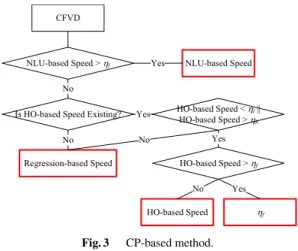
Fig. 3 CP-based method.
2.4 CP-Based Method
Figure 3 shows the CP-based method to analyse the NLU- based speed, HO-based speed, and regression-based speed for vehicle speed estimation. In accordance with the ex- periment results in previous studies, NLU-based method can provide high vehicle speed estimation accuracy when the traffic state is free flow[1]. Therefore, the NLU-based speed is adopted when the NLU-based speed is faster than the threshold of free flow speed (ηf). However, NLU-based method cannot immediately estimate the vehicle speed of the short road segment. Therefore, the HO-based speed and the regression-based speed in accordance with the amount of CAs are considered in this paper. The HO-based speed re- port is not always available in accordance with the call hold- ing time, so it should be checked in each cycle. Moreover, the HO-based method can provide high vehicle speed esti- mation accuracy when the traffic state is congestion or free flow. Therefore, HO-based speed is adopted when it is faster than the threshold of high speed (ηh) or is slower than the threshold of low speed (ηl); otherwise the regression-based speed in accordance with the amount of CAs is adopted.
3. Practical Experimental Results and Discussions The aim of the practical experiments is to analyse the ac- curacies of vehicle speed estimation. The practical experi- ments were carried out on a 30 km long highway segment in the Highway No. 1 in Taiwan. For the evaluation of speed estimation, this study collected the actual speed (U) infor- mation obtained from VD and analysed the error ratio (Rh) for the evaluation of estimated speedu(e.g.,uh,un, andui)) by Formula (2).
Rh=min |U−u|
U ,1
!
×100% (2)
For CP-based method, this study adopted some parameters as follows to estimate the vehicle speed: ηf = 90 km/hr, ηl = 50 km/hr and ηh = 85 km/hr. The CFVD from Chunghwa Telecom and the VD data from Taiwan Area Na- tional Freeway Bureau during September and November in
LETTER
267 Table 1 The speed estimation accuracies of the CP-based method.
Table 2 The speed estimation accuracy comparisons of methods.
Table 3 The cost comparisons of methods.
last year were recorded and analysed for the evaluation of the proposed method in the offline environments. Table 1 shows that the average accuracy of the CP-based method is 97.63%.
For the comparisons of vehicle speed estimation ac- curacy, this study analysed the cellular network signals from Chunghwa Telecom and provides the comparison with NLU-based method[1], HO-based method[2], FPA-based method[5], and CP-based method. The aim of the practical experiments was to analyse the accuracies of vehicles speed estimation based on the different methods. The collected control signals included NLU, CA and HO, and the traffic information reporting cycle is 5 min/cycle (i.e., 288 cycles in one day). The practical results of NLU-based method, HO- based method, FPA-based method, and CP-based method are showed in Table 2. In the practical experimental re- sults, the accuracy of NLU-based speed is about 93%, but this method only obtains precise estimated speed with free flow. Although HO-based method can provide good accu- racy for shorter road segment, the availability ratio is about 19%. Moreover, the speed estimation accuracy of the CP- based method is about 98%, and the availability ratio of this method is 100%. In the CP-based method, the average usage ratio of NLU-based, HO-based and Regression-based algo- rithms are 91%, 1% and 8%, respectively. Therefore, the CP-based method is more suitable for ITS.
For deployment and computation cost, A-bis and Iub interfaces are needed to be monitored for FPA-based method (shown in Table 3). The number of these interfaces in Taiwan is larger than 10000, and more monitor servers are required. Although the FPA-based method can provide the lower error ratio of vehicle speed estimation than HO-based
method, the cost of FPA-based method is too expensive.
However, the number of A and IuCS interfaces in Taiwan is smaller than 100. Therefore in the view of cost, the pro- posed CP-based method is more suitable for ITS.
4. Conclusions
This study proposed a CP-based method to analyse cellular network signals (i.e., NLUs, HOs, and CAs) for estimating vehicle speeds. In practical experiments, this study com- pared the practical traffic information of VD with the es- timated traffic information by the proposed methods. Al- though FPA-based method can provide good vehicle speed estimation accuracy, it needs to retrieve the cellular network signals via A-bis and Iub interfaces. However, HO-based method and CP-based method need to retrieve the cellular network signals via A and IuCS interfaces which are usu- ally monitored in each telecom company. Therefore, the de- ployment and computation cost of FPA-based method is too expensive and is not suitable for vehicle speed estimation.
Furthermore, the results showed that the accuracy of vehi- cle speed estimation by CP-based method which is 97.63%
is higher than NLU-based, HO-based and FPA-based meth- ods. Therefore, the CP-based method can be used to esti- mate vehicle speed from CFVD for ITS.
Acknowledgments
This work was partially supported by the National Natural Science Foundation of China (Nos. 61906043, 51978172, 61877010, 11501114 and 11901100), Fujian Natural Sci- ence Funds (No. 2019J01243), and Fuzhou University (Nos.
510730/XRC-18075, 510809/GXRC-19037, 510649/XRC- 18049 and 510650/XRC-18050). The author thanks the Telecommunication Lab. of Chunghwa Telecom Co. Ltd. for the supports.
References
[1] A. Janecek, D. Valerio, K.A. Hummel, F. Ricciato, and H. Hlavacs,
“The cellular network as a sensor: From mobile phone data to real- time road traffic monitoring,” IEEE Trans. Intell. Transp. Syst., vol.16, no.5, pp.2551–2572, 2015. doi: 10.1109/TITS.2015.2413215 [2] R.-H. Liou, Y.-B. Lin, Y.-L. Chang, H.-N. Hung, N.-F. Peng, and M.-
F. Chang, “Deriving the vehicle speeds from a mobile telecommu- nications network,” IEEE Trans. Intell. Transp. Syst., vol.14, no.3, pp.1208–1217, 2013. doi: 10.1109/TITS.2013.2255039
[3] C.-H. Chen, H.-C. Chang, C.-Y. Su, C.-C. Lo, and H.-F. Lin, “Traffic speed estimation based on normal location updates and call arrivals from cellular networks,” Simulation Modelling Practice and Theory, vol.35, pp.26–33, 2013. doi: 10.1016/j.simpat.2013.02.005 [4] G.A.F. Seber and A.J. Lee, Linear Regression Analysis, 2nd ed., John
Wiley & Sons, New Jersey, USA, 2003.
[5] D.-Y. Cheng, C.-H. Chen, C.-H. Hsiang, C.-C. Lo, H.-F. Lin, and B.- Y. Lin, “The optimal sampling period of a fingerprint positioning al- gorithm for vehicle speed estimation,” Math. Probl. Eng., vol.2013, 306783, 2013. doi: 10.1155/2013/306783