A Study on the Composite Teeth of Polyester Resin / Glass Bead
journal or
publication title
福井大学工学部研究報告
volume 28
number 1
page range 101‑110
year 1980‑03
URL http://hdl.handle.net/10098/4383
MEMOIRS OF THE FACULTY OF ENGINEERING FUKUI UNIVERSITY VOL.28 No. 1 1980
A Study on the Composite Teeth of Polyester Resin / Glass Bead
Hiroshi KIMURA*, Takuji YAMAGUCHI**,
Tetsuro SHIRAISHI**, Masakazu TSUBOKAWA**and Yoshitsugu FUKUDA**
(Received Dec.24, 1979)
In this paper we describe an experimental study, reported in this article are trial manufacture of composite tooth material from unsaturated polyester as matrix and glass bead as filler and results of experimental studies in its mechanical properties, abrasion properties, surface profile and micro-properties of fracture.
As a result of this series of tests and experiments, i t was found that, with filling glass beads by 30 wt.%, abrasion quantity of the composite material falls to 1/4 of that of unsaturated polyester resin, and abrasion resistance is improved remarkably.
By filling glass beads, tensile and bending strength, elongation and deflection become smaller. In terms of elastic modulus, the composite material has tendency to show increase in dry condition, while to show decrease in wet condition. It is fairly expectable to have composite artificial teeth having glass beads by 30 wt.%.
1. INTRODUCTION
101
Resin teeth have advantages in easiness in grinding and putting into shape, adhesive property, corrosion resistance, and being light in weight and cheap in cost, but they are inferior in abrasion resistance and hardness. In order to make up such disadvantages, composite arti- ficial teeth of resin and glass beads have come up.O~~ Reported in this article are results of experiments in respect of mechanical pro- perty, abrasion characteristics, etc. conducted with trial-manufactured composite artificial teeth of unsaturated polyester as @atrix and glass beads as filler.
* Osaka University Dental School
** Fukui University, Department of Textile Engineering
102
2. EXPERIMENTAL PROCEDURES
Unsaturated polyester (U.P.) is one of the most widely used resins for F.R.P. (Fiber Reinforced Plastic).~ Process of manufacture of U.P. is that unsaturated dibasic acid was esterized in the first place, either alone or in combination with saturated dibasic acid, under temperature in the neighborhood of 200°C in inert gas such as carbonic acid gas or nitrogen gas; thence unsaturated alkyd, solid or viscous under room temperature, having 2,000-3,000 molecular weight and acid value of less than 50, was resolved into monomer together with a little quantity of polymerization inhibiter to obtain transparent liquid
resin of lemon-yellow. This liquid resin is thermo-setting plastic which can be cured by adding polymerization starter.IV U.P and glass beads used in these experiments were "POLYLITE FH-164" made by Dai- Nippon Ink Chemical Industries Co., Ltd. and "3000CP-Ol (for plas- tics)" of 5-63 jJ- in diameter made by Toshiba, respectively.
Glass beads was mixed with U.P. by 10, 20, 30, 40, 50 wt.%. It was then moulded to prepare plate specimens, from which long rectangular test pieces of 50 x 10 x 2rnm for No.2 Dumbell test and abrasion resis- tance test11) were made by machine work. Tension test and bending test were carried out in dry and wet conditions of the specimens. As for the wet condition, the specimen was first dipped in boiling water for 2 hours, thence cooled down to rbom temperature and presented to test
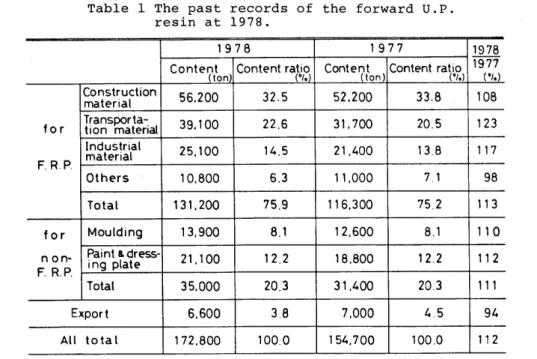
Table 1 The past records of the forward U.P.
resin at 1978.
1978 1977
Content I) Content ratio Content Content ratio
(ton ("10) (ton) ("10)
Construction
56.200 32.5 52.200 33.8 material
for Transporta-
tion material 39.100 22.6 31. 700 20.5
Industrial 25.100 14.5 21.400 13.8
material F. R. P.
Others 10.800 6.3 11.000 7.1
Total 131.200 75.9 116.300 75.2
for Moulding 13.900 8.1 12.600 8.1
n on- Paint & dress-
21.100 12.2 18.800 12.2 ing plate
F. R. P.
Total 35.000 20.3 31.400 20.3
Export 6.600 3.8 7.000 4.5
All total 172.800 100.0 154.700 100.0
1978 1977
("10)
108 123 117 98 113 110 112 111
94 112
<D :
Spec imenGO :
Cylinder of mild steelQ) :
Thermocouple®:
Spring(2):
Recorder~: Differential transmission
Fig.l Schematic arrangement of the friction and wear test apparatus.
immediately thereafter.
Fig.2 Dimension of specimen and cylinder of mild steel.
3. EXPERIMENTAL RESULTS AND CONSIDERATION
103
Fig.3 shows relationship between bead blending ratio and tensile strength of U.P./glass bead composite artificial teeth. As the filler content increased strength dropped, sharply at first, then gradually.
Strength of the teeth with 30 wt.% filler content (3.5kg/mm2) was 56%
of strength of U.P. (6.2kg/mm2) , but the strength in wet condition was 85% of that in dry condition. Relationship between blending ratio of the filler and elongation at the time of tensile failure is shown in Fig.4, from which i t is found that as the blending ratio increased, the elongation dropped sharply, and when the blending ratio of the filler reached 30 wt.%, the elongation was 30% of that of simple substance of U.P., and i t was saturated thereafter. The less in blending ratio, the smaller was in elongation with specimen in wet condition. When the blending ratio was more than 30 wt.%, no
difference was observed between the specimens in dry and wet condi- tions. Fig.5 shows moduli of longitudinal elasticity at different blending ratios. It was found that E increased linearly as the blending ratio of the filler of the specimen in dry condition inc-
104
6
!
o : Dry condition _I
.·Wet condition r-
0
I 0
I
I
0• • •
0I
0• .-
t10 20 30 40 50
Weight content of glass beads (./.)
Fig.3 Relation between tensile strength and weight content of glass beads.
I
o . Dry condition
• Wet condition
I
0 0 0 I~
0 I ~-, I~ •
I I~
10 20
1
30 50Weight content of glass beads (./.)
Fig.5 Relation between Young's modulus and weight content of glass beads.
10
9 o . Dry condition I
.:Wet condition -
-
•
r - - - O 0I
Ir-j • --
O--~-l I
2
10 20 30 50
Weight content of glass beads (.,.)
Fig.4 Relation between elonga- tion and weight content of glass beads.
l
I•
q o . Dry condition.•. Wet condition
I
0
I
• I
0 0•
0 -• • .- I
4
J
10 20 40 50
Weight content of glass beads (.,.)
Fig.6 Relation between bending strength and weight content of glass beads.
reased: E at 30 and 50 wt.% was 1.45 and 1.79 times as much respec- tively. With the specimens in wet condition, no difference in elastic modulus was observed irrespective of filler content. Results of
bending test of the specimens with different filler blending ratio are shown in Fig.6, from which i t is known that bending strength falls very sharply as the filler content increased; i.e. 64.5% and 55.1% at 30 and 50 wt.% respectively in case of dry specimens, while 47.9% and 40.4% at 30 and 50 wt.% respectively in case of wet specimens, and this means that the bending strength of the wet specimen having 30%
filler content was about 63% of that of dry specimen. Fig.7 shows bending deflections at the time of failure of the composite materials
10
1
o : Dry condItion I ~l I .·wet
c.ondition•
0 I~ e
~--.--o-0 I•
°0
m w
~ ~ ~Weight content of glass beads (·'0)
Fig.7 Relation between deflec- tion and weight content of glass beads.
0
1-
0
0 0
~
• I
i • • .-
o : Dry condition
r-- .:'M!t condition
l I
°0 10 20 30 ~ ~
Weight content of glasS beads (0,.)
Fig.8 Relation between bending elastic modulus and weight content of glass beads.
Gt.ss beads
°
wt.°'oL
Glass b~ads Owt."IoFig.9 Results of surface rough- ness test.
J
Glass beads 30 wt."Io
~ It>
d
Glass beads 50 wt."Io
=L !
lmm
(a) Dry condition
~
lRd
::a.
~%
j
~L
lmm(b) W.t condition
having different blending ratios. It was found that deflection dec- reased as the blending ratio increased; i.e. the deflection decreased to 52% of that of the parent material when the blending ratio reached 30 wt.%, but i t was also noted that the deflection was saturated thereafter. Difference in deflection was observed between dry and wet composite materials having low blending ratio; specimen in wet
condition gave deflection of 60-80% of that of dry specimen. Results of experiment with regard to bending elastic modulus are shown in Fig.8, from which i t is noted that elastic modulus of the specimen in dry condition increased as the blending ratio increased, but on the contrary i t decreased in case of the specimen in wet condition. This
105
106
(a) Dry, glass beads 0 wt.% (d) Wet, glass beads 0 wt.%
(b) Dry, glass beads 30 wt.% (e) Wet, glass beads 30 wt.%
(c) Dry, glass beads 50 wt.% (f) Wet, glass beads 50 wt.%
Photo.l The appearances of tensile fracture of unsaturated polyester/glass beads composite materials.
Fig.10 Abrasion vs. time for unsaturated poly- ester/glass beads composite materials;
load,12kg/cm2; velo- city,52cm/sec.
(a) Glass beads 0 wt.%
o.6 . - - - --,.--- - -- ---,,---- - ---,---, 0.5 f---,f--~---~'-
°
:CU55 bNds(Owl ",)6,. • 00 .. )
II
/ 0 0 . (~.)0.4f-- - -O/ • 00' )
E
/ 0 . . .
~)503 t;;.
° •
(!1): ).~
~02 /o ~o/1
~ • ___ • I ___. ---· --r
"'-
_ :t . ti • ~--... ~_ ...- .&--I
II i
.~... -
I0.1 /' ~ ... -=--... - • -
. -=--.-
= .==.-- - --- --- --.-- --
°0~-~-~-3~0-~-~-~60~~~~~~~~
Time (min.)
(c) Glass beads 30 wt.%
(b) Glass beads 10 wt.% (d) Glass beads 50 wt.%
Photo.2 The appearances of abrasion surfaces of unsaturated polyester/glass beads composite materials.
107
108
is attributable to remarkable drop in bending strength of the specimen in wet condition as the blending ratio increased. Fig~9 shows the results of observation of roughness of surface of each specimen by universal surface profile measuring machine (Kosaka Laboratory Co., Ltd.: TR-IOOX). It is noted from this Fig.9 that, although surface of the specimen in dry condition becomes a little more rough as blending ratio of filler increases, the specimen in wet condition gives extra- ordinary rough surface, and this may be the reason why tensile and bending strength of the specimen in wet conditio~ is so inferior.
Photo.l shows tensile fracture observed by a scanning type electron microscope, and dispersion of glass beads is clearly seen. In case of blending of 50 wt.%, beads are found filling very closely to almost the limit of composite material. Results of abrasion test conducted with composite artificial teeth having different blending ratios of glass beads are shown in Fig.lO,l~-l~ from which i t is known that, when the filler content of glass beads reaches 30 wt.%, the abrasion quantity drops remarkably and is only 1/4 of the simple substance of the V.P .. It further falls to 1/5 as the blending ratio goes up to 50 wt.%. Pictures of abrasion surface taken by scanning type electron microscope are shown in Photo.2, from which i t is noted that inter- granulation resin was abraded in the first place, glass beads in the next place, and i t is observed very clearly how the deformation progresses in grain boundary.
4. CONCLUSION
The following summary can be made from the results of the present experiments. As a result of this series of tests and experiments, i t was found that.
1) With filling glass beads by 30 wt.%, abrasion quantity of the compo- site material falls to 1/4 of that of V.P. resin, and abrasion resis- tance is improved remarkably.
2) By filling glass beads, tensile and bending strength, elongation and deflection become smaller.
3) In terms of elastic modulus, the composite material has tendency to show increase in dry condition, while to show decrease in wet condi- tion.
4) It is fairly expectable to have composite artificial teeth having glass beads by 30 wt.%.
ACKNOWLEDGMENTS
The authors wish to express his sincere thanks to Prof. Dr. Y.Kawa- mura, Dr. Y.Okuno and Dr. H.Matsushiro of Osaka University Dental school for their encouragements and valuable discussions.
The authors would like to express sincere thank to Mr. T.Nishiura of Osaka University Science and Industry Research Institute for procedure to abrasion experiment.
The authors thank to Toshiba-Ballotini Co. Ltd. for prepare of filler material.
REFERENCES
1) Publication Commission of Small Complete Book of Dentistry:
Prosthetic Dentistry I, p.163, 1977.
2) H.Kimura, T.Yamaguchi, T.Shiraishi, M.Tsubokawa, T.Hirai, J.Awa- tani, T.Nishiura, S.Kawai, Y.Okuno and H.Matsushiro: A Study on the Composite Teeth of Polyester Resin / Feldspar, The Journal of the Japan Research Society of Dental Materials & Appliances, Vol.35, No.3, p.251-258, 1978.
3) H.Kimura, T.Yamaguchi, T.Shiraishi, M.Tsubokawa, K.Oomae, J.Awa- tani, T.Nishiura, S.Kawai, Y.Okuno and H.Matsushiro: A Study on the Abrasion for Composite Teeth, The Journal of the Japan Research Society of Dental Materials & Appliances, Vol.35, No.1, p.86-94, 1978.
4) E.Masuhara: Recent Dental Materials-Plastic Manufactures-, G-C Clinical Series, 14, 1963.
5) A.Muramatsu, N.Shiokawa, E.Masuhara and S.Miyake: Mechanical
Properties of Dental Composite Resin, Report of Research Institute of Dental Materials, Vol.l, p.41, 1953.
6) F.D.William: Clinical Observations of Number of Fractures of Acrylic and Modified Copolymer, Vinyl Dentures, J. Amer. Dent.
Ass., Vol.61, p.578, 1960.
7) T.Ikenaga: A Study on the Abrasion of Dental Material-Composite Resin-, Oral Science, Vol.lO, p.149, 1961.
8) Y.Suzuki and T.Kasutani: A Study on the Hardness and Abrasion of Resin, The Journal of the Japan Research Society of Dental Mate- rials & Appliances, No.2, p.19-21, 1955.
9) U.Tamasaki: The Market Report of Composite Resin, Composite Resin Newspaper, No .1355, (4), 1979.
10) A.Ooishi: Reinforced Plastic Handbook, Publication of Nikkan
109
110
Kogyo Press Co. Ltd., p.13, 1967.
11) T.Nishiura, M.Miki and J.Awatani: A Study on Wear Limit (pv- limit) of Ultra High Molecular Weight polyethylene, Journal of the Society of Materials Science, Japan, Vol.26, No.289, p.976- 981, 1977.
l2} M.Nakasato: A Study on the Finish Polishing of Composite Resin, The Journal of the Japan Reseach Society of Dental Materials &
Appliances, Vol.3l, No~2, p.109-ll9, 1974.
13) Y.Matono, M.Tsuneoka and T.Horie: A Study on the Abrasion of Composite Resin, The Journal of the Japan Research Society of Dental Materials & Appliances, Vol.3l, No.2, p.95-l02, 1974.
l4} H.Jibiki: Studies of Abrasion Resistance of Various Materials Used for Artificial Teeth and Crowns, Partn; On Abrasion Resis- tance of Various Materials by Impact and Sliding Abrasing Testing Machine, Journal of the Society of Dental Pathology, Vol.4l, No.1, p.109-l28, 1974.
15) H.Jibiki: Studies of Abrasion Resistance of Various Materials Used for Artl.ficial Teeth and Crowns, Part I; On Abrasion Resis- tance of Acrylic Resin by Impact and Sliding Abrasion Testing Machine, Journal of the Society of Dental Pathology, Vol.40, No.4, p.404-4l9, 1973.
16) Y.Satake and Y.Tanaka: Observation on the Attrition between the Porcelain and Resin Teeth, The Journal of the Japan Research Society of Dental Materials & Appliances, No.8, p.55-60, 1961.
17) Y.Satake, Y.Tanaka, T.Asada and H.Hanabusa: A Study on Artificial Teeth Made of Polycarbonate Resin{ The Journal of the Japan
Research Society of Dental Materials & Appliances, No.13, p.1-5, 1966.