Environmental Destruction and the Social Impacts of the Fukushima Nuclear Disaster
著者 FUJIKAWA Ken
journal or
publication title
明治学院大学社会学・社会福祉学研究 = The Meiji Gakuin sociology and social welfare review
volume 144
page range 1‑15
year 2015‑02‑27
URL http://hdl.handle.net/10723/2368
of the Fukushima Nuclear Disaster
Ken FUJIKAWA
1.The Nuclear Disaster in Fukushima: Three years later
Fukushima Daiichi Nuclear Power Plant (hereafter F1) began operations in 1971 as Tokyo Electric Power Corporation’s (TEPCO) first nuclear power station. In 2009, F1’s six reactors generated about one-eighth of all TEPCO’s electricity, although TEPCO does not supply electricity to the Fukushima area (Genshiryoku shiryo joho shitsu 2010).
Because of these accumulated nuclear reactors, the damages of the Great East Japan Earthquake in the Fukushima prefecture have been more chaos, widespread and prolonged than that experienced in other areas (1). Many municipal offices were forced to relocate office functions, and approximately 150 thousand residents were ordered to evacuate their hometowns.
Today, three years after the Fukushima Daiichi Nuclear Power Plant disaster (hereafter Nuclear disaster), the situation has not improved. Time seems to have stopped in the core zone around F1. While some town and village offices implemented their reconstruction plans, the rescheduling of evacuation orders is a new source of confusion. Since there are few consistent standards and explanations regarding radioactivity, more than 100 thousand people still live in the evacuation areas, away from their hometowns, and many more face the risk of radioactive contamination, considering another accident at the nuclear plant as likely. Negative perceptions of Fukushima’s products prevail, although these have started to
improve. Most residents of Fukushima are living extraordinary daily lives (2). In this report, I examine the sociological features of the remaining and possibly escalating damages caused by the Nuclear disaster in Fukushima from the viewpoint of the social structure of pollution victims.
2 .Prolonged suffering in Fukushima and sociological foci around disputes
Disputes regarding the Nuclear disaster have four focus areas: (a) Support for residents and evacuees, including dialogue on compensation, decontamination and reconstruction of evacuated communities; (b) Taking responsibility for the Nuclear Disaster; (c) Evaluating the risk of radioactivity and (d) Changing the energy policy and deciding on an end to nuclear energy.
The Japanese government has been criticized for its lack of ability to control disputes, partly because measures to contain the Nuclear disaster have not been implemented (Funabashi 2013:353-354). In Fukushima, residents have suffered for this long-term confusion, and the number of disaster-related deaths has increased (Table 1). As Gill (2013) noted the words of a man who was to evacuate Iitate village in May 2011, many people suffer from the problems without seeing ‘what’s going to us’.
He also said that he envied the tsunami-ravaged communities of Miyagi and Iwate. ‘At least they know who’s been killed, and whose houses have been destroyed. We have no idea what’s going to us. That’s the thing with radiation.’ (Gill 2013:215)
Table 1: Death toll from the Great East Japan Earthquake and related causes
Prefecture
Number of death from the earth quakes and tsunami (1)
Number of missing by the earth quakes and tsunami (1)
Number of Disaster related death (till March 2012) (2)
Number of Disaster related death(till January 2014) (3)
Iwate 4673 1132 193 434
Miyagi 9537 1280 636 879
Fukushima 1608 207 761 1660
Note: (1) Press release from National Police Agency (April 10, 2014), the number include the loss of human lives from the related earthquakes in North-east Japan after the Great East Japan Earthquake. (2) Press release from Reconstruction Agency (August 21, 2012). (3) Report of the newspaper Asahi Shinbun (March 7, 2014)
3.Natural disaster, industrial pollution and the nuclear disaster
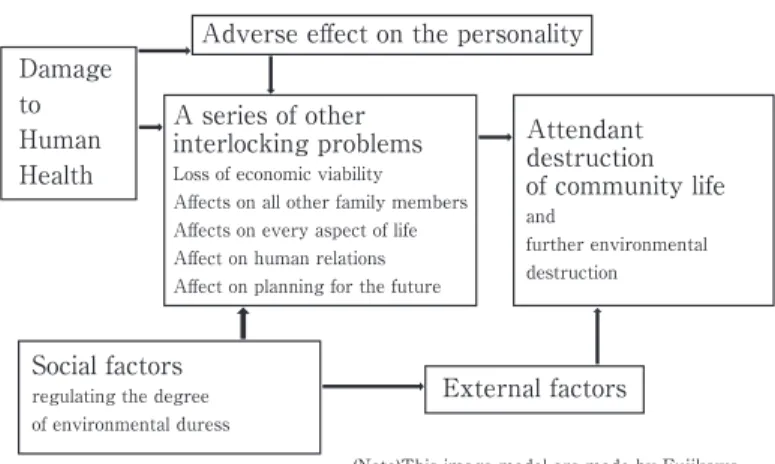
While the processes and causes of a nuclear accident differ from those of a natural disaster (Prichard 2013a), the social damages in the Fukushima prefecture differ from the damage caused by a natural disaster alone. The social factors exacerbating damage have also been obstacles to finding a solution (3).Case studies on victims of kogai (or industrial pollution) in the 1960s in Japan have indicated similar characteristics. Environmental sociologist Nobuko Iijima unified the relationships between environmental destruction and their attendant social structures of some cases as ‘the structures of environmental destruction’. She argued that there are four loci of pollution- related destruction: (1) human life and health, (2) living situations, (3) personality and (4) community environment and local society, which all constitute an interwoven fabric with degrees of damage and various social factors (Iijima 1992:155). Figure 1 shows this fabric. In the diagram, Iijima characterises the ‘destruction of community’ as the final stage of the destruction process, reflecting a feature of traditional culture that Japanese people regard the maintenance of the community very highly, often ahead of
health problems.
In comparison with this fabric, we see the characteristics of the Fukushima Nuclear disaster in Figure 2.
Adverse effect on the personality Damage
to Human Health
A series of other interlocking problems
Loss of economic viability Affects on all other family members Affects on every aspect of life Affect on human relations Affect on planning for the future
Attendant destruction of community life
and
further environmental destruction
Social factors
regulating the degree of environmental duress
External factors
(Note)This image model are made by Fujikawa according to the description of Nobuko Iijima(1992)
Figure 1. The image of the structure of environmental distraction
External factors Damage
to Human Health
Social factors
Adverse effect on the personality
A series of other Interlocking problems
Attendant destruction of community life
and
further environmental destruction
Figure 2. The characteristics of Fukushima Nuclear disaster within the image of environmental distraction structure
(blank arrows and italic letters mean the characteristics for the case of Fukushima)
4.Escalation and invisibility of health damage
The blank arrows and italic letters in Figure 2 are added to the original diagram (Figure 1). Although these changes may seem extensive, the characteristics of the Fukushima case can be summarized into three key points: (1) No one can identify the influence of radiation on health. Health problems are linked to radioactivity involving terms such as ‘risk’, ‘possible’
and ‘worry’. (2) Community and family ties were disbanded by evacuation orders (4), which may have been the main cause mental and physical illness.
(3) Unstable governmental nuclear policies influenced the well-being of people, families and communities in many ways.
These differences do not indicate the essential difference between pollution problems in the 1960s in Japan and the current nuclear disaster.
They do suggest the possible continuing escalation of damages caused by the Fukushima Nuclear disaster. All arrows in Figure 1 remain in Figure 2.
Influences of physical and mental health problems and anxiety of risk have affected many families’ livelihoods, even though the relationship between radiation and human health is uncertain.
In relation to uncertainty, Iijima points out that the victims themselves sometimes tend to deny pollution or the cause of their diseases; thus, they exacerbate pollution problems unintentionally (Iijima 1984[1993]: 91).
[T]here are still many disaster victims who have not yet been able to understand the cause of their problems nor take any corrective action, and in such instances the related destruction simply continues, claiming more and more victims. (Iijima 1992:155)
Regardless, the residents of the Fukushima prefecture know the risk of radioactive materials. However, since no definite standards distinguish between the safe and dangerous, people occasionally expose themselves to places registering high doses of radiation. For example, a constructor in his
fifties says:
‘I would accept an order (from F1). Since the decommissioning of reactors needs many workers, those who have not been exposed to high doses of radioactivity should do the work. Decommissioning cannot be done without sacrifice (gisei). Only we local workers can work at the plant’ (5).
He acknowledges the risk of high-dose radioactivity exposure and tries to prevent young workers from entering the high-dose radioactivity area.
However, since he hopes for the recovery of his hometown Okuma, which houses the F1, he has worked within the high-dose radioactivity area.
Furthermore, he suppresses his feelings regarding the risks as he hopes to not make ‘noises’ around communities. In a sense, he wants to underplay his anxiety and the risk he faces.
We see similar situations in lower-dose radioactivity areas. Many residents of the Fukushima prefecture have been exposed to higher doses of radioactivity than people in other prefectures. There are also many differences regarding the degree of radioactivity-related anxiety in the same community. Residents have reacted to radioactivity in various manners:
some evacuated, whereas others did not; some made their children wear masks when leaving the house, whereas others did not; some avoided the foods produced in Fukushima, whereas others did not, and so on. On the other hand, some residents have a family member working at the nuclear plant in Fukushima. To maintain community harmony, many people are careful not to discuss radioactivity and nuclear accidents.
A high-school student living in Koriyama city, about 60 km west of F1, spoke at a symposium in January 2013:
‘I have decided to remain in Koriyama city with my family, though the dose of radiation in our house is relatively high. I have been living anxious days. I tend to consider my decision: can I stay healthy in this city, can I conceive a healthy baby in the future? When I pass by the thick grass, I keep my distance to avoid radioactive materials…these are extraordinary days’ (6).
She also does not discuss these anxieties with her friends.
As mentioned, some victims of past pollution-related diseases tended to keep their anxiety and pain silent. This superficial silence further intensified the damage. I am afraid that a similar situation could occur in the Fukushima prefecture.
5.Distinction and expansion of local community destruction
The risk for health damage is related to other loci of environmental destruction in Iijima’s perspective. We see the social impact of the Nuclear disaster on local communities of the Fukushima prefecture.
When residents of Fukushima faced evacuation, they had to consider many factors: money, gasoline, destination, child’s school, job guarantee and so on. Some emphasized human relations as part of these considerations.
Ikeda (2013) provides an example of a doctor who had lived in Fukushima city for five years.
As a precaution, he avoided food and water from Fukushima. Some of his friends left the city or took their children to grandparents living outside the prefecture. He and his wife, however, did not leave, though John said he was ‘really concerned about the situation’, especially for his small children.
He never considered abandoning the people in Fukushima with whom he had built close ties: it seemed ‘not fair’. (Ikeda 2013:159)
Though most people who stayed in Fukushima do not speak negatively of those who decided to leave (ibid: 160), many cases are ambiguous. A woman in her sixties told us:
‘I have heard of an episode regarding an obstetrician who escaped. My friend’s daughter, being near her term, got a phone call from the doctor after the nuclear accident. Though the doctor told her that he had transferred her to another hospital, she discovered this had not gone through. There were many difficulties in a few days before she gave birth. I cannot believe that the doctor, who should protect his patients, evacuated,
leaving them behind’ (7).
While the doctor has since returned to his hospital, she still does not trust him. Fukushima residents were forced to make important decisions based on unfavourable choices. Though differences between individual conditions are quite small in one community, the outcomes of their decisions might diverge. In addition, it is not easy for Fukushima’s residents to maintain candid human relations by discussing the impact of radioactivity.
Even for one person, feelings regarding the evacuation and risk of radioactivity risk may change daily. For example, while many fathers relocated their small children and wives to other prefectures from Fukushima, some, separated from their families, are tired of their lonely lives in Fukushima. They can discuss their future with their wives, but deciding on when they can move their child back to Fukushima without any risks is difficult. Sometimes, they may find it more difficult to maintain a good family partnership than to think about the risks of radioactivity. Many people have also chosen not to discuss the Nuclear disaster.
Here, official evacuation orders, which sometimes change, have intensified differences in communities. Assigned zoning has divided the area into several parts. Zoning is related to compensation funds received from TEPCO. After the evacuation order is lifted, the compensation payment stops in the ‘return preparation zone’ and ‘resident restriction zone’, whereas neighbours located in the ‘difficult-to-return zone’ will continue receiving compensation. Lack of clarity regarding the meaning of the term ‘return preparation zone’, the complete safety of the zone as a residential area and whether people can re-start their lives near the ‘difficult-to-return zone’
means that more than half the residents of the ‘return preparation zone’
have not decided to return to their homes. These differences may become an obstacle for good human relations.
6.The nuclear energy policy in Japan: A historical perspective
In a sense, the social destruction caused by the nuclear power plant didnot begin after the accident in March 2011. Rather, the history of human relations damage caused by nuclear plants goes back to the 1950s, when planning for the construction of nuclear power plants in Japan began.
Nuclear policy in Japan faced the anti-nuclear movement from the onset because of Hiroshima, Nagasaki and the Daigo Fukuryu Maru incident (contamination of a fishing boat by effluence from the Bikini Hydrogen bomb Bravo test). Rather than creating a platform to discuss the policy, pro- nuclear advocates established the Genshiryoku Mura, or nuclear village, interest group.
The nuclear village’s influence has extended across nuclear power plant host towns and the national government. Most host towns accrue large annual revenues from the plant, and many residents have relatives who work (or have worked) at the plants or companies that receive orders from the plants. Thus, it is difficult for residents of these towns to discuss plant safety.
On the other hand, most Japanese, including residents of villages and towns near the plants, have been indifferent to nuclear energy, even when their perceptions of nuclear policy are unfavourable, partly because they have no opportunity to express their opinions. As such, the existence and influence of plants are not acknowledged consciously.
Some differences regarding evacuation and compensation funds related to the Nuclear disaster are evident between the residents of host towns and adjacent municipalities. Host town residents were able to evacuate earlier than people from other villages and towns. Many people in Iitate village, 30 km northwest of F1, suffered serious radiation exposure. Levels were estimated at more than 10 times higher than the exposure of host town residents since evacuation from Iitate was only ordered in the summer.
However, more compensation funds were received by the host town residents than most residents in Iitate since the evacuation order in Iitate will be lifted earlier than in host towns. Furthermore, residents of the Fukushima prefecture living outside the ordered evacuation zone received only a lump-sum compensation, that is 400 thousand yen for persons aged 18
or younger and pregnant women and 80 thousand yen for others.
The residents of the Fukushima prefecture have been aware of these accumulated differences partly because they now live in the same cities. A retired teacher in Iwaki city, about 30 km south of F1, once said:
‘I understand that the host towns need power plants since there are no other workplaces. Nevertheless, we have seen the inequalities. For example, municipal primary schools in the host town have air-conditioning, whereas even a new school has only stoves in our city. I do not discuss these inequalities openly because I know that I should not talk about it, but sometimes I do think about the benefits received by the host towns from the power plants’ (8).
Iwaki city is the largest city on the coastline of the Fukushima prefecture; thus, many evacuees and temporary labourers tasked with decontamination and F1 repair have settled here. A rapidly increasing population has led to traffic jams, increasing housing rent, increasing crime and so on. These have reminded her of the inequalities related to nuclear power plants.
It is still difficult for many Japanese to candidly discuss the nuclear power plant. In a sense, this historical nuclear policy process seems to decrease resilience in the Fukushima prefecture and other regions where nuclear facilities have become a political issue.
7.Social factors and discrimination
In Figure 1, Iijima points out the influence of social factors and external factors ‘that make up social structures surrounding the victims’ (Iijima 1992:
160). The influence of the Nuclear disaster on residents of Fukushima differs according to health condition, household economy, social relations, occupations, life stages and other conditions.
For example, most full-time workers have full-time jobs—even after evacuation—whereas part-time workers, farmers and the self-employed face the difficulty of finding suitable employment after the Nuclear disaster,
especially if they are women. Many women are forced to spend more hours caring for their family than before. They must now care for children, who cannot play outside because of radioactivity, and elders, who cannot live by themselves after the evacuation. As such, the disaster has enforced the gender division of labour.
There is another side to this story too. To maintain their income, many evacuating full-time workers now endure separation from family. Clearly, the families of Fukushima face various difficulties.
Iijima further refers to the role of ‘external factors’, which include the behaviour of pollution-generating industries, governmental administrators, scholars, mass media and outsiders. Victims are vulnerable to irresponsible rumours. Many residents of Fukushima share anxiety regarding fuka, or weathering, that is, those outside Fukushima now acknowledge the Nuclear disaster as a past event, and do not comprehend the various, longstanding difficulties experienced by residents.
8.Possible invisible development of the destruction
With regard to fuka, I consider gaps in the perception of the Nuclear disaster between residents of Fukushima and the Japanese government or TEPCO.
In September 2013, at the final presentation of the Tokyo bid for the 2020 Olympic Games, Prime Minister Abe Shinzo assured International Olympic Committee members that the situation regarding the crippled Fukushima nuclear plant was under control. Many residents of Fukushima disagreed. Even residents who returned home soon after the evacuation order was lifted doubted countermeasures implemented to contain the accident. Most have acquaintances with direct information on the F1 sites.
They think a severe accident may re-occur in the event of a large earthquake or typhoon.
The second point is related to responsibility for the long-term restoration process of communities. Recently, TEPCO has been criticized for
selfishly deciding on the amount to be paid out as compensation funds (9). As such, TEPCO seems eager to escape the responsibility as early as possible.
The company tends to pay the money in advance—if it decides to pay. Yet, difficulties prevail for the residents of Fukushima a long time after returning to their homes and receiving compensation. It is unclear for how long TEPCO and the Japanese government will be responsible for the livelihoods of Fukushima’s residents. This depends on external factors such as the public opinion of those outside Fukushima.
Residents are concerned that outsiders may forget the problems in Fukushima and ignore the difficulties remaining in restoration processes.
They are also concerned about the reputation now attached to the name
‘Fukushima’. Negative perceptions of ‘Fukushima’ prevail, although these are less severe than those three years ago. While the debris of the earthquake and tsunami in Miyagi and Iwate are distributed across Japan, the debris and removed contaminated soil in Fukushima are contained there, posing an obstacle to recovery work. This has caused a dilemma regarding Fukushima’
s radioactivity: on the one hand, many people hope to dispel concerns about radioactive contamination in Fukushima, and on the other, they need support for the recovery process.
9.Conclusion
We have seen the pervasive problems caused by the Fukushima Nuclear disaster that could intensify despite recovered superficial silence. As Nobuko Iijima points out, the victims’ silence may exacerbate the destruction. We have seen some dilemmas faced by residents of Fukushima. Though they hope to live in their hometowns, they are afraid to return there; they are anxious about radioactivity, but hesitant to express this anxiety; they want to decrease the negative perception of Fukushima and its radioactivity, but are concerned that people will forget the Nuclear disaster.
These dilemmas and the situation make it difficult to discuss the nuclear power plant, resulting in a vicious cycle that is enhanced by external factors.
The historical process of nuclear policies has built national indifference to nuclear problems.
The power structure of the nuclear village has separated the dilemma of the focal area around nuclear plants using logic such as the Chernobyl accident cannot occur in Japan and the energy policy has nothing to do with it. If the same process is repeated for the Nuclear disaster in Fukushima, residents will be left in silent anxiety, and the situation of nuclear policy will remain unchanged. Everyone must comprehend the difficulties in Fukushima and consider who should take responsibility for them.
Notes
(1) The focus of this report is restricted to the current problems caused by the Nuclear disaster. See Funabashi (2013) et al. for an overview of damages in Fukushima.
(2) Since the radioactive material was distributed far away, many areas outside Fukushima prefecture were contaminated. As such, many people were evacuated.
I use the words ‘residents of Fukushima’ or ‘people of Fukushima’ to refer to residents or people experiencing the problems caused by the Fukushima Nuclear disaster.
(3) Kai Erikson also refers to the ‘life in Appalachia that has been the source of a deeper and more sustained form of trauma’ (Erikson 1976:131-132). He further points out that the people who suffered from the disaster of Buffalo Creek were compensated only for the loss of their property and not for their communal base (ibid: 249). The confusion surrounding nuclear policies of recent Japanese government problems regarding Fukushima also remind us of the elite panic described by Solnit (Solnit 2009=2010).
(4) Temporary dwellings and apartment houses are very small; thus, it is difficult for large families to retain their households.
(5) Interviewed on December 10, 2013 in Iwaki city.
(6) From a speech delivered at the symposium in January 2013.
(7) Group discussion held in a city in Fukushima on March 17, 2014.
(8) Interviewed on April 28, 2012.
(9) For example, an article in the local newspaper Fukushima Minyu, entitled ‘An
assault should not decide it: TEPCO emasculates guidance’ (kagai sya ga kimeru-na:
Toden shishin wo honenuki ni), May 1, 2014.
References
Erikson, Kai T., 1976, Everything in Its Path, Simon & Schuster Paperbacks.
Funabashi, Harutoshi, 2013, Shinsai Mondai Taisyo no tame ni Hitsuyou na Seisaku to Nihon Syakai ni okeru Seigyo Nouryoku no Ketsujo [Necessary Policies to Deal with the Problems Caused by the Great Earthquake and the Lack of Ability to Control in Japanese Society], Shakaigaku-Hyoron [Japanese Sociological Review] 64-3, 342-365.
Genshiryoku shiryo joho shitsu, 2010, Genshiryoku Shimin Nenkan [Citizens’ Yearbook on Nuclear Energy], Nanatsumori-syokan, Tokyo.
Gill, Tom, Brigitte Steger & David H. Slater ed., 2013, Japan Copes with Calamity, Peter Lang.
Iijima, Nobuko, 1984[1993], (new edition) Kankyo Mondai to Higaisya Undo [Environmental Problems and the Victims’ Movements], Gakubun-sya, Tokyo.
Iijima, Nobuko, 1992, Social Structures of Pollution Victims, in Ui Jun (ed.) Industrial Pollution in Japan, United Nations University Press, 154-172.
Ikeda, Yoko, 2013, The Construction of Risk and the Resilience of Fukushima in the Aftermath of the Nuclear Power Plant Accident, in Tom Gill et al (ed.) Japan Copes with Calamity, Peter Lang, 151-175.
Ministry of Economy, Trade and Industry, 2012, Enerugii Hakusyo 2011 [Energy White Paper 2011].
Pritchard, Sara B., 2013a, Envirotechnical Disaster at Fukushima, in Richard Hindmarsh (ed.) Nuclear Disaster at Fukushima Daiichi, Routledge, 116-134.
Pritchard, Sara B., 2013b, An Envirotechnical Disaster, in Ian Jared Miller et al (ed.) Japan at Nature’s Edge, University of Hawaii Press, 255-279.
Solnit, Rebecca, 2009=2010, A Paradise Built in Hell, (Japanese translation) Saigai Yuutopia, Aki-syobo.
Toyoda, Naomi, 2014, Fukushima wo Ikiru Hitobito [People Living Fukushima]. Iwanami- syoten, Tokyo.
Acknowledgement
This work was supported by JSPS KAKENHI Grant Number 24530665 and the Mitsui
& Co., Ltd., Environment Fund.
付記
本稿は,2014年7月14日の第18回世界社会学会「Natural/Human Disasters and the Recovery of Local Society」部会での口頭報告の際,補助資料として配布したものである。
なお,福島第一原発および避難指示区域の状況を示す地図3点が記載されていたが,本 稿では割愛した。