Fukushima Medical University
福島県立医科大学 学術機関リポジトリ
This document is downloaded at: 2021-11-08T00:17:40Z
Title Preoperative pulmonary function as a predictor of respiratory complications and mortality in patients undergoing lung cancer resection
Author(s) Fujiu, Koichi; Kanno, Ryuzo; Suzuki, Hiroyuki; Shio, Yutaka;
Higuchi, Mitsunori; Ohsugi, Jun; Oishi, Akio; Gotoh, Mitsukazu
Citation Fukushima Journal of Medical Science. 49(2): 117-127
Issue Date 2003-12
URL http://ir.fmu.ac.jp/dspace/handle/123456789/143
Rights © 2003 The Fukushima Society of Medical Science
DOI
Text Version publisher
Vol. 49, No.2, 2003
[Original Article]
PREOPERATIVE PULMONARY FUNCTION AS A PREDICTOR OF RESPIRATORY COMPLICATIONS AND MORTALITY IN
PATIENTS UNDERGOING LUNG CANCER RESECTION
KOICHI FUJIUI>, RYUZO KANNOI>, HIROYUKI SUZUKP>, YUT AKA SHIOI>, MITSUNORI HIGUCHP>, JUN OHSUGP>,
AKIO OISHF> and MITSUKAZU GOTOH!)
l)Department of Surgery I, Fukushima Medical University School of Medicine, Fukushima
2) Department of Surgery, Fukushima Red Cross Hospital, Fukushima (Received April 1, 2003, accepted June 12, 2003)
Abstract:
Objective:We evaluated preoperative pulmonary function as a predictor of respiratory complications and mortality in patients undergoing lung cancer resection to confirm the guideline of the British Thoracic Society: lung cancer surgery in patients with predictive postoperative FEV 1.0 (%FEV 1.0PPO) > 40% and predictive postoperative diffusion capacity for carbon monoxide (%DLcoppo»40%
can be carried out with average risk.
Methods:
We retrospectively studied 356 consecutive patients who underwent pulmonary resection at our Department from January 1992 to December 200l.
Preoperative pulmonary function tests included vital capacity (VC), %VC, forced expiratory volume in one second (FEVl.o), FEVI.O%, diffusion capacity for carbon monoxide (DLco), predictive postoperative FEVl.o (FEVI.Oppo), postoperative respi- ratory function expressed as a percentage of the predicted normal value (%FEV 1.0 ppo, %DLcoppo). Postoperative complications were divided into 2 groups: respira- tory complications (pneumonia, atelectasis, etc) and other complications (broncho- pleural fistula, prolonged air leak, arrhythmia, etc).
Results: Postoperative deaths occurred in 14 (3.9%) patients. Postoperative respiratory complications developed in 27 (7.6%) patients. Pneumonectomy
(p<
0.001), preoperative chemotherapy
(p< 0.01) and advanced stage
(p< 0.05) were identified as risk factors of postoperative deaths.
Patients undergoing lobectomy with
FEVI.0~1,500ml did not die of respiratory complications. Patients undergoing pneumonectomy with
FEVI.OPpo~800ml/m2 did not die of respiratory complications. Patients undergoing pneumonectomy with
%FEVI.Oppo<40% and %DLcoppo<40% did not survive. Five of the 7 patients who died of respiratory complications were treated with preoperative chemother-
~~~-, ~~~=, ~*~ff,~ ft,~D*~, *~~, *E~., ~~~
Correspondence to: Koichi Fujiu, Department of Surgery I, Fukushima Medical University School of Medicine, Fukushima City, Fukushima 960-1295, Japan.
E-mail: [email protected]
117
118 K. FUJIU et ai.
apy. The values of their %DLcoppo were all less than 40%. By multivariate analysis, %FEV 1.0PPO was significant independent factor associated postoperative death.
Conclusions: We conclude that the guideline is useful for the selection for surgery of lung cancer patients.
Ifpreoperative chemotherapy is performed, the measurement of %DLco is recommended before surgery.
Key words: lung cancer, lung resection, pulmonary function, respiratory complica- tion, mortality
INTRODUCTION
Lung cancer often occurs in elderly people or smokers who are frequently associated with the respiratory diseases such as pulmonary emphysema or fibrosis.
Many of the patients are found at the advanced clinical stage, so preoperative chemotherapy or pneumonectomy are sometimes needed. It is important to con- sider the risk of lung resection for respiratory insufficiency patients.
The British Thoracic Society and the Society of Cardiothoracic Surgeons of Great Britain and Ireland produced the recommendations
l )for the selection for surgery of lung cancer patients. The guideline states that the patients with predic- tive postoperative FEV 1.0 (%FEV I.OPPO) > 40% and predictive postoperative diffusion capacity for carbon monoxide (%DLcoppo»40% can be carried out with average risk, but the patients with %FEVI.
oppo<40% and %DLcoppo<40% have a higher risk of postoperative complications.
We studied the postoperative respiratory complications and mortality from the point of preoperative pulmonary function in patients who underwent lung cancer resection and we confirmed the guideline.
MATERIALS AND METHODS
We performed thoracotomy on 372 consecutive patients with primary lung cancer at our Department from January 1992 to December 2001. Sixteen patients who underwent segmentectomy or partial resection of the lung were excluded from the study. Therefore, 356 patients are included in the present study.
Preoperative pulmonary function tests included vital capacity (VC), forced vital capacity (FVC), FEV
1•o,DLco. The percent vital capacity (%VC) was a percentage of the actual VC over calculated standard value using the formula of Baldwin et a!2).
FEV 1.0 percent (FEV
1.0%) was expressed by FEV 1.0/FVC x 100. Percent DLco was
a percentage of actual DLco over calculated standard value using the formula of
Nishida
3 ).Normal DLco for men
=(20.6 - 0.086 x age) x height/lOO, and for women
=(15.9 - 0.038 x age) x height/IOO. Values of DLco were obtained in 273 patients
(76.7%).
Contralateral FEV 1.0 was calculated by the formula: contralateral FEV 1.0 = A x FEV 1.0 -:- body surface area (BSA). Predictive postoperative FEV 1.0 (FEV 1.0Ppo) and
%DLco (%DLcoppo) were calculated by the formula'): Fppo={A+ [I-(b-n)/(C- n) ]
X(1- A)} x F, where F is the value of FEV 1.0 or %DLco before operation, b is the number of subsegments of the resected lung lobe, and n is the number of subsegments obstructed by the tumor, which was assessed by the findings on the chest computed tomography, bronchofiberscopy, or a combination of them. C is the total number of subsegments of the affected lung: 22 branches in right and 20 branches in left. A is the fraction of perfusion obtained by quantitative pulmonary scintigraphy to the unaffected lung.
Postoperative FEVl.o expressed as a percentage of the predicted normal value (%FEVl.oPpo) was calculated by the formula: %FEVl.oppo=FEVl.oppo/normal FEVl.o x 100. The formula of Berglund was applied to calculate the normal FEVl.o.
Normal FEVl.o for men=34.4xheight-33xage-I,000, and for women=26.7x height - 27 x age - 540.
Postoperative complications were divided into 2 groups: respiratory complica- tions and other complications. Respiratory complications were determined as follows
5):(1) atelectasis where more than two sessions of sputum aspiration were required using a bronchoscope; (2) respiratory failure requiring artificial ventilation for more than 48 hours; (3) pneumonia with temperatures higher than 38°C, leucocytosis (more than IO,000/mm
3)and pneumonia findings on chest roentgeno- grams. The other complications were as follows: arrhythmia, prolonged air leak, pyothorax, bronchopleural fistula, chylothorax, myocardial infarction, pulmonary embolism, recurrent laryngeal nerve palsy, bleeding from gastric ulcer, etc. Pro- longed air leak, pyothorax and bronchopleural fistula were not included in respira- tory complications, because these complications can develop as a result of surgical technique. Prolonged air leak was defined as the air leak prolonged more than 7 days. Postoperative deaths included both patients who died within 30 days after operation and those who died later but during the same hospitalization.
The significance of the differences between those who did and those who did not experience postoperative complications was determined by the x
2test or by Fischer's exact test when the expected cell count was less than 5. Uni-and multivariate analysis of the logistic regression model was used for analysis of the contribution of each variable to postoperative death. A probability value < 0.05 was accepted as statistically significant. Statistical analysis was performed on a personal computer with Stat View ver. 5.0 software (SAS Institute, Cary, NC, USA).
RESULTS
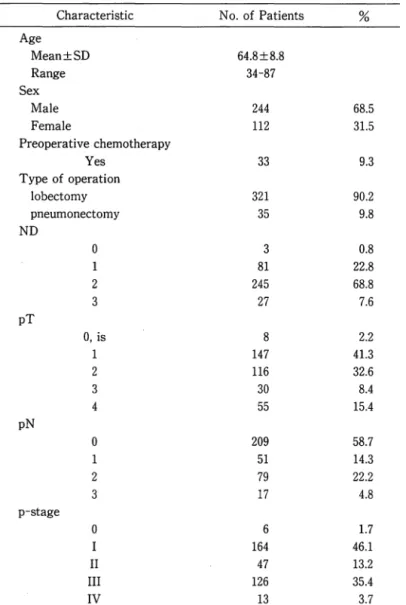
Data regarding patient characteristics as well as surgical procedure and cancer
stage are shown in Table
1.Lymph node clean up, pathological TNM staging were
120 K. FUJIU et al.
Table 1. Characteristics of 356 patients who underwent lung resection
Characteristic No. of Patients
%
Age
Mean±SD 64.8±8.8
Range 34-87
Sex
Male 244 68.5
Female 112 31.5
Preoperative chemotherapy
Yes 33 9.3
Type of operation
lobectomy 321 90.2
pneumonectomy 35 9.8
ND
0 3 0.8
1 81 22.8
2 245 68.8
3 27 7.6
pT
0, is 8 2.2
1 147 41.3
2 116 32.6
3 30 8.4
4 55 15.4
pN
0 209 58.7
1 51 14.3
2 79 22.2
3 17 4.8
p-stage
0 6 1.7
I 164 46.1
II 47 13.2
III 126 35.4
IV 13 3.7
divided according to the general rule for clinical and pathological record of lung cancer6). Pneumonectomy was performed in
35patients, lobectomy in
321(two lobes were removed in
21patients).
Postoperative complications developed in
157 (44.1%)patients: respiratory
complications in
27 (7.6%)and other complications in
130 (36.5%).The morbidity of
postoperative complications in pneumonectomy was significantly higher than that in
lobectomy
(p < 0.01).Bronchopleural fistula developed in
14.The morbidity of
bronchopleural fistula in pneumonectomy was significantly higher than that in
lobectomy
(p <0.0001)(Table
2).Preoperative chemotherapy
(p <0.001)and male
(p < 0.05)were identified as risk factors for postoperative respiratory complications
Table 2. Complications occurring in 356 patients after lung resection All cases Lobectomy Pneumonectomy
n=356
%
n=321%
n=35%
Any complications . 157 (14) 44.1 l34 (7) 41.7 23 (7) 65.7
Respiratory 27 (7) 7.6 23 (3) 7.2 4 (4) 11.4
Atelectasis 17 4.8 17 5.3
Pneumonia 13 3.7 10 3.1 3 8.6
Expectoration disorder 10 2.8 8 2.5 2 5.7
Interstitial pneumonia 3 0.8 2 0.6 1 2.9
Respiratory failure 2 0.6 2 0.6
Asthma attack 2 0.6 2 0.6
Others 130 (7) 36.5 111 (4) 34.6 19 (3) 54.3
Arrhythmia 70 19.7 61 19.0 9 25.7
Prolonged air leak 42 11.8 42 13.1
Pyothorax 19 5.3 17 5.3 2 5.7
Bronchopleural fistula 14 3.9 6 1.9 8 22.9
Chylothorax 9 2.5 9 2.8
Myocardial infarction 2 0.6 2 0.6
Pulmonary embolism 2 0.6 1 0.3 1 2.9
Values in parentheses are number of patients of postoperative death.
Table 3. Clinical correlates of respiratory complications and postoperative death No. of Respiratory (%) p Postopera ti ve (%) p
Patients Complications Death
Age
~70 125 14 11.2 0.06 7 5.6 0.23
<70 231 13 5.6 7 3.0
Sex
Male 244 24 9.8 <0.05 13 5.3 0.07
Female 112 3 2.7 1 0.9
Preoperative chemotherapy
Yes 33 9 27.3 <0.001 5 15.2 <0.01
No 323 18 5.6 9 2.8
Pneumonectomy
Yes 35 4 11.4 0.37 7 20.0 <0.001
No 321 23 7.2 7 2.2
ND
O. 1 84 8 9.5 0.44 4 4.8 0.75
2,3 272 19 7.0 10 3.7
p-stage
0, I, II 217 12 5.5 0.07 4 1.8 <0.05
III, IV 139 15 10.8 10 7.2
(Table 3).
Postoperative deaths occurred in 14 (3.9%) patients. Seven patients died of
respiratory complications: pneumonia (5), interstitial pneumonia and expectoration
disorder (1). Five of the 7 patients who died of respiratory complications had been
122 K. FU JIU et al.
received preoperative chemotherapy. Four of the 7 patients who underwent pneumonectomy after preoperative chemotherapy died of respiratory complications.
Seven patients died of other complications: bronchopleural fistula (5), pulmo- nary embolism and pyothorax (1) respectively. Four of the 5 patients who died of bronchopleural fistula were above pathological stage three. Deaths due to broncho- pleural fistula were patients who underwent pneumonectomy (2) (including wedge pneumonectomy (1», wedge lobectomy (1) and bilobectomy (1). The patients treated with preoperative chemotherapy were not included among the patients who died of bronchopleural fistula. Pneumonectomy
(p< 0.001), preoperative chemotherapy
(p
< 0.01) and advanced lung cancer
(p< 0.05) were identified as risk factors for
postoperative deaths (Table 3).
The mortality rate was 31.3% (5/16) in right pneumonectomy and 10.5% (2/19) in left. The mortality rate in pneumonectomy after preoperative chemotherapy was 36.4% (4/11); 50% (3/6) in right and 20% (1/5) in left. But there was no statistical significance.
In patients who underwent lobectomy, three patients died of respiratory compli- cations. All 3 were FEV 1.0 < 1,500 ml. No patients with FEV 1.0> 1,500 ml died of respiratory complications. Causes of the postoperative deaths of the patients whose FEV1.o was more than 1,500 ml were bronchopleural fistula (3) and pyothorax (1).
Fig. 1 shows the %FEV 1.0PPO in lobectomy patients who were divided into 4 groups: no complication, survivor with respiratory complications, death with respi- ratory complications and death without respiratory complications. One of the 8 patients with %FEV 1.0PPO < 40% died of respiratory complications.
Fig. 2 shows the relationship between %FEV1.oPpo and %DLcoppo in lobectomy
(%)
160 140
0
120
0..
0.. ~
>" 100
Ul u.
'$.
80 60 40
•
•
: :$
~t-t · •
•
• (BPF)
• (BPF)
• (pneumonia) • (pyothorax)
• (pneumonia) • (BPF)
• (expectoration disorder)
20
~----~.~---~---~No complication Survivor with Death with Death without respiratory respiratory
complication complication
respiratory complication
Fig.1. %FEVl.oPpO in patients who underwent lobectomy (n=321). Disease in parentheses is cause of postoperative death. BPF, bronchopleural fistula.
(%)140
0 0.. 0..
-l
8
Cl ac.
120 100 80 60 40 20 20
0 0
0 No complication
....
Survivor with0 respiratory complication
X
Death witho 0 respiratory complication
0 • Death without
0 0 0
0 00 0 respiratory complication
00 0 0
X
0 ~ 0'000 80 0 0 0• 0
:tI&0o
00 !Q)q,~ <llJCPOO 0
o 0 0
~ ~~
& 0101~~800~
o o
X.
0 •40 60 80 100 120 140 160
%FEV,Oppo (%)
Fig. 2. %FEVl.oPpo vs. %DLcoppo in patients who underwent lobectomy (n=250).
(mllm2 )
•
1400 •
1200 •
• •
(BPF)0
1000
I
c.. c..
q (pneumonia)
;; 800 • •
~
• •
(pneumonia)•
~
400 600 • • • •
• (pneumonia)•
(IP)•
(PE)•
(BPF)200
No complication Death with respiratory Death without respiratory complication complication Fig. 3. FEV I.OPPO in patients who underwent pneumonectomy (n = 35). Disease in
parentheses is cause of postoperative death. BPF, bronchopleural fistula; PE, pulmonary embolism; IP, interstitial pneumonia.
patients. Among the 19 patients with %FEVl.OPpo> 40% and %DLcoppo<40%, one patient who had preoperative chemotherapy died of pneumonia and two patients died of bronchopleural fistula. One of the 229 patients with %FEV l.OPPO > 40% and
%DLcoppo > 40% died of respiratory complications.
Fig. 3 shows the FEV l.OPPO in pneumonectomy patients who were divided into 3 groups: no complication, death with respiratory complications and death without respiratory complications. One patient with FEV1.oppo;;;;800 ml/m
2died of bron- chopleural fistula. But no patients with FEV1.oppo;;;;800 ml/m
2died of respiratory complications.
Fig.4 shows the relationship between %FEV1.oPPo and %DLcoppo in
124
(%)
90 80 70
o
60
J
c..50
o 40
#.
30 20 10 o
K. FV JIV et at.
~PF
00 0 0 0
e
0cx ~
0oca
IP pC
O O co
0 No complicationCx
0X
Death withP respiratory complication
•
PE'Xp
Death without•
.BPF respiratory complication
10 20 30 40 50 60 70 80 90 100
%FEVI.OPpo (%)
Fig. 4. %FEV,.oppo vs. %DLcoppo in patients who underwent pneumonectomy (n=
23). C at upper left of the mark shows patient who was treated with preoperative chemotherapy. Disease at lower right of the mark shows cause of postoperative death. BPF, bronchopleural fistula; PE, pulmonary embolism; P, pneumonia;
IP, interstitial pneumonia.
pneumonectomy patients. All 4 with %FEVl.oppo<40% and %DL
coppo<40% died of postoperative complications. The causes of death of the 4 patients were pneumo- nia after preoperative chemotherapy, interstitial pneumonia after preoperative chemotherapy, bronchopleural fistula and pulmonary embolism. Two of the 7 patients who underwent pneumonectomy with %FEV I.OPPO > 40% and %DLcoppo <
40% died of pneumonia after preoperative chemotherapy. One of the 12 patients who underwent pneumonectomy with %FEVl.OPpo> 40% and %DLcoppo> 40% died of bronchopleural fistula.
Univariate analysis indicated that the factors related significantly to postoper- ative death following lung resection were preoperative chemotherapy, operation procedure (lobectomy vs. pneumonectomy), p-stage (I, II vs. III, IV), %VC, FEVl.o,
%DLco, contralateral FEVl.o, %FEVl.oPpO and %DLcoppo (Table 4). Age, sex, extent of lymph node resection, VC and FEV
1.0% were unrelated to postoperative death.
In multivariate analysis, %FEV l.OPPO
(p =0.0131; relative risk, 0.938; 95%
confidence interval, 0.892-0.987) was significant independent factor associated pos- toperative death, whereas preoperative chemotherapy
(p= 0.8648), operation proce- dure
(p=0.2886),p-stage
(p=0.1133),%VC
(p=0.2359)and %DLcoppo
(p=0.4912)were not significant independent factors.
Pulmonary function tests before and after preoperative chemotherapy were studied in 26 of 33 patients who had preoperative chemotherapy. Most of the patients were treated with 2 courses of preoperative chemotherapy. Eight patients were treated with a combination chemotherapy consisting of cisplatin and vindesine.
Seven patients were treated with cisplatin, vindesine and mitomycin C. Four
Table 4. Univariate analysis of peri operative variables contributing occurrence of postoperative death following lung resection
Variable p Relative Risk 95% CI
preoperative chemotherapy (- vs +) 0.002 6.230 1.954~ 19.867 lobectomy vs pneumonectomy <0.0001 11.214 3.671 ~34.260
p-stage (1, II vs III, IV) 0.0185 4.128 1.268~ 13.435
%VC 0.0015 0.946 0.914~0.979
FEV!.o 0.0494 0.999 0.998~ 1.000
%DLco 0.0017 0.949 0.918~0.980
contralateral FEV,.o 0.0489 0.997 0.995~ 1.000
% FEV!.oPpo <0.0001 0.925 0.897~0.955
%DLcoppo <0.0001 0.920 0.883~0.959
CI: confidence interval
patients were treated with cisplatin and etoposide. Seven patients were treated with other drugs. Preoperative chemotherapy had adverse effect on %DLco. The average value of %DLco was 7l±1l% before chemotherapy and 60±10% after chemotherapy. The decrease was significant
(p<0.01). One patient with %DLco <
40% before right lower lobectomy and two patients with %DLco < 45% before pneumonectomy died of respiratory complications.
DISCUSSION
Lobectomy and pneumonectomy are consistently described with mortality rates of 2-4% and 6-8%, respectively. Mortality rates following resection should not be in excess of 4% for lobectomy or 8% for pneumonectomy
1).In the present study, the mortality rate was 3.9%.
Data from more than 2,000 patients in the 1970s have shown that a mortality rate of under 5% should be expected if the preoperative FEV
1.0is > 1.5 liters for a lobectomy and > 2 liters for a pneumonectomy7). There is substantial evidence that the perioperative risks of resection are related to the absolute predicted postoper- ative FEV
1.0and the postoperative FEV
1.0expressed as % predicted
8 ).The DLco reflects the capillary surface area available for gas diffusion across the alveolus and thus indicates the lung's ability to oxygenate blood. A reduction in DLco is a predictor of respiratory complications after pulmonary resection. The DLco may act as an independent variable with respect to other pulmonary function tests
9 ).A low preoperative DLco predicts not only respiratory complications but also poor postoperative quaiity-of-lifelO).
In the present study, postoperative respiratory complications were related to
%FEVl.oppo or %DLcoppo. This relation was remarkable in patients who under-
went pneumonectomy. The postoperative complications other than respiratory
complications were also related to %FEVl.oppo or %DLcoppo. For example,
bronchopleural fistula was not involved in respiratory complications in the present
126 K.
FUnu
et at.study, but the most significant risk factor for bronchopleural fistula is respiratory complications necessitating ventilation
l l ).Our study showed that 2 of the 5 patients who died of bronchopleural fistula had experienced ventilation.
Pneumonectomy with
FEVl.oppo~800ml/m2 can be carried out with average risk.
Ifa patient with FEV l.OPPO;;;; 800 ml/m2 is candidate for pneumonectomy, the unilateral pulmonary artery occlusion (UPAO) test is recommended, for cardiopul- monary failures sometimes occur after pneumonectomy. Calculation of the total pulmonary vascular resistance index (TPVRI) is as follows: TPVRI
=(average pulmonary artery pressure/cardiac output/BSA)
X80 dyneosecocm-
5 • Ifthe TPVRI is <500 dyne
0sec
0cm-
5 ,pneumonectomy can be carried out with average risk.
But if the TPVRI is <700 dyne
0sec
0cm-
5 ,there is a higher risk of postoperative complications after pneumonectomy. But we must be aware that preoperative evaluations of TPVRI from the UP AO tests sometimes overestimate the right ventricular afterload12).
But patients should not be excluded from pneumonectomy on the basis of any single criterion. Rather, the use of preoperative studies including predicted pos- toperative pulmonary function might assist the surgeon in better selecting patients who will potentially benefit from pneumonectomy13). Surgery need not be denied on the basis of a low FEVl.oPpo. Cutoff values indicate the need for further examina- tion (exercise testing) rather than inoperability14).
In the present study, 5 of the 7 patients who died of respiratory complications after pulmonary resection had preoperative chemotherapy. The values of the
%DLcoppo of the 5 patients who died were less than 40%. Some of the anti-cancer agents cause alveolitis, interstitial pneumonitis and fibrosis. The mechanism of injury may relate to vascular or endothelial injury, mediated at least in part by free radical oxygen formed during intracellular reductive activation of the compound under aerobic conditions
15).As a result of that, the values of %DLco decrease.
Patients whose %DLco before final therapy was reduced > 10% from their individ- ual baseline values, of ten develop toxicity after the final therapylS).
Ifpreoperative chemotherapy is performed, the measurement of %DLco is recommended after the chemotherapy.
For pulmonary insufficient patients, the cessation of smoking, pulmonary reha-
bilitation, the inhalation of bronchodilator and cleaning an airway are recommended
before operation. Pulmonary rehabilitation that improves the peak expiratory flow
and the maximal voluntary ventilation is useful for patients with obstructive pulmo-
nary diseases. During operation, aspiration of airway products is needed. After
operation, care not to overhydrate, pain control using epidural anesthesia and
getting out of bed early are important for the prevention of respiratory complica-
tions.
REFERENCES
1. Armstrong P, Congleton J, Fountain SW, Jagoe T, McAuley DF, MacMahon J. Muers MF, Page RD, Plant PK, Roland M, Rudd RM, Walker WS, Williams
TJ.
Guidelines on the selection of patients with lung cancer for surgery. Thorax, 56: 89-108, 2001.2. Baldwin E deF, Cournand A, Richards DW. Pulmonary insufficiency: 1. Physiological classification, clinical methods of analysis, standard values in normal subjects. Medicine, 27: 243, 1948.
3. Nishida 0, Kambe M, Sewake N, Takano M, Kawane H, Kodomari Y, Arita K, Nasuno H, Nishimoto Y. Pulmonary function in healthy subjects and its prediction, 5. Pulmo·
nary diffusing capacity in adults. Jap J Clin Pathol, 24: 941-947, 1976.
4. Ali MK, Mountain C, Ewer MS. Predicting loss of pulmonary function after pulmonary resection for bronchogenic carcinoma. Chest, 77: 337, 1980.
5. Nakahara K, Ohno K, Hashimoto J, Miyoshi S, Maeda H, Matsumura A, Mizuta T, Akashi A, Nakagawa K, Kawashima Y. Prediction of postoperative respiratory failure in patients undergoing lung resection for lung cancer. Ann Thorac Surg, 46: 549-552, 1988.
6. Sobin LH, Wittekind CH. International Union Against Cancer. Lung tumors. In:
TNM classification of malignant tumors, 5th ed. Wiley- Liss, New York, 91-97, 1997.
7. Miller J1. Physiologic evaluation of pulmonary function in the candidate for lung resection. J Thorac Cardiovasc Surg, 105: 347-352, 1993.
8. Kearney DJ, Lee TH, Reilly J], DeCamp MM, Sugarbaker D]. Assessment of operative risk in patients undergoing lung resection: importance of predicted pulmonary function.
Chest, 105: 753-759, 1994.
9. Bousamra M, Presberg KW, Chammas JH, Tweddell JS, Winton BL, Bielefeld MR, Haasler GB. Early and late morbidity in patients undergoing pulmonary resection with low diffusion capacity. Ann Thorac Surg, 62: 968-75, 1996.
10. Handy JR, Asaph JW, Skokan L, Reed CE, Koh S, Brooks G, Douville EC, Tsen AC, Ott GY, Silvestri GA. What happens to patients undergoing lung cancer surgery? Out- comes and quality of life before and after surgery. Chest, 122: 21-30, 2002.
11. Wright CD, Wain JC, Mathisen DJ, Grillo He. Postpneumonectomy bronchopleural fistula after sutured bronchial closure: incidence, risk factors, and management. J Thorac Cardiovasc Surg, 112: 1367-71, 1996.
12. Ohishi A, Yanai K, Takurou S, Kanno R, Kogure M, Takeshige T, Teranishi Y, Usuba A, Inoue H, Motoki R. Revaluation of the unilateral pulmonary artery occlusion test:
hemodynamics after lobectomy and pneumonectomy for lung cancer. Jpn J Thorac Cardiovasc Surg, 39: 855-861, 1991.
13. Putnam JB, Lammermeier DE, Colon R, McMurtrey MJ. Ali MK, Roth J A. Predicted pulmonary function and survival after pneumonectomy for primary lung carcinoma.
Ann Thorac Surg, 49: 909-15, 1990.
14. Brunelli A, Fianchini A. Predicted postoperative FEV, and complications in lung resec·
tion candidates. Chest, 111: 1145-46, 1997.
15. Spain Re. Neoadjuvant mitomycin C, cisplatin, and infusion vinblastine in locally and regionally advanced non-small cell lung cancer: problems and progress from the perspec- tive of long-term follow-up. Semin Oncol, 15: 6-15, 1988.
16. Bachur N, Gordon S, Gee M. A general mechanism for microsomal activation of quinone anticancer agents to free radicals. Cancer Res, 38: 1745-1750, 1979.